

Sign Up
Thank you for Submitting!
AI is now embedded in SaaS operations, service desks, analytics, and business workflows. For CIOs and IT leaders in regulated industries, the question is no longer "should we use AI" but "how do we control it." That is where AI usage governance best practices become a board level priority.
Recent enterprise IT research shows that 81% of enterprise IT leaders now treat AI usage governance as a board agenda topic, driven by evolving regulations and operational risk in 2026. At the same time, 44% of audited organizations were found non compliant due to insufficient tracking of AI prompts and data retention, exposing them to penalties and reputational damage.
This article lays out a practical framework to govern prompts, data types, and retention, and shows how CloudNuro helps enterprises execute these policies with centralized visibility and automation.
For highly regulated sectors, AI is both an accelerator and a new risk surface. The same generative models that help IT teams resolve tickets faster can also exfiltrate sensitive data through unsafe prompts or overly permissive access.
Several trends are converging:
In other words, governance has moved from policy documents to embedded controls in daily AI use.
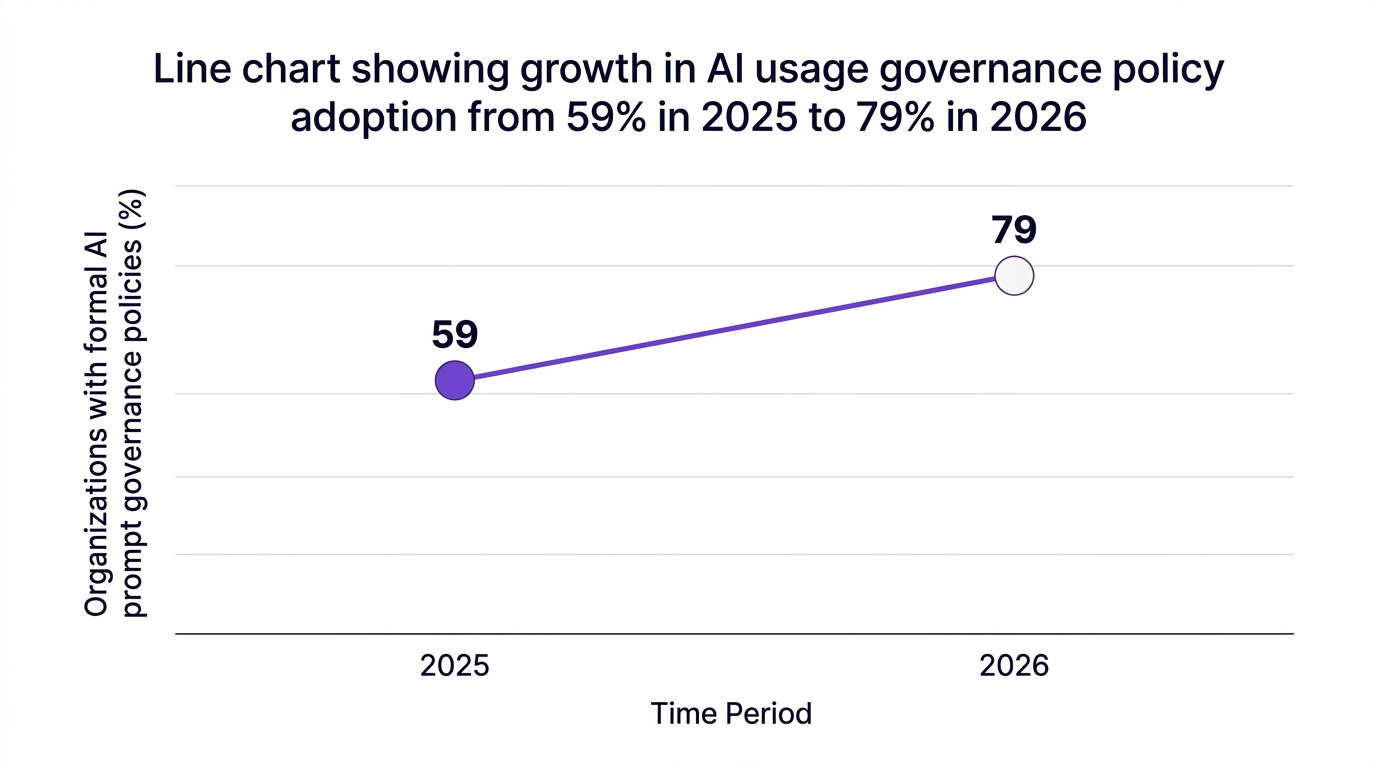
The core challenge: AI usage cuts across security, compliance, FinOps, and SaaS operations. Traditional policy binders or static DLP rules are not enough. Enterprises need AI usage governance best practices that are operationalized inside their SaaS and cloud estate, with continuous monitoring.
Prompt interactions are now part of your production environment. Treat them like code or API calls, not casual chat. A strong AI compliance policy for prompts should answer three questions: who can ask what, from where, and with which data.
Start with a prompt taxonomy that is easy to understand and enforce:
Codify examples in a living "prompt safety standards" catalog, ideally embedded directly into your AI interfaces.
AI prompt security is only as strong as your identity and access model. Best practice is to map enterprise AI policy controls to roles, not individuals:
More than 68% of enterprises now cite real time compliance dashboards and role based access as essential for effective AI usage governance. That aligns AI usage with the same discipline used for privileged access management.

One of the most common failures in SaaS usage governance is treating AI prompts as ephemeral. For regulated environments, prompts and responses are regulated records when they contain or influence regulated data.
Your AI usage governance best practices should mandate:
According to recent enterprise audits, organizations that embed review workflows saw 2x reduction in audit remediation cycles, because they can quickly prove how AI was used, by whom, and with which safeguards.
Prompt governance is only effective if it is grounded in clear AI data classification policy. AI models work best when they are fed context, which is exactly what raises exposure risk.
Most enterprises already classify data at rest. AI governance requires classification that reflects usage in prompts and model contexts, for example:
Recent enterprise IT research indicates that 72% of enterprises now classify and restrict access to sensitive data types specifically for AI prompts.
A frequent counterargument is that "we already have data loss prevention," so separate AI controls are unnecessary. In practice, generic DLP lacks context awareness for prompts.
AI focused data controls should include:
This combination aligns with data privacy in AI operations, where the unit of control is the prompt payload, not just the underlying file or database.
As AI models are fine tuned on internal data, new high value datasets emerge: embeddings, vector stores, synthetic corpora. These often escape traditional database or file based controls.
Best practices include:
This approach connects AI governance with multi cloud governance and Goaa SaaS governance objectives, where every new AI store is onboarded as a governed asset.
Request a Demo | Get Free Savings | Explore Product
Retention Strategies For AI Generated And Processed Data
Retention is where many AI programs fail audits. Recent reports show 65% of companies introduced automated retention schedules for AI generated and processed data, yet 44% of audited organizations were still found non compliant because they lacked consistent tracking and enforcement.
The goal is simple: data lifecycle management for AI artifacts should mirror or exceed your existing cloud app compliance controls.
Extend your SaaS data retention rules to explicitly cover:
For each, specify:
Manual retention is impossible at AI scale. Research shows 61% of regulated enterprises invested in policy engine tools for automated retention in 2026, and 55% used AI assisted reviews.
Effective AI usage governance best practices in retention include:
This is central to cloud security retention and AI risk mitigation, since over retention of sensitive AI artifacts is a common regulatory finding.
To reduce blast radius, separate:
Each should have its own SaaS usage governance and retention schedule. For instance, an AI generated email draft may be deleted after 30 days, while an AI backed credit decision record could require 7 years of retention.
This segmentation supports enterprise compliance AI requirements and gives auditors confidence that AI is not a "black box" outside existing policy controls.
Experience across large enterprises shows recurring failure modes. Addressing these upfront accelerates your AI governance program.
Publishing an AI compliance policy without instrumentation in SaaS tools creates a false sense of security. Teams continue to use AI in email, collaboration, and CRM without real enforcement.
Guardrail: treat policies as code. Use compliance automation software and policy management SaaS tools to bind rules to actual prompts, datasets, and roles.
AI features are often billed separately or trigger consumption based charges. Without cost aware governance, organizations overpay for low value AI usage.
Guardrail: integrate FinOps for SaaS practices into AI usage tracking. Use metrics such as cost per compliant AI transaction, and link license reclamation automation to underused AI entitlements.
A common counterargument from business units is that strong governance will "kill innovation." Overly rigid controls can indeed push users to unapproved tools.
Guardrail: apply risk based governance. Provide compliance ready SaaS tools with approved AI features and safe data, so teams have a fast, compliant option. Pair strict controls on sensitive data with more open sandboxes for low risk experimentation.
If each SaaS application manages AI features differently, security teams lose sight of the overall risk posture.
Guardrail: consolidate telemetry through centralized SaaS visibility. Map which users engage which AI features, with which data types, across collaboration, productivity, CRM, and line of business tools.
AI usage governance is only effective when it is enforced continuously inside your SaaS estate. CloudNuro was built with a governance first architecture to give CIOs and security leaders the control and transparency they need.
CloudNuro AI Custodian provides complete visibility across SaaS and cloud, including AI capabilities inside tools such as Microsoft 365 and major CRM platforms. IT can quickly answer:
This addresses a core prerequisite for AI usage tracking and regulated industry cloud oversight.
With AI Custodian, organizations can define prompt safety standards and map them to roles and groups through role based access AI controls. Examples include:
These controls are backed by real time compliance dashboards, which more than 68% of enterprises now view as essential for AI usage governance.

CloudNuro extends data lifecycle management and SaaS data retention rules into AI specific records. IT and compliance teams can:
This supports cloud app compliance obligations and reduces exposure from long lived AI artifacts.
CloudNuro brings AI driven cost optimization into the AI governance conversation. By unifying utilization, entitlements, and policy compliance, AI Custodian helps you:
This aligns with the reality that AI usage governance is not just about avoiding fines, but also about driving a cost conscious, compliant AI culture.
Recent deployments illustrate the impact of operationalized AI governance:
Across CloudNuro customers, organizations that adopt a centralized AI usage governance model report fewer unintentional data exposures, echoing industry data that robust policies reduced such incidents by 36% in 2026.
The first priority is visibility. You cannot govern what you cannot see. Start by inventorying where AI features exist across your SaaS stack, who is using them, and which data types they touch.
Once that baseline is in place, define your AI data classification policy and prompt categories, then connect them to identity and access controls.
Use a classification scheme tailored to AI usage, not just storage. At a minimum, distinguish between public, internal, confidential, and restricted data types, and explicitly label what is allowed or prohibited in prompts.
Pair classification with automated redaction and masking controls that operate at prompt time, especially for regulated data domains like financial or health information.
There is no single standard period, because retention must align to existing regulatory and business requirements. For many organizations, prompts and low risk outputs can be retained for short periods, for example 30 to 90 days, while AI influenced decisions may need multi year retention.
The key is to define AI specific retention classes, document them in your AI compliance policy, and enforce them automatically using policy engines.
Use a risk based approach. Provide approved, compliant AI tools and data sandboxes where teams can innovate with low risk data, while applying strict controls and monitoring around sensitive datasets.
Clear communication, quick approval pathways, and visible dashboards help business units see governance as an enabler instead of a barrier.
Effective AI governance is cross functional. Security, compliance, and legal define policy, IT and SaaS operations implement controls and monitoring, and business units own process level adoption.
Many enterprises formalize this through an AI risk or AI governance council, supported by platforms like CloudNuro that provide centralized visibility and control.
Relying on individual application logs does not scale. Instead, route AI related events and prompt logs into a central governance platform that correlates usage across tools.
With CloudNuro, organizations gain consolidated logs, role based insights, and dashboards designed specifically for AI usage governance, making audits faster and more transparent.
AI will only accelerate across SaaS and cloud environments. Organizations that treat AI usage governance best practices as a one time policy exercise will struggle. Those that embed governance into prompts, data classification, retention, and cost management will build trusted, compliant AI programs at scale.
The path forward is clear: centralize visibility, operationalize policies through automation, and align AI usage with both regulatory requirements and financial discipline.
CloudNuro helps enterprises do exactly that, with AI enabled SaaS governance, compliance ready controls, and cost optimization built into a single platform. To see how this could work in your environment, connect with the CloudNuro team and review your current AI usage posture.
CloudNuro is a leader in Enterprise SaaS Management Platforms, providing enterprises with unmatched visibility, governance, and cost optimization. Recognized twice in a row in the SaaS Management Platforms category and named a Leader in the SoftwareReviews Data Quadrant, CloudNuro is trusted by global enterprises and government agencies to bring financial discipline to SaaS, cloud, and AI. Trusted by enterprises such as Konica Minolta and Federal Signal, CloudNuro provides centralized SaaS inventory, license optimization, and renewal management along with advanced cost allocation and chargeback, giving IT and Finance leaders the visibility, control, and cost-conscious culture needed to drive financial discipline.
Request a no cost, no obligation free assessment —just 15 minutes to savings!
Get StartedAI is now embedded in SaaS operations, service desks, analytics, and business workflows. For CIOs and IT leaders in regulated industries, the question is no longer "should we use AI" but "how do we control it." That is where AI usage governance best practices become a board level priority.
Recent enterprise IT research shows that 81% of enterprise IT leaders now treat AI usage governance as a board agenda topic, driven by evolving regulations and operational risk in 2026. At the same time, 44% of audited organizations were found non compliant due to insufficient tracking of AI prompts and data retention, exposing them to penalties and reputational damage.
This article lays out a practical framework to govern prompts, data types, and retention, and shows how CloudNuro helps enterprises execute these policies with centralized visibility and automation.
For highly regulated sectors, AI is both an accelerator and a new risk surface. The same generative models that help IT teams resolve tickets faster can also exfiltrate sensitive data through unsafe prompts or overly permissive access.
Several trends are converging:
In other words, governance has moved from policy documents to embedded controls in daily AI use.
The core challenge: AI usage cuts across security, compliance, FinOps, and SaaS operations. Traditional policy binders or static DLP rules are not enough. Enterprises need AI usage governance best practices that are operationalized inside their SaaS and cloud estate, with continuous monitoring.
Prompt interactions are now part of your production environment. Treat them like code or API calls, not casual chat. A strong AI compliance policy for prompts should answer three questions: who can ask what, from where, and with which data.
Start with a prompt taxonomy that is easy to understand and enforce:
Codify examples in a living "prompt safety standards" catalog, ideally embedded directly into your AI interfaces.
AI prompt security is only as strong as your identity and access model. Best practice is to map enterprise AI policy controls to roles, not individuals:
More than 68% of enterprises now cite real time compliance dashboards and role based access as essential for effective AI usage governance. That aligns AI usage with the same discipline used for privileged access management.
One of the most common failures in SaaS usage governance is treating AI prompts as ephemeral. For regulated environments, prompts and responses are regulated records when they contain or influence regulated data.
Your AI usage governance best practices should mandate:
According to recent enterprise audits, organizations that embed review workflows saw 2x reduction in audit remediation cycles, because they can quickly prove how AI was used, by whom, and with which safeguards.
Prompt governance is only effective if it is grounded in clear AI data classification policy. AI models work best when they are fed context, which is exactly what raises exposure risk.
Most enterprises already classify data at rest. AI governance requires classification that reflects usage in prompts and model contexts, for example:
Recent enterprise IT research indicates that 72% of enterprises now classify and restrict access to sensitive data types specifically for AI prompts.
A frequent counterargument is that "we already have data loss prevention," so separate AI controls are unnecessary. In practice, generic DLP lacks context awareness for prompts.
AI focused data controls should include:
This combination aligns with data privacy in AI operations, where the unit of control is the prompt payload, not just the underlying file or database.
As AI models are fine tuned on internal data, new high value datasets emerge: embeddings, vector stores, synthetic corpora. These often escape traditional database or file based controls.
Best practices include:
This approach connects AI governance with multi cloud governance and Goaa SaaS governance objectives, where every new AI store is onboarded as a governed asset.
Request a Demo | Get Free Savings | Explore Product
Retention Strategies For AI Generated And Processed Data
Retention is where many AI programs fail audits. Recent reports show 65% of companies introduced automated retention schedules for AI generated and processed data, yet 44% of audited organizations were still found non compliant because they lacked consistent tracking and enforcement.
The goal is simple: data lifecycle management for AI artifacts should mirror or exceed your existing cloud app compliance controls.
Extend your SaaS data retention rules to explicitly cover:
For each, specify:
Manual retention is impossible at AI scale. Research shows 61% of regulated enterprises invested in policy engine tools for automated retention in 2026, and 55% used AI assisted reviews.
Effective AI usage governance best practices in retention include:
This is central to cloud security retention and AI risk mitigation, since over retention of sensitive AI artifacts is a common regulatory finding.
To reduce blast radius, separate:
Each should have its own SaaS usage governance and retention schedule. For instance, an AI generated email draft may be deleted after 30 days, while an AI backed credit decision record could require 7 years of retention.
This segmentation supports enterprise compliance AI requirements and gives auditors confidence that AI is not a "black box" outside existing policy controls.
Experience across large enterprises shows recurring failure modes. Addressing these upfront accelerates your AI governance program.
Publishing an AI compliance policy without instrumentation in SaaS tools creates a false sense of security. Teams continue to use AI in email, collaboration, and CRM without real enforcement.
Guardrail: treat policies as code. Use compliance automation software and policy management SaaS tools to bind rules to actual prompts, datasets, and roles.
AI features are often billed separately or trigger consumption based charges. Without cost aware governance, organizations overpay for low value AI usage.
Guardrail: integrate FinOps for SaaS practices into AI usage tracking. Use metrics such as cost per compliant AI transaction, and link license reclamation automation to underused AI entitlements.
A common counterargument from business units is that strong governance will "kill innovation." Overly rigid controls can indeed push users to unapproved tools.
Guardrail: apply risk based governance. Provide compliance ready SaaS tools with approved AI features and safe data, so teams have a fast, compliant option. Pair strict controls on sensitive data with more open sandboxes for low risk experimentation.
If each SaaS application manages AI features differently, security teams lose sight of the overall risk posture.
Guardrail: consolidate telemetry through centralized SaaS visibility. Map which users engage which AI features, with which data types, across collaboration, productivity, CRM, and line of business tools.
AI usage governance is only effective when it is enforced continuously inside your SaaS estate. CloudNuro was built with a governance first architecture to give CIOs and security leaders the control and transparency they need.
CloudNuro AI Custodian provides complete visibility across SaaS and cloud, including AI capabilities inside tools such as Microsoft 365 and major CRM platforms. IT can quickly answer:
This addresses a core prerequisite for AI usage tracking and regulated industry cloud oversight.
With AI Custodian, organizations can define prompt safety standards and map them to roles and groups through role based access AI controls. Examples include:
These controls are backed by real time compliance dashboards, which more than 68% of enterprises now view as essential for AI usage governance.
CloudNuro extends data lifecycle management and SaaS data retention rules into AI specific records. IT and compliance teams can:
This supports cloud app compliance obligations and reduces exposure from long lived AI artifacts.
CloudNuro brings AI driven cost optimization into the AI governance conversation. By unifying utilization, entitlements, and policy compliance, AI Custodian helps you:
This aligns with the reality that AI usage governance is not just about avoiding fines, but also about driving a cost conscious, compliant AI culture.
Recent deployments illustrate the impact of operationalized AI governance:
Across CloudNuro customers, organizations that adopt a centralized AI usage governance model report fewer unintentional data exposures, echoing industry data that robust policies reduced such incidents by 36% in 2026.
The first priority is visibility. You cannot govern what you cannot see. Start by inventorying where AI features exist across your SaaS stack, who is using them, and which data types they touch.
Once that baseline is in place, define your AI data classification policy and prompt categories, then connect them to identity and access controls.
Use a classification scheme tailored to AI usage, not just storage. At a minimum, distinguish between public, internal, confidential, and restricted data types, and explicitly label what is allowed or prohibited in prompts.
Pair classification with automated redaction and masking controls that operate at prompt time, especially for regulated data domains like financial or health information.
There is no single standard period, because retention must align to existing regulatory and business requirements. For many organizations, prompts and low risk outputs can be retained for short periods, for example 30 to 90 days, while AI influenced decisions may need multi year retention.
The key is to define AI specific retention classes, document them in your AI compliance policy, and enforce them automatically using policy engines.
Use a risk based approach. Provide approved, compliant AI tools and data sandboxes where teams can innovate with low risk data, while applying strict controls and monitoring around sensitive datasets.
Clear communication, quick approval pathways, and visible dashboards help business units see governance as an enabler instead of a barrier.
Effective AI governance is cross functional. Security, compliance, and legal define policy, IT and SaaS operations implement controls and monitoring, and business units own process level adoption.
Many enterprises formalize this through an AI risk or AI governance council, supported by platforms like CloudNuro that provide centralized visibility and control.
Relying on individual application logs does not scale. Instead, route AI related events and prompt logs into a central governance platform that correlates usage across tools.
With CloudNuro, organizations gain consolidated logs, role based insights, and dashboards designed specifically for AI usage governance, making audits faster and more transparent.
AI will only accelerate across SaaS and cloud environments. Organizations that treat AI usage governance best practices as a one time policy exercise will struggle. Those that embed governance into prompts, data classification, retention, and cost management will build trusted, compliant AI programs at scale.
The path forward is clear: centralize visibility, operationalize policies through automation, and align AI usage with both regulatory requirements and financial discipline.
CloudNuro helps enterprises do exactly that, with AI enabled SaaS governance, compliance ready controls, and cost optimization built into a single platform. To see how this could work in your environment, connect with the CloudNuro team and review your current AI usage posture.
CloudNuro is a leader in Enterprise SaaS Management Platforms, providing enterprises with unmatched visibility, governance, and cost optimization. Recognized twice in a row in the SaaS Management Platforms category and named a Leader in the SoftwareReviews Data Quadrant, CloudNuro is trusted by global enterprises and government agencies to bring financial discipline to SaaS, cloud, and AI. Trusted by enterprises such as Konica Minolta and Federal Signal, CloudNuro provides centralized SaaS inventory, license optimization, and renewal management along with advanced cost allocation and chargeback, giving IT and Finance leaders the visibility, control, and cost-conscious culture needed to drive financial discipline.
Request a no cost, no obligation free assessment - just 15 minutes to savings!
Get StartedWe're offering complimentary ServiceNow license assessments to only 25 enterprises this quarter who want to unlock immediate savings without disrupting operations.
Get Free AssessmentGet Started




CloudNuro Corp
1755 Park St. Suite 207
Naperville, IL 60563
Phone : +1-630-277-9470
Email: info@cloudnuro.com





.webp)

Recognized Leader in SaaS Management Platforms by Info-Tech SoftwareReviews


.svg)