Sign Up
Thank you for Submitting!
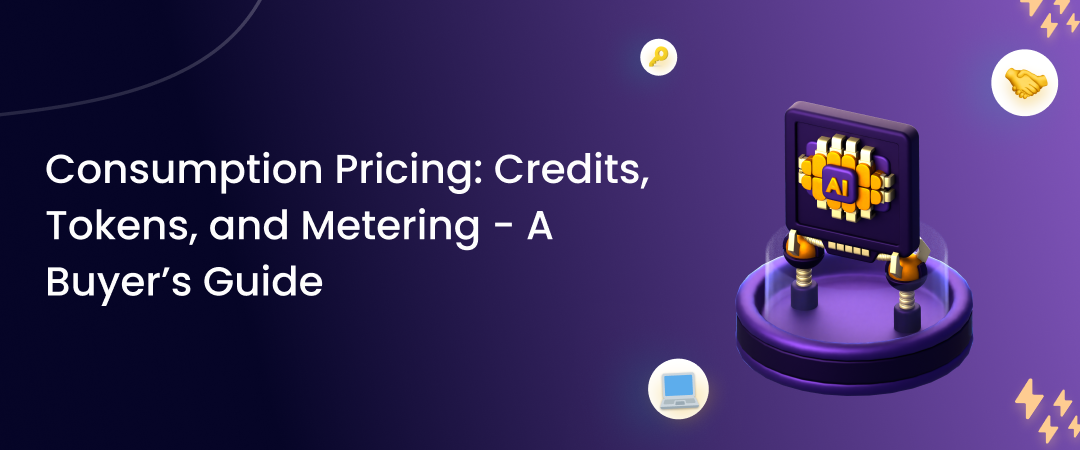
Consumption pricing is a billing model where customers pay only for what they use, whether that is gigabytes of storage, API calls, active users, or AI tokens, rather than a flat subscription fee. In 2026, this model has shifted from being a cloud infrastructure standard to the dominant pricing strategy for SaaS and AI platforms.
For buyers, this offers flexibility, but it introduces a dangerous new variable: cost unpredictability. Without strict governance, a single engineering script or a spike in AI usage can blow through a quarterly budget in a matter of days. This guide breaks down the mechanics of credits, metering, and tokens, providing IT and finance leaders with the strategy needed to buy and manage these tools effectively.
What is it? A pay-as-you-go model based on actual usage metrics (compute, storage, tokens) rather than fixed seats.
The Trap: While it lowers barriers to entry, it transfers risk to the buyer. "Credit-based" models often result in wasted, expired pre-payments (breakage).
The Trend: Generative AI is forcing this shift. You are now paying for "tokens" (compute/output) rather than just access.
The Solution: You cannot manage consumption with spreadsheets. You need automated FinOps Unit Economics to correlate spend with business value.
Key Insight: Successful buyers negotiate "rollover" clauses for unused credits and implement strict automated alerting on metering.
Consumption pricing (often called usage-based pricing, or UBP) is a monetization strategy in which the cost of a software service fluctuates based on how much the customer uses the product's resources. Unlike a flat-rate subscription, where you pay $50/user regardless of activity, consumption pricing meters specific units of value.
Why this definition matters:
Understanding the specific "meter" (the unit being counted) is critical for forecasting. If a vendor charges by "active users," your costs scale with headcount. If they charge by "API calls" or "compute hours," your costs scale with technical architecture and customer traffic, which is much harder for Finance teams to predict.
Pay-as-you-go (Post-paid): You use the service and get a bill at the end of the month for exactly what was used (e.g., AWS On-Demand).
Credit-based (Pre-paid): You buy a bucket of "credits" or "points" upfront (a drawdown model). This is popular in SaaS because it secures revenue for the vendor.
Tiered Usage: You pay a flat fee for a baseline usage amount, and pay overage fees for consumption above that limit.
Consumption pricing is dominating because the rise of Generative AI has made "seat-based" pricing obsolete for many tools. When an employee uses an AI assistant, they consume expensive GPU compute power (tokens). Vendors cannot afford to offer unlimited AI usage at a flat fee, so they pass along the variable cost to the buyer.
What changed recently?
The AI Token Economy: Tools like Microsoft Copilot and various coding assistants rely on token consumption. This creates a direct link between work output and cost.
Economic Pressure: CFOs are scrutinizing shelfware. Consumption models allow companies to start small and scale, theoretically aligning cost with value.
Infrastructure Hybridization: As companies adopt Multi-Cloud FinOps strategies, they are accustomed to variable billing and expect SaaS vendors to match that flexibility.
Insight: We have observed that companies switching to consumption models without a forecasting tool often see a 40% spike in spend during the first quarter due to unchecked usage.
Credit-based pricing is a specific subset of consumption pricing where the buyer purchases a virtual currency (credits) upfront, which is then burned down as services are used. This is common in data platforms, email marketing tools, and API services.
Why vendors love it: It guarantees cash flow upfront and benefits from "breakage", credits that expire unused.
Why buyers struggle with it: It creates a "use it or lose it" mentality that can lead to inefficient spending at the end of a contract term.
The critical metric in credit-based pricing is the "burn rate", how fast you consume your prepaid balance.
Scenario A: You buy 100,000 credits. You only use 60,000. You wasted 40% of your budget (unless you negotiated rollover).
Scenario B: You buy 100,000 credits. You burn them in 6 months. You are now forced to renew early or pay high "on-demand" overage rates.
Unsure if you're overpaying for credits? CloudNuro analyzes usage patterns to find savings instantly.
Demand Rollover: Negotiate that unused credits carry over to the next term.
Quarterly True-Ups: Instead of hard stops or high overage fees, ask for a quarterly review to adjust credit pools without penalty.
Visible Metering: Ensure the vendor provides a real-time dashboard of credit consumption, not just a monthly PDF statement.
Token-based pricing is the standard for LLMs (Large Language Models). A "token" is roughly 0.75 words. When you buy AI software now, you are often buying millions of tokens.
The Complexity of Input vs. Output Tokens
Not all tokens cost the same.
Input Tokens: The text you feed into the AI (prompts, context, documents). These are usually cheaper.
Output Tokens: The text the AI generates. These are computationally intensive and more expensive.
The Budget Risk:
If an engineering team decides to feed a massive codebase into an AI tool for analysis, they might consume 10 million input tokens in minutes. If this isn't governed, you effectively write a blank check to the vendor. Understanding Shadow AI is essential here, as unauthorized AI usage is purely consumption-based and bypasses standard procurement checks.
The primary risk of consumption pricing is the decoupling of cost from headcount, making traditional budgeting methods irrelevant. In a seat-based model, if you don't hire anyone, your cost stays flat. In a consumption model, your cost can double overnight without a single new hire.
A developer leaves a test environment running over the weekend, or an automated workflow enters an infinite loop. In a fixed model, this slows the system down. In a consumption model, this generates a massive bill.
How do you budget for next year when you don't know how much your customers will use your product? Finance teams hate unpredictability. This requires a shift to SaaS budget forecasting based on trend analysis rather than static spreadsheets.
Vendors often charge a premium for usage that exceeds the prepaid commitment. If you underestimate your consumption, the "on-demand" rate can be 20–50% higher than the committed rate.
Struggling to forecast AI token costs? CloudNuro projects variable spend with precision, see it live.
Forecasting consumption spend requires a shift from static planning to continuous analysis. You cannot set a budget in January and ignore it until December. You need a rolling forecast.
Look at the last 3–6 months of usage data. Identify the "base load", the minimum consumption required to keep the lights on.
Correlate usage with business metrics.
Does usage go up when you sign a new customer?
Does usage spike during seasonal marketing campaigns?
Is usage tied to the number of developers shipping code?
You need automated tools that flag deviations from the norm. If daily spend typically averages $500 and suddenly hits $2,000 on a Tuesday, you need an alert immediately, not at the end of the month. This is a core component of FinOps anomaly detection.
Model out "Best Case," "Worst Case," and "Expected" scenarios. If your product goes viral, how much will your consumption costs increase? Ensure your margins remain healthy even in high-consumption scenarios.
When negotiating with vendors offering consumption or credit-based pricing, you have leverage. Do not accept their standard terms. Use SaaS contract negotiation best practices to build safety nets.
Do not commit to peak usage volume in Year 1. Structure the contract to "ramp up" commitments.
Year 1: $50k commitment (conservative estimate).
Year 2: $75k commitment (as adoption grows).
This prevents you from buying credits you can't use while you are still implementing the tool.
Ask for "Burst Capacity" at the committed rate. This means if you exceed your credits by 10%, you are not charged the penalty "on-demand" rate, but rather your standard discounted rate.
If you are buying multiple products from one vendor (e.g., Salesforce Cloud + Data Cloud), negotiate for credits to be "fungible" or transferable between products. If you underuse one tool but overuse another, the credits should balance out.
Ask the vendor if they support "Hard Caps" or "Soft Caps."
Hard Cap: Service shuts off when budget is reached (Good for non-critical dev environments).
Soft Cap: Admins are alerted, but service continues (Good for production).
Want to automate consumption alerts? CloudNuro triggers warnings before you hit budget caps.
A consumption model can be a competitive advantage, or it can bleed your budget dry. Here are the failures we see in real-life scenarios.
Mistake 1: Treating Pre-Paid Credits as "Sunk Cost"
Teams often think, "We already paid for the credits, so the cost is zero." This leads to wasteful behavior. Credits are cash. Every unit consumed depletes an asset.
Mistake 2: Lack of Tagging
If you get a bill for 1 million tokens, but you don't know which team used them, you cannot govern usage. You must enforce tagging strategies (e.g., Project ID, Cost Center) to allocate consumption costs accurately.
Mistake 3: Ignoring the "Free Tier" Trap
Developers often sign up for tools with generous free tiers. Once the application scales, they cross the threshold into paid tiers without Finance realizing it until the credit card is charged.
Mistake 4: Over-Committing for Discounts
Vendors will say, "Buy $1M in credits and get a 30% discount!" If you only utilize $500k worth of service, you didn't save 30%; you wasted $500k. Always base commitments on historical data, not sales pressure.
If you are evaluating new software in 2026, use this checklist to assess the pricing model risks.
Metric Clarity: Is the unit of measure (meter) clearly defined in the contract? (e.g., "What exactly constitutes an 'active' user?")
Overage Protection: Is there a cap on overage rates?
Rollover Rights: Do unused credits expire, or roll over?
Transparency: Does the vendor provide an API or dashboard to track consumption in real-time?
Price Protection: Is the price per unit locked for the renewal term, or can the vendor increase the "cost per token" next year?
What is the difference between metering and rating?
Metering is the act of measuring usage (counting the events). Rating is the act of applying a price to that count (calculating the bill). You need to validate both accuracy.
Is credit-based pricing better than pay-as-you-go?
Credit-based pricing is usually cheaper per unit because you commit upfront (volume discount). However, pay-as-you-go is safer if your usage is unpredictable or low volume, as there is no risk of wasted credits.
How do I track SaaS consumption without vendor dashboards?
You need a SaaS Management Platform (SMP) that integrates with vendor APIs. This pulls usage data into a central view, allowing you to track consumption across Salesforce, Snowflake, AWS, and OpenAI in one place.
What creates "breakage" in credit pricing?
Breakage occurs when you buy credits but don't use them before they expire. Vendors treat this as 100% margin revenue. Buyers should view breakage as 100% wasted budget.
Can CloudNuro manage cloud infrastructure consumption too?
Yes. CloudNuro is unique because it unifies SaaS and IaaS management. We track consumption for software (like Zoom/Slack) and infrastructure (like AWS/Azure) in a single pane of glass, applying FinOps frameworks to both.
How does AI impact consumption pricing?
AI introduces "tokens" as a new metric. Because AI usage is highly variable (dependent on user prompts), consumption pricing becomes more volatile. Governance tools are required to prevent token sprawl.
Consumption pricing is the future of software procurement. It aligns costs with value, enables rapid scaling, and supports the modern AI tech stack. However, it requires a sophisticated buyer. You can no longer negotiate a flat rate and walk away.
Success in 2026 requires active monitoring, predictive forecasting, and the ability to negotiate contract terms that protect against volatility. Whether you are dealing with credits, tokens, or metering, the goal remains the same: ensure every dollar spent drives tangible business outcomes.
CloudNuro is a leader in Enterprise SaaS Management Platforms, giving enterprises unmatched visibility, governance, and cost optimization. We are the only platform that unifies SaaS and IaaS management under a robust FinOps framework, allowing you to forecast and control consumption-based spend effectively.
Recognized in Gartner Magic Quadrant for SaaS Management Platforms 2025
Recognized Leader in Info-Tech SoftwareReviews Data Quadrant
Gain control over your consumption pricing and eliminate software waste today.
Request a Demo | Get Free Savings Assessment | Explore Product
Request a no cost, no obligation free assessment —just 15 minutes to savings!
Get StartedConsumption pricing is a billing model where customers pay only for what they use, whether that is gigabytes of storage, API calls, active users, or AI tokens, rather than a flat subscription fee. In 2026, this model has shifted from being a cloud infrastructure standard to the dominant pricing strategy for SaaS and AI platforms.
For buyers, this offers flexibility, but it introduces a dangerous new variable: cost unpredictability. Without strict governance, a single engineering script or a spike in AI usage can blow through a quarterly budget in a matter of days. This guide breaks down the mechanics of credits, metering, and tokens, providing IT and finance leaders with the strategy needed to buy and manage these tools effectively.
What is it? A pay-as-you-go model based on actual usage metrics (compute, storage, tokens) rather than fixed seats.
The Trap: While it lowers barriers to entry, it transfers risk to the buyer. "Credit-based" models often result in wasted, expired pre-payments (breakage).
The Trend: Generative AI is forcing this shift. You are now paying for "tokens" (compute/output) rather than just access.
The Solution: You cannot manage consumption with spreadsheets. You need automated FinOps Unit Economics to correlate spend with business value.
Key Insight: Successful buyers negotiate "rollover" clauses for unused credits and implement strict automated alerting on metering.
Consumption pricing (often called usage-based pricing, or UBP) is a monetization strategy in which the cost of a software service fluctuates based on how much the customer uses the product's resources. Unlike a flat-rate subscription, where you pay $50/user regardless of activity, consumption pricing meters specific units of value.
Why this definition matters:
Understanding the specific "meter" (the unit being counted) is critical for forecasting. If a vendor charges by "active users," your costs scale with headcount. If they charge by "API calls" or "compute hours," your costs scale with technical architecture and customer traffic, which is much harder for Finance teams to predict.
Pay-as-you-go (Post-paid): You use the service and get a bill at the end of the month for exactly what was used (e.g., AWS On-Demand).
Credit-based (Pre-paid): You buy a bucket of "credits" or "points" upfront (a drawdown model). This is popular in SaaS because it secures revenue for the vendor.
Tiered Usage: You pay a flat fee for a baseline usage amount, and pay overage fees for consumption above that limit.
Consumption pricing is dominating because the rise of Generative AI has made "seat-based" pricing obsolete for many tools. When an employee uses an AI assistant, they consume expensive GPU compute power (tokens). Vendors cannot afford to offer unlimited AI usage at a flat fee, so they pass along the variable cost to the buyer.
What changed recently?
The AI Token Economy: Tools like Microsoft Copilot and various coding assistants rely on token consumption. This creates a direct link between work output and cost.
Economic Pressure: CFOs are scrutinizing shelfware. Consumption models allow companies to start small and scale, theoretically aligning cost with value.
Infrastructure Hybridization: As companies adopt Multi-Cloud FinOps strategies, they are accustomed to variable billing and expect SaaS vendors to match that flexibility.
Insight: We have observed that companies switching to consumption models without a forecasting tool often see a 40% spike in spend during the first quarter due to unchecked usage.
Credit-based pricing is a specific subset of consumption pricing where the buyer purchases a virtual currency (credits) upfront, which is then burned down as services are used. This is common in data platforms, email marketing tools, and API services.
Why vendors love it: It guarantees cash flow upfront and benefits from "breakage", credits that expire unused.
Why buyers struggle with it: It creates a "use it or lose it" mentality that can lead to inefficient spending at the end of a contract term.
The critical metric in credit-based pricing is the "burn rate", how fast you consume your prepaid balance.
Scenario A: You buy 100,000 credits. You only use 60,000. You wasted 40% of your budget (unless you negotiated rollover).
Scenario B: You buy 100,000 credits. You burn them in 6 months. You are now forced to renew early or pay high "on-demand" overage rates.
Unsure if you're overpaying for credits? CloudNuro analyzes usage patterns to find savings instantly.
Demand Rollover: Negotiate that unused credits carry over to the next term.
Quarterly True-Ups: Instead of hard stops or high overage fees, ask for a quarterly review to adjust credit pools without penalty.
Visible Metering: Ensure the vendor provides a real-time dashboard of credit consumption, not just a monthly PDF statement.
Token-based pricing is the standard for LLMs (Large Language Models). A "token" is roughly 0.75 words. When you buy AI software now, you are often buying millions of tokens.
The Complexity of Input vs. Output Tokens
Not all tokens cost the same.
Input Tokens: The text you feed into the AI (prompts, context, documents). These are usually cheaper.
Output Tokens: The text the AI generates. These are computationally intensive and more expensive.
The Budget Risk:
If an engineering team decides to feed a massive codebase into an AI tool for analysis, they might consume 10 million input tokens in minutes. If this isn't governed, you effectively write a blank check to the vendor. Understanding Shadow AI is essential here, as unauthorized AI usage is purely consumption-based and bypasses standard procurement checks.
The primary risk of consumption pricing is the decoupling of cost from headcount, making traditional budgeting methods irrelevant. In a seat-based model, if you don't hire anyone, your cost stays flat. In a consumption model, your cost can double overnight without a single new hire.
A developer leaves a test environment running over the weekend, or an automated workflow enters an infinite loop. In a fixed model, this slows the system down. In a consumption model, this generates a massive bill.
How do you budget for next year when you don't know how much your customers will use your product? Finance teams hate unpredictability. This requires a shift to SaaS budget forecasting based on trend analysis rather than static spreadsheets.
Vendors often charge a premium for usage that exceeds the prepaid commitment. If you underestimate your consumption, the "on-demand" rate can be 20–50% higher than the committed rate.
Struggling to forecast AI token costs? CloudNuro projects variable spend with precision, see it live.
Forecasting consumption spend requires a shift from static planning to continuous analysis. You cannot set a budget in January and ignore it until December. You need a rolling forecast.
Look at the last 3–6 months of usage data. Identify the "base load", the minimum consumption required to keep the lights on.
Correlate usage with business metrics.
Does usage go up when you sign a new customer?
Does usage spike during seasonal marketing campaigns?
Is usage tied to the number of developers shipping code?
You need automated tools that flag deviations from the norm. If daily spend typically averages $500 and suddenly hits $2,000 on a Tuesday, you need an alert immediately, not at the end of the month. This is a core component of FinOps anomaly detection.
Model out "Best Case," "Worst Case," and "Expected" scenarios. If your product goes viral, how much will your consumption costs increase? Ensure your margins remain healthy even in high-consumption scenarios.
When negotiating with vendors offering consumption or credit-based pricing, you have leverage. Do not accept their standard terms. Use SaaS contract negotiation best practices to build safety nets.
Do not commit to peak usage volume in Year 1. Structure the contract to "ramp up" commitments.
Year 1: $50k commitment (conservative estimate).
Year 2: $75k commitment (as adoption grows).
This prevents you from buying credits you can't use while you are still implementing the tool.
Ask for "Burst Capacity" at the committed rate. This means if you exceed your credits by 10%, you are not charged the penalty "on-demand" rate, but rather your standard discounted rate.
If you are buying multiple products from one vendor (e.g., Salesforce Cloud + Data Cloud), negotiate for credits to be "fungible" or transferable between products. If you underuse one tool but overuse another, the credits should balance out.
Ask the vendor if they support "Hard Caps" or "Soft Caps."
Hard Cap: Service shuts off when budget is reached (Good for non-critical dev environments).
Soft Cap: Admins are alerted, but service continues (Good for production).
Want to automate consumption alerts? CloudNuro triggers warnings before you hit budget caps.
A consumption model can be a competitive advantage, or it can bleed your budget dry. Here are the failures we see in real-life scenarios.
Mistake 1: Treating Pre-Paid Credits as "Sunk Cost"
Teams often think, "We already paid for the credits, so the cost is zero." This leads to wasteful behavior. Credits are cash. Every unit consumed depletes an asset.
Mistake 2: Lack of Tagging
If you get a bill for 1 million tokens, but you don't know which team used them, you cannot govern usage. You must enforce tagging strategies (e.g., Project ID, Cost Center) to allocate consumption costs accurately.
Mistake 3: Ignoring the "Free Tier" Trap
Developers often sign up for tools with generous free tiers. Once the application scales, they cross the threshold into paid tiers without Finance realizing it until the credit card is charged.
Mistake 4: Over-Committing for Discounts
Vendors will say, "Buy $1M in credits and get a 30% discount!" If you only utilize $500k worth of service, you didn't save 30%; you wasted $500k. Always base commitments on historical data, not sales pressure.
If you are evaluating new software in 2026, use this checklist to assess the pricing model risks.
Metric Clarity: Is the unit of measure (meter) clearly defined in the contract? (e.g., "What exactly constitutes an 'active' user?")
Overage Protection: Is there a cap on overage rates?
Rollover Rights: Do unused credits expire, or roll over?
Transparency: Does the vendor provide an API or dashboard to track consumption in real-time?
Price Protection: Is the price per unit locked for the renewal term, or can the vendor increase the "cost per token" next year?
What is the difference between metering and rating?
Metering is the act of measuring usage (counting the events). Rating is the act of applying a price to that count (calculating the bill). You need to validate both accuracy.
Is credit-based pricing better than pay-as-you-go?
Credit-based pricing is usually cheaper per unit because you commit upfront (volume discount). However, pay-as-you-go is safer if your usage is unpredictable or low volume, as there is no risk of wasted credits.
How do I track SaaS consumption without vendor dashboards?
You need a SaaS Management Platform (SMP) that integrates with vendor APIs. This pulls usage data into a central view, allowing you to track consumption across Salesforce, Snowflake, AWS, and OpenAI in one place.
What creates "breakage" in credit pricing?
Breakage occurs when you buy credits but don't use them before they expire. Vendors treat this as 100% margin revenue. Buyers should view breakage as 100% wasted budget.
Can CloudNuro manage cloud infrastructure consumption too?
Yes. CloudNuro is unique because it unifies SaaS and IaaS management. We track consumption for software (like Zoom/Slack) and infrastructure (like AWS/Azure) in a single pane of glass, applying FinOps frameworks to both.
How does AI impact consumption pricing?
AI introduces "tokens" as a new metric. Because AI usage is highly variable (dependent on user prompts), consumption pricing becomes more volatile. Governance tools are required to prevent token sprawl.
Consumption pricing is the future of software procurement. It aligns costs with value, enables rapid scaling, and supports the modern AI tech stack. However, it requires a sophisticated buyer. You can no longer negotiate a flat rate and walk away.
Success in 2026 requires active monitoring, predictive forecasting, and the ability to negotiate contract terms that protect against volatility. Whether you are dealing with credits, tokens, or metering, the goal remains the same: ensure every dollar spent drives tangible business outcomes.
CloudNuro is a leader in Enterprise SaaS Management Platforms, giving enterprises unmatched visibility, governance, and cost optimization. We are the only platform that unifies SaaS and IaaS management under a robust FinOps framework, allowing you to forecast and control consumption-based spend effectively.
Recognized in Gartner Magic Quadrant for SaaS Management Platforms 2025
Recognized Leader in Info-Tech SoftwareReviews Data Quadrant
Gain control over your consumption pricing and eliminate software waste today.
Request a Demo | Get Free Savings Assessment | Explore Product
Request a no cost, no obligation free assessment - just 15 minutes to savings!
Get StartedWe're offering complimentary ServiceNow license assessments to only 25 enterprises this quarter who want to unlock immediate savings without disrupting operations.
Get Free AssessmentGet Started




CloudNuro Corp
1755 Park St. Suite 207
Naperville, IL 60563
Phone : +1-630-277-9470
Email: info@cloudnuro.com


.svg)




.webp)

Recognized Leader in SaaS Management Platforms by Info-Tech SoftwareReviews
.png)