

Sign Up
Thank you for Submitting!

Box is one of the most widely adopted enterprise content collaboration platforms, but many organizations unknowingly overspend on their licenses. While Box offers powerful features for secure file sharing, collaboration, and governance, its licensing structure, user growth, and decentralized administration often create a silent licensing challenge that quietly drains IT budgets every year.
Organizations frequently overprovision users, fail to deactivate former employees, and maintain dormant accounts “just in case.” In many cases, teams purchase their own Box instances or request add-ons without central IT visibility, resulting in duplicate licenses and overlapping functionality. All this leads to a pattern that CloudNuro often sees with customers: enterprises end up paying 20–30% more for Box than they actually use.
Most IT admins know they need to optimize Box licenses, but struggle with fragmented data, manual reporting, and lack of continuous oversight. License optimization is not a one-time clean-up; it needs structured steps, clear governance, and automated monitoring to prevent the cycle from repeating.
If you’ve been asking yourself how to optimize Box licenses and stop paying for unused or underused seats, this guide walks you through a practical, step-by-step approach that will help you identify waste, right-size licenses, and implement ongoing monitoring, to ensure you stop paying for what you don’t use.
✅ Box License Optimization: How to Stop Paying for What You Don't Use
CloudNuro helps optimize Box licenses with precision.
From identifying underused licenses to reallocating resources based on real usage data, CloudNuro’s FinOps-aligned platform ensures you only pay for what you actually use.
👉 Schedule your 15-minute setup and unlock hidden savings.
Why this matters: Before you can optimize Box licensing, you need full visibility into who has a license, what type it is, and whether it is actually being used.
Step-by-step process:
What to look for:
This initial scan usually reveals 10–20% of licenses that are either inactive, misaligned with user needs, or safe to reclaim.
Why this matters: Not all users need the same level of access or features within Box. Assigning all users to the same license tier leads to overspend.
Step-by-step process:
Outcome: Role-based licensing eliminates overprovisioning and ensures higher-value features are reserved for users who need them most.
Why this matters: Dormant and orphaned accounts represent pure waste. They consume budget without adding any value, and in some cases, pose a security risk.
Step-by-step process:
Best practice: Implement a standard “90-day inactivity” rule to automatically trigger a review or downgrade.
Why this matters: Some users may have high-tier licenses without actually using advanced features such as workflow automation, governance, or integration-heavy workloads.
Step-by-step process:
Outcome: You retain performance and security for high-value users while minimizing costs for light users.
Why this matters: In many enterprises, multiple departments or business units have purchased Box independently. This leads to fragmented contracts, inconsistent governance, and poor negotiation leverage.
Step-by-step process:
Outcome: Consolidation can unlock volume-based discounts and simplify license management.
Why this matters: License optimization is not a one-and-done exercise. Without ongoing governance, license creep returns within 12–18 months.
Step-by-step process:
Outcome: License optimization becomes part of your operating rhythm, not a last-minute renewal scramble.
Why this matters: Sustainable optimization requires shared ownership. IT alone cannot maintain optimal licensing if departments continue to procure tools independently or request unnecessary upgrades.
Step-by-step process:
Outcome: Governance reduces ad hoc decisions and ensures that every license allocation is justified and monitored.
While the above framework can be executed manually using Box’s native reports, it quickly becomes time-consuming and error-prone, especially at enterprise scale. This is where CloudNuro adds significant value.
CloudNuro is a FinOps-aligned SaaS and cloud management platform designed to give enterprises deep visibility into app usage, licensing, and cost optimization opportunities. For Box in particular, CloudNuro offers:
CloudNuro does not replace Box. Instead, it sits on top of your Box deployment and turns raw usage data into actionable cost savings and governance controls.
To illustrate how Box license optimization works in practice, let’s walk through a fictional but realistic case study.
Client: A mid-size professional services enterprise
Employees: 1,200
Box Users: 950
Challenge: Rapid headcount growth over 3 years, with fragmented license management, leading to inflated Box spend and difficulty justifying renewal increases.
CloudNuro connected to the client’s Box environment and ingested user and license data. Within days, the platform highlighted several optimization areas:
Based on CloudNuro’s insights, the enterprise implemented the following actions:
| Department | Licenses Purchased | Active Users | Dormant (90+ days) | Orphaned | Never Logged In |
|---|---|---|---|---|---|
| Sales | 300 | 240 | 35 | 10 | 15 |
| Consulting | 250 | 210 | 25 | 8 | 7 |
| Operations | 200 | 170 | 20 | 6 | 4 |
| Support | 200 | 170 | 15 | 6 | 9 |
After optimization:
| Department | Licenses Purchased | Active Users | Dormant (90+ days) | Orphaned | Never Logged In |
|---|---|---|---|---|---|
| Sales | 260 | 245 | 10 | 2 | 3 |
| Consulting | 220 | 212 | 8 | 1 | 1 |
| Operations | 180 | 172 | 5 | 1 | 2 |
| Support | 180 | 172 | 5 | 1 | 2 |
Before:
After:
Long-term benefit: A sustainable governance framework that prevents license bloat from returning.
The impact of these optimizations can be easily visualized with a simple “before vs. after” license and cost trajectory.
Example:
Prior to optimization, the graph shows a steady increase in licenses alongside flat or slowly growing active usage. After optimization, the license count drops and then grows more gradually, aligned closely with active usage. The gap between “licenses purchased” and “active users” narrows significantly.
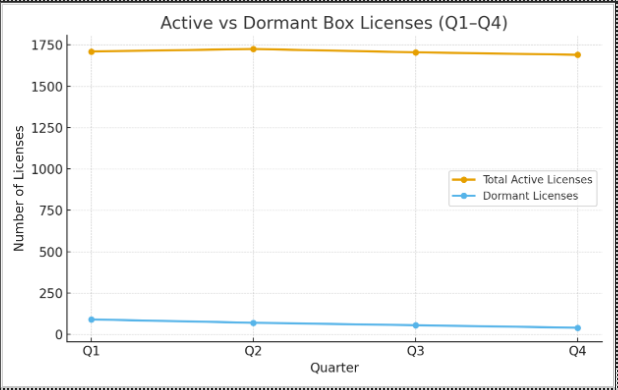
Visual representation: Line graph: A downward curve showing “Total Active Licenses vs. Unused Seats” with a noticeable drop in unused seats after optimization. This visually demonstrates how structured license reclamation and tier right-sizing directly reduce waste.
This demonstrates how methodical visibility and automation help optimize Box licenses sustainably.
Turn your Box license data into savings insights.
With CloudNuro, IT teams gain a unified dashboard showing Box usage, dormant licenses, and optimization-ready accounts across the organization. Insights are delivered proactively before renewal dates, no manual spreadsheet tracking required.
Use this quick checklist to assess whether your organization is likely overspending on Box:
| Question | If Yes | Risk Level |
|---|---|---|
| Do you have users who have never logged into Box? | You are paying for licenses that provide zero value | High |
| Have you identified ex-employees who still have Box accounts? | You have orphaned licenses and potential security exposure | High |
| Do multiple departments purchase Box licenses independently? | You may be missing out on enterprise-level discounts | Medium |
| Is there a clear policy for who gets which Box license tier? | Ad hoc license assignment likely leads to overprovisioning | Medium |
| Do you review Box usage data at least quarterly? | Lack of regular review means waste accumulates silently | Medium |
| Is finance able to see how Box spend maps to departments? | Without cost allocation, there is little accountability | Medium |
| Do you have a process to reclaim licenses from inactive users? | Manual reclaim leads to inconsistency; no reclaim leads to waste | High |
Interpretation:
CloudNuro is designed to help IT, finance, and procurement teams continuously optimize SaaS and cloud platforms like Box. Rather than treating optimization as a one-time project, CloudNuro embeds it into your operating model.
Key capabilities for Box:
With CloudNuro, you gain an always-on optimization engine instead of manual, inconsistent license audits.
CloudNuro is a leader in Enterprise SaaS Management Platforms, giving enterprises unmatched visibility, governance, and cost optimization. Recognized twice in a row by Gartner in the SaaS Management Platforms Magic Quadrant and named a Leader in the Info-Tech SoftwareReviews Data Quadrant, CloudNuro is trusted by global enterprises and government agencies to bring financial discipline to SaaS and cloud, with a 15-minute setup and measurable results in under 24 hours.
CloudNuro helps optimize Box licenses with precision. 👉 Schedule your 15-minute setup and unlock hidden savings.
1. How often should we review Box license usage?
Ideally, Box license usage should be monitored continuously and reviewed at least quarterly. With CloudNuro, you can automate this visibility so that underused licenses and dormant users are surfaced proactively, long before renewals. That way, optimization is performed as part of regular operations rather than as a last-minute clean-up exercise.
2. Can CloudNuro work with multiple Box instances across regions?
Yes. CloudNuro is built to support complex, multi-entity environments. It can ingest data from multiple Box instances, unify it into a single view, and help you consolidate insights across regions or subsidiaries. This helps enterprises standardize policies, eliminate duplicate spend, and negotiate better terms based on global usage.
3. What kind of savings can we expect from Box license optimization?
While actual savings will vary by organization, CloudNuro commonly helps customers identify 15–30% in potential savings on Box, especially when there is significant historical growth, mergers and acquisitions, or decentralized license purchasing. Savings come from reclaiming dormant licenses, eliminating orphaned accounts, right-sizing license tiers, and consolidating contracts.
4. What are early indicators of license waste?
Red flags include a growing base of Box licenses without a corresponding increase in active users, a high number of “never logged in” users, departments managing their own Box contracts, and a lack of clear governance around license assignment. Another warning sign is when finance or procurement only engages with Box data at renewal time, rather than throughout the year.
5. How can CloudNuro help IT and finance teams collaborate on Box optimization?
CloudNuro provides shared dashboards that present Box utilization, spend, and optimization opportunities in a format that both IT and finance teams can act on. IT gets the technical view (users, activity, features), while finance sees cost allocation, savings potential, and trends by department. This shared view supports joint decision-making and enables chargeback to departments, helping IT and finance work in sync.
Effective license optimization in Box transforms the platform from a rising cost center into a managed, measurable investment. By following a structured approach—auditing licenses, classifying users by role, reclaiming dormant and orphaned accounts, right-sizing tiers, consolidating contracts, and implementing governance—you can gain measurable savings while maintaining user satisfaction.
Enterprises that embed license governance within a FinOps framework, backed by tools like CloudNuro, are better prepared to scale, adapt, and control SaaS costs over time. Instead of reacting to renewal surprises, your teams operate with a clear view of usage, cost, and optimization paths, so IT and finance can focus on strategy, not spreadsheets.
CloudNuro is the industry’s most comprehensive SaaS Management and FinOps platform for managing licenses across tools like Box, Microsoft 365, Salesforce, and dozens of other enterprise applications. Recognized by Gartner and Info-Tech, CloudNuro helps you:
Start your 15-minute Box optimization assessment today and uncover potential savings of 20–30%. Schedule a free demo with CloudNuro
Request a no cost, no obligation free assessment —just 15 minutes to savings!
Get StartedBox is one of the most widely adopted enterprise content collaboration platforms, but many organizations unknowingly overspend on their licenses. While Box offers powerful features for secure file sharing, collaboration, and governance, its licensing structure, user growth, and decentralized administration often create a silent licensing challenge that quietly drains IT budgets every year.
Organizations frequently overprovision users, fail to deactivate former employees, and maintain dormant accounts “just in case.” In many cases, teams purchase their own Box instances or request add-ons without central IT visibility, resulting in duplicate licenses and overlapping functionality. All this leads to a pattern that CloudNuro often sees with customers: enterprises end up paying 20–30% more for Box than they actually use.
Most IT admins know they need to optimize Box licenses, but struggle with fragmented data, manual reporting, and lack of continuous oversight. License optimization is not a one-time clean-up; it needs structured steps, clear governance, and automated monitoring to prevent the cycle from repeating.
If you’ve been asking yourself how to optimize Box licenses and stop paying for unused or underused seats, this guide walks you through a practical, step-by-step approach that will help you identify waste, right-size licenses, and implement ongoing monitoring, to ensure you stop paying for what you don’t use.
✅ Box License Optimization: How to Stop Paying for What You Don't Use
CloudNuro helps optimize Box licenses with precision.
From identifying underused licenses to reallocating resources based on real usage data, CloudNuro’s FinOps-aligned platform ensures you only pay for what you actually use.
👉 Schedule your 15-minute setup and unlock hidden savings.
Why this matters: Before you can optimize Box licensing, you need full visibility into who has a license, what type it is, and whether it is actually being used.
Step-by-step process:
What to look for:
This initial scan usually reveals 10–20% of licenses that are either inactive, misaligned with user needs, or safe to reclaim.
Why this matters: Not all users need the same level of access or features within Box. Assigning all users to the same license tier leads to overspend.
Step-by-step process:
Outcome: Role-based licensing eliminates overprovisioning and ensures higher-value features are reserved for users who need them most.
Why this matters: Dormant and orphaned accounts represent pure waste. They consume budget without adding any value, and in some cases, pose a security risk.
Step-by-step process:
Best practice: Implement a standard “90-day inactivity” rule to automatically trigger a review or downgrade.
Why this matters: Some users may have high-tier licenses without actually using advanced features such as workflow automation, governance, or integration-heavy workloads.
Step-by-step process:
Outcome: You retain performance and security for high-value users while minimizing costs for light users.
Why this matters: In many enterprises, multiple departments or business units have purchased Box independently. This leads to fragmented contracts, inconsistent governance, and poor negotiation leverage.
Step-by-step process:
Outcome: Consolidation can unlock volume-based discounts and simplify license management.
Why this matters: License optimization is not a one-and-done exercise. Without ongoing governance, license creep returns within 12–18 months.
Step-by-step process:
Outcome: License optimization becomes part of your operating rhythm, not a last-minute renewal scramble.
Why this matters: Sustainable optimization requires shared ownership. IT alone cannot maintain optimal licensing if departments continue to procure tools independently or request unnecessary upgrades.
Step-by-step process:
Outcome: Governance reduces ad hoc decisions and ensures that every license allocation is justified and monitored.
While the above framework can be executed manually using Box’s native reports, it quickly becomes time-consuming and error-prone, especially at enterprise scale. This is where CloudNuro adds significant value.
CloudNuro is a FinOps-aligned SaaS and cloud management platform designed to give enterprises deep visibility into app usage, licensing, and cost optimization opportunities. For Box in particular, CloudNuro offers:
CloudNuro does not replace Box. Instead, it sits on top of your Box deployment and turns raw usage data into actionable cost savings and governance controls.
To illustrate how Box license optimization works in practice, let’s walk through a fictional but realistic case study.
Client: A mid-size professional services enterprise
Employees: 1,200
Box Users: 950
Challenge: Rapid headcount growth over 3 years, with fragmented license management, leading to inflated Box spend and difficulty justifying renewal increases.
CloudNuro connected to the client’s Box environment and ingested user and license data. Within days, the platform highlighted several optimization areas:
Based on CloudNuro’s insights, the enterprise implemented the following actions:
| Department | Licenses Purchased | Active Users | Dormant (90+ days) | Orphaned | Never Logged In |
|---|---|---|---|---|---|
| Sales | 300 | 240 | 35 | 10 | 15 |
| Consulting | 250 | 210 | 25 | 8 | 7 |
| Operations | 200 | 170 | 20 | 6 | 4 |
| Support | 200 | 170 | 15 | 6 | 9 |
After optimization:
| Department | Licenses Purchased | Active Users | Dormant (90+ days) | Orphaned | Never Logged In |
|---|---|---|---|---|---|
| Sales | 260 | 245 | 10 | 2 | 3 |
| Consulting | 220 | 212 | 8 | 1 | 1 |
| Operations | 180 | 172 | 5 | 1 | 2 |
| Support | 180 | 172 | 5 | 1 | 2 |
Before:
After:
Long-term benefit: A sustainable governance framework that prevents license bloat from returning.
The impact of these optimizations can be easily visualized with a simple “before vs. after” license and cost trajectory.
Example:
Prior to optimization, the graph shows a steady increase in licenses alongside flat or slowly growing active usage. After optimization, the license count drops and then grows more gradually, aligned closely with active usage. The gap between “licenses purchased” and “active users” narrows significantly.
Visual representation: Line graph: A downward curve showing “Total Active Licenses vs. Unused Seats” with a noticeable drop in unused seats after optimization. This visually demonstrates how structured license reclamation and tier right-sizing directly reduce waste.
This demonstrates how methodical visibility and automation help optimize Box licenses sustainably.
Turn your Box license data into savings insights.
With CloudNuro, IT teams gain a unified dashboard showing Box usage, dormant licenses, and optimization-ready accounts across the organization. Insights are delivered proactively before renewal dates, no manual spreadsheet tracking required.
Use this quick checklist to assess whether your organization is likely overspending on Box:
| Question | If Yes | Risk Level |
|---|---|---|
| Do you have users who have never logged into Box? | You are paying for licenses that provide zero value | High |
| Have you identified ex-employees who still have Box accounts? | You have orphaned licenses and potential security exposure | High |
| Do multiple departments purchase Box licenses independently? | You may be missing out on enterprise-level discounts | Medium |
| Is there a clear policy for who gets which Box license tier? | Ad hoc license assignment likely leads to overprovisioning | Medium |
| Do you review Box usage data at least quarterly? | Lack of regular review means waste accumulates silently | Medium |
| Is finance able to see how Box spend maps to departments? | Without cost allocation, there is little accountability | Medium |
| Do you have a process to reclaim licenses from inactive users? | Manual reclaim leads to inconsistency; no reclaim leads to waste | High |
Interpretation:
CloudNuro is designed to help IT, finance, and procurement teams continuously optimize SaaS and cloud platforms like Box. Rather than treating optimization as a one-time project, CloudNuro embeds it into your operating model.
Key capabilities for Box:
With CloudNuro, you gain an always-on optimization engine instead of manual, inconsistent license audits.
CloudNuro is a leader in Enterprise SaaS Management Platforms, giving enterprises unmatched visibility, governance, and cost optimization. Recognized twice in a row by Gartner in the SaaS Management Platforms Magic Quadrant and named a Leader in the Info-Tech SoftwareReviews Data Quadrant, CloudNuro is trusted by global enterprises and government agencies to bring financial discipline to SaaS and cloud, with a 15-minute setup and measurable results in under 24 hours.
CloudNuro helps optimize Box licenses with precision. 👉 Schedule your 15-minute setup and unlock hidden savings.
1. How often should we review Box license usage?
Ideally, Box license usage should be monitored continuously and reviewed at least quarterly. With CloudNuro, you can automate this visibility so that underused licenses and dormant users are surfaced proactively, long before renewals. That way, optimization is performed as part of regular operations rather than as a last-minute clean-up exercise.
2. Can CloudNuro work with multiple Box instances across regions?
Yes. CloudNuro is built to support complex, multi-entity environments. It can ingest data from multiple Box instances, unify it into a single view, and help you consolidate insights across regions or subsidiaries. This helps enterprises standardize policies, eliminate duplicate spend, and negotiate better terms based on global usage.
3. What kind of savings can we expect from Box license optimization?
While actual savings will vary by organization, CloudNuro commonly helps customers identify 15–30% in potential savings on Box, especially when there is significant historical growth, mergers and acquisitions, or decentralized license purchasing. Savings come from reclaiming dormant licenses, eliminating orphaned accounts, right-sizing license tiers, and consolidating contracts.
4. What are early indicators of license waste?
Red flags include a growing base of Box licenses without a corresponding increase in active users, a high number of “never logged in” users, departments managing their own Box contracts, and a lack of clear governance around license assignment. Another warning sign is when finance or procurement only engages with Box data at renewal time, rather than throughout the year.
5. How can CloudNuro help IT and finance teams collaborate on Box optimization?
CloudNuro provides shared dashboards that present Box utilization, spend, and optimization opportunities in a format that both IT and finance teams can act on. IT gets the technical view (users, activity, features), while finance sees cost allocation, savings potential, and trends by department. This shared view supports joint decision-making and enables chargeback to departments, helping IT and finance work in sync.
Effective license optimization in Box transforms the platform from a rising cost center into a managed, measurable investment. By following a structured approach—auditing licenses, classifying users by role, reclaiming dormant and orphaned accounts, right-sizing tiers, consolidating contracts, and implementing governance—you can gain measurable savings while maintaining user satisfaction.
Enterprises that embed license governance within a FinOps framework, backed by tools like CloudNuro, are better prepared to scale, adapt, and control SaaS costs over time. Instead of reacting to renewal surprises, your teams operate with a clear view of usage, cost, and optimization paths, so IT and finance can focus on strategy, not spreadsheets.
CloudNuro is the industry’s most comprehensive SaaS Management and FinOps platform for managing licenses across tools like Box, Microsoft 365, Salesforce, and dozens of other enterprise applications. Recognized by Gartner and Info-Tech, CloudNuro helps you:
Start your 15-minute Box optimization assessment today and uncover potential savings of 20–30%. Schedule a free demo with CloudNuro
Request a no cost, no obligation free assessment - just 15 minutes to savings!
Get StartedWe're offering complimentary ServiceNow license assessments to only 25 enterprises this quarter who want to unlock immediate savings without disrupting operations.
Get Free AssessmentGet Started




CloudNuro Corp
1755 Park St. Suite 207
Naperville, IL 60563
Phone : +1-630-277-9470
Email: info@cloudnuro.com





.webp)

Recognized Leader in SaaS Management Platforms by Info-Tech SoftwareReviews


.svg)