

Sign Up
Thank you for Submitting!
Knowing how to negotiate SaaS contract renewal effectively now depends on one thing more than any other: the quality of your usage data.
Gartner reported in 2026 that 68% of enterprise CIOs call usage based pricing data "critical" for SaaS renewal success. Yet Flexera found that only 34% of IT leaders routinely audit SaaS usage data before entering negotiations, which means most enterprises walk into high stakes conversations half blind.
This guide explains exactly what usage data to bring into SaaS negotiations, how to prepare it, and how to turn it into pricing power, better terms, and stronger governance.
Usage transparency has moved from helpful to mandatory. As one Gartner VP analyst put it in 2026, "bringing granular usage and license utilization data to the table isn't just beneficial, it has become table stakes for modern SaaS contract negotiation."
Three forces are driving this shift:
Forrester’s 2026 research shows that organizations using automated usage analytics in negotiations achieve an average 21% reduction in renewal costs, compared to single digit savings with manual tracking.

In other words, renewal readiness is now a data problem. Your goal is not simply to collect information, but to curate a set of metrics that exposes waste, proves value gaps, and supports a concrete renewal proposal.
The starting point for how to negotiate SaaS contract renewal is knowing which metrics truly matter. You do not need everything, you need the few critical numbers that shift the discussion.
Gartner’s 2026 analysis shows that the most common figures enterprises bring into SaaS renewal negotiations cluster around four themes.
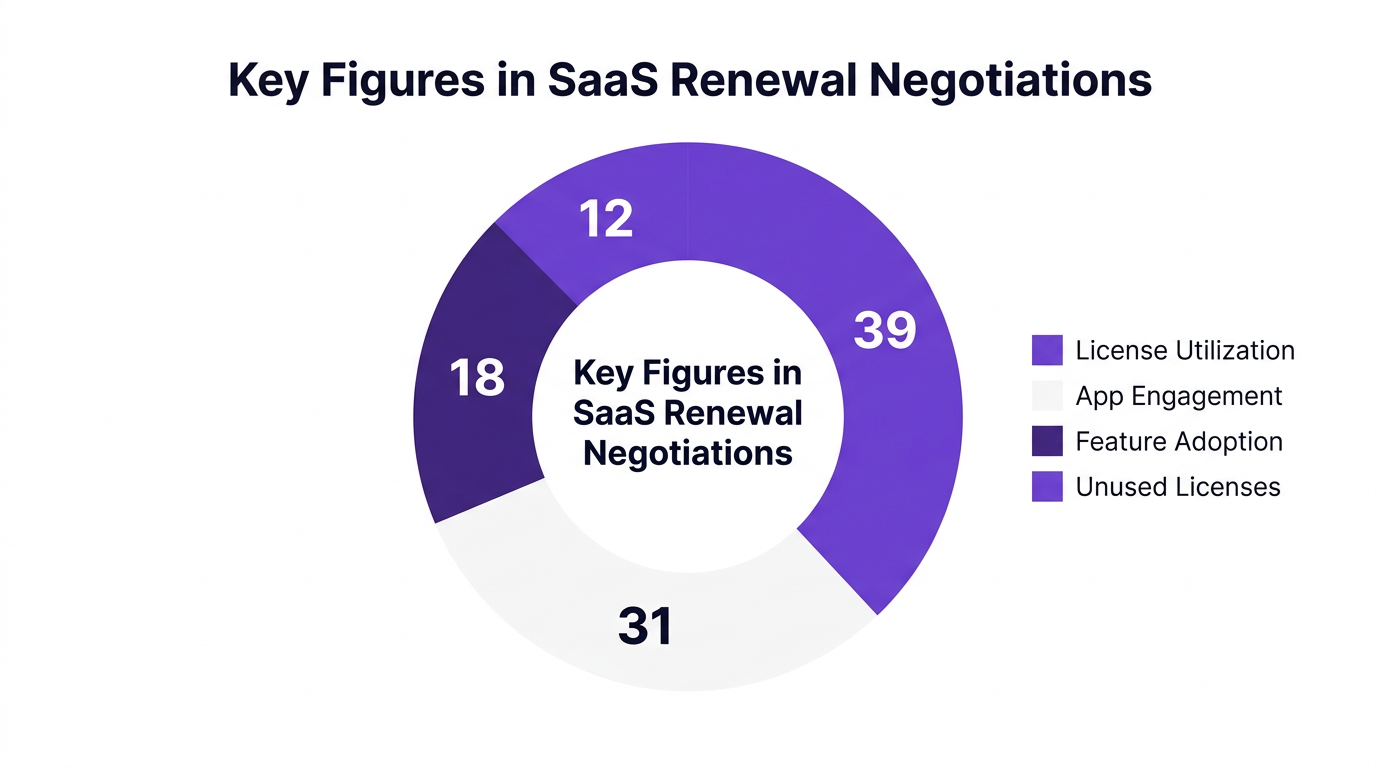
License utilization is usually your highest impact metric in SaaS renewal negotiation.
Key data points to assemble:
When McKinsey reports 24% average under utilization, that is not an abstract number. For a 5,000 seat deployment, it implies 1,200 seats that may be candidates for downgrade, reassignment, or removal.
Use this metric to:
Most enterprise SaaS contracts bundle multiple modules. Vendors will defend price based on full bundle value, but your usage data may tell a different story.
Track:
If only 15% of your workforce uses an advanced analytics add on, yet you are paying for it at 100% coverage, you have a strong argument to restructure.
Counterargument to prepare for: vendors may claim low usage is a change management issue, not a product value gap. Address this by showing training activity, internal campaigns, and still flat adoption. Data turns opinion into evidence.
Engagement metrics tie seat cost to business reality.
Useful indicators include:
Everest Group reported in 2026 that 92% of procurement leaders saw better renewal terms when they brought proof of utilization and engagement data. Depth of use shows which groups are driving value and where you can safely shrink footprint.
Many platforms apply usage based pricing for storage, API calls, workflow runs, or AI queries.
Collect:
This data enables you to:
Usage data is not only about cost. For regulated industries, it is also your proof of control.
Track:
These metrics support compliance in SaaS renewals and give you leverage to demand stronger controls and auditability without paying premium upcharges.
Collecting raw metrics is not enough. You need to translate SaaS usage metrics into a concise artifact your executives and vendors can understand.
Think of this as your SaaS contract negotiation playbook 2026: a repeatable process that IT, finance, and procurement can run every time.
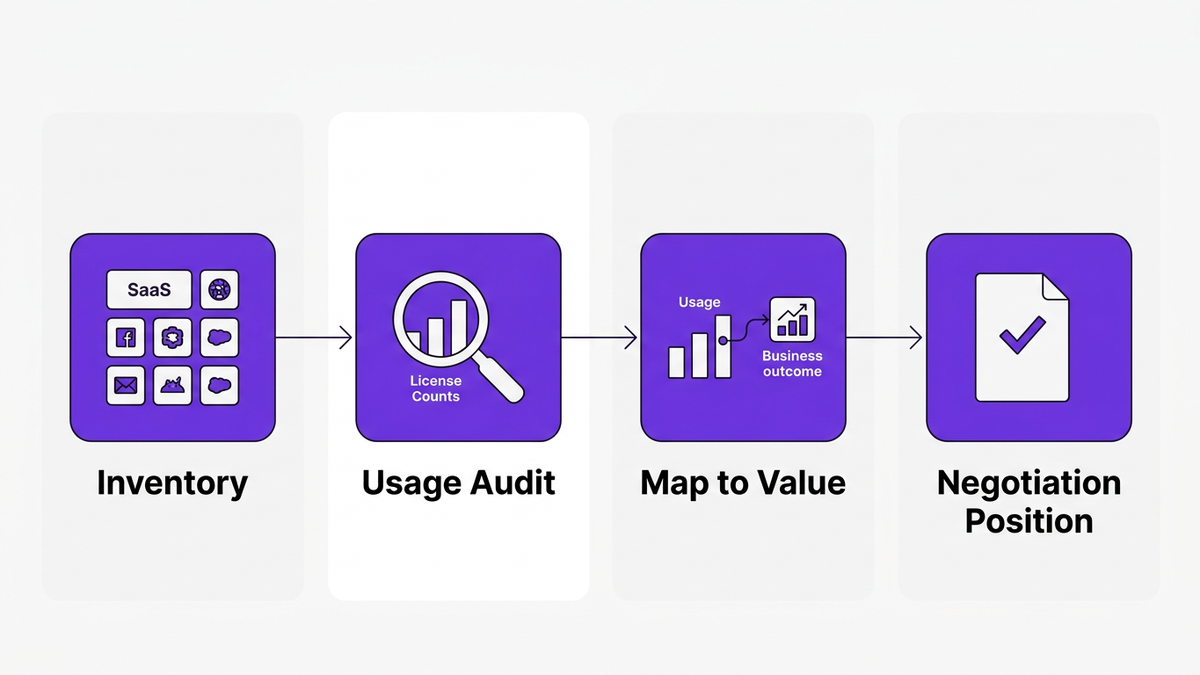
You cannot optimize what you cannot see. Start with a single source of truth for:
IDC observed in 2026 that enterprises with real time SaaS visibility platforms experience 2.5x higher cost optimization during renewals than those relying on manual tracking. The inventory is your foundation for prioritizing which renewals deserve the most scrutiny.
For each upcoming renewal, run an audit at least 90 days before the end date.
Your SaaS subscription renewal checklist 2026 for data should include:
This is also where how to audit SaaS usage data for renewal becomes practical. Ensure data is drawn from authoritative logs, not anecdotal surveys. Use standardized definitions like "active user" to avoid vendor disputes.
Usage alone does not win negotiations. You must connect it to business value.
Examples:
This step is what separates basic SaaS usage metrics for contract negotiation from a compelling narrative that CFOs and line of business leaders will back.
Summarize your analysis into a renewal position one pager per vendor that includes:
Enter negotiations with this document as the default, not as a wish list.
Once you are in the conversation, the way you deploy data matters as much as the numbers themselves. Successful SaaS vendor negotiation tactics enterprise teams treat data as a way to co design a sustainable contract, not just to pressure the other side.
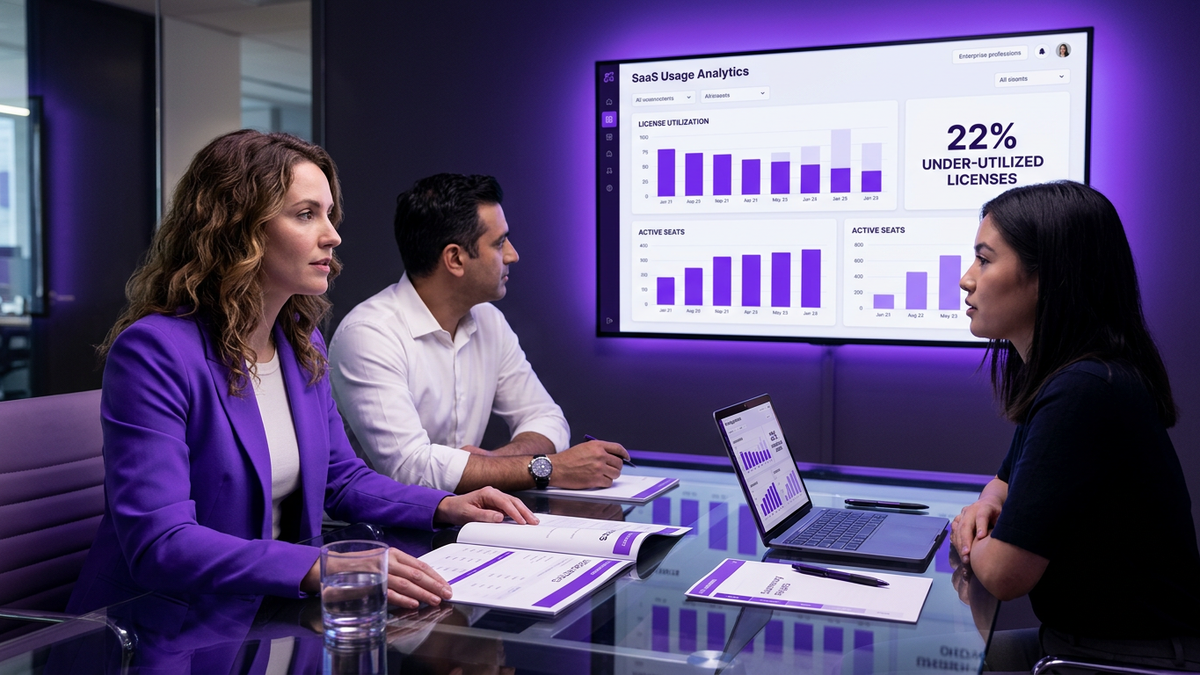
Start by aligning on:
If a vendor’s internal logs differ from yours, use this as a governance discussion, not an argument. Well run organizations can calmly walk through discrepancies and agree a common baseline.
A common mistake in how to negotiate lower SaaS pricing is to ask for flat discounts without changing the shape of the deal.
Better options:
This creates a sustainable structure that vendors can accept while still cutting your total cost.
Research like "enterprises that benchmark license consumption secure 12 to 18% better discount rates on average" (SaaS Management Pulse 2026) is helpful, but should be used thoughtfully.
Two guidelines:
Counterargument vendors raise: "Our solution is more strategic, so benchmarks do not apply." Respond with value based reasoning tied to your actual outcome metrics, not generic comparisons.
Translate your data backed agreement into clear terms:
This also informs your SaaS renewal negotiation email templates, which should summarize the key utilization insights and proposed structure for easy stakeholder review.
A North American healthcare provider illustrates how usage analytics for software negotiation can materially change renewal outcomes.
The organization used CloudNuro AI Custodian to track real time license utilization across more than 60 SaaS apps. The platform exposed 22% under used licenses across the portfolio and highlighted 110 redundant seats clustered in their IT service management environment.
Armed with this data, IT and procurement:
In a separate case, a global financial firm used CloudNuro’s Unified Cloud Custodian to prepare for a major productivity suite renewal. Granular consumption data across collaboration, storage, and analytics workloads showed that high end SKUs were significantly under used.
The result:
These examples highlight a consistent pattern. When enterprises optimize SaaS usage data to lower costs, they gain:
Enterprises looking for the best SaaS negotiation strategies 2026 are increasingly standardizing on SaaS management platforms that automate the hardest parts of renewal readiness.
CloudNuro is built for exactly this purpose.
CloudNuro’s Unified Cloud Custodian gives IT leaders centralized visibility across SaaS, PaaS, and IaaS.
Capabilities include:
This foundation removes the manual spreadsheet work that delays renewal analysis and creates blind spots.
With dedicated products such as Microsoft 365 Custodian, Salesforce Custodian, and ServiceNow Custodian, enterprises can surface detailed license utilization data for their most expensive platforms.
CloudNuro helps you:
These insights feed directly into your software renewal metrics and provide solid evidence for rightsizing proposals.
CloudNuro AI Custodian adds an AI powered SaaS analytics layer on top of raw usage.
You gain:
This supports both IT procurement for SaaS renewals and risk teams who need to validate that contract changes will not compromise security or compliance.
CloudNuro’s FinOps services and cost optimization dashboards surface actionable savings opportunities across 400 plus integrated apps.
Teams can:
Customers routinely report outcomes such as 35% SaaS overspend reduction and 18% savings on major renewals, supported by repeatable, data driven processes rather than one off negotiation heroics.
In practical terms, CloudNuro becomes the backbone of your SaaS contract negotiation playbook 2026, centralizing the data, workflows, and governance you need to consistently achieve better renewal outcomes.
The most impactful metrics are license utilization, feature and module adoption, engagement depth, and consumption vs quota for usage based elements. Together, these expose under used capacity and help you propose a contract that matches real demand.
License utilization data shows how many seats are truly active, how many users need premium features, and where dormant accounts exist. By pairing this with SaaS spend optimization scenarios, you can rightsize seat counts and tiers, then use the savings potential as a basis for discounts and structural changes.
Authoritative sources include admin consoles, audit logs, identity provider sign in records, and SaaS usage analytics dashboard data from platforms like CloudNuro. The key is consistency: use standardized definitions and a single system of record so vendors cannot dispute your numbers.
Aim to start renewal readiness at least 90 days before contract end for smaller platforms and 6 months for strategic systems. This gives time to run audits, socialize findings with stakeholders, and align on a unified position before engaging the vendor.
Common pitfalls include relying on incomplete data, focusing only on cost and ignoring compliance implications, and using benchmarks as blunt instruments rather than context for a reasoned proposal. Another frequent error is treating each renewal as a one off event instead of building a repeatable SaaS spend management process.
Strong usage data enables you to negotiate governance and access terms, such as audit log retention, data export rights, and visibility into AI workloads. It also supports commitments around service levels, onboarding, and training that can improve adoption and business impact, not just reduce spend.
CloudNuro is a leader in Enterprise SaaS Management Platforms, giving enterprises unmatched visibility, governance, and cost optimization.
We are proud to be recognized twice in a row by Gartner in the SaaS Management Platforms and named a Leader in the Info-Tech SoftwareReviews Data Quadrant.
Trusted by global enterprises and government agencies, CloudNuro provides centralized SaaS inventory, license optimization, and renewal management. With a 15-minute setup and measurable results in under 24 hours, CloudNuro gives IT teams a fast path to value.
Request a Demo | Get Free Savings Assessment | Explore Product
Request a no cost, no obligation free assessment —just 15 minutes to savings!
Get StartedKnowing how to negotiate SaaS contract renewal effectively now depends on one thing more than any other: the quality of your usage data.
Gartner reported in 2026 that 68% of enterprise CIOs call usage based pricing data "critical" for SaaS renewal success. Yet Flexera found that only 34% of IT leaders routinely audit SaaS usage data before entering negotiations, which means most enterprises walk into high stakes conversations half blind.
This guide explains exactly what usage data to bring into SaaS negotiations, how to prepare it, and how to turn it into pricing power, better terms, and stronger governance.
Usage transparency has moved from helpful to mandatory. As one Gartner VP analyst put it in 2026, "bringing granular usage and license utilization data to the table isn't just beneficial, it has become table stakes for modern SaaS contract negotiation."
Three forces are driving this shift:
Forrester’s 2026 research shows that organizations using automated usage analytics in negotiations achieve an average 21% reduction in renewal costs, compared to single digit savings with manual tracking.
In other words, renewal readiness is now a data problem. Your goal is not simply to collect information, but to curate a set of metrics that exposes waste, proves value gaps, and supports a concrete renewal proposal.
The starting point for how to negotiate SaaS contract renewal is knowing which metrics truly matter. You do not need everything, you need the few critical numbers that shift the discussion.
Gartner’s 2026 analysis shows that the most common figures enterprises bring into SaaS renewal negotiations cluster around four themes.
License utilization is usually your highest impact metric in SaaS renewal negotiation.
Key data points to assemble:
When McKinsey reports 24% average under utilization, that is not an abstract number. For a 5,000 seat deployment, it implies 1,200 seats that may be candidates for downgrade, reassignment, or removal.
Use this metric to:
Most enterprise SaaS contracts bundle multiple modules. Vendors will defend price based on full bundle value, but your usage data may tell a different story.
Track:
If only 15% of your workforce uses an advanced analytics add on, yet you are paying for it at 100% coverage, you have a strong argument to restructure.
Counterargument to prepare for: vendors may claim low usage is a change management issue, not a product value gap. Address this by showing training activity, internal campaigns, and still flat adoption. Data turns opinion into evidence.
Engagement metrics tie seat cost to business reality.
Useful indicators include:
Everest Group reported in 2026 that 92% of procurement leaders saw better renewal terms when they brought proof of utilization and engagement data. Depth of use shows which groups are driving value and where you can safely shrink footprint.
Many platforms apply usage based pricing for storage, API calls, workflow runs, or AI queries.
Collect:
This data enables you to:
Usage data is not only about cost. For regulated industries, it is also your proof of control.
Track:
These metrics support compliance in SaaS renewals and give you leverage to demand stronger controls and auditability without paying premium upcharges.
Collecting raw metrics is not enough. You need to translate SaaS usage metrics into a concise artifact your executives and vendors can understand.
Think of this as your SaaS contract negotiation playbook 2026: a repeatable process that IT, finance, and procurement can run every time.
You cannot optimize what you cannot see. Start with a single source of truth for:
IDC observed in 2026 that enterprises with real time SaaS visibility platforms experience 2.5x higher cost optimization during renewals than those relying on manual tracking. The inventory is your foundation for prioritizing which renewals deserve the most scrutiny.
For each upcoming renewal, run an audit at least 90 days before the end date.
Your SaaS subscription renewal checklist 2026 for data should include:
This is also where how to audit SaaS usage data for renewal becomes practical. Ensure data is drawn from authoritative logs, not anecdotal surveys. Use standardized definitions like "active user" to avoid vendor disputes.
Usage alone does not win negotiations. You must connect it to business value.
Examples:
This step is what separates basic SaaS usage metrics for contract negotiation from a compelling narrative that CFOs and line of business leaders will back.
Summarize your analysis into a renewal position one pager per vendor that includes:
Enter negotiations with this document as the default, not as a wish list.
Once you are in the conversation, the way you deploy data matters as much as the numbers themselves. Successful SaaS vendor negotiation tactics enterprise teams treat data as a way to co design a sustainable contract, not just to pressure the other side.
Start by aligning on:
If a vendor’s internal logs differ from yours, use this as a governance discussion, not an argument. Well run organizations can calmly walk through discrepancies and agree a common baseline.
A common mistake in how to negotiate lower SaaS pricing is to ask for flat discounts without changing the shape of the deal.
Better options:
This creates a sustainable structure that vendors can accept while still cutting your total cost.
Research like "enterprises that benchmark license consumption secure 12 to 18% better discount rates on average" (SaaS Management Pulse 2026) is helpful, but should be used thoughtfully.
Two guidelines:
Counterargument vendors raise: "Our solution is more strategic, so benchmarks do not apply." Respond with value based reasoning tied to your actual outcome metrics, not generic comparisons.
Translate your data backed agreement into clear terms:
This also informs your SaaS renewal negotiation email templates, which should summarize the key utilization insights and proposed structure for easy stakeholder review.
A North American healthcare provider illustrates how usage analytics for software negotiation can materially change renewal outcomes.
The organization used CloudNuro AI Custodian to track real time license utilization across more than 60 SaaS apps. The platform exposed 22% under used licenses across the portfolio and highlighted 110 redundant seats clustered in their IT service management environment.
Armed with this data, IT and procurement:
In a separate case, a global financial firm used CloudNuro’s Unified Cloud Custodian to prepare for a major productivity suite renewal. Granular consumption data across collaboration, storage, and analytics workloads showed that high end SKUs were significantly under used.
The result:
These examples highlight a consistent pattern. When enterprises optimize SaaS usage data to lower costs, they gain:
Enterprises looking for the best SaaS negotiation strategies 2026 are increasingly standardizing on SaaS management platforms that automate the hardest parts of renewal readiness.
CloudNuro is built for exactly this purpose.
CloudNuro’s Unified Cloud Custodian gives IT leaders centralized visibility across SaaS, PaaS, and IaaS.
Capabilities include:
This foundation removes the manual spreadsheet work that delays renewal analysis and creates blind spots.
With dedicated products such as Microsoft 365 Custodian, Salesforce Custodian, and ServiceNow Custodian, enterprises can surface detailed license utilization data for their most expensive platforms.
CloudNuro helps you:
These insights feed directly into your software renewal metrics and provide solid evidence for rightsizing proposals.
CloudNuro AI Custodian adds an AI powered SaaS analytics layer on top of raw usage.
You gain:
This supports both IT procurement for SaaS renewals and risk teams who need to validate that contract changes will not compromise security or compliance.
CloudNuro’s FinOps services and cost optimization dashboards surface actionable savings opportunities across 400 plus integrated apps.
Teams can:
Customers routinely report outcomes such as 35% SaaS overspend reduction and 18% savings on major renewals, supported by repeatable, data driven processes rather than one off negotiation heroics.
In practical terms, CloudNuro becomes the backbone of your SaaS contract negotiation playbook 2026, centralizing the data, workflows, and governance you need to consistently achieve better renewal outcomes.
The most impactful metrics are license utilization, feature and module adoption, engagement depth, and consumption vs quota for usage based elements. Together, these expose under used capacity and help you propose a contract that matches real demand.
License utilization data shows how many seats are truly active, how many users need premium features, and where dormant accounts exist. By pairing this with SaaS spend optimization scenarios, you can rightsize seat counts and tiers, then use the savings potential as a basis for discounts and structural changes.
Authoritative sources include admin consoles, audit logs, identity provider sign in records, and SaaS usage analytics dashboard data from platforms like CloudNuro. The key is consistency: use standardized definitions and a single system of record so vendors cannot dispute your numbers.
Aim to start renewal readiness at least 90 days before contract end for smaller platforms and 6 months for strategic systems. This gives time to run audits, socialize findings with stakeholders, and align on a unified position before engaging the vendor.
Common pitfalls include relying on incomplete data, focusing only on cost and ignoring compliance implications, and using benchmarks as blunt instruments rather than context for a reasoned proposal. Another frequent error is treating each renewal as a one off event instead of building a repeatable SaaS spend management process.
Strong usage data enables you to negotiate governance and access terms, such as audit log retention, data export rights, and visibility into AI workloads. It also supports commitments around service levels, onboarding, and training that can improve adoption and business impact, not just reduce spend.
CloudNuro is a leader in Enterprise SaaS Management Platforms, giving enterprises unmatched visibility, governance, and cost optimization.
We are proud to be recognized twice in a row by Gartner in the SaaS Management Platforms and named a Leader in the Info-Tech SoftwareReviews Data Quadrant.
Trusted by global enterprises and government agencies, CloudNuro provides centralized SaaS inventory, license optimization, and renewal management. With a 15-minute setup and measurable results in under 24 hours, CloudNuro gives IT teams a fast path to value.
Request a Demo | Get Free Savings Assessment | Explore Product
Request a no cost, no obligation free assessment - just 15 minutes to savings!
Get StartedWe're offering complimentary ServiceNow license assessments to only 25 enterprises this quarter who want to unlock immediate savings without disrupting operations.
Get Free AssessmentGet Started




CloudNuro Corp
1755 Park St. Suite 207
Naperville, IL 60563
Phone : +1-630-277-9470
Email: info@cloudnuro.com





.webp)

Recognized Leader in SaaS Management Platforms by Info-Tech SoftwareReviews

.svg)