

Sign Up
What is best time for the call?
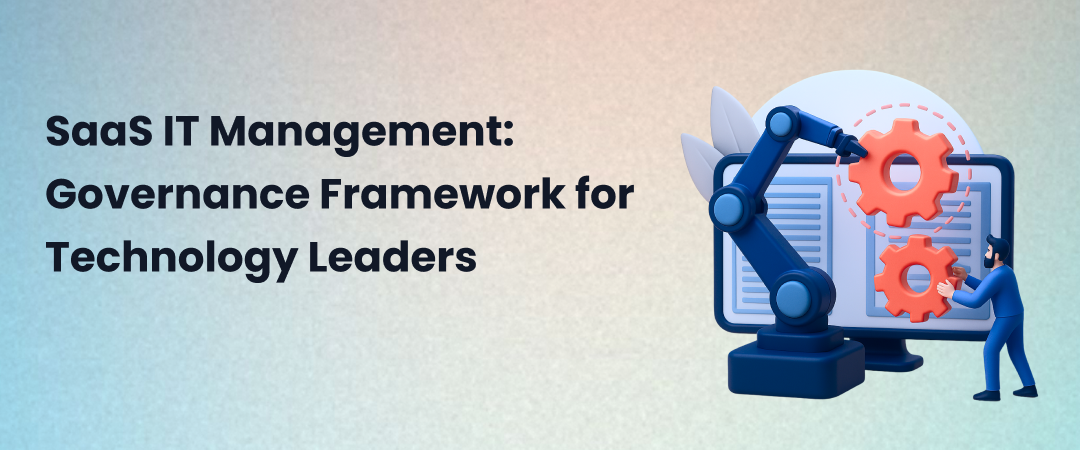
SaaS IT management is the discipline of governing, securing, and optimizing software-as-a-service applications across an enterprise. Unlike traditional IT asset management, it demands real-time visibility, automated policy enforcement, and unified oversight of SaaS, cloud, and AI tools. A robust governance framework combines discovery, cost control, security posture management, and cross-functional accountability, enabling CIOs to turn SaaS sprawl into a strategic advantage.
The average enterprise now uses over 370 SaaS applications, yet IT leaders estimate they're aware of only 40% of them. This visibility gap isn't just an inventory problem; it's a governance crisis. Unmanaged SaaS creates security vulnerabilities, compliance blind spots, and runaway costs that compound every renewal cycle.
SaaS IT management has emerged as the critical capability separating high-performing IT organizations from those drowning in tool sprawl. It's no longer enough to know *which applications employees use; CIOs must govern how they're provisioned, who has access to them*, *what* they cost per business unit, and *whether* they meet security and compliance standards.
Traditional IT governance frameworks, built for on-premise infrastructure and perpetual licenses, break down in the SaaS era. Software is purchased by marketing, deployed by sales, and billed monthly across dozens of credit cards. The result? Shadow IT, duplicate tools, ghost licenses, and a technology strategy that's more patchwork than platform.
Modern IT governance strategies must account for decentralized buying, usage-based pricing, and the convergence of SaaS, IaaS, and AI workloads. That's where a purpose-built SaaS governance framework comes in, not as a compliance checkbox, but as the operating system for technology leadership in 2025 and beyond.
SaaS IT management is the end-to-end discipline of discovering, governing, securing, optimizing, and retiring software-as-a-service applications across an organization. It encompasses:
Traditional IT asset management (ITAM) was designed for a world of hardware, servers, and shrink-wrapped software. It's asset-centric, not user-centric. It assumes centralized procurement, fixed pricing, and annual refresh cycles. SaaS breaks every one of those assumptions.
With SaaS, procurement is federated. Pricing is dynamic. Licenses are tied to named users, feature tiers, and consumption metrics. The software itself lives outside your perimeter, updated continuously by vendors you don't control. ITAM tools built for Windows Server 2008 can't keep up.
That's why leading enterprises are adopting enterprise SaaS management as a distinct practice, one that blends ITAM rigor with FinOps cost governance, SSPM security posture, and vendor management discipline.
SaaS IT management isn't just about tracking licenses. It's about governance at the speed of cloud, automated, policy-driven, and aligned to business outcomes.
See how CloudNuro automates SaaS governance in under 24 hours, request a demo.
A comprehensive SaaS governance framework rests on five interdependent pillars. Miss one, and your entire model tilts toward risk, waste, or compliance failure.
You can't govern what you can't see. The foundation of SaaS IT management is a centralized SaaS inventory that auto-discovers applications via SSO integrations, expense feeds, network traffic, and browser plugins. This isn't a one-time audit; it's continuous discovery that catches shadow IT the moment it appears.
Best practice: integrate your SaaS management platform with Okta, Azure AD, Google Workspace, Salesforce, ServiceNow, and finance systems to build a real-time system of record. Track not just the app, but the owner, department, contract, and usage.
Governance without automation is just documentation. Define policies for provisioning, access reviews, data classification, and offboarding, then enforce them automatically. Examples:
Policy-as-code is the future of IT governance, and SaaS platforms that offer workflow automation let you scale governance without scaling headcount.
Every SaaS app is a potential attack vector. A robust governance framework integrates SaaS Security Posture Management (SSPM) to audit continuously:
Layer this with identity governance: who has admin access, are there orphaned accounts, and is MFA enforced? Security-first SaaS governance is non-negotiable for regulated industries and government agencies.
SaaS costs grow 30% year-over-year in the average enterprise, yet 40% of licenses sit unused. Application governance must include financial discipline:
When IT leaders tie SaaS spend to business units and application owners, waste drops and accountability rises. This is where SaaS management converges with FinOps.
SaaS renewals don't wait for annual budget cycles. Auto-renewals, price escalations, and vendor lock-in are baked into most contracts. A governance framework tracks:
Vendor lifecycle management is how CIOs shift from reactive firefighting to strategic vendor partnerships.
Not every organization starts with the same governance maturity. Here's a pragmatic three-stage model for SaaS oversight:
Goal: Establish visibility and stop the bleeding.
At this stage, you're mostly reacting, but you're building the data foundation for proactive governance.
Goal: Automate policies and shift ownership to business units.
You're now preventing problems before they escalate, and business units understand their SaaS spend and risk profile.
Goal: Optimize continuously with AI-driven insights.
At maturity, SaaS IT management becomes a strategic enabler rather than a cost center. You're not just governing; you're optimizing for business outcomes.
Accelerate your SaaS governance maturity by exploring CloudNuro's platform.
SaaS applications don't exist in isolation. They integrate with cloud workloads (AWS, Azure, GCP), on-prem infrastructure, APIs, and, increasingly, AI models. The challenge for technology leaders is that application governance, cloud cost management, and AI oversight are often siloed across different teams and tools.
A unified IT portfolio approach treats SaaS, IaaS, PaaS, and AI as interconnected layers of a single technology stack. This means:
Multi-cloud governance tools are evolving to support this unified model, but most still treat SaaS as an afterthought. The next generation of technology strategy demands platforms that converge SaaS, cloud, and AI into a single pane of glass.
Why does this matter? Because the fastest-growing cost centers in 2025 aren't VMs or VPNs, they're Databricks, OpenAI API calls, and the 40 SaaS tools your data science team signed up for last quarter. Governance frameworks that ignore this convergence will be obsolete before they're implemented.
CloudNuro is the only platform architected from day one for unified FinOps governance, bringing SaaS, IaaS, and AI into a single system of record. That's not marketing. That's architecture.
Even well-intentioned governance programs fail. Here are the top mistakes, and how to sidestep them:
Pitfall: Every department buys its own SaaS, IT has no budget authority, and no one owns renewals.
Fix: Establish a SaaS governance council with IT, finance, procurement, and security. Centralize approval workflows and cost allocation.
Pitfall: IT maintains a spreadsheet of "known" SaaS apps that's outdated the day it's published.
Fix: Deploy automated discovery via SSO, expense feeds, and network telemetry. Real-time inventory is non-negotiable.
Pitfall: Vendors auto-renew at list price because IT missed the notification window.
Fix: Set 90-day renewal alerts, require vendor performance reviews, and use data-driven negotiation tactics from vendor lifecycle management.
Pitfall: IT focuses on cost, ignoring access sprawl, orphaned accounts, and non-compliant integrations.
Fix: Integrate SSPM, run quarterly access reviews, enforce SSO/MFA, and audit vendor security posture.
Pitfall: SaaS spend is treated as a "corporate overhead" line item, so business units have no incentive to optimize.
Fix: Implement showback first, then migrate to chargeback when marketing sees their Salesforce bill and behavior changes.
Pitfall: Beautiful governance documents that no one follows because there's no enforcement mechanism.
Fix: Automate enforcement. If your policy says "all SaaS requires SSO," make SSO a pre-req in the approval workflow.
Avoid these traps, and your SaaS governance program shifts from overhead to competitive advantage.
Ready to move from theory to practice? Here's a tactical deployment roadmap:
Output: A prioritized list of governance gaps and quick wins.
Output: A living governance playbook, not a static PDF.
Look for platforms that offer:
Output: A single source of truth for SaaS across the enterprise.
Output: Governance that scales without adding headcount.
Start with showback: publish monthly reports showing each department's SaaS spend, usage, and waste. Once visibility is normalized, transition to chargeback, where IT actually bills business units for their consumption.
This creates IT cost accountability and aligns incentives. When engineering sees their $200K Datadog bill, they start optimizing.
Output: Financial discipline embedded in every SaaS decision.
Governance is not "set and forget." Run quarterly reviews:
Output: A continuously improving governance engine aligned to business strategy.
See how CloudNuro customers deploy governance in under 24 hours.
ITAM (IT Asset Management) focuses on hardware, software licenses, and infrastructure, typically on-premise or perpetual licenses. SaaS IT management is purpose-built for subscription-based, cloud-delivered software with dynamic pricing, decentralized procurement, and continuous usage analytics. While ITAM is asset-centric, SaaS management is user-centric and governance-driven.
Deploy a SaaS management platform that integrates with:
Combine these data sources for 90%+ shadow IT coverage. Learn more in our guide on shadow IT discovery.
Track these KPIs:
Technically, yes, but it doesn't scale. Spreadsheets and manual audits can't keep pace with SaaS velocity. Enterprises that rely on manual governance see 30--40% license waste, delayed renewals, and undetected security risks. A purpose-built platform automates discovery, policy enforcement, and cost optimization, delivering ROI in weeks, not quarters.
FinOps is the practice of bringing financial accountability to cloud spending. SaaS is the fastest-growing component of cloud cost, yet it's often managed separately. Leading organizations extend FinOps principles, allocation, optimization, and forecasting, to SaaS subscriptions. Platforms like CloudNuro unify SaaS and IaaS into a single FinOps framework, enabling unified cost intelligence across the entire technology portfolio.
Common frameworks include:
No single framework is perfect; the best practice is to blend elements into a custom technology governance strategy tailored to your industry and maturity.
SaaS IT management is no longer optional. It's the operating system for modern technology leadership. Without a robust governance framework, SaaS sprawl becomes a security risk, compliance exposure, and budget overruns that erode trust among IT, finance, and the business.
The best governance programs share five traits: automated discovery, policy-driven enforcement, security-first posture, financial accountability, and unified oversight of SaaS, cloud, and AI. They don't treat governance as a compliance tax; they treat it as a strategic lever for agility, cost efficiency, and risk management.
Start where you are. Build the visibility foundation. Automate the policies. Align the incentives. And remember: governance isn't about saying "no" to SaaS, it's about saying "yes" to the right tools, at the correct cost, with the proper controls.
The CIOs who win in 2025 won't be the ones who block innovation. They'll be the ones who govern it at scale.
CloudNuro is a leader in Enterprise SaaS Management Platforms, giving enterprises unmatched visibility, governance, and cost optimization. Recognized twice in a row by Gartner in the SaaS Management Platforms Magic Quadrant (2024, 2025) and named a Leader in the Info-Tech SoftwareReviews Data Quadrant, CloudNuro is trusted by global enterprises and government agencies to bring financial discipline to SaaS, cloud, and AI.
Trusted by enterprises such as Konica Minolta and FederalSignal, CloudNuro provides centralized SaaS inventory, license optimization, and renewal management along with advanced cost allocation and chargeback. This gives IT and Finance leaders the visibility, control, and cost-conscious culture needed to drive financial discipline.
As the only Unified FinOps SaaS Management Platform for the Enterprise, CloudNuro brings AI, SaaS, and IaaS management together in a unified view. With a 15-minute setup and measurable results in under 24 hours, CloudNuro gives IT teams a fast path to value.
Request a Demo | Get Free Savings Assessment | Explore Product
Request a no cost, no obligation free assessment —just 15 minutes to savings!
Get StartedSaaS IT management is the discipline of governing, securing, and optimizing software-as-a-service applications across an enterprise. Unlike traditional IT asset management, it demands real-time visibility, automated policy enforcement, and unified oversight of SaaS, cloud, and AI tools. A robust governance framework combines discovery, cost control, security posture management, and cross-functional accountability, enabling CIOs to turn SaaS sprawl into a strategic advantage.
The average enterprise now uses over 370 SaaS applications, yet IT leaders estimate they're aware of only 40% of them. This visibility gap isn't just an inventory problem; it's a governance crisis. Unmanaged SaaS creates security vulnerabilities, compliance blind spots, and runaway costs that compound every renewal cycle.
SaaS IT management has emerged as the critical capability separating high-performing IT organizations from those drowning in tool sprawl. It's no longer enough to know *which applications employees use; CIOs must govern how they're provisioned, who has access to them*, *what* they cost per business unit, and *whether* they meet security and compliance standards.
Traditional IT governance frameworks, built for on-premise infrastructure and perpetual licenses, break down in the SaaS era. Software is purchased by marketing, deployed by sales, and billed monthly across dozens of credit cards. The result? Shadow IT, duplicate tools, ghost licenses, and a technology strategy that's more patchwork than platform.
Modern IT governance strategies must account for decentralized buying, usage-based pricing, and the convergence of SaaS, IaaS, and AI workloads. That's where a purpose-built SaaS governance framework comes in, not as a compliance checkbox, but as the operating system for technology leadership in 2025 and beyond.
SaaS IT management is the end-to-end discipline of discovering, governing, securing, optimizing, and retiring software-as-a-service applications across an organization. It encompasses:
Traditional IT asset management (ITAM) was designed for a world of hardware, servers, and shrink-wrapped software. It's asset-centric, not user-centric. It assumes centralized procurement, fixed pricing, and annual refresh cycles. SaaS breaks every one of those assumptions.
With SaaS, procurement is federated. Pricing is dynamic. Licenses are tied to named users, feature tiers, and consumption metrics. The software itself lives outside your perimeter, updated continuously by vendors you don't control. ITAM tools built for Windows Server 2008 can't keep up.
That's why leading enterprises are adopting enterprise SaaS management as a distinct practice, one that blends ITAM rigor with FinOps cost governance, SSPM security posture, and vendor management discipline.
SaaS IT management isn't just about tracking licenses. It's about governance at the speed of cloud, automated, policy-driven, and aligned to business outcomes.
See how CloudNuro automates SaaS governance in under 24 hours, request a demo.
A comprehensive SaaS governance framework rests on five interdependent pillars. Miss one, and your entire model tilts toward risk, waste, or compliance failure.
You can't govern what you can't see. The foundation of SaaS IT management is a centralized SaaS inventory that auto-discovers applications via SSO integrations, expense feeds, network traffic, and browser plugins. This isn't a one-time audit; it's continuous discovery that catches shadow IT the moment it appears.
Best practice: integrate your SaaS management platform with Okta, Azure AD, Google Workspace, Salesforce, ServiceNow, and finance systems to build a real-time system of record. Track not just the app, but the owner, department, contract, and usage.
Governance without automation is just documentation. Define policies for provisioning, access reviews, data classification, and offboarding, then enforce them automatically. Examples:
Policy-as-code is the future of IT governance, and SaaS platforms that offer workflow automation let you scale governance without scaling headcount.
Every SaaS app is a potential attack vector. A robust governance framework integrates SaaS Security Posture Management (SSPM) to audit continuously:
Layer this with identity governance: who has admin access, are there orphaned accounts, and is MFA enforced? Security-first SaaS governance is non-negotiable for regulated industries and government agencies.
SaaS costs grow 30% year-over-year in the average enterprise, yet 40% of licenses sit unused. Application governance must include financial discipline:
When IT leaders tie SaaS spend to business units and application owners, waste drops and accountability rises. This is where SaaS management converges with FinOps.
SaaS renewals don't wait for annual budget cycles. Auto-renewals, price escalations, and vendor lock-in are baked into most contracts. A governance framework tracks:
Vendor lifecycle management is how CIOs shift from reactive firefighting to strategic vendor partnerships.
Not every organization starts with the same governance maturity. Here's a pragmatic three-stage model for SaaS oversight:
Goal: Establish visibility and stop the bleeding.
At this stage, you're mostly reacting, but you're building the data foundation for proactive governance.
Goal: Automate policies and shift ownership to business units.
You're now preventing problems before they escalate, and business units understand their SaaS spend and risk profile.
Goal: Optimize continuously with AI-driven insights.
At maturity, SaaS IT management becomes a strategic enabler rather than a cost center. You're not just governing; you're optimizing for business outcomes.
Accelerate your SaaS governance maturity by exploring CloudNuro's platform.
SaaS applications don't exist in isolation. They integrate with cloud workloads (AWS, Azure, GCP), on-prem infrastructure, APIs, and, increasingly, AI models. The challenge for technology leaders is that application governance, cloud cost management, and AI oversight are often siloed across different teams and tools.
A unified IT portfolio approach treats SaaS, IaaS, PaaS, and AI as interconnected layers of a single technology stack. This means:
Multi-cloud governance tools are evolving to support this unified model, but most still treat SaaS as an afterthought. The next generation of technology strategy demands platforms that converge SaaS, cloud, and AI into a single pane of glass.
Why does this matter? Because the fastest-growing cost centers in 2025 aren't VMs or VPNs, they're Databricks, OpenAI API calls, and the 40 SaaS tools your data science team signed up for last quarter. Governance frameworks that ignore this convergence will be obsolete before they're implemented.
CloudNuro is the only platform architected from day one for unified FinOps governance, bringing SaaS, IaaS, and AI into a single system of record. That's not marketing. That's architecture.
Even well-intentioned governance programs fail. Here are the top mistakes, and how to sidestep them:
Pitfall: Every department buys its own SaaS, IT has no budget authority, and no one owns renewals.
Fix: Establish a SaaS governance council with IT, finance, procurement, and security. Centralize approval workflows and cost allocation.
Pitfall: IT maintains a spreadsheet of "known" SaaS apps that's outdated the day it's published.
Fix: Deploy automated discovery via SSO, expense feeds, and network telemetry. Real-time inventory is non-negotiable.
Pitfall: Vendors auto-renew at list price because IT missed the notification window.
Fix: Set 90-day renewal alerts, require vendor performance reviews, and use data-driven negotiation tactics from vendor lifecycle management.
Pitfall: IT focuses on cost, ignoring access sprawl, orphaned accounts, and non-compliant integrations.
Fix: Integrate SSPM, run quarterly access reviews, enforce SSO/MFA, and audit vendor security posture.
Pitfall: SaaS spend is treated as a "corporate overhead" line item, so business units have no incentive to optimize.
Fix: Implement showback first, then migrate to chargeback when marketing sees their Salesforce bill and behavior changes.
Pitfall: Beautiful governance documents that no one follows because there's no enforcement mechanism.
Fix: Automate enforcement. If your policy says "all SaaS requires SSO," make SSO a pre-req in the approval workflow.
Avoid these traps, and your SaaS governance program shifts from overhead to competitive advantage.
Ready to move from theory to practice? Here's a tactical deployment roadmap:
Output: A prioritized list of governance gaps and quick wins.
Output: A living governance playbook, not a static PDF.
Look for platforms that offer:
Output: A single source of truth for SaaS across the enterprise.
Output: Governance that scales without adding headcount.
Start with showback: publish monthly reports showing each department's SaaS spend, usage, and waste. Once visibility is normalized, transition to chargeback, where IT actually bills business units for their consumption.
This creates IT cost accountability and aligns incentives. When engineering sees their $200K Datadog bill, they start optimizing.
Output: Financial discipline embedded in every SaaS decision.
Governance is not "set and forget." Run quarterly reviews:
Output: A continuously improving governance engine aligned to business strategy.
See how CloudNuro customers deploy governance in under 24 hours.
ITAM (IT Asset Management) focuses on hardware, software licenses, and infrastructure, typically on-premise or perpetual licenses. SaaS IT management is purpose-built for subscription-based, cloud-delivered software with dynamic pricing, decentralized procurement, and continuous usage analytics. While ITAM is asset-centric, SaaS management is user-centric and governance-driven.
Deploy a SaaS management platform that integrates with:
Combine these data sources for 90%+ shadow IT coverage. Learn more in our guide on shadow IT discovery.
Track these KPIs:
Technically, yes, but it doesn't scale. Spreadsheets and manual audits can't keep pace with SaaS velocity. Enterprises that rely on manual governance see 30--40% license waste, delayed renewals, and undetected security risks. A purpose-built platform automates discovery, policy enforcement, and cost optimization, delivering ROI in weeks, not quarters.
FinOps is the practice of bringing financial accountability to cloud spending. SaaS is the fastest-growing component of cloud cost, yet it's often managed separately. Leading organizations extend FinOps principles, allocation, optimization, and forecasting, to SaaS subscriptions. Platforms like CloudNuro unify SaaS and IaaS into a single FinOps framework, enabling unified cost intelligence across the entire technology portfolio.
Common frameworks include:
No single framework is perfect; the best practice is to blend elements into a custom technology governance strategy tailored to your industry and maturity.
SaaS IT management is no longer optional. It's the operating system for modern technology leadership. Without a robust governance framework, SaaS sprawl becomes a security risk, compliance exposure, and budget overruns that erode trust among IT, finance, and the business.
The best governance programs share five traits: automated discovery, policy-driven enforcement, security-first posture, financial accountability, and unified oversight of SaaS, cloud, and AI. They don't treat governance as a compliance tax; they treat it as a strategic lever for agility, cost efficiency, and risk management.
Start where you are. Build the visibility foundation. Automate the policies. Align the incentives. And remember: governance isn't about saying "no" to SaaS, it's about saying "yes" to the right tools, at the correct cost, with the proper controls.
The CIOs who win in 2025 won't be the ones who block innovation. They'll be the ones who govern it at scale.
CloudNuro is a leader in Enterprise SaaS Management Platforms, giving enterprises unmatched visibility, governance, and cost optimization. Recognized twice in a row by Gartner in the SaaS Management Platforms Magic Quadrant (2024, 2025) and named a Leader in the Info-Tech SoftwareReviews Data Quadrant, CloudNuro is trusted by global enterprises and government agencies to bring financial discipline to SaaS, cloud, and AI.
Trusted by enterprises such as Konica Minolta and FederalSignal, CloudNuro provides centralized SaaS inventory, license optimization, and renewal management along with advanced cost allocation and chargeback. This gives IT and Finance leaders the visibility, control, and cost-conscious culture needed to drive financial discipline.
As the only Unified FinOps SaaS Management Platform for the Enterprise, CloudNuro brings AI, SaaS, and IaaS management together in a unified view. With a 15-minute setup and measurable results in under 24 hours, CloudNuro gives IT teams a fast path to value.
Request a Demo | Get Free Savings Assessment | Explore Product
Request a no cost, no obligation free assessment - just 15 minutes to savings!
Get StartedWe're offering complimentary ServiceNow license assessments to only 25 enterprises this quarter who want to unlock immediate savings without disrupting operations.
Get Free AssessmentGet Started



CloudNuro Corp
1755 Park St. Suite 207
Naperville, IL 60563
Phone : +1-630-277-9470
Email: info@cloudnuro.com


.svg)
.webp)

.png)


Recognized Leader in SaaS Management Platforms by Info-Tech SoftwareReviews
%20Tools%20for%20Secure%20IT%20Environments%20in%202025.png)

.png)