
Sign Up
Thank you for Submitting!
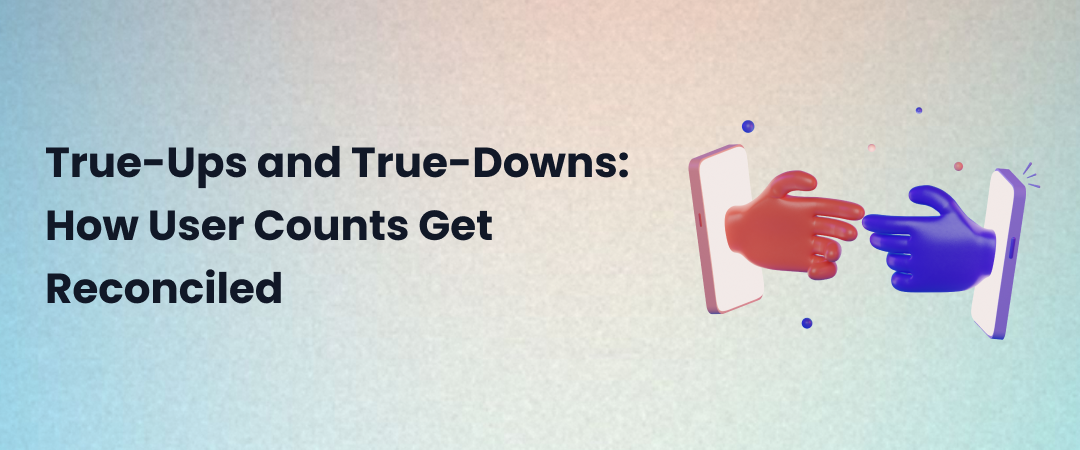
A SaaS true-up is a retroactive bill from a vendor to charge you for exceeding your contracted license count. It is a vendor-friendly mechanism for capturing revenue from overuse. A SaaS true-down is the opposite: a buyer-friendly process to reduce your license count and costs at a reconciliation point, driven by decreased usage. While true-ups are standard, true-downs are rare and must be proactively negotiated into your contract to give you the flexibility to align your spend with your actual needs.
A SaaS true-up is a reconciliation process initiated by a vendor when a customer's usage of a software service exceeds their purchased entitlements. In simpler terms, it is the bill you get after the fact for using more licenses than you paid for. This process is a standard feature in most enterprise software agreements, designed to protect the vendor's revenue.
Why does this definition matter? Because a true-up is not a simple re-billing. It often comes with financial penalties. Vendors frequently charge for overage licenses at the full, undiscounted list price, which can be 30-50% higher than the rate you initially negotiated. This turns organic growth or a temporary spike in usage into a significant, unbudgeted financial liability.
For example, if you purchased 1,000 licenses at a discounted rate of $100 per user, but your active user count grew to 1,100, the vendor will send you a true-up bill for the 100 extra users. Without a negotiated price protection clause, they may charge you the list price of $150 per user for the overage, resulting in a surprise bill of $15,000.
A SaaS true-down is the buyer-centric counterpart to a true-up. It is the contractual right to reduce your license count and corresponding costs at a specified reconciliation point if your actual usage is lower than your commitment. This is the ultimate tool for maintaining cost efficiency and agility in a volatile business environment.
Why is this clause so critical? Because it introduces downside protection to your SaaS contracts. Businesses are not static. You might have a reduction in headcount, divest a business unit, or find that a tool's adoption did not meet expectations. A SaaS true-down right ensures you are not forced to pay for "shelfware"—licenses that sit completely unused—for the remainder of a contract term.
Unsurprisingly, vendors are extremely resistant to granting this right. Their financial models are built on predictable Annual Recurring Revenue (ARR) and high Net Revenue Retention (NRR). Allowing customers to reduce their spend mid-contract introduces revenue volatility. Therefore, the SaaS true-down is almost never included in a standard vendor contract and must be a key point of negotiation for any sophisticated buyer.
Learn how to negotiate for rights like this: Mastering SaaS Negotiation
In 2026, the static annual license model is being challenged by dynamic business realities. The ability to reconcile user counts up or down is no longer just an IT asset management task; it is a core component of corporate financial strategy.
Key Trends Driving the Need for Flexible Reconciliation:
Key Statistic:
Industry data shows that in enterprises without a proactive reconciliation process, an average of 25-30% of all SaaS licenses are inactive or underutilized. A SaaS true-down clause is the most direct mechanism to reclaim this wasted spend.
Vendors often position true-ups as a flexible convenience, but they are a powerful tool for generating revenue.
How the trap works:
The Financial Impact of an Unnegotiated True-Up:
| Item | Negotiated Contract | Unnegotiated True-Up |
|---|---|---|
| Initial Purchase | 1,000 seats @ $120/yr (40% discount) | 1,000 seats @ $120/yr (40% discount) |
| Overage Usage | 200 seats | 200 seats |
| Overage Price | $120/yr (at negotiated rate) | $200/yr (at full list price) |
| True-Up Cost | $24,000 | $40,000 |
| The Penalty | $16,000 (67% Premium) |
Securing the right to a SaaS true-down requires a strategic and proactive negotiation approach.
Automating the discovery of your license usage is critical to arming your negotiation team with the data they need to make these arguments effectively.
The ability to successfully negotiate a SaaS true-down often depends on your industry's purchasing power and operational model.
True-Down Negotiability Index:
| Industry | Likelihood of Success | Key Factors |
|---|---|---|
| Large Enterprise & Government | High | These entities have immense purchasing power and sophisticated procurement teams. They can often make a true-down right a standard part of their master service agreements. |
| Private Equity & Holding Companies | High | PE firms that manage a portfolio of companies often negotiate master agreements that allow them to transfer licenses between portfolio companies or true down licenses as they divest assets. |
| Manufacturing & Logistics | Moderate | For core ERP systems, true-downs are rare due to the high level of integration. For other software, their scale can give them leverage. |
| High-Growth Tech / Startups | Very Low | These companies have the greatest need for flexibility but the least leverage to demand it. Vendors know their growth trajectory is upward and will rarely agree to a true-down. |
| Professional Services & Agencies | Low to Moderate | Their project-based nature provides a strong business case, but they often lack the scale of a large enterprise to force the vendor's hand. |
To measure the effectiveness of your true-up and true-down strategy, track these KPIs.
| KPI | Formula | What It Measures |
|---|---|---|
| License Utilization Rate | (Active Users / Total Purchased Licenses) * 100 | Your overall license efficiency. A low rate indicates a need for a true-down. |
| True-Up Spend as % of ACV | (Total Annual True-Up Costs / Annual Contract Value) * 100 | The financial impact of overage. A high rate indicates poor forecasting or a predatory vendor. |
| Cost Avoidance from True-Downs | (Previous Annual Cost - Post-True-Down Annual Cost) | The hard dollar savings generated by exercising your true-down rights. |
| Forecast Accuracy | (Actual User Count / Forecasted User Count) * 100 | Your ability to predict usage. A consistently low accuracy strengthens the case for needing a true-down clause. |
Here are the top questions professionals ask about SaaS true-downs and true-ups.
True-up reconciliation is typically done on a quarterly or annual basis, as specified in the contract. A SaaS true-down is almost always an annual event, aligned with the contract renewal or anniversary date.
Almost never. A true-down typically results in a lower invoice for the next contract term or a service credit. It does not result in a cash refund for prepaid fees.
A SaaS true-down is a contractual reduction in your total license commitment. License re-harvesting (or optimization) is an internal process where you identify an inactive license and reassign it to a new user, keeping your total license count the same. You should be re-harvesting continuously and using a true-down annually.
The Power of License Optimization
Because it directly conflicts with a SaaS vendor's core business metric: Net Revenue Retention (NRR). NRR measures revenue growth from existing customers. A true-down creates churn and negatively impacts NRR, which is why sales teams are heavily incentivized to prevent it.
Some vendors offer "unlimited" plans to avoid reconciliation entirely. However, these often include hidden caps in a "Fair Use Policy" on other metrics, such as storage or API calls, creating a different kind of true-up risk.
The reconciliation of user counts through true-ups and true-downs is a critical battleground in modern SaaS management. While vendors have standardized the true-up process to capture overage revenue, the SaaS true-down remains a buyer's right that must be fought for.
Achieving this contractual flexibility is not just about saving money; it is about future-proofing your business. It provides the agility to adapt to market changes, M&A activity, and technological evolution without being penalized by rigid, long-term contracts. The key to winning this battle is proactive negotiation, armed with a deep understanding of your own usage data. Do not just accept the vendor's reconciliation process; define your own.
CloudNuro is a leader in Enterprise SaaS Management Platforms, giving enterprises unmatched visibility, governance, and cost optimization.
We are proud to be recognized twice in a row by Gartner in the SaaS Management Platforms and named a Leader in the Info-Tech SoftwareReviews Data Quadrant.
Trusted by global enterprises and government agencies, CloudNuro provides centralized SaaS inventory, license optimization, and renewal management. With a 15-minute setup and measurable results in under 24 hours, CloudNuro gives IT teams a fast path to value.
Request a Demo | Get Free Savings Assessment | Explore Product
Request a no cost, no obligation free assessment —just 15 minutes to savings!
Get StartedA SaaS true-up is a retroactive bill from a vendor to charge you for exceeding your contracted license count. It is a vendor-friendly mechanism for capturing revenue from overuse. A SaaS true-down is the opposite: a buyer-friendly process to reduce your license count and costs at a reconciliation point, driven by decreased usage. While true-ups are standard, true-downs are rare and must be proactively negotiated into your contract to give you the flexibility to align your spend with your actual needs.
A SaaS true-up is a reconciliation process initiated by a vendor when a customer's usage of a software service exceeds their purchased entitlements. In simpler terms, it is the bill you get after the fact for using more licenses than you paid for. This process is a standard feature in most enterprise software agreements, designed to protect the vendor's revenue.
Why does this definition matter? Because a true-up is not a simple re-billing. It often comes with financial penalties. Vendors frequently charge for overage licenses at the full, undiscounted list price, which can be 30-50% higher than the rate you initially negotiated. This turns organic growth or a temporary spike in usage into a significant, unbudgeted financial liability.
For example, if you purchased 1,000 licenses at a discounted rate of $100 per user, but your active user count grew to 1,100, the vendor will send you a true-up bill for the 100 extra users. Without a negotiated price protection clause, they may charge you the list price of $150 per user for the overage, resulting in a surprise bill of $15,000.
A SaaS true-down is the buyer-centric counterpart to a true-up. It is the contractual right to reduce your license count and corresponding costs at a specified reconciliation point if your actual usage is lower than your commitment. This is the ultimate tool for maintaining cost efficiency and agility in a volatile business environment.
Why is this clause so critical? Because it introduces downside protection to your SaaS contracts. Businesses are not static. You might have a reduction in headcount, divest a business unit, or find that a tool's adoption did not meet expectations. A SaaS true-down right ensures you are not forced to pay for "shelfware"—licenses that sit completely unused—for the remainder of a contract term.
Unsurprisingly, vendors are extremely resistant to granting this right. Their financial models are built on predictable Annual Recurring Revenue (ARR) and high Net Revenue Retention (NRR). Allowing customers to reduce their spend mid-contract introduces revenue volatility. Therefore, the SaaS true-down is almost never included in a standard vendor contract and must be a key point of negotiation for any sophisticated buyer.
Learn how to negotiate for rights like this: Mastering SaaS Negotiation
In 2026, the static annual license model is being challenged by dynamic business realities. The ability to reconcile user counts up or down is no longer just an IT asset management task; it is a core component of corporate financial strategy.
Key Trends Driving the Need for Flexible Reconciliation:
Key Statistic:
Industry data shows that in enterprises without a proactive reconciliation process, an average of 25-30% of all SaaS licenses are inactive or underutilized. A SaaS true-down clause is the most direct mechanism to reclaim this wasted spend.
Vendors often position true-ups as a flexible convenience, but they are a powerful tool for generating revenue.
How the trap works:
The Financial Impact of an Unnegotiated True-Up:
| Item | Negotiated Contract | Unnegotiated True-Up |
|---|---|---|
| Initial Purchase | 1,000 seats @ $120/yr (40% discount) | 1,000 seats @ $120/yr (40% discount) |
| Overage Usage | 200 seats | 200 seats |
| Overage Price | $120/yr (at negotiated rate) | $200/yr (at full list price) |
| True-Up Cost | $24,000 | $40,000 |
| The Penalty | $16,000 (67% Premium) |
Securing the right to a SaaS true-down requires a strategic and proactive negotiation approach.
Automating the discovery of your license usage is critical to arming your negotiation team with the data they need to make these arguments effectively.
The ability to successfully negotiate a SaaS true-down often depends on your industry's purchasing power and operational model.
True-Down Negotiability Index:
| Industry | Likelihood of Success | Key Factors |
|---|---|---|
| Large Enterprise & Government | High | These entities have immense purchasing power and sophisticated procurement teams. They can often make a true-down right a standard part of their master service agreements. |
| Private Equity & Holding Companies | High | PE firms that manage a portfolio of companies often negotiate master agreements that allow them to transfer licenses between portfolio companies or true down licenses as they divest assets. |
| Manufacturing & Logistics | Moderate | For core ERP systems, true-downs are rare due to the high level of integration. For other software, their scale can give them leverage. |
| High-Growth Tech / Startups | Very Low | These companies have the greatest need for flexibility but the least leverage to demand it. Vendors know their growth trajectory is upward and will rarely agree to a true-down. |
| Professional Services & Agencies | Low to Moderate | Their project-based nature provides a strong business case, but they often lack the scale of a large enterprise to force the vendor's hand. |
To measure the effectiveness of your true-up and true-down strategy, track these KPIs.
| KPI | Formula | What It Measures |
|---|---|---|
| License Utilization Rate | (Active Users / Total Purchased Licenses) * 100 | Your overall license efficiency. A low rate indicates a need for a true-down. |
| True-Up Spend as % of ACV | (Total Annual True-Up Costs / Annual Contract Value) * 100 | The financial impact of overage. A high rate indicates poor forecasting or a predatory vendor. |
| Cost Avoidance from True-Downs | (Previous Annual Cost - Post-True-Down Annual Cost) | The hard dollar savings generated by exercising your true-down rights. |
| Forecast Accuracy | (Actual User Count / Forecasted User Count) * 100 | Your ability to predict usage. A consistently low accuracy strengthens the case for needing a true-down clause. |
Here are the top questions professionals ask about SaaS true-downs and true-ups.
True-up reconciliation is typically done on a quarterly or annual basis, as specified in the contract. A SaaS true-down is almost always an annual event, aligned with the contract renewal or anniversary date.
Almost never. A true-down typically results in a lower invoice for the next contract term or a service credit. It does not result in a cash refund for prepaid fees.
A SaaS true-down is a contractual reduction in your total license commitment. License re-harvesting (or optimization) is an internal process where you identify an inactive license and reassign it to a new user, keeping your total license count the same. You should be re-harvesting continuously and using a true-down annually.
The Power of License Optimization
Because it directly conflicts with a SaaS vendor's core business metric: Net Revenue Retention (NRR). NRR measures revenue growth from existing customers. A true-down creates churn and negatively impacts NRR, which is why sales teams are heavily incentivized to prevent it.
Some vendors offer "unlimited" plans to avoid reconciliation entirely. However, these often include hidden caps in a "Fair Use Policy" on other metrics, such as storage or API calls, creating a different kind of true-up risk.
The reconciliation of user counts through true-ups and true-downs is a critical battleground in modern SaaS management. While vendors have standardized the true-up process to capture overage revenue, the SaaS true-down remains a buyer's right that must be fought for.
Achieving this contractual flexibility is not just about saving money; it is about future-proofing your business. It provides the agility to adapt to market changes, M&A activity, and technological evolution without being penalized by rigid, long-term contracts. The key to winning this battle is proactive negotiation, armed with a deep understanding of your own usage data. Do not just accept the vendor's reconciliation process; define your own.
CloudNuro is a leader in Enterprise SaaS Management Platforms, giving enterprises unmatched visibility, governance, and cost optimization.
We are proud to be recognized twice in a row by Gartner in the SaaS Management Platforms and named a Leader in the Info-Tech SoftwareReviews Data Quadrant.
Trusted by global enterprises and government agencies, CloudNuro provides centralized SaaS inventory, license optimization, and renewal management. With a 15-minute setup and measurable results in under 24 hours, CloudNuro gives IT teams a fast path to value.
Request a Demo | Get Free Savings Assessment | Explore Product
Request a no cost, no obligation free assessment - just 15 minutes to savings!
Get StartedWe're offering complimentary ServiceNow license assessments to only 25 enterprises this quarter who want to unlock immediate savings without disrupting operations.
Get Free AssessmentGet Started




CloudNuro Corp
1755 Park St. Suite 207
Naperville, IL 60563
Phone : +1-630-277-9470
Email: info@cloudnuro.com


.svg)


.webp)

Recognized Leader in SaaS Management Platforms by Info-Tech SoftwareReviews