
Sign Up
Thank you for Submitting!
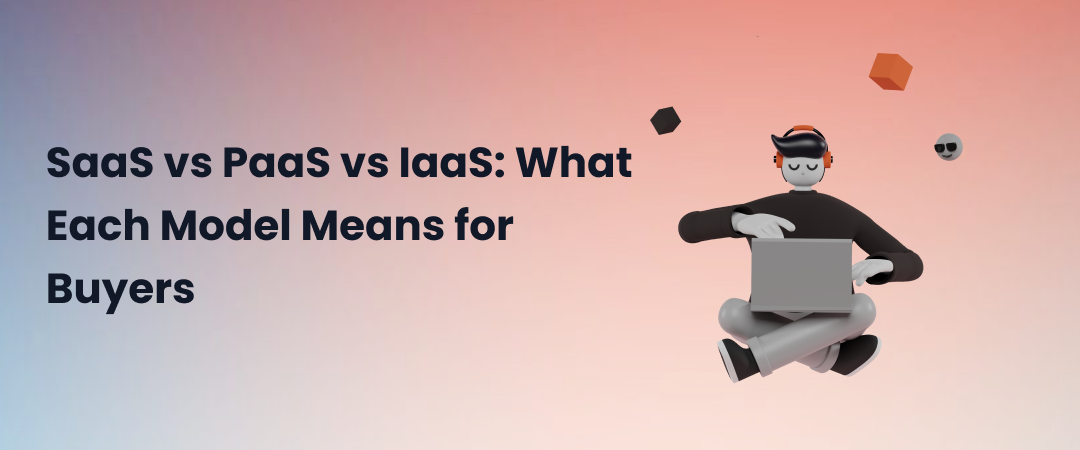
Understanding the differences between SaaS, PaaS, and IaaS is critical for making smart cloud investment decisions. SaaS (Software as a Service) delivers ready-to-use applications, PaaS (Platform as a Service) provides development environments, and IaaS (Infrastructure as a Service) offers virtualized computing resources. For enterprise buyers, SaaS typically accounts for 62% of cloud budgets, with average annual spending of $2.3M, while IaaS accounts for 28% and PaaS for 10%. Organizations implementing proper governance of cloud service models reduce total cloud spending by 23-35% while improving operational efficiency. The right model depends on your use case, technical capabilities, and control requirements, rather than on one-size-fits-all recommendations.
The cloud computing market reached $597 billion in 2024 and continues accelerating at 20.7% annually, yet 68% of organizations struggle to categorize their cloud spending across service models. This confusion creates significant financial and operational risks as companies overspend on inappropriate service models, lack visibility into actual cloud consumption, and fail to optimize across their multi-cloud environments.
The fundamental question facing every IT buyer is not whether to adopt cloud services but which cloud service models align with specific business needs. A SaaS application might cost $50 per user per month but require zero infrastructure management. In contrast, equivalent IaaS resources could cost $15 per instance per month, but demand dedicated DevOps expertise costing $150,000+ annually in salaries.
The distinction between SaaS, PaaS, and IaaS extends far beyond technical architecture differences. Each model represents fundamentally different cost structures, operational responsibilities, flexibility constraints, and long-term strategic implications. Making the wrong choice leads to budget overruns averaging 38% above projections, technical debt requiring expensive migrations, and opportunity costs from delayed time-to-value.
This guide provides enterprise buyers with a framework for understanding cloud service models from a procurement and financial governance perspective. Whether you are a CIO evaluating cloud strategy, CFO managing technology budgets, or procurement leader negotiating cloud contracts, understanding these models enables smarter decisions that balance functionality, cost, and operational burden.
All cloud service models operate on a shared responsibility principle where providers and customers divide security, management, and operational duties. Understanding this division is fundamental to making informed purchasing decisions.
In traditional on-premises environments, organizations manage everything from physical data centers to application software. Cloud computing transfers portions of this responsibility to providers, with the extent of transfer defining the service model. The more responsibility the provider assumes, the less control and flexibility customers retain, but the lower their operational burden.
IaaS providers manage physical infrastructure (servers, storage, networking, data centers), while customers handle everything above the virtualization layer, including operating systems, middleware, runtimes, applications, and data. PaaS extends the provider's responsibility to the runtime and middleware layers, leaving customers focused on applications and data. SaaS providers manage the entire stack from infrastructure through applications, with customers only managing user data and access configurations.
This spectrum creates direct trade-offs between costs and capabilities. IaaS offers maximum flexibility and control but requires the most internal expertise and ongoing management. SaaS delivers the fastest time-to-value and the lowest operational burden, but it offers limited customization and vendor lock-in risks. PaaS occupies the middle ground, offering development flexibility while abstracting infrastructure complexity.
The service model directly impacts total cost of ownership. IaaS typically shows the lowest per-unit cost but highest total cost when accounting for personnel, management tools, and operational overhead. A $500 monthly IaaS commitment might require $8,000 in monthly labor and tooling to operate effectively. Conversely, a $2,000 monthly SaaS subscription covers all operational costs, resulting in a lower total cost despite higher per-unit pricing.
Organizations optimizing cloud spending must evaluate total cost of ownership across all models rather than comparing list prices in isolation. Discover how CloudNuro provides unified visibility across SaaS, PaaS, and IaaS spending.
Measuring cloud spending and efficiency against industry benchmarks helps organizations identify optimization opportunities and justify governance investments.
Enterprise cloud budgets allocate on average 62% to SaaS, 28% to IaaS, and 10% to PaaS according to 2024 cloud spending analysis. This distribution reflects the maturity of SaaS adoption and ongoing IaaS growth supporting cloud-native applications. High-growth technology companies skew toward 70% SaaS and 25% IaaS, while traditional enterprises maintain a more balanced distribution around 55% SaaS, 35% IaaS, and 10% PaaS.
SaaS spending grows 18-25% annually for typical enterprises, outpacing overall IT budget growth of 3-6%. Key management KPIs include:
IaaS environments require different metrics focused on resource utilization and cost efficiency:
Organizations managing all three cloud service models should track:
Understanding SaaS market dynamics helps buyers anticipate trends and benchmark their adoption patterns.
The global SaaS market reached $317 billion in 2024, growing 18.7% from 2023 and projected to reach $825 billion by 2030. North America accounts for 62% of SaaS revenue, EMEA 24%, and Asia-Pacific 14%, though APAC grows fastest at 24% annually.
SaaS adoption varies significantly by industry:
Enterprise SaaS budgets allocate across categories as follows:
The average enterprise managed 371 SaaS applications in 2024, up from 288 in 2022 and 175 in 2020. This 20-25% annual growth rate outpaces employee growth, indicating increasing application density per worker. Organizations with 500-2,000 employees average 242 applications, while those with 10,000+ employees average 650+ applications. Without systematic SaaS governance, this proliferation creates management challenges, security risks, and cost inefficiencies.
Understanding the differences across key dimensions helps align service models with specific use cases and organizational capabilities.
| Dimension | SaaS | PaaS | IaaS |
|---|---|---|---|
| Control Level | Low: Use software as provided | Medium: Control applications and data | High: Control everything above hypervisor |
| Customization | Limited to configuration options | Moderate through custom code | Extensive through infrastructure design |
| Management Burden | Minimal: Provider manages all | Low: Focus on app development | High: Manage OS, apps, security, scaling |
| Time to Value | Hours to days | Days to weeks | Weeks to months |
| Technical Expertise Required | Business users | Developers | Infrastructure engineers and architects |
| Cost Structure | Per-user or feature-based subscription | Platform fee + consumption | Pure consumption-based |
| Typical Monthly Cost | $10-$200 per user | $100-$10,000+ per application | $500-$50,000+ per workload |
| Scalability | Automatic, vendor-managed | Automatic platform scaling | Manual or auto-scaling configuration required |
| Security Responsibility | Minimal: user access and data | Moderate: app security and data | Extensive: OS hardening, patching, network |
| Vendor Lock-in Risk | High: data and process dependencies | Very High: platform-specific APIs | Low: portable infrastructure configurations |
| Common Use Cases | Business productivity, CRM, collaboration | Custom app development, APIs, microservices | Legacy migrations, custom infrastructure |
| Examples | Salesforce, Microsoft 365, Slack | Heroku, AWS Elastic Beanstalk | AWS EC2, Azure VMs, Google Compute Engine |
| Ideal For | Buyers wanting ready-to-use solutions | Development teams needing speed | Teams with infrastructure expertise needing control |
This comparison reveals that no single model is universally superior. The right choice depends on specific requirements, internal capabilities, and strategic priorities.
SaaS delivers complete applications accessible via web browsers or APIs, with providers managing infrastructure, platforms, and software. For buyers, SaaS represents the fastest path from purchase decision to business value with minimal technical implementation.
SaaS operates on subscription pricing ranging from $5 to $500+ per user monthly depending on application complexity and value. Enterprise agreements often include volume discounts of 15-40% and annual prepayment discounts of 10-20%. Total SaaS spending for mid-market companies (500-2,000 employees) averages $1.2M to $4.5M annually across 150-400 applications.
SaaS eliminates infrastructure management, reduces time-to-value to days or weeks, and shifts capital expenditure to predictable operational expense. Automatic updates ensure access to latest features without migration projects. For non-technical buyers, SaaS removes barriers to adopting sophisticated capabilities previously requiring extensive IT resources.
Limited customization restricts workflow adaptation to vendor-designed processes. Data portability and integration challenges create vendor lock-in risks. Without proper governance, SaaS spending grows uncontrolled through shadow IT, unused licenses, and redundant applications. Organizations lacking centralized SaaS management experience 47% waste from these inefficiencies.
PaaS provides complete development and deployment environments including infrastructure, operating systems, middleware, databases, and development tools. Developers focus on writing and deploying applications without managing underlying platforms.
PaaS pricing combines base platform fees with usage-based consumption for compute, storage, and data transfer. Entry-level development environments start at $25-$100 monthly, while production workloads range from $500 to $50,000+ monthly based on scale and performance requirements.
Organizations building custom applications without wanting infrastructure management burdens benefit most from PaaS. Scenarios include rapid prototyping and MVP development, web and mobile application backends, API development and microservices, and integration platforms connecting SaaS applications. PaaS excels when development speed and reduced operational burden justify vendor lock-in risk.
IaaS delivers virtualized computing resources including servers, storage, networking, and data centers. Buyers rent infrastructure capacity on-demand, managing operating systems, applications, and data while providers handle physical infrastructure.
IaaS pricing is purely consumption-based, charging for compute hours, storage gigabytes, data transfer, and ancillary services. A typical mid-sized application might consume $2,000-$8,000 monthly in IaaS resources, while enterprise workloads range from $50,000 to $5M+ monthly. Reserved instances and savings plans offer 30-70% discounts versus on-demand pricing.
IaaS requires the most technical expertise and operational overhead of any cloud model. Organizations need dedicated staff for OS patching, security configuration, monitoring, backup management, and capacity planning. Underutilized resources waste 30-45% of IaaS budgets without proper governance and optimization.
See how CloudNuro tracks optimization opportunities across your entire cloud portfolio.
Making the right cloud service models decision requires matching organizational capabilities and requirements to model characteristics.
You need proven solutions for standard business processes (CRM, HRIS, email, collaboration). Your organization lacks deep technical resources or wants to minimize operational overhead. Time-to-value is critical and you can adapt processes to vendor-designed workflows. Most organizations should default to SaaS for standard business applications unless compelling reasons dictate custom development.
You are building custom applications and want to focus on code rather than infrastructure. Your team has development expertise but limited infrastructure experience. Development speed and reduced operational burden justify vendor lock-in risk. PaaS works well for net-new development but rarely makes sense for migrating existing applications due to re-architecture requirements.
You need maximum control over infrastructure, operating systems, and configurations. Applications have specific OS dependencies, licensing requirements, or legacy architecture incompatible with PaaS. You have existing infrastructure expertise and want to leverage it in the cloud. Organizations with mature IT operations often start cloud adoption with IaaS, gradually shifting appropriate workloads to PaaS and adopting SaaS for business applications.
Understanding total cost of ownership across SaaS vs PaaS vs IaaS enables better financial decisions and budget management.
Optimization strategies include rightsizing license counts through regular access reviews, downgrading inactive or light users to lower tiers, consolidating redundant applications, negotiating volume discounts and multi-year commitments, and leveraging annual prepayment discounts of 10-20%. Organizations implementing systematic SaaS cost optimization typically reduce spending 23-35% without functionality loss.
Key strategies include rightsizing instances based on actual utilization (average 30% savings opportunity), implementing auto-scaling and scheduling for non-production environments (20-40% savings), purchasing reserved instances or savings plans for steady-state workloads (30-70% discounts), and implementing storage lifecycle policies archiving infrequently accessed data.
Managing costs across all three models requires unified visibility, chargeback mechanisms allocating costs to business units, budget alerts preventing overruns, and regular optimization reviews. Without centralized governance, organizations lose visibility into total cloud spending and miss optimization opportunities requiring cross-model analysis.
SaaS is a complete, managed app (e.g., Gmail). PaaS is a platform for building apps, managing only your code and data. IaaS is raw infrastructure (servers, storage), requiring you to manage the OS and software. SaaS offers the least control but simplest use; IaaS offers the most control and management burden.
It depends. SaaS often has the lowest total cost by eliminating infrastructure management, despite higher per-user fees. IaaS appears cheaper per unit but requires costly expertise to operate. Calculate total ownership costs; personnel, tools, overhead for an accurate comparison suited to your specific needs and capabilities.
Yes, most organizations use a combination. This "best-of-breed" approach uses SaaS for standard apps (like email), PaaS for development, and IaaS for legacy systems or unique needs. The key challenge is managing security, cost, and integration across these different environments effectively.
Responsibility is shared. In SaaS, the provider secures almost everything; you manage user access and data. In PaaS, you secure your apps and data atop a secured platform. In IaaS, you secure almost everything (OS, apps, data) on the rented infrastructure. Your responsibility increases from SaaS to IaaS.
You risk losing access. Mitigate by choosing stable vendors, ensuring contracts include data export clauses, and maintaining regular backups of your data. For critical apps, consider escrow agreements that secure your data and access rights if the vendor fails.
Easier to migrate "up" to less management (IaaS to PaaS/SaaS). Harder to migrate "down" (SaaS to PaaS/IaaS) or between similar models due to vendor lock-in, proprietary formats, and retraining. Assess portability and exit strategies before commitment to minimize future migration challenges.
Assess needs and internal skills. Use SaaS for standard processes with limited IT staff. Choose PaaS for custom app development without managing infrastructure. Select IaaS for maximum control, legacy migration, or unique requirements. Prioritize operational simplicity vs. control and evaluate total cost, not just price.
Typical enterprise allocation is roughly 60% SaaS, 30% IaaS, 10% PaaS, shifting toward SaaS over time. Use this as a guideline, not a rule. Allocate based on your specific strategy: more SaaS for efficiency, more IaaS/PaaS for custom development and control.
The fundamental insight is that no single model is universally superior. SaaS delivers unmatched speed-to-value and operational simplicity for standard business applications. PaaS accelerates custom development while abstracting infrastructure complexity. IaaS provides maximum control and flexibility for organizations with infrastructure expertise and specific requirements. Most enterprises use all three models for different purposes, optimizing each workload to the most appropriate service level.
Success requires treating cloud service model management as strategic discipline rather than tactical procurement activity. Implement centralized visibility spanning all models, establish cost accountability through chargeback mechanisms, conduct regular optimization reviews, and maintain security and compliance governance appropriate to each model's shared responsibility framework.
As you evaluate cloud service models for specific use cases, remember that the best technical decision considers total cost of ownership, organizational capabilities, long-term flexibility requirements, and strategic alignment beyond simple feature comparisons or list prices.
CloudNuro is a leader in Enterprise SaaS Management Platforms, giving enterprises unmatched visibility, governance, and cost optimization.
CloudNuro's advanced analytics identify redundant applications across service models, reveal license optimization opportunities that reduce SaaS waste by 23-35%, and provide usage insights to inform right-sizing decisions. The platform tracks costs across AWS, Azure, GCP, and Oracle Cloud, as well as SaaS spending, delivering the comprehensive FinOps capabilities modern enterprises require.
Request a Demo | Get Free Savings Assessment | Explore Product
Request a no cost, no obligation free assessment —just 15 minutes to savings!
Get StartedUnderstanding the differences between SaaS, PaaS, and IaaS is critical for making smart cloud investment decisions. SaaS (Software as a Service) delivers ready-to-use applications, PaaS (Platform as a Service) provides development environments, and IaaS (Infrastructure as a Service) offers virtualized computing resources. For enterprise buyers, SaaS typically accounts for 62% of cloud budgets, with average annual spending of $2.3M, while IaaS accounts for 28% and PaaS for 10%. Organizations implementing proper governance of cloud service models reduce total cloud spending by 23-35% while improving operational efficiency. The right model depends on your use case, technical capabilities, and control requirements, rather than on one-size-fits-all recommendations.
The cloud computing market reached $597 billion in 2024 and continues accelerating at 20.7% annually, yet 68% of organizations struggle to categorize their cloud spending across service models. This confusion creates significant financial and operational risks as companies overspend on inappropriate service models, lack visibility into actual cloud consumption, and fail to optimize across their multi-cloud environments.
The fundamental question facing every IT buyer is not whether to adopt cloud services but which cloud service models align with specific business needs. A SaaS application might cost $50 per user per month but require zero infrastructure management. In contrast, equivalent IaaS resources could cost $15 per instance per month, but demand dedicated DevOps expertise costing $150,000+ annually in salaries.
The distinction between SaaS, PaaS, and IaaS extends far beyond technical architecture differences. Each model represents fundamentally different cost structures, operational responsibilities, flexibility constraints, and long-term strategic implications. Making the wrong choice leads to budget overruns averaging 38% above projections, technical debt requiring expensive migrations, and opportunity costs from delayed time-to-value.
This guide provides enterprise buyers with a framework for understanding cloud service models from a procurement and financial governance perspective. Whether you are a CIO evaluating cloud strategy, CFO managing technology budgets, or procurement leader negotiating cloud contracts, understanding these models enables smarter decisions that balance functionality, cost, and operational burden.
All cloud service models operate on a shared responsibility principle where providers and customers divide security, management, and operational duties. Understanding this division is fundamental to making informed purchasing decisions.
In traditional on-premises environments, organizations manage everything from physical data centers to application software. Cloud computing transfers portions of this responsibility to providers, with the extent of transfer defining the service model. The more responsibility the provider assumes, the less control and flexibility customers retain, but the lower their operational burden.
IaaS providers manage physical infrastructure (servers, storage, networking, data centers), while customers handle everything above the virtualization layer, including operating systems, middleware, runtimes, applications, and data. PaaS extends the provider's responsibility to the runtime and middleware layers, leaving customers focused on applications and data. SaaS providers manage the entire stack from infrastructure through applications, with customers only managing user data and access configurations.
This spectrum creates direct trade-offs between costs and capabilities. IaaS offers maximum flexibility and control but requires the most internal expertise and ongoing management. SaaS delivers the fastest time-to-value and the lowest operational burden, but it offers limited customization and vendor lock-in risks. PaaS occupies the middle ground, offering development flexibility while abstracting infrastructure complexity.
The service model directly impacts total cost of ownership. IaaS typically shows the lowest per-unit cost but highest total cost when accounting for personnel, management tools, and operational overhead. A $500 monthly IaaS commitment might require $8,000 in monthly labor and tooling to operate effectively. Conversely, a $2,000 monthly SaaS subscription covers all operational costs, resulting in a lower total cost despite higher per-unit pricing.
Organizations optimizing cloud spending must evaluate total cost of ownership across all models rather than comparing list prices in isolation. Discover how CloudNuro provides unified visibility across SaaS, PaaS, and IaaS spending.
Measuring cloud spending and efficiency against industry benchmarks helps organizations identify optimization opportunities and justify governance investments.
Enterprise cloud budgets allocate on average 62% to SaaS, 28% to IaaS, and 10% to PaaS according to 2024 cloud spending analysis. This distribution reflects the maturity of SaaS adoption and ongoing IaaS growth supporting cloud-native applications. High-growth technology companies skew toward 70% SaaS and 25% IaaS, while traditional enterprises maintain a more balanced distribution around 55% SaaS, 35% IaaS, and 10% PaaS.
SaaS spending grows 18-25% annually for typical enterprises, outpacing overall IT budget growth of 3-6%. Key management KPIs include:
IaaS environments require different metrics focused on resource utilization and cost efficiency:
Organizations managing all three cloud service models should track:
Understanding SaaS market dynamics helps buyers anticipate trends and benchmark their adoption patterns.
The global SaaS market reached $317 billion in 2024, growing 18.7% from 2023 and projected to reach $825 billion by 2030. North America accounts for 62% of SaaS revenue, EMEA 24%, and Asia-Pacific 14%, though APAC grows fastest at 24% annually.
SaaS adoption varies significantly by industry:
Enterprise SaaS budgets allocate across categories as follows:
The average enterprise managed 371 SaaS applications in 2024, up from 288 in 2022 and 175 in 2020. This 20-25% annual growth rate outpaces employee growth, indicating increasing application density per worker. Organizations with 500-2,000 employees average 242 applications, while those with 10,000+ employees average 650+ applications. Without systematic SaaS governance, this proliferation creates management challenges, security risks, and cost inefficiencies.
Understanding the differences across key dimensions helps align service models with specific use cases and organizational capabilities.
| Dimension | SaaS | PaaS | IaaS |
|---|---|---|---|
| Control Level | Low: Use software as provided | Medium: Control applications and data | High: Control everything above hypervisor |
| Customization | Limited to configuration options | Moderate through custom code | Extensive through infrastructure design |
| Management Burden | Minimal: Provider manages all | Low: Focus on app development | High: Manage OS, apps, security, scaling |
| Time to Value | Hours to days | Days to weeks | Weeks to months |
| Technical Expertise Required | Business users | Developers | Infrastructure engineers and architects |
| Cost Structure | Per-user or feature-based subscription | Platform fee + consumption | Pure consumption-based |
| Typical Monthly Cost | $10-$200 per user | $100-$10,000+ per application | $500-$50,000+ per workload |
| Scalability | Automatic, vendor-managed | Automatic platform scaling | Manual or auto-scaling configuration required |
| Security Responsibility | Minimal: user access and data | Moderate: app security and data | Extensive: OS hardening, patching, network |
| Vendor Lock-in Risk | High: data and process dependencies | Very High: platform-specific APIs | Low: portable infrastructure configurations |
| Common Use Cases | Business productivity, CRM, collaboration | Custom app development, APIs, microservices | Legacy migrations, custom infrastructure |
| Examples | Salesforce, Microsoft 365, Slack | Heroku, AWS Elastic Beanstalk | AWS EC2, Azure VMs, Google Compute Engine |
| Ideal For | Buyers wanting ready-to-use solutions | Development teams needing speed | Teams with infrastructure expertise needing control |
This comparison reveals that no single model is universally superior. The right choice depends on specific requirements, internal capabilities, and strategic priorities.
SaaS delivers complete applications accessible via web browsers or APIs, with providers managing infrastructure, platforms, and software. For buyers, SaaS represents the fastest path from purchase decision to business value with minimal technical implementation.
SaaS operates on subscription pricing ranging from $5 to $500+ per user monthly depending on application complexity and value. Enterprise agreements often include volume discounts of 15-40% and annual prepayment discounts of 10-20%. Total SaaS spending for mid-market companies (500-2,000 employees) averages $1.2M to $4.5M annually across 150-400 applications.
SaaS eliminates infrastructure management, reduces time-to-value to days or weeks, and shifts capital expenditure to predictable operational expense. Automatic updates ensure access to latest features without migration projects. For non-technical buyers, SaaS removes barriers to adopting sophisticated capabilities previously requiring extensive IT resources.
Limited customization restricts workflow adaptation to vendor-designed processes. Data portability and integration challenges create vendor lock-in risks. Without proper governance, SaaS spending grows uncontrolled through shadow IT, unused licenses, and redundant applications. Organizations lacking centralized SaaS management experience 47% waste from these inefficiencies.
PaaS provides complete development and deployment environments including infrastructure, operating systems, middleware, databases, and development tools. Developers focus on writing and deploying applications without managing underlying platforms.
PaaS pricing combines base platform fees with usage-based consumption for compute, storage, and data transfer. Entry-level development environments start at $25-$100 monthly, while production workloads range from $500 to $50,000+ monthly based on scale and performance requirements.
Organizations building custom applications without wanting infrastructure management burdens benefit most from PaaS. Scenarios include rapid prototyping and MVP development, web and mobile application backends, API development and microservices, and integration platforms connecting SaaS applications. PaaS excels when development speed and reduced operational burden justify vendor lock-in risk.
IaaS delivers virtualized computing resources including servers, storage, networking, and data centers. Buyers rent infrastructure capacity on-demand, managing operating systems, applications, and data while providers handle physical infrastructure.
IaaS pricing is purely consumption-based, charging for compute hours, storage gigabytes, data transfer, and ancillary services. A typical mid-sized application might consume $2,000-$8,000 monthly in IaaS resources, while enterprise workloads range from $50,000 to $5M+ monthly. Reserved instances and savings plans offer 30-70% discounts versus on-demand pricing.
IaaS requires the most technical expertise and operational overhead of any cloud model. Organizations need dedicated staff for OS patching, security configuration, monitoring, backup management, and capacity planning. Underutilized resources waste 30-45% of IaaS budgets without proper governance and optimization.
See how CloudNuro tracks optimization opportunities across your entire cloud portfolio.
Making the right cloud service models decision requires matching organizational capabilities and requirements to model characteristics.
You need proven solutions for standard business processes (CRM, HRIS, email, collaboration). Your organization lacks deep technical resources or wants to minimize operational overhead. Time-to-value is critical and you can adapt processes to vendor-designed workflows. Most organizations should default to SaaS for standard business applications unless compelling reasons dictate custom development.
You are building custom applications and want to focus on code rather than infrastructure. Your team has development expertise but limited infrastructure experience. Development speed and reduced operational burden justify vendor lock-in risk. PaaS works well for net-new development but rarely makes sense for migrating existing applications due to re-architecture requirements.
You need maximum control over infrastructure, operating systems, and configurations. Applications have specific OS dependencies, licensing requirements, or legacy architecture incompatible with PaaS. You have existing infrastructure expertise and want to leverage it in the cloud. Organizations with mature IT operations often start cloud adoption with IaaS, gradually shifting appropriate workloads to PaaS and adopting SaaS for business applications.
Understanding total cost of ownership across SaaS vs PaaS vs IaaS enables better financial decisions and budget management.
Optimization strategies include rightsizing license counts through regular access reviews, downgrading inactive or light users to lower tiers, consolidating redundant applications, negotiating volume discounts and multi-year commitments, and leveraging annual prepayment discounts of 10-20%. Organizations implementing systematic SaaS cost optimization typically reduce spending 23-35% without functionality loss.
Key strategies include rightsizing instances based on actual utilization (average 30% savings opportunity), implementing auto-scaling and scheduling for non-production environments (20-40% savings), purchasing reserved instances or savings plans for steady-state workloads (30-70% discounts), and implementing storage lifecycle policies archiving infrequently accessed data.
Managing costs across all three models requires unified visibility, chargeback mechanisms allocating costs to business units, budget alerts preventing overruns, and regular optimization reviews. Without centralized governance, organizations lose visibility into total cloud spending and miss optimization opportunities requiring cross-model analysis.
SaaS is a complete, managed app (e.g., Gmail). PaaS is a platform for building apps, managing only your code and data. IaaS is raw infrastructure (servers, storage), requiring you to manage the OS and software. SaaS offers the least control but simplest use; IaaS offers the most control and management burden.
It depends. SaaS often has the lowest total cost by eliminating infrastructure management, despite higher per-user fees. IaaS appears cheaper per unit but requires costly expertise to operate. Calculate total ownership costs; personnel, tools, overhead for an accurate comparison suited to your specific needs and capabilities.
Yes, most organizations use a combination. This "best-of-breed" approach uses SaaS for standard apps (like email), PaaS for development, and IaaS for legacy systems or unique needs. The key challenge is managing security, cost, and integration across these different environments effectively.
Responsibility is shared. In SaaS, the provider secures almost everything; you manage user access and data. In PaaS, you secure your apps and data atop a secured platform. In IaaS, you secure almost everything (OS, apps, data) on the rented infrastructure. Your responsibility increases from SaaS to IaaS.
You risk losing access. Mitigate by choosing stable vendors, ensuring contracts include data export clauses, and maintaining regular backups of your data. For critical apps, consider escrow agreements that secure your data and access rights if the vendor fails.
Easier to migrate "up" to less management (IaaS to PaaS/SaaS). Harder to migrate "down" (SaaS to PaaS/IaaS) or between similar models due to vendor lock-in, proprietary formats, and retraining. Assess portability and exit strategies before commitment to minimize future migration challenges.
Assess needs and internal skills. Use SaaS for standard processes with limited IT staff. Choose PaaS for custom app development without managing infrastructure. Select IaaS for maximum control, legacy migration, or unique requirements. Prioritize operational simplicity vs. control and evaluate total cost, not just price.
Typical enterprise allocation is roughly 60% SaaS, 30% IaaS, 10% PaaS, shifting toward SaaS over time. Use this as a guideline, not a rule. Allocate based on your specific strategy: more SaaS for efficiency, more IaaS/PaaS for custom development and control.
The fundamental insight is that no single model is universally superior. SaaS delivers unmatched speed-to-value and operational simplicity for standard business applications. PaaS accelerates custom development while abstracting infrastructure complexity. IaaS provides maximum control and flexibility for organizations with infrastructure expertise and specific requirements. Most enterprises use all three models for different purposes, optimizing each workload to the most appropriate service level.
Success requires treating cloud service model management as strategic discipline rather than tactical procurement activity. Implement centralized visibility spanning all models, establish cost accountability through chargeback mechanisms, conduct regular optimization reviews, and maintain security and compliance governance appropriate to each model's shared responsibility framework.
As you evaluate cloud service models for specific use cases, remember that the best technical decision considers total cost of ownership, organizational capabilities, long-term flexibility requirements, and strategic alignment beyond simple feature comparisons or list prices.
CloudNuro is a leader in Enterprise SaaS Management Platforms, giving enterprises unmatched visibility, governance, and cost optimization.
CloudNuro's advanced analytics identify redundant applications across service models, reveal license optimization opportunities that reduce SaaS waste by 23-35%, and provide usage insights to inform right-sizing decisions. The platform tracks costs across AWS, Azure, GCP, and Oracle Cloud, as well as SaaS spending, delivering the comprehensive FinOps capabilities modern enterprises require.
Request a Demo | Get Free Savings Assessment | Explore Product
Request a no cost, no obligation free assessment - just 15 minutes to savings!
Get StartedWe're offering complimentary ServiceNow license assessments to only 25 enterprises this quarter who want to unlock immediate savings without disrupting operations.
Get Free AssessmentGet Started




CloudNuro Corp
1755 Park St. Suite 207
Naperville, IL 60563
Phone : +1-630-277-9470
Email: info@cloudnuro.com


.svg)



.webp)

Recognized Leader in SaaS Management Platforms by Info-Tech SoftwareReviews

.png)