

Sign Up
Thank you for Submitting!
AI data privacy is no longer a theoretical concern. As generative models, copilots, and AI assistants move from pilots into production, CIOs and CISOs are realizing that their existing SaaS privacy playbook is not enough.
Traditional SaaS already brought its own data protection challenges. AI multiplies them. Models can learn from sensitive inputs, infer information about individuals, and reuse context across sessions in ways most SaaS applications never could.
This post breaks down how ai data privacy differs from SaaS, what new risks and regulations are emerging, and how governance leaders can adapt their controls without slowing innovation.
On the surface, AI tools often look like any other cloud app: web interface, APIs, and a subscription. Under the hood, privacy behaves very differently.
According to a recent enterprise IT report, 81% of enterprise IT leaders say AI-driven platforms introduce unique privacy risks not present in traditional SaaS applications as of 2026. That perception is grounded in several structural differences.
In SaaS, data is typically used for transactions and reporting. In AI, data also feeds training, fine-tuning, and evaluation pipelines.
That creates two privacy layers:
Once personal data flows into training or fine-tuning, the boundary between "data subject" and "model behavior" blurs. Machine learning and privacy concerns now include data provenance and potential memorization, not just database access.
Traditional SaaS risk is mostly about exposure of stored records. With AI, ai privacy and security concerns extend to what the model can infer.
Models can:
This shifts the focus from database-centric controls to behavioral and inference controls, for example rate limiting sensitive queries or redacting entities before prompts.
Most SaaS applications evolve on a release schedule. AI systems may update more frequently and in some cases continuously.
For privacy teams, that means:
One compliance expert summarized it this way in 2026: AI systems introduce new risks related to data provenance and model explainability, demanding tailored privacy frameworks beyond what traditional SaaS has established.
AI and privacy concerns are not just more of the same. They are different in kind, not only degree. Several risks are unique to data privacy in AI.
According to a 2026 industry study, 63% of enterprises cite enhanced data governance as the top requirement for AI integration compared to SaaS environments. The main drivers are below.

AI workflows often span:
Without end-to-end lineage, it is difficult to:
This is where machine learning data privacy must be more rigorous than traditional SaaS logging.
Many foundation models operate as black boxes. Privacy regulators, however, increasingly expect organizations to explain:
A 2026 industry analyst noted that enterprises must move from siloed SaaS security policies to enterprise-wide, continuous governance models for AI, especially as AI regulations mature.
AI workloads are frequently shared across teams and projects. For example, a single large language model instance may serve customer support, engineering, and HR at once.
Without clear controls over AI workload consumption, organizations risk:
These are ai privacy examples that traditional SaaS access management rarely has to confront.
AI-specific attack vectors include:
These machine learning privacy concerns sit alongside classic SaaS threats like credential theft or misconfigured storage.
Regulatory focus on artificial intelligence and privacy is accelerating. In 2026, multiple jurisdictions introduced or expanded AI-specific laws and guidelines.
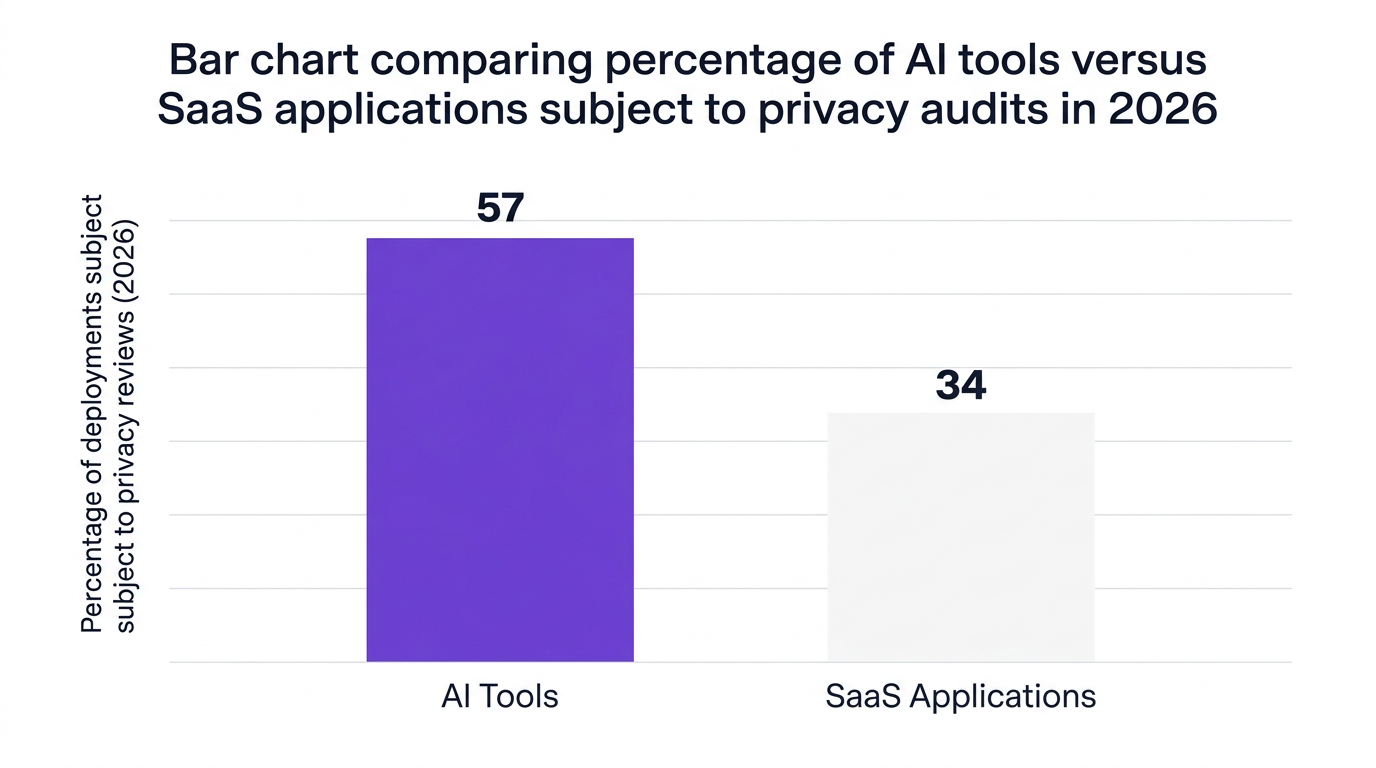
One enterprise IT report found that 57% of AI deployments in large enterprises are subject to regulatory reviews for privacy compliance, compared to 34% of SaaS deployments. That gap highlights how regulators see AI as distinct.

While details vary by region, emerging AI frameworks typically require organizations to:
These expectations go beyond a typical SaaS DPIA. They call for AI governance that can connect data sources, models, and outcomes.
Traditional privacy principles still apply to data privacy and AI, but enforcement is more complex.
AI use cases often evolve quickly. A dataset collected for customer support may later be used to fine-tune a model for product recommendations. Regulators increasingly view such secondary use as requiring fresh consent or strong anonymization.
Enterprises must therefore:
Rights such as access, rectification, deletion, and objection become harder when data is embedded in models.
To honor these rights, organizations should:
A 2026 security consultant pointed out that certifications like SOC 2 Type II help build baseline trust for AI applications, but true compliance requires layered controls for data handling and transparency.
Privacy and AI do not have to be in tension. The organizations that succeed treat ai data protection as a design constraint from the beginning, not an afterthought.
According to a 2026 industry survey, 72% of organizations expect to implement dedicated AI privacy controls by the end of 2026. The following practices are emerging as baseline expectations.

Start with a clear picture of data flows:
This inventory becomes your foundation for SaaS data security, AI governance, and compliance reviews.
For both traditional and privacy AI tooling, the safest data is the data that never leaves your domain.
Enforce:
Recent market analysis shows strong growth in automated, policy-driven minimization and anonymization features, especially in finance and healthcare.
Avoid single monolithic AI environments. Instead:
This approach mirrors zero trust principles, but tuned for ai privacy and security.
Privacy controls are only as strong as your visibility.
Implement:
Demand for real-time compliance monitoring grew roughly 45% among large enterprises in 2026, reflecting how critical continuous visibility has become.
Do not build an entirely separate AI compliance universe.
Instead:
This reduces friction across audit, legal, and security teams.
Real deployments illustrate both the upside of strong data privacy AI practices and the cost of gaps.
A large global bank adopted a cloud management platform with automated AI governance for its risk scoring models and customer support assistants.
By centralizing policies and monitoring across AI tools, the bank:
The key success factor was integrated governance. AI was treated as an extension of cloud and SaaS risk, not a separate experiment.
A multinational healthcare group deployed consistent privacy controls across AI diagnostic tools and their existing SaaS operations.
With unified oversight of AI and SaaS:
These ai privacy examples underscore a recurring theme: automation and visibility matter more than any individual technical point solution.
A useful analogy is air traffic control. Traditional SaaS privacy is like managing a single busy airport. AI and data privacy turn it into a dense multi-airport region. You cannot rely on tower-level coordination alone. You need regional radar, flight plans, and real-time communication to avoid collisions.
Enterprises do not have the luxury of managing SaaS and AI as separate worlds. They need unified AI governance, cost control, and compliance over both.
CloudNuro was built for exactly this convergence. Its platform combines governance-first architecture, automated controls, and deep integration across SaaS and AI environments.
CloudNuro provides a centralized inventory of SaaS and AI applications, including AI assistants embedded inside collaboration platforms, CRM, and productivity suites.
With more than 400 supported integrations, IT and security teams can:
This visibility is foundational to modern privacy and AI programs.
CloudNuro AI Custodian focuses specifically on ai data protection and compliance for AI workloads.
Key capabilities include:
These features help translate ai data privacy policies into enforceable controls that operate at cloud speed.
CloudNuro operates on a SOC 2 Type II certified platform that underpins its SaaS data security and AI management capabilities.
On top of this foundation, CloudNuro adds:
This layered approach aligns with expert guidance that certifications provide baseline trust, while AI-specific controls deliver real assurance.
AI workloads can be expensive and opaque. CloudNuro combines FinOps Services, chargeback, and AI usage analytics to:
This financial lens reinforces governance. Teams are more willing to follow privacy rules when they see a direct connection to budget and value.
AI data privacy introduces risks around training data, model behavior, and inference that traditional SaaS does not. Data can influence models long after it leaves transactional systems, and models may infer sensitive attributes or reveal patterns across datasets.
As a result, organizations must govern not only data at rest and in transit, but also how models are built, accessed, and monitored.
Yes. New risks include model inversion, prompt injection, data poisoning, and unintended memorization of personal data in model weights. These issues are specific to artificial intelligence and data protection, not classic SaaS architectures.
Controls must address these behaviors directly, for example by restricting training data, testing models for leakage, and monitoring inference activity.
Regulators increasingly require organizations to classify AI systems by risk, explain AI-driven decisions, and document datasets and models in more detail than for typical SaaS platforms. Many frameworks also emphasize human oversight for high impact AI decisions.
This means privacy programs must incorporate AI risk assessments, model documentation, and stronger evidence of purpose limitation and consent.
Enterprises should start by extending existing data protection policies to explicitly cover AI uses. This includes updating DPIAs, vendor evaluations, and incident response playbooks to include ai privacy and security considerations.
From there, organizations can implement AI-specific inventories, data lineage tracking, and automated policy enforcement using platforms like CloudNuro to maintain continuous compliance.
SOC 2 Type II provides a baseline assurance that a platform adheres to strong security, availability, and confidentiality practices. For AI, this is a starting point, not the finish line.
Enterprises still need AI-specific controls around training data, model access, and logging. A SOC 2 Type II aligned platform like CloudNuro can make it much easier to implement and prove those controls.
Securing machine learning pipelines requires:
Unified governance platforms that span SaaS, cloud, and AI can help coordinate these controls across teams and technologies.
AI is reshaping how enterprises think about ai data privacy. The move from static records to dynamic, learning systems introduces fresh risks, new regulations, and higher expectations from regulators and customers alike.
Organizations that succeed will treat data privacy and AI as part of a single governance fabric that covers SaaS, cloud, and AI workloads together. They will invest in inventories, lineage, automated controls, and real-time monitoring rather than relying on policy documents alone.
CloudNuro gives CIOs, CISOs, and FinOps leaders a unified platform to manage privacy, security, and cost across both AI and traditional SaaS. To see how CloudNuro can strengthen your AI privacy posture while improving financial discipline, request a personalized demo today.
CloudNuro is a leader in Enterprise SaaS Management Platforms, providing enterprises with unmatched visibility, governance, and cost optimization. Recognized twice in a row in the SaaS Management Platforms category and named a Leader in the SoftwareReviews Data Quadrant, CloudNuro is trusted by global enterprises and government agencies to bring financial discipline to SaaS, cloud, and AI. Trusted by enterprises such as Konica Minolta and Federal Signal, CloudNuro provides centralized SaaS inventory, license optimization, and renewal management along with advanced cost allocation and chargeback, giving IT and Finance leaders the visibility, control, and cost-conscious culture needed to drive financial discipline. Request a Demo | Get Free Savings | Explore Product
Request a no cost, no obligation free assessment —just 15 minutes to savings!
Get StartedAI data privacy is no longer a theoretical concern. As generative models, copilots, and AI assistants move from pilots into production, CIOs and CISOs are realizing that their existing SaaS privacy playbook is not enough.
Traditional SaaS already brought its own data protection challenges. AI multiplies them. Models can learn from sensitive inputs, infer information about individuals, and reuse context across sessions in ways most SaaS applications never could.
This post breaks down how ai data privacy differs from SaaS, what new risks and regulations are emerging, and how governance leaders can adapt their controls without slowing innovation.
On the surface, AI tools often look like any other cloud app: web interface, APIs, and a subscription. Under the hood, privacy behaves very differently.
According to a recent enterprise IT report, 81% of enterprise IT leaders say AI-driven platforms introduce unique privacy risks not present in traditional SaaS applications as of 2026. That perception is grounded in several structural differences.
In SaaS, data is typically used for transactions and reporting. In AI, data also feeds training, fine-tuning, and evaluation pipelines.
That creates two privacy layers:
Once personal data flows into training or fine-tuning, the boundary between "data subject" and "model behavior" blurs. Machine learning and privacy concerns now include data provenance and potential memorization, not just database access.
Traditional SaaS risk is mostly about exposure of stored records. With AI, ai privacy and security concerns extend to what the model can infer.
Models can:
This shifts the focus from database-centric controls to behavioral and inference controls, for example rate limiting sensitive queries or redacting entities before prompts.
Most SaaS applications evolve on a release schedule. AI systems may update more frequently and in some cases continuously.
For privacy teams, that means:
One compliance expert summarized it this way in 2026: AI systems introduce new risks related to data provenance and model explainability, demanding tailored privacy frameworks beyond what traditional SaaS has established.
AI and privacy concerns are not just more of the same. They are different in kind, not only degree. Several risks are unique to data privacy in AI.
According to a 2026 industry study, 63% of enterprises cite enhanced data governance as the top requirement for AI integration compared to SaaS environments. The main drivers are below.
AI workflows often span:
Without end-to-end lineage, it is difficult to:
This is where machine learning data privacy must be more rigorous than traditional SaaS logging.
Many foundation models operate as black boxes. Privacy regulators, however, increasingly expect organizations to explain:
A 2026 industry analyst noted that enterprises must move from siloed SaaS security policies to enterprise-wide, continuous governance models for AI, especially as AI regulations mature.
AI workloads are frequently shared across teams and projects. For example, a single large language model instance may serve customer support, engineering, and HR at once.
Without clear controls over AI workload consumption, organizations risk:
These are ai privacy examples that traditional SaaS access management rarely has to confront.
AI-specific attack vectors include:
These machine learning privacy concerns sit alongside classic SaaS threats like credential theft or misconfigured storage.
Regulatory focus on artificial intelligence and privacy is accelerating. In 2026, multiple jurisdictions introduced or expanded AI-specific laws and guidelines.
One enterprise IT report found that 57% of AI deployments in large enterprises are subject to regulatory reviews for privacy compliance, compared to 34% of SaaS deployments. That gap highlights how regulators see AI as distinct.
While details vary by region, emerging AI frameworks typically require organizations to:
These expectations go beyond a typical SaaS DPIA. They call for AI governance that can connect data sources, models, and outcomes.
Traditional privacy principles still apply to data privacy and AI, but enforcement is more complex.
AI use cases often evolve quickly. A dataset collected for customer support may later be used to fine-tune a model for product recommendations. Regulators increasingly view such secondary use as requiring fresh consent or strong anonymization.
Enterprises must therefore:
Rights such as access, rectification, deletion, and objection become harder when data is embedded in models.
To honor these rights, organizations should:
A 2026 security consultant pointed out that certifications like SOC 2 Type II help build baseline trust for AI applications, but true compliance requires layered controls for data handling and transparency.
Privacy and AI do not have to be in tension. The organizations that succeed treat ai data protection as a design constraint from the beginning, not an afterthought.
According to a 2026 industry survey, 72% of organizations expect to implement dedicated AI privacy controls by the end of 2026. The following practices are emerging as baseline expectations.
Start with a clear picture of data flows:
This inventory becomes your foundation for SaaS data security, AI governance, and compliance reviews.
For both traditional and privacy AI tooling, the safest data is the data that never leaves your domain.
Enforce:
Recent market analysis shows strong growth in automated, policy-driven minimization and anonymization features, especially in finance and healthcare.
Avoid single monolithic AI environments. Instead:
This approach mirrors zero trust principles, but tuned for ai privacy and security.
Privacy controls are only as strong as your visibility.
Implement:
Demand for real-time compliance monitoring grew roughly 45% among large enterprises in 2026, reflecting how critical continuous visibility has become.
Do not build an entirely separate AI compliance universe.
Instead:
This reduces friction across audit, legal, and security teams.
Real deployments illustrate both the upside of strong data privacy AI practices and the cost of gaps.
A large global bank adopted a cloud management platform with automated AI governance for its risk scoring models and customer support assistants.
By centralizing policies and monitoring across AI tools, the bank:
The key success factor was integrated governance. AI was treated as an extension of cloud and SaaS risk, not a separate experiment.
A multinational healthcare group deployed consistent privacy controls across AI diagnostic tools and their existing SaaS operations.
With unified oversight of AI and SaaS:
These ai privacy examples underscore a recurring theme: automation and visibility matter more than any individual technical point solution.
A useful analogy is air traffic control. Traditional SaaS privacy is like managing a single busy airport. AI and data privacy turn it into a dense multi-airport region. You cannot rely on tower-level coordination alone. You need regional radar, flight plans, and real-time communication to avoid collisions.
Enterprises do not have the luxury of managing SaaS and AI as separate worlds. They need unified AI governance, cost control, and compliance over both.
CloudNuro was built for exactly this convergence. Its platform combines governance-first architecture, automated controls, and deep integration across SaaS and AI environments.
CloudNuro provides a centralized inventory of SaaS and AI applications, including AI assistants embedded inside collaboration platforms, CRM, and productivity suites.
With more than 400 supported integrations, IT and security teams can:
This visibility is foundational to modern privacy and AI programs.
CloudNuro AI Custodian focuses specifically on ai data protection and compliance for AI workloads.
Key capabilities include:
These features help translate ai data privacy policies into enforceable controls that operate at cloud speed.
CloudNuro operates on a SOC 2 Type II certified platform that underpins its SaaS data security and AI management capabilities.
On top of this foundation, CloudNuro adds:
This layered approach aligns with expert guidance that certifications provide baseline trust, while AI-specific controls deliver real assurance.
AI workloads can be expensive and opaque. CloudNuro combines FinOps Services, chargeback, and AI usage analytics to:
This financial lens reinforces governance. Teams are more willing to follow privacy rules when they see a direct connection to budget and value.
AI data privacy introduces risks around training data, model behavior, and inference that traditional SaaS does not. Data can influence models long after it leaves transactional systems, and models may infer sensitive attributes or reveal patterns across datasets.
As a result, organizations must govern not only data at rest and in transit, but also how models are built, accessed, and monitored.
Yes. New risks include model inversion, prompt injection, data poisoning, and unintended memorization of personal data in model weights. These issues are specific to artificial intelligence and data protection, not classic SaaS architectures.
Controls must address these behaviors directly, for example by restricting training data, testing models for leakage, and monitoring inference activity.
Regulators increasingly require organizations to classify AI systems by risk, explain AI-driven decisions, and document datasets and models in more detail than for typical SaaS platforms. Many frameworks also emphasize human oversight for high impact AI decisions.
This means privacy programs must incorporate AI risk assessments, model documentation, and stronger evidence of purpose limitation and consent.
Enterprises should start by extending existing data protection policies to explicitly cover AI uses. This includes updating DPIAs, vendor evaluations, and incident response playbooks to include ai privacy and security considerations.
From there, organizations can implement AI-specific inventories, data lineage tracking, and automated policy enforcement using platforms like CloudNuro to maintain continuous compliance.
SOC 2 Type II provides a baseline assurance that a platform adheres to strong security, availability, and confidentiality practices. For AI, this is a starting point, not the finish line.
Enterprises still need AI-specific controls around training data, model access, and logging. A SOC 2 Type II aligned platform like CloudNuro can make it much easier to implement and prove those controls.
Securing machine learning pipelines requires:
Unified governance platforms that span SaaS, cloud, and AI can help coordinate these controls across teams and technologies.
AI is reshaping how enterprises think about ai data privacy. The move from static records to dynamic, learning systems introduces fresh risks, new regulations, and higher expectations from regulators and customers alike.
Organizations that succeed will treat data privacy and AI as part of a single governance fabric that covers SaaS, cloud, and AI workloads together. They will invest in inventories, lineage, automated controls, and real-time monitoring rather than relying on policy documents alone.
CloudNuro gives CIOs, CISOs, and FinOps leaders a unified platform to manage privacy, security, and cost across both AI and traditional SaaS. To see how CloudNuro can strengthen your AI privacy posture while improving financial discipline, request a personalized demo today.
CloudNuro is a leader in Enterprise SaaS Management Platforms, providing enterprises with unmatched visibility, governance, and cost optimization. Recognized twice in a row in the SaaS Management Platforms category and named a Leader in the SoftwareReviews Data Quadrant, CloudNuro is trusted by global enterprises and government agencies to bring financial discipline to SaaS, cloud, and AI. Trusted by enterprises such as Konica Minolta and Federal Signal, CloudNuro provides centralized SaaS inventory, license optimization, and renewal management along with advanced cost allocation and chargeback, giving IT and Finance leaders the visibility, control, and cost-conscious culture needed to drive financial discipline. Request a Demo | Get Free Savings | Explore Product
Request a no cost, no obligation free assessment - just 15 minutes to savings!
Get StartedWe're offering complimentary ServiceNow license assessments to only 25 enterprises this quarter who want to unlock immediate savings without disrupting operations.
Get Free AssessmentGet Started




CloudNuro Corp
1755 Park St. Suite 207
Naperville, IL 60563
Phone : +1-630-277-9470
Email: info@cloudnuro.com




.webp)

Recognized Leader in SaaS Management Platforms by Info-Tech SoftwareReviews



.svg)