

Sign Up
Thank you for Submitting!

A structured SaaS vendor scorecard is no longer a nice-to-have. For enterprise IT, security, and procurement leaders, it is the difference between predictable SaaS operations and an endless cycle of incidents, escalations, and surprise costs.
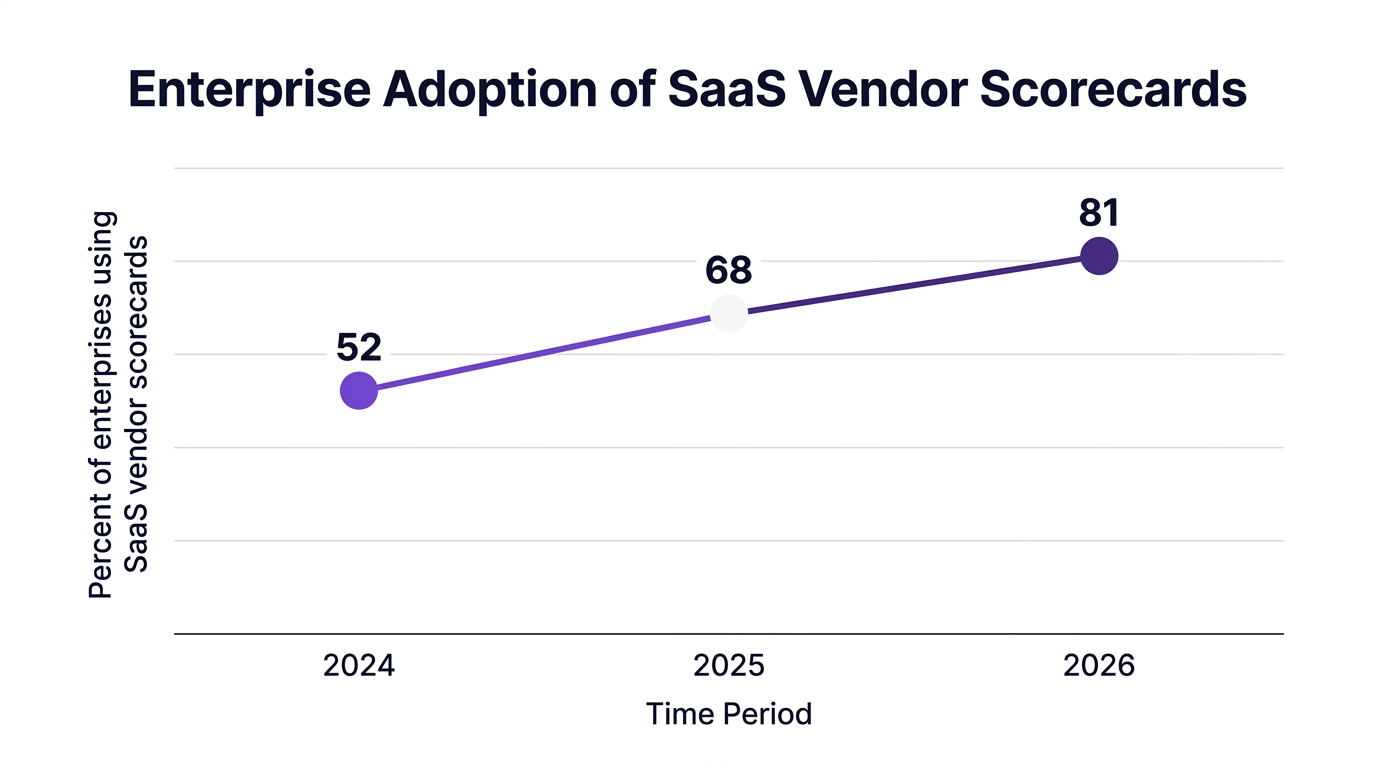
Gartner reports that 92% of enterprises require at least 99.9% uptime SLA for mission-critical SaaS (Gartner, 2026). At the same time, Forrester finds that 81% of IT leaders already use performance scorecards to benchmark vendors on support responsiveness and ticket resolution (Forrester, 2026). The message is clear: you need a standardized, data-driven view of vendor performance across uptime, support, roadmap, and security.
This guide explains how to build a practical SaaS performance scorecard, which metrics matter most, and how platforms like CloudNuro automate the process so your teams can manage risk and cost with confidence.
SaaS estates have exploded in size and complexity. It is common for large enterprises to run hundreds of SaaS applications across functions, regulatory regimes, and geographies. Managing this only through contracts and quarterly business reviews is like flying a plane using last week’s weather report.
A SaaS performance scorecard gives you a single, consistent view of vendor health and risk across four domains:
According to Gartner, automated SaaS scorecard tools and real-time dashboards are now a standard requirement in 61% of Fortune 500 IT procurement departments (Gartner, 2026). Everest Group adds that enterprises using automated SaaS scorecard platforms cut vendor evaluation cycle times by 36% (Everest Group, 2026).
A good analogy is credit scoring. Just as credit bureaus condense complex financial histories into a score that lenders can act on, a vendor management scorecard condenses complex operational data into an objective rating that IT, security, and procurement can understand and act on together.
Not every metric deserves a place on your scorecard. Focus on the ones that have a direct impact on risk, resilience, and cost. Research across Gartner, IDC, and KPMG shows four metric families dominate enterprise scorecards.
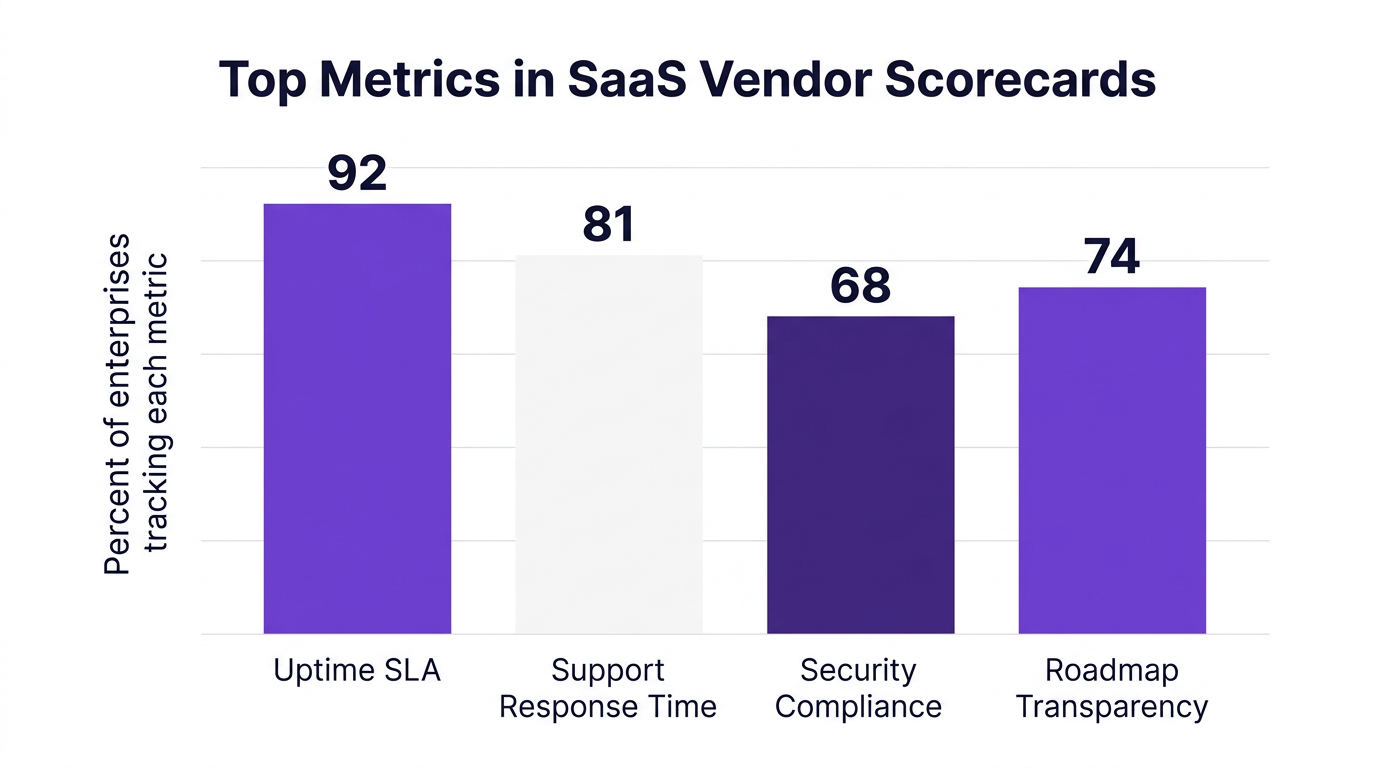
Uptime is the most visible failure point. Downtime halts revenue, disrupts care, or stops public services. 92% of enterprises require at least 99.9% uptime SLA for mission-critical SaaS (Gartner, 2026), and many are moving to 99.95% or 99.99% for core systems.
Key SaaS uptime scorecard metrics:
A strong SaaS uptime monitoring posture uses independent telemetry, not just marketing claims. Track both raw uptime and the vendor’s adherence to notification and incident communication standards.
Support performance often matters more than feature gaps. Deloitte reports that 52% of financial services firms rate support SLA compliance as the top metric in SaaS scorecard evaluations (Deloitte, 2026). Forrester notes that enterprise targets are converging on under 2 hours first response time for high-severity tickets (Forrester, 2026).
Core support quality metrics:
When running a SaaS support comparison, normalize metrics across vendors by severity definition and working hours. Otherwise, you may reward a vendor that simply defines fewer incidents as critical.
Roadmap transparency is the most underestimated dimension. IDC finds 74% of organizations now consider roadmap transparency non-negotiable in SaaS procurement and expect at least quarterly updates (IDC, 2026).
Relevant roadmap metrics for a vendor management scorecard:
This is where SaaS roadmap transparency importance becomes evident. A vendor that shares a clear, credible roadmap and delivers on it consistently reduces long-term platform risk and costly re-platform projects.
Security is now board-level. KPMG reports that 68% of enterprise procurement teams mandate real-time security compliance reporting from SaaS providers (KPMG, 2026). This has pushed many organizations to adopt a SaaS security scorecard framework and SaaS vendor risk assessment scorecard as standard practice.
Key metrics for a SaaS performance scorecard with security compliance:
Security metrics should not live in a silo. Integrate them into the same real-time vendor performance dashboard that tracks uptime and support, so you can see tradeoffs and patterns across domains.
A robust vendor evaluation framework balances objectivity with context. Overly complex scorecards become shelfware, but overly simple ones hide real risk. The goal is an actionable instrument that procurement, IT, and security can use jointly.
Here is a practical five-step approach to build the best SaaS vendor scorecard for uptime tracking and beyond.
Start by confirming your four main categories:
Then weight them. For example, a healthcare EHR integration might assign 40% to security, 30% to uptime, 20% to support, and 10% to roadmap. A marketing analytics tool might tilt more toward roadmap and integrations.
Within each category, pick 3 to 7 scorecard metrics that you can measure consistently across vendors. Examples:
Keep the metric set small enough that your team can maintain it without manual heroics.
Translate raw values into scores, for example:
Document the rules. For example, for uptime:
This prevents subjective adjustments during tense renewals.
This is where many programs fail. Manual data collection using spreadsheets and ad-hoc exports introduces Shadow IT and stale data. Enterprises are increasingly turning to SaaS monitoring tools and SaaS scorecard automation platforms that:
Automation also supports continuous compliance scorecard SaaS tracking instead of once-a-year snapshots.
A scorecard only has value if it drives action. Define concrete thresholds and playbooks:
This creates a predictable, governance-first environment where stakeholders understand how performance impacts renewals, expansion, or exit plans.
Scorecards look good on paper, but how do they perform in high-risk environments like healthcare and financial services?
A major healthcare provider faced recurring outages and audit pressure across dozens of clinical and back-office applications. They implemented a SaaS vendor scorecard healthcare program with automated uptime and security compliance tracking across all critical vendors.
Results after 12 months (Gartner, 2026):
By surfacing performance issues early, the organization could intervene before outages impacted patient care or regulatory deadlines.
A global financial services firm ran core productivity and CRM systems on large SaaS platforms. They used a performance scorecard, supported by CloudNuro AI Custodian, to monitor uptime, support, and license utilization across Microsoft 365 and CRM workloads.
According to Forrester (2026), the program achieved:
This example highlights an often missed benefit: a combined SaaS vendor risk assessment scorecard and license optimization strategy can drive both resilience and cost savings.
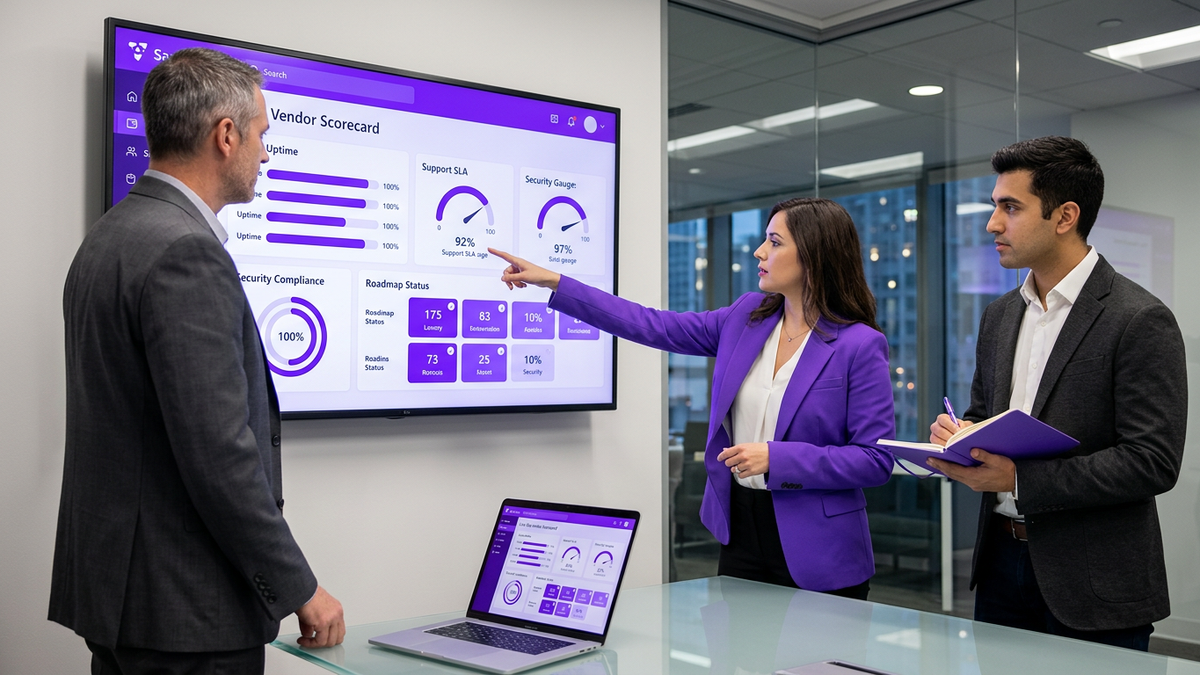
CloudNuro is built to make the SaaS vendor scorecard concept an operational reality instead of a static spreadsheet. Its AI-enabled platform brings together SaaS monitoring tools, compliance automation, and financial governance into a single source of truth.
With CloudNuro AI Custodian, IT and procurement teams can configure a real-time vendor performance dashboard that tracks uptime, incidents, and support metrics across SaaS, PaaS, and IaaS environments.
Key capabilities:
These dashboards align directly with the SaaS performance scorecard categories described earlier and feed live data into your governance workflows.
CloudNuro’s Microsoft 365 Custodian and Salesforce Custodian extend the scorecard into daily operations:
This operational context helps you answer how to measure SaaS vendor performance roadmap alignment and manage tradeoffs between vendor innovation and stability.
Security and compliance are embedded across CloudNuro’s architecture. The platform provides compliance scoring and security risk assessment modules that you can use as a SaaS vendor security scorecard 2026 template.
Capabilities include:
This delivers a true SaaS security scorecard framework and continuous compliance scorecard SaaS approach, rather than annual spreadsheet-based audits.
Finally, CloudNuro’s governance-first architecture supports SaaS scorecard automation across procurement and IT operations:
By codifying rules in the platform, organizations avoid ad-hoc exceptions and create a predictable vendor management model that scales with SaaS growth.
Like any governance tool, scorecards can fail if misused. Two common objections deserve a direct response.
Objection 1: Scorecards are too rigid and will hurt innovation.
This can happen if you use the same strict thresholds for every vendor. The remedy is to tune weightings and acceptable scores by risk tier. For low-risk experimental tools, your SaaS vendor scorecard can emphasize roadmap and integration and relax some uptime criteria.
Objection 2: Vendors will game the metrics.
If you rely solely on vendor-reported metrics, they might optimize for the score instead of genuine performance. Automated telemetry, independent uptime SLA tracking software, and objective security signals reduce this risk. Maintain a small set of qualitative indicators to capture context that numbers miss.
The healthiest programs blend hard metrics with executive judgment, anchored by transparent rules everyone understands.
A strong scorecard tracks metrics across four domains: uptime, support, roadmap, and security. For uptime, focus on 12-month uptime percentage, SLA adherence, and P1 incidents. For support, track first response time, resolution within SLA, and CSAT. For roadmap, monitor update frequency and on-time delivery of committed items. For security, evaluate certifications, vulnerability remediation times, and continuous compliance reporting.
Uptime SLA defines the minimum reliability you can expect, and Gartner notes 92% of enterprises require at least 99.9% for mission-critical workloads. However, selection should not be based only on contractual SLA. Your SaaS uptime scorecard should compare historical uptime data against the SLA, along with incident communication quality. Vendors that consistently outperform SLA with transparent communication are usually safer choices than vendors that promise high SLAs but fail to deliver.
Security scorecards standardize how you assess vendor risk across a large SaaS portfolio. With 68% of procurement teams now mandating real-time security compliance reporting (KPMG, 2026), a SaaS vendor security scorecard 2026 view ensures each vendor meets your baseline controls and certifications. This reduces audit overhead, improves regulatory alignment, and helps security leaders influence renewals and new purchases based on objective data instead of informal questionnaires.
Use a SaaS support comparison that normalizes metrics such as first response time, resolution time, and SLA compliance by severity. Incorporate both quantitative data and qualitative feedback from key user groups. Support is particularly critical in tightly regulated sectors like finance and healthcare, where Deloitte found 52% of firms rank support SLA compliance as their top scorecard metric. Include trend analysis to see if support is improving or degrading over time.
Roadmap transparency indicates whether a vendor is a long-term partner or a short-term workaround. IDC reports 74% of organizations treat roadmap transparency as non-negotiable, with expectations for quarterly updates (IDC, 2026). A transparent roadmap that aligns to your strategy reduces the risk of surprise deprecations and costly migrations. It also helps you answer how to measure SaaS vendor performance roadmap alignment and justify multi-year commitments.
Use a standardized SaaS security scorecard framework that looks at certifications, control coverage, testing frequency, and remediation performance. Compare vendors on the same dimensions: SOC 2 Type II, ISO 27001, CSA Star, encryption practices, data residency, and vulnerability management. Automated platforms like CloudNuro help aggregate this data into a SaaS vendor risk assessment scorecard so you can compare vendors side-by-side with consistent criteria.
A well-designed SaaS vendor scorecard transforms vendor management from a reactive, contract-driven process into a proactive, data-driven discipline. By standardizing metrics for uptime, support, roadmap transparency, and security, you create a common language for IT, security, finance, and procurement to manage risk and cost together.
As enterprise SaaS portfolios grow, manual approaches will not keep up. Platforms like CloudNuro offer automated SaaS performance scorecard capabilities, real-time dashboards, and continuous compliance monitoring so you can operationalize these principles across hundreds of applications.
If you want to turn your SaaS environment into a governed, resilient, and cost-optimized ecosystem, start by defining your scorecard framework, then explore how CloudNuro can automate it across your enterprise.
We are proud to be recognized twice in a row by Gartner in the SaaS Management Platforms and named a Leader in the Info-Tech SoftwareReviews Data Quadrant.
Trusted by global enterprises and government agencies, CloudNuro provides centralized SaaS inventory, license optimization, and renewal management. With a 15-minute setup and measurable results in under 24 hours, CloudNuro gives IT teams a fast path to value.
Request a Demo | Get Free Savings Assessment | Explore Product
Request a no cost, no obligation free assessment —just 15 minutes to savings!
Get StartedA structured SaaS vendor scorecard is no longer a nice-to-have. For enterprise IT, security, and procurement leaders, it is the difference between predictable SaaS operations and an endless cycle of incidents, escalations, and surprise costs.
Gartner reports that 92% of enterprises require at least 99.9% uptime SLA for mission-critical SaaS (Gartner, 2026). At the same time, Forrester finds that 81% of IT leaders already use performance scorecards to benchmark vendors on support responsiveness and ticket resolution (Forrester, 2026). The message is clear: you need a standardized, data-driven view of vendor performance across uptime, support, roadmap, and security.
This guide explains how to build a practical SaaS performance scorecard, which metrics matter most, and how platforms like CloudNuro automate the process so your teams can manage risk and cost with confidence.
SaaS estates have exploded in size and complexity. It is common for large enterprises to run hundreds of SaaS applications across functions, regulatory regimes, and geographies. Managing this only through contracts and quarterly business reviews is like flying a plane using last week’s weather report.
A SaaS performance scorecard gives you a single, consistent view of vendor health and risk across four domains:
According to Gartner, automated SaaS scorecard tools and real-time dashboards are now a standard requirement in 61% of Fortune 500 IT procurement departments (Gartner, 2026). Everest Group adds that enterprises using automated SaaS scorecard platforms cut vendor evaluation cycle times by 36% (Everest Group, 2026).
A good analogy is credit scoring. Just as credit bureaus condense complex financial histories into a score that lenders can act on, a vendor management scorecard condenses complex operational data into an objective rating that IT, security, and procurement can understand and act on together.
Not every metric deserves a place on your scorecard. Focus on the ones that have a direct impact on risk, resilience, and cost. Research across Gartner, IDC, and KPMG shows four metric families dominate enterprise scorecards.
Uptime is the most visible failure point. Downtime halts revenue, disrupts care, or stops public services. 92% of enterprises require at least 99.9% uptime SLA for mission-critical SaaS (Gartner, 2026), and many are moving to 99.95% or 99.99% for core systems.
Key SaaS uptime scorecard metrics:
A strong SaaS uptime monitoring posture uses independent telemetry, not just marketing claims. Track both raw uptime and the vendor’s adherence to notification and incident communication standards.
Support performance often matters more than feature gaps. Deloitte reports that 52% of financial services firms rate support SLA compliance as the top metric in SaaS scorecard evaluations (Deloitte, 2026). Forrester notes that enterprise targets are converging on under 2 hours first response time for high-severity tickets (Forrester, 2026).
Core support quality metrics:
When running a SaaS support comparison, normalize metrics across vendors by severity definition and working hours. Otherwise, you may reward a vendor that simply defines fewer incidents as critical.
Roadmap transparency is the most underestimated dimension. IDC finds 74% of organizations now consider roadmap transparency non-negotiable in SaaS procurement and expect at least quarterly updates (IDC, 2026).
Relevant roadmap metrics for a vendor management scorecard:
This is where SaaS roadmap transparency importance becomes evident. A vendor that shares a clear, credible roadmap and delivers on it consistently reduces long-term platform risk and costly re-platform projects.
Security is now board-level. KPMG reports that 68% of enterprise procurement teams mandate real-time security compliance reporting from SaaS providers (KPMG, 2026). This has pushed many organizations to adopt a SaaS security scorecard framework and SaaS vendor risk assessment scorecard as standard practice.
Key metrics for a SaaS performance scorecard with security compliance:
Security metrics should not live in a silo. Integrate them into the same real-time vendor performance dashboard that tracks uptime and support, so you can see tradeoffs and patterns across domains.
A robust vendor evaluation framework balances objectivity with context. Overly complex scorecards become shelfware, but overly simple ones hide real risk. The goal is an actionable instrument that procurement, IT, and security can use jointly.
Here is a practical five-step approach to build the best SaaS vendor scorecard for uptime tracking and beyond.
Start by confirming your four main categories:
Then weight them. For example, a healthcare EHR integration might assign 40% to security, 30% to uptime, 20% to support, and 10% to roadmap. A marketing analytics tool might tilt more toward roadmap and integrations.
Within each category, pick 3 to 7 scorecard metrics that you can measure consistently across vendors. Examples:
Keep the metric set small enough that your team can maintain it without manual heroics.
Translate raw values into scores, for example:
Document the rules. For example, for uptime:
This prevents subjective adjustments during tense renewals.
This is where many programs fail. Manual data collection using spreadsheets and ad-hoc exports introduces Shadow IT and stale data. Enterprises are increasingly turning to SaaS monitoring tools and SaaS scorecard automation platforms that:
Automation also supports continuous compliance scorecard SaaS tracking instead of once-a-year snapshots.
A scorecard only has value if it drives action. Define concrete thresholds and playbooks:
This creates a predictable, governance-first environment where stakeholders understand how performance impacts renewals, expansion, or exit plans.
Scorecards look good on paper, but how do they perform in high-risk environments like healthcare and financial services?
A major healthcare provider faced recurring outages and audit pressure across dozens of clinical and back-office applications. They implemented a SaaS vendor scorecard healthcare program with automated uptime and security compliance tracking across all critical vendors.
Results after 12 months (Gartner, 2026):
By surfacing performance issues early, the organization could intervene before outages impacted patient care or regulatory deadlines.
A global financial services firm ran core productivity and CRM systems on large SaaS platforms. They used a performance scorecard, supported by CloudNuro AI Custodian, to monitor uptime, support, and license utilization across Microsoft 365 and CRM workloads.
According to Forrester (2026), the program achieved:
This example highlights an often missed benefit: a combined SaaS vendor risk assessment scorecard and license optimization strategy can drive both resilience and cost savings.
CloudNuro is built to make the SaaS vendor scorecard concept an operational reality instead of a static spreadsheet. Its AI-enabled platform brings together SaaS monitoring tools, compliance automation, and financial governance into a single source of truth.
With CloudNuro AI Custodian, IT and procurement teams can configure a real-time vendor performance dashboard that tracks uptime, incidents, and support metrics across SaaS, PaaS, and IaaS environments.
Key capabilities:
These dashboards align directly with the SaaS performance scorecard categories described earlier and feed live data into your governance workflows.
CloudNuro’s Microsoft 365 Custodian and Salesforce Custodian extend the scorecard into daily operations:
This operational context helps you answer how to measure SaaS vendor performance roadmap alignment and manage tradeoffs between vendor innovation and stability.
Security and compliance are embedded across CloudNuro’s architecture. The platform provides compliance scoring and security risk assessment modules that you can use as a SaaS vendor security scorecard 2026 template.
Capabilities include:
This delivers a true SaaS security scorecard framework and continuous compliance scorecard SaaS approach, rather than annual spreadsheet-based audits.
Finally, CloudNuro’s governance-first architecture supports SaaS scorecard automation across procurement and IT operations:
By codifying rules in the platform, organizations avoid ad-hoc exceptions and create a predictable vendor management model that scales with SaaS growth.
Like any governance tool, scorecards can fail if misused. Two common objections deserve a direct response.
Objection 1: Scorecards are too rigid and will hurt innovation.
This can happen if you use the same strict thresholds for every vendor. The remedy is to tune weightings and acceptable scores by risk tier. For low-risk experimental tools, your SaaS vendor scorecard can emphasize roadmap and integration and relax some uptime criteria.
Objection 2: Vendors will game the metrics.
If you rely solely on vendor-reported metrics, they might optimize for the score instead of genuine performance. Automated telemetry, independent uptime SLA tracking software, and objective security signals reduce this risk. Maintain a small set of qualitative indicators to capture context that numbers miss.
The healthiest programs blend hard metrics with executive judgment, anchored by transparent rules everyone understands.
A strong scorecard tracks metrics across four domains: uptime, support, roadmap, and security. For uptime, focus on 12-month uptime percentage, SLA adherence, and P1 incidents. For support, track first response time, resolution within SLA, and CSAT. For roadmap, monitor update frequency and on-time delivery of committed items. For security, evaluate certifications, vulnerability remediation times, and continuous compliance reporting.
Uptime SLA defines the minimum reliability you can expect, and Gartner notes 92% of enterprises require at least 99.9% for mission-critical workloads. However, selection should not be based only on contractual SLA. Your SaaS uptime scorecard should compare historical uptime data against the SLA, along with incident communication quality. Vendors that consistently outperform SLA with transparent communication are usually safer choices than vendors that promise high SLAs but fail to deliver.
Security scorecards standardize how you assess vendor risk across a large SaaS portfolio. With 68% of procurement teams now mandating real-time security compliance reporting (KPMG, 2026), a SaaS vendor security scorecard 2026 view ensures each vendor meets your baseline controls and certifications. This reduces audit overhead, improves regulatory alignment, and helps security leaders influence renewals and new purchases based on objective data instead of informal questionnaires.
Use a SaaS support comparison that normalizes metrics such as first response time, resolution time, and SLA compliance by severity. Incorporate both quantitative data and qualitative feedback from key user groups. Support is particularly critical in tightly regulated sectors like finance and healthcare, where Deloitte found 52% of firms rank support SLA compliance as their top scorecard metric. Include trend analysis to see if support is improving or degrading over time.
Roadmap transparency indicates whether a vendor is a long-term partner or a short-term workaround. IDC reports 74% of organizations treat roadmap transparency as non-negotiable, with expectations for quarterly updates (IDC, 2026). A transparent roadmap that aligns to your strategy reduces the risk of surprise deprecations and costly migrations. It also helps you answer how to measure SaaS vendor performance roadmap alignment and justify multi-year commitments.
Use a standardized SaaS security scorecard framework that looks at certifications, control coverage, testing frequency, and remediation performance. Compare vendors on the same dimensions: SOC 2 Type II, ISO 27001, CSA Star, encryption practices, data residency, and vulnerability management. Automated platforms like CloudNuro help aggregate this data into a SaaS vendor risk assessment scorecard so you can compare vendors side-by-side with consistent criteria.
A well-designed SaaS vendor scorecard transforms vendor management from a reactive, contract-driven process into a proactive, data-driven discipline. By standardizing metrics for uptime, support, roadmap transparency, and security, you create a common language for IT, security, finance, and procurement to manage risk and cost together.
As enterprise SaaS portfolios grow, manual approaches will not keep up. Platforms like CloudNuro offer automated SaaS performance scorecard capabilities, real-time dashboards, and continuous compliance monitoring so you can operationalize these principles across hundreds of applications.
If you want to turn your SaaS environment into a governed, resilient, and cost-optimized ecosystem, start by defining your scorecard framework, then explore how CloudNuro can automate it across your enterprise.
We are proud to be recognized twice in a row by Gartner in the SaaS Management Platforms and named a Leader in the Info-Tech SoftwareReviews Data Quadrant.
Trusted by global enterprises and government agencies, CloudNuro provides centralized SaaS inventory, license optimization, and renewal management. With a 15-minute setup and measurable results in under 24 hours, CloudNuro gives IT teams a fast path to value.
Request a Demo | Get Free Savings Assessment | Explore Product
Request a no cost, no obligation free assessment - just 15 minutes to savings!
Get StartedWe're offering complimentary ServiceNow license assessments to only 25 enterprises this quarter who want to unlock immediate savings without disrupting operations.
Get Free AssessmentGet Started




CloudNuro Corp
1755 Park St. Suite 207
Naperville, IL 60563
Phone : +1-630-277-9470
Email: info@cloudnuro.com



.webp)

Recognized Leader in SaaS Management Platforms by Info-Tech SoftwareReviews


.svg)