

Sign Up
Thank you for Submitting!
AI is now embedded in critical workflows, customer interactions, and decisioning systems across enterprises. Yet AI risk management, transparency, and accountability often lag far behind adoption.
An AI governance maturity model gives executives a structured way to benchmark where they are today, identify capability gaps, and design an actionable roadmap to responsible AI at scale.
According to Gartner in 2026, 80% of Global 2000 companies are expected to embed AI governance maturity assessments into their digital transformation strategies. At the same time, IDC reports that 61% of enterprises in regulated industries already have a formalized AI governance maturity program.
So where does your organization really stand, and what would it take to move up a level?
Maturity models are familiar in cybersecurity and data management. AI now demands the same rigor.
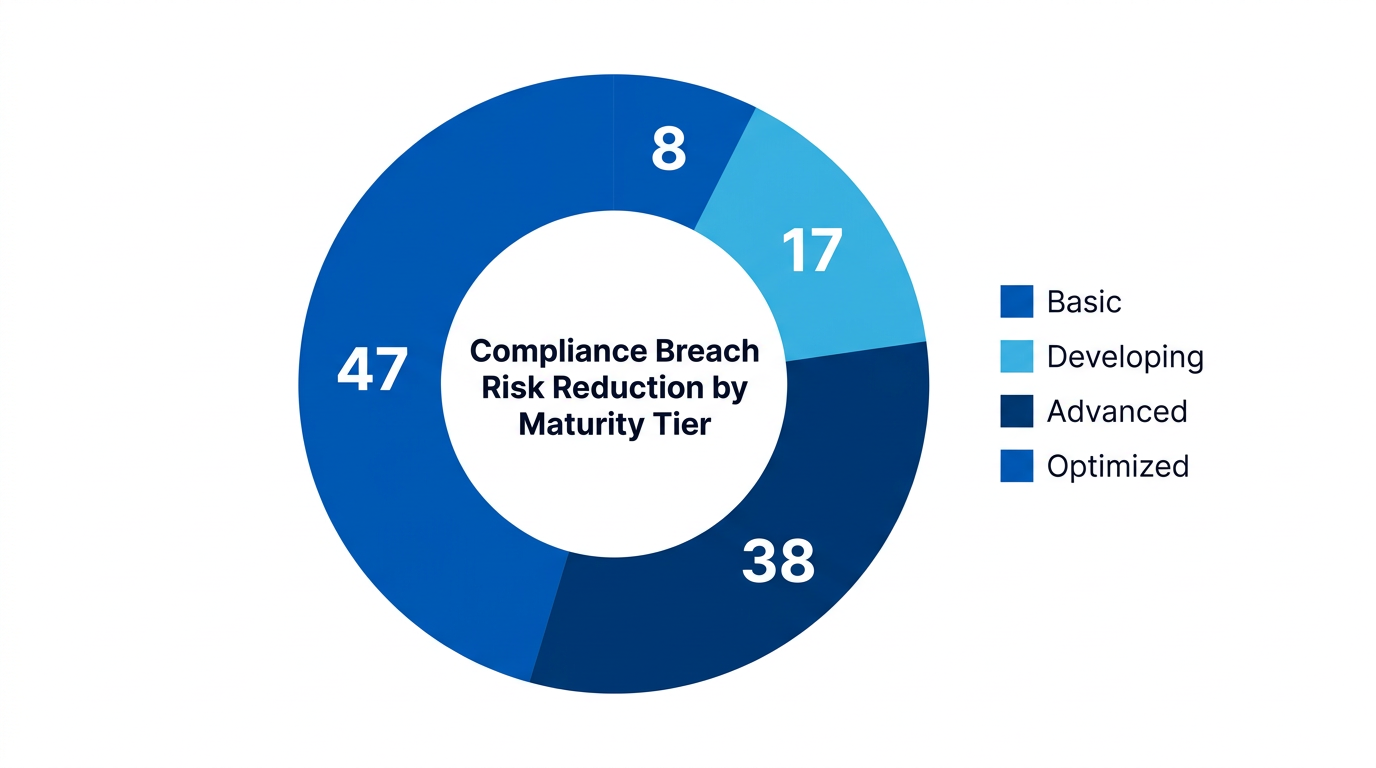
Forrester’s 2026 analysis shows organizations with advanced AI governance maturity reduce compliance breach risk by 47% on average. McKinsey finds that enterprises using structured AI maturity models see a 34% improvement in explainability and transparency KPIs.
This is not only a compliance story. A well-defined enterprise AI governance framework becomes a strategic asset that:
Aligns business, technology, and risk stakeholders around a shared language
Prioritizes investments that raise AI trust, safety, and value realization
Shortens time to production for compliant AI initiatives
Creates defensible documentation for auditors and regulators

Think of the AI governance maturity model like a map for a long-distance journey. You may have a powerful engine and a skilled driver, but without a map you will waste fuel, revisit the same roads, and risk ending up somewhere you never intended.
Below is a practical AI program maturity model tailored to large enterprises. Most organizations will find they are at different levels for different business units, so treat this as a directional guide.
AI projects are scattered, often owned by individual teams or innovators.
There is no centralized AI governance framework, and policies are either non-existent or generic IT guidelines repurposed for AI.
Typical characteristics:
No formal AI risk framework or risk register
Limited or no AI model inventory
Manual, inconsistent model validation and testing
Little documentation of model assumptions, data sources, or limitations
AI used mainly in pilots, POCs, and isolated use cases
Risk posture: High. Compliance is reactive and heavily dependent on individual experts.
Leadership recognizes AI risk as strategic, and early governance structures appear.
An AI maturity assessment may have been done once, often as part of a consulting engagement, but it is not yet operationalized.
Typical characteristics:
Draft AI policies and standards for high-risk use cases
Initial AI model inventory in a spreadsheet or basic repository
Some responsible AI practices, such as bias testing, applied in key projects
Limited automation for monitoring and AI audit process
Manual regulatory reporting for AI-related systems
Risk posture: Medium to high. Governance exists but is fragile, heavily manual, and inconsistently enforced.
AI governance is institutionalized and integrated into core workflows.
AI governance levels, roles, and responsibilities are clearly defined across business, risk, and technology functions.
Typical characteristics:
Formal enterprise AI governance framework aligned to data, security, and compliance standards
Centralized AI model inventory with lifecycle metadata (owner, purpose, risk tier, data sources)
Standardized AI risk framework and approval gates for high-impact use cases
Automated AI monitoring tools for performance, drift, and basic fairness checks
Regular, structured AI audit process with evidence trails
Emerging capabilities for AI regulatory reporting and board-level risk updates
Risk posture: Managed. Issues are identified faster, and AI compliance roadmap items are tracked and executed.
AI governance and responsible AI for business are treated as core strategic capabilities.
Executives use governance metrics as leading indicators of AI trust, value, and resilience.
Typical characteristics:
Continuous AI maturity assessment embedded in governance workflows
Dynamic policies with AI policy automation across the entire model lifecycle
Advanced AI explainability solutions, bias analysis, and scenario testing
Integrated model lifecycle governance, from ideation to retirement
Automated AI regulatory reporting across jurisdictions and business units
Real-time views of AI risk posture, AI trust and safety indicators, and compliance status
Forrester’s 2026 research shows that organizations at the optimized tier see the highest reduction in compliance breach risk. Their analysis indicates risk reduction ranging from 8% at basic levels to 47% at advanced and optimized tiers.
Risk posture: Proactively managed. AI becomes safer to scale, and governance becomes an enabler, not a blocker.
A credible AI governance maturity model must be measurable, repeatable, and explainable to executive stakeholders.
Here is a practical, four-dimensional AI assessment framework you can apply immediately.
Ask:
Do we have documented AI policies covering development, deployment, and use?
Are there clear guidelines for responsible AI practices such as fairness, explainability, and human oversight?
How often are policies updated to reflect new regulations?
Indicators of maturity:
Level 1: Minimal or generic policy coverage
Level 2: Policies exist for specific high-risk domains only
Level 3: Enterprise-wide AI policy framework with defined exceptions process
Level 4: Dynamic policies integrated with AI policy automation and continuous risk feedback
This is where model lifecycle governance becomes critical.
Evaluate:
How do we approve, deploy, monitor, and retire models?
Is there a consistent process across business units?
How are changes tracked and reviewed?
Indicators of maturity:
Level 1: Each team follows its own process, if any
Level 2: Basic stages are defined, but sign-offs and documentation vary
Level 3: Standardized model lifecycle, with risk-based gates and documentation
Level 4: Fully integrated lifecycle with automated approvals, controls, and evidence trails
Deloitte reports that 63% of Chief Data Officers cite lack of automated model monitoring as the main barrier to moving up AI governance levels.
Assess:
Do we have real-time monitoring for performance, drift, and stability?
Are fairness, bias, and explainability monitored regularly?
How do we detect and respond to incidents?
Indicators of maturity:
Level 1: Monitoring is largely manual or ad hoc
Level 2: Key models have dashboards; alerts are limited
Level 3: Automated monitoring for key risks, with documented playbooks
Level 4: Comprehensive AI risk framework, real-time alerts, and continuous control testing
Transparency is the foundation of enterprise AI compliance.
Evaluate:
Can we explain how critical models work, in language business leaders and regulators understand?
Do we maintain detailed documentation of data sources, features, and model assumptions?
Can we generate AI regulatory reporting on demand?
Indicators of maturity:
Level 1: Documentation scattered across teams, often out of date
Level 2: Key models documented; explainability is limited
Level 3: Standard templates and tool-enabled AI transparency practices
Level 4: Integrated explainability, standardized reports, and automated evidence packs
As you assess each dimension, assign a level from 1 to 4. Your overall maturity equals the lowest dimension level, not the average. This avoids the illusion of maturity when one critical capability, such as monitoring or auditability, is lagging.
Progressing in the AI governance maturity model is less about buying tools and more about building the right operating model. Tools amplify good practice; they cannot substitute for it.
Below are pragmatic, stage-specific best practices.
Focus on:
Create a single source of truth for AI models. Start a central AI model inventory with basic fields: owner, purpose, data sources, risk tier, and business impact.
Draft initial AI policies. Cover data usage, consent, model risk tiers, approval requirements, and human oversight.
Identify high-risk use cases. Prioritize governance for models that affect customers, financial decisions, or regulated outcomes.
Counterargument: Some teams fear that formalizing governance will slow experimentation.
Reality: Clear guardrails often increase innovation, because teams understand what is allowed and what requires extra scrutiny.
Focus on:
Institutionalize your AI program maturity model. Make maturity assessment part of annual planning and risk reviews.
Standardize model lifecycle governance. Define consistent gates for design, validation, deployment, and periodic review.
Introduce automated monitoring and alerts. Start with performance and drift, then add fairness and stability metrics.
Embed AI oversight best practices. Clarify who is responsible for approvals, sign-offs, and incident management.
This is typically where a formal AI compliance roadmap and supporting AI governance solutions become necessary.
Focus on:
Unify risk, compliance, and business views. Create dashboards that connect AI risk posture to business KPIs.
Automate AI regulatory reporting. Reduce manual work with prebuilt templates, evidence capture, and logs.
Advance explainability and trust. Use AI explainability solutions that support both technical teams and non-technical stakeholders.
Institutionalize continuous improvement. Refresh your AI assessment framework regularly and tie maturity targets to incentives.
Counterargument: Some leaders assume that top-tier maturity is only necessary for highly regulated industries.
Reality: As AI influences brand reputation, revenue, and strategic decisions, mature governance becomes a competitive differentiator for any enterprise-scale AI adopter.
ExampleAI is purpose-built to help large organizations progress through each stage of the AI governance maturity model.
The platform operationalizes your enterprise AI governance framework so it is not just a policy document, but a living system.
ExampleAI’s policy management suite lets you draft, approve, and update AI policies in one place.
You can:
Define risk tiers and apply them consistently across models
Automate policy checks at key lifecycle stages
Set clear approval workflows for high-risk use cases
This centralization is essential for moving from Level 2 (Defined) to Level 3 (Managed), where AI policy development and enforcement must be consistent across business units.
The platform’s real-time AI monitoring tools provide alerts for performance issues, drift, bias, and compliance violations.
Given that 63% of Chief Data Officers cite lack of monitoring as a maturation barrier, this directly addresses one of the most common blockers.
Key capabilities include:
Automated tracking of model performance and stability
Bias and fairness checks aligned with your AI risk framework
Incident workflows that tie into existing risk systems
These controls strengthen your AI risk posture and support ongoing Enterprise AI Risk Management initiatives.
ExampleAI maintains detailed model lineage and AI audit process logs, from training data through production deployments.
Explainability modules generate tailored, human-readable insights for regulators, auditors, and business leaders.
This supports:
Transparent model decisions and AI trust and safety
Efficient AI regulatory reporting with standardized evidence packs
Stronger AI lifecycle management and defensible decision records
For teams focused on transparency, ExampleAI’s dedicated AI Explainability Tools help you meet the rising expectations highlighted by McKinsey, where 72% of enterprises in 2026 rated explainability as critical in governance solution RFPs.
ExampleAI’s compliance automation features streamline reporting for GDPR, CCPA, and sector-specific regulations.
Executives gain unified views through dashboards that cover:
AI model inventory, ownership, and criticality
Current and target AI governance maturity scores
AI risk posture and outstanding issues
This enables leadership to treat AI governance as a measurable, improvable capability, not a vague risk topic.
For organizations building or refining their AI compliance roadmap, ExampleAI’s AI Governance Solutions and downloadable AI Compliance Checklist provide structured starting points.
Two recent ExampleAI case studies illustrate what progression can look like in practice.
A multinational bank had scattered AI initiatives and a partially defined governance framework.
By implementing ExampleAI’s centralized model inventory and automated reporting, the institution:
Achieved a 53% reduction in regulatory reporting time
Reduced model drift violations by 42% within 12 months
Standardized lifecycle governance for all material models
This moved the organization from Level 2 toward Level 3 in the AI program maturity model, particularly in monitoring, transparency, and reporting.
A global pharmaceutical enterprise sought to elevate its AI governance to support high-stakes clinical and supply chain models.
Using ExampleAI’s policy management, explainability, and compliance modules, it:
Centralized AI policy enforcement across global business units
Implemented real-time audit trails for all regulated models
Cut compliance-related operational costs by 38%
This positioned the organization at the “optimized” level, with continuous AI maturity assessment and integrated AI oversight best practices.

These examples highlight a common pattern: maturity progression requires both operating model change and platform support. Neither alone is sufficient.
Regulators are increasingly expecting documented, measurable AI program maturity.
A 2026 analysis indicates that regulatory requirements now mandate benchmarking and reporting of AI governance maturity in 68% of regulated industries.
At the same time, Gartner reports a steep rise in adoption of AI governance maturity models.
This reinforces why executives should treat maturity assessment as a recurring, board-visible activity, not a one-off project.
An AI governance maturity model is a structured framework that describes the stages of organizational AI readiness, from ad hoc experimentation to optimized, strategic governance.
It helps enterprises benchmark their current capabilities across policy, risk management, lifecycle governance, and transparency, then plan targeted improvements.
Start by defining assessment dimensions such as policy, lifecycle, monitoring, and reporting.
For each dimension, apply clear criteria for Levels 1 through 4, gather evidence from stakeholders, and assign a level based on the lowest consistent practice, not the best example.
Many organizations adopt an AI assessment framework aligned with their existing risk and compliance processes, then refine it over time.
Regulated sectors face higher expectations for AI trust and safety, fairness, and explainability.
A well-defined enterprise AI governance framework helps demonstrate due diligence to regulators, reduces the risk of enforcement actions, and streamlines AI regulatory reporting.
It also supports standardized controls across complex portfolios of AI systems.
Tools that help benchmark maturity typically include:
Centralized AI model inventory capabilities
Policy management and AI policy automation
Real-time AI monitoring tools and risk dashboards
AI audit process support and lineage tracking
AI explainability solutions for technical and non-technical audiences
Platforms such as ExampleAI are designed to combine these into integrated AI governance solutions.
Most large enterprises reassess annually, at minimum.
However, as AI usage grows and regulations evolve, many organizations move to semiannual or continuous maturity tracking, especially in high-risk domains.
The key is to make maturity assessment part of your standing risk management cadence rather than a one-time exercise.
The AI governance maturity model is not a theoretical framework. It is a practical management tool that helps you reduce risk, accelerate AI adoption, and build durable trust.
Organizations that invest in structured AI governance maturity achieve measurable benefits: lower compliance breach risk, faster reporting cycles, and improved transparency for stakeholders.
If you are ready to assess your current maturity and design a path forward, ExampleAI can help you operationalize a robust governance program, from policy to real-time monitoring.
CloudNuro is a leader in Enterprise SaaS Management Platforms, providing enterprises with unmatched visibility, governance, and cost optimization. Recognized twice in a row in the SaaS Management Platforms category and named a Leader in the SoftwareReviews Data Quadrant, CloudNuro is trusted by global enterprises and government agencies to bring financial discipline to SaaS, cloud, and AI.
Trusted by enterprises such as Konica Minolta and Federal Signal, CloudNuro provides centralized SaaS inventory, license optimization, and renewal management along with advanced cost allocation and chargeback, giving IT and Finance leaders the visibility, control, and cost conscious culture needed to drive financial discipline.
Request a no cost, no obligation free assessment —just 15 minutes to savings!
Get StartedAI is now embedded in critical workflows, customer interactions, and decisioning systems across enterprises. Yet AI risk management, transparency, and accountability often lag far behind adoption.
An AI governance maturity model gives executives a structured way to benchmark where they are today, identify capability gaps, and design an actionable roadmap to responsible AI at scale.
According to Gartner in 2026, 80% of Global 2000 companies are expected to embed AI governance maturity assessments into their digital transformation strategies. At the same time, IDC reports that 61% of enterprises in regulated industries already have a formalized AI governance maturity program.
So where does your organization really stand, and what would it take to move up a level?
Maturity models are familiar in cybersecurity and data management. AI now demands the same rigor.
Forrester’s 2026 analysis shows organizations with advanced AI governance maturity reduce compliance breach risk by 47% on average. McKinsey finds that enterprises using structured AI maturity models see a 34% improvement in explainability and transparency KPIs.
This is not only a compliance story. A well-defined enterprise AI governance framework becomes a strategic asset that:
Aligns business, technology, and risk stakeholders around a shared language
Prioritizes investments that raise AI trust, safety, and value realization
Shortens time to production for compliant AI initiatives
Creates defensible documentation for auditors and regulators
Think of the AI governance maturity model like a map for a long-distance journey. You may have a powerful engine and a skilled driver, but without a map you will waste fuel, revisit the same roads, and risk ending up somewhere you never intended.
Below is a practical AI program maturity model tailored to large enterprises. Most organizations will find they are at different levels for different business units, so treat this as a directional guide.
AI projects are scattered, often owned by individual teams or innovators.
There is no centralized AI governance framework, and policies are either non-existent or generic IT guidelines repurposed for AI.
Typical characteristics:
No formal AI risk framework or risk register
Limited or no AI model inventory
Manual, inconsistent model validation and testing
Little documentation of model assumptions, data sources, or limitations
AI used mainly in pilots, POCs, and isolated use cases
Risk posture: High. Compliance is reactive and heavily dependent on individual experts.
Leadership recognizes AI risk as strategic, and early governance structures appear.
An AI maturity assessment may have been done once, often as part of a consulting engagement, but it is not yet operationalized.
Typical characteristics:
Draft AI policies and standards for high-risk use cases
Initial AI model inventory in a spreadsheet or basic repository
Some responsible AI practices, such as bias testing, applied in key projects
Limited automation for monitoring and AI audit process
Manual regulatory reporting for AI-related systems
Risk posture: Medium to high. Governance exists but is fragile, heavily manual, and inconsistently enforced.
AI governance is institutionalized and integrated into core workflows.
AI governance levels, roles, and responsibilities are clearly defined across business, risk, and technology functions.
Typical characteristics:
Formal enterprise AI governance framework aligned to data, security, and compliance standards
Centralized AI model inventory with lifecycle metadata (owner, purpose, risk tier, data sources)
Standardized AI risk framework and approval gates for high-impact use cases
Automated AI monitoring tools for performance, drift, and basic fairness checks
Regular, structured AI audit process with evidence trails
Emerging capabilities for AI regulatory reporting and board-level risk updates
Risk posture: Managed. Issues are identified faster, and AI compliance roadmap items are tracked and executed.
AI governance and responsible AI for business are treated as core strategic capabilities.
Executives use governance metrics as leading indicators of AI trust, value, and resilience.
Typical characteristics:
Continuous AI maturity assessment embedded in governance workflows
Dynamic policies with AI policy automation across the entire model lifecycle
Advanced AI explainability solutions, bias analysis, and scenario testing
Integrated model lifecycle governance, from ideation to retirement
Automated AI regulatory reporting across jurisdictions and business units
Real-time views of AI risk posture, AI trust and safety indicators, and compliance status
Forrester’s 2026 research shows that organizations at the optimized tier see the highest reduction in compliance breach risk. Their analysis indicates risk reduction ranging from 8% at basic levels to 47% at advanced and optimized tiers.
Risk posture: Proactively managed. AI becomes safer to scale, and governance becomes an enabler, not a blocker.
A credible AI governance maturity model must be measurable, repeatable, and explainable to executive stakeholders.
Here is a practical, four-dimensional AI assessment framework you can apply immediately.
Ask:
Do we have documented AI policies covering development, deployment, and use?
Are there clear guidelines for responsible AI practices such as fairness, explainability, and human oversight?
How often are policies updated to reflect new regulations?
Indicators of maturity:
Level 1: Minimal or generic policy coverage
Level 2: Policies exist for specific high-risk domains only
Level 3: Enterprise-wide AI policy framework with defined exceptions process
Level 4: Dynamic policies integrated with AI policy automation and continuous risk feedback
This is where model lifecycle governance becomes critical.
Evaluate:
How do we approve, deploy, monitor, and retire models?
Is there a consistent process across business units?
How are changes tracked and reviewed?
Indicators of maturity:
Level 1: Each team follows its own process, if any
Level 2: Basic stages are defined, but sign-offs and documentation vary
Level 3: Standardized model lifecycle, with risk-based gates and documentation
Level 4: Fully integrated lifecycle with automated approvals, controls, and evidence trails
Deloitte reports that 63% of Chief Data Officers cite lack of automated model monitoring as the main barrier to moving up AI governance levels.
Assess:
Do we have real-time monitoring for performance, drift, and stability?
Are fairness, bias, and explainability monitored regularly?
How do we detect and respond to incidents?
Indicators of maturity:
Level 1: Monitoring is largely manual or ad hoc
Level 2: Key models have dashboards; alerts are limited
Level 3: Automated monitoring for key risks, with documented playbooks
Level 4: Comprehensive AI risk framework, real-time alerts, and continuous control testing
Transparency is the foundation of enterprise AI compliance.
Evaluate:
Can we explain how critical models work, in language business leaders and regulators understand?
Do we maintain detailed documentation of data sources, features, and model assumptions?
Can we generate AI regulatory reporting on demand?
Indicators of maturity:
Level 1: Documentation scattered across teams, often out of date
Level 2: Key models documented; explainability is limited
Level 3: Standard templates and tool-enabled AI transparency practices
Level 4: Integrated explainability, standardized reports, and automated evidence packs
As you assess each dimension, assign a level from 1 to 4. Your overall maturity equals the lowest dimension level, not the average. This avoids the illusion of maturity when one critical capability, such as monitoring or auditability, is lagging.
Progressing in the AI governance maturity model is less about buying tools and more about building the right operating model. Tools amplify good practice; they cannot substitute for it.
Below are pragmatic, stage-specific best practices.
Focus on:
Create a single source of truth for AI models. Start a central AI model inventory with basic fields: owner, purpose, data sources, risk tier, and business impact.
Draft initial AI policies. Cover data usage, consent, model risk tiers, approval requirements, and human oversight.
Identify high-risk use cases. Prioritize governance for models that affect customers, financial decisions, or regulated outcomes.
Counterargument: Some teams fear that formalizing governance will slow experimentation.
Reality: Clear guardrails often increase innovation, because teams understand what is allowed and what requires extra scrutiny.
Focus on:
Institutionalize your AI program maturity model. Make maturity assessment part of annual planning and risk reviews.
Standardize model lifecycle governance. Define consistent gates for design, validation, deployment, and periodic review.
Introduce automated monitoring and alerts. Start with performance and drift, then add fairness and stability metrics.
Embed AI oversight best practices. Clarify who is responsible for approvals, sign-offs, and incident management.
This is typically where a formal AI compliance roadmap and supporting AI governance solutions become necessary.
Focus on:
Unify risk, compliance, and business views. Create dashboards that connect AI risk posture to business KPIs.
Automate AI regulatory reporting. Reduce manual work with prebuilt templates, evidence capture, and logs.
Advance explainability and trust. Use AI explainability solutions that support both technical teams and non-technical stakeholders.
Institutionalize continuous improvement. Refresh your AI assessment framework regularly and tie maturity targets to incentives.
Counterargument: Some leaders assume that top-tier maturity is only necessary for highly regulated industries.
Reality: As AI influences brand reputation, revenue, and strategic decisions, mature governance becomes a competitive differentiator for any enterprise-scale AI adopter.
ExampleAI is purpose-built to help large organizations progress through each stage of the AI governance maturity model.
The platform operationalizes your enterprise AI governance framework so it is not just a policy document, but a living system.
ExampleAI’s policy management suite lets you draft, approve, and update AI policies in one place.
You can:
Define risk tiers and apply them consistently across models
Automate policy checks at key lifecycle stages
Set clear approval workflows for high-risk use cases
This centralization is essential for moving from Level 2 (Defined) to Level 3 (Managed), where AI policy development and enforcement must be consistent across business units.
The platform’s real-time AI monitoring tools provide alerts for performance issues, drift, bias, and compliance violations.
Given that 63% of Chief Data Officers cite lack of monitoring as a maturation barrier, this directly addresses one of the most common blockers.
Key capabilities include:
Automated tracking of model performance and stability
Bias and fairness checks aligned with your AI risk framework
Incident workflows that tie into existing risk systems
These controls strengthen your AI risk posture and support ongoing Enterprise AI Risk Management initiatives.
ExampleAI maintains detailed model lineage and AI audit process logs, from training data through production deployments.
Explainability modules generate tailored, human-readable insights for regulators, auditors, and business leaders.
This supports:
Transparent model decisions and AI trust and safety
Efficient AI regulatory reporting with standardized evidence packs
Stronger AI lifecycle management and defensible decision records
For teams focused on transparency, ExampleAI’s dedicated AI Explainability Tools help you meet the rising expectations highlighted by McKinsey, where 72% of enterprises in 2026 rated explainability as critical in governance solution RFPs.
ExampleAI’s compliance automation features streamline reporting for GDPR, CCPA, and sector-specific regulations.
Executives gain unified views through dashboards that cover:
AI model inventory, ownership, and criticality
Current and target AI governance maturity scores
AI risk posture and outstanding issues
This enables leadership to treat AI governance as a measurable, improvable capability, not a vague risk topic.
For organizations building or refining their AI compliance roadmap, ExampleAI’s AI Governance Solutions and downloadable AI Compliance Checklist provide structured starting points.
Two recent ExampleAI case studies illustrate what progression can look like in practice.
A multinational bank had scattered AI initiatives and a partially defined governance framework.
By implementing ExampleAI’s centralized model inventory and automated reporting, the institution:
Achieved a 53% reduction in regulatory reporting time
Reduced model drift violations by 42% within 12 months
Standardized lifecycle governance for all material models
This moved the organization from Level 2 toward Level 3 in the AI program maturity model, particularly in monitoring, transparency, and reporting.
A global pharmaceutical enterprise sought to elevate its AI governance to support high-stakes clinical and supply chain models.
Using ExampleAI’s policy management, explainability, and compliance modules, it:
Centralized AI policy enforcement across global business units
Implemented real-time audit trails for all regulated models
Cut compliance-related operational costs by 38%
This positioned the organization at the “optimized” level, with continuous AI maturity assessment and integrated AI oversight best practices.
These examples highlight a common pattern: maturity progression requires both operating model change and platform support. Neither alone is sufficient.
Regulators are increasingly expecting documented, measurable AI program maturity.
A 2026 analysis indicates that regulatory requirements now mandate benchmarking and reporting of AI governance maturity in 68% of regulated industries.
At the same time, Gartner reports a steep rise in adoption of AI governance maturity models.
This reinforces why executives should treat maturity assessment as a recurring, board-visible activity, not a one-off project.
An AI governance maturity model is a structured framework that describes the stages of organizational AI readiness, from ad hoc experimentation to optimized, strategic governance.
It helps enterprises benchmark their current capabilities across policy, risk management, lifecycle governance, and transparency, then plan targeted improvements.
Start by defining assessment dimensions such as policy, lifecycle, monitoring, and reporting.
For each dimension, apply clear criteria for Levels 1 through 4, gather evidence from stakeholders, and assign a level based on the lowest consistent practice, not the best example.
Many organizations adopt an AI assessment framework aligned with their existing risk and compliance processes, then refine it over time.
Regulated sectors face higher expectations for AI trust and safety, fairness, and explainability.
A well-defined enterprise AI governance framework helps demonstrate due diligence to regulators, reduces the risk of enforcement actions, and streamlines AI regulatory reporting.
It also supports standardized controls across complex portfolios of AI systems.
Tools that help benchmark maturity typically include:
Centralized AI model inventory capabilities
Policy management and AI policy automation
Real-time AI monitoring tools and risk dashboards
AI audit process support and lineage tracking
AI explainability solutions for technical and non-technical audiences
Platforms such as ExampleAI are designed to combine these into integrated AI governance solutions.
Most large enterprises reassess annually, at minimum.
However, as AI usage grows and regulations evolve, many organizations move to semiannual or continuous maturity tracking, especially in high-risk domains.
The key is to make maturity assessment part of your standing risk management cadence rather than a one-time exercise.
The AI governance maturity model is not a theoretical framework. It is a practical management tool that helps you reduce risk, accelerate AI adoption, and build durable trust.
Organizations that invest in structured AI governance maturity achieve measurable benefits: lower compliance breach risk, faster reporting cycles, and improved transparency for stakeholders.
If you are ready to assess your current maturity and design a path forward, ExampleAI can help you operationalize a robust governance program, from policy to real-time monitoring.
CloudNuro is a leader in Enterprise SaaS Management Platforms, providing enterprises with unmatched visibility, governance, and cost optimization. Recognized twice in a row in the SaaS Management Platforms category and named a Leader in the SoftwareReviews Data Quadrant, CloudNuro is trusted by global enterprises and government agencies to bring financial discipline to SaaS, cloud, and AI.
Trusted by enterprises such as Konica Minolta and Federal Signal, CloudNuro provides centralized SaaS inventory, license optimization, and renewal management along with advanced cost allocation and chargeback, giving IT and Finance leaders the visibility, control, and cost conscious culture needed to drive financial discipline.
Request a no cost, no obligation free assessment - just 15 minutes to savings!
Get StartedWe're offering complimentary ServiceNow license assessments to only 25 enterprises this quarter who want to unlock immediate savings without disrupting operations.
Get Free AssessmentGet Started




CloudNuro Corp
1755 Park St. Suite 207
Naperville, IL 60563
Phone : +1-630-277-9470
Email: info@cloudnuro.com





.webp)

Recognized Leader in SaaS Management Platforms by Info-Tech SoftwareReviews


.svg)