

Sign Up
Thank you for Submitting!

Sizing a workload based solely on raw data volume is a fundamental flaw. Inefficient queries against a small dataset often cost orders of magnitude more than highly optimized routines running against massive volumes. The challenge for enterprise IT and finance teams is predicting exact compute needs before the monthly bill arrives.
CloudNuro delivers automated cloud operations management and FinOps Services that empower organizations to right-size their capacity and bypass costly overprovisioning. For organizations managing complex analytics platforms, understanding the invisible consumption traps is the first step toward true financial discipline.
Analytics deployments scale on compute intensity rather than mere storage footprint. An organization might hold terabytes of historical tables but only run scheduled summaries. Conversely, a small subset of interactive dashboards recalculating complex measures every time a user applies a filter can quickly consume available resources. Sizing models built exclusively around storage metrics inevitably inflate the required tier estimate.
Strategic capacity forecasting avoids this error by mapping the true computational cost of individual queries. The Cloud Commitment Optimization engine continuously ingests telemetry for each specific capacity tier to identify idle or underutilized compute resources and execute targeted downshifts. By actively monitoring these queries, organizations align their requested capacity units with empirical execution data instead of generic storage volumes.
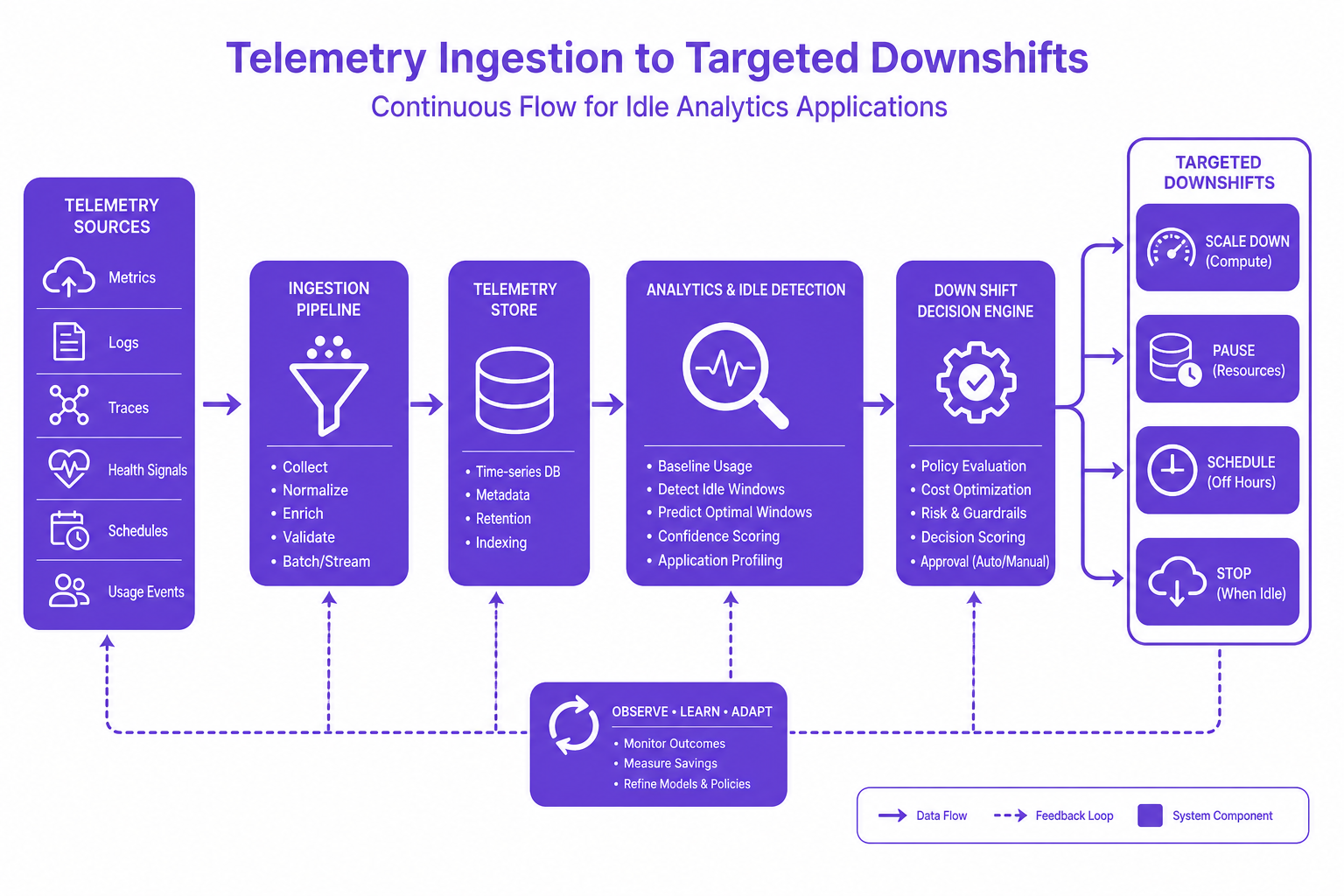
Automating deployment rightsizing resulted in a 36 percent reduction in annual analytics platform spend and a 45 percent drop in unused capacity hours for a large organization. This outcome demonstrates that deploying continuous measurement replaces initial guesswork with measurable precision.
Relying purely on estimator calculations for lower compute tiers often backfires by emphasizing compute availability without calculating the severe financial impact of individual viewer licenses. Technical teams frequently configure a fabric capacity calculator focused entirely on processing requirements, missing the broader software access cost.
When using compute tiers between F2 and F32, each viewer consuming content requires a dedicated user license costing approximately $14 per month. Opting for lower capacity tiers with 200 users inherently generates approximately $2,800 per month in additional licensing fees.
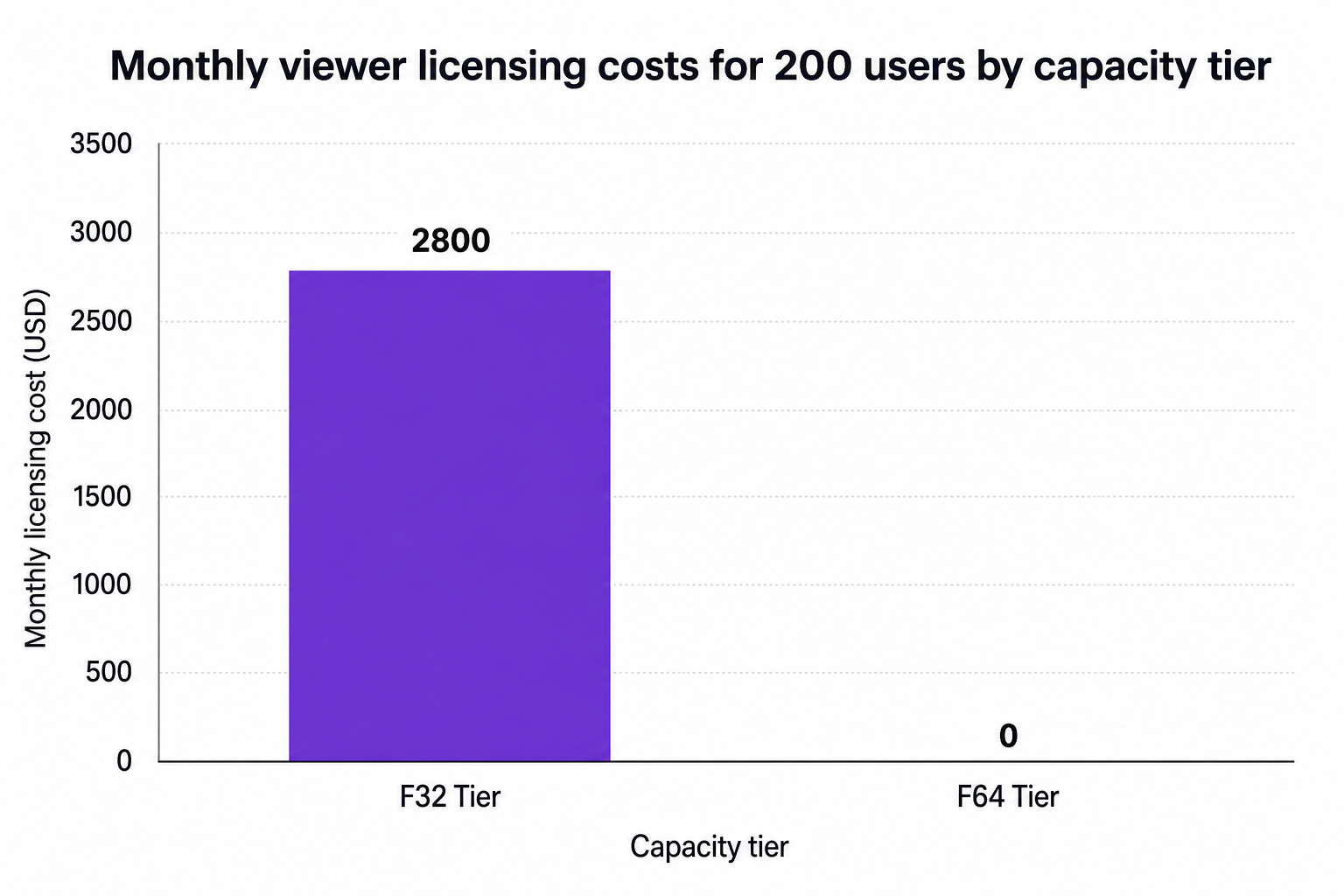
Fabric SKU optimization tools naturally output compute suggestions based on query loads alone. The total cost of ownership shifts rapidly when human reader counts grow. Accurate sizing strategies build user expansion logic directly into the model to identify the exact threshold where scaling up to a larger premium tier becomes cheaper than leasing hundreds of individual user passes.
Basing capacity limits on a single morning refresh peak inevitably forces organizations to pay continuous premium rates for a large tier that sits almost entirely dormant for the rest of the working day. Many deployments procure permanent capacity to handle an isolated 45-minute processing window at eight o'clock in the morning.
Organizations are systematically shifting to a sustained consumption evaluation model over short-burst sizing to better accommodate the rolling smoothing and bursting windows inherent to modern data platforms. Sustained workload modeling smooths these heavy processing spikes over continuous background compute cycles.
However, borrowing compute strictly from the future introduces a performance cliff. Around 10 minutes of borrowed future capacity results in an approximate 20-second delay on every interactive request, including dashboards and ad-hoc queries. Interactive and background queries start getting rejected entirely when a workload borrows beyond 60 minutes of future capacity. To prevent the penalty of excessive smoothing debt, the Unified Cloud Custodian provides real-time proactive alerting on capacity thresholds before performance throttling degrades the end-user experience.
Unmanaged workspaces act as silent resource drains. Without structured revocation protocols, departed employees or concluding projects leave lingering queries, outdated integrations, and orphaned artifacts constantly refreshing in the background.
CloudNuro FinOps Services counteracts the invisible consumption trap by utilizing the Cloud Commitment Optimization engine to identify and automatically downshift idle artifacts and unmanaged scheduled refreshes. Automated workflows securely attach and revoke workspace access in direct alignment with HR lifecycle events to prevent orphaned resources and lingering licensing fees.
Controlling the lifecycle of a deployed model is critical because penalties apply when boundaries are breached. Capacity overage is billed at three times the normal pay-as-you-go capacity unit rate when consumption exceeds the planned compute tier. Maintaining an overage limit around one-third of daily capacity unit hours is the optimal technical threshold before scaling to a larger permanent tier becomes cheaper.
Dedicated financial operations teams are increasingly taking ownership of capacity tier tuning to prevent operational staff from automatically jumping to a larger, more expensive tier at the first sign of query throttling. Developers and operational workers prioritize uptime and speed, making them naturally inclined to over-procure compute to solve performance bottlenecks.
Quarterly automated right-sizing operations are replacing one-off deployment estimations as enterprise data workloads continuously shift and grow over time. CloudNuro bridges the gap between raw compute estimates and actual business expense by embedding detailed Chargeback modules to align cross-environment usage directly to specific department budgets.
The platform calculates precise department-level usage based on applied metadata tags, workspaces, and individual users to automatically generate detailed showback statements. Chargeback modules dynamically allocate costs across specific business units or project codes so finance teams can trace capacity consumption directly to budget owners.
A unified operations platform connects pure application telemetry to definitive business logic. The unified deployment requires only a 15-minute setup to provide a single pane of glass view across SaaS applications, public cloud infrastructure, and AI workloads.
Proactive overage alerts can be configured based on predefined budgets, custom usage thresholds, or automated anomaly detection to prevent runaway query costs. Taking a proactive stance directly alters the financial trajectory of large analytics deployments.
A large enterprise managed capacity units and achieved a 25 percent reduction in idle capacity to generate immediate annual cost avoidance. Integrating the unified platform with an existing analytics environment achieved a 36 percent reduction in overage costs and fully automated chargeback across 27 departments. A healthcare provider achieved real-time monitoring and spend optimization to improve cost accountability and shorten their quarter-close process by 30 percent.
It is a capacity forecasting tool utilized by IT architects to approximate required compute units and financial costs for analytical workloads. It calculates expected baseline models by evaluating variables such as storage quantity, expected query concurrency, and data refresh cadences to recommend a sustained tier limit.
Organizations bypass overprovisioning by continuously mapping empirical execution data against the predictive model. Employing an automated FinOps platform actively uncovers unused infrastructure, identifies idle query loads, highlights bloated user permissions, and downshifts unused tiers to reflect reality rather than worst-case projections.
The most prevalent errors stem from treating raw data mass as the primary sizing variable rather than focusing on compute intensity. Additional traps include overlooking the individual recurring cost of user licenses on lower tiers, and buying a permanent compute bracket solely to accommodate a brief morning data refresh peak.
Acquiring excess resources locks an enterprise into paying an uninterrupted premium rate for capabilities that remain entirely inactive most of the day. Without strict consumption limits, spontaneous workloads occasionally trigger capacity overages which are billed at three times the standard operational rate.
Platforms focused centrally on detailed financial operations provide the visibility needed for targeted rightsizing. Automated mapping engines and embedded continuous telemetry monitors equip technology and finance teams with precise showback reports, usage anomaly indicators, and clear anomaly alerting.
Predicting enterprise cloud demands requires precise alignment of application telemetry with financial oversight. Raw data demands will only grow, but financial waste is optional. By neutralizing these five distinct sizing traps, enterprises can build data platforms around verifiable metrics rather than cautious estimates.
About CloudNuro
CloudNuro is a leader in Enterprise AI Adoption Management, providing enterprises with unmatched visibility, governance, and cost optimization. Recognized twice in a row in the SaaS Management Platforms category and named a Leader in the SoftwareReviews Data Quadrant, CloudNuro is trusted by global enterprises and government agencies to bring financial discipline to SaaS, cloud, and AI. Trusted by enterprises such as Konica Minolta and Federal Signal, CloudNuro provides centralized SaaS inventory, license optimization, and renewal management along with advanced cost allocation and chargeback, giving IT and Finance leaders the visibility, control, and cost-conscious culture needed to drive financial discipline.
Request a no cost, no obligation free assessment —just 15 minutes to savings!
Get StartedSizing a workload based solely on raw data volume is a fundamental flaw. Inefficient queries against a small dataset often cost orders of magnitude more than highly optimized routines running against massive volumes. The challenge for enterprise IT and finance teams is predicting exact compute needs before the monthly bill arrives.
CloudNuro delivers automated cloud operations management and FinOps Services that empower organizations to right-size their capacity and bypass costly overprovisioning. For organizations managing complex analytics platforms, understanding the invisible consumption traps is the first step toward true financial discipline.
Analytics deployments scale on compute intensity rather than mere storage footprint. An organization might hold terabytes of historical tables but only run scheduled summaries. Conversely, a small subset of interactive dashboards recalculating complex measures every time a user applies a filter can quickly consume available resources. Sizing models built exclusively around storage metrics inevitably inflate the required tier estimate.
Strategic capacity forecasting avoids this error by mapping the true computational cost of individual queries. The Cloud Commitment Optimization engine continuously ingests telemetry for each specific capacity tier to identify idle or underutilized compute resources and execute targeted downshifts. By actively monitoring these queries, organizations align their requested capacity units with empirical execution data instead of generic storage volumes.
Automating deployment rightsizing resulted in a 36 percent reduction in annual analytics platform spend and a 45 percent drop in unused capacity hours for a large organization. This outcome demonstrates that deploying continuous measurement replaces initial guesswork with measurable precision.
Relying purely on estimator calculations for lower compute tiers often backfires by emphasizing compute availability without calculating the severe financial impact of individual viewer licenses. Technical teams frequently configure a fabric capacity calculator focused entirely on processing requirements, missing the broader software access cost.
When using compute tiers between F2 and F32, each viewer consuming content requires a dedicated user license costing approximately $14 per month. Opting for lower capacity tiers with 200 users inherently generates approximately $2,800 per month in additional licensing fees.
Fabric SKU optimization tools naturally output compute suggestions based on query loads alone. The total cost of ownership shifts rapidly when human reader counts grow. Accurate sizing strategies build user expansion logic directly into the model to identify the exact threshold where scaling up to a larger premium tier becomes cheaper than leasing hundreds of individual user passes.
Basing capacity limits on a single morning refresh peak inevitably forces organizations to pay continuous premium rates for a large tier that sits almost entirely dormant for the rest of the working day. Many deployments procure permanent capacity to handle an isolated 45-minute processing window at eight o'clock in the morning.
Organizations are systematically shifting to a sustained consumption evaluation model over short-burst sizing to better accommodate the rolling smoothing and bursting windows inherent to modern data platforms. Sustained workload modeling smooths these heavy processing spikes over continuous background compute cycles.
However, borrowing compute strictly from the future introduces a performance cliff. Around 10 minutes of borrowed future capacity results in an approximate 20-second delay on every interactive request, including dashboards and ad-hoc queries. Interactive and background queries start getting rejected entirely when a workload borrows beyond 60 minutes of future capacity. To prevent the penalty of excessive smoothing debt, the Unified Cloud Custodian provides real-time proactive alerting on capacity thresholds before performance throttling degrades the end-user experience.
Unmanaged workspaces act as silent resource drains. Without structured revocation protocols, departed employees or concluding projects leave lingering queries, outdated integrations, and orphaned artifacts constantly refreshing in the background.
CloudNuro FinOps Services counteracts the invisible consumption trap by utilizing the Cloud Commitment Optimization engine to identify and automatically downshift idle artifacts and unmanaged scheduled refreshes. Automated workflows securely attach and revoke workspace access in direct alignment with HR lifecycle events to prevent orphaned resources and lingering licensing fees.
Controlling the lifecycle of a deployed model is critical because penalties apply when boundaries are breached. Capacity overage is billed at three times the normal pay-as-you-go capacity unit rate when consumption exceeds the planned compute tier. Maintaining an overage limit around one-third of daily capacity unit hours is the optimal technical threshold before scaling to a larger permanent tier becomes cheaper.
Dedicated financial operations teams are increasingly taking ownership of capacity tier tuning to prevent operational staff from automatically jumping to a larger, more expensive tier at the first sign of query throttling. Developers and operational workers prioritize uptime and speed, making them naturally inclined to over-procure compute to solve performance bottlenecks.
Quarterly automated right-sizing operations are replacing one-off deployment estimations as enterprise data workloads continuously shift and grow over time. CloudNuro bridges the gap between raw compute estimates and actual business expense by embedding detailed Chargeback modules to align cross-environment usage directly to specific department budgets.
The platform calculates precise department-level usage based on applied metadata tags, workspaces, and individual users to automatically generate detailed showback statements. Chargeback modules dynamically allocate costs across specific business units or project codes so finance teams can trace capacity consumption directly to budget owners.
A unified operations platform connects pure application telemetry to definitive business logic. The unified deployment requires only a 15-minute setup to provide a single pane of glass view across SaaS applications, public cloud infrastructure, and AI workloads.
Proactive overage alerts can be configured based on predefined budgets, custom usage thresholds, or automated anomaly detection to prevent runaway query costs. Taking a proactive stance directly alters the financial trajectory of large analytics deployments.
A large enterprise managed capacity units and achieved a 25 percent reduction in idle capacity to generate immediate annual cost avoidance. Integrating the unified platform with an existing analytics environment achieved a 36 percent reduction in overage costs and fully automated chargeback across 27 departments. A healthcare provider achieved real-time monitoring and spend optimization to improve cost accountability and shorten their quarter-close process by 30 percent.
It is a capacity forecasting tool utilized by IT architects to approximate required compute units and financial costs for analytical workloads. It calculates expected baseline models by evaluating variables such as storage quantity, expected query concurrency, and data refresh cadences to recommend a sustained tier limit.
Organizations bypass overprovisioning by continuously mapping empirical execution data against the predictive model. Employing an automated FinOps platform actively uncovers unused infrastructure, identifies idle query loads, highlights bloated user permissions, and downshifts unused tiers to reflect reality rather than worst-case projections.
The most prevalent errors stem from treating raw data mass as the primary sizing variable rather than focusing on compute intensity. Additional traps include overlooking the individual recurring cost of user licenses on lower tiers, and buying a permanent compute bracket solely to accommodate a brief morning data refresh peak.
Acquiring excess resources locks an enterprise into paying an uninterrupted premium rate for capabilities that remain entirely inactive most of the day. Without strict consumption limits, spontaneous workloads occasionally trigger capacity overages which are billed at three times the standard operational rate.
Platforms focused centrally on detailed financial operations provide the visibility needed for targeted rightsizing. Automated mapping engines and embedded continuous telemetry monitors equip technology and finance teams with precise showback reports, usage anomaly indicators, and clear anomaly alerting.
Predicting enterprise cloud demands requires precise alignment of application telemetry with financial oversight. Raw data demands will only grow, but financial waste is optional. By neutralizing these five distinct sizing traps, enterprises can build data platforms around verifiable metrics rather than cautious estimates.
About CloudNuro
CloudNuro is a leader in Enterprise AI Adoption Management, providing enterprises with unmatched visibility, governance, and cost optimization. Recognized twice in a row in the SaaS Management Platforms category and named a Leader in the SoftwareReviews Data Quadrant, CloudNuro is trusted by global enterprises and government agencies to bring financial discipline to SaaS, cloud, and AI. Trusted by enterprises such as Konica Minolta and Federal Signal, CloudNuro provides centralized SaaS inventory, license optimization, and renewal management along with advanced cost allocation and chargeback, giving IT and Finance leaders the visibility, control, and cost-conscious culture needed to drive financial discipline.
Request a no cost, no obligation free assessment - just 15 minutes to savings!
Get StartedWe're offering complimentary ServiceNow license assessments to only 25 enterprises this quarter who want to unlock immediate savings without disrupting operations.
Get Free AssessmentGet Started




CloudNuro Corp
1755 Park St. Suite 207
Naperville, IL 60563
Phone : +1-630-277-9470
Email: info@cloudnuro.com





.webp)

Recognized Leader in SaaS Management Platforms by Info-Tech SoftwareReviews



.svg)