
Sign Up
Thank you for Submitting!
As demonstrated by forward-thinking organizations and shared through the FinOps Foundation's community stories, this case reflects how data-driven anomaly detection and FinOps automation can transform cost visibility into proactive financial governance across multi-cloud ecosystems.
In the high-velocity world of cloud operations, even a few hours of unnoticed overspend can cascade into massive budget overruns. For one global financial exchange, cloud adoption brought unparalleled agility but also a new challenge: detecting and responding to spend anomalies quickly enough to protect margins. As cloud consumption surged across hundreds of applications and services, the FinOps team found themselves buried under daily dashboards, manually investigating spikes that often turned out to be false positives. By the time the root cause was found, the cost impact was already material.
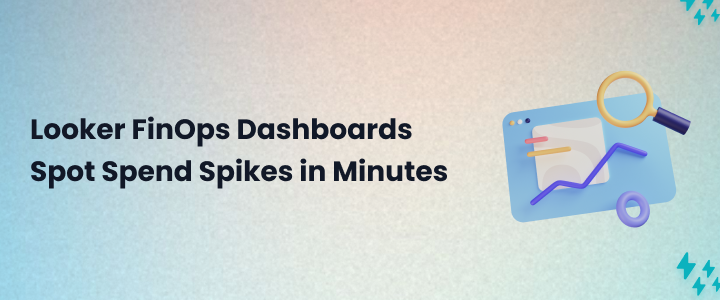
To solve this, the team set out to automate what was once a tedious, reactive process, transforming anomaly detection from a manual chase into a predictive FinOps practice. Their journey led them to FinOps anomaly detection with Looker, a scalable BI framework built atop BigQuery Machine Learning (BigQuery ML). This model, based on ARIMA+ forecasting, analyzed a full year of billing history and identified deviations at the project, product, and application levels within seconds. Suddenly, cloud cost spikes that once took hours to uncover surfaced instantly, complete with contextual drill-downs, service-level insights, and automated alerts.
What made this transformation remarkable wasn't just the technology but the cultural shift it enabled. Engineers no longer saw anomaly detection as a financial control; it became a shared safeguard for operational excellence. By integrating forecasting, alerting, and deep-dive root-cause analysis directly into Looker dashboards, the FinOps team built a system that identified, explained, and acted on anomalies within minutes.
This case study showcases how anomaly detection, powered by Looker and GCP, became the FinOps nerve center for a global enterprise, detecting cost anomalies, catching misconfigurations, and even flagging early security signals before they reached finance. It demonstrates how FinOps anomaly detection in Looker evolved from a cost-governance tool into a business-resilience enabler.
The financial enterprise's FinOps journey with Looker anomaly detection began with a single objective, to detect spend anomalies before they created financial surprises. What started as an analyst-driven reporting effort matured into an automated, machine-learning-powered engine that continuously surfaced deviations within minutes, not hours.
At the beginning, daily reports were the FinOps team's primary defense. Analysts manually reviewed billing exports, tagged outliers, and investigated spikes across hundreds of GCP projects. The problem wasn't data; it was time. With delays in detection and limited visibility across products, cost overruns often went unnoticed until finance reviews.
Key actions and insights
This phase proved one thing human vigilance could not scale with modern cloud velocity.
To move beyond static rules, the team turned to FinOps anomaly detection with Looker and BigQuery ML. Using ARIMA+ forecasting models, they trained algorithms on twelve months of cost and usage data to predict "expected" spend and flag deviations exceeding statistical confidence thresholds.
Key actions and insights
Within weeks, anomalies that once required hours of manual review were spotted in seconds, transforming anomaly management from detective work into data science.
The final evolution embedded anomaly detection into the organization's FinOps operating model. The Looker dashboards triggered scheduled checks and automated alerts routed through Slack and email, ensuring the right stakeholders acted immediately.
Key actions and insights
By automating anomaly forecasting, validation, and escalation, the enterprise shifted FinOps from reactive reporting to predictive governance, making spend spikes visible, explainable, and actionable within minutes.
As the FinOps team's maturity evolved, anomaly detection became more than financial control. It became a real-time operational safety net. The FinOps anomaly detection system in Looker began surfacing issues far beyond budget deviations, uncovering technical inefficiencies, configuration errors, and even early warning signs of security exposure.
What began as a cost-monitoring initiative gradually evolved into an enterprise-wide insight engine that empowered engineers, security analysts, and finance leaders to act faster and smarter.
Looker dashboards began catching the kinds of mistakes that once triggered late-night financial escalations. Sudden spikes often pointed to over-provisioned test environments or misconfigured scaling rules, issues engineers could now detect and roll back within minutes.
This operational awareness reduced time-to-detection of deployment errors from hours to under 10 minutes, protecting both budgets and brand confidence.
Unexpected data egress or API call anomalies often reveal more than financial inefficiency. They became early indicators of potential data exposure or misconfigured permissions.
This convergence of FinOps and SecOps created a shared awareness layer, proving that anomaly detection could double as a compliance safeguard.
As dashboards became accessible to every stakeholder, from product managers to engineers, the perception of FinOps changed. Visibility wasn't a policing function anymore; it became a collaborative feedback loop.
This shift democratized accountability, making anomaly detection a daily operational rhythm rather than a monthly audit.
By evolving anomaly detection into a multi-domain control system, the enterprise proved that visibility is only as valuable as its actionability. When engineers, finance, and security operate from one shared dashboard, anomalies become not just data points but decisions in motion.
By leveraging FinOps anomaly detection in Looker, the financial enterprise achieved outcomes that reshaped both its cost management and operational culture. Visibility transformed into velocity, and anomaly response became a shared language across business and engineering teams.
Before automation, anomalies took hours to identify and validate. With Looker dashboards and ARIMA+ forecasting, detection times dropped by over 80%, turning reactive cost reviews into proactive prevention.
Key results
The result was immediate: spend spikes were no longer found in finance reports; they were intercepted before the next billing cycle.
Manual investigations once consumed multiple analyst hours per anomaly. By automating classification, context enrichment, and distribution, the FinOps team reduced investigative effort by 70%, freeing analysts to focus on strategic optimization.
Key results
Automation didn't eliminate people; it amplified them, transforming the FinOps team from cost chasers into insight architects.
Anomalies are most expensive when detected late. Within six months, the organization estimated annualized savings of over $100,000 through early detection and correction of over-provisioned workloads, misconfigurations, and unused resources.
Key results
These tangible savings validated anomaly detection not as a reporting metric but as an operational defense mechanism.
The ultimate win was trust. Finance, engineering, and product leaders aligned a single version of truth for spend behavior, solidifying FinOps as a cultural pillar.
Key results
This trust-driven transparency turned FinOps from a cost discipline into a shared business enabler, where every anomaly detection cycle deepened financial literacy and operational confidence.
The success of this financial enterprise reveals how FinOps anomaly detection with Looker can evolve from reactive cost tracking into proactive governance. The following lessons distill the most transferable insights for organizations seeking to operationalize anomaly intelligence and establish continuous financial awareness.
Anomaly detection is only as good as the data feeding it. The organization learned early that schema inconsistencies and untagged resources reduced model precision and created blind spots across GCP projects.
Key takeaways
Clean data built confidence; without it, automation becomes noise.
Automation should never replace understanding. The team built controls to ensure anomaly alerts were meaningful, explainable, and auditable before scaling.
Key takeaways
Responsible automation allowed teams to expand coverage without sacrificing reliability.
FinOps maturity accelerated when every stakeholder could access anomaly data, including engineers, finance analysts, and product owners. Shared dashboards built alignment and accountability.
Key takeaways
Visibility makes FinOps everyone's responsibility, not just a finance initiative.
What began as financial oversight evolved into a cross-domain risk management system. The same Looker models that caught overspend also flagged performance inefficiencies and potential security anomalies.
Key takeaways
Expanding the definition of "anomaly" elevated FinOps from cost control to operational intelligence.
The final lesson: FinOps is never "done." The team formalized anomaly reviews into weekly retrospectives, transforming them into learning cycles that improved both systems and teams.
Key takeaways
Culture makes sustainability possible because tools alone don't create transformation; people do.
CloudNuro is a leader in Enterprise SaaS Management Platforms, giving enterprises unmatched visibility, governance, and cost optimization. Recognized twice in a row by Gartner in the SaaS Management Platforms Magic Quadrant and named a Leader in the Info-Tech Software Reviews Data Quadrant, CloudNuro is trusted by global enterprises and government agencies to bring financial discipline to SaaS and cloud.
Trusted by enterprises such as Konica Minolta and Federal Signal, CloudNuro provides centralized SaaS inventory, license optimization, and renewal management along with advanced cost allocation and chargeback, giving IT and Finance leaders the visibility, control, and cost-conscious culture needed to drive financial discipline.
As the only Enterprise SaaS Management Platform built on the FinOps framework, CloudNuro brings SaaS and IaaS management together in a single unified view. With a 15-minute setup and measurable results in under 24 hours, CloudNuro gives IT teams a fast path to value, turning financial visibility into operational agility.
By extending FinOps beyond visibility into action, CloudNuro empowers organizations to detect and prevent cloud anomalies before they escalate into spend overruns, automate chargeback and showback for full accountability, unify cloud and SaaS visibility through AI-powered dashboards, and integrate sustainability, compliance, and optimization metrics within the same FinOps workflow. With CloudNuro, enterprises don't just track anomalies; they predict, prevent, and proactively optimize across every layer of their digital ecosystem.
Want to see how anomaly-driven FinOps can transform your enterprise? Sign up for a free CloudNuro assessment to explore how predictive automation, unified chargeback, and FinOps intelligence can create lasting financial and operational impact.
The shift to automated anomaly detection was a turning point. For the first time, we could spot spending irregularities in minutes instead of days. Our teams no longer debate where costs came from; they act on them. This kind of visibility has completely changed how finance and engineering collaborate.
Head of Cloud Economics
Global Retail Enterprise
This story was initially shared with the FinOps Foundation as part of their Enterprise Case Study Series.
Request a no cost, no obligation free assessment —just 15 minutes to savings!
Get StartedAs demonstrated by forward-thinking organizations and shared through the FinOps Foundation's community stories, this case reflects how data-driven anomaly detection and FinOps automation can transform cost visibility into proactive financial governance across multi-cloud ecosystems.
In the high-velocity world of cloud operations, even a few hours of unnoticed overspend can cascade into massive budget overruns. For one global financial exchange, cloud adoption brought unparalleled agility but also a new challenge: detecting and responding to spend anomalies quickly enough to protect margins. As cloud consumption surged across hundreds of applications and services, the FinOps team found themselves buried under daily dashboards, manually investigating spikes that often turned out to be false positives. By the time the root cause was found, the cost impact was already material.
To solve this, the team set out to automate what was once a tedious, reactive process, transforming anomaly detection from a manual chase into a predictive FinOps practice. Their journey led them to FinOps anomaly detection with Looker, a scalable BI framework built atop BigQuery Machine Learning (BigQuery ML). This model, based on ARIMA+ forecasting, analyzed a full year of billing history and identified deviations at the project, product, and application levels within seconds. Suddenly, cloud cost spikes that once took hours to uncover surfaced instantly, complete with contextual drill-downs, service-level insights, and automated alerts.
What made this transformation remarkable wasn't just the technology but the cultural shift it enabled. Engineers no longer saw anomaly detection as a financial control; it became a shared safeguard for operational excellence. By integrating forecasting, alerting, and deep-dive root-cause analysis directly into Looker dashboards, the FinOps team built a system that identified, explained, and acted on anomalies within minutes.
This case study showcases how anomaly detection, powered by Looker and GCP, became the FinOps nerve center for a global enterprise, detecting cost anomalies, catching misconfigurations, and even flagging early security signals before they reached finance. It demonstrates how FinOps anomaly detection in Looker evolved from a cost-governance tool into a business-resilience enabler.
The financial enterprise's FinOps journey with Looker anomaly detection began with a single objective, to detect spend anomalies before they created financial surprises. What started as an analyst-driven reporting effort matured into an automated, machine-learning-powered engine that continuously surfaced deviations within minutes, not hours.
At the beginning, daily reports were the FinOps team's primary defense. Analysts manually reviewed billing exports, tagged outliers, and investigated spikes across hundreds of GCP projects. The problem wasn't data; it was time. With delays in detection and limited visibility across products, cost overruns often went unnoticed until finance reviews.
Key actions and insights
This phase proved one thing human vigilance could not scale with modern cloud velocity.
To move beyond static rules, the team turned to FinOps anomaly detection with Looker and BigQuery ML. Using ARIMA+ forecasting models, they trained algorithms on twelve months of cost and usage data to predict "expected" spend and flag deviations exceeding statistical confidence thresholds.
Key actions and insights
Within weeks, anomalies that once required hours of manual review were spotted in seconds, transforming anomaly management from detective work into data science.
The final evolution embedded anomaly detection into the organization's FinOps operating model. The Looker dashboards triggered scheduled checks and automated alerts routed through Slack and email, ensuring the right stakeholders acted immediately.
Key actions and insights
By automating anomaly forecasting, validation, and escalation, the enterprise shifted FinOps from reactive reporting to predictive governance, making spend spikes visible, explainable, and actionable within minutes.
As the FinOps team's maturity evolved, anomaly detection became more than financial control. It became a real-time operational safety net. The FinOps anomaly detection system in Looker began surfacing issues far beyond budget deviations, uncovering technical inefficiencies, configuration errors, and even early warning signs of security exposure.
What began as a cost-monitoring initiative gradually evolved into an enterprise-wide insight engine that empowered engineers, security analysts, and finance leaders to act faster and smarter.
Looker dashboards began catching the kinds of mistakes that once triggered late-night financial escalations. Sudden spikes often pointed to over-provisioned test environments or misconfigured scaling rules, issues engineers could now detect and roll back within minutes.
This operational awareness reduced time-to-detection of deployment errors from hours to under 10 minutes, protecting both budgets and brand confidence.
Unexpected data egress or API call anomalies often reveal more than financial inefficiency. They became early indicators of potential data exposure or misconfigured permissions.
This convergence of FinOps and SecOps created a shared awareness layer, proving that anomaly detection could double as a compliance safeguard.
As dashboards became accessible to every stakeholder, from product managers to engineers, the perception of FinOps changed. Visibility wasn't a policing function anymore; it became a collaborative feedback loop.
This shift democratized accountability, making anomaly detection a daily operational rhythm rather than a monthly audit.
By evolving anomaly detection into a multi-domain control system, the enterprise proved that visibility is only as valuable as its actionability. When engineers, finance, and security operate from one shared dashboard, anomalies become not just data points but decisions in motion.
By leveraging FinOps anomaly detection in Looker, the financial enterprise achieved outcomes that reshaped both its cost management and operational culture. Visibility transformed into velocity, and anomaly response became a shared language across business and engineering teams.
Before automation, anomalies took hours to identify and validate. With Looker dashboards and ARIMA+ forecasting, detection times dropped by over 80%, turning reactive cost reviews into proactive prevention.
Key results
The result was immediate: spend spikes were no longer found in finance reports; they were intercepted before the next billing cycle.
Manual investigations once consumed multiple analyst hours per anomaly. By automating classification, context enrichment, and distribution, the FinOps team reduced investigative effort by 70%, freeing analysts to focus on strategic optimization.
Key results
Automation didn't eliminate people; it amplified them, transforming the FinOps team from cost chasers into insight architects.
Anomalies are most expensive when detected late. Within six months, the organization estimated annualized savings of over $100,000 through early detection and correction of over-provisioned workloads, misconfigurations, and unused resources.
Key results
These tangible savings validated anomaly detection not as a reporting metric but as an operational defense mechanism.
The ultimate win was trust. Finance, engineering, and product leaders aligned a single version of truth for spend behavior, solidifying FinOps as a cultural pillar.
Key results
This trust-driven transparency turned FinOps from a cost discipline into a shared business enabler, where every anomaly detection cycle deepened financial literacy and operational confidence.
The success of this financial enterprise reveals how FinOps anomaly detection with Looker can evolve from reactive cost tracking into proactive governance. The following lessons distill the most transferable insights for organizations seeking to operationalize anomaly intelligence and establish continuous financial awareness.
Anomaly detection is only as good as the data feeding it. The organization learned early that schema inconsistencies and untagged resources reduced model precision and created blind spots across GCP projects.
Key takeaways
Clean data built confidence; without it, automation becomes noise.
Automation should never replace understanding. The team built controls to ensure anomaly alerts were meaningful, explainable, and auditable before scaling.
Key takeaways
Responsible automation allowed teams to expand coverage without sacrificing reliability.
FinOps maturity accelerated when every stakeholder could access anomaly data, including engineers, finance analysts, and product owners. Shared dashboards built alignment and accountability.
Key takeaways
Visibility makes FinOps everyone's responsibility, not just a finance initiative.
What began as financial oversight evolved into a cross-domain risk management system. The same Looker models that caught overspend also flagged performance inefficiencies and potential security anomalies.
Key takeaways
Expanding the definition of "anomaly" elevated FinOps from cost control to operational intelligence.
The final lesson: FinOps is never "done." The team formalized anomaly reviews into weekly retrospectives, transforming them into learning cycles that improved both systems and teams.
Key takeaways
Culture makes sustainability possible because tools alone don't create transformation; people do.
CloudNuro is a leader in Enterprise SaaS Management Platforms, giving enterprises unmatched visibility, governance, and cost optimization. Recognized twice in a row by Gartner in the SaaS Management Platforms Magic Quadrant and named a Leader in the Info-Tech Software Reviews Data Quadrant, CloudNuro is trusted by global enterprises and government agencies to bring financial discipline to SaaS and cloud.
Trusted by enterprises such as Konica Minolta and Federal Signal, CloudNuro provides centralized SaaS inventory, license optimization, and renewal management along with advanced cost allocation and chargeback, giving IT and Finance leaders the visibility, control, and cost-conscious culture needed to drive financial discipline.
As the only Enterprise SaaS Management Platform built on the FinOps framework, CloudNuro brings SaaS and IaaS management together in a single unified view. With a 15-minute setup and measurable results in under 24 hours, CloudNuro gives IT teams a fast path to value, turning financial visibility into operational agility.
By extending FinOps beyond visibility into action, CloudNuro empowers organizations to detect and prevent cloud anomalies before they escalate into spend overruns, automate chargeback and showback for full accountability, unify cloud and SaaS visibility through AI-powered dashboards, and integrate sustainability, compliance, and optimization metrics within the same FinOps workflow. With CloudNuro, enterprises don't just track anomalies; they predict, prevent, and proactively optimize across every layer of their digital ecosystem.
Want to see how anomaly-driven FinOps can transform your enterprise? Sign up for a free CloudNuro assessment to explore how predictive automation, unified chargeback, and FinOps intelligence can create lasting financial and operational impact.
The shift to automated anomaly detection was a turning point. For the first time, we could spot spending irregularities in minutes instead of days. Our teams no longer debate where costs came from; they act on them. This kind of visibility has completely changed how finance and engineering collaborate.
Head of Cloud Economics
Global Retail Enterprise
This story was initially shared with the FinOps Foundation as part of their Enterprise Case Study Series.
Request a no cost, no obligation free assessment - just 15 minutes to savings!
Get StartedWe're offering complimentary ServiceNow license assessments to only 25 enterprises this quarter who want to unlock immediate savings without disrupting operations.
Get Free AssessmentGet Started




CloudNuro Corp
1755 Park St. Suite 207
Naperville, IL 60563
Phone : +1-630-277-9470
Email: info@cloudnuro.com


.svg)




.webp)

Recognized Leader in SaaS Management Platforms by Info-Tech SoftwareReviews