

Sign Up
Thank you for Submitting!
AI workloads, cloud deployments, and GPU resources have rapidly matured in recent years, fundamentally changing how enterprises measure efficiency and value. The demand for better performance, lower cost, and improved governance has propelled a new focus on granular GPU utilization statistics. In 2026, understanding what “good” looks like for GPU utilization, in both benchmarking and daily operations, has never been more critical for IT and AI leaders.
This report draws on the latest industry benchmarks and operational trends to define the current standards for GPU efficiency, highlight key differences between A100 and H100 GPUs, and demonstrate how CloudNuro AI Custodian empowers organizations to achieve benchmark-leading utilization rates while driving cost, compliance, and performance outcomes.

As enterprise AI and cloud scaling have accelerated, visibility, efficiency, and optimization are now at the forefront of every CIO’s mandate. Industry statistics reveal the urgent need for better governance:
Real production enterprise AI clusters average only 5% overall GPU utilization.
Average GPU utilization for production inference workloads sits at 22%.
Model Flops Utilization (MFU) rates above 50% are considered strong for single-node, optimized training environments.
Workload-level observability and automated cost optimization tools are now key purchasing criteria. Organizations require unified, cross-cloud dashboards and the means to attribute exact costs down to the project, agent, or even the AI model. Unified solutions help pinpoint inefficiencies and reclaim lost capacity, opportunities that CloudNuro AI Custodian users typically capitalize on within their first 90 days, with 20% to 30% cost savings identified through redundancy elimination and capacity reclamation.
Good GPU utilization is defined by context: workload type, hardware, and organizational goals. In 2026, industry benchmarks for widely used hardware are:
A100 Training Runs: Typically around 40% Model Flops Utilization (MFU)
H100 Training Runs: Range from 35% to 50% MFU
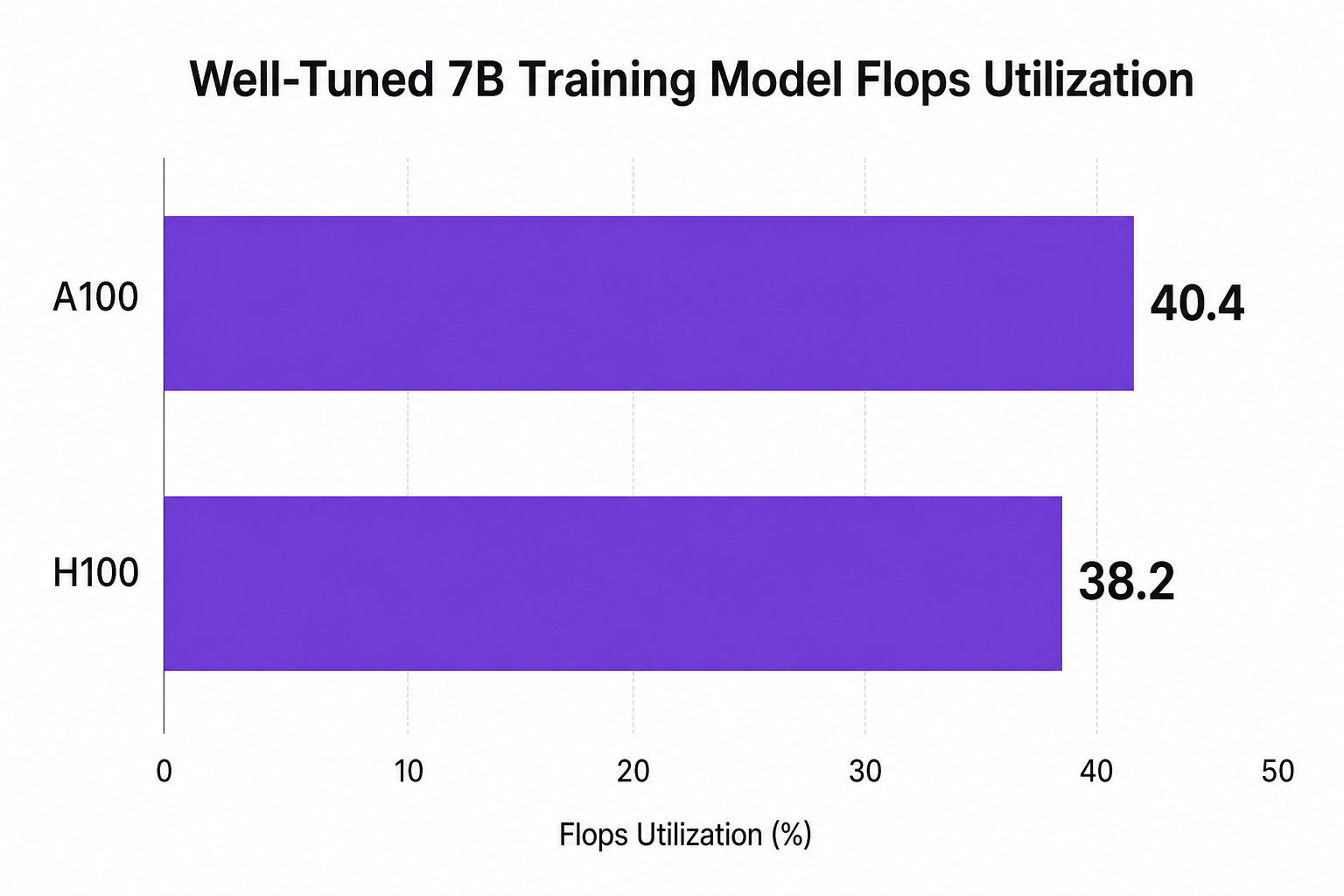
Well-Tuned 7B Parameter Model Training: Achieve approximately 40.4% MFU on A100 and 38.2% on H100 hardware
Strong Single-Node Training Environments: MFU rates above 50% are rare and considered excellent
Despite high-performance hardware, real-world aggregated efficiency remains much lower, especially in multi-tenant, production AI clusters. This performance gap is a signal that right-sizing, observability, and active management are essential.
Model Flops Utilization (MFU) represents the percentage of theoretical maximum floating-point operations per second (FLOPS) achieved during training. MFU reflects the interplay of software stack, model architecture, data pipeline throughput, and hardware efficiency.
Higher MFU means each GPU delivers more AI work per dollar spent and per watt consumed. Inadequate MFU often reveals I/O bottlenecks, fragmentation, or suboptimal workload scheduling, areas targeted by modern AI operations platforms.
CloudNuro AI Custodian helps organizations move toward ideal MFU by providing administrators with:
Historical performance metrics for CPU, GPU, memory, and network usage
Budget enforcement at the project or user level
Actionable recommendations for right-sizing and scaling down underutilized resources
The shift from A100 to H100 hardware has delivered significant throughput gains, but not always higher MFU. According to the latest benchmarks:
7B Parameter Model Training:
Tokens per Second per GPU: H100 achieves 18,000 vs. 3,000 on A100
MFU: Remains similar, at 40.4% (A100) and 38.2% (H100)
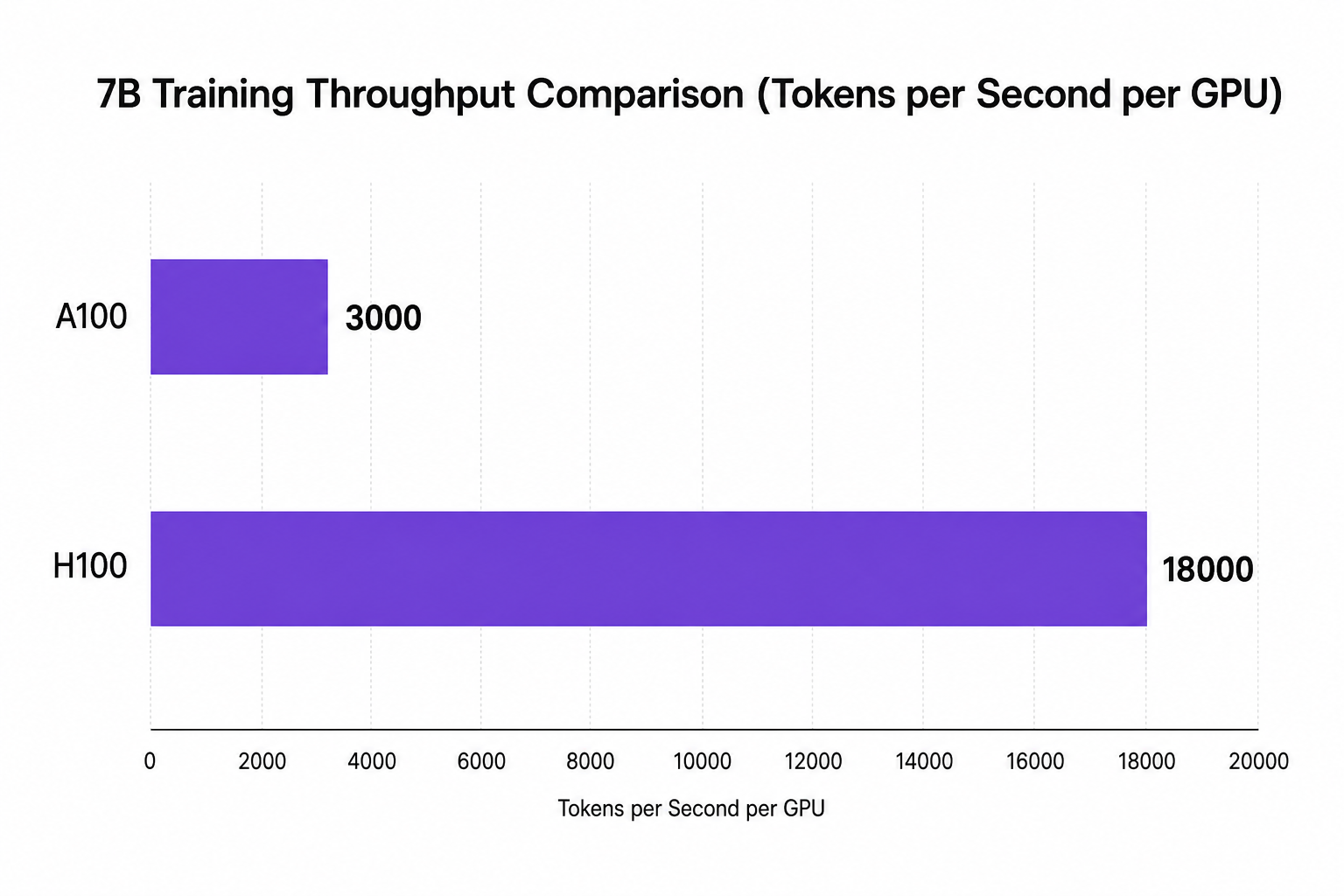
H100 GPUs demonstrate much higher raw throughput but require highly optimized software and pipeline engineering to push MFU rates well above 40%.
Organizations without unified, granular observability often find that hardware upgrades alone do not result in proportionately better utilization.
By centralizing visibility across AI agents, projects, and business units, CloudNuro enables better attribution, cost discipline, and performance tuning, regardless of hardware generation.
Industry statistics show aggregate GPU utilization lags well behind hardware potential, especially as organizations expand across clouds and geographies.
Common causes:
Fragmented monitoring tools that lack cross-cloud visibility
Over-provisioned or idle resources due to lack of automated right-sizing
AI models or data pipelines that fail to saturate hardware, suppressing MFU
Shadow IT and unsanctioned AI tools siphoning capacity
CloudNuro AI Custodian closes these gaps by:
Integrating with over 400 platforms for unified resource tracking
Detecting shadow AI tool adoption using SSO and multi-source discovery engines
Allowing administrators to segment users and projects by utilization, targeting specific optimization actions
Establishing before-and-after productivity baselines to measure true business impact
Operational transparency and agentless, cross-cloud monitoring (unified under a single dashboard) have now become the standard that separates high-performing enterprises from the rest.
To meet and exceed 2026 GPU utilization benchmarks, organizations need more than upgraded hardware, they need modern governance and intelligent optimization workflows:
Implement AI FinOps: Assign budgets and project-level accountability for GPU usage; integrate spend, licensing, and usage data.
Insist on Unified Visibility: Replace fragmented, vendor-specific dashboards with a platform that centralizes resource and cost monitoring across all clouds.
Automate Optimization: Use historical metrics and right-sizing intelligence to scale down idle or low-ROI resources; reclaim underutilized capacity.
Benchmark Smartly: Regularly measure MFU, throughput, and cost-per-AI-output across projects; act on recommendations to improve.
Through CloudNuro’s AI Custodian, organizations have:
Identified an average of 20%.30% cost savings within 90 days
Seen over 1000% ROI in 12 months, with results beginning in just 6 weeks
Enabled accurate, project-level cost allocation in major public sector deployments
What is considered good GPU utilization in 2026?
Good utilization for enterprise AI workloads is around 40% MFU for A100/H100 hardware in optimized environments, but real-world averages are much lower. MFU above 50% for single-node training is considered outstanding.
How do A100 and H100 GPUs compare in utilization?
H100 achieves much higher raw throughput (up to 18,000 tokens/sec for 7B models) than A100 (3,000 tokens/sec), but both land in the 35.40% MFU range in practice, unless optimization is prioritized.
What is MFU in GPU benchmarking?
Model Flops Utilization (MFU) quantifies how close a training or inference job gets to theoretical GPU performance. Higher MFU = better hardware ROI and lower energy per AI operation.
How can organizations improve GPU efficiency for AI workloads?
By implementing unified observability, automating right-sizing, segmenting users/projects, and leveraging cost optimization tools like CloudNuro AI Custodian.
In 2026, “good” GPU utilization requires a holistic blend of governance, automation, and observability. Merely upgrading hardware no longer guarantees efficiency or ROI. Platforms like CloudNuro AI Custodian are setting the new standard by centralizing GPU tracking, automating right-sizing, and linking every resource to cost and business impact.
Organizations leveraging unified SaaS and GPU management can expect reduced waste, stronger security and compliance, and AI that delivers on both performance and financial promise.
To see how CloudNuro can help your enterprise redefine GPU efficiency, visit the IT Operations Solution page, explore Unified Cloud Custodian, or connect with FinOps experts through our FinOps Services.
About CloudNuro
CloudNuro is a leader in Enterprise AI Adoption Management, providing enterprises with unmatched visibility, governance, and cost optimization. Recognized twice in a row in the SaaS Management Platforms category and named a Leader in the SoftwareReviews Data Quadrant, CloudNuro is trusted by global enterprises and government agencies to bring financial discipline to SaaS, cloud, and AI. Trusted by enterprises, CloudNuro provides centralized SaaS inventory, license optimization, and renewal management along with advanced cost allocation and chargeback, giving IT and Finance leaders the visibility, control, and cost-conscious culture needed to drive financial discipline.
Request a no cost, no obligation free assessment —just 15 minutes to savings!
Get StartedAI workloads, cloud deployments, and GPU resources have rapidly matured in recent years, fundamentally changing how enterprises measure efficiency and value. The demand for better performance, lower cost, and improved governance has propelled a new focus on granular GPU utilization statistics. In 2026, understanding what “good” looks like for GPU utilization, in both benchmarking and daily operations, has never been more critical for IT and AI leaders.
This report draws on the latest industry benchmarks and operational trends to define the current standards for GPU efficiency, highlight key differences between A100 and H100 GPUs, and demonstrate how CloudNuro AI Custodian empowers organizations to achieve benchmark-leading utilization rates while driving cost, compliance, and performance outcomes.
As enterprise AI and cloud scaling have accelerated, visibility, efficiency, and optimization are now at the forefront of every CIO’s mandate. Industry statistics reveal the urgent need for better governance:
Real production enterprise AI clusters average only 5% overall GPU utilization.
Average GPU utilization for production inference workloads sits at 22%.
Model Flops Utilization (MFU) rates above 50% are considered strong for single-node, optimized training environments.
Workload-level observability and automated cost optimization tools are now key purchasing criteria. Organizations require unified, cross-cloud dashboards and the means to attribute exact costs down to the project, agent, or even the AI model. Unified solutions help pinpoint inefficiencies and reclaim lost capacity, opportunities that CloudNuro AI Custodian users typically capitalize on within their first 90 days, with 20% to 30% cost savings identified through redundancy elimination and capacity reclamation.
Good GPU utilization is defined by context: workload type, hardware, and organizational goals. In 2026, industry benchmarks for widely used hardware are:
A100 Training Runs: Typically around 40% Model Flops Utilization (MFU)
H100 Training Runs: Range from 35% to 50% MFU
Well-Tuned 7B Parameter Model Training: Achieve approximately 40.4% MFU on A100 and 38.2% on H100 hardware
Strong Single-Node Training Environments: MFU rates above 50% are rare and considered excellent
Despite high-performance hardware, real-world aggregated efficiency remains much lower, especially in multi-tenant, production AI clusters. This performance gap is a signal that right-sizing, observability, and active management are essential.
Model Flops Utilization (MFU) represents the percentage of theoretical maximum floating-point operations per second (FLOPS) achieved during training. MFU reflects the interplay of software stack, model architecture, data pipeline throughput, and hardware efficiency.
Higher MFU means each GPU delivers more AI work per dollar spent and per watt consumed. Inadequate MFU often reveals I/O bottlenecks, fragmentation, or suboptimal workload scheduling, areas targeted by modern AI operations platforms.
CloudNuro AI Custodian helps organizations move toward ideal MFU by providing administrators with:
Historical performance metrics for CPU, GPU, memory, and network usage
Budget enforcement at the project or user level
Actionable recommendations for right-sizing and scaling down underutilized resources
The shift from A100 to H100 hardware has delivered significant throughput gains, but not always higher MFU. According to the latest benchmarks:
7B Parameter Model Training:
Tokens per Second per GPU: H100 achieves 18,000 vs. 3,000 on A100
MFU: Remains similar, at 40.4% (A100) and 38.2% (H100)
H100 GPUs demonstrate much higher raw throughput but require highly optimized software and pipeline engineering to push MFU rates well above 40%.
Organizations without unified, granular observability often find that hardware upgrades alone do not result in proportionately better utilization.
By centralizing visibility across AI agents, projects, and business units, CloudNuro enables better attribution, cost discipline, and performance tuning, regardless of hardware generation.
Industry statistics show aggregate GPU utilization lags well behind hardware potential, especially as organizations expand across clouds and geographies.
Common causes:
Fragmented monitoring tools that lack cross-cloud visibility
Over-provisioned or idle resources due to lack of automated right-sizing
AI models or data pipelines that fail to saturate hardware, suppressing MFU
Shadow IT and unsanctioned AI tools siphoning capacity
CloudNuro AI Custodian closes these gaps by:
Integrating with over 400 platforms for unified resource tracking
Detecting shadow AI tool adoption using SSO and multi-source discovery engines
Allowing administrators to segment users and projects by utilization, targeting specific optimization actions
Establishing before-and-after productivity baselines to measure true business impact
Operational transparency and agentless, cross-cloud monitoring (unified under a single dashboard) have now become the standard that separates high-performing enterprises from the rest.
To meet and exceed 2026 GPU utilization benchmarks, organizations need more than upgraded hardware, they need modern governance and intelligent optimization workflows:
Implement AI FinOps: Assign budgets and project-level accountability for GPU usage; integrate spend, licensing, and usage data.
Insist on Unified Visibility: Replace fragmented, vendor-specific dashboards with a platform that centralizes resource and cost monitoring across all clouds.
Automate Optimization: Use historical metrics and right-sizing intelligence to scale down idle or low-ROI resources; reclaim underutilized capacity.
Benchmark Smartly: Regularly measure MFU, throughput, and cost-per-AI-output across projects; act on recommendations to improve.
Through CloudNuro’s AI Custodian, organizations have:
Identified an average of 20%.30% cost savings within 90 days
Seen over 1000% ROI in 12 months, with results beginning in just 6 weeks
Enabled accurate, project-level cost allocation in major public sector deployments
What is considered good GPU utilization in 2026?
Good utilization for enterprise AI workloads is around 40% MFU for A100/H100 hardware in optimized environments, but real-world averages are much lower. MFU above 50% for single-node training is considered outstanding.
How do A100 and H100 GPUs compare in utilization?
H100 achieves much higher raw throughput (up to 18,000 tokens/sec for 7B models) than A100 (3,000 tokens/sec), but both land in the 35.40% MFU range in practice, unless optimization is prioritized.
What is MFU in GPU benchmarking?
Model Flops Utilization (MFU) quantifies how close a training or inference job gets to theoretical GPU performance. Higher MFU = better hardware ROI and lower energy per AI operation.
How can organizations improve GPU efficiency for AI workloads?
By implementing unified observability, automating right-sizing, segmenting users/projects, and leveraging cost optimization tools like CloudNuro AI Custodian.
In 2026, “good” GPU utilization requires a holistic blend of governance, automation, and observability. Merely upgrading hardware no longer guarantees efficiency or ROI. Platforms like CloudNuro AI Custodian are setting the new standard by centralizing GPU tracking, automating right-sizing, and linking every resource to cost and business impact.
Organizations leveraging unified SaaS and GPU management can expect reduced waste, stronger security and compliance, and AI that delivers on both performance and financial promise.
To see how CloudNuro can help your enterprise redefine GPU efficiency, visit the IT Operations Solution page, explore Unified Cloud Custodian, or connect with FinOps experts through our FinOps Services.
About CloudNuro
CloudNuro is a leader in Enterprise AI Adoption Management, providing enterprises with unmatched visibility, governance, and cost optimization. Recognized twice in a row in the SaaS Management Platforms category and named a Leader in the SoftwareReviews Data Quadrant, CloudNuro is trusted by global enterprises and government agencies to bring financial discipline to SaaS, cloud, and AI. Trusted by enterprises, CloudNuro provides centralized SaaS inventory, license optimization, and renewal management along with advanced cost allocation and chargeback, giving IT and Finance leaders the visibility, control, and cost-conscious culture needed to drive financial discipline.
Request a no cost, no obligation free assessment - just 15 minutes to savings!
Get StartedWe're offering complimentary ServiceNow license assessments to only 25 enterprises this quarter who want to unlock immediate savings without disrupting operations.
Get Free AssessmentGet Started




CloudNuro Corp
1755 Park St. Suite 207
Naperville, IL 60563
Phone : +1-630-277-9470
Email: info@cloudnuro.com





.webp)

Recognized Leader in SaaS Management Platforms by Info-Tech SoftwareReviews


.png)
.svg)