

Sign Up
Thank you for Submitting!
Agentic AI infrastructure and federated tool calling are redefining the enterprise technology stack. As organizations accelerate their adoption of next-gen AI and SaaS tools, a new architectural need has emerged: the Model Context Protocol (MCP) gateway. This gateway acts as a trusted control point, enabling secure, compliant orchestration of AI workflows while preserving granular visibility over tool usage, data flows, and spending.
This guide will explore how an MCP gateway works, its central role in agentic AI infrastructure, and why CloudNuro’s governance-first approach gives IT and Finance leaders the confidence to scale AI responsibly.
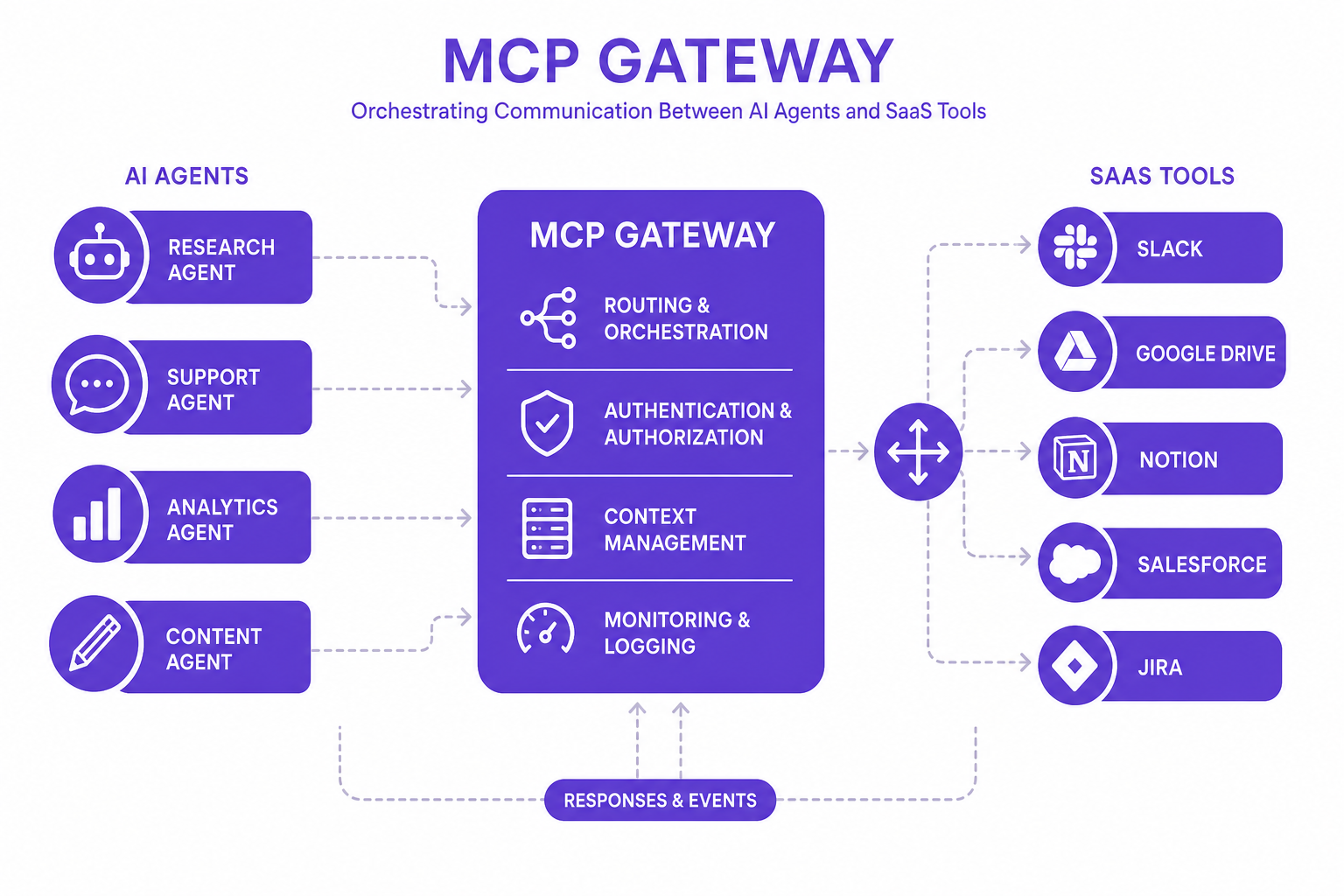
The MCP gateway is a protocol-based control layer that brokers communications between agentic AI systems and the various tools or APIs those agents call upon. Rather than each agent integrating directly with tools (leading to authentication sprawl, duplicated policy logic, and potential security blind spots), all invocations are federated through a central, policy-enforcing gateway.
Key Functions of an MCP Gateway:
- Standardizes authentication, logging, and access control for all tool calls
- Enforces guardrails and compliance policies at the point of invocation
- Provides unified visibility into agent tool usage, spend, and data flows
- Aggregates multiple MCP servers and routes requests for optimal efficiency
In much the same way that API gateways revolutionized REST architectures, MCP gateways unify and secure next-generation, agent-based AI systems with minimal integration friction.
Agentic AI refers to software systems comprised of semi-autonomous agents that execute contextual tasks by orchestrating calls to models, internal tools, and external APIs. As AI agents become deeply embedded in core business processes, governance and operational risk management become paramount.
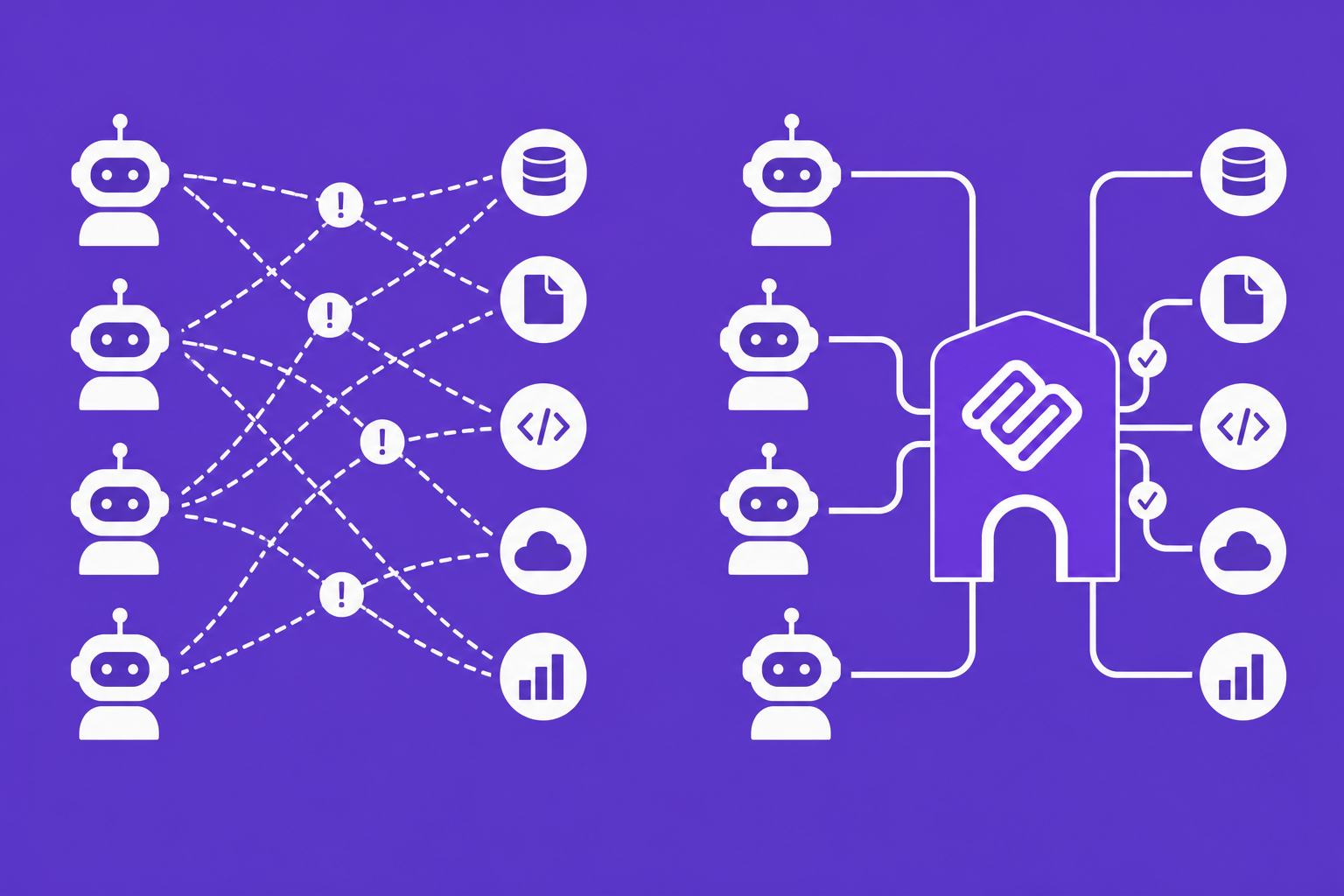
Without a gateway:
- AI agents may access sensitive systems without consistent authentication or logging.
- Security policies and cost controls must be duplicated across every integration point.
- Audit trails are fragmented, leaving blind spots in risk and compliance monitoring.
With an MCP gateway:
- All agent actions are routed through a single, governed point of enforcement.
- Enterprise standards for access, budgeting, and protection are consistently applied.
- IT maintains total operational visibility from agent invocation to spend analysis.
It is no surprise that industry experts view the MCP gateway as the AI era’s new trust anchor, with adoption rates for API gateway vendors with Model Context Protocol features expected to hit 75% by 2026.
Enterprises are moving rapidly to federate their AI integrations and tool orchestration via MCP gateways because of the clear value in security, efficiency, and cost control:
Holistic Visibility: Unify logs, usage stats, and access trails across every AI agent and tool. CloudNuro’s AI Custodian, for example, tracks specific token consumption, prompt volumes, and associated financial costs at the individual agent or project level.
Enforced Compliance: Guardrails, policy-based controls, and budget thresholds are applied at the gateway, eliminating accidental data oversharing or runaway costs. Integration with tools like Microsoft Purview and Microsoft Defender extends protection to shadow AI and sensitive document exposure.
Simplified Operations: A single integration yields control and compliance, saving engineering time, reducing security risk, and enabling faster adoption of emerging AI standards.
Seamless Scaling: As the number of agents and tools grows, governance logic is maintained in one place. Features like per-agent allowlists, OAuth-based access, and inline anomaly detection are easier to enforce and audit.
The shift to cloud and SaaS has brought decentralized app sprawl. AI-enabled SaaS tools create new challenges in spend oversight, security, and compliance, often outpacing the controls found in traditional IT.
Growing Complexity: Today, 40% of enterprise applications are expected to embed task-specific AI agents, dramatically increasing the number of tool and API interactions to be monitored.
Demand for Centralization: 70% of software engineering teams building multimodel applications are expected to use AI gateways to avoid duplicated authentication, logging, and policy enforcement.
Federation as Default: The centralized gateway pattern is emerging as the default for federating multiple MCP servers, abstracting direct connections and enabling unified discovery, filtering, and resource allocation.
CloudNuro’s solution uniquely fits here by delivering cost optimization and governance as code, no matter how many SaaS apps, AI agents, or underlying models are utilized.
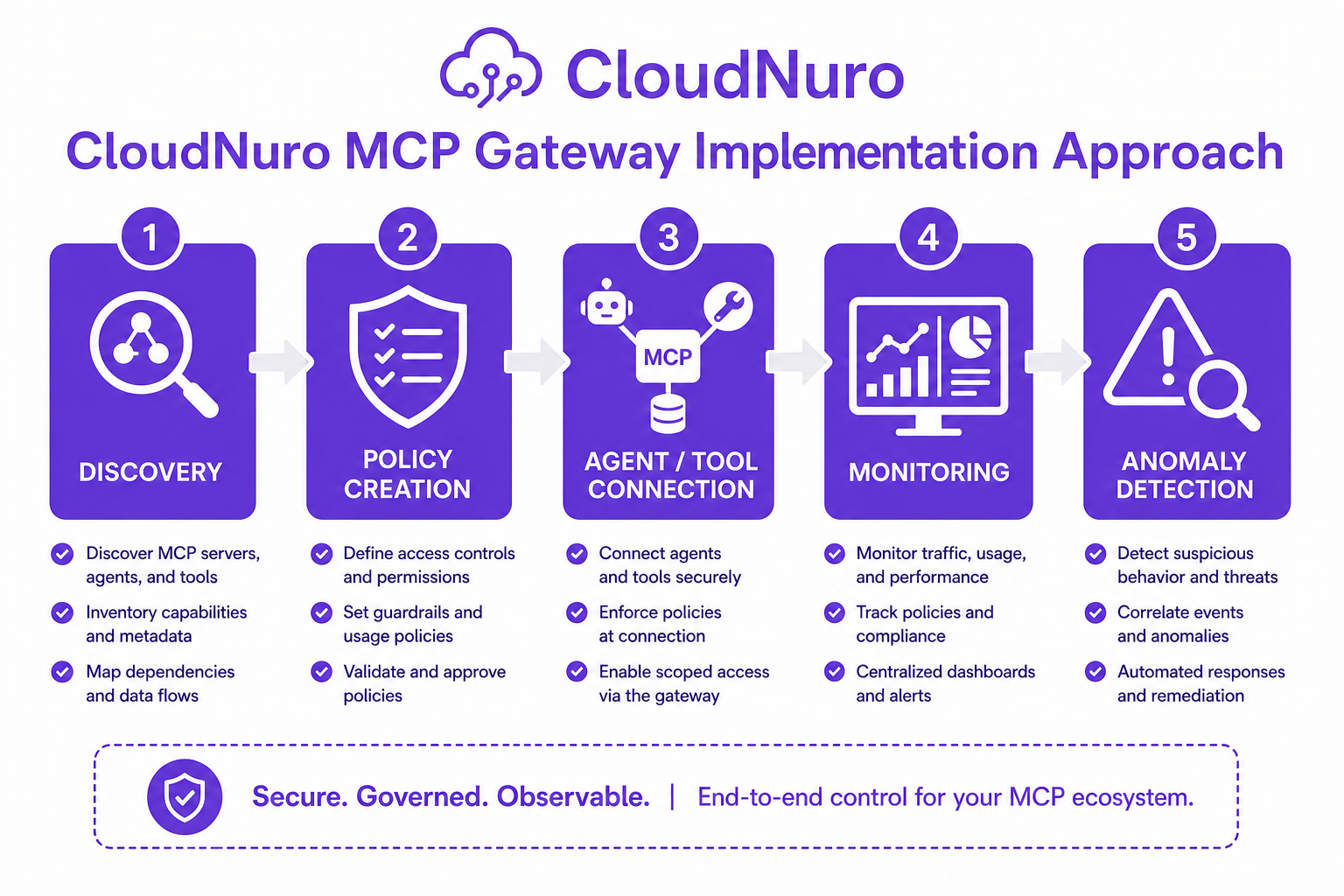
A robust MCP gateway rollout should include the following steps:
Inventory Agent Integrations: Catalogue every tool, SaaS product, API, and model your AI agents interact with. This forms the basis for governance.
Establish Gateway Policies: Define authentication, cost allocation, compliance, and auditing policies centrally at the gateway rather than embedding them in every agent.
Connect Tools and Agents: Use CloudNuro’s seamless integration capabilities to connect 400+ SaaS, cloud, and AI tools to your MCP gateway.
Enable Observability: Activate dashboards that consolidate activity and spend across all users, projects, and tools. Use AI Custodian’s segmentation to optimize license allocation and budgeting.
Automate Detection: Deploy anomaly detection to flag unexpected AI usage, runaway spending, or unauthorized data flows in real time.
Iterate and Evolve: As new agents, tools, and business use-cases are introduced, update gateway policies and segmentations for agility and control.
CloudNuro’s AI Custodian is purpose-built to support agentic AI infrastructure and MCP gateway adoption:
Governance-First Enforcement: Policy-based controls, guardrails, and project-based budgets are centralized for every AI tool call, reducing compliance risk and operational complexity.
Financial Discipline: Real-time tracking of token consumption, prompt volumes, and cost per agent lets IT and Finance maintain precise allocation and chargebacks for every project.
Operational Visibility: Unified dashboards reduce blind spots; automatic anomaly detection reveals abnormal spend or shadow agent behavior before budgets are exceeded.
Scalable Integration: Over 400 SaaS and AI tool integrations accelerate broad adoption with minimal engineering lift.
Most CloudNuro implementations deliver actionable visibility in under 24 hours, and drive an average of 20.30% savings on managed SaaS and cloud spend.
An MCP gateway is a standardized, policy-enforcing platform that brokers agent-tool communication in AI systems. It centralizes authentication, policy enforcement, and auditing for all tool calls.
It serves as the secure, operational control point for all AI agent tool calls, ensuring governance and compliance while streamlining workflows.
It delivers unified visibility, centralized policy enforcement, cost control, and simplifies scaling of secure agent integrations.
It addresses the need for operational centralization, risk management, and financial discipline across a rapidly expanding landscape of AI-enabled SaaS and cloud tools.
Inventory all agent integrations, define gateway-level policies, connect tools and agents, enable observability, and continuously automate detection using a platform like CloudNuro.
About CloudNuro
CloudNuro is a leader in Enterprise AI Adoption Management, providing enterprises with unmatched visibility, governance, and cost optimization. Recognized twice in a row in the SaaS Management Platforms category and named a Leader in the SoftwareReviews Data Quadrant, CloudNuro is trusted by global enterprises and government agencies to bring financial discipline to SaaS, cloud, and AI. Trusted by enterprises, CloudNuro provides centralized SaaS inventory, license optimization, and renewal management along with advanced cost allocation and chargeback, giving IT and Finance leaders the visibility, control, and cost-conscious culture needed to drive financial discipline.
Request a no cost, no obligation free assessment —just 15 minutes to savings!
Get StartedAgentic AI infrastructure and federated tool calling are redefining the enterprise technology stack. As organizations accelerate their adoption of next-gen AI and SaaS tools, a new architectural need has emerged: the Model Context Protocol (MCP) gateway. This gateway acts as a trusted control point, enabling secure, compliant orchestration of AI workflows while preserving granular visibility over tool usage, data flows, and spending.
This guide will explore how an MCP gateway works, its central role in agentic AI infrastructure, and why CloudNuro’s governance-first approach gives IT and Finance leaders the confidence to scale AI responsibly.
The MCP gateway is a protocol-based control layer that brokers communications between agentic AI systems and the various tools or APIs those agents call upon. Rather than each agent integrating directly with tools (leading to authentication sprawl, duplicated policy logic, and potential security blind spots), all invocations are federated through a central, policy-enforcing gateway.
Key Functions of an MCP Gateway:
- Standardizes authentication, logging, and access control for all tool calls
- Enforces guardrails and compliance policies at the point of invocation
- Provides unified visibility into agent tool usage, spend, and data flows
- Aggregates multiple MCP servers and routes requests for optimal efficiency
In much the same way that API gateways revolutionized REST architectures, MCP gateways unify and secure next-generation, agent-based AI systems with minimal integration friction.
Agentic AI refers to software systems comprised of semi-autonomous agents that execute contextual tasks by orchestrating calls to models, internal tools, and external APIs. As AI agents become deeply embedded in core business processes, governance and operational risk management become paramount.
Without a gateway:
- AI agents may access sensitive systems without consistent authentication or logging.
- Security policies and cost controls must be duplicated across every integration point.
- Audit trails are fragmented, leaving blind spots in risk and compliance monitoring.
With an MCP gateway:
- All agent actions are routed through a single, governed point of enforcement.
- Enterprise standards for access, budgeting, and protection are consistently applied.
- IT maintains total operational visibility from agent invocation to spend analysis.
It is no surprise that industry experts view the MCP gateway as the AI era’s new trust anchor, with adoption rates for API gateway vendors with Model Context Protocol features expected to hit 75% by 2026.
Enterprises are moving rapidly to federate their AI integrations and tool orchestration via MCP gateways because of the clear value in security, efficiency, and cost control:
Holistic Visibility: Unify logs, usage stats, and access trails across every AI agent and tool. CloudNuro’s AI Custodian, for example, tracks specific token consumption, prompt volumes, and associated financial costs at the individual agent or project level.
Enforced Compliance: Guardrails, policy-based controls, and budget thresholds are applied at the gateway, eliminating accidental data oversharing or runaway costs. Integration with tools like Microsoft Purview and Microsoft Defender extends protection to shadow AI and sensitive document exposure.
Simplified Operations: A single integration yields control and compliance, saving engineering time, reducing security risk, and enabling faster adoption of emerging AI standards.
Seamless Scaling: As the number of agents and tools grows, governance logic is maintained in one place. Features like per-agent allowlists, OAuth-based access, and inline anomaly detection are easier to enforce and audit.
The shift to cloud and SaaS has brought decentralized app sprawl. AI-enabled SaaS tools create new challenges in spend oversight, security, and compliance, often outpacing the controls found in traditional IT.
Growing Complexity: Today, 40% of enterprise applications are expected to embed task-specific AI agents, dramatically increasing the number of tool and API interactions to be monitored.
Demand for Centralization: 70% of software engineering teams building multimodel applications are expected to use AI gateways to avoid duplicated authentication, logging, and policy enforcement.
Federation as Default: The centralized gateway pattern is emerging as the default for federating multiple MCP servers, abstracting direct connections and enabling unified discovery, filtering, and resource allocation.
CloudNuro’s solution uniquely fits here by delivering cost optimization and governance as code, no matter how many SaaS apps, AI agents, or underlying models are utilized.
A robust MCP gateway rollout should include the following steps:
Inventory Agent Integrations: Catalogue every tool, SaaS product, API, and model your AI agents interact with. This forms the basis for governance.
Establish Gateway Policies: Define authentication, cost allocation, compliance, and auditing policies centrally at the gateway rather than embedding them in every agent.
Connect Tools and Agents: Use CloudNuro’s seamless integration capabilities to connect 400+ SaaS, cloud, and AI tools to your MCP gateway.
Enable Observability: Activate dashboards that consolidate activity and spend across all users, projects, and tools. Use AI Custodian’s segmentation to optimize license allocation and budgeting.
Automate Detection: Deploy anomaly detection to flag unexpected AI usage, runaway spending, or unauthorized data flows in real time.
Iterate and Evolve: As new agents, tools, and business use-cases are introduced, update gateway policies and segmentations for agility and control.
CloudNuro’s AI Custodian is purpose-built to support agentic AI infrastructure and MCP gateway adoption:
Governance-First Enforcement: Policy-based controls, guardrails, and project-based budgets are centralized for every AI tool call, reducing compliance risk and operational complexity.
Financial Discipline: Real-time tracking of token consumption, prompt volumes, and cost per agent lets IT and Finance maintain precise allocation and chargebacks for every project.
Operational Visibility: Unified dashboards reduce blind spots; automatic anomaly detection reveals abnormal spend or shadow agent behavior before budgets are exceeded.
Scalable Integration: Over 400 SaaS and AI tool integrations accelerate broad adoption with minimal engineering lift.
Most CloudNuro implementations deliver actionable visibility in under 24 hours, and drive an average of 20.30% savings on managed SaaS and cloud spend.
An MCP gateway is a standardized, policy-enforcing platform that brokers agent-tool communication in AI systems. It centralizes authentication, policy enforcement, and auditing for all tool calls.
It serves as the secure, operational control point for all AI agent tool calls, ensuring governance and compliance while streamlining workflows.
It delivers unified visibility, centralized policy enforcement, cost control, and simplifies scaling of secure agent integrations.
It addresses the need for operational centralization, risk management, and financial discipline across a rapidly expanding landscape of AI-enabled SaaS and cloud tools.
Inventory all agent integrations, define gateway-level policies, connect tools and agents, enable observability, and continuously automate detection using a platform like CloudNuro.
About CloudNuro
CloudNuro is a leader in Enterprise AI Adoption Management, providing enterprises with unmatched visibility, governance, and cost optimization. Recognized twice in a row in the SaaS Management Platforms category and named a Leader in the SoftwareReviews Data Quadrant, CloudNuro is trusted by global enterprises and government agencies to bring financial discipline to SaaS, cloud, and AI. Trusted by enterprises, CloudNuro provides centralized SaaS inventory, license optimization, and renewal management along with advanced cost allocation and chargeback, giving IT and Finance leaders the visibility, control, and cost-conscious culture needed to drive financial discipline.
Request a no cost, no obligation free assessment - just 15 minutes to savings!
Get StartedWe're offering complimentary ServiceNow license assessments to only 25 enterprises this quarter who want to unlock immediate savings without disrupting operations.
Get Free AssessmentGet Started




CloudNuro Corp
1755 Park St. Suite 207
Naperville, IL 60563
Phone : +1-630-277-9470
Email: info@cloudnuro.com



.webp)

Recognized Leader in SaaS Management Platforms by Info-Tech SoftwareReviews

.png)
.svg)