

Sign Up
Thank you for Submitting!

Slack has become the core collaboration layer in thousands of enterprises. Yet, many organizations quietly overpay for licenses they don't use. When teams scale rapidly, onboarding and offboarding processes often fail to keep pace, leaving inactive accounts, unmonitored guest users, and redundant workspaces consuming paid seats.
Under the surface of this convenience lies a complex licensing structure that can easily spiral out of control if not properly governed. Slack's active-user pricing model charges for every user provisioned within a paid workspace. Overprovisioned accounts, unused add-ons, or misaligned license tiers collectively drain IT budgets and create compliance blind spots.
In most enterprise environments, 10–25% of paid Slack licenses go unused at any given time. That translates to tens or even hundreds of thousands of dollars per year that could have been reallocated elsewhere. Optimizing Slack licenses is not merely about cost avoidance; it's about visibility, operational efficiency, and more innovative governance.

Each of the following steps outlines exactly how IT admins and SaaS managers can regain control of their Slack deployments.
Goal: Identify dormant or never-logged-in users consuming paid licenses.
Process:
Example:
| User Type | Active (<30 days) | Dormant (30–90 days) | Never Logged In | Total Users |
|---|---|---|---|---|
| Employees | 1,540 | 260 | 70 | 1,870 |
| Contractors | 320 | 60 | 15 | 395 |
After reclaiming 145 dormant accounts, this organization reduced its paid seat count by 7.5%.
Tools: Slack analytics export, or CloudNuro automated user-activity dashboard for cross-app visibility.
Goal: Align users to the correct Slack plan based on their role and actual feature utilization.
Process:
Example:
A retail organization discovered that only 15% of its 3,200 users needed Enterprise Grid features. Migrating 2,720 users to lower tiers yielded $182K in annual savings without disrupting communication.
Tools: Slack's usage statistics under Settings → Analytics → Features, combined with CloudNuro's entitlement reports that highlight unused premium features.
Goal: Stop paying for guest and external collaborators long after projects end.
Process:
Example:
An IT services firm found 310 external vendors still active months after project completion. Removing or downgrading those users lowered annualized costs by 12%.
Tools: Slack Access Management API, CloudNuro's external-identity audit module.
Tip: Schedule quarterly guest audits; it's the simplest recurring optimization step that pays immediate dividends.
Goal: Prevent duplicate billing and enhance visibility across departments.
Process:
Example:
A financial enterprise discovered 14 isolated Slack workspaces, each paying separately. Consolidating into a single Enterprise Grid reduced duplicate licenses by 19% and simplified user lifecycle management.
Visual Description: The Slack Grid Admin dashboard now displays a single organization with unified billing, shared channels, and integrated analytics, eliminating fragmented spend.
Goal: Ensure departments pay for their actual Slack usage to encourage ownership.
Process:
Example Table:
| Department | Paid Seats | Active Users | Inactive Users | Cost per Month (USD) |
|---|---|---|---|---|
| Engineering | 800 | 720 | 80 | $9,600 |
| Marketing | 400 | 280 | 120 | $4,800 |
| HR | 250 | 200 | 50 | $3,000 |
By publishing these reports through CloudNuro's automated chargeback dashboard, one enterprise reduced inactive user percentages from 14% to 5% in a single quarter.
Goal: Prevent overpayment by adjusting licenses before renewal.
Process:
Example:
A professional-services firm performing a true-down 30 days before renewal avoided paying for 220 unused licenses, saving $25K annually.
Tools: Slack Billing Portal, CloudNuro's Renewal Readiness alerts and optimization reports.
Goal: Sustain optimization continuously rather than as a one-time cleanup.
Process:
Example:
After automating Slack license reporting, a manufacturing enterprise reduced manual admin time by 60% and improved renewal forecasting accuracy by 25%.
Tools: CloudNuro SaaS Governance Platform with prebuilt Slack connector, or Slack API with custom scripts for smaller teams.
CloudNuro helps IT and SaaS leaders optimize Slack licenses with precision. Our intelligent dashboards surface inactive users, duplicate seats, and unused premium features long before renewal time.
Within 15 minutes of setup and results under 24 hours, CloudNuro reveals exactly where you can reclaim waste and turn license visibility into real savings.
Book your free Slack License Optimization Assessment today.
| Mistake | What Goes Wrong | How to Fix It |
|---|---|---|
| Not monitoring inactive users. | Paid licenses remain assigned to dormant users. | Run monthly activity audits or automate alerts via CloudNuro. |
| Overprovisioning new hires | Accounts created before employees log in are often never used. | Set "login within 14 days" policy; reclaim if inactive. |
| Neglecting guest expiration | Vendor or partner accounts persist indefinitely. | Implement 30-day guest expiration and quarterly reviews. |
| Duplicated workspaces | Departments create separate workspaces; users are billed twice. | Migrate to Enterprise Grid for unified billing. |
| Lack of chargeback discipline | Teams have no visibility into their costs, leading to apathy. | Introduce Slack chargeback dashboards; show department spend monthly. |
| Annual plans without review | Locked-in costs even after staff reductions. | Shift to quarterly or monthly billing where headcount fluctuates. |
Already paid for becomes inactive, a prorated credit will be added to your account for the unused time, and this will be reflected on your following billing statement. If all members become inactive, you'll be billed for at least one member, unless you downgrade to Slack's free version.
Avoiding these pitfalls can immediately optimize Slack licenses by 15–30% in most enterprise environments.
Trusted by enterprises such as Konica Minolta and Federal Signal, the solution provides centralized SaaS inventory, license optimization, and renewal management, along with advanced cost allocation and chargeback, giving IT and Finance leaders the visibility, control, and cost-conscious culture needed to drive financial discipline.
| Optimization Area | Admin Action | Frequency | Expected Outcome |
|---|---|---|---|
| User Activity Audit | Export and review last-login data | Monthly | Identify dormant and never-used accounts |
| License Tier Review | Verify plan assignment per user role | Quarterly | Prevent overpayment for unused features |
| Guest Access Management | Revoke old guest accounts | Monthly | Reduce external seat costs |
| Workspace Consolidation | Merge departmental workspaces | Annual / as needed | Simplify billing and governance |
| Chargeback Reporting | Publish departmental spend dashboards | Monthly | Create accountability and ownership |
| Renewal Readiness | Adjust seat count pre-renewal | Quarterly | Avoid prepaid waste |
| Automation Setup | Integrate Slack data into CloudNuro | Continuous | Maintain real-time visibility and compliance |
Bookmark this checklist or print it as a reference for every renewal cycle.
CloudNuro is a leader in Enterprise SaaS Management Platforms, giving enterprises unmatched visibility, governance, and cost optimization. Recognized twice in a row by Gartner in the SaaS Management Platforms Magic Quadrant and named a Leader in the Info-Tech SoftwareReviews Data Quadrant, CloudNuro is trusted by global enterprises and government agencies to bring financial discipline to SaaS and cloud.
At least once per quarter. Automated monitoring tools such as CloudNuro can make it continuous by flagging inactive users daily.
Start with user activity exports. Deactivate any account that has been inactive for 60+ days and review guest access immediately.
No. Slack licenses are user-specific. However, admins can reassign unused seats when employees leave.
Slack charges for all provisioned users, even if inactive. Deactivation is the only way to stop billing for them.
CloudNuro integrates directly with Slack APIs to monitor user activity, generate chargeback reports, and highlight savings opportunities.
Yes. CloudNuro offers unified dashboards across Slack, Microsoft 365, Zoom, and Salesforce, enabling enterprise-wide license governance.
Typical outcomes range from 20–35% reduction in Slack costs during the first optimization cycle.
Effective Slack license optimization is not a one-time cleanup; it's an ongoing practice of governance, visibility, and accountability. Enterprises that regularly audit their user base, right-size license tiers, manage guest accounts, and align renewals to usage prevent silent budget leakage.
CloudNuro empowers IT and SaaS managers to move beyond reactive license tracking. Our platform delivers unified visibility, automated chargeback, and real-time license intelligence, ensuring you always know who's using what, when, and at what cost.
By integrating Slack into your broader SaaS governance model, CloudNuro helps you continuously optimize Slack licenses, enhance compliance, and capture measurable ROI across the collaboration stack.
Ready to stop paying for what you don't use?
Schedule your complimentary 15-minute Slack License Optimization Assessment with CloudNuro and discover how increased visibility directly translates into savings.
A Fortune 1000 technology enterprise with over 3,600 Slack users across six global departments was facing unexplained increases in its annual collaboration budget.
Despite Slack's reputation as a cost-efficient, user-friendly communication platform, the IT Finance team noticed that the company's monthly Slack bill had grown from $41,000 to nearly $52,000 within eight months, without a proportional increase in headcount.
Initial assumptions blamed rising user adoption and additional integrations. However, deeper examination revealed a lack of governance around license allocation, different workspace sprawl, and inactive accounts. Each department managed its own workspace with minimal visibility into actual license consumption. The absence of centralized reporting meant no one could accurately answer, "How many paid Slack users actually log in every month?"
This opaque environment led to several forms of overspending:
Slack costs had quietly turned into an unmonitored operational burden.
The internal review and CloudNuro's initial visibility assessment uncovered the following data points:
| Metric | Observation | Financial Impact |
|---|---|---|
| Total Slack Users | 3,615 | |
| Active Users (last 30 days) | 2,740 | |
| Dormant Users (31–90 days) | 560 | ~$6,700/month |
| Never Logged In | 315 | ~$3,700/month |
| Duplicate Accounts (multi-workspace) | 180 | ~$2,100/month |
| External Guest Users > 90 days | 210 | ~$1,900/month |
| Total Overspending Identified | ~$14,400/month (~27% waste) |
Key Insight: Nearly one in four paid licenses showed little or no activity. These inactive accounts collectively cost the enterprise over $170,000 annually.
To transform insight into savings, CloudNuro's SaaS Cost Governance team executed a structured Slack License Optimization Audit.
The audit followed a five-step FinOps-aligned framework:
CloudNuro deployed its Slack Integration Adapter to automatically ingest usage, license, and billing data from all workspaces.
The platform's License Optimization Engine performed deep analysis, identifying reclaimable licenses, duplicate accounts, and underutilized features.
Key Actions Implemented:
Tools Used:
Within 90 days of implementing CloudNuro's Slack License Optimization framework:
| Metric | Before Optimization | After Optimization | Savings/Improvement |
|---|---|---|---|
| Total Paid Users | 3,615 | 2,725 | -24.6% |
| Monthly Slack Spend | $52,000 | $37,800 | -$14,200 (27%) |
| Guest Accounts | 320 | 105 | -67% |
| Duplicate Workspaces | 6 | 3 | -50% |
| Departments Using Chargeback Reports | 0 | 6 | 100% adoption |
| Average License Utilization Rate | 74% | 95% | +21 points |
Beyond cost reduction, the enterprise achieved a unified governance model, aligning IT, Finance, and departmental managers under a single visibility framework.
Key Optimization Drivers:
These combined optimizations not only reduced Slack spend but also established a repeatable governance cycle that prevented waste recurrence.
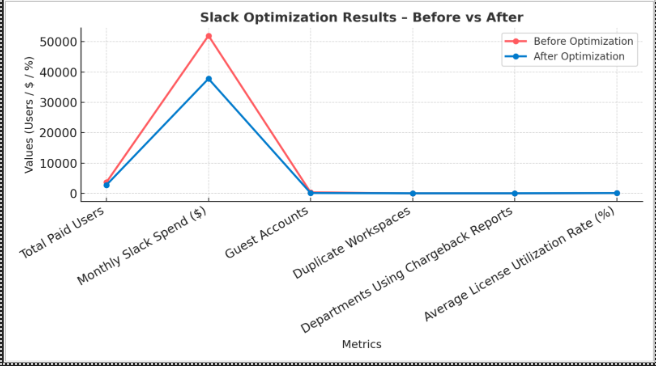
Line Graph: "Slack Monthly Spend – Before vs. After Optimization"
| Month | Total Slack Spend (USD) | Active Users | Dormant Users | Never Logged In |
|---|---|---|---|---|
| Month 1 (Before Audit) | 52,000 | 2,740 | 560 | 315 |
| Month 2 | 45,300 | 2,850 | 420 | 260 |
| Month 3 | 37,800 | 2,910 | 270 | 180 |
Visual Description:
The line graph shows a steady downward trend in total Slack costs from $52K to $37.8K over three months, with a simultaneous improvement in the active user ratio and a reduction in dormant accounts. The inflection point occurs post-audit implementation, demonstrating the correlation between visibility and savings.
This case study underscores an everyday reality in enterprise SaaS management: even collaboration tools designed for efficiency can silently inflate budgets when left unchecked.
The enterprise's 27% reduction in Slack costs wasn't achieved through renegotiation or discounts; it came from data-driven license optimization and visibility.
By applying CloudNuro's unified SaaS governance framework, the company:
In less than one fiscal quarter, Slack transitioned from a fragmented expense to a governed, optimized collaboration platform.
CloudNuro is a leader in Enterprise SaaS Management Platforms, giving enterprises unmatched visibility, governance, and cost optimization. Recognized twice in a row by Gartner in the SaaS Management Platforms Magic Quadrant and named a Leader in the Info-Tech SoftwareReviews Data Quadrant, CloudNuro is trusted by global enterprises and government agencies to bring financial discipline to SaaS and cloud.
As the only FinOps-certified Enterprise SaaS Management Platform, CloudNuro unifies SaaS and IaaS management in a single view. With a 15-minute setup and measurable results in under 24 hours, CloudNuro gives IT teams a fast path to value.
CloudNuro helps organizations optimize Slack licenses by integrating entitlement mapping, inactivity detection, and chargeback automation into one unified dashboard.
Within 15 minutes, CloudNuro surfaces exactly where your collaboration budget leaks, and helps you reclaim it before renewal.
Book your free Slack License Optimization Assessment with CloudNuro
Request a no cost, no obligation free assessment —just 15 minutes to savings!
Get StartedSlack has become the core collaboration layer in thousands of enterprises. Yet, many organizations quietly overpay for licenses they don't use. When teams scale rapidly, onboarding and offboarding processes often fail to keep pace, leaving inactive accounts, unmonitored guest users, and redundant workspaces consuming paid seats.
Under the surface of this convenience lies a complex licensing structure that can easily spiral out of control if not properly governed. Slack's active-user pricing model charges for every user provisioned within a paid workspace. Overprovisioned accounts, unused add-ons, or misaligned license tiers collectively drain IT budgets and create compliance blind spots.
In most enterprise environments, 10–25% of paid Slack licenses go unused at any given time. That translates to tens or even hundreds of thousands of dollars per year that could have been reallocated elsewhere. Optimizing Slack licenses is not merely about cost avoidance; it's about visibility, operational efficiency, and more innovative governance.
Each of the following steps outlines exactly how IT admins and SaaS managers can regain control of their Slack deployments.
Goal: Identify dormant or never-logged-in users consuming paid licenses.
Process:
Example:
| User Type | Active (<30 days) | Dormant (30–90 days) | Never Logged In | Total Users |
|---|---|---|---|---|
| Employees | 1,540 | 260 | 70 | 1,870 |
| Contractors | 320 | 60 | 15 | 395 |
After reclaiming 145 dormant accounts, this organization reduced its paid seat count by 7.5%.
Tools: Slack analytics export, or CloudNuro automated user-activity dashboard for cross-app visibility.
Goal: Align users to the correct Slack plan based on their role and actual feature utilization.
Process:
Example:
A retail organization discovered that only 15% of its 3,200 users needed Enterprise Grid features. Migrating 2,720 users to lower tiers yielded $182K in annual savings without disrupting communication.
Tools: Slack's usage statistics under Settings → Analytics → Features, combined with CloudNuro's entitlement reports that highlight unused premium features.
Goal: Stop paying for guest and external collaborators long after projects end.
Process:
Example:
An IT services firm found 310 external vendors still active months after project completion. Removing or downgrading those users lowered annualized costs by 12%.
Tools: Slack Access Management API, CloudNuro's external-identity audit module.
Tip: Schedule quarterly guest audits; it's the simplest recurring optimization step that pays immediate dividends.
Goal: Prevent duplicate billing and enhance visibility across departments.
Process:
Example:
A financial enterprise discovered 14 isolated Slack workspaces, each paying separately. Consolidating into a single Enterprise Grid reduced duplicate licenses by 19% and simplified user lifecycle management.
Visual Description: The Slack Grid Admin dashboard now displays a single organization with unified billing, shared channels, and integrated analytics, eliminating fragmented spend.
Goal: Ensure departments pay for their actual Slack usage to encourage ownership.
Process:
Example Table:
| Department | Paid Seats | Active Users | Inactive Users | Cost per Month (USD) |
|---|---|---|---|---|
| Engineering | 800 | 720 | 80 | $9,600 |
| Marketing | 400 | 280 | 120 | $4,800 |
| HR | 250 | 200 | 50 | $3,000 |
By publishing these reports through CloudNuro's automated chargeback dashboard, one enterprise reduced inactive user percentages from 14% to 5% in a single quarter.
Goal: Prevent overpayment by adjusting licenses before renewal.
Process:
Example:
A professional-services firm performing a true-down 30 days before renewal avoided paying for 220 unused licenses, saving $25K annually.
Tools: Slack Billing Portal, CloudNuro's Renewal Readiness alerts and optimization reports.
Goal: Sustain optimization continuously rather than as a one-time cleanup.
Process:
Example:
After automating Slack license reporting, a manufacturing enterprise reduced manual admin time by 60% and improved renewal forecasting accuracy by 25%.
Tools: CloudNuro SaaS Governance Platform with prebuilt Slack connector, or Slack API with custom scripts for smaller teams.
CloudNuro helps IT and SaaS leaders optimize Slack licenses with precision. Our intelligent dashboards surface inactive users, duplicate seats, and unused premium features long before renewal time.
Within 15 minutes of setup and results under 24 hours, CloudNuro reveals exactly where you can reclaim waste and turn license visibility into real savings.
Book your free Slack License Optimization Assessment today.
| Mistake | What Goes Wrong | How to Fix It |
|---|---|---|
| Not monitoring inactive users. | Paid licenses remain assigned to dormant users. | Run monthly activity audits or automate alerts via CloudNuro. |
| Overprovisioning new hires | Accounts created before employees log in are often never used. | Set "login within 14 days" policy; reclaim if inactive. |
| Neglecting guest expiration | Vendor or partner accounts persist indefinitely. | Implement 30-day guest expiration and quarterly reviews. |
| Duplicated workspaces | Departments create separate workspaces; users are billed twice. | Migrate to Enterprise Grid for unified billing. |
| Lack of chargeback discipline | Teams have no visibility into their costs, leading to apathy. | Introduce Slack chargeback dashboards; show department spend monthly. |
| Annual plans without review | Locked-in costs even after staff reductions. | Shift to quarterly or monthly billing where headcount fluctuates. |
Already paid for becomes inactive, a prorated credit will be added to your account for the unused time, and this will be reflected on your following billing statement. If all members become inactive, you'll be billed for at least one member, unless you downgrade to Slack's free version.
Avoiding these pitfalls can immediately optimize Slack licenses by 15–30% in most enterprise environments.
Trusted by enterprises such as Konica Minolta and Federal Signal, the solution provides centralized SaaS inventory, license optimization, and renewal management, along with advanced cost allocation and chargeback, giving IT and Finance leaders the visibility, control, and cost-conscious culture needed to drive financial discipline.
| Optimization Area | Admin Action | Frequency | Expected Outcome |
|---|---|---|---|
| User Activity Audit | Export and review last-login data | Monthly | Identify dormant and never-used accounts |
| License Tier Review | Verify plan assignment per user role | Quarterly | Prevent overpayment for unused features |
| Guest Access Management | Revoke old guest accounts | Monthly | Reduce external seat costs |
| Workspace Consolidation | Merge departmental workspaces | Annual / as needed | Simplify billing and governance |
| Chargeback Reporting | Publish departmental spend dashboards | Monthly | Create accountability and ownership |
| Renewal Readiness | Adjust seat count pre-renewal | Quarterly | Avoid prepaid waste |
| Automation Setup | Integrate Slack data into CloudNuro | Continuous | Maintain real-time visibility and compliance |
Bookmark this checklist or print it as a reference for every renewal cycle.
CloudNuro is a leader in Enterprise SaaS Management Platforms, giving enterprises unmatched visibility, governance, and cost optimization. Recognized twice in a row by Gartner in the SaaS Management Platforms Magic Quadrant and named a Leader in the Info-Tech SoftwareReviews Data Quadrant, CloudNuro is trusted by global enterprises and government agencies to bring financial discipline to SaaS and cloud.
At least once per quarter. Automated monitoring tools such as CloudNuro can make it continuous by flagging inactive users daily.
Start with user activity exports. Deactivate any account that has been inactive for 60+ days and review guest access immediately.
No. Slack licenses are user-specific. However, admins can reassign unused seats when employees leave.
Slack charges for all provisioned users, even if inactive. Deactivation is the only way to stop billing for them.
CloudNuro integrates directly with Slack APIs to monitor user activity, generate chargeback reports, and highlight savings opportunities.
Yes. CloudNuro offers unified dashboards across Slack, Microsoft 365, Zoom, and Salesforce, enabling enterprise-wide license governance.
Typical outcomes range from 20–35% reduction in Slack costs during the first optimization cycle.
Effective Slack license optimization is not a one-time cleanup; it's an ongoing practice of governance, visibility, and accountability. Enterprises that regularly audit their user base, right-size license tiers, manage guest accounts, and align renewals to usage prevent silent budget leakage.
CloudNuro empowers IT and SaaS managers to move beyond reactive license tracking. Our platform delivers unified visibility, automated chargeback, and real-time license intelligence, ensuring you always know who's using what, when, and at what cost.
By integrating Slack into your broader SaaS governance model, CloudNuro helps you continuously optimize Slack licenses, enhance compliance, and capture measurable ROI across the collaboration stack.
Ready to stop paying for what you don't use?
Schedule your complimentary 15-minute Slack License Optimization Assessment with CloudNuro and discover how increased visibility directly translates into savings.
A Fortune 1000 technology enterprise with over 3,600 Slack users across six global departments was facing unexplained increases in its annual collaboration budget.
Despite Slack's reputation as a cost-efficient, user-friendly communication platform, the IT Finance team noticed that the company's monthly Slack bill had grown from $41,000 to nearly $52,000 within eight months, without a proportional increase in headcount.
Initial assumptions blamed rising user adoption and additional integrations. However, deeper examination revealed a lack of governance around license allocation, different workspace sprawl, and inactive accounts. Each department managed its own workspace with minimal visibility into actual license consumption. The absence of centralized reporting meant no one could accurately answer, "How many paid Slack users actually log in every month?"
This opaque environment led to several forms of overspending:
Slack costs had quietly turned into an unmonitored operational burden.
The internal review and CloudNuro's initial visibility assessment uncovered the following data points:
| Metric | Observation | Financial Impact |
|---|---|---|
| Total Slack Users | 3,615 | |
| Active Users (last 30 days) | 2,740 | |
| Dormant Users (31–90 days) | 560 | ~$6,700/month |
| Never Logged In | 315 | ~$3,700/month |
| Duplicate Accounts (multi-workspace) | 180 | ~$2,100/month |
| External Guest Users > 90 days | 210 | ~$1,900/month |
| Total Overspending Identified | ~$14,400/month (~27% waste) |
Key Insight: Nearly one in four paid licenses showed little or no activity. These inactive accounts collectively cost the enterprise over $170,000 annually.
To transform insight into savings, CloudNuro's SaaS Cost Governance team executed a structured Slack License Optimization Audit.
The audit followed a five-step FinOps-aligned framework:
CloudNuro deployed its Slack Integration Adapter to automatically ingest usage, license, and billing data from all workspaces.
The platform's License Optimization Engine performed deep analysis, identifying reclaimable licenses, duplicate accounts, and underutilized features.
Key Actions Implemented:
Tools Used:
Within 90 days of implementing CloudNuro's Slack License Optimization framework:
| Metric | Before Optimization | After Optimization | Savings/Improvement |
|---|---|---|---|
| Total Paid Users | 3,615 | 2,725 | -24.6% |
| Monthly Slack Spend | $52,000 | $37,800 | -$14,200 (27%) |
| Guest Accounts | 320 | 105 | -67% |
| Duplicate Workspaces | 6 | 3 | -50% |
| Departments Using Chargeback Reports | 0 | 6 | 100% adoption |
| Average License Utilization Rate | 74% | 95% | +21 points |
Beyond cost reduction, the enterprise achieved a unified governance model, aligning IT, Finance, and departmental managers under a single visibility framework.
Key Optimization Drivers:
These combined optimizations not only reduced Slack spend but also established a repeatable governance cycle that prevented waste recurrence.
Line Graph: "Slack Monthly Spend – Before vs. After Optimization"
| Month | Total Slack Spend (USD) | Active Users | Dormant Users | Never Logged In |
|---|---|---|---|---|
| Month 1 (Before Audit) | 52,000 | 2,740 | 560 | 315 |
| Month 2 | 45,300 | 2,850 | 420 | 260 |
| Month 3 | 37,800 | 2,910 | 270 | 180 |
Visual Description:
The line graph shows a steady downward trend in total Slack costs from $52K to $37.8K over three months, with a simultaneous improvement in the active user ratio and a reduction in dormant accounts. The inflection point occurs post-audit implementation, demonstrating the correlation between visibility and savings.
This case study underscores an everyday reality in enterprise SaaS management: even collaboration tools designed for efficiency can silently inflate budgets when left unchecked.
The enterprise's 27% reduction in Slack costs wasn't achieved through renegotiation or discounts; it came from data-driven license optimization and visibility.
By applying CloudNuro's unified SaaS governance framework, the company:
In less than one fiscal quarter, Slack transitioned from a fragmented expense to a governed, optimized collaboration platform.
CloudNuro is a leader in Enterprise SaaS Management Platforms, giving enterprises unmatched visibility, governance, and cost optimization. Recognized twice in a row by Gartner in the SaaS Management Platforms Magic Quadrant and named a Leader in the Info-Tech SoftwareReviews Data Quadrant, CloudNuro is trusted by global enterprises and government agencies to bring financial discipline to SaaS and cloud.
As the only FinOps-certified Enterprise SaaS Management Platform, CloudNuro unifies SaaS and IaaS management in a single view. With a 15-minute setup and measurable results in under 24 hours, CloudNuro gives IT teams a fast path to value.
CloudNuro helps organizations optimize Slack licenses by integrating entitlement mapping, inactivity detection, and chargeback automation into one unified dashboard.
Within 15 minutes, CloudNuro surfaces exactly where your collaboration budget leaks, and helps you reclaim it before renewal.
Book your free Slack License Optimization Assessment with CloudNuro
Request a no cost, no obligation free assessment - just 15 minutes to savings!
Get StartedWe're offering complimentary ServiceNow license assessments to only 25 enterprises this quarter who want to unlock immediate savings without disrupting operations.
Get Free AssessmentGet Started




CloudNuro Corp
1755 Park St. Suite 207
Naperville, IL 60563
Phone : +1-630-277-9470
Email: info@cloudnuro.com





.webp)

Recognized Leader in SaaS Management Platforms by Info-Tech SoftwareReviews



.png)
.svg)