

Sign Up
Thank you for Submitting!
SaaS has become the default delivery model for enterprise software, yet most IT leaders are still managing their portfolios with incomplete data. Effective SaaS management is impossible when you only see a fraction of the applications, contracts, and licenses your organization is actually using.
According to a recent SaaS management trends report in 2026, 81% of organizations discovered previously unknown SaaS applications after deploying dedicated SaaS discovery solutions. That single data point captures the core problem: you cannot secure, govern, or optimize what you do not know exists.
This article explains why SaaS discovery must be the first step in any serious SaaS strategy, how discovery directly impacts cost, risk, and compliance, and how IT and Finance teams can build a discovery-first operating model using a modern SaaS management platform.
SaaS discovery is the continuous process of identifying every SaaS, cloud, and web application in use across your organization, regardless of who purchased it, where it is hosted, or how it is accessed.
In practical terms, that means consolidating signals from:
The goal is to build a single, trusted inventory of SaaS applications, users, licenses, and associated costs. This inventory becomes the foundation for all other activities, from SaaS spend management to security reviews and contract negotiations.
Why does this matter now? Several 2026 market trends highlight the urgency:
In other words, SaaS discovery is not just an IT hygiene task. It is now central to financial, security, and compliance outcomes.
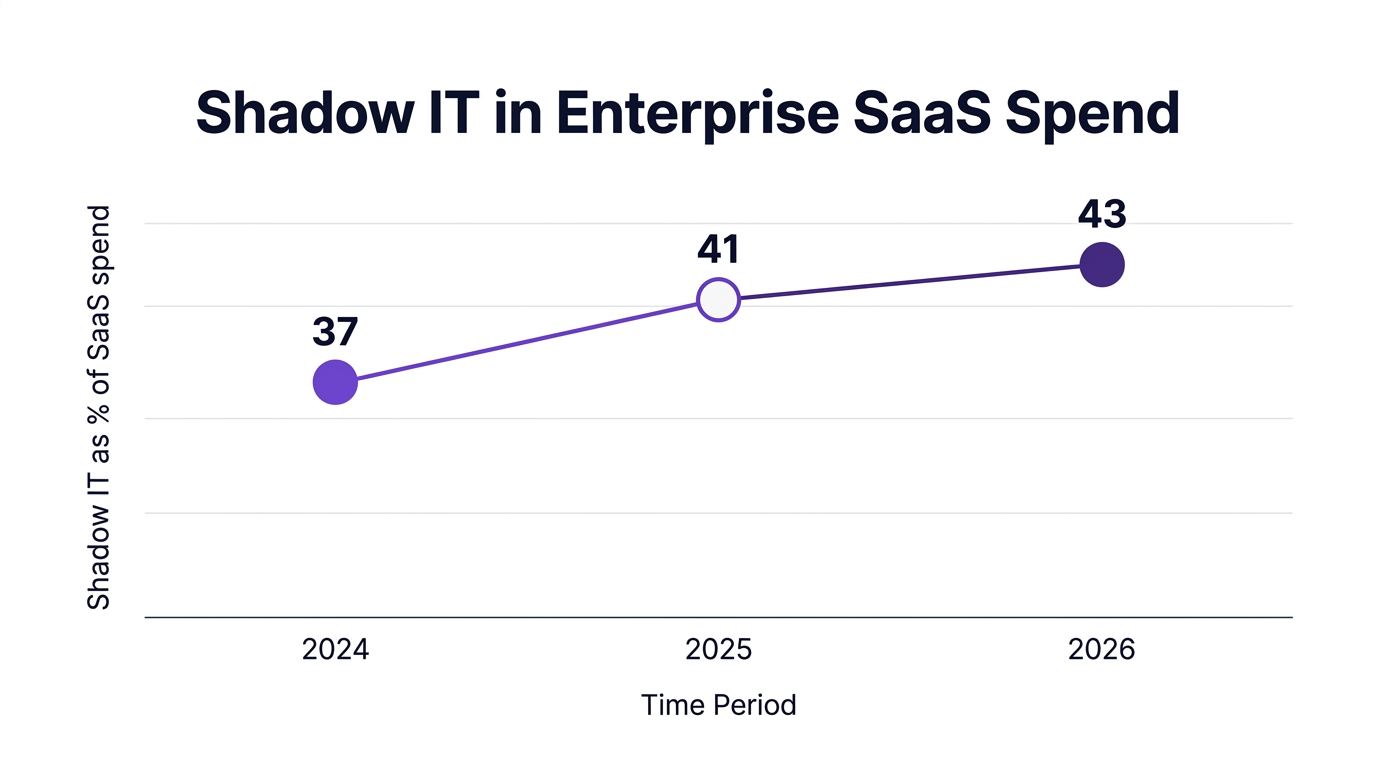
Shadow IT is any technology acquired and used outside formal IT oversight. In the SaaS era, this often means teams swiping a corporate card for a monthly subscription, connecting it to core data, and moving on.
A 2026 governance and risk study found that SaaS sprawl is the leading contributor to compliance and audit issues for 80% of mid to large enterprises. When almost half of your SaaS spend is in the shadows, the risk profile is obvious.
Without robust SaaS visibility, organizations face multiple exposure points:
A recent cloud operations efficiency brief found that SaaS discovery reduces time to incident remediation by 38%, precisely because teams know which applications are involved and who owns them.
Shadow IT is often compared to an iceberg: executives see the approved applications above the waterline, but most of the mass is hidden below. SaaS discovery brings the full iceberg into view, so IT and Security teams can manage it deliberately.

SaaS discovery does more than build an inventory. It is the engine behind effective SaaS cost optimization and sustainable SaaS spend management.
When you combine application discovery with usage analytics and contract data, you can:
A 2026 industry insights study reported that automated SaaS discovery led to an average 24% reduction in redundant application costs across healthcare and finance sectors.
A mature SaaS management program typically follows a recurring loop:
A recent SaaS spend analysis showed that enterprises with full SaaS discovery capabilities reduced unused license costs to about $0.7 million per year, compared with $1.8 million for peers with no discovery.
This is where SaaS spend management software earns its keep. Without discovery, you are doing cost optimization in the dark. With it, you can manage SaaS spend proactively, not reactively.
Effective SaaS governance is impossible if you do not know which apps exist, who owns them, and what data they access. Governance frameworks, approval workflows, and policy documents are only useful if they apply to the real estate you actually occupy.
A 2026 enterprise IT report highlighted that 80% of audit and compliance issues involving SaaS were linked to apps that were unknown or inadequately documented. In other words, governance failures often start as discovery failures.
When SaaS discovery is fully operational, it becomes the front line of SaaS security management:
A head of technology risk at a global finance firm summarized this in 2026: “Shadow IT is only manageable when you see everything. SaaS discovery is the first and most critical step to achieving regulatory compliance.”
With this foundation, you can support:
The result is that SaaS software management stops being a manual spreadsheet exercise and becomes a data-driven control system, where IT, Security, and Finance share the same source of truth.
Real outcomes show the impact of putting discovery at the front of a SaaS management platform initiative.
A global healthcare provider deployed an enterprise SaaS discovery solution in 2026.
Within months, the organization:
This transformation started with a simple shift in mindset: discovery first, optimization second. Only after they had comprehensive SaaS visibility could they build a credible governance model.
A large financial services enterprise used advanced SaaS visibility and governance in 2026 to assess its entire SaaS estate.
Key results included:
This organization moved from fragmented SaaS application management to a unified view, supported by automation and consistent governance.
Many organizations try to solve SaaS problems with point tools or manual processes. That approach usually fails because it starts in the middle, for example, with contract negotiations, rather than at the beginning, which is discovery.
CloudNuro was designed around a discovery-first architecture, so that every cost, security, and governance decision is grounded in real usage data.
CloudNuro Unified Cloud Custodian provides real-time discovery across SaaS, PaaS, and IaaS environments. It uses integrations with over 400 applications, identity providers, and financial systems to build a single-pane-of-glass view of your estate.
For IT and FinOps teams, that means:
This is the backbone for advanced SaaS spend management, SaaS contract management, and financial management SaaS workflows.
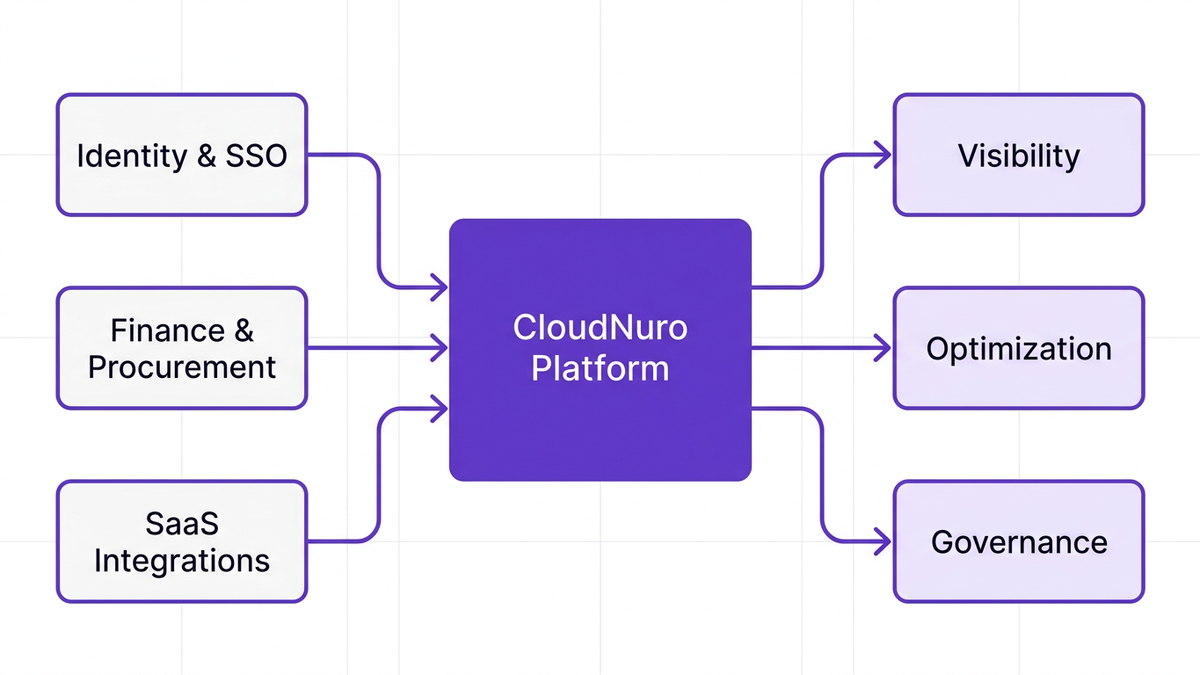
Discovery is only valuable if it leads to action. CloudNuro’s AI Custodian uses machine learning to:
This turns SaaS spend optimization into a continuous process instead of a one-off project. Enterprises can manage SaaS subscriptions dynamically as usage patterns change.
CloudNuro’s governance dashboards and SOC 2 aligned alerting give IT and Security teams a real-time control plane for SaaS security management:
Because all of these workflows are powered by SaaS discovery, the organization’s SaaS management tools never operate on stale or partial data.
Technology alone is not enough. To fully realize the benefits of SaaS management software, organizations need to embed discovery into their operating model.
Here is a practical roadmap:
Choose a SaaS management platform that can ingest:
Make this the authoritative inventory for all SaaS, cloud, and AI services.
Assign clear owners for:
Use the platform to enforce review cycles, access certifications, and renewal approvals.
Use discovery data to fuel automated workflows for:
This is where CloudNuro’s FinOps services and AI Custodian can significantly accelerate cost savings.
Connect your SaaS software management system with ITSM and HR platforms to:
When these steps are in place, discovery becomes the heartbeat of data-driven IT operations.
SaaS discovery is a continuous, automated process that identifies every SaaS, cloud, and web application in use across the organization, including shadow IT.
Traditional asset management often focuses on hardware and on-premise software, and usually relies on manual updates. SaaS discovery, by contrast, uses integrations, logs, and financial data to maintain a real-time inventory for modern SaaS environments.
SaaS discovery correlates data from identity systems, network logs, and expense platforms to find applications that have not gone through formal IT channels.
When a new app appears in SSO logs or on expense reports, the SaaS management platform flags it for review, which enables IT and Security teams to evaluate risk and either onboard it properly or decommission it.
Once you know exactly which applications exist, who uses them, and how often, you can quickly spot unused or underused licenses, redundant tools, and oversized contracts.
Organizations that combine discovery with automated optimization workflows routinely see double digit percentage reductions in SaaS spend through license reclamation and rationalization.
A modern SaaS management platform should offer:
CloudNuro provides these capabilities in a unified, AI enabled platform.
Yes. Comprehensive discovery provides the evidence base auditors expect: a complete inventory of apps, data flows, and access controls.
Because CloudNuro maintains this inventory in real time, organizations can answer audit questions quickly, demonstrate control effectiveness, and reduce the likelihood of findings related to unknown or unmanaged SaaS.
For CIOs, CTOs, and IT Finance leaders, the lesson is clear: SaaS discovery is the non negotiable first step of effective SaaS management.
Without discovery, you cannot:
With a discovery-first platform like CloudNuro, you gain the visibility needed to turn SaaS application management into a strategic advantage rather than a source of risk and waste.
If you want to bring financial discipline, governance, and control to your SaaS estate, start by seeing everything.
Take the next step: use CloudNuro to build a discovery-first SaaS operating model that unifies cost, risk, and compliance.
CloudNuro is a leader in Enterprise SaaS Management Platforms, providing enterprises with unmatched visibility, governance, and cost optimization. Recognized twice in a row in the SaaS Management Platforms category and named a Leader in the SoftwareReviews Data Quadrant, CloudNuro is trusted by global enterprises and government agencies to bring financial discipline to SaaS, cloud, and AI. Trusted by enterprises such as Konica Minolta and Federal Signal, CloudNuro provides centralized SaaS inventory, license optimization, and renewal management along with advanced cost allocation and chargeback, giving IT and Finance leaders the visibility, control, and cost-conscious culture needed to drive financial discipline. Request a Demo | Get Free Savings | Explore Product
Request a no cost, no obligation free assessment —just 15 minutes to savings!
Get StartedSaaS has become the default delivery model for enterprise software, yet most IT leaders are still managing their portfolios with incomplete data. Effective SaaS management is impossible when you only see a fraction of the applications, contracts, and licenses your organization is actually using.
According to a recent SaaS management trends report in 2026, 81% of organizations discovered previously unknown SaaS applications after deploying dedicated SaaS discovery solutions. That single data point captures the core problem: you cannot secure, govern, or optimize what you do not know exists.
This article explains why SaaS discovery must be the first step in any serious SaaS strategy, how discovery directly impacts cost, risk, and compliance, and how IT and Finance teams can build a discovery-first operating model using a modern SaaS management platform.
SaaS discovery is the continuous process of identifying every SaaS, cloud, and web application in use across your organization, regardless of who purchased it, where it is hosted, or how it is accessed.
In practical terms, that means consolidating signals from:
The goal is to build a single, trusted inventory of SaaS applications, users, licenses, and associated costs. This inventory becomes the foundation for all other activities, from SaaS spend management to security reviews and contract negotiations.
Why does this matter now? Several 2026 market trends highlight the urgency:
In other words, SaaS discovery is not just an IT hygiene task. It is now central to financial, security, and compliance outcomes.
Shadow IT is any technology acquired and used outside formal IT oversight. In the SaaS era, this often means teams swiping a corporate card for a monthly subscription, connecting it to core data, and moving on.
A 2026 governance and risk study found that SaaS sprawl is the leading contributor to compliance and audit issues for 80% of mid to large enterprises. When almost half of your SaaS spend is in the shadows, the risk profile is obvious.
Without robust SaaS visibility, organizations face multiple exposure points:
A recent cloud operations efficiency brief found that SaaS discovery reduces time to incident remediation by 38%, precisely because teams know which applications are involved and who owns them.
Shadow IT is often compared to an iceberg: executives see the approved applications above the waterline, but most of the mass is hidden below. SaaS discovery brings the full iceberg into view, so IT and Security teams can manage it deliberately.
SaaS discovery does more than build an inventory. It is the engine behind effective SaaS cost optimization and sustainable SaaS spend management.
When you combine application discovery with usage analytics and contract data, you can:
A 2026 industry insights study reported that automated SaaS discovery led to an average 24% reduction in redundant application costs across healthcare and finance sectors.
A mature SaaS management program typically follows a recurring loop:
A recent SaaS spend analysis showed that enterprises with full SaaS discovery capabilities reduced unused license costs to about $0.7 million per year, compared with $1.8 million for peers with no discovery.
This is where SaaS spend management software earns its keep. Without discovery, you are doing cost optimization in the dark. With it, you can manage SaaS spend proactively, not reactively.
Effective SaaS governance is impossible if you do not know which apps exist, who owns them, and what data they access. Governance frameworks, approval workflows, and policy documents are only useful if they apply to the real estate you actually occupy.
A 2026 enterprise IT report highlighted that 80% of audit and compliance issues involving SaaS were linked to apps that were unknown or inadequately documented. In other words, governance failures often start as discovery failures.
When SaaS discovery is fully operational, it becomes the front line of SaaS security management:
A head of technology risk at a global finance firm summarized this in 2026: “Shadow IT is only manageable when you see everything. SaaS discovery is the first and most critical step to achieving regulatory compliance.”
With this foundation, you can support:
The result is that SaaS software management stops being a manual spreadsheet exercise and becomes a data-driven control system, where IT, Security, and Finance share the same source of truth.
Real outcomes show the impact of putting discovery at the front of a SaaS management platform initiative.
A global healthcare provider deployed an enterprise SaaS discovery solution in 2026.
Within months, the organization:
This transformation started with a simple shift in mindset: discovery first, optimization second. Only after they had comprehensive SaaS visibility could they build a credible governance model.
A large financial services enterprise used advanced SaaS visibility and governance in 2026 to assess its entire SaaS estate.
Key results included:
This organization moved from fragmented SaaS application management to a unified view, supported by automation and consistent governance.
Many organizations try to solve SaaS problems with point tools or manual processes. That approach usually fails because it starts in the middle, for example, with contract negotiations, rather than at the beginning, which is discovery.
CloudNuro was designed around a discovery-first architecture, so that every cost, security, and governance decision is grounded in real usage data.
CloudNuro Unified Cloud Custodian provides real-time discovery across SaaS, PaaS, and IaaS environments. It uses integrations with over 400 applications, identity providers, and financial systems to build a single-pane-of-glass view of your estate.
For IT and FinOps teams, that means:
This is the backbone for advanced SaaS spend management, SaaS contract management, and financial management SaaS workflows.
Discovery is only valuable if it leads to action. CloudNuro’s AI Custodian uses machine learning to:
This turns SaaS spend optimization into a continuous process instead of a one-off project. Enterprises can manage SaaS subscriptions dynamically as usage patterns change.
CloudNuro’s governance dashboards and SOC 2 aligned alerting give IT and Security teams a real-time control plane for SaaS security management:
Because all of these workflows are powered by SaaS discovery, the organization’s SaaS management tools never operate on stale or partial data.
Technology alone is not enough. To fully realize the benefits of SaaS management software, organizations need to embed discovery into their operating model.
Here is a practical roadmap:
Choose a SaaS management platform that can ingest:
Make this the authoritative inventory for all SaaS, cloud, and AI services.
Assign clear owners for:
Use the platform to enforce review cycles, access certifications, and renewal approvals.
Use discovery data to fuel automated workflows for:
This is where CloudNuro’s FinOps services and AI Custodian can significantly accelerate cost savings.
Connect your SaaS software management system with ITSM and HR platforms to:
When these steps are in place, discovery becomes the heartbeat of data-driven IT operations.
SaaS discovery is a continuous, automated process that identifies every SaaS, cloud, and web application in use across the organization, including shadow IT.
Traditional asset management often focuses on hardware and on-premise software, and usually relies on manual updates. SaaS discovery, by contrast, uses integrations, logs, and financial data to maintain a real-time inventory for modern SaaS environments.
SaaS discovery correlates data from identity systems, network logs, and expense platforms to find applications that have not gone through formal IT channels.
When a new app appears in SSO logs or on expense reports, the SaaS management platform flags it for review, which enables IT and Security teams to evaluate risk and either onboard it properly or decommission it.
Once you know exactly which applications exist, who uses them, and how often, you can quickly spot unused or underused licenses, redundant tools, and oversized contracts.
Organizations that combine discovery with automated optimization workflows routinely see double digit percentage reductions in SaaS spend through license reclamation and rationalization.
A modern SaaS management platform should offer:
CloudNuro provides these capabilities in a unified, AI enabled platform.
Yes. Comprehensive discovery provides the evidence base auditors expect: a complete inventory of apps, data flows, and access controls.
Because CloudNuro maintains this inventory in real time, organizations can answer audit questions quickly, demonstrate control effectiveness, and reduce the likelihood of findings related to unknown or unmanaged SaaS.
For CIOs, CTOs, and IT Finance leaders, the lesson is clear: SaaS discovery is the non negotiable first step of effective SaaS management.
Without discovery, you cannot:
With a discovery-first platform like CloudNuro, you gain the visibility needed to turn SaaS application management into a strategic advantage rather than a source of risk and waste.
If you want to bring financial discipline, governance, and control to your SaaS estate, start by seeing everything.
Take the next step: use CloudNuro to build a discovery-first SaaS operating model that unifies cost, risk, and compliance.
CloudNuro is a leader in Enterprise SaaS Management Platforms, providing enterprises with unmatched visibility, governance, and cost optimization. Recognized twice in a row in the SaaS Management Platforms category and named a Leader in the SoftwareReviews Data Quadrant, CloudNuro is trusted by global enterprises and government agencies to bring financial discipline to SaaS, cloud, and AI. Trusted by enterprises such as Konica Minolta and Federal Signal, CloudNuro provides centralized SaaS inventory, license optimization, and renewal management along with advanced cost allocation and chargeback, giving IT and Finance leaders the visibility, control, and cost-conscious culture needed to drive financial discipline. Request a Demo | Get Free Savings | Explore Product
Request a no cost, no obligation free assessment - just 15 minutes to savings!
Get StartedWe're offering complimentary ServiceNow license assessments to only 25 enterprises this quarter who want to unlock immediate savings without disrupting operations.
Get Free AssessmentGet Started




CloudNuro Corp
1755 Park St. Suite 207
Naperville, IL 60563
Phone : +1-630-277-9470
Email: info@cloudnuro.com





.webp)

Recognized Leader in SaaS Management Platforms by Info-Tech SoftwareReviews
%20Tools%20for%20Proactive%20Security%20Managemen.png)

.svg)