
Sign Up
Thank you for Submitting!
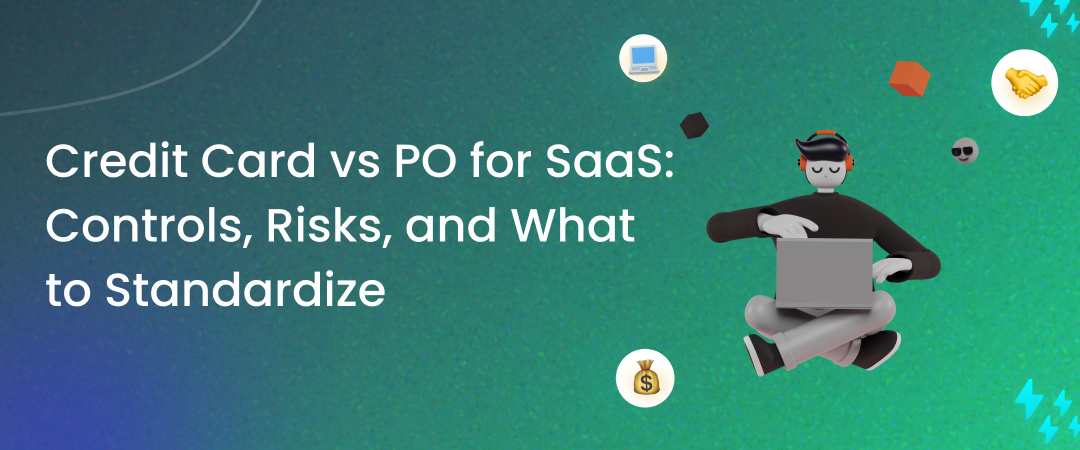
SaaS purchase order processes provide superior visibility, negotiating leverage, and financial controls for larger SaaS investments, while credit cards enable speed and convenience for smaller purchases within governance guardrails. Optimal SaaS payment governance uses threshold-based approaches: credit cards for purchases under $10,000- $25,000 with pre-approved vendors, and purchase orders for larger contracts that require negotiation and formal approval. Organizations standardizing payment approaches reduce unauthorized spending by 65-78%, improve pricing by 18-27% on PO-based purchases, and achieve 94% versus 58% in spending visibility. Success requires balancing control with speed through tiered processes, pre-approved vendor programs, and centralized tracking that captures all payment methods in a unified view.
The choice between credit cards and purchase orders for SaaS acquisitions represents one of the most consequential yet underexamined decisions in enterprise procurement governance. This decision directly impacts spending visibility, negotiation outcomes, compliance controls, and operational efficiency across portfolios, averaging 371 SaaS applications. Yet most organizations lack explicit payment-method policies, leading to ad hoc decisions that create inconsistent practices, governance gaps, and optimization opportunities left unrealized.
The tension between these payment approaches reflects deeper organizational tradeoffs. Credit cards embody departmental empowerment, enabling rapid tool acquisition that supports business agility and user satisfaction. Purchase orders provide centralized control, visibility, negotiation leverage, and assurance of compliance, protecting organizational interests. Neither approach is universally superior; effectiveness depends on purchase characteristics, organizational context, and governance maturity.
The SaaS delivery model intensifies these tradeoffs compared to traditional software procurement. Subscription pricing creates ongoing spending commitments rather than one-time purchases, making payment method decisions about long-term relationships rather than isolated transactions. Cloud delivery and self-service onboarding enable immediate access that rewards credit card speed while bypassing PO controls. Per-user pricing within departmental budgets creates purchasing authority that may exceed governance capacity.
This comprehensive analysis examines credit card and SaaS purchase order approaches across control dimensions, risk profiles, and standardization opportunities. For CFOs, procurement leaders, and IT directors seeking to optimize SaaS payment governance, this framework provides practical guidance for balancing agility with accountability.
Credit card payments have become the default for smaller SaaS purchases, offering speed and convenience that enable departmental agility. Understanding both benefits and risks enables appropriate use within governance frameworks.
Credit cards dramatically accelerate purchase completion, reducing typical procurement cycles from weeks to minutes. When a marketing team needs immediate access to a campaign management tool, or sales requires a new prospecting platform, a credit card purchase eliminates procurement delays that impact business velocity. This speed advantage is most valuable for low-risk purchases where extended evaluation adds cost without proportional benefit.
Departmental autonomy through credit card purchasing enables distributed decision-making that responds to local needs without centralized bottlenecks. Department leaders can acquire tools addressing specific workflow requirements without navigating procurement bureaucracy designed for larger purchases. This empowerment improves user satisfaction and reduces frustration that otherwise drives informal workarounds.
Administrative simplicity reduces procurement overhead for smaller transactions where formal process costs might exceed purchase value. The effort required to create purchase requisitions, obtain approvals, generate POs, and process invoices may not be justified for $500 monthly subscriptions. Credit cards eliminate this overhead while maintaining payment records through expense systems.
Visibility fragmentation represents the primary credit card risk for SaaS governance. Unlike centralized procurement capturing purchases in unified systems, credit card transactions scatter across individual expense reports, departmental budgets, and personal card statements. Organizations typically discover 35-45% of SaaS spending retroactively rather than through proactive procurement, creating blind spots that prevent portfolio optimization.
Reduced negotiating leverage accompanies fragmented purchasing. Individual credit card transactions represent isolated buying events that vendors price at standard rates. Unlike SaaS purchase order processes that aggregate spending across departments and leverage competitive bidding, credit card purchases accept vendor pricing without negotiation. This pricing gap averages 18-27% for mid-sized contracts where PO processes would apply competitive pressure.
Security and compliance gaps emerge when credit card purchases bypass IT review. Applications accessing sensitive data may reach production use without security assessment, creating vulnerabilities and compliance risks. Auto-renewal clauses in click-through agreements perpetuate spending without periodic evaluation. Data handling practices may not align with organizational requirements when contracts are accepted without legal review.
Spending limits constrain credit card authority to appropriate thresholds, typically $5,000- $25,000 annually, depending on organizational risk tolerance. Transactions exceeding limits trigger escalation to formal procurement processes, ensuring significant purchases receive appropriate oversight.
Category restrictions limit credit card purchases to pre-approved vendor categories that have been validated for security and compliance. Software categories handling sensitive data may require purchase order processes regardless of amount, while productivity tools may permit credit card purchase within spending limits.
Expense policy enforcement through automated systems flags non-compliant purchases for review before reimbursement. Integration with expense management platforms enables policy validation at transaction time rather than after-the-fact discovery. Discover visibility across all SaaS payment methods.
SaaS purchase order processes provide superior control and visibility for larger purchases, though traditional implementations often create friction that drives workarounds. Modern PO approaches balance control with efficiency.
Comprehensive visibility comes automatically with PO-based procurement. Every purchase flows through centralized systems that capture vendor information, contract terms, pricing details, and approval records. This visibility enables portfolio analysis, spending optimization, and renewal management impossible with fragmented credit card purchasing. Organizations using POs for majority of SaaS achieve 94% spending visibility versus 58% for credit-card-dominant approaches.
Negotiation leverage improves dramatically with purchase order processes. Procurement teams can aggregate spending across departments, introduce competitive alternatives, and structure negotiations that extract 18-27% better pricing than credit card transactions. Volume discounts, annual prepayment terms, and multi-year commitments become negotiable when purchases flow through structured procurement.
Compliance assurance strengthens when purchase orders trigger required reviews. Security assessment ensures applications meet data protection requirements before deployment. Legal review validates contract terms protect organizational interests. Budget approval confirms spending aligns with financial plans. These checkpoints prevent risks that emerge when credit card purchases bypass oversight.
Contract management improves with PO-based purchasing that captures agreement terms systematically. Renewal dates, pricing provisions, termination rights, and service levels become trackable rather than buried in click-through agreements. This visibility enables proactive renewal management rather than reactive discovery of auto-renewed contracts.
Process friction represents the primary PO risk, potentially driving shadow IT when legitimate business needs cannot wait for extended procurement cycles. Average PO-based procurement requires 42-73 days for mid-market SaaS contracts, creating friction that departmental leaders may bypass through credit cards or expense reports. This workaround behavior undermines the control objectives PO processes intended to achieve.
Administrative burden diverts resources from value-creating activities to transactional processing. Creating requisitions, obtaining approvals, generating purchase orders, matching invoices, and processing payments consume significant effort for each transaction. This overhead may not be justified for smaller purchases where control benefits are marginal.
Vendor relationship complexity increases when PO requirements conflict with vendor processes. Some SaaS vendors resist PO-based purchasing, preferring credit card transactions that simplify their operations. Requiring POs may limit vendor selection or create implementation delays when vendors lack infrastructure for formal procurement.
Streamlined workflows reduce cycle times without sacrificing control. Electronic requisition, automated approval routing, and digital PO delivery can compress traditional 42-73 day cycles to 7-15 days for standard purchases. Eliminating paper processes and manual handoffs addresses friction that drives workarounds.
Tiered approval authorities match review intensity to purchase risk. Small POs within budget and from pre-approved vendors may require single manager approval completing in 24-48 hours. Larger or non-standard purchases trigger additional review layers appropriate to their risk profile. This tiering concentrates oversight effort where it delivers value.
Blanket purchase orders for recurring SaaS subscriptions eliminate repetitive PO creation for known spending. Once the initial agreement is established, monthly or annual renewals process automatically without repeating the full procurement cycle. This approach combines PO control benefits with operational efficiency.
| Dimension | Credit Card | Purchase Order | Optimal Use Case |
|---|---|---|---|
| Speed | 1-3 days for purchase completion | 7-73 days depending on process maturity | Credit card for urgent, low-risk needs |
| Visibility | 52-58% spending visibility average | 90-95% spending visibility average | PO for comprehensive tracking |
| Negotiation | Accept standard pricing | 18-27% better pricing achieved | PO for contracts over $15,000-$25,000 |
| Security Review | Typically bypassed | Integrated into approval workflow | PO for applications handling sensitive data |
| Contract Terms | Click-through acceptance | Negotiated terms protecting organization | PO for contracts with significant commitments |
| Administrative Cost | Minimal processing overhead | Higher overhead, reducible through automation | Credit card for transactions under $5,000 |
| Budget Control | Retrospective tracking via expense | Proactive approval before spending | PO for budget-critical categories |
| Renewal Management | Often miss auto-renewal deadlines | Systematic tracking and alerts | PO for subscriptions over threshold |
Effective SaaS payment governance implements threshold-based approaches that apply appropriate payment methods based on purchase characteristics rather than arbitrary policy.
Low-risk purchases under $10,000-$15,000 annually with pre-approved vendors and no sensitive data access warrant credit card convenience. The control benefits of PO processes do not justify administrative overhead and speed sacrifices for these transactions. Category restrictions and spending limits provide sufficient governance within credit card channels.
Mid-range purchases between $15,000-$50,000 annually should use streamlined PO processes achieving 7-15 day cycle times. These purchases warrant negotiation effort, security review, and contract term attention that PO processes enable. Procurement involvement typically recovers more than administrative costs through better pricing and terms.
High-value purchases exceeding $50,000 annually require comprehensive SaaS purchase order processes including competitive evaluation, formal negotiation, legal review, and executive approval. The stakes justify investment in thorough evaluation, and vendors expect formal procurement for enterprise commitments.
Security-sensitive applications require PO processes regardless of amount when accessing confidential data, financial information, personal records, or regulated content. Security review integration with PO approval ensures assessment before deployment.
Pre-approved vendors with validated security, established master agreements, and volume pricing may warrant elevated credit card limits. When procurement has already done the work of vendor validation and term negotiation, individual purchases can use simplified channels while maintaining governance benefits.
Strategic vendor relationships should use PO processes to maintain negotiating leverage and relationship documentation regardless of individual purchase size. Consolidating spending with strategic vendors through formal procurement enables volume leverage across transactions.
Clear communication ensures employees understand payment method requirements and rationale. Policy documentation, training sessions, and accessible guidance prevent inadvertent non-compliance from confusion rather than circumvention.
Technology enablement simplifies compliance by routing purchases automatically to appropriate channels. Integration between expense systems, procurement platforms, and SaaS management tools provides visibility across payment methods. Learn how CloudNuro unifies visibility across credit card and PO-based SaaS purchases.
Exception processes address legitimate situations requiring deviation from standard approaches. Emergency purchases, unique vendor requirements, and special circumstances need documented pathways that maintain governance while enabling business operations.
Technology and software companies show highest credit card usage at 58% of SaaS transactions, reflecting fast-moving environments prioritizing speed over control for many purchases. However, these organizations also demonstrate highest PO maturity for strategic purchases, using sophisticated threshold-based approaches.
Financial services organizations use POs for 68% of SaaS purchases, driven by regulatory requirements mandating procurement controls. Credit card usage concentrates in low-risk productivity categories with strict spending limits, typically $5,000 or less.
Healthcare organizations demonstrate 54% PO usage for SaaS, with HIPAA compliance requirements forcing formal procurement for applications accessing protected health information. Credit card purchasing remains common for administrative tools without patient data access.
Professional services firms balance at 48% PO and 45% credit card usage, with 7% invoiced. Client confidentiality requirements drive PO processes for applications handling client data while administrative tools use credit card convenience.
Manufacturing organizations show lowest SaaS procurement maturity with only 42% PO usage, reflecting traditional IT approaches not yet adapted to cloud purchasing. Higher credit card usage (52%) creates visibility gaps these organizations are working to address.
Credit card transactions average $8,400 annually per subscription across all organizations. Purchase order-based subscriptions average $47,600 annually, reflecting threshold-based approaches directing larger purchases through formal procurement. Invoice/ACH payments average $28,200, often used for mid-range purchases where credit cards hit limits but PO overhead seems excessive.
The top 20% of SaaS vendors by spending account for 73% of total SaaS expenditure and receive 89% of PO-based payments. The remaining 80% of vendors representing 27% of spending receive 78% credit card payments. This concentration suggests threshold-based approaches naturally direct procurement resources to highest-impact vendors.
What spending threshold should trigger PO requirements? Most organizations set SaaS purchase order thresholds between $10,000-$25,000 annually, with $15,000 being most common. Lower thresholds (under $10,000) create administrative burden exceeding control benefits, while higher thresholds (over $25,000) miss negotiation opportunities and visibility for significant purchases.
How do we handle vendors that won't accept POs? Evaluate whether vendor relationship justifies process exception. For strategic vendors, escalate to management for commercial discussion about procurement accommodation. For replaceable vendors, consider alternatives that support your procurement processes. For low-value purchases, credit card may be appropriate regardless of preference.
Should all SaaS use POs for better control? Universal PO requirements create friction that drives workarounds, undermining control objectives. Threshold-based approaches that apply PO processes to larger purchases while permitting credit cards for smaller transactions within governance guardrails achieve better outcomes than one-size-fits-all policies.
How do we track credit card SaaS purchases? Integrate expense management systems with SaaS management platforms to capture credit card transactions systematically. Require specific expense categories for software subscriptions enabling filtering and analysis. Conduct periodic reconciliation between discovered applications and expense records to identify gaps.
What controls work best for credit card SaaS? Effective credit card controls include spending limits by category, pre-approved vendor lists, required expense coding for software purchases, automatic flagging of recurring charges, and policy enforcement at transaction time rather than after-the-fact review.
How do we improve PO process speed? Streamline by eliminating paper processes, automating approval routing, implementing electronic signatures, using blanket POs for recurring subscriptions, and pre-negotiating master agreements with common vendors. Target 7-15 day cycle times for standard purchases.
Understanding the distribution of SaaS payment methods reveals significant governance implications for organizations seeking to balance agility with control.
Credit card payments represent 47% of SaaS transactions in 2024, up from 31% in 2018, while purchase orders (POs) account for 38% and invoice/ACH payments cover the remaining 15%. For contracts under $25,000 annually, credit cards dominate at 73% of payments, while purchases exceeding $100,000 use POs 82% of the time. This bifurcation reflects different control requirements for varying purchase sizes, but also creates governance gaps where mid-range purchases fall between standardized processes.
The average enterprise processes 371 SaaS subscriptions through multiple payment channels, creating fragmented visibility that obscures total spending. Organizations relying primarily on credit cards for SaaS discover 35-45% of spending only through expense report reconciliation rather than proactive procurement. Those using SaaS purchase order processes for the majority of subscriptions achieve 94% spending visibility versus 58% for credit-card-dominant organizations.
Payment method directly correlates with negotiation outcomes. PO-based purchases achieve 18-27% better pricing than credit card transactions due to competitive bidding processes, volume aggregation, and structured negotiation. However, credit card purchases complete in 3-5 days versus 42-73 days for PO-processed acquisitions, creating genuine speed-control tradeoffs that organizations must navigate strategically.
Best-in-class organizations maintain visibility into 95%+ of SaaS spending through centralized payment processes. The industry average sits at 68%, with credit-card-heavy organizations averaging 52-58% visibility. Target discovery rate of less than 5% of spending through retrospective expense analysis versus current average of 35-45% for organizations lacking payment governance.
Purchase order utilization rate should exceed 80% for contracts above $15,000-$25,000 thresholds. Credit card spending should concentrate in pre-approved vendor categories with established spending limits. Exception rates (purchases bypassing established payment channels) should remain below 10%, with best-in-class achieving under 5%.
Credit card purchases should complete within 48-72 hours for pre-approved vendors. Streamlined PO processes should achieve 7-10 day cycle times for standard purchases versus industry average of 42-73 days. Emergency procurement provisions should enable same-day approvals for documented urgent needs.
Budget variance from SaaS spending should remain within 5% of planned allocations with proper payment governance. Unauthorized spending (purchases outside established limits or categories) should represent less than 3% of total SaaS expenditure. Price variance from negotiated rates should trigger alerts when exceeding 10% thresholds.
The choice between credit cards and SaaS purchase order processes for SaaS acquisitions involves genuine tradeoffs that threshold-based governance frameworks address more effectively than rigid universal policies. Credit cards deliver speed and convenience that supports business agility for smaller purchases, while purchase orders provide visibility, negotiation leverage, and compliance controls essential for significant investments.
Optimal governance recognizes these complementary roles rather than viewing payment methods as competing approaches. Low-risk purchases under $10,000-$15,000 flow through credit card channels with spending limits and category controls providing sufficient governance. Mid-range and high-value purchases use streamlined PO processes that balance control benefits with operational efficiency. Category-based adjustments ensure security-sensitive applications receive appropriate oversight regardless of size.
Implementation success depends on process design that achieves control objectives without creating friction driving workarounds. When PO processes require 42-73 days for approvals, departmental leaders rationally turn to credit cards or expense reports that complete in days. When streamlined processes achieve 7-15 day cycle times with appropriate review integration, compliance becomes the path of least resistance rather than bureaucratic obstacle.
Technology platforms providing unified visibility across payment methods eliminate the false choice between agility and accountability. When credit card transactions flow into the same management systems as PO-based purchases, organizations achieve portfolio-wide visibility while preserving appropriate payment flexibility.
For CFOs, procurement leaders, and IT directors optimizing SaaS payment governance, the goal is not to maximize either credit card convenience or PO control, but to find a threshold-based balance that serves organizational interests across the full portfolio of 371 average applications.
CloudNuro is a leader in Enterprise SaaS Management Platforms, giving enterprises unmatched visibility, governance, and cost optimization.
While this guide examined trade-offs between credit card and SaaS purchase orders, CloudNuro eliminates the visibility gap that makes payment method choice so consequential. The platform discovers SaaS applications regardless of payment channel, capturing credit card subscriptions from expense systems alongside PO-based purchases from procurement platforms. This unified visibility enables portfolio-wide optimization impossible when different payment methods create fragmented information.
CloudNuro tracks spending, utilization, and renewal dates across all payment sources, alerting teams to upcoming auto-renewals whether originally purchased via credit card or PO. The platform identifies optimization opportunities regardless of how purchases originated, enabling systematic waste elimination across the full 371-application average portfolio.
For organizations implementing threshold-based payment governance, CloudNuro provides the visibility foundation ensuring governance policies translate into actual spending control. Rather than discovering credit card SaaS spending retroactively through expense analysis, CloudNuro captures transactions in real-time for immediate portfolio integration.
Request a Demo | Get Free Savings Assessment | Explore Product
Request a no cost, no obligation free assessment —just 15 minutes to savings!
Get StartedSaaS purchase order processes provide superior visibility, negotiating leverage, and financial controls for larger SaaS investments, while credit cards enable speed and convenience for smaller purchases within governance guardrails. Optimal SaaS payment governance uses threshold-based approaches: credit cards for purchases under $10,000- $25,000 with pre-approved vendors, and purchase orders for larger contracts that require negotiation and formal approval. Organizations standardizing payment approaches reduce unauthorized spending by 65-78%, improve pricing by 18-27% on PO-based purchases, and achieve 94% versus 58% in spending visibility. Success requires balancing control with speed through tiered processes, pre-approved vendor programs, and centralized tracking that captures all payment methods in a unified view.
The choice between credit cards and purchase orders for SaaS acquisitions represents one of the most consequential yet underexamined decisions in enterprise procurement governance. This decision directly impacts spending visibility, negotiation outcomes, compliance controls, and operational efficiency across portfolios, averaging 371 SaaS applications. Yet most organizations lack explicit payment-method policies, leading to ad hoc decisions that create inconsistent practices, governance gaps, and optimization opportunities left unrealized.
The tension between these payment approaches reflects deeper organizational tradeoffs. Credit cards embody departmental empowerment, enabling rapid tool acquisition that supports business agility and user satisfaction. Purchase orders provide centralized control, visibility, negotiation leverage, and assurance of compliance, protecting organizational interests. Neither approach is universally superior; effectiveness depends on purchase characteristics, organizational context, and governance maturity.
The SaaS delivery model intensifies these tradeoffs compared to traditional software procurement. Subscription pricing creates ongoing spending commitments rather than one-time purchases, making payment method decisions about long-term relationships rather than isolated transactions. Cloud delivery and self-service onboarding enable immediate access that rewards credit card speed while bypassing PO controls. Per-user pricing within departmental budgets creates purchasing authority that may exceed governance capacity.
This comprehensive analysis examines credit card and SaaS purchase order approaches across control dimensions, risk profiles, and standardization opportunities. For CFOs, procurement leaders, and IT directors seeking to optimize SaaS payment governance, this framework provides practical guidance for balancing agility with accountability.
Credit card payments have become the default for smaller SaaS purchases, offering speed and convenience that enable departmental agility. Understanding both benefits and risks enables appropriate use within governance frameworks.
Credit cards dramatically accelerate purchase completion, reducing typical procurement cycles from weeks to minutes. When a marketing team needs immediate access to a campaign management tool, or sales requires a new prospecting platform, a credit card purchase eliminates procurement delays that impact business velocity. This speed advantage is most valuable for low-risk purchases where extended evaluation adds cost without proportional benefit.
Departmental autonomy through credit card purchasing enables distributed decision-making that responds to local needs without centralized bottlenecks. Department leaders can acquire tools addressing specific workflow requirements without navigating procurement bureaucracy designed for larger purchases. This empowerment improves user satisfaction and reduces frustration that otherwise drives informal workarounds.
Administrative simplicity reduces procurement overhead for smaller transactions where formal process costs might exceed purchase value. The effort required to create purchase requisitions, obtain approvals, generate POs, and process invoices may not be justified for $500 monthly subscriptions. Credit cards eliminate this overhead while maintaining payment records through expense systems.
Visibility fragmentation represents the primary credit card risk for SaaS governance. Unlike centralized procurement capturing purchases in unified systems, credit card transactions scatter across individual expense reports, departmental budgets, and personal card statements. Organizations typically discover 35-45% of SaaS spending retroactively rather than through proactive procurement, creating blind spots that prevent portfolio optimization.
Reduced negotiating leverage accompanies fragmented purchasing. Individual credit card transactions represent isolated buying events that vendors price at standard rates. Unlike SaaS purchase order processes that aggregate spending across departments and leverage competitive bidding, credit card purchases accept vendor pricing without negotiation. This pricing gap averages 18-27% for mid-sized contracts where PO processes would apply competitive pressure.
Security and compliance gaps emerge when credit card purchases bypass IT review. Applications accessing sensitive data may reach production use without security assessment, creating vulnerabilities and compliance risks. Auto-renewal clauses in click-through agreements perpetuate spending without periodic evaluation. Data handling practices may not align with organizational requirements when contracts are accepted without legal review.
Spending limits constrain credit card authority to appropriate thresholds, typically $5,000- $25,000 annually, depending on organizational risk tolerance. Transactions exceeding limits trigger escalation to formal procurement processes, ensuring significant purchases receive appropriate oversight.
Category restrictions limit credit card purchases to pre-approved vendor categories that have been validated for security and compliance. Software categories handling sensitive data may require purchase order processes regardless of amount, while productivity tools may permit credit card purchase within spending limits.
Expense policy enforcement through automated systems flags non-compliant purchases for review before reimbursement. Integration with expense management platforms enables policy validation at transaction time rather than after-the-fact discovery. Discover visibility across all SaaS payment methods.
SaaS purchase order processes provide superior control and visibility for larger purchases, though traditional implementations often create friction that drives workarounds. Modern PO approaches balance control with efficiency.
Comprehensive visibility comes automatically with PO-based procurement. Every purchase flows through centralized systems that capture vendor information, contract terms, pricing details, and approval records. This visibility enables portfolio analysis, spending optimization, and renewal management impossible with fragmented credit card purchasing. Organizations using POs for majority of SaaS achieve 94% spending visibility versus 58% for credit-card-dominant approaches.
Negotiation leverage improves dramatically with purchase order processes. Procurement teams can aggregate spending across departments, introduce competitive alternatives, and structure negotiations that extract 18-27% better pricing than credit card transactions. Volume discounts, annual prepayment terms, and multi-year commitments become negotiable when purchases flow through structured procurement.
Compliance assurance strengthens when purchase orders trigger required reviews. Security assessment ensures applications meet data protection requirements before deployment. Legal review validates contract terms protect organizational interests. Budget approval confirms spending aligns with financial plans. These checkpoints prevent risks that emerge when credit card purchases bypass oversight.
Contract management improves with PO-based purchasing that captures agreement terms systematically. Renewal dates, pricing provisions, termination rights, and service levels become trackable rather than buried in click-through agreements. This visibility enables proactive renewal management rather than reactive discovery of auto-renewed contracts.
Process friction represents the primary PO risk, potentially driving shadow IT when legitimate business needs cannot wait for extended procurement cycles. Average PO-based procurement requires 42-73 days for mid-market SaaS contracts, creating friction that departmental leaders may bypass through credit cards or expense reports. This workaround behavior undermines the control objectives PO processes intended to achieve.
Administrative burden diverts resources from value-creating activities to transactional processing. Creating requisitions, obtaining approvals, generating purchase orders, matching invoices, and processing payments consume significant effort for each transaction. This overhead may not be justified for smaller purchases where control benefits are marginal.
Vendor relationship complexity increases when PO requirements conflict with vendor processes. Some SaaS vendors resist PO-based purchasing, preferring credit card transactions that simplify their operations. Requiring POs may limit vendor selection or create implementation delays when vendors lack infrastructure for formal procurement.
Streamlined workflows reduce cycle times without sacrificing control. Electronic requisition, automated approval routing, and digital PO delivery can compress traditional 42-73 day cycles to 7-15 days for standard purchases. Eliminating paper processes and manual handoffs addresses friction that drives workarounds.
Tiered approval authorities match review intensity to purchase risk. Small POs within budget and from pre-approved vendors may require single manager approval completing in 24-48 hours. Larger or non-standard purchases trigger additional review layers appropriate to their risk profile. This tiering concentrates oversight effort where it delivers value.
Blanket purchase orders for recurring SaaS subscriptions eliminate repetitive PO creation for known spending. Once the initial agreement is established, monthly or annual renewals process automatically without repeating the full procurement cycle. This approach combines PO control benefits with operational efficiency.
| Dimension | Credit Card | Purchase Order | Optimal Use Case |
|---|---|---|---|
| Speed | 1-3 days for purchase completion | 7-73 days depending on process maturity | Credit card for urgent, low-risk needs |
| Visibility | 52-58% spending visibility average | 90-95% spending visibility average | PO for comprehensive tracking |
| Negotiation | Accept standard pricing | 18-27% better pricing achieved | PO for contracts over $15,000-$25,000 |
| Security Review | Typically bypassed | Integrated into approval workflow | PO for applications handling sensitive data |
| Contract Terms | Click-through acceptance | Negotiated terms protecting organization | PO for contracts with significant commitments |
| Administrative Cost | Minimal processing overhead | Higher overhead, reducible through automation | Credit card for transactions under $5,000 |
| Budget Control | Retrospective tracking via expense | Proactive approval before spending | PO for budget-critical categories |
| Renewal Management | Often miss auto-renewal deadlines | Systematic tracking and alerts | PO for subscriptions over threshold |
Effective SaaS payment governance implements threshold-based approaches that apply appropriate payment methods based on purchase characteristics rather than arbitrary policy.
Low-risk purchases under $10,000-$15,000 annually with pre-approved vendors and no sensitive data access warrant credit card convenience. The control benefits of PO processes do not justify administrative overhead and speed sacrifices for these transactions. Category restrictions and spending limits provide sufficient governance within credit card channels.
Mid-range purchases between $15,000-$50,000 annually should use streamlined PO processes achieving 7-15 day cycle times. These purchases warrant negotiation effort, security review, and contract term attention that PO processes enable. Procurement involvement typically recovers more than administrative costs through better pricing and terms.
High-value purchases exceeding $50,000 annually require comprehensive SaaS purchase order processes including competitive evaluation, formal negotiation, legal review, and executive approval. The stakes justify investment in thorough evaluation, and vendors expect formal procurement for enterprise commitments.
Security-sensitive applications require PO processes regardless of amount when accessing confidential data, financial information, personal records, or regulated content. Security review integration with PO approval ensures assessment before deployment.
Pre-approved vendors with validated security, established master agreements, and volume pricing may warrant elevated credit card limits. When procurement has already done the work of vendor validation and term negotiation, individual purchases can use simplified channels while maintaining governance benefits.
Strategic vendor relationships should use PO processes to maintain negotiating leverage and relationship documentation regardless of individual purchase size. Consolidating spending with strategic vendors through formal procurement enables volume leverage across transactions.
Clear communication ensures employees understand payment method requirements and rationale. Policy documentation, training sessions, and accessible guidance prevent inadvertent non-compliance from confusion rather than circumvention.
Technology enablement simplifies compliance by routing purchases automatically to appropriate channels. Integration between expense systems, procurement platforms, and SaaS management tools provides visibility across payment methods. Learn how CloudNuro unifies visibility across credit card and PO-based SaaS purchases.
Exception processes address legitimate situations requiring deviation from standard approaches. Emergency purchases, unique vendor requirements, and special circumstances need documented pathways that maintain governance while enabling business operations.
Technology and software companies show highest credit card usage at 58% of SaaS transactions, reflecting fast-moving environments prioritizing speed over control for many purchases. However, these organizations also demonstrate highest PO maturity for strategic purchases, using sophisticated threshold-based approaches.
Financial services organizations use POs for 68% of SaaS purchases, driven by regulatory requirements mandating procurement controls. Credit card usage concentrates in low-risk productivity categories with strict spending limits, typically $5,000 or less.
Healthcare organizations demonstrate 54% PO usage for SaaS, with HIPAA compliance requirements forcing formal procurement for applications accessing protected health information. Credit card purchasing remains common for administrative tools without patient data access.
Professional services firms balance at 48% PO and 45% credit card usage, with 7% invoiced. Client confidentiality requirements drive PO processes for applications handling client data while administrative tools use credit card convenience.
Manufacturing organizations show lowest SaaS procurement maturity with only 42% PO usage, reflecting traditional IT approaches not yet adapted to cloud purchasing. Higher credit card usage (52%) creates visibility gaps these organizations are working to address.
Credit card transactions average $8,400 annually per subscription across all organizations. Purchase order-based subscriptions average $47,600 annually, reflecting threshold-based approaches directing larger purchases through formal procurement. Invoice/ACH payments average $28,200, often used for mid-range purchases where credit cards hit limits but PO overhead seems excessive.
The top 20% of SaaS vendors by spending account for 73% of total SaaS expenditure and receive 89% of PO-based payments. The remaining 80% of vendors representing 27% of spending receive 78% credit card payments. This concentration suggests threshold-based approaches naturally direct procurement resources to highest-impact vendors.
What spending threshold should trigger PO requirements? Most organizations set SaaS purchase order thresholds between $10,000-$25,000 annually, with $15,000 being most common. Lower thresholds (under $10,000) create administrative burden exceeding control benefits, while higher thresholds (over $25,000) miss negotiation opportunities and visibility for significant purchases.
How do we handle vendors that won't accept POs? Evaluate whether vendor relationship justifies process exception. For strategic vendors, escalate to management for commercial discussion about procurement accommodation. For replaceable vendors, consider alternatives that support your procurement processes. For low-value purchases, credit card may be appropriate regardless of preference.
Should all SaaS use POs for better control? Universal PO requirements create friction that drives workarounds, undermining control objectives. Threshold-based approaches that apply PO processes to larger purchases while permitting credit cards for smaller transactions within governance guardrails achieve better outcomes than one-size-fits-all policies.
How do we track credit card SaaS purchases? Integrate expense management systems with SaaS management platforms to capture credit card transactions systematically. Require specific expense categories for software subscriptions enabling filtering and analysis. Conduct periodic reconciliation between discovered applications and expense records to identify gaps.
What controls work best for credit card SaaS? Effective credit card controls include spending limits by category, pre-approved vendor lists, required expense coding for software purchases, automatic flagging of recurring charges, and policy enforcement at transaction time rather than after-the-fact review.
How do we improve PO process speed? Streamline by eliminating paper processes, automating approval routing, implementing electronic signatures, using blanket POs for recurring subscriptions, and pre-negotiating master agreements with common vendors. Target 7-15 day cycle times for standard purchases.
Understanding the distribution of SaaS payment methods reveals significant governance implications for organizations seeking to balance agility with control.
Credit card payments represent 47% of SaaS transactions in 2024, up from 31% in 2018, while purchase orders (POs) account for 38% and invoice/ACH payments cover the remaining 15%. For contracts under $25,000 annually, credit cards dominate at 73% of payments, while purchases exceeding $100,000 use POs 82% of the time. This bifurcation reflects different control requirements for varying purchase sizes, but also creates governance gaps where mid-range purchases fall between standardized processes.
The average enterprise processes 371 SaaS subscriptions through multiple payment channels, creating fragmented visibility that obscures total spending. Organizations relying primarily on credit cards for SaaS discover 35-45% of spending only through expense report reconciliation rather than proactive procurement. Those using SaaS purchase order processes for the majority of subscriptions achieve 94% spending visibility versus 58% for credit-card-dominant organizations.
Payment method directly correlates with negotiation outcomes. PO-based purchases achieve 18-27% better pricing than credit card transactions due to competitive bidding processes, volume aggregation, and structured negotiation. However, credit card purchases complete in 3-5 days versus 42-73 days for PO-processed acquisitions, creating genuine speed-control tradeoffs that organizations must navigate strategically.
Best-in-class organizations maintain visibility into 95%+ of SaaS spending through centralized payment processes. The industry average sits at 68%, with credit-card-heavy organizations averaging 52-58% visibility. Target discovery rate of less than 5% of spending through retrospective expense analysis versus current average of 35-45% for organizations lacking payment governance.
Purchase order utilization rate should exceed 80% for contracts above $15,000-$25,000 thresholds. Credit card spending should concentrate in pre-approved vendor categories with established spending limits. Exception rates (purchases bypassing established payment channels) should remain below 10%, with best-in-class achieving under 5%.
Credit card purchases should complete within 48-72 hours for pre-approved vendors. Streamlined PO processes should achieve 7-10 day cycle times for standard purchases versus industry average of 42-73 days. Emergency procurement provisions should enable same-day approvals for documented urgent needs.
Budget variance from SaaS spending should remain within 5% of planned allocations with proper payment governance. Unauthorized spending (purchases outside established limits or categories) should represent less than 3% of total SaaS expenditure. Price variance from negotiated rates should trigger alerts when exceeding 10% thresholds.
The choice between credit cards and SaaS purchase order processes for SaaS acquisitions involves genuine tradeoffs that threshold-based governance frameworks address more effectively than rigid universal policies. Credit cards deliver speed and convenience that supports business agility for smaller purchases, while purchase orders provide visibility, negotiation leverage, and compliance controls essential for significant investments.
Optimal governance recognizes these complementary roles rather than viewing payment methods as competing approaches. Low-risk purchases under $10,000-$15,000 flow through credit card channels with spending limits and category controls providing sufficient governance. Mid-range and high-value purchases use streamlined PO processes that balance control benefits with operational efficiency. Category-based adjustments ensure security-sensitive applications receive appropriate oversight regardless of size.
Implementation success depends on process design that achieves control objectives without creating friction driving workarounds. When PO processes require 42-73 days for approvals, departmental leaders rationally turn to credit cards or expense reports that complete in days. When streamlined processes achieve 7-15 day cycle times with appropriate review integration, compliance becomes the path of least resistance rather than bureaucratic obstacle.
Technology platforms providing unified visibility across payment methods eliminate the false choice between agility and accountability. When credit card transactions flow into the same management systems as PO-based purchases, organizations achieve portfolio-wide visibility while preserving appropriate payment flexibility.
For CFOs, procurement leaders, and IT directors optimizing SaaS payment governance, the goal is not to maximize either credit card convenience or PO control, but to find a threshold-based balance that serves organizational interests across the full portfolio of 371 average applications.
CloudNuro is a leader in Enterprise SaaS Management Platforms, giving enterprises unmatched visibility, governance, and cost optimization.
While this guide examined trade-offs between credit card and SaaS purchase orders, CloudNuro eliminates the visibility gap that makes payment method choice so consequential. The platform discovers SaaS applications regardless of payment channel, capturing credit card subscriptions from expense systems alongside PO-based purchases from procurement platforms. This unified visibility enables portfolio-wide optimization impossible when different payment methods create fragmented information.
CloudNuro tracks spending, utilization, and renewal dates across all payment sources, alerting teams to upcoming auto-renewals whether originally purchased via credit card or PO. The platform identifies optimization opportunities regardless of how purchases originated, enabling systematic waste elimination across the full 371-application average portfolio.
For organizations implementing threshold-based payment governance, CloudNuro provides the visibility foundation ensuring governance policies translate into actual spending control. Rather than discovering credit card SaaS spending retroactively through expense analysis, CloudNuro captures transactions in real-time for immediate portfolio integration.
Request a Demo | Get Free Savings Assessment | Explore Product
Request a no cost, no obligation free assessment - just 15 minutes to savings!
Get StartedWe're offering complimentary ServiceNow license assessments to only 25 enterprises this quarter who want to unlock immediate savings without disrupting operations.
Get Free AssessmentGet Started




CloudNuro Corp
1755 Park St. Suite 207
Naperville, IL 60563
Phone : +1-630-277-9470
Email: info@cloudnuro.com


.svg)



.webp)

Recognized Leader in SaaS Management Platforms by Info-Tech SoftwareReviews