

Sign Up
Thank you for Submitting!
AI is at the center of enterprise transformation in 2026. With 70% of software engineering teams building multimodel applications expected to use AI gateways and 40% of enterprise applications embedding task-specific AI agents, the deployment architecture you choose is now directly tied to cost control, compliance, and operational speed. The question is no longer "if" you’ll deploy an AI gateway, but rather: Do you go self-hosted or managed?
This guide provides CIOs, CTOs, and IT leaders in healthcare, finance, government, and corporate sectors with an actionable framework for evaluating self-hosted versus managed AI gateways. We’ll unpack the operational and compliance tradeoffs, cost optimization best practices, and show how CloudNuro AI Custodian enables governance, spend management, and flexible integration across both deployment types.
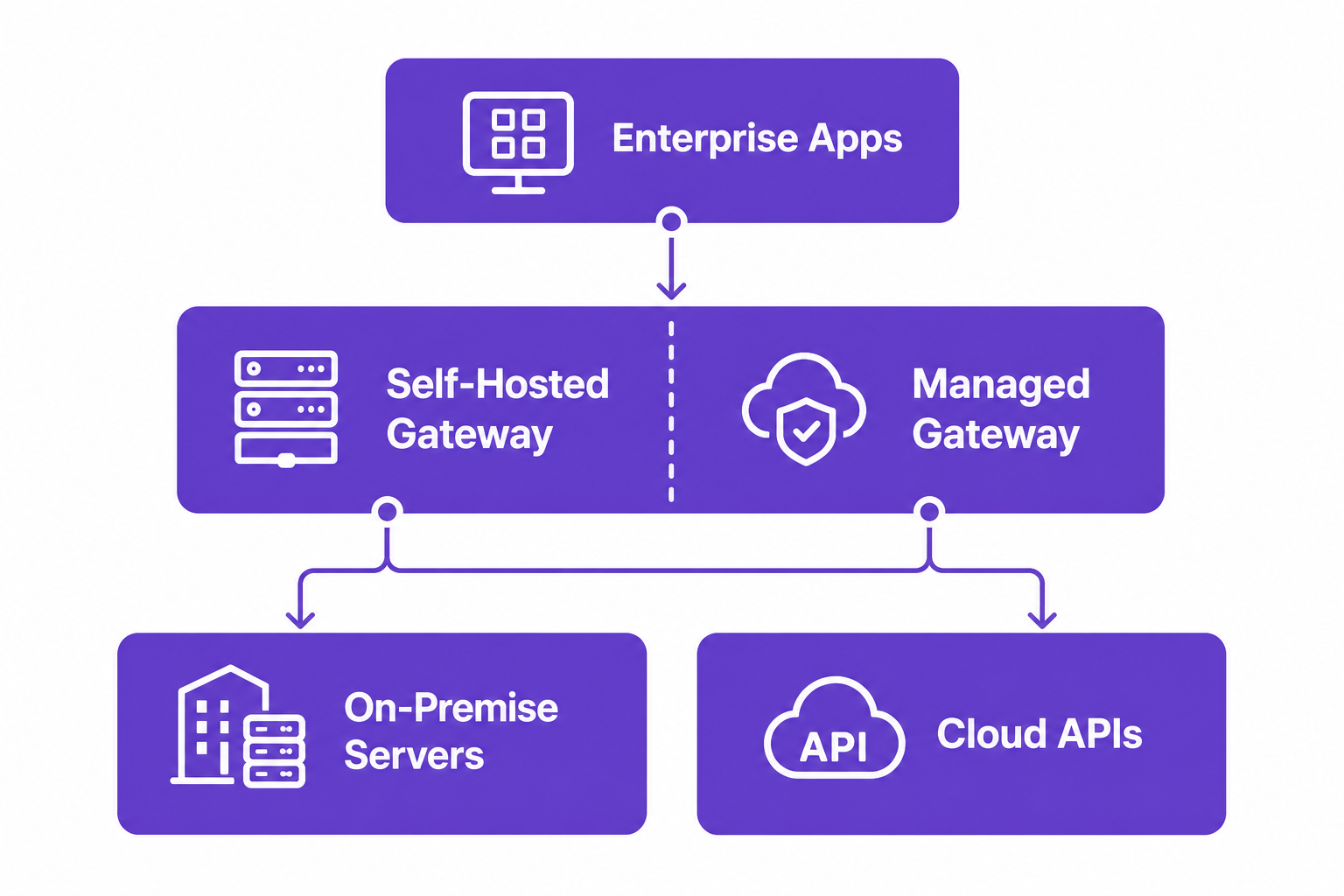
AI gateways serve as the critical point of control for routing, compliance enforcement, and cost allocation in enterprise AI deployments. As adoption trends move toward hybrid decision-making, let’s define the two main models:
Control & Residency: Operate entirely within your environment, on-premises or private cloud. Data never leaves your perimeter and you set all system parameters.
Security & Compliance: Ideal when meeting strict regulations on data sovereignty, compliance frameworks, or sensitive workload isolation is the top priority.
Operational Effort: You are responsible for setup, scaling, patching, and lifecycle management.
Simplicity: Run as-a-service by a provider, abstracting away deployment, scaling, and maintenance tasks.
Feature Acceleration: Typically roll out new integrations, caching, and security upgrades rapidly as centralized SaaS.
Trust Shift: Data and runtime are in the vendor’s domain, making vendor assurance critical for regulated sectors.
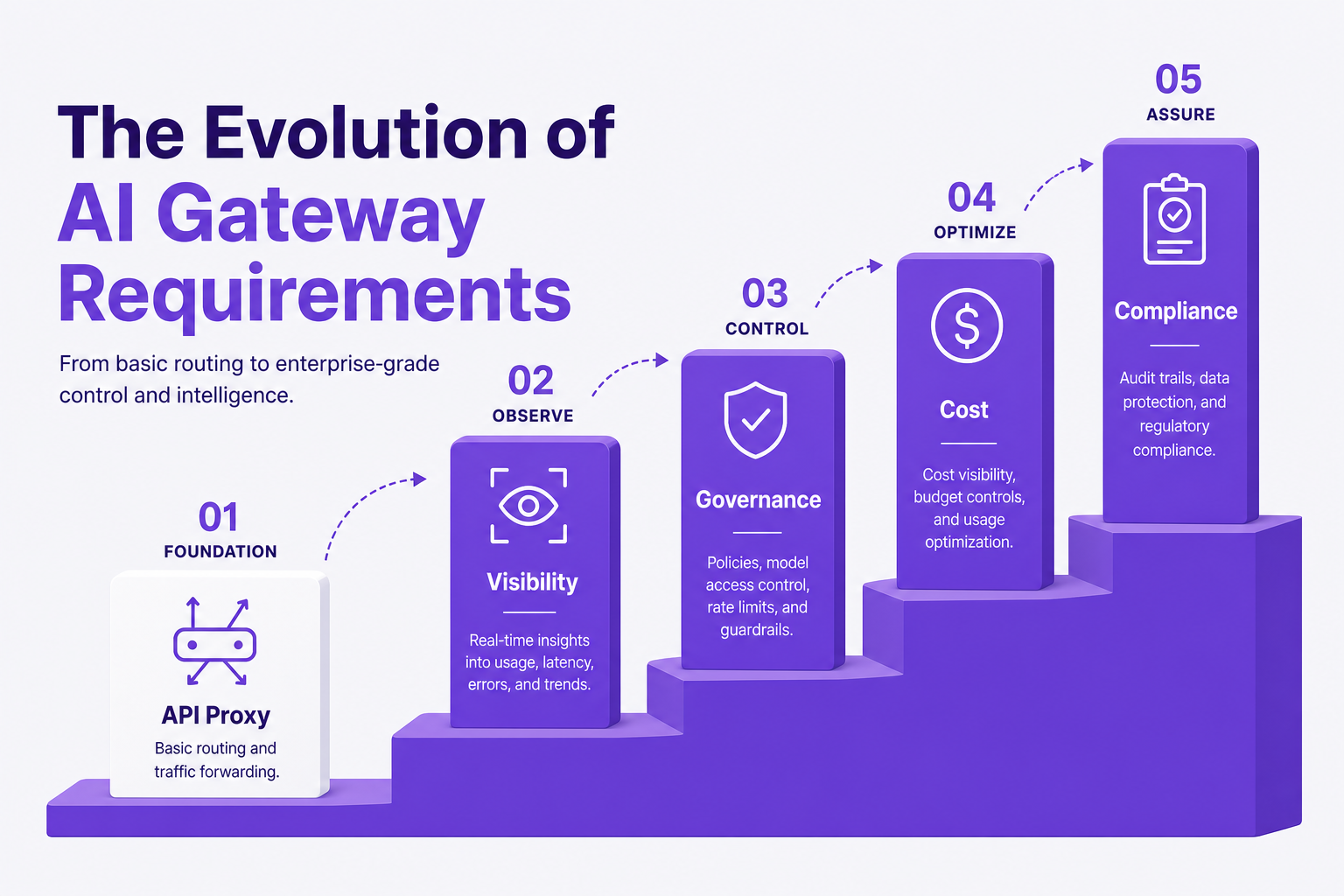
Today’s enterprise AI gateway needs have outgrown simple API brokering:
Centralized Visibility: Unified tracking of cost, user activity, and prompt volume across all connected apps and teams.
Cost-Aware Routing & Caching: Direct jobs to the best model or vendor instance based on cost, performance, or policy.
Governance-Driven Controls: Automated policy enforcement and evidence trails for audits.
Deep Integration: Seamless plug-in to existing SaaS management, security, and IT operations platforms.
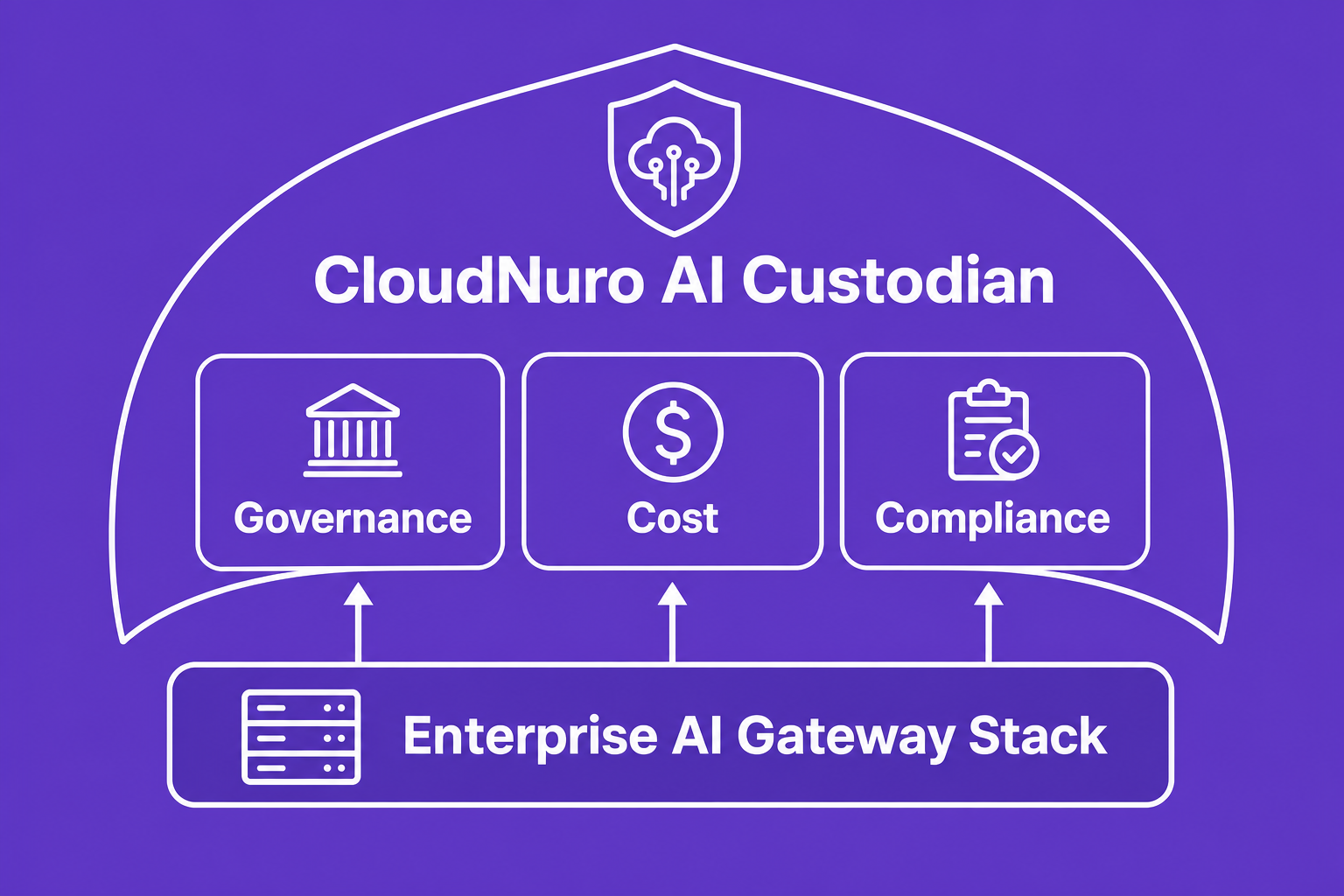
CloudNuro AI Custodian delivers these must-haves by:
Monitoring active users, prompt flows, and per-app adoption for full-stack visibility.
Segmenting users by activity, surfacing optimization opportunities for costly AI licenses.
Tracking token consumption and spend at the individual AI agent or project level to enforce smart budgeting.
Integrating with enterprise tools to check prompt content for risk and compliance violations.
Let’s break down the tradeoffs from an enterprise perspective:
|
Consideration |
Self-Hosted Gateway |
Managed Gateway |
|---|---|---|
|
Data Control |
Full ownership, meets strict residency needs |
Data may leave premises, depends on vendor controls |
|
Compliance |
Highest auditability, in-house enforcement |
Up to vendor’s compliance framework |
|
Operational Load |
Internal teams manage scaling and outages |
Offloaded to vendor, faster go-live |
|
Scalability |
Requires proactive resourcing |
Elastic, handled by provider |
|
Feature Rollout |
Customization possible, but slower upgrades |
Rapid access to new capabilities |
|
Cost Governance |
Cost is more predictable, but requires careful tracking |
Subscription-based, variable usage-based billing |
Expert insight: The crossover point often hinges on the cost of avoided engineering effort compared to ongoing platform fees. If data residency, audit trails, and direct control are first-order needs, self-hosted wins; for fast scaling and minimal management, managed will appeal.
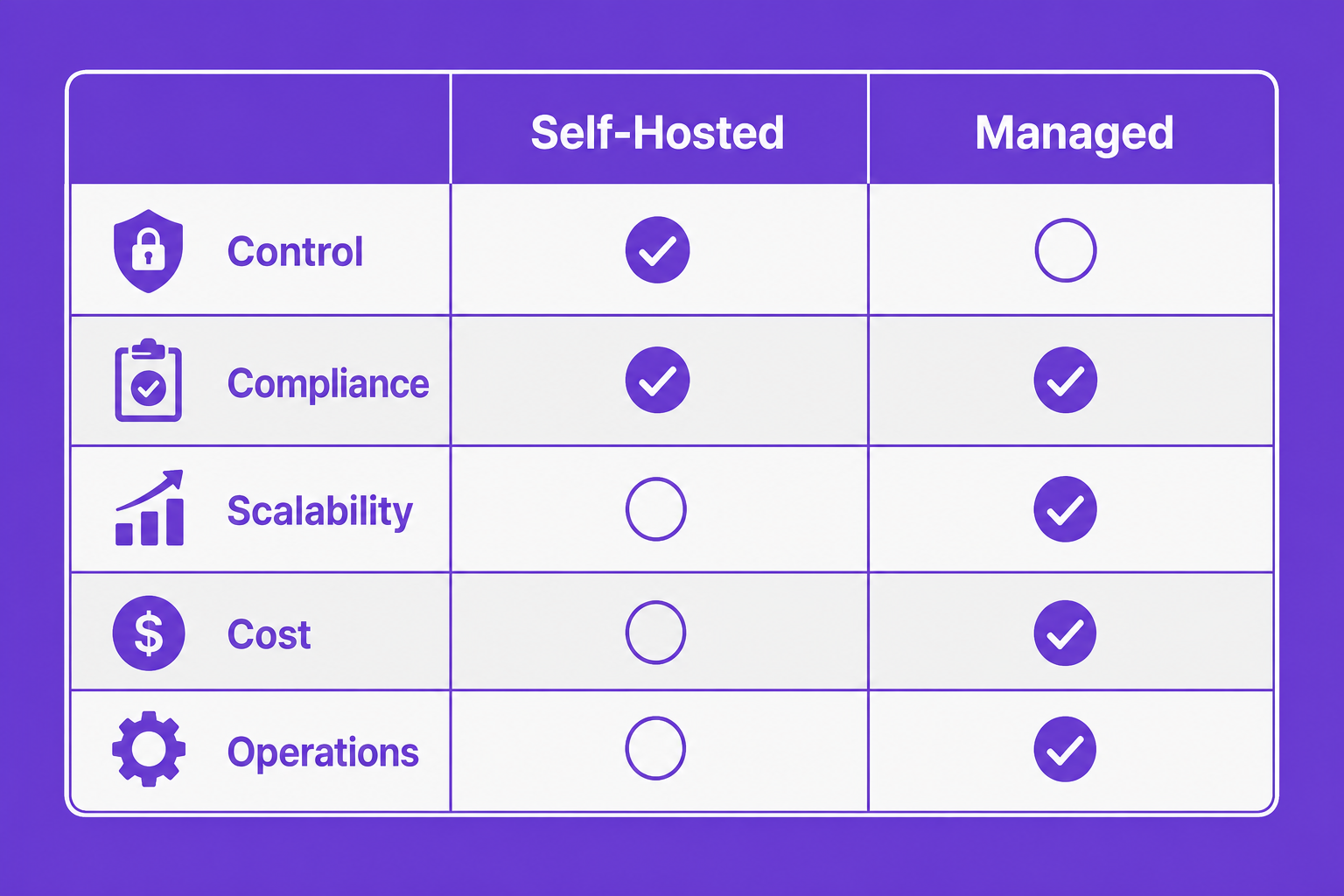
Hybrid approaches are gaining momentum. Enterprises may use managed gateways for general workloads while reserving self-hosted solutions for sensitive applications or regulated teams. Two options often asked about are:
An open source, self-hostable proxy designed for routing and managing access to various large language models. While it provides solid core functionality and cost transparency, large-scale production deployment may require additional engineering/operational investment for HA, integration, and policy controls.
Marketed as an open AI gateway for cost, security, and compliance routing, Portkey emphasizes open standards. It can be suitable for enterprises but organizations must validate its controls, reliability, and integration with existing identity/governance systems before betting critical workloads on it.
A truly enterprise-grade gateway, regardless of source model, needs:
Policy enforcement
Centralized cost tracking
User and app segmentation
Audit trails
Integration with SaaS management and compliance tools
CloudNuro AI Custodian layers these enterprise features, whether you host or manage.
Here’s a practical, risk-based framework for evaluating which model is right for your needs:
Define Compliance Needs: If data sovereignty, PII leakage prevention, or custom auditability is a top-tier requirement, lean toward self-hosted or hybrid with strong controls.
Map Operational Constraints: If engineering capacity is limited and speed-to-value is critical, managed may win.
Quantify Cost Governance Requirements: Do you need granular budgeting, chargeback, and real-time visibility into how different business units use and spend on AI? If so, a solution with robust cost allocation (like CloudNuro AI Custodian) is non-negotiable.
Check Integration Demands: Will the gateway integrate seamlessly into existing ITSM, security, and SaaS management tooling?
Plan for Growth: Can your chosen model scale as business lines, AI models, and regulatory needs grow or shift?
CloudNuro’s governance-first architecture powers all these areas, abstracting complexity while providing centralized dashboards, chargeback tools, and compliance monitors regardless of where the gateway runs.
What are the key pros and cons of self-hosted vs managed AI gateways?
Self-hosted gateways lead in data residency, auditability, and fine-grained control but require more internal operational investment. Managed gateways simplify scaling and lifecycle management, with quick upgrades and lower day-to-day engineering burden, at the cost of giving some data/control to a vendor.
How do you deploy a self-hosted AI gateway in the enterprise?
Begin with scoping your compliance boundaries, then launch on secure infrastructure, integrating with central IT and security controls. CloudNuro AI Custodian allows you to layer governance, monitoring, and cost controls on top of self-hosted instances for holistic oversight.
What is LiteLLM self-host and how does it compare?
LiteLLM is an open source project allowing you to route and audit access to LLMs under your control. It is a good starting framework but may require additional layers for compliance, cost tracking, and enterprise policy integration. CloudNuro AI Custodian can complement this by tracking prompt activity, user adoption, and enforcing budgeting policies.
Is Portkey open source suitable for enterprises?
Portkey emphasizes security and cost routing, but like any open source gateway, you will need to validate its integration capabilities, scalability, and policy support. Supplementing it with CloudNuro’s governance and cost controls creates a more robust enterprise solution.
Which is better for compliance: managed or self-hosted AI gateways?
When compliance and data control are paramount, self-hosted gateways typically offer the strongest guarantees, especially with additional governance tooling like CloudNuro AI Custodian that tracks policy adherence, data leakage, and audit trails.
AI deployment isn’t simply about picking a hosting model. True financial discipline and compliance hinge on end-to-end governance, spend visibility, and the ability to adapt as hybrid architectures become the norm. By leveraging CloudNuro AI Custodian, IT and Finance leaders gain deep visibility, automated budgeting, and seamless integration, ensuring that both self-hosted and managed gateways serve the enterprise in a secure, cost-optimized, and compliant way.
About CloudNuro
CloudNuro is a leader in Enterprise AI Adoption Management, providing enterprises with unmatched visibility, governance, and cost optimization. Recognized twice in a row in the SaaS Management Platforms category and named a Leader in the SoftwareReviews Data Quadrant, CloudNuro is trusted by global enterprises and government agencies to bring financial discipline to SaaS, cloud, and AI. Trusted by enterprises, CloudNuro provides centralized SaaS inventory, license optimization, and renewal management along with advanced cost allocation and chargeback, giving IT and Finance leaders the visibility, control, and cost-conscious culture needed to drive financial discipline.
Request a no cost, no obligation free assessment —just 15 minutes to savings!
Get StartedAI is at the center of enterprise transformation in 2026. With 70% of software engineering teams building multimodel applications expected to use AI gateways and 40% of enterprise applications embedding task-specific AI agents, the deployment architecture you choose is now directly tied to cost control, compliance, and operational speed. The question is no longer "if" you’ll deploy an AI gateway, but rather: Do you go self-hosted or managed?
This guide provides CIOs, CTOs, and IT leaders in healthcare, finance, government, and corporate sectors with an actionable framework for evaluating self-hosted versus managed AI gateways. We’ll unpack the operational and compliance tradeoffs, cost optimization best practices, and show how CloudNuro AI Custodian enables governance, spend management, and flexible integration across both deployment types.
AI gateways serve as the critical point of control for routing, compliance enforcement, and cost allocation in enterprise AI deployments. As adoption trends move toward hybrid decision-making, let’s define the two main models:
Control & Residency: Operate entirely within your environment, on-premises or private cloud. Data never leaves your perimeter and you set all system parameters.
Security & Compliance: Ideal when meeting strict regulations on data sovereignty, compliance frameworks, or sensitive workload isolation is the top priority.
Operational Effort: You are responsible for setup, scaling, patching, and lifecycle management.
Simplicity: Run as-a-service by a provider, abstracting away deployment, scaling, and maintenance tasks.
Feature Acceleration: Typically roll out new integrations, caching, and security upgrades rapidly as centralized SaaS.
Trust Shift: Data and runtime are in the vendor’s domain, making vendor assurance critical for regulated sectors.
Today’s enterprise AI gateway needs have outgrown simple API brokering:
Centralized Visibility: Unified tracking of cost, user activity, and prompt volume across all connected apps and teams.
Cost-Aware Routing & Caching: Direct jobs to the best model or vendor instance based on cost, performance, or policy.
Governance-Driven Controls: Automated policy enforcement and evidence trails for audits.
Deep Integration: Seamless plug-in to existing SaaS management, security, and IT operations platforms.
CloudNuro AI Custodian delivers these must-haves by:
Monitoring active users, prompt flows, and per-app adoption for full-stack visibility.
Segmenting users by activity, surfacing optimization opportunities for costly AI licenses.
Tracking token consumption and spend at the individual AI agent or project level to enforce smart budgeting.
Integrating with enterprise tools to check prompt content for risk and compliance violations.
Let’s break down the tradeoffs from an enterprise perspective:
|
Consideration |
Self-Hosted Gateway |
Managed Gateway |
|---|---|---|
|
Data Control |
Full ownership, meets strict residency needs |
Data may leave premises, depends on vendor controls |
|
Compliance |
Highest auditability, in-house enforcement |
Up to vendor’s compliance framework |
|
Operational Load |
Internal teams manage scaling and outages |
Offloaded to vendor, faster go-live |
|
Scalability |
Requires proactive resourcing |
Elastic, handled by provider |
|
Feature Rollout |
Customization possible, but slower upgrades |
Rapid access to new capabilities |
|
Cost Governance |
Cost is more predictable, but requires careful tracking |
Subscription-based, variable usage-based billing |
Expert insight: The crossover point often hinges on the cost of avoided engineering effort compared to ongoing platform fees. If data residency, audit trails, and direct control are first-order needs, self-hosted wins; for fast scaling and minimal management, managed will appeal.
Hybrid approaches are gaining momentum. Enterprises may use managed gateways for general workloads while reserving self-hosted solutions for sensitive applications or regulated teams. Two options often asked about are:
An open source, self-hostable proxy designed for routing and managing access to various large language models. While it provides solid core functionality and cost transparency, large-scale production deployment may require additional engineering/operational investment for HA, integration, and policy controls.
Marketed as an open AI gateway for cost, security, and compliance routing, Portkey emphasizes open standards. It can be suitable for enterprises but organizations must validate its controls, reliability, and integration with existing identity/governance systems before betting critical workloads on it.
A truly enterprise-grade gateway, regardless of source model, needs:
Policy enforcement
Centralized cost tracking
User and app segmentation
Audit trails
Integration with SaaS management and compliance tools
CloudNuro AI Custodian layers these enterprise features, whether you host or manage.
Here’s a practical, risk-based framework for evaluating which model is right for your needs:
Define Compliance Needs: If data sovereignty, PII leakage prevention, or custom auditability is a top-tier requirement, lean toward self-hosted or hybrid with strong controls.
Map Operational Constraints: If engineering capacity is limited and speed-to-value is critical, managed may win.
Quantify Cost Governance Requirements: Do you need granular budgeting, chargeback, and real-time visibility into how different business units use and spend on AI? If so, a solution with robust cost allocation (like CloudNuro AI Custodian) is non-negotiable.
Check Integration Demands: Will the gateway integrate seamlessly into existing ITSM, security, and SaaS management tooling?
Plan for Growth: Can your chosen model scale as business lines, AI models, and regulatory needs grow or shift?
CloudNuro’s governance-first architecture powers all these areas, abstracting complexity while providing centralized dashboards, chargeback tools, and compliance monitors regardless of where the gateway runs.
What are the key pros and cons of self-hosted vs managed AI gateways?
Self-hosted gateways lead in data residency, auditability, and fine-grained control but require more internal operational investment. Managed gateways simplify scaling and lifecycle management, with quick upgrades and lower day-to-day engineering burden, at the cost of giving some data/control to a vendor.
How do you deploy a self-hosted AI gateway in the enterprise?
Begin with scoping your compliance boundaries, then launch on secure infrastructure, integrating with central IT and security controls. CloudNuro AI Custodian allows you to layer governance, monitoring, and cost controls on top of self-hosted instances for holistic oversight.
What is LiteLLM self-host and how does it compare?
LiteLLM is an open source project allowing you to route and audit access to LLMs under your control. It is a good starting framework but may require additional layers for compliance, cost tracking, and enterprise policy integration. CloudNuro AI Custodian can complement this by tracking prompt activity, user adoption, and enforcing budgeting policies.
Is Portkey open source suitable for enterprises?
Portkey emphasizes security and cost routing, but like any open source gateway, you will need to validate its integration capabilities, scalability, and policy support. Supplementing it with CloudNuro’s governance and cost controls creates a more robust enterprise solution.
Which is better for compliance: managed or self-hosted AI gateways?
When compliance and data control are paramount, self-hosted gateways typically offer the strongest guarantees, especially with additional governance tooling like CloudNuro AI Custodian that tracks policy adherence, data leakage, and audit trails.
AI deployment isn’t simply about picking a hosting model. True financial discipline and compliance hinge on end-to-end governance, spend visibility, and the ability to adapt as hybrid architectures become the norm. By leveraging CloudNuro AI Custodian, IT and Finance leaders gain deep visibility, automated budgeting, and seamless integration, ensuring that both self-hosted and managed gateways serve the enterprise in a secure, cost-optimized, and compliant way.
About CloudNuro
CloudNuro is a leader in Enterprise AI Adoption Management, providing enterprises with unmatched visibility, governance, and cost optimization. Recognized twice in a row in the SaaS Management Platforms category and named a Leader in the SoftwareReviews Data Quadrant, CloudNuro is trusted by global enterprises and government agencies to bring financial discipline to SaaS, cloud, and AI. Trusted by enterprises, CloudNuro provides centralized SaaS inventory, license optimization, and renewal management along with advanced cost allocation and chargeback, giving IT and Finance leaders the visibility, control, and cost-conscious culture needed to drive financial discipline.
Request a no cost, no obligation free assessment - just 15 minutes to savings!
Get StartedWe're offering complimentary ServiceNow license assessments to only 25 enterprises this quarter who want to unlock immediate savings without disrupting operations.
Get Free AssessmentGet Started




CloudNuro Corp
1755 Park St. Suite 207
Naperville, IL 60563
Phone : +1-630-277-9470
Email: info@cloudnuro.com




.webp)

Recognized Leader in SaaS Management Platforms by Info-Tech SoftwareReviews


.svg)