

Sign Up
Thank you for Submitting!
Shadow AI is no longer an edge case. It is the unsanctioned, ungoverned use of AI tools, models, and AI-powered SaaS inside your enterprise, outside official IT oversight. As employees adopt generative AI and automation to move faster, they often do it without security review or compliance checks, creating a $670,000 blind spot per incident that most CIOs and CISOs still underestimate.
A recent enterprise risk analysis found that the average cost of a single Shadow AI-related data breach in large enterprises reached $670,000 in 2026. That figure does not include downstream impacts like regulatory fines, brand damage, or forced remediation projects. For IT, security, and procurement leaders, Shadow AI is now where Shadow IT was ten years ago, only faster, more opaque, and more expensive.
This article explains what Shadow AI is, why it is uniquely dangerous, what the real Shadow AI breach cost profile looks like, and how to govern it with a unified SaaS and AI management strategy.
Shadow AI refers to any use of AI tools, services, or models that bypasses official IT governance, security review, or procurement processes. It shows up in many forms:
According to a recent industry report, 73% of enterprises reported instances of ungoverned AI tool usage by employees in 2026. This is not a theoretical risk. It is already widespread and growing.
The analogy many executives use is Shadow IT. The difference is that Shadow AI touches data, models, and decision logic, not just applications. That means higher stakes for:
Shadow AI in the workplace is effectively a parallel AI ecosystem living outside your policies, your CMDB, and your audit trails.
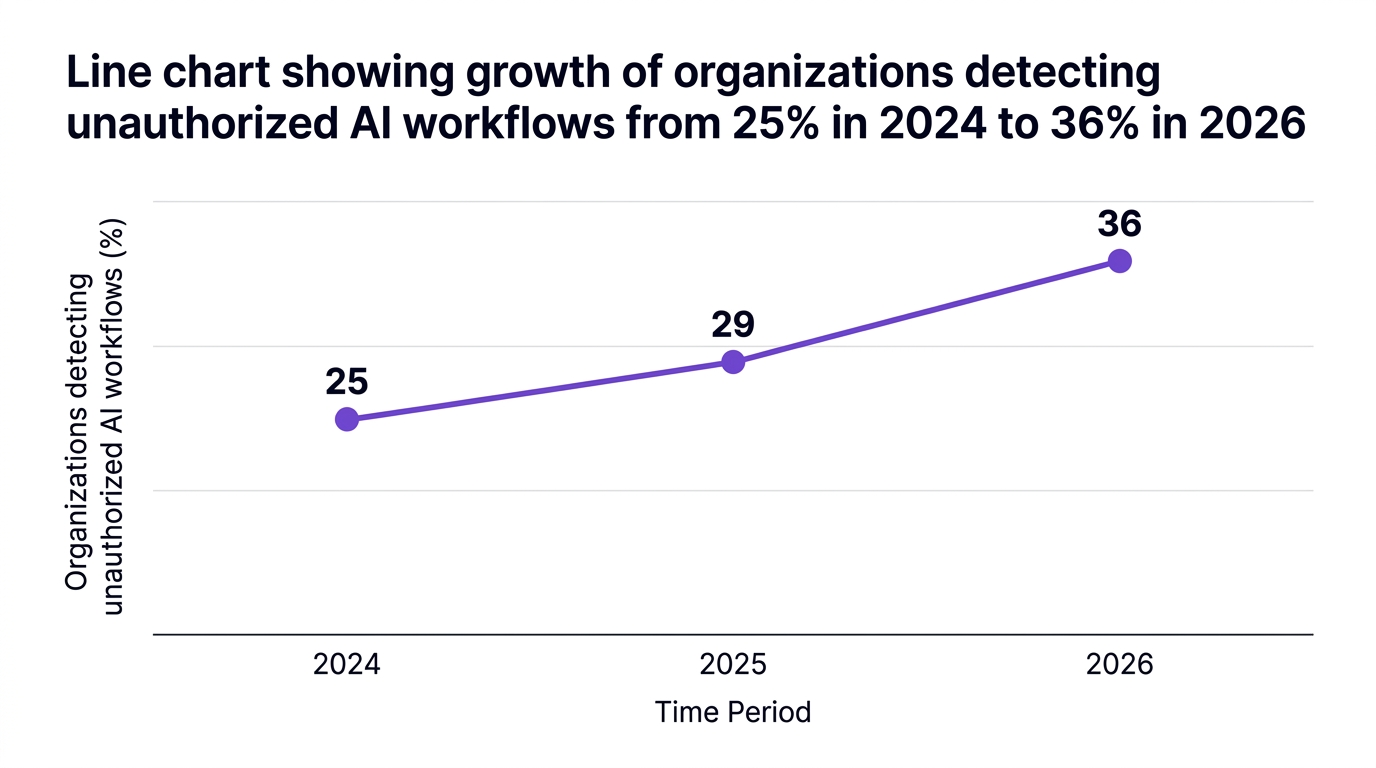
Shadow AI risk is not only about tools. It is about ungoverned AI behaviors embedded into workflows and decisions. A recent enterprise IT survey found that over 36% of organizations detected unauthorized AI workflows deployed in production environments in 2026, up from 29% in 2025.
Several characteristics make the risk of Shadow AI especially severe for large enterprises and regulated industries.
With unsanctioned AI tools, data flows are opaque. Sensitive inputs might include:
Because the tools are unvetted, you cannot be sure how prompts and outputs are stored, logged, or used to train external models. Shadow AI detection becomes essential, not optional.
Regulators in finance, healthcare, and government increasingly expect auditable AI policy enforcement, including:
A 2026 survey found that 44% of IT leaders in regulated industries cited Shadow AI as their number one emerging compliance concern. Enterprise AI compliance is now a board-level issue.
Shadow AI is also a cost problem. Hidden AI workloads create:
A SaaS management analysis in 2026 reported that enterprises that implemented centralized AI governance saw a 25% improvement in cost containment related to AI and SaaS tools. Shadow AI breach cost is one dimension, but ongoing spend leakage is an equally material concern.
AI is often wired directly into workflows: ticket triage, credit decisions, patient prioritization, or KYC checks. When those AI logic paths are ungoverned, errors scale with automation, not with headcount.
As one leading cybersecurity executive observed in 2026, traditional IT controls cannot keep pace with AI-powered SaaS, and Shadow AI has become the largest compliance and cost blind spot in the enterprise stack.
To treat Shadow AI as a top-tier risk, you need to quantify it. Recent enterprise risk analysis shows that the average cost of a single Shadow AI-related data breach hit $670,000 in 2026. That figure typically includes:
In regulated industries, the true financial exposure can be much higher when you add fines and opportunity cost.
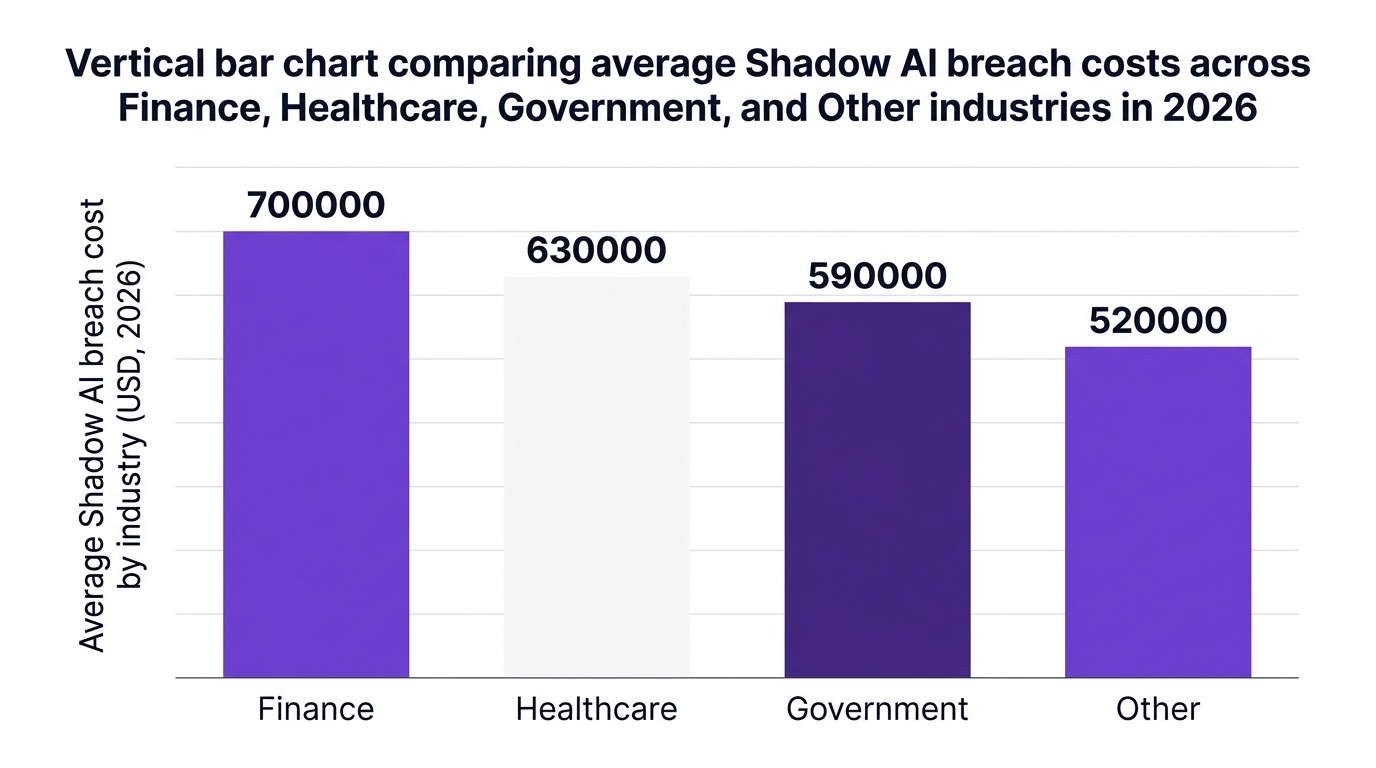
A 2026 industry study on AI breach cost patterns found that Shadow AI breach cost varies by vertical:
The higher financial and healthcare numbers reflect stricter regulations and more sensitive datasets. For a large bank or hospital network, only a few such incidents can erase years of IT cost optimization.
Beyond headline breach numbers, ungoverned AI enterprise usage introduces recurring costs:
Industry benchmarks from 2026 show that enterprises with centralized AI governance observed a 22% reduction in compliance incidents and a 25% improvement in cost containment for AI and SaaS. Those metrics quantify the upside of moving Shadow AI out of the shadows.
Shadow AI in the workplace rarely starts with malice. It usually emerges from well-intentioned innovation without guardrails.

Typical patterns include:
When governance fails, it often fails in three ways:
A SaaS management analyst noted in 2026 that unchecked Shadow AI can impose millions in unanticipated costs due to duplicate and rogue workloads. The risk is as much financial as it is security-related.
To get ahead of Shadow AI risk, enterprises need a simple, repeatable model. One practical approach is the 5P Shadow AI Governance Model: People, Policies, Platforms, Processes, and Proof.
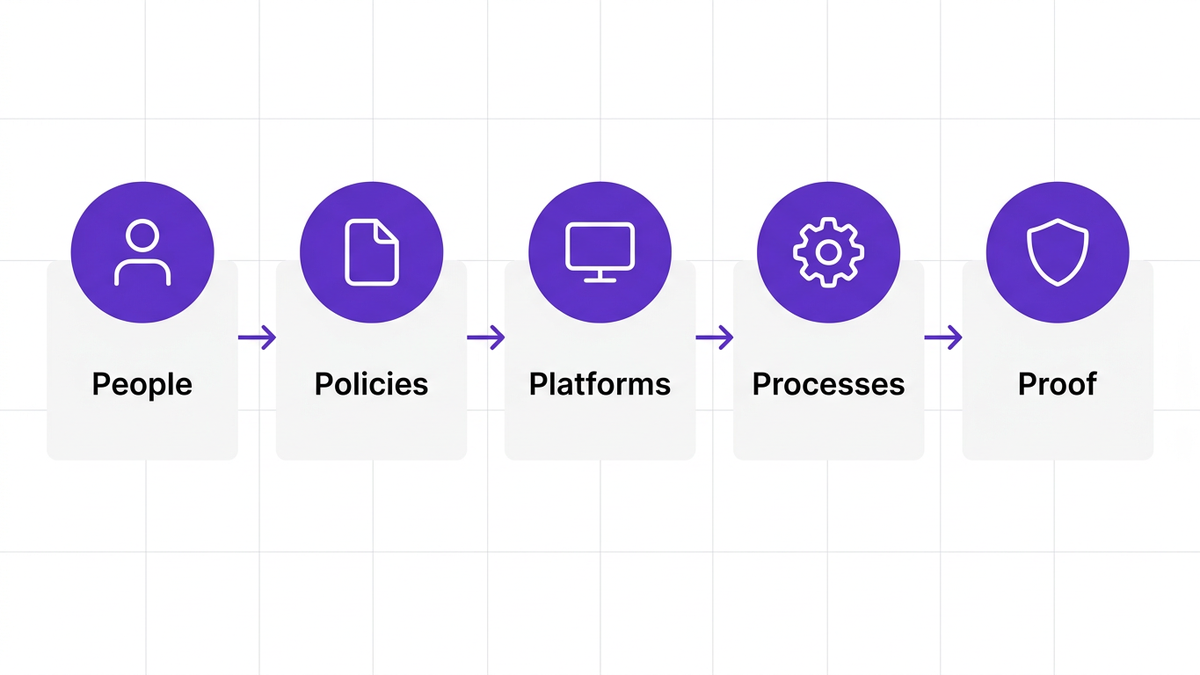
Define clear ownership for AI governance across IT, security, data, and the business.
Shadow AI risk grows when "everyone owns AI" but no one is accountable.
Develop and communicate a clear AI policy that covers:
AI policy enforcement should be embedded into tools, not just employee handbooks.
Shadow AI detection cannot rely on spreadsheets or manual surveys. You need centralized platforms that provide:
By 2026, over 55% of large enterprises were consolidating SaaS, cloud, and AI governance under single platforms to improve risk signal correlation and compliance automation.
Treat AI like any other enterprise asset, with a defined lifecycle:
AI audit capabilities should track this full lifecycle to satisfy regulators.
Regulators, auditors, and boards expect evidence. That means:
Without proof, your AI governance looks superficial, even if you have good intentions.
CloudNuro is built for enterprises that want governance-first AI and SaaS operations, not just visibility. Its platform addresses Shadow AI risk across several dimensions.
CloudNuro's AI Custodian provides automated, real-time monitoring of AI usage across SaaS and cloud environments.
Key capabilities include:
This is central for shadow AI detection, transforming unknown AI activity into governed, observable workloads.
With Unified Cloud Custodian, IT and security teams gain a single-pane-of-glass for cloud and AI resources:
This unified approach helps expose cloud security blind spots that often originate as Shadow AI experiments.
AI rarely lives alone. It is often embedded in major SaaS platforms. CloudNuro's Microsoft 365 Custodian and Salesforce Custodian modules:
Enterprises using CloudNuro typically see 20% or more reduction in SaaS and cloud overspend, often uncovering hidden AI and automation costs in the process.
CloudNuro's security and compliance features help enterprises move from reactive investigations to compliance automation:
These capabilities support robust enterprise AI compliance without slowing down innovation.
Recent case examples illustrate the impact of unified governance:
These results are consistent with broader benchmarks showing that centralized AI governance can materially reduce both compliance incidents and cost leakage.
Shadow AI risk can feel abstract, but there are concrete steps you can implement this quarter.
Draft and circulate a one-page AI acceptable use guide that explains:
Make this short, practical, and embedded into onboarding, not buried in policy portals.
Use existing telemetry and specialized platforms to:
The priority is to create basic visibility. You cannot govern what you cannot see.
Focus early governance on domains with the highest enterprise AI risk:
Apply stricter AI policy enforcement and review cycles to these areas first.
Shadow AI risk is easier to address when budgets and accountability are clear.
This aligns with FinOps principles and supports ongoing cloud cost optimization.
Manual reviews cannot scale. Use ai-enabled governance capabilities to automate:
Then layer AI audit processes on top to periodically test and validate the controls.
Shadow AI is the use of AI tools, models, or AI-powered SaaS without formal IT approval, security review, or governance. It sits outside official inventories and policies, similar to Shadow IT, and introduces significant security, compliance, and cost risks.
Shadow AI not only introduces unapproved tools, it also handles sensitive data and makes or influences decisions. That raises stakes around data privacy, model bias, regulatory compliance, and operational outcomes, particularly in finance, healthcare, and public sector environments.
According to a 2026 enterprise risk analysis, the average cost of a single Shadow AI-related data breach in large enterprises is about $670,000. In regulated sectors like finance and healthcare, the effective cost can be higher once fines and remediation are factored in.
Effective shadow AI detection combines network and cloud telemetry with SaaS and SSO visibility. Enterprises use platforms to identify unsanctioned AI tools, track AI API calls and GPU workloads, and map those back to departments and users for further investigation and governance.
Key ai governance best practices include: creating a clear AI policy and acceptable use standard, standing up centralized visibility across SaaS, cloud, and AI, prioritizing high-risk domains, tying AI usage to cost ownership, and automating controls wherever possible, while maintaining strong AI audit capabilities.
CloudNuro provides a unified platform that brings together AI Custodian, Unified Cloud Custodian, and SaaS-specific custodians, along with FinOps and compliance tooling. This gives enterprises real-time visibility into AI and SaaS usage, automated policy enforcement, cost optimization, and audit-ready compliance reporting for Shadow AI scenarios.
Shadow AI is already embedded across your enterprise, shaping decisions, touching regulated data, and consuming expensive compute. With 73% of enterprises reporting ungoverned AI tool usage and breach costs averaging $670,000 per incident, treating Shadow AI as a marginal risk is no longer defensible.
The path forward is clear: centralize visibility, enforce AI policy through automation, tie AI usage to cost ownership, and maintain strong audit trails. Enterprises that have implemented centralized AI governance are already seeing tangible benefits, including fewer compliance incidents and better cost control.
CloudNuro helps CIOs, CISOs, and finance leaders move from reaction to control by unifying SaaS, cloud, and AI governance in one platform. If you are ready to bring Shadow AI into the light and build a cost-conscious, compliant AI culture, now is the time to act.
Call to action: Explore how CloudNuro can help you detect, govern, and optimize Shadow AI and SaaS across your enterprise.
CloudNuro is a leader in Enterprise SaaS Management Platforms, providing enterprises with unmatched visibility, governance, and cost optimization. Recognized twice in a row in the SaaS Management Platforms category and named a Leader in the SoftwareReviews Data Quadrant, CloudNuro is trusted by global enterprises and government agencies to bring financial discipline to SaaS, cloud, and AI. Trusted by enterprises such as Konica Minolta and Federal Signal, CloudNuro provides centralized SaaS inventory, license optimization, and renewal management along with advanced cost allocation and chargeback, giving IT and Finance leaders the visibility, control, and cost-conscious culture needed to drive financial discipline. Request a Demo | Get Free Savings | Explore Product
Request a no cost, no obligation free assessment —just 15 minutes to savings!
Get StartedShadow AI is no longer an edge case. It is the unsanctioned, ungoverned use of AI tools, models, and AI-powered SaaS inside your enterprise, outside official IT oversight. As employees adopt generative AI and automation to move faster, they often do it without security review or compliance checks, creating a $670,000 blind spot per incident that most CIOs and CISOs still underestimate.
A recent enterprise risk analysis found that the average cost of a single Shadow AI-related data breach in large enterprises reached $670,000 in 2026. That figure does not include downstream impacts like regulatory fines, brand damage, or forced remediation projects. For IT, security, and procurement leaders, Shadow AI is now where Shadow IT was ten years ago, only faster, more opaque, and more expensive.
This article explains what Shadow AI is, why it is uniquely dangerous, what the real Shadow AI breach cost profile looks like, and how to govern it with a unified SaaS and AI management strategy.
Shadow AI refers to any use of AI tools, services, or models that bypasses official IT governance, security review, or procurement processes. It shows up in many forms:
According to a recent industry report, 73% of enterprises reported instances of ungoverned AI tool usage by employees in 2026. This is not a theoretical risk. It is already widespread and growing.
The analogy many executives use is Shadow IT. The difference is that Shadow AI touches data, models, and decision logic, not just applications. That means higher stakes for:
Shadow AI in the workplace is effectively a parallel AI ecosystem living outside your policies, your CMDB, and your audit trails.
Shadow AI risk is not only about tools. It is about ungoverned AI behaviors embedded into workflows and decisions. A recent enterprise IT survey found that over 36% of organizations detected unauthorized AI workflows deployed in production environments in 2026, up from 29% in 2025.
Several characteristics make the risk of Shadow AI especially severe for large enterprises and regulated industries.
With unsanctioned AI tools, data flows are opaque. Sensitive inputs might include:
Because the tools are unvetted, you cannot be sure how prompts and outputs are stored, logged, or used to train external models. Shadow AI detection becomes essential, not optional.
Regulators in finance, healthcare, and government increasingly expect auditable AI policy enforcement, including:
A 2026 survey found that 44% of IT leaders in regulated industries cited Shadow AI as their number one emerging compliance concern. Enterprise AI compliance is now a board-level issue.
Shadow AI is also a cost problem. Hidden AI workloads create:
A SaaS management analysis in 2026 reported that enterprises that implemented centralized AI governance saw a 25% improvement in cost containment related to AI and SaaS tools. Shadow AI breach cost is one dimension, but ongoing spend leakage is an equally material concern.
AI is often wired directly into workflows: ticket triage, credit decisions, patient prioritization, or KYC checks. When those AI logic paths are ungoverned, errors scale with automation, not with headcount.
As one leading cybersecurity executive observed in 2026, traditional IT controls cannot keep pace with AI-powered SaaS, and Shadow AI has become the largest compliance and cost blind spot in the enterprise stack.
To treat Shadow AI as a top-tier risk, you need to quantify it. Recent enterprise risk analysis shows that the average cost of a single Shadow AI-related data breach hit $670,000 in 2026. That figure typically includes:
In regulated industries, the true financial exposure can be much higher when you add fines and opportunity cost.
A 2026 industry study on AI breach cost patterns found that Shadow AI breach cost varies by vertical:
The higher financial and healthcare numbers reflect stricter regulations and more sensitive datasets. For a large bank or hospital network, only a few such incidents can erase years of IT cost optimization.
Beyond headline breach numbers, ungoverned AI enterprise usage introduces recurring costs:
Industry benchmarks from 2026 show that enterprises with centralized AI governance observed a 22% reduction in compliance incidents and a 25% improvement in cost containment for AI and SaaS. Those metrics quantify the upside of moving Shadow AI out of the shadows.
Shadow AI in the workplace rarely starts with malice. It usually emerges from well-intentioned innovation without guardrails.
Typical patterns include:
When governance fails, it often fails in three ways:
A SaaS management analyst noted in 2026 that unchecked Shadow AI can impose millions in unanticipated costs due to duplicate and rogue workloads. The risk is as much financial as it is security-related.
To get ahead of Shadow AI risk, enterprises need a simple, repeatable model. One practical approach is the 5P Shadow AI Governance Model: People, Policies, Platforms, Processes, and Proof.
Define clear ownership for AI governance across IT, security, data, and the business.
Shadow AI risk grows when "everyone owns AI" but no one is accountable.
Develop and communicate a clear AI policy that covers:
AI policy enforcement should be embedded into tools, not just employee handbooks.
Shadow AI detection cannot rely on spreadsheets or manual surveys. You need centralized platforms that provide:
By 2026, over 55% of large enterprises were consolidating SaaS, cloud, and AI governance under single platforms to improve risk signal correlation and compliance automation.
Treat AI like any other enterprise asset, with a defined lifecycle:
AI audit capabilities should track this full lifecycle to satisfy regulators.
Regulators, auditors, and boards expect evidence. That means:
Without proof, your AI governance looks superficial, even if you have good intentions.
CloudNuro is built for enterprises that want governance-first AI and SaaS operations, not just visibility. Its platform addresses Shadow AI risk across several dimensions.
CloudNuro's AI Custodian provides automated, real-time monitoring of AI usage across SaaS and cloud environments.
Key capabilities include:
This is central for shadow AI detection, transforming unknown AI activity into governed, observable workloads.
With Unified Cloud Custodian, IT and security teams gain a single-pane-of-glass for cloud and AI resources:
This unified approach helps expose cloud security blind spots that often originate as Shadow AI experiments.
AI rarely lives alone. It is often embedded in major SaaS platforms. CloudNuro's Microsoft 365 Custodian and Salesforce Custodian modules:
Enterprises using CloudNuro typically see 20% or more reduction in SaaS and cloud overspend, often uncovering hidden AI and automation costs in the process.
CloudNuro's security and compliance features help enterprises move from reactive investigations to compliance automation:
These capabilities support robust enterprise AI compliance without slowing down innovation.
Recent case examples illustrate the impact of unified governance:
These results are consistent with broader benchmarks showing that centralized AI governance can materially reduce both compliance incidents and cost leakage.
Shadow AI risk can feel abstract, but there are concrete steps you can implement this quarter.
Draft and circulate a one-page AI acceptable use guide that explains:
Make this short, practical, and embedded into onboarding, not buried in policy portals.
Use existing telemetry and specialized platforms to:
The priority is to create basic visibility. You cannot govern what you cannot see.
Focus early governance on domains with the highest enterprise AI risk:
Apply stricter AI policy enforcement and review cycles to these areas first.
Shadow AI risk is easier to address when budgets and accountability are clear.
This aligns with FinOps principles and supports ongoing cloud cost optimization.
Manual reviews cannot scale. Use ai-enabled governance capabilities to automate:
Then layer AI audit processes on top to periodically test and validate the controls.
Shadow AI is the use of AI tools, models, or AI-powered SaaS without formal IT approval, security review, or governance. It sits outside official inventories and policies, similar to Shadow IT, and introduces significant security, compliance, and cost risks.
Shadow AI not only introduces unapproved tools, it also handles sensitive data and makes or influences decisions. That raises stakes around data privacy, model bias, regulatory compliance, and operational outcomes, particularly in finance, healthcare, and public sector environments.
According to a 2026 enterprise risk analysis, the average cost of a single Shadow AI-related data breach in large enterprises is about $670,000. In regulated sectors like finance and healthcare, the effective cost can be higher once fines and remediation are factored in.
Effective shadow AI detection combines network and cloud telemetry with SaaS and SSO visibility. Enterprises use platforms to identify unsanctioned AI tools, track AI API calls and GPU workloads, and map those back to departments and users for further investigation and governance.
Key ai governance best practices include: creating a clear AI policy and acceptable use standard, standing up centralized visibility across SaaS, cloud, and AI, prioritizing high-risk domains, tying AI usage to cost ownership, and automating controls wherever possible, while maintaining strong AI audit capabilities.
CloudNuro provides a unified platform that brings together AI Custodian, Unified Cloud Custodian, and SaaS-specific custodians, along with FinOps and compliance tooling. This gives enterprises real-time visibility into AI and SaaS usage, automated policy enforcement, cost optimization, and audit-ready compliance reporting for Shadow AI scenarios.
Shadow AI is already embedded across your enterprise, shaping decisions, touching regulated data, and consuming expensive compute. With 73% of enterprises reporting ungoverned AI tool usage and breach costs averaging $670,000 per incident, treating Shadow AI as a marginal risk is no longer defensible.
The path forward is clear: centralize visibility, enforce AI policy through automation, tie AI usage to cost ownership, and maintain strong audit trails. Enterprises that have implemented centralized AI governance are already seeing tangible benefits, including fewer compliance incidents and better cost control.
CloudNuro helps CIOs, CISOs, and finance leaders move from reaction to control by unifying SaaS, cloud, and AI governance in one platform. If you are ready to bring Shadow AI into the light and build a cost-conscious, compliant AI culture, now is the time to act.
Call to action: Explore how CloudNuro can help you detect, govern, and optimize Shadow AI and SaaS across your enterprise.
CloudNuro is a leader in Enterprise SaaS Management Platforms, providing enterprises with unmatched visibility, governance, and cost optimization. Recognized twice in a row in the SaaS Management Platforms category and named a Leader in the SoftwareReviews Data Quadrant, CloudNuro is trusted by global enterprises and government agencies to bring financial discipline to SaaS, cloud, and AI. Trusted by enterprises such as Konica Minolta and Federal Signal, CloudNuro provides centralized SaaS inventory, license optimization, and renewal management along with advanced cost allocation and chargeback, giving IT and Finance leaders the visibility, control, and cost-conscious culture needed to drive financial discipline. Request a Demo | Get Free Savings | Explore Product
Request a no cost, no obligation free assessment - just 15 minutes to savings!
Get StartedWe're offering complimentary ServiceNow license assessments to only 25 enterprises this quarter who want to unlock immediate savings without disrupting operations.
Get Free AssessmentGet Started




CloudNuro Corp
1755 Park St. Suite 207
Naperville, IL 60563
Phone : +1-630-277-9470
Email: info@cloudnuro.com




.webp)

Recognized Leader in SaaS Management Platforms by Info-Tech SoftwareReviews

.svg)