

Sign Up
Thank you for Submitting!
Shadow AI vs Shadow IT is no longer a theoretical debate for architecture diagrams. It is a frontline issue for CIOs, CISOs, and digital transformation leaders who see AI tools and unsanctioned apps creeping into every workflow.
By 2026, Shadow AI has overtaken classic Shadow IT in both frequency and impact. Gartner reports that 78% of enterprises saw a significant increase in unauthorized AI tool usage compared to Shadow IT in 2026. To stay ahead, enterprises need a clear playbook that separates the two, manages both together, and turns AI innovation into a governed advantage.
This guide breaks down the differences, risks, and practical steps to control Shadow AI and Shadow IT together, without suffocating innovation.
Traditional Shadow IT refers to any software, cloud service, or device used without formal IT approval. Shadow AI is a specific subset: AI tools, models, prompts, and automations used outside sanctioned governance, often plugged into existing systems or data flows.
The distinction is more than semantics. AI tools can learn from sensitive data, generate content at scale, and be chained into critical business processes with minimal oversight. Forrester found that 68% of CIOs now rank Shadow AI as a top three security risk for 2026, surpassing Shadow IT.
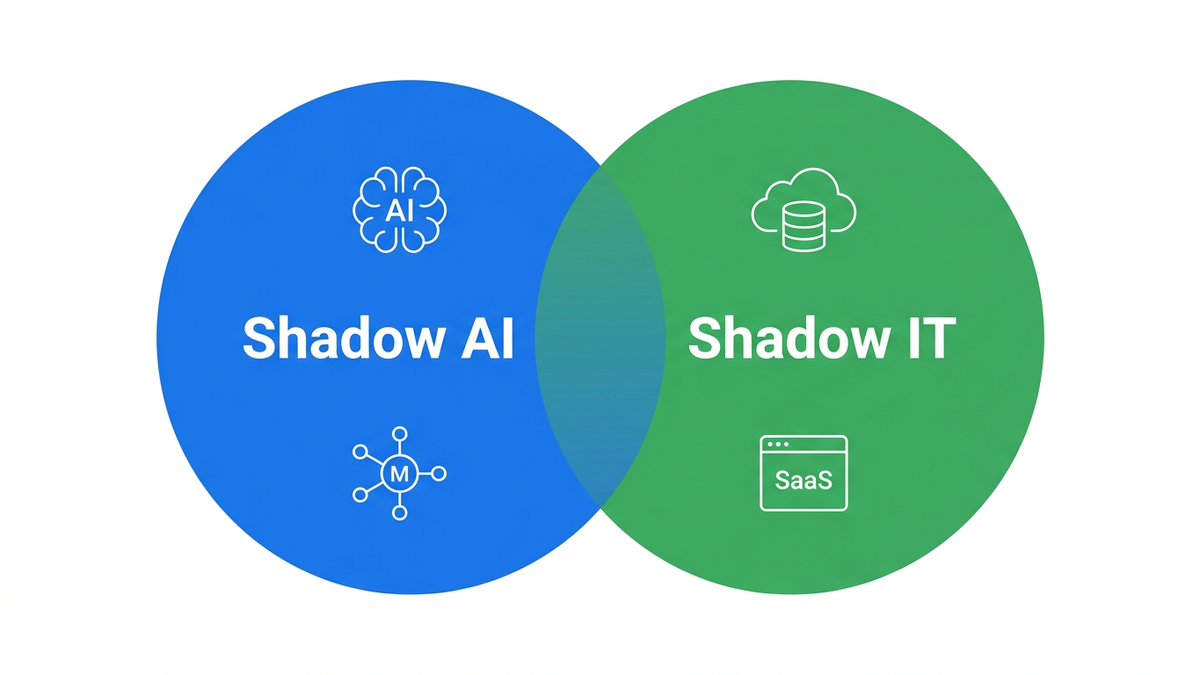
Shadow IT:
Shadow AI:
A useful analogy: Shadow IT is like unapproved side roads off your corporate highway, while Shadow AI is more like autonomous vehicles on those roads that can change direction on their own. You must manage both the roads and the behavior of the vehicles.
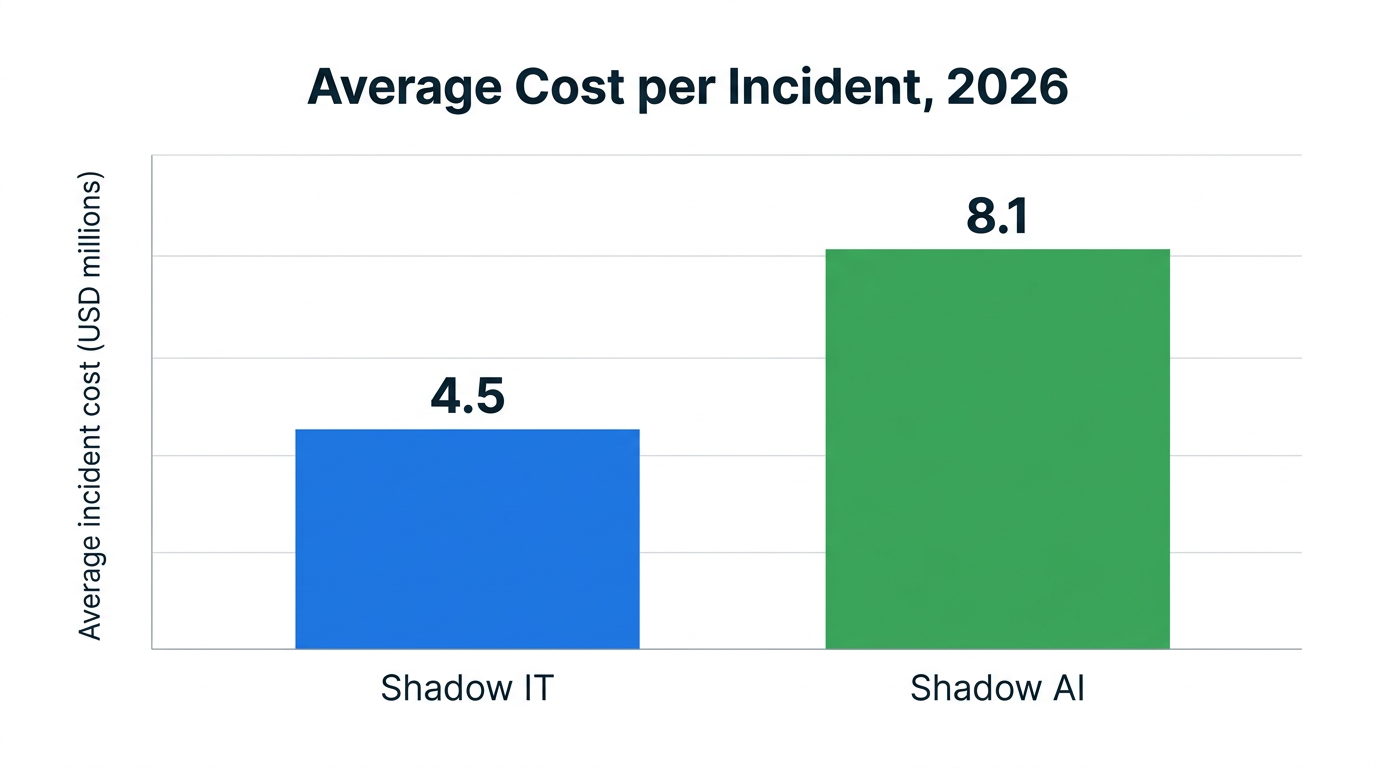
The data is blunt. IDC reports that 59% of large-enterprise data breaches in 2026 were linked to unsanctioned AI applications or models. PwC found that the average cost of a Shadow AI incident hit 8.1 million dollars, compared with 4.5 million dollars for Shadow IT.
Several factors explain why Shadow AI risks are escalating faster than classic Shadow IT:
When employees paste confidential data, source code, or customer records into unauthorized AI tools, they may effectively be training external models. That creates:
Unlike a traditional file-sharing Shadow IT incident, Shadow AI incidents may not be fully reversible because model training is cumulative and difficult to unwind.
Shadow IT often supports peripheral workflows. Shadow AI frequently sits closer to decision points: credit recommendations, pricing updates, contract drafts, or triage summaries.
A single misconfigured or biased model can:
KPMG research cited that 90% of IT leaders agree Shadow AI is more difficult to detect than Shadow IT in 2026. The reasons:
Traditional discovery approaches that focus on apps or endpoints struggle to identify prompts, model usage patterns, or AI-specific data flows.
Gartner notes that enterprises are moving toward unified platforms that cover both Shadow IT governance and AI sprawl detection. The logic is straightforward: users do not distinguish between “IT” and “AI” when they try tools, so your governance cannot treat them as disconnected.
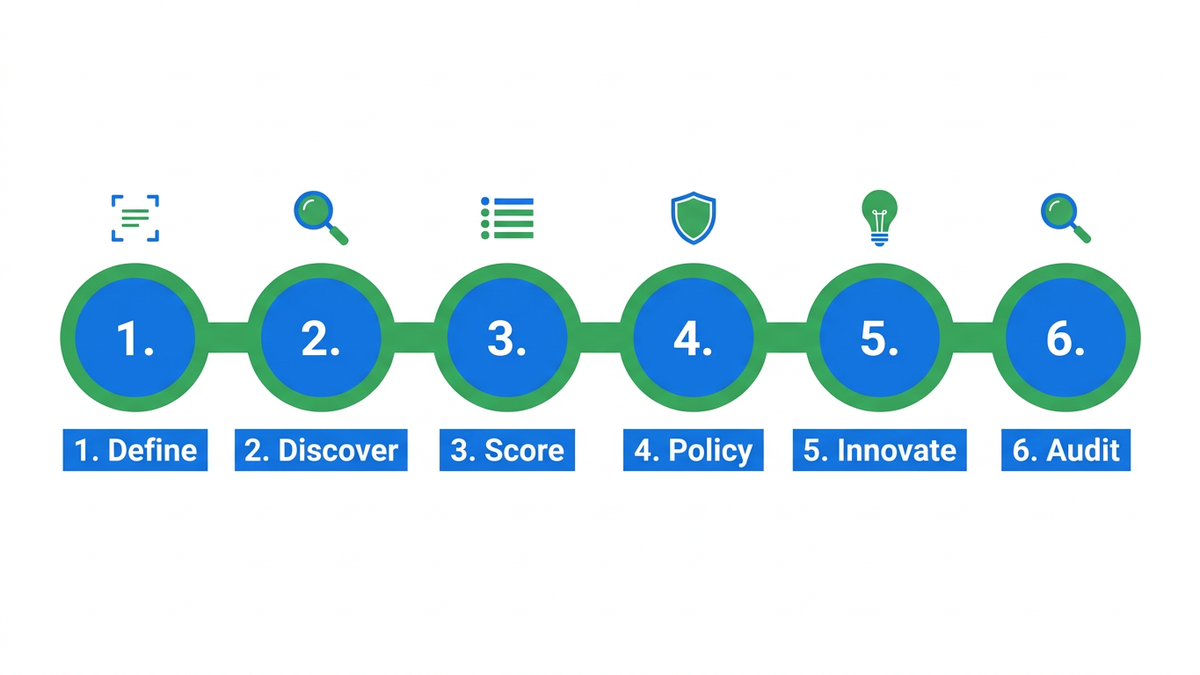
Here is a practical, 6-part playbook for 2026.
Start by aligning leadership on clear definitions of Shadow AI vs Shadow IT. Then create a simple taxonomy that classifies:
Codify these categories within your AI governance and Shadow IT policies so security, risk, and business units share the same language.
Annual or quarterly audits are not enough in a world where AI tools can be adopted in hours. Forrester observed that real-time automated discovery and risk scoring have become baseline requirements.
Your discovery capabilities should include:
This requires instrumentation across browsers, identity providers, and cloud environments that is specific to AI patterns, such as large bursts of prompt traffic or atypical data export volumes to model endpoints.
Traditional Shadow IT governance often uses coarse categories: high, medium, low. Shadow AI needs more granular AI risk management dimensions:
McKinsey reports that 82% of organizations with comprehensive AI governance frameworks saw fewer Shadow AI-related compliance violations in 2026. These frameworks succeed because they integrate AI-aware risk scoring into intake and monitoring workflows.
Long-form policy documents rarely change behavior. Treat policy as a product with:
Back this with IT policy enforcement that uses automation instead of manual reviews: default model configurations, auto-tagging of AI outputs, and mandatory logging for sensitive use cases.
A strict prohibition stance on Generative AI in business almost guarantees an explosion of Shadow AI. People will find a way to use what helps them.
A better approach:
This combines digital transformation 2026 ambitions with realistic risk controls. It also shifts Shadow AI from “rebellion” toward “co-created innovation”.
Regulated enterprises are adopting AI-specific compliance automation platforms, with Deloitte reporting 71% adoption in 2026. To manage both Shadow AI and Shadow IT, you need:
These practices turn audits from reactive hunting exercises into structured confirmations.
Consider a global enterprise starting to see employees copy sensitive documents into consumer-grade AI chatbots. Early indicators show rising AI sprawl, but no centralized view.
The company takes three steps:
Within six months, the share of Shadow AI traffic drops by more than half, and the remaining activity is visible, tagged, and governed. Instead of treating Shadow AI users as offenders, the company treats them as early adopters who help refine policy and tooling.
This pattern aligns closely with a recurring theme in 2026 research: enterprises that combine discovery, safe alternatives, and calibrated enforcement see the steepest decline in Shadow AI risk while maintaining strong productivity gains.
For additional perspective on aligning these controls with enterprise AI adoption, see the Blog: Enterprise AI Governance.
Example Enterprise AI is built specifically for enterprise AI oversight and Shadow IT governance at scale. Its platform approach reflects market trends identified by Gartner, Forrester, and others: unified visibility, real-time analytics, and codified AI governance.
The InsightGuard platform provides end-to-end monitoring of AI application usage across hybrid environments.
Core capabilities include:
This moves organizations from “we think people are using AI somewhere” to “we know exactly how AI and unsanctioned apps are being used, and what risk they create”.
For a detailed feature overview, visit the InsightGuard Platform.
The AI Compliance Suite translates evolving AI regulatory trends into practical guardrails.
It enables:
This is especially relevant for enterprise AI compliance teams that need demonstrable controls for regulators and auditors. Organizations can standardize how they document AI usage, making Shadow AI incidents easier to identify and remediate.
Learn more in the AI Compliance Suite Overview.
Technology alone will not fix Shadow AI risks.
Example Enterprise AI’s advisory services help leaders design AI security frameworks and operating models that:
By coupling platforms with advisory support, enterprises can accelerate the move from policy drafts to live, enforceable controls.
For organizations in regulated sectors, see the company’s Solutions for Regulated Industries to align AI oversight with sector-specific mandates.
To know if your Shadow AI vs Shadow IT strategy works, you need a shortlist of metrics that combine technology, behavior, and business outcomes.
Consider tracking:
Deloitte reports that healthcare and finance sectors increased investments in Shadow AI detection and governance tools by 40% between 2025 and 2026. Those organizations that track clear metrics tend to derive stronger productivity benefits from AI because they can safely scale sanctioned solutions while constraining Shadow AI.
A counterpoint sometimes raised is that aggressive monitoring will alienate users and slow enterprise cloud security or digital initiatives. Experience suggests the opposite, if you:
Shadow IT covers any unauthorized software usage, such as unsanctioned SaaS tools or cloud storage. Shadow AI refers specifically to unauthorized use of AI models, chatbots, or AI features, often within those tools.
Shadow AI carries all the traditional Shadow IT risks plus AI-specific issues like model training on sensitive data, output misuse, and opaque decisioning.
Research from Gartner, Forrester, and IDC shows that Shadow AI incidents and costs are rising more steeply than classic Shadow IT.
Reasons include:
Detection requires a combination of:
Modern AI tool management platforms like InsightGuard add model-aware discovery and AI usage monitoring, which traditional Shadow IT tools lack.
Successful enterprises treat this as a portfolio problem. They:
This creates a balance where employees can experiment safely while IT and security maintain visibility and control.
Regulated sectors are moving toward AI governance models that integrate:
Platforms such as the AI Compliance Suite help codify these frameworks with workflow automation and auditability.
Shadow AI vs Shadow IT is not a future concern. It is a current, quantifiable risk, with Shadow AI already accounting for most AI-related breaches and nearly double the average incident cost compared with traditional Shadow IT.
Enterprises that win in 2026 will:
Example Enterprise AI provides the oversight platforms, compliance automation, and advisory expertise to help enterprises operationalize this playbook and align innovation with non-negotiable security and compliance.
To explore how your organization can govern Shadow AI and Shadow IT with confidence, visit the InsightGuard Platform and the AI Compliance Suite Overview.
Request a no cost, no obligation free assessment —just 15 minutes to savings!
Get StartedShadow AI vs Shadow IT is no longer a theoretical debate for architecture diagrams. It is a frontline issue for CIOs, CISOs, and digital transformation leaders who see AI tools and unsanctioned apps creeping into every workflow.
By 2026, Shadow AI has overtaken classic Shadow IT in both frequency and impact. Gartner reports that 78% of enterprises saw a significant increase in unauthorized AI tool usage compared to Shadow IT in 2026. To stay ahead, enterprises need a clear playbook that separates the two, manages both together, and turns AI innovation into a governed advantage.
This guide breaks down the differences, risks, and practical steps to control Shadow AI and Shadow IT together, without suffocating innovation.
Traditional Shadow IT refers to any software, cloud service, or device used without formal IT approval. Shadow AI is a specific subset: AI tools, models, prompts, and automations used outside sanctioned governance, often plugged into existing systems or data flows.
The distinction is more than semantics. AI tools can learn from sensitive data, generate content at scale, and be chained into critical business processes with minimal oversight. Forrester found that 68% of CIOs now rank Shadow AI as a top three security risk for 2026, surpassing Shadow IT.
Shadow IT:
Shadow AI:
A useful analogy: Shadow IT is like unapproved side roads off your corporate highway, while Shadow AI is more like autonomous vehicles on those roads that can change direction on their own. You must manage both the roads and the behavior of the vehicles.
The data is blunt. IDC reports that 59% of large-enterprise data breaches in 2026 were linked to unsanctioned AI applications or models. PwC found that the average cost of a Shadow AI incident hit 8.1 million dollars, compared with 4.5 million dollars for Shadow IT.
Several factors explain why Shadow AI risks are escalating faster than classic Shadow IT:
When employees paste confidential data, source code, or customer records into unauthorized AI tools, they may effectively be training external models. That creates:
Unlike a traditional file-sharing Shadow IT incident, Shadow AI incidents may not be fully reversible because model training is cumulative and difficult to unwind.
Shadow IT often supports peripheral workflows. Shadow AI frequently sits closer to decision points: credit recommendations, pricing updates, contract drafts, or triage summaries.
A single misconfigured or biased model can:
KPMG research cited that 90% of IT leaders agree Shadow AI is more difficult to detect than Shadow IT in 2026. The reasons:
Traditional discovery approaches that focus on apps or endpoints struggle to identify prompts, model usage patterns, or AI-specific data flows.
Gartner notes that enterprises are moving toward unified platforms that cover both Shadow IT governance and AI sprawl detection. The logic is straightforward: users do not distinguish between “IT” and “AI” when they try tools, so your governance cannot treat them as disconnected.
Here is a practical, 6-part playbook for 2026.
Start by aligning leadership on clear definitions of Shadow AI vs Shadow IT. Then create a simple taxonomy that classifies:
Codify these categories within your AI governance and Shadow IT policies so security, risk, and business units share the same language.
Annual or quarterly audits are not enough in a world where AI tools can be adopted in hours. Forrester observed that real-time automated discovery and risk scoring have become baseline requirements.
Your discovery capabilities should include:
This requires instrumentation across browsers, identity providers, and cloud environments that is specific to AI patterns, such as large bursts of prompt traffic or atypical data export volumes to model endpoints.
Traditional Shadow IT governance often uses coarse categories: high, medium, low. Shadow AI needs more granular AI risk management dimensions:
McKinsey reports that 82% of organizations with comprehensive AI governance frameworks saw fewer Shadow AI-related compliance violations in 2026. These frameworks succeed because they integrate AI-aware risk scoring into intake and monitoring workflows.
Long-form policy documents rarely change behavior. Treat policy as a product with:
Back this with IT policy enforcement that uses automation instead of manual reviews: default model configurations, auto-tagging of AI outputs, and mandatory logging for sensitive use cases.
A strict prohibition stance on Generative AI in business almost guarantees an explosion of Shadow AI. People will find a way to use what helps them.
A better approach:
This combines digital transformation 2026 ambitions with realistic risk controls. It also shifts Shadow AI from “rebellion” toward “co-created innovation”.
Regulated enterprises are adopting AI-specific compliance automation platforms, with Deloitte reporting 71% adoption in 2026. To manage both Shadow AI and Shadow IT, you need:
These practices turn audits from reactive hunting exercises into structured confirmations.
Consider a global enterprise starting to see employees copy sensitive documents into consumer-grade AI chatbots. Early indicators show rising AI sprawl, but no centralized view.
The company takes three steps:
Within six months, the share of Shadow AI traffic drops by more than half, and the remaining activity is visible, tagged, and governed. Instead of treating Shadow AI users as offenders, the company treats them as early adopters who help refine policy and tooling.
This pattern aligns closely with a recurring theme in 2026 research: enterprises that combine discovery, safe alternatives, and calibrated enforcement see the steepest decline in Shadow AI risk while maintaining strong productivity gains.
For additional perspective on aligning these controls with enterprise AI adoption, see the Blog: Enterprise AI Governance.
Example Enterprise AI is built specifically for enterprise AI oversight and Shadow IT governance at scale. Its platform approach reflects market trends identified by Gartner, Forrester, and others: unified visibility, real-time analytics, and codified AI governance.
The InsightGuard platform provides end-to-end monitoring of AI application usage across hybrid environments.
Core capabilities include:
This moves organizations from “we think people are using AI somewhere” to “we know exactly how AI and unsanctioned apps are being used, and what risk they create”.
For a detailed feature overview, visit the InsightGuard Platform.
The AI Compliance Suite translates evolving AI regulatory trends into practical guardrails.
It enables:
This is especially relevant for enterprise AI compliance teams that need demonstrable controls for regulators and auditors. Organizations can standardize how they document AI usage, making Shadow AI incidents easier to identify and remediate.
Learn more in the AI Compliance Suite Overview.
Technology alone will not fix Shadow AI risks.
Example Enterprise AI’s advisory services help leaders design AI security frameworks and operating models that:
By coupling platforms with advisory support, enterprises can accelerate the move from policy drafts to live, enforceable controls.
For organizations in regulated sectors, see the company’s Solutions for Regulated Industries to align AI oversight with sector-specific mandates.
To know if your Shadow AI vs Shadow IT strategy works, you need a shortlist of metrics that combine technology, behavior, and business outcomes.
Consider tracking:
Deloitte reports that healthcare and finance sectors increased investments in Shadow AI detection and governance tools by 40% between 2025 and 2026. Those organizations that track clear metrics tend to derive stronger productivity benefits from AI because they can safely scale sanctioned solutions while constraining Shadow AI.
A counterpoint sometimes raised is that aggressive monitoring will alienate users and slow enterprise cloud security or digital initiatives. Experience suggests the opposite, if you:
Shadow IT covers any unauthorized software usage, such as unsanctioned SaaS tools or cloud storage. Shadow AI refers specifically to unauthorized use of AI models, chatbots, or AI features, often within those tools.
Shadow AI carries all the traditional Shadow IT risks plus AI-specific issues like model training on sensitive data, output misuse, and opaque decisioning.
Research from Gartner, Forrester, and IDC shows that Shadow AI incidents and costs are rising more steeply than classic Shadow IT.
Reasons include:
Detection requires a combination of:
Modern AI tool management platforms like InsightGuard add model-aware discovery and AI usage monitoring, which traditional Shadow IT tools lack.
Successful enterprises treat this as a portfolio problem. They:
This creates a balance where employees can experiment safely while IT and security maintain visibility and control.
Regulated sectors are moving toward AI governance models that integrate:
Platforms such as the AI Compliance Suite help codify these frameworks with workflow automation and auditability.
Shadow AI vs Shadow IT is not a future concern. It is a current, quantifiable risk, with Shadow AI already accounting for most AI-related breaches and nearly double the average incident cost compared with traditional Shadow IT.
Enterprises that win in 2026 will:
Example Enterprise AI provides the oversight platforms, compliance automation, and advisory expertise to help enterprises operationalize this playbook and align innovation with non-negotiable security and compliance.
To explore how your organization can govern Shadow AI and Shadow IT with confidence, visit the InsightGuard Platform and the AI Compliance Suite Overview.
Request a no cost, no obligation free assessment - just 15 minutes to savings!
Get StartedWe're offering complimentary ServiceNow license assessments to only 25 enterprises this quarter who want to unlock immediate savings without disrupting operations.
Get Free AssessmentGet Started




CloudNuro Corp
1755 Park St. Suite 207
Naperville, IL 60563
Phone : +1-630-277-9470
Email: info@cloudnuro.com





.webp)

Recognized Leader in SaaS Management Platforms by Info-Tech SoftwareReviews


.svg)