
Sign Up
Thank you for Submitting!
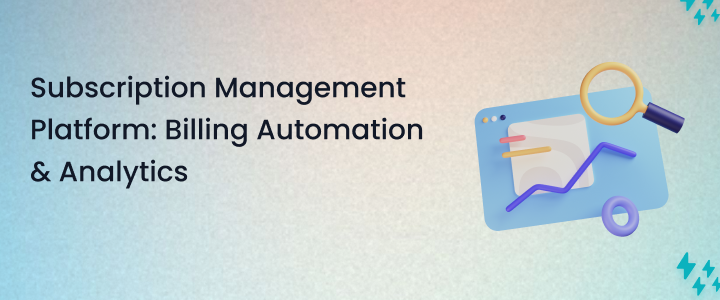
A subscription management platform automates recurring billing, optimizes revenue recognition, and provides actionable analytics that reduce churn by 15-28%. Modern platforms integrate billing automation with subscription analytics to eliminate revenue leakage, accelerate cash flow by 12-18 days, and provide real-time visibility into customer lifecycle metrics. Organizations implementing comprehensive subscription management solutions report reductions of 23-41% in billing errors, 89% faster month-end close processes, and 34% improvement in customer retention compared to manual or legacy systems.
The subscription economy has fundamentally transformed how businesses generate and manage revenue. Global subscription revenue surpassed $1.5 trillion in 2024, with projections reaching $2.1 trillion by 2027, according to Gartner research. Yet despite this explosive growth, 67% of subscription businesses struggle with billing accuracy, revenue leakage, and inadequate analytics capabilities.
A subscription management platform serves as the operational backbone for recurring revenue businesses, automating the entire quote-to-cash cycle while generating the analytics needed for strategic decision-making. This guide examines how billing automation and subscription analytics work together to drive measurable business outcomes, what capabilities separate best-in-class platforms from basic billing tools, and how to evaluate solutions that align with your growth trajectory.
The subscription management landscape is evolving rapidly as new business models, regulatory requirements, and customer expectations reshape platform capabilities.
Consumption-based models are replacing fixed subscriptions across industries. From cloud infrastructure (AWS, Azure) to data platforms (Snowflake, Databricks) to collaboration tools (Slack, Zoom), customers demand pay-for-what-you-use flexibility. This shift requires billing automation systems that ingest usage data. Platforms lacking robust usage metering capabilities create manual workarounds that scale poorly and increase error rates.
Artificial intelligence is transforming subscription analytics from descriptive reporting to predictive and prescriptive capabilities. The best platforms embed AI across the customer lifecycle, enabling proactive intervention rather than reactive damage control.
ASC 606 and IFRS 15, the revenue recognition standards, create complex accounting requirements that manual processes cannot reliably handle. Modern platforms automate contract analysis, identification of performance obligations, transaction price allocation, and recognition scheduling; organizations that implement automated chargeback and cost allocation report 78% reduction in revenue recognition errors.
Subscription platforms are integrating payment processing, banking services, and financial products directly into billing workflows. Integration with accounts receivable automation, dunning management, and payment retry logic recovers 40-60% of failed transactions that would otherwise become churn.
Subscription intelligence requires data from CRM, support, product analytics, and billing systems. Unified data hubs that aggregate customer signals, calculate comprehensive health scores, and trigger automated workflows across systems enable true 360-degree customer views.
Monthly reporting cycles no longer meet the demands of fast-moving subscription businesses. Modern platforms provide real-time dashboards showing current MRR, ARR, churn rate, customer acquisition cost (CAC), and lifetime value (LTV). These live metrics enable agile decision-making and rapid response to emerging trends. Get visibility.
Effective subscription management requires measuring performance against industry benchmarks and tracking the right key performance indicators.
Best-in-class SaaS companies achieve 15-25% quarterly MRR growth during growth stage, tapering to 8-15% at scale. Calculate MRR growth by subtracting churned MRR from new and expansion MRR. Negative growth indicates fundamental business model challenges requiring immediate attention.
For enterprise-focused subscriptions, ARR provides a more stable metric than MRR. Track ARR by customer segment, product line, and geographic region to identify growth drivers and laggards. Companies with ARR exceeding $10M should maintain detailed cohort analysis showing retention patterns over 24-36 month periods.
The benchmark ratio is 3:1 or higher, meaning customers generate at least three times their acquisition cost over their lifetime. Ratios below 2:1 indicate unsustainable economics. Calculate CLV as (Average Revenue per Account × Gross Margin) / Churn Rate. Track CAC payback period, targeting under 12 months for healthy unit economics.
Elite SaaS companies achieve NRR above 120%, meaning existing customers expand spending by 20%+ annually even after accounting for churn. NRR between 100% and 110% is acceptable, while rates below 100% signal challenges with product-market fit. Calculate as (Starting ARR + Expansion - Contraction - Churn) / Starting ARR.
Target annual gross retention above 90% for B2B SaaS, above 80% for SMB-focused products. Monthly churn above 5% (annual churn above 60%) indicates critical issues requiring immediate intervention. Track retention by cohort, plan type, and customer segment to identify patterns.
Low logo churn (high customer retention) with high revenue churn indicates that large customers are leaving. Conversely, high logo churn with low revenue churn suggests small customers churn while large accounts remain stable.
World-class operations maintain billing error rates below 0.5%, with most errors caught before customer invoicing. Error rates above 2% create customer dissatisfaction, increase support burden, and damage brand reputation; track errors by type (calculation, timing, tax, proration) to identify systemic issues.
Monitor DSO trends monthly and investigate spikes immediately.
Implementing comprehensive billing automation reduces revenue leakage to under 1%. Calculate by comparing contract value to actual collected revenue, adjusting for legitimate discounts and credits.
Delayed invoicing extends DSO, creates customer confusion, and signals operational inefficiency. Track time from the billing trigger (renewal, usage period end) to invoice delivery.
High-performing SaaS companies generate 30-40% of new ARR from existing customer expansion rather than new logos. Calculate as Expansion MRR / Total New MRR. Low expansion ratios indicate missed upsell opportunities or product limitations preventing customer growth.
Leading platforms correlate product usage metrics with retention and expansion outcomes. Define engagement scores using product analytics data, support interactions, and feature adoption patterns. Accounts scoring in the bottom quartile face a 5-8x higher churn risk than those in the top quartile.
Revenue forecasting accuracy should exceed 95% for the current quarter and 90% for the next quarter. Track forecast variance monthly and investigate systematic over or under-estimation. Inaccurate forecasting indicates poor visibility into customer lifecycle events and renewal likelihood.
The decision to implement a subscription management platform represents a strategic inflection point. While early-stage companies may survive with manual billing processes, scaling subscription operations without purpose-built infrastructure creates compounding inefficiencies and risks.
Organizations implementing comprehensive subscription management solutions report an ROI of 300-600% within 18 months, driven by reduced revenue leakage, faster cash collection, lower operational costs, and improved retention enabled by better analytics.
Understanding the feature landscape helps organizations distinguish between basic billing tools and comprehensive revenue management solutions.
Support for fixed, tiered, volume-based, usage-based, and hybrid pricing models. Ability to combine multiple pricing dimensions (seats, usage, features) within single subscriptions. Real-time pricing simulation for what-if analysis. Custom pricing rules without code deployment.
Scheduled recurring billing with configurable cadences (monthly, quarterly, annual). Proration calculations for mid-cycle changes. Multi-currency support with configurable exchange rate handling. Tax calculation integration (Avalara, TaxJar, Vertex). Customizable invoice templates and branding. Automatic invoice delivery via email, portal, or API.
ASC 606 / IFRS 15 compliant revenue scheduling. Automatic performance obligation identification from contract terms. Deferred revenue tracking and waterfall reports. Multi-element arrangement allocation. Real-time recognition journal entries for accounting system integration.
Integrated payment gateway support (Stripe, Adyen, Braintree). Automatic payment retry logic with intelligent timing. Dunning workflows with customizable communication sequences. Payment method expiration alerts. Support for ACH, wire transfer, and alternative payment methods.
Real-time usage data ingestion from multiple sources. Configurable rating engines applying pricing logic to raw usage. Usage aggregation, rollup, and threshold monitoring. Overages, allowances, and tiered consumption pricing. Usage visibility for customers via self-service portals.
Trial-to-paid conversion workflows with automated provisioning. Subscription upgrades, downgrades, and crossgrades with proration. Add-on and feature toggle management. Contract renewals with configurable auto-renewal logic. Cancellation workflows with retention offers and win-back campaigns.
Pre-built dashboards for MRR, ARR, churn, retention, and cohort analysis. Custom report builder for ad-hoc analysis. Revenue forecasting and scenario modeling. Churn prediction and risk scoring. Expansion opportunity identification. Executive summary reports for board presentations.
Native integrations with CRM systems (Salesforce, HubSpot). Accounting system sync (NetSuite, QuickBooks, Xero). Payment processor connections. Product analytics platforms (Amplitude, Mixpanel). Customer success tools (Gainsight, ChurnZero). Data warehouse export for custom analytics.
The most capable platforms treat these features as interconnected systems rather than isolated modules, enabling data and workflow to flow seamlessly across the customer lifecycle.
| Capability | CloudNuro | Traditional Subscription Platforms | Strategic Advantage |
|---|---|---|---|
| Subscription Scope | SaaS, IaaS, and AI services unified view | Primarily SaaS subscription billing | Complete technology spend visibility, not just recurring revenue |
| Cost Optimization | Automated license rightsizing, usage analytics, and renewal optimization | Limited to billing efficiency | Active cost reduction vs passive billing processing |
| Implementation Time | 15-minute setup, value in 24 hours | 4-12 week implementation cycles | Immediate ROI vs delayed value realization |
| FinOps Integration | Native FinOps framework with cloud + SaaS | Requires separate cloud cost tools | Unified financial operations vs fragmented toolsets |
| Vendor Management | Centralized vendor tracking, SLA monitoring, and contract lifecycle | Subscription customer management only | IT buyer perspective vs seller perspective |
| License Governance | Proactive unused license detection, compliance tracking | Reactive billing and usage reporting | Cost avoidance vs cost recording |
| Chargeback Capabilities | Advanced cost allocation and showback by department, project, and application | Limited revenue allocation features | Internal cost accountability vs external revenue tracking |
| Analytics Depth | Usage patterns, optimization opportunities, waste identification | Revenue metrics, churn analysis, and expansion tracking | Operational intelligence vs financial reporting |
| Multi-Cloud Support | AWS, Azure, GCP, Oracle Cloud unified | Not applicable (SaaS-only focus) | Hybrid cloud + SaaS visibility vs SaaS-only limitation |
| Target Persona | CIO, IT Operations, FinOps teams managing technology spend | CFO, RevOps teams managing recurring revenue | Buyer-side cost control vs seller-side revenue management |
| Primary Outcome | Reduce total technology spend 23-35% through optimization | Increase billing accuracy and revenue capture | Cost reduction vs revenue protection |
| Secondary Outcome | Governance, compliance, renewal management | Customer retention and expansion | Risk mitigation vs growth acceleration |
Explore how CloudNuro manages your subscription portfolio while optimizing costs enterprise-wide.
Billing automation transforms subscription operations from labor-intensive manual processes into efficient, accurate, scalable systems.
Manual billing requires finance teams to extract contract data, calculate charges, apply proration logic, generate invoices, send to customers, track payments, and reconcile discrepancies. Automation reduces this to under 5 hours of review and exception handling.
Manual processes produce error rates of 3-7% even with careful review. Automated systems reduce errors to under 0.5% by applying consistent logic, validating inputs, and flagging anomalies before invoices are delivered.
Automated platforms generate and deliver invoices within hours of billing triggers, accelerating cash collection by 12-18 days on average. For a $20M ARR business, this acceleration represents $650K–$1M in improved working capital.
Usage-based pricing requires ingesting millions of metering events, applying tiered rating logic, calculating overages, and aggregating across multiple dimensions. Automation can handle unlimited complexity while maintaining transparency and auditability.
When customers upgrade, downgrade, add users, or modify plans mid-billing cycle, proration calculations become complex. Automation calculates precise prorated charges in real time, enabling instant subscription changes that improve the customer experience while maintaining revenue accuracy.
Automated platforms maintain complete documentation, generate required schedules, and ensure regulatory compliance with minimal human oversight.
Organizations should map current billing workflows, identify exception scenarios, define approval thresholds, and configure validation rules before launching automated processes. Learn about IT automation best practices that apply equally to billing operations.
While billing automation improves operational efficiency, subscription analytics drives strategic decision-making that directly impacts revenue and retention. Modern platforms transform transaction data into actionable intelligence across the customer lifecycle.
Companies implementing predictive churn models reduce cancellations by 18-32% through targeted retention campaigns, product education, and strategic discounting.
Data-driven expansion programs generate 40-60% more upsell revenue than intuition-based approaches.
Cohort data informs product roadmap prioritization, pricing adjustments, and market positioning. Organizations using cohort analysis achieve 25-35% higher product-market fit scores and reduce time-to-value by 40%.
Subscription analytics enable accurate revenue projections based on current MRR, historical retention rates, expected expansion, and sales pipeline. Monte Carlo simulation models quantify forecast uncertainty and the outcomes of scenarios.
Companies implementing data-driven pricing optimization increase average contract value by 15-28%.
Clustering customers by usage behavior, growth trajectory, and engagement patterns creates actionable segments beyond simple firmographic categories. Segmentation-driven customer success programs improve retention by 22-38% compared to one-size-fits-all approaches.
The most sophisticated analytics programs combine descriptive (what happened), diagnostic (why it happened), predictive (what will happen), and prescriptive (what should we do) capabilities. This full-spectrum approach transforms subscription analytics from a reporting function into a strategic competitive advantage.
Organizations implementing comprehensive SaaS analytics and inventory management report 2.8x higher customer lifetime value and 45% lower CAC compared to those relying on basic financial metrics.
Even organizations investing in subscription management platforms make predictable errors that undermine value realization. Avoiding these pitfalls accelerates ROI and prevents costly rework.
Comprehensive implementations that integrate billing, analytics, and customer success achieve 3-4x higher ROI than billing-only deployments.
Implementing billing automation during the growth phase prevents the revenue lost and cleanup costs and enables scaling without a crisis.
Proper integration with CRM, accounting, product analytics, and customer success systems, along with planning during selection and implementation, prevents functionality gaps.
Automation process optimization should include redesigning billing workflows, pricing structures, and revenue policies before platform implementation rather than digitizing existing inefficiencies.
Investing in data cleanup and ongoing quality processes before relying on analytics prevents incorrect conclusions and misguided decisions.
Comprehensive training, stakeholder engagement, and gradual rollout strategies improve success rates by 55-70%.
Pricing simplicity often generates better outcomes than optimization sophistication. Test pricing changes with small customer cohorts before full deployment.
Baseline measurements before implementation and ongoing tracking enable data-driven optimization and demonstrate value to stakeholders.
Successful platform implementation requires a structured methodology that balances speed-to-value with thoroughness. This roadmap guides organizations from selection through optimization.
Document current billing processes, pricing models, integration needs, and pain points. Define success criteria, including technical requirements, business outcomes, and budget constraints. Evaluate 3-5 platforms using proof-of-concept testing with real data and workflows. Select based on capability fit, implementation complexity, total cost of ownership, and vendor viability.
Redesign billing workflows to leverage automation rather than replicating manual processes. Standardize pricing structures, revenue policies, and contract templates. Clean customer data, migrate contract information, and validate historical transactions, map touchpoints for map integration with CRM, accounting, and analytics systems. Define roles, responsibilities, and approval workflows.
Configure pricing engine, billing schedules, invoice templates, and payment processing. Build revenue recognition rules and reporting templates. Implement integrations with priority systems (CRM and accounting first, others progressively). Develop a customer self-service portal and notification workflows. Create data validation rules and exception handling processes.
Conduct end-to-end testing with representative customer scenarios including standard renewals, mid-cycle changes, usage billing, credits, and refunds. Validate billing calculations, proration logic, and tax handling. Test integration data flows and reconciliation processes. Perform user acceptance testing with finance, sales, and customer success teams. Document edge cases and exception handling procedures.
Migrate customer subscriptions in phased approach (pilot group, then broader rollout). Run parallel billing processes comparing automated output against manual calculations. Monitor closely for discrepancies and address immediately. Gradually expand automation scope as confidence builds. Maintain manual backup processes during transition period.
Train finance teams on platform operations, exception handling, and reporting. Educate sales on quoting and subscription management workflows. Enable customer success teams on usage analytics and churn prediction. Provide customer communication about billing changes and new self-service capabilities. Establish internal support model for questions and issues.
Analyze platform usage and identify underutilized capabilities. Expand analytics adoption across business functions. Refine pricing structures based on data insights. Implement advanced features (predictive analytics, automated dunning optimization, expansion workflows). Integrate additional systems for comprehensive data flows.
Total implementation timelines range from 4-8 months for comprehensive deployments, though modern platforms like CloudNuro deliver initial value in under 24 hours through rapid deployment approaches. Organizations should balance speed with thoroughness based on their complexity and risk tolerance.
A subscription management platform encompasses the entire customer lifecycle from trial through renewal, including pricing, provisioning, billing, analytics, and retention. Subscription platforms include billing capabilities but extend far beyond transactional processing to strategic revenue management.
The most predictive churn analysis metrics combine usage, engagement, and financial signals.
Essential integrations include CRM systems (Salesforce, HubSpot) for opportunity-to-quote workflows and customer data synchronization; accounting systems (NetSuite, QuickBooks, Xero) for revenue recognition and financial reporting; payment processors (Stripe, Adyen, Braintree) for transaction handling; product analytics (Amplitude, Mixpanel, Segment) for usage data; customer success tools (Gainsight, ChurnZero) for health scoring; and data warehouses (Snowflake, BigQuery, Redshift) for advanced analytics. Platforms should offer pre-built connectors rather than requiring custom API development. Bi-directional sync enables workflow automation across systems. Real-time data exchange supports operational use cases while scheduled batch processes handle reporting. Organizations implementing comprehensive vendor management and integration strategies report 55% higher platform ROI than those treating subscription systems as isolated tools.
A comprehensive subscription management platform serves as the operational and analytical backbone, enabling scalable growth. The capabilities outlined here, ranging from flexible pricing engines to predictive churn analytics to revenue recognition automation, directly impact the metrics that matter: MRR growth, customer retention, cash flow velocity, and unit economics.
Remember that subscription management is not a one-time project but an ongoing capability development journey. As your business evolves with new pricing models, market expansion, and product innovation, your platform and processes must evolve correspondingly. The organizations that treat subscription management as a strategic differentiator rather than an operational necessity achieve measurably superior business outcomes.
CloudNuro is a leader in Enterprise SaaS Management Platforms. CloudNuro's subscription analytics reveal which applications deliver value and which represent waste, enabling data-driven decisions about renewals, consolidation, and elimination. Integration with cloud cost management provides unified visibility across SaaS subscriptions and IaaS consumption, delivering the comprehensive FinOps capabilities modern enterprises require.
Request a Demo | Get Free Savings Assessment | Explore Product
Request a no cost, no obligation free assessment —just 15 minutes to savings!
Get StartedA subscription management platform automates recurring billing, optimizes revenue recognition, and provides actionable analytics that reduce churn by 15-28%. Modern platforms integrate billing automation with subscription analytics to eliminate revenue leakage, accelerate cash flow by 12-18 days, and provide real-time visibility into customer lifecycle metrics. Organizations implementing comprehensive subscription management solutions report reductions of 23-41% in billing errors, 89% faster month-end close processes, and 34% improvement in customer retention compared to manual or legacy systems.
The subscription economy has fundamentally transformed how businesses generate and manage revenue. Global subscription revenue surpassed $1.5 trillion in 2024, with projections reaching $2.1 trillion by 2027, according to Gartner research. Yet despite this explosive growth, 67% of subscription businesses struggle with billing accuracy, revenue leakage, and inadequate analytics capabilities.
A subscription management platform serves as the operational backbone for recurring revenue businesses, automating the entire quote-to-cash cycle while generating the analytics needed for strategic decision-making. This guide examines how billing automation and subscription analytics work together to drive measurable business outcomes, what capabilities separate best-in-class platforms from basic billing tools, and how to evaluate solutions that align with your growth trajectory.
The subscription management landscape is evolving rapidly as new business models, regulatory requirements, and customer expectations reshape platform capabilities.
Consumption-based models are replacing fixed subscriptions across industries. From cloud infrastructure (AWS, Azure) to data platforms (Snowflake, Databricks) to collaboration tools (Slack, Zoom), customers demand pay-for-what-you-use flexibility. This shift requires billing automation systems that ingest usage data. Platforms lacking robust usage metering capabilities create manual workarounds that scale poorly and increase error rates.
Artificial intelligence is transforming subscription analytics from descriptive reporting to predictive and prescriptive capabilities. The best platforms embed AI across the customer lifecycle, enabling proactive intervention rather than reactive damage control.
ASC 606 and IFRS 15, the revenue recognition standards, create complex accounting requirements that manual processes cannot reliably handle. Modern platforms automate contract analysis, identification of performance obligations, transaction price allocation, and recognition scheduling; organizations that implement automated chargeback and cost allocation report 78% reduction in revenue recognition errors.
Subscription platforms are integrating payment processing, banking services, and financial products directly into billing workflows. Integration with accounts receivable automation, dunning management, and payment retry logic recovers 40-60% of failed transactions that would otherwise become churn.
Subscription intelligence requires data from CRM, support, product analytics, and billing systems. Unified data hubs that aggregate customer signals, calculate comprehensive health scores, and trigger automated workflows across systems enable true 360-degree customer views.
Monthly reporting cycles no longer meet the demands of fast-moving subscription businesses. Modern platforms provide real-time dashboards showing current MRR, ARR, churn rate, customer acquisition cost (CAC), and lifetime value (LTV). These live metrics enable agile decision-making and rapid response to emerging trends. Get visibility.
Effective subscription management requires measuring performance against industry benchmarks and tracking the right key performance indicators.
Best-in-class SaaS companies achieve 15-25% quarterly MRR growth during growth stage, tapering to 8-15% at scale. Calculate MRR growth by subtracting churned MRR from new and expansion MRR. Negative growth indicates fundamental business model challenges requiring immediate attention.
For enterprise-focused subscriptions, ARR provides a more stable metric than MRR. Track ARR by customer segment, product line, and geographic region to identify growth drivers and laggards. Companies with ARR exceeding $10M should maintain detailed cohort analysis showing retention patterns over 24-36 month periods.
The benchmark ratio is 3:1 or higher, meaning customers generate at least three times their acquisition cost over their lifetime. Ratios below 2:1 indicate unsustainable economics. Calculate CLV as (Average Revenue per Account × Gross Margin) / Churn Rate. Track CAC payback period, targeting under 12 months for healthy unit economics.
Elite SaaS companies achieve NRR above 120%, meaning existing customers expand spending by 20%+ annually even after accounting for churn. NRR between 100% and 110% is acceptable, while rates below 100% signal challenges with product-market fit. Calculate as (Starting ARR + Expansion - Contraction - Churn) / Starting ARR.
Target annual gross retention above 90% for B2B SaaS, above 80% for SMB-focused products. Monthly churn above 5% (annual churn above 60%) indicates critical issues requiring immediate intervention. Track retention by cohort, plan type, and customer segment to identify patterns.
Low logo churn (high customer retention) with high revenue churn indicates that large customers are leaving. Conversely, high logo churn with low revenue churn suggests small customers churn while large accounts remain stable.
World-class operations maintain billing error rates below 0.5%, with most errors caught before customer invoicing. Error rates above 2% create customer dissatisfaction, increase support burden, and damage brand reputation; track errors by type (calculation, timing, tax, proration) to identify systemic issues.
Monitor DSO trends monthly and investigate spikes immediately.
Implementing comprehensive billing automation reduces revenue leakage to under 1%. Calculate by comparing contract value to actual collected revenue, adjusting for legitimate discounts and credits.
Delayed invoicing extends DSO, creates customer confusion, and signals operational inefficiency. Track time from the billing trigger (renewal, usage period end) to invoice delivery.
High-performing SaaS companies generate 30-40% of new ARR from existing customer expansion rather than new logos. Calculate as Expansion MRR / Total New MRR. Low expansion ratios indicate missed upsell opportunities or product limitations preventing customer growth.
Leading platforms correlate product usage metrics with retention and expansion outcomes. Define engagement scores using product analytics data, support interactions, and feature adoption patterns. Accounts scoring in the bottom quartile face a 5-8x higher churn risk than those in the top quartile.
Revenue forecasting accuracy should exceed 95% for the current quarter and 90% for the next quarter. Track forecast variance monthly and investigate systematic over or under-estimation. Inaccurate forecasting indicates poor visibility into customer lifecycle events and renewal likelihood.
The decision to implement a subscription management platform represents a strategic inflection point. While early-stage companies may survive with manual billing processes, scaling subscription operations without purpose-built infrastructure creates compounding inefficiencies and risks.
Organizations implementing comprehensive subscription management solutions report an ROI of 300-600% within 18 months, driven by reduced revenue leakage, faster cash collection, lower operational costs, and improved retention enabled by better analytics.
Understanding the feature landscape helps organizations distinguish between basic billing tools and comprehensive revenue management solutions.
Support for fixed, tiered, volume-based, usage-based, and hybrid pricing models. Ability to combine multiple pricing dimensions (seats, usage, features) within single subscriptions. Real-time pricing simulation for what-if analysis. Custom pricing rules without code deployment.
Scheduled recurring billing with configurable cadences (monthly, quarterly, annual). Proration calculations for mid-cycle changes. Multi-currency support with configurable exchange rate handling. Tax calculation integration (Avalara, TaxJar, Vertex). Customizable invoice templates and branding. Automatic invoice delivery via email, portal, or API.
ASC 606 / IFRS 15 compliant revenue scheduling. Automatic performance obligation identification from contract terms. Deferred revenue tracking and waterfall reports. Multi-element arrangement allocation. Real-time recognition journal entries for accounting system integration.
Integrated payment gateway support (Stripe, Adyen, Braintree). Automatic payment retry logic with intelligent timing. Dunning workflows with customizable communication sequences. Payment method expiration alerts. Support for ACH, wire transfer, and alternative payment methods.
Real-time usage data ingestion from multiple sources. Configurable rating engines applying pricing logic to raw usage. Usage aggregation, rollup, and threshold monitoring. Overages, allowances, and tiered consumption pricing. Usage visibility for customers via self-service portals.
Trial-to-paid conversion workflows with automated provisioning. Subscription upgrades, downgrades, and crossgrades with proration. Add-on and feature toggle management. Contract renewals with configurable auto-renewal logic. Cancellation workflows with retention offers and win-back campaigns.
Pre-built dashboards for MRR, ARR, churn, retention, and cohort analysis. Custom report builder for ad-hoc analysis. Revenue forecasting and scenario modeling. Churn prediction and risk scoring. Expansion opportunity identification. Executive summary reports for board presentations.
Native integrations with CRM systems (Salesforce, HubSpot). Accounting system sync (NetSuite, QuickBooks, Xero). Payment processor connections. Product analytics platforms (Amplitude, Mixpanel). Customer success tools (Gainsight, ChurnZero). Data warehouse export for custom analytics.
The most capable platforms treat these features as interconnected systems rather than isolated modules, enabling data and workflow to flow seamlessly across the customer lifecycle.
| Capability | CloudNuro | Traditional Subscription Platforms | Strategic Advantage |
|---|---|---|---|
| Subscription Scope | SaaS, IaaS, and AI services unified view | Primarily SaaS subscription billing | Complete technology spend visibility, not just recurring revenue |
| Cost Optimization | Automated license rightsizing, usage analytics, and renewal optimization | Limited to billing efficiency | Active cost reduction vs passive billing processing |
| Implementation Time | 15-minute setup, value in 24 hours | 4-12 week implementation cycles | Immediate ROI vs delayed value realization |
| FinOps Integration | Native FinOps framework with cloud + SaaS | Requires separate cloud cost tools | Unified financial operations vs fragmented toolsets |
| Vendor Management | Centralized vendor tracking, SLA monitoring, and contract lifecycle | Subscription customer management only | IT buyer perspective vs seller perspective |
| License Governance | Proactive unused license detection, compliance tracking | Reactive billing and usage reporting | Cost avoidance vs cost recording |
| Chargeback Capabilities | Advanced cost allocation and showback by department, project, and application | Limited revenue allocation features | Internal cost accountability vs external revenue tracking |
| Analytics Depth | Usage patterns, optimization opportunities, waste identification | Revenue metrics, churn analysis, and expansion tracking | Operational intelligence vs financial reporting |
| Multi-Cloud Support | AWS, Azure, GCP, Oracle Cloud unified | Not applicable (SaaS-only focus) | Hybrid cloud + SaaS visibility vs SaaS-only limitation |
| Target Persona | CIO, IT Operations, FinOps teams managing technology spend | CFO, RevOps teams managing recurring revenue | Buyer-side cost control vs seller-side revenue management |
| Primary Outcome | Reduce total technology spend 23-35% through optimization | Increase billing accuracy and revenue capture | Cost reduction vs revenue protection |
| Secondary Outcome | Governance, compliance, renewal management | Customer retention and expansion | Risk mitigation vs growth acceleration |
Explore how CloudNuro manages your subscription portfolio while optimizing costs enterprise-wide.
Billing automation transforms subscription operations from labor-intensive manual processes into efficient, accurate, scalable systems.
Manual billing requires finance teams to extract contract data, calculate charges, apply proration logic, generate invoices, send to customers, track payments, and reconcile discrepancies. Automation reduces this to under 5 hours of review and exception handling.
Manual processes produce error rates of 3-7% even with careful review. Automated systems reduce errors to under 0.5% by applying consistent logic, validating inputs, and flagging anomalies before invoices are delivered.
Automated platforms generate and deliver invoices within hours of billing triggers, accelerating cash collection by 12-18 days on average. For a $20M ARR business, this acceleration represents $650K–$1M in improved working capital.
Usage-based pricing requires ingesting millions of metering events, applying tiered rating logic, calculating overages, and aggregating across multiple dimensions. Automation can handle unlimited complexity while maintaining transparency and auditability.
When customers upgrade, downgrade, add users, or modify plans mid-billing cycle, proration calculations become complex. Automation calculates precise prorated charges in real time, enabling instant subscription changes that improve the customer experience while maintaining revenue accuracy.
Automated platforms maintain complete documentation, generate required schedules, and ensure regulatory compliance with minimal human oversight.
Organizations should map current billing workflows, identify exception scenarios, define approval thresholds, and configure validation rules before launching automated processes. Learn about IT automation best practices that apply equally to billing operations.
While billing automation improves operational efficiency, subscription analytics drives strategic decision-making that directly impacts revenue and retention. Modern platforms transform transaction data into actionable intelligence across the customer lifecycle.
Companies implementing predictive churn models reduce cancellations by 18-32% through targeted retention campaigns, product education, and strategic discounting.
Data-driven expansion programs generate 40-60% more upsell revenue than intuition-based approaches.
Cohort data informs product roadmap prioritization, pricing adjustments, and market positioning. Organizations using cohort analysis achieve 25-35% higher product-market fit scores and reduce time-to-value by 40%.
Subscription analytics enable accurate revenue projections based on current MRR, historical retention rates, expected expansion, and sales pipeline. Monte Carlo simulation models quantify forecast uncertainty and the outcomes of scenarios.
Companies implementing data-driven pricing optimization increase average contract value by 15-28%.
Clustering customers by usage behavior, growth trajectory, and engagement patterns creates actionable segments beyond simple firmographic categories. Segmentation-driven customer success programs improve retention by 22-38% compared to one-size-fits-all approaches.
The most sophisticated analytics programs combine descriptive (what happened), diagnostic (why it happened), predictive (what will happen), and prescriptive (what should we do) capabilities. This full-spectrum approach transforms subscription analytics from a reporting function into a strategic competitive advantage.
Organizations implementing comprehensive SaaS analytics and inventory management report 2.8x higher customer lifetime value and 45% lower CAC compared to those relying on basic financial metrics.
Even organizations investing in subscription management platforms make predictable errors that undermine value realization. Avoiding these pitfalls accelerates ROI and prevents costly rework.
Comprehensive implementations that integrate billing, analytics, and customer success achieve 3-4x higher ROI than billing-only deployments.
Implementing billing automation during the growth phase prevents the revenue lost and cleanup costs and enables scaling without a crisis.
Proper integration with CRM, accounting, product analytics, and customer success systems, along with planning during selection and implementation, prevents functionality gaps.
Automation process optimization should include redesigning billing workflows, pricing structures, and revenue policies before platform implementation rather than digitizing existing inefficiencies.
Investing in data cleanup and ongoing quality processes before relying on analytics prevents incorrect conclusions and misguided decisions.
Comprehensive training, stakeholder engagement, and gradual rollout strategies improve success rates by 55-70%.
Pricing simplicity often generates better outcomes than optimization sophistication. Test pricing changes with small customer cohorts before full deployment.
Baseline measurements before implementation and ongoing tracking enable data-driven optimization and demonstrate value to stakeholders.
Successful platform implementation requires a structured methodology that balances speed-to-value with thoroughness. This roadmap guides organizations from selection through optimization.
Document current billing processes, pricing models, integration needs, and pain points. Define success criteria, including technical requirements, business outcomes, and budget constraints. Evaluate 3-5 platforms using proof-of-concept testing with real data and workflows. Select based on capability fit, implementation complexity, total cost of ownership, and vendor viability.
Redesign billing workflows to leverage automation rather than replicating manual processes. Standardize pricing structures, revenue policies, and contract templates. Clean customer data, migrate contract information, and validate historical transactions, map touchpoints for map integration with CRM, accounting, and analytics systems. Define roles, responsibilities, and approval workflows.
Configure pricing engine, billing schedules, invoice templates, and payment processing. Build revenue recognition rules and reporting templates. Implement integrations with priority systems (CRM and accounting first, others progressively). Develop a customer self-service portal and notification workflows. Create data validation rules and exception handling processes.
Conduct end-to-end testing with representative customer scenarios including standard renewals, mid-cycle changes, usage billing, credits, and refunds. Validate billing calculations, proration logic, and tax handling. Test integration data flows and reconciliation processes. Perform user acceptance testing with finance, sales, and customer success teams. Document edge cases and exception handling procedures.
Migrate customer subscriptions in phased approach (pilot group, then broader rollout). Run parallel billing processes comparing automated output against manual calculations. Monitor closely for discrepancies and address immediately. Gradually expand automation scope as confidence builds. Maintain manual backup processes during transition period.
Train finance teams on platform operations, exception handling, and reporting. Educate sales on quoting and subscription management workflows. Enable customer success teams on usage analytics and churn prediction. Provide customer communication about billing changes and new self-service capabilities. Establish internal support model for questions and issues.
Analyze platform usage and identify underutilized capabilities. Expand analytics adoption across business functions. Refine pricing structures based on data insights. Implement advanced features (predictive analytics, automated dunning optimization, expansion workflows). Integrate additional systems for comprehensive data flows.
Total implementation timelines range from 4-8 months for comprehensive deployments, though modern platforms like CloudNuro deliver initial value in under 24 hours through rapid deployment approaches. Organizations should balance speed with thoroughness based on their complexity and risk tolerance.
A subscription management platform encompasses the entire customer lifecycle from trial through renewal, including pricing, provisioning, billing, analytics, and retention. Subscription platforms include billing capabilities but extend far beyond transactional processing to strategic revenue management.
The most predictive churn analysis metrics combine usage, engagement, and financial signals.
Essential integrations include CRM systems (Salesforce, HubSpot) for opportunity-to-quote workflows and customer data synchronization; accounting systems (NetSuite, QuickBooks, Xero) for revenue recognition and financial reporting; payment processors (Stripe, Adyen, Braintree) for transaction handling; product analytics (Amplitude, Mixpanel, Segment) for usage data; customer success tools (Gainsight, ChurnZero) for health scoring; and data warehouses (Snowflake, BigQuery, Redshift) for advanced analytics. Platforms should offer pre-built connectors rather than requiring custom API development. Bi-directional sync enables workflow automation across systems. Real-time data exchange supports operational use cases while scheduled batch processes handle reporting. Organizations implementing comprehensive vendor management and integration strategies report 55% higher platform ROI than those treating subscription systems as isolated tools.
A comprehensive subscription management platform serves as the operational and analytical backbone, enabling scalable growth. The capabilities outlined here, ranging from flexible pricing engines to predictive churn analytics to revenue recognition automation, directly impact the metrics that matter: MRR growth, customer retention, cash flow velocity, and unit economics.
Remember that subscription management is not a one-time project but an ongoing capability development journey. As your business evolves with new pricing models, market expansion, and product innovation, your platform and processes must evolve correspondingly. The organizations that treat subscription management as a strategic differentiator rather than an operational necessity achieve measurably superior business outcomes.
CloudNuro is a leader in Enterprise SaaS Management Platforms. CloudNuro's subscription analytics reveal which applications deliver value and which represent waste, enabling data-driven decisions about renewals, consolidation, and elimination. Integration with cloud cost management provides unified visibility across SaaS subscriptions and IaaS consumption, delivering the comprehensive FinOps capabilities modern enterprises require.
Request a Demo | Get Free Savings Assessment | Explore Product
Request a no cost, no obligation free assessment - just 15 minutes to savings!
Get StartedWe're offering complimentary ServiceNow license assessments to only 25 enterprises this quarter who want to unlock immediate savings without disrupting operations.
Get Free AssessmentGet Started




CloudNuro Corp
1755 Park St. Suite 207
Naperville, IL 60563
Phone : +1-630-277-9470
Email: info@cloudnuro.com


.svg)




.webp)

Recognized Leader in SaaS Management Platforms by Info-Tech SoftwareReviews