
The Agentic AI Governance Gap: Why Your Current Policies Cannot Govern AI Agents Operating at Machine Speed

Originally Published:
July 31, 2026
Last Updated:
July 31, 2026
8 min

Introduction: A New Era of Autonomous Agents, a New Crisis in Governance

The surge of agentic artificial intelligence (AI) into enterprise workflows is transforming everything from automation to decision-making. Yet most organizations remain dangerously reliant on legacy governance policies crafted for human users, not for fleets of autonomous AI agents operating at machine speed. The result? A growing governance gap that exposes enterprises to unprecedented risks, cost overruns, compliance blind spots, and security vulnerabilities.

Concept illustration of autonomous AI agents interacting within enterprise networks

As agentic AI becomes an operational reality, CIOs, CTOs, IT governance leaders, and compliance officers must face a fundamental question: Are legacy policies truly equipped to regulate thousands of AI agents making real-time decisions and actions, autonomously traversing enterprise networks? Or is a radical new approach to AI agent governance overdue?

The Governance Gap: Why Traditional Policies Cannot Control AI at Machine Speed

The legacy frameworks most organizations deploy were built for human behavior, relying on periodic audits, session-based controls, and manual exception review. However, agentic AI systems behave distinctly. They never tire, never pause, and make split-second decisions across multiple platforms and workflows.

Expert insights point to one root cause: traditional governance frameworks fail because they were designed for session-based, human-paced interactions, while AI agents bypass these processes entirely. Instead of waiting for daily or weekly reviews, agents initiate, execute, and complete complex workflows autonomously in minutes or seconds. By the time a human review cycle begins, the agent may have accessed data, moved funds, provisioned users, or even exposed sensitive assets, completely outside existing policy triggers.

Key statistics expose this deficiency:

  • 75% of technology leaders cite governance and security as their leading deployment challenge.
  • Only 12% of organizations have implemented a centralized platform to govern AI agents, even though 96% are deploying agents in some way.
  • Over 80% of enterprises lack documented policies for agent-based workloads, leaving critical gaps in compliance and accountability.

Horizontal bar chart titled AI Agent Adoption vs. Governance Maturity showing data on organizational readiness

The Rapid Rise of Agentic AI: The Scale and Scope Explosion

Enterprise AI is moving from isolated pilots to orchestrated, multi-agent operations automating critical core and customer-facing processes. According to market trends and real data:

  • 23% of organizations are scaling agentic AI in a business function, with 82% planning formal integration within three years.
  • Multi-agent orchestration deployments doubled from 9% to 18% in just one quarter.
  • Only 27% of organizations express trust in fully autonomous agents, down from 43% previously, citing absent governance as the primary barrier.

Meanwhile, incidents abound: 97% of organizations reporting AI-related breaches were lacking proper access control for agents; another 40% of enterprises doubt their governance is even adequate for the challenge ahead.

This rapid escalation creates massive technical debt, security exposures, and cost sprawl. Without continuous, automated governance scaled to the paradigm of Future-of-Enterprise-AI, organizations risk repercussions spanning financial loss to regulatory violations.

Horizontal bar chart titled Enterprise Multi-Agent Orchestration Deployment showing phases of adoption

Governance Challenges Unique to Agentic AI

Agentic AI introduces unique complexity compared to traditional SaaS or cloud deployments:
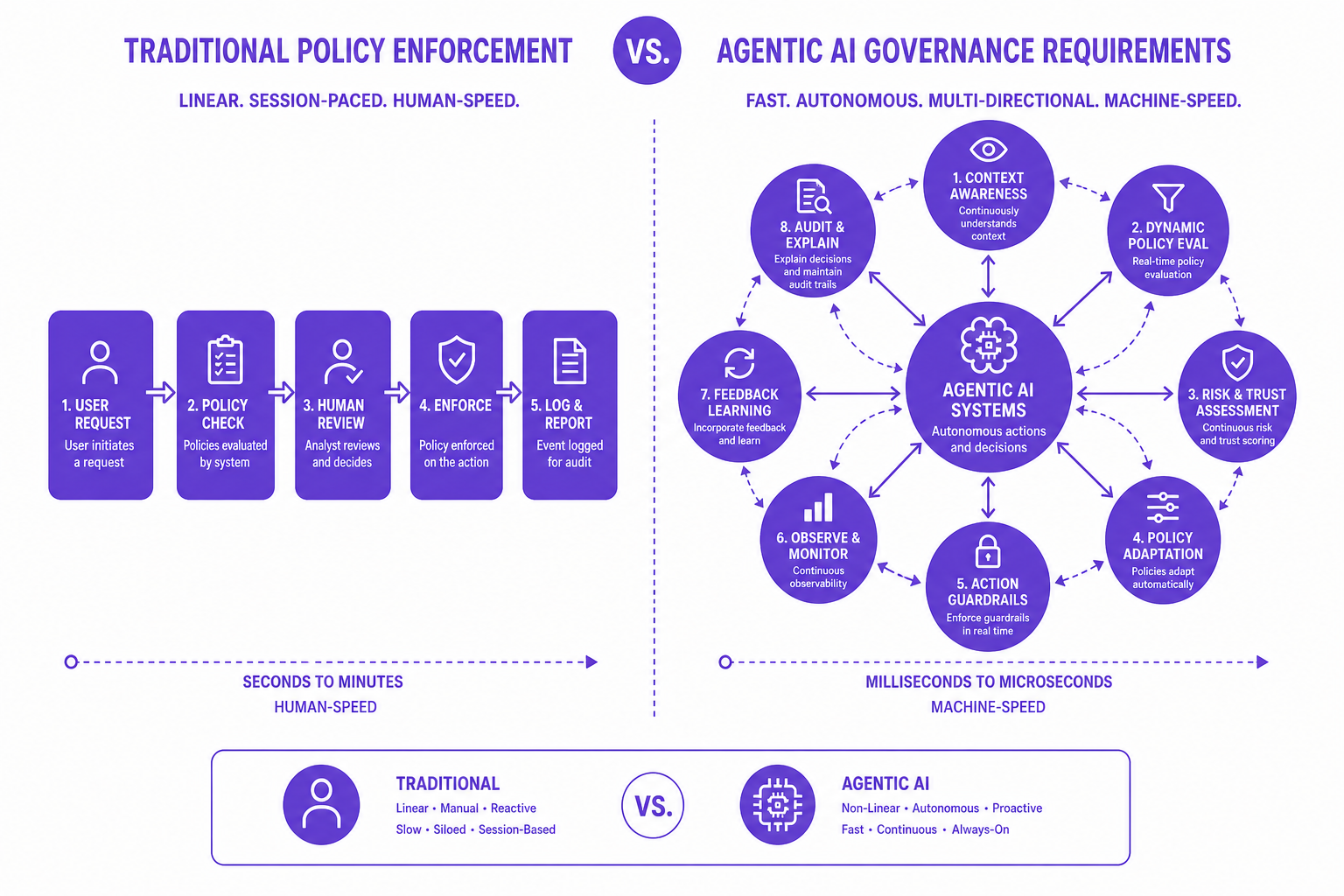
  • Autonomy at Scale: Agents initiate and complete tasks without human intervention, making role-based access and periodic approvals obsolete.
  • Continuous Decision Cycles: Agents process, learn, and act in real time, driving up the speed and volume of decisions beyond manual human oversight.
  • Machine-to-Machine Workflows: Agents communicate, exchange data, and trigger actions across loosely coupled digital systems, outpacing the guardrails of siloed governance tools.
  • Fragmented Visibility: With decentralized agents, visibility into who, what, and why is lost, obscuring accountability and increasing risk of policy violations or cost overruns.
  • Compliance at Risk: Data privacy, auditability, and regulatory mandates grow complex as agents propagate sensitive data or execute actions not directly visible to traditional tools.

Diagram contrasting structured traditional policy enforcement with dynamic agentic AI governance requirements

CloudNuro’s Solution: Next-Generation Governance Built for the Agentic AI Era

CloudNuro AI Custodian is purpose-built to bridge the agentic AI governance gap. Where legacy tools falter, CloudNuro provides:

  • Automated Agent Segmentation & Guardrails: Segment agent identities and set granular access, budget, and behavioral controls per agent across 400-plus enterprise applications.
  • Precise, Real-Time Visibility: Monitor active users, adoption trends, prompt volume, and application usage for both human and agentic activity.
  • No-Code Conditional Policy Enforcement: Use a workflow builder with templated logic and branching to automate multi-step policies, like license reallocation, without developer support.
  • Continuous Compliance Monitoring: Instantly detect and remediate oversharing of confidential data, with real-time monitoring for PII leakage triggered by agent prompts.
  • Cost & License Optimization: Dynamically reallocate expensive AI licenses by activity level and project, minimizing spend leakage from dormant or orphaned agents.
  • AI-Powered Policy Automation: Intelligent algorithms enforce budgeting, anomaly detection, and access controls at the exact pace of agent-driven activity, not just during scheduled audits.

Proof in Action: A manufacturing company leveraged the platform to identify and remediate rogue AI accounts, systematically reducing spend leakage and security risks within one year, validation that governance-first AI management can be transformative.

Concept illustration depicting CloudNuro AI Custodian applying governance guardrails to AI agents

The Road to Machine-Speed AI Governance: What’s Next for Enterprises

Modern enterprise AI governance frameworks must evolve to prioritize real-time controls, automation, and central visibility:

  • Continuous Policy Enforcement: Static policies and periodic reviews must be replaced with intelligent, automated, and adaptive policy engines.
  • Centralized Orchestration: Fragmented, manual admin tools cannot scale. A unified platform like CloudNuro aggregates agent activity across SaaS, cloud, and on-premise environments.
  • Dynamic Risk and Cost Control: Real-time monitoring of agent usage, financial impact, and compliance flags gives IT and finance continual leverage.
  • Human-in-the-Loop Safeguards: Blending automated controls with required checkpoints ensures critical enterprise functions remain compliant and secure.

Organizations that ignore this gap risk runaway costs, abundant compliance failures, reputational harm, and growing technical debt. Those who modernize governance with a dedicated platform gain agility, resilience, and future-proof control over AI-driven operations.

FAQ: Navigating the Agentic AI Governance Gap

What is agentic AI governance and why does it matter?
Agentic AI governance refers to frameworks, automated rules, and real-time controls designed to manage autonomous AI agents. It is critical because agentic AI operates faster and wider than human-managed systems, making conventional compliance and visibility insufficient.
Why can't traditional policies govern AI agents at machine speed?
Traditional policies rely on scheduled audits and manual review, which cannot keep up with the speed or complexity of AI agents making real-time, machine-to-machine decisions across multiple systems.
How should enterprises adapt governance for agentic AI?
Enterprises must shift to continuous, automated governance platforms that deliver real-time visibility, dynamic policy enforcement, and cost optimization tailored for both human and non-human actors.
What are the risks of ignoring the AI governance gap?
Failure to address this gap leads to security incidents, uncontrolled spending, compliance fines, loss of intellectual property, and the proliferation of unsanctioned, rogue AI agents.
How does CloudNuro position enterprises for next-gen AI architecture?
CloudNuro provides centralized visibility, ongoing policy enforcement, license optimization, and compliance monitoring purpose-built for the next wave of agentic AI architectures, enabling enterprises to operate rapidly, securely, and efficiently.

Conclusion: Future-of-Enterprise-AI is Now. Close the Governance Gap

The next wave of enterprise automation is already underway, with agentic AI set to drive core workflows at scale and speed. Traditional policies are no match for this transformation. Enterprises must urgently close the AI governance gap by adopting platforms purpose-built for agentic, machine-speed operations. With CloudNuro, enterprises gain the visibility, cost control, and compliance assurance essential for sustainable and secure advancement into the Future-of-Enterprise-AI.


About CloudNuro

CloudNuro is a leader in Enterprise AI Adoption Management, providing enterprises with unmatched visibility, governance, and cost optimization. Recognized twice in a row in the SaaS Management Platforms category and named a Leader in the SoftwareReviews Data Quadrant, CloudNuro is trusted by global enterprises and government agencies to bring financial discipline to SaaS, cloud, and AI. Trusted by enterprises, CloudNuro provides centralized SaaS inventory, license optimization, and renewal management along with advanced cost allocation and chargeback, giving IT and Finance leaders the visibility, control, and cost-conscious culture needed to drive financial discipline. Request a Demo | Explore Product

Table of Content

Start saving with CloudNuro

Request a no cost, no obligation free assessment —just 15 minutes to savings!

Get Started

Table of Contents

Introduction: A New Era of Autonomous Agents, a New Crisis in Governance

The surge of agentic artificial intelligence (AI) into enterprise workflows is transforming everything from automation to decision-making. Yet most organizations remain dangerously reliant on legacy governance policies crafted for human users, not for fleets of autonomous AI agents operating at machine speed. The result? A growing governance gap that exposes enterprises to unprecedented risks, cost overruns, compliance blind spots, and security vulnerabilities.

Concept illustration of autonomous AI agents interacting within enterprise networks

As agentic AI becomes an operational reality, CIOs, CTOs, IT governance leaders, and compliance officers must face a fundamental question: Are legacy policies truly equipped to regulate thousands of AI agents making real-time decisions and actions, autonomously traversing enterprise networks? Or is a radical new approach to AI agent governance overdue?

The Governance Gap: Why Traditional Policies Cannot Control AI at Machine Speed

The legacy frameworks most organizations deploy were built for human behavior, relying on periodic audits, session-based controls, and manual exception review. However, agentic AI systems behave distinctly. They never tire, never pause, and make split-second decisions across multiple platforms and workflows.

Expert insights point to one root cause: traditional governance frameworks fail because they were designed for session-based, human-paced interactions, while AI agents bypass these processes entirely. Instead of waiting for daily or weekly reviews, agents initiate, execute, and complete complex workflows autonomously in minutes or seconds. By the time a human review cycle begins, the agent may have accessed data, moved funds, provisioned users, or even exposed sensitive assets, completely outside existing policy triggers.

Key statistics expose this deficiency:

  • 75% of technology leaders cite governance and security as their leading deployment challenge.
  • Only 12% of organizations have implemented a centralized platform to govern AI agents, even though 96% are deploying agents in some way.
  • Over 80% of enterprises lack documented policies for agent-based workloads, leaving critical gaps in compliance and accountability.

Horizontal bar chart titled AI Agent Adoption vs. Governance Maturity showing data on organizational readiness

The Rapid Rise of Agentic AI: The Scale and Scope Explosion

Enterprise AI is moving from isolated pilots to orchestrated, multi-agent operations automating critical core and customer-facing processes. According to market trends and real data:

  • 23% of organizations are scaling agentic AI in a business function, with 82% planning formal integration within three years.
  • Multi-agent orchestration deployments doubled from 9% to 18% in just one quarter.
  • Only 27% of organizations express trust in fully autonomous agents, down from 43% previously, citing absent governance as the primary barrier.

Meanwhile, incidents abound: 97% of organizations reporting AI-related breaches were lacking proper access control for agents; another 40% of enterprises doubt their governance is even adequate for the challenge ahead.

This rapid escalation creates massive technical debt, security exposures, and cost sprawl. Without continuous, automated governance scaled to the paradigm of Future-of-Enterprise-AI, organizations risk repercussions spanning financial loss to regulatory violations.

Horizontal bar chart titled Enterprise Multi-Agent Orchestration Deployment showing phases of adoption

Governance Challenges Unique to Agentic AI

Agentic AI introduces unique complexity compared to traditional SaaS or cloud deployments:

  • Autonomy at Scale: Agents initiate and complete tasks without human intervention, making role-based access and periodic approvals obsolete.
  • Continuous Decision Cycles: Agents process, learn, and act in real time, driving up the speed and volume of decisions beyond manual human oversight.
  • Machine-to-Machine Workflows: Agents communicate, exchange data, and trigger actions across loosely coupled digital systems, outpacing the guardrails of siloed governance tools.
  • Fragmented Visibility: With decentralized agents, visibility into who, what, and why is lost, obscuring accountability and increasing risk of policy violations or cost overruns.
  • Compliance at Risk: Data privacy, auditability, and regulatory mandates grow complex as agents propagate sensitive data or execute actions not directly visible to traditional tools.

Diagram contrasting structured traditional policy enforcement with dynamic agentic AI governance requirements

CloudNuro’s Solution: Next-Generation Governance Built for the Agentic AI Era

CloudNuro AI Custodian is purpose-built to bridge the agentic AI governance gap. Where legacy tools falter, CloudNuro provides:

  • Automated Agent Segmentation & Guardrails: Segment agent identities and set granular access, budget, and behavioral controls per agent across 400-plus enterprise applications.
  • Precise, Real-Time Visibility: Monitor active users, adoption trends, prompt volume, and application usage for both human and agentic activity.
  • No-Code Conditional Policy Enforcement: Use a workflow builder with templated logic and branching to automate multi-step policies, like license reallocation, without developer support.
  • Continuous Compliance Monitoring: Instantly detect and remediate oversharing of confidential data, with real-time monitoring for PII leakage triggered by agent prompts.
  • Cost & License Optimization: Dynamically reallocate expensive AI licenses by activity level and project, minimizing spend leakage from dormant or orphaned agents.
  • AI-Powered Policy Automation: Intelligent algorithms enforce budgeting, anomaly detection, and access controls at the exact pace of agent-driven activity, not just during scheduled audits.

Proof in Action: A manufacturing company leveraged the platform to identify and remediate rogue AI accounts, systematically reducing spend leakage and security risks within one year, validation that governance-first AI management can be transformative.

Concept illustration depicting CloudNuro AI Custodian applying governance guardrails to AI agents

The Road to Machine-Speed AI Governance: What’s Next for Enterprises

Modern enterprise AI governance frameworks must evolve to prioritize real-time controls, automation, and central visibility:

  • Continuous Policy Enforcement: Static policies and periodic reviews must be replaced with intelligent, automated, and adaptive policy engines.
  • Centralized Orchestration: Fragmented, manual admin tools cannot scale. A unified platform like CloudNuro aggregates agent activity across SaaS, cloud, and on-premise environments.
  • Dynamic Risk and Cost Control: Real-time monitoring of agent usage, financial impact, and compliance flags gives IT and finance continual leverage.
  • Human-in-the-Loop Safeguards: Blending automated controls with required checkpoints ensures critical enterprise functions remain compliant and secure.

Organizations that ignore this gap risk runaway costs, abundant compliance failures, reputational harm, and growing technical debt. Those who modernize governance with a dedicated platform gain agility, resilience, and future-proof control over AI-driven operations.

FAQ: Navigating the Agentic AI Governance Gap

What is agentic AI governance and why does it matter?
Agentic AI governance refers to frameworks, automated rules, and real-time controls designed to manage autonomous AI agents. It is critical because agentic AI operates faster and wider than human-managed systems, making conventional compliance and visibility insufficient.
Why can't traditional policies govern AI agents at machine speed?
Traditional policies rely on scheduled audits and manual review, which cannot keep up with the speed or complexity of AI agents making real-time, machine-to-machine decisions across multiple systems.
How should enterprises adapt governance for agentic AI?
Enterprises must shift to continuous, automated governance platforms that deliver real-time visibility, dynamic policy enforcement, and cost optimization tailored for both human and non-human actors.
What are the risks of ignoring the AI governance gap?
Failure to address this gap leads to security incidents, uncontrolled spending, compliance fines, loss of intellectual property, and the proliferation of unsanctioned, rogue AI agents.
How does CloudNuro position enterprises for next-gen AI architecture?
CloudNuro provides centralized visibility, ongoing policy enforcement, license optimization, and compliance monitoring purpose-built for the next wave of agentic AI architectures, enabling enterprises to operate rapidly, securely, and efficiently.

Conclusion: Future-of-Enterprise-AI is Now. Close the Governance Gap

The next wave of enterprise automation is already underway, with agentic AI set to drive core workflows at scale and speed. Traditional policies are no match for this transformation. Enterprises must urgently close the AI governance gap by adopting platforms purpose-built for agentic, machine-speed operations. With CloudNuro, enterprises gain the visibility, cost control, and compliance assurance essential for sustainable and secure advancement into the Future-of-Enterprise-AI.


About CloudNuro

CloudNuro is a leader in Enterprise AI Adoption Management, providing enterprises with unmatched visibility, governance, and cost optimization. Recognized twice in a row in the SaaS Management Platforms category and named a Leader in the SoftwareReviews Data Quadrant, CloudNuro is trusted by global enterprises and government agencies to bring financial discipline to SaaS, cloud, and AI. Trusted by enterprises, CloudNuro provides centralized SaaS inventory, license optimization, and renewal management along with advanced cost allocation and chargeback, giving IT and Finance leaders the visibility, control, and cost-conscious culture needed to drive financial discipline. Request a Demo | Explore Product

Start saving with CloudNuro

Request a no cost, no obligation free assessment - just 15 minutes to savings!

Get Started

Don't Let Hidden ServiceNow Costs Drain Your IT Budget - Claim Your Free

We're offering complimentary ServiceNow license assessments to only 25 enterprises this quarter who want to unlock immediate savings without disrupting operations.

Get Free AssessmentGet Started


Ask AI for a Summary of This Blog

Save 20% of your SaaS spends with CloudNuro.ai

Recognized Leader in SaaS Management Platforms by Info-Tech SoftwareReviews

Thank you! Your submission has been received!
Oops! Something went wrong while submitting the form.