

Sign Up
Thank you for Submitting!
Agentic AI is transforming enterprise operations with autonomous, multi-step workflows powered by teams of AI agents. But as organizations accelerate adoption, they face a new challenge: making sense of how AI agents actually behave in production. Traditional logs, once sufficient for cloud application monitoring, often fall short in the face of complex, branching workflows and collaborative agent activity. Enter agentic AI observability with traces, a paradigm that provides not just data, but actionable insight and governance across every step of the AI-driven process.
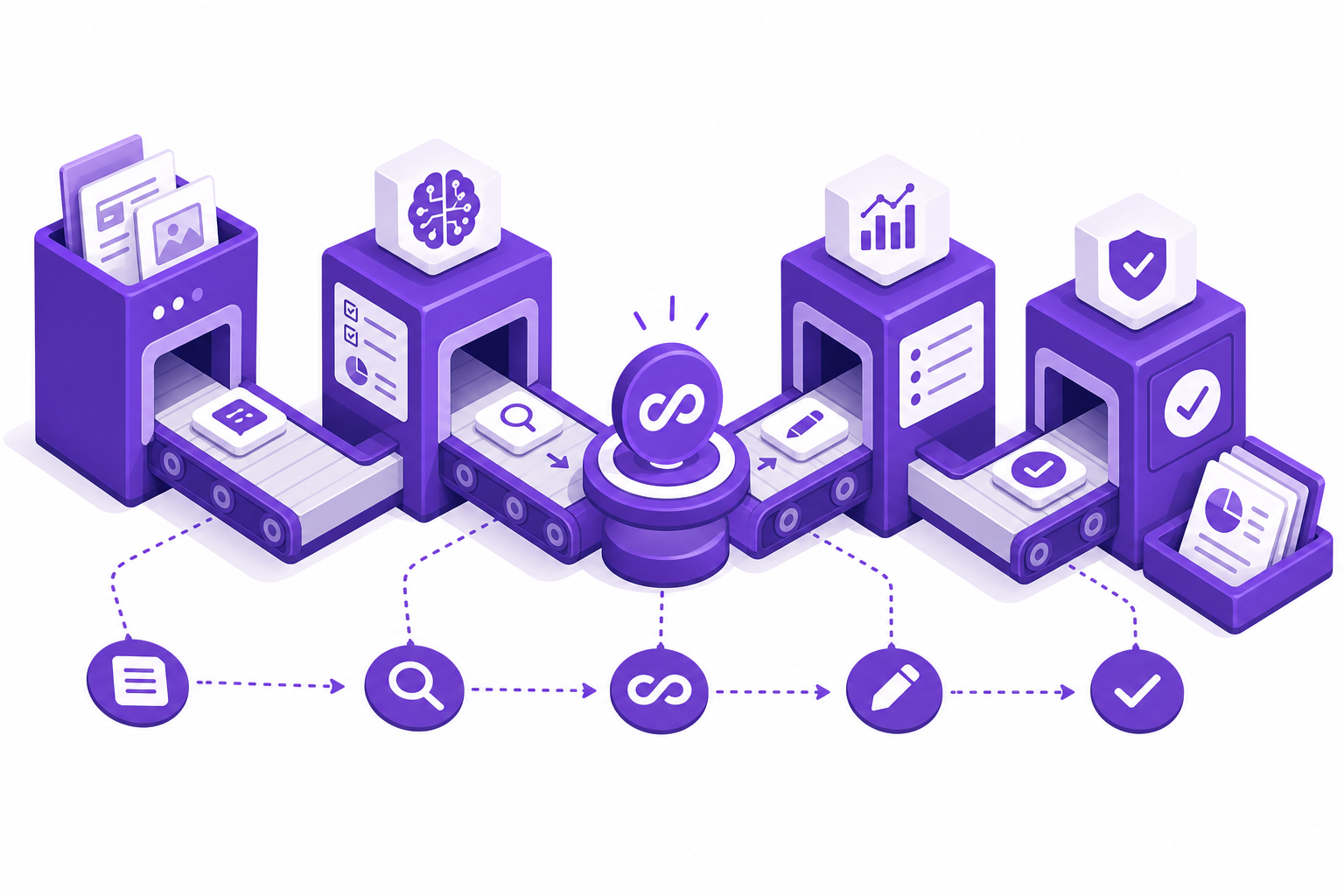
Multi-step workflows in AI, especially those built on agentic architectures, are rarely linear. Agents plan, call tools, retrieve or manipulate context, and hand off work to each other. In these scenarios, logging captures isolated events, but fails to reconstruct the full narrative of a workflow, making root cause analysis and optimization difficult, and leaving blind spots that threaten compliance and cost control.
Traces record every step along an agent's execution path. In agentic observability, the emerging pattern is: one trace per agent run, one span per step, with structured logs attached to spans for detailed drill-down analysis. This model captures the order, dependencies, and outcomes across planning, tool calls, retries, and handoffs. For complex AI projects, traces reveal not just "where" something happened but "how" and "why", enabling both debugging and strategic oversight.
Lack of Context: Logs are excellent for point-in-time events but struggle to correlate actions across steps or agents.
Fragmentation: In multi-agent workflows, logs are dispersed across tools and services, making it hard to stitch together the complete story.
Missed Semantics: Most AI workflow failures are semantic (e.g., the agent chose the wrong tool or failed to retrieve pertinent context), not just technical errors. Logs can miss the intent and results alignment crucial in AI governance.
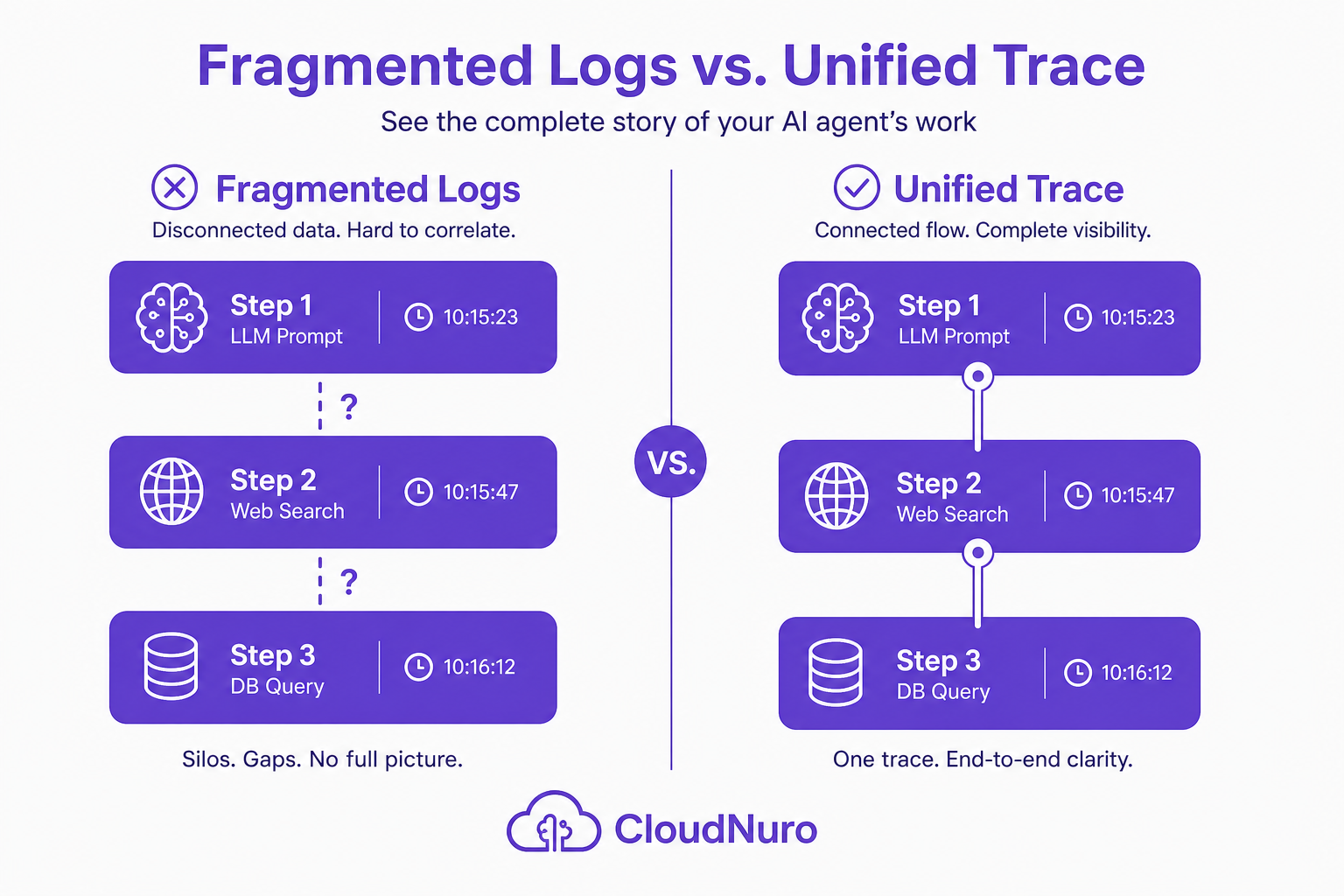
Agentic observability is about reconstructing the full execution path: from agent inception to every decision, tool call, and handoff between agents. Tracing enables IT and security teams to:
Visualize agent workflows end-to-end for both operational insight and compliance.
Diagnose root causes rapidly, including semantic errors unique to AI (e.g., wrong retrieval, misaligned output).
Tie resource consumption (tokens, costs, time) to agent activities, essential for financial discipline and optimization.
Monitor for policy violations, sensitive data exposure, or unauthorized actions, underpinning robust governance.
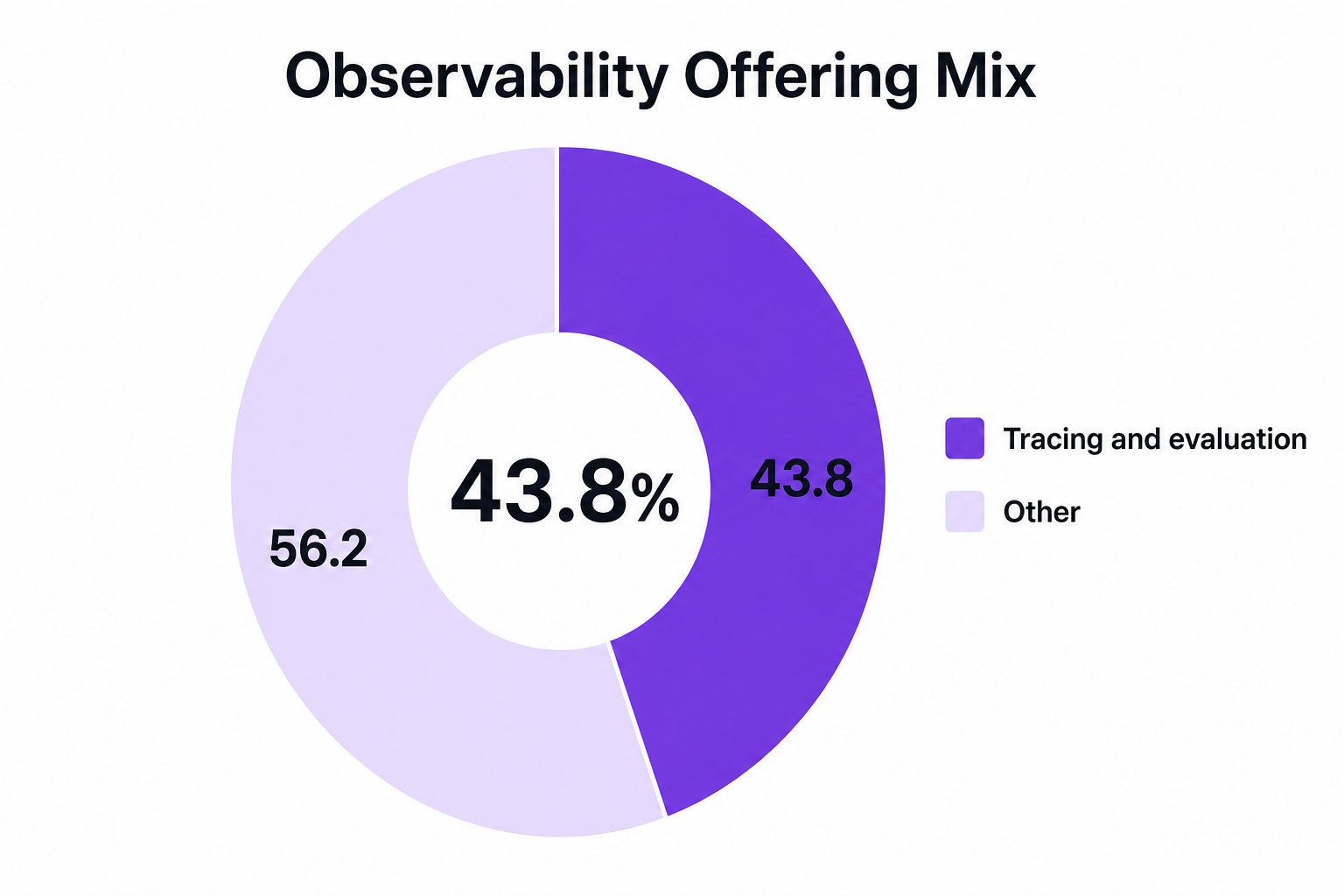
The observability market is converging around OpenTelemetry, an open standard for collecting traces, metrics, and logs. For AI agent workflows, OpenTelemetry makes it possible to:
Instrument every step, span, and agent action, regardless of the underlying model, provider, or infrastructure.
Integrate tracing data with logs and metrics for comprehensive root cause analysis.
Standardize observability, even with mixed tools, services, and hybrid cloud deployments.
Market trends show that OpenTelemetry is quickly becoming the preferred way to monitor, evaluate, and govern agentic AI systems, especially at scale. Bundling observability with proactive safety, policy, and audit features is now a requirement for enterprise adopters.
While organizations struggle to gain insight into dispersed, multi-agent AI environments, CloudNuro AI Custodian delivers a comprehensive, governance-first solution:
Centralized AI Environment View: Visibility across users, projects, tools, agents, and models.
Agent-Level Tracking: Monitors specific token consumption and financial costs at the individual AI agent level, supporting project-based budgeting and chargebacks.
Real-Time User Segmentation: Categorizes users by prompt activity; enables license reallocation to optimize spend.
Automated Compliance: Integrates with Microsoft Purview and Graph API to detect oversharing, monitor sensitive data leakage, and ensure AI policy adherence.
No-Code/Low-Code Workflow Orchestration: Build, monitor, and trace multi-step AI workflows visually, simplifying automation and policy enforcement.
Customers typically identify 20% to 30% in cost-saving opportunities in their first 90 days by eliminating redundant apps and reclaiming unused licenses.
Setup takes just 15 minutes, delivering actionable visibility in under 24 hours.
Scales seamlessly to manage highly complex, distributed environments with thousands of users and agents.
Instrument Every Agent Run: Adopt the one-trace-per-agent, one-span-per-step pattern. Ensure all tool calls, handoffs, and state changes are traced.
Group Logs with Traces: Use structured logs attached to spans, making it easy to drill down from high-level traces to granular events.
Monitor Resource Consumption: Track tokens, costs, latency, and data flow at the agent and workflow level.
Integrate Policy and Compliance Monitoring: Observability should extend beyond technical failures to include business and security policy violations.
Empower IT and Finance: Make trace data available not only to developers but to IT operations, security, and finance teams for full lifecycle governance.
What is agentic AI observability?
Agentic AI observability refers to comprehensive monitoring and governance of workflows carried out by autonomous AI agents. It emphasizes full-path visibility, not just isolated events, helping organizations understand, diagnose, and optimize complex agent interactions.
Why are traces better than logs in multi-step AI workflows?
Traces reconstruct the complete workflow across multiple agents and steps, revealing dependencies, failures, and outcomes that traditional logs cannot correlate. This is vital for debugging, compliance, and cost tracking in agent-driven environments.
How does trace-based monitoring improve agent workflow visibility?
Trace-based monitoring creates a detailed, navigable record of every action, handoff, and result, making it easier to spot inefficiencies, policy violations, and bottlenecks while enabling proactive optimization.
What tools support agent workflow monitoring with traces?
OpenTelemetry has become the leading open-source standard for collecting and integrating traces in AI workflows and can be leveraged in platforms like CloudNuro AI Custodian for unified visibility and governance.
What are best practices for OpenTelemetry AI in monitoring?
Instrument each agent run and workflow step as a span, link relevant logs, and tie traces to business and compliance policies to maximize governance, security, and operational efficiency.
As enterprise AI evolves, traditional logs alone cannot keep pace with the complexity and compliance demands of agentic workflows. Tracing is the only observability primitive that reconstructs the full journey, empowering IT, security, and finance leaders to drive optimization and proactive governance.
CloudNuro AI Custodian stands at the forefront of this transformation, providing a single pane of glass for agentic observability, compliance, and cost optimization. Bring your AI environment under control with trace-powered visibility, and build the foundation for secure, cost-effective, and auditable AI operations at scale.
About CloudNuro
CloudNuro is a leader in Enterprise AI Adoption Management, providing enterprises with unmatched visibility, governance, and cost optimization. Recognized twice in a row in the SaaS Management Platforms category and named a Leader in the SoftwareReviews Data Quadrant, CloudNuro is trusted by global enterprises and government agencies to bring financial discipline to SaaS, cloud, and AI. Trusted by enterprises, CloudNuro provides centralized SaaS inventory, license optimization, and renewal management along with advanced cost allocation and chargeback, giving IT and Finance leaders the visibility, control, and cost-conscious culture needed to drive financial discipline.
Request a no cost, no obligation free assessment —just 15 minutes to savings!
Get StartedAgentic AI is transforming enterprise operations with autonomous, multi-step workflows powered by teams of AI agents. But as organizations accelerate adoption, they face a new challenge: making sense of how AI agents actually behave in production. Traditional logs, once sufficient for cloud application monitoring, often fall short in the face of complex, branching workflows and collaborative agent activity. Enter agentic AI observability with traces, a paradigm that provides not just data, but actionable insight and governance across every step of the AI-driven process.
Multi-step workflows in AI, especially those built on agentic architectures, are rarely linear. Agents plan, call tools, retrieve or manipulate context, and hand off work to each other. In these scenarios, logging captures isolated events, but fails to reconstruct the full narrative of a workflow, making root cause analysis and optimization difficult, and leaving blind spots that threaten compliance and cost control.
Traces record every step along an agent's execution path. In agentic observability, the emerging pattern is: one trace per agent run, one span per step, with structured logs attached to spans for detailed drill-down analysis. This model captures the order, dependencies, and outcomes across planning, tool calls, retries, and handoffs. For complex AI projects, traces reveal not just "where" something happened but "how" and "why", enabling both debugging and strategic oversight.
Lack of Context: Logs are excellent for point-in-time events but struggle to correlate actions across steps or agents.
Fragmentation: In multi-agent workflows, logs are dispersed across tools and services, making it hard to stitch together the complete story.
Missed Semantics: Most AI workflow failures are semantic (e.g., the agent chose the wrong tool or failed to retrieve pertinent context), not just technical errors. Logs can miss the intent and results alignment crucial in AI governance.
Agentic observability is about reconstructing the full execution path: from agent inception to every decision, tool call, and handoff between agents. Tracing enables IT and security teams to:
Visualize agent workflows end-to-end for both operational insight and compliance.
Diagnose root causes rapidly, including semantic errors unique to AI (e.g., wrong retrieval, misaligned output).
Tie resource consumption (tokens, costs, time) to agent activities, essential for financial discipline and optimization.
Monitor for policy violations, sensitive data exposure, or unauthorized actions, underpinning robust governance.
The observability market is converging around OpenTelemetry, an open standard for collecting traces, metrics, and logs. For AI agent workflows, OpenTelemetry makes it possible to:
Instrument every step, span, and agent action, regardless of the underlying model, provider, or infrastructure.
Integrate tracing data with logs and metrics for comprehensive root cause analysis.
Standardize observability, even with mixed tools, services, and hybrid cloud deployments.
Market trends show that OpenTelemetry is quickly becoming the preferred way to monitor, evaluate, and govern agentic AI systems, especially at scale. Bundling observability with proactive safety, policy, and audit features is now a requirement for enterprise adopters.
While organizations struggle to gain insight into dispersed, multi-agent AI environments, CloudNuro AI Custodian delivers a comprehensive, governance-first solution:
Centralized AI Environment View: Visibility across users, projects, tools, agents, and models.
Agent-Level Tracking: Monitors specific token consumption and financial costs at the individual AI agent level, supporting project-based budgeting and chargebacks.
Real-Time User Segmentation: Categorizes users by prompt activity; enables license reallocation to optimize spend.
Automated Compliance: Integrates with Microsoft Purview and Graph API to detect oversharing, monitor sensitive data leakage, and ensure AI policy adherence.
No-Code/Low-Code Workflow Orchestration: Build, monitor, and trace multi-step AI workflows visually, simplifying automation and policy enforcement.
Customers typically identify 20% to 30% in cost-saving opportunities in their first 90 days by eliminating redundant apps and reclaiming unused licenses.
Setup takes just 15 minutes, delivering actionable visibility in under 24 hours.
Scales seamlessly to manage highly complex, distributed environments with thousands of users and agents.
Instrument Every Agent Run: Adopt the one-trace-per-agent, one-span-per-step pattern. Ensure all tool calls, handoffs, and state changes are traced.
Group Logs with Traces: Use structured logs attached to spans, making it easy to drill down from high-level traces to granular events.
Monitor Resource Consumption: Track tokens, costs, latency, and data flow at the agent and workflow level.
Integrate Policy and Compliance Monitoring: Observability should extend beyond technical failures to include business and security policy violations.
Empower IT and Finance: Make trace data available not only to developers but to IT operations, security, and finance teams for full lifecycle governance.
What is agentic AI observability?
Agentic AI observability refers to comprehensive monitoring and governance of workflows carried out by autonomous AI agents. It emphasizes full-path visibility, not just isolated events, helping organizations understand, diagnose, and optimize complex agent interactions.
Why are traces better than logs in multi-step AI workflows?
Traces reconstruct the complete workflow across multiple agents and steps, revealing dependencies, failures, and outcomes that traditional logs cannot correlate. This is vital for debugging, compliance, and cost tracking in agent-driven environments.
How does trace-based monitoring improve agent workflow visibility?
Trace-based monitoring creates a detailed, navigable record of every action, handoff, and result, making it easier to spot inefficiencies, policy violations, and bottlenecks while enabling proactive optimization.
What tools support agent workflow monitoring with traces?
OpenTelemetry has become the leading open-source standard for collecting and integrating traces in AI workflows and can be leveraged in platforms like CloudNuro AI Custodian for unified visibility and governance.
What are best practices for OpenTelemetry AI in monitoring?
Instrument each agent run and workflow step as a span, link relevant logs, and tie traces to business and compliance policies to maximize governance, security, and operational efficiency.
As enterprise AI evolves, traditional logs alone cannot keep pace with the complexity and compliance demands of agentic workflows. Tracing is the only observability primitive that reconstructs the full journey, empowering IT, security, and finance leaders to drive optimization and proactive governance.
CloudNuro AI Custodian stands at the forefront of this transformation, providing a single pane of glass for agentic observability, compliance, and cost optimization. Bring your AI environment under control with trace-powered visibility, and build the foundation for secure, cost-effective, and auditable AI operations at scale.
About CloudNuro
CloudNuro is a leader in Enterprise AI Adoption Management, providing enterprises with unmatched visibility, governance, and cost optimization. Recognized twice in a row in the SaaS Management Platforms category and named a Leader in the SoftwareReviews Data Quadrant, CloudNuro is trusted by global enterprises and government agencies to bring financial discipline to SaaS, cloud, and AI. Trusted by enterprises, CloudNuro provides centralized SaaS inventory, license optimization, and renewal management along with advanced cost allocation and chargeback, giving IT and Finance leaders the visibility, control, and cost-conscious culture needed to drive financial discipline.
Request a no cost, no obligation free assessment - just 15 minutes to savings!
Get StartedWe're offering complimentary ServiceNow license assessments to only 25 enterprises this quarter who want to unlock immediate savings without disrupting operations.
Get Free AssessmentGet Started




CloudNuro Corp
1755 Park St. Suite 207
Naperville, IL 60563
Phone : +1-630-277-9470
Email: info@cloudnuro.com



.webp)

Recognized Leader in SaaS Management Platforms by Info-Tech SoftwareReviews

.svg)