

Sign Up
Thank you for Submitting!
The rise of agentic AI has fundamentally changed enterprise workflows. From automating document reviews to orchestrating dynamic SaaS permissions, autonomous AI agents now handle sensitive tasks in real time. Yet, as IT leaders and operators know, these advances also introduce new risks: without robust AI agent monitoring, enterprises face blind spots in compliance, security, and cost governance. As of 2026, 57% of organizations have AI agents in production, but observability and evaluation remain the weakest links. Organizations that lack real-time visibility into agent behavior, cost, and operational health risk runaway expenses, compliance violations, and lost business value.
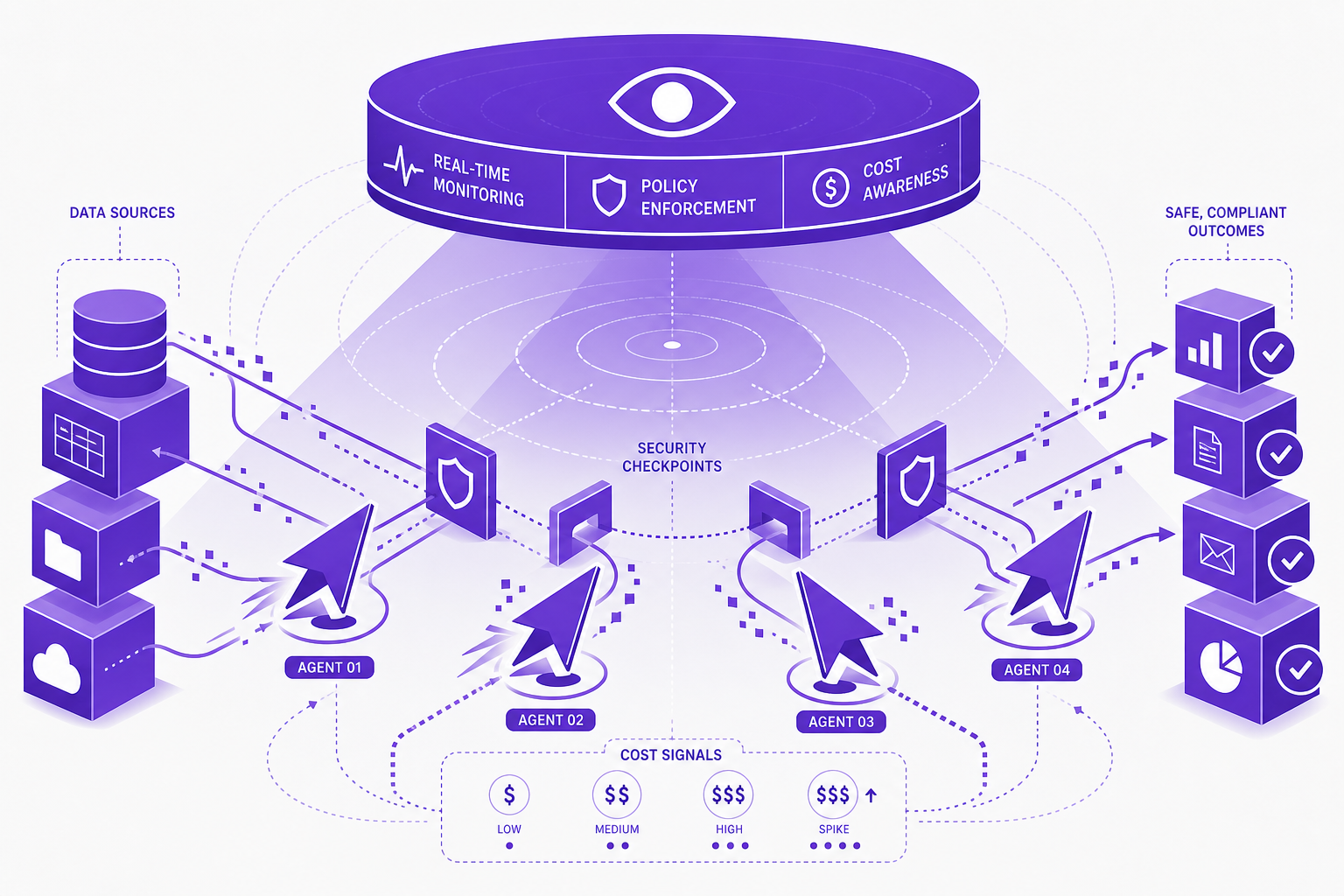
This playbook tackles what it takes to operationalize AI agent monitoring at scale. CIOs, CTOs, and technology teams will learn how to implement best practices, measure key performance and compliance metrics, and leverage the observability tools that matter most. Throughout, we’ll show how CloudNuro empowers enterprise IT leaders with unmatched visibility, automated cost optimization, and real-time governance for the age of agentic AI.
AI agent monitoring extends far beyond traditional infrastructure checks. Legacy metrics like uptime, CPU, or memory usage barely scratch the surface of agentic systems, where multi-step reasoning, looping logic, and self-directed action are the norm. In 2026, best-in-class observability is:
Trace-based and continuous: Every agent action, decision, and tool call is traced end-to-end, revealing the "why" behind output, not just the "what."
Focused on business impact: Enterprises track economic signals like cost per resolved task, not just technical stats, to maximize AI return on investment.
Security-centric: Telemetry tracks prompt injections, sensitive data leaks, and compliance violations.
Market trends confirm this shift:
Security telemetry and cost visibility are now integral to AI observability.
Standardized semantics are enabling unified dashboards that show agent behavior, financial metrics, and compliance status together.
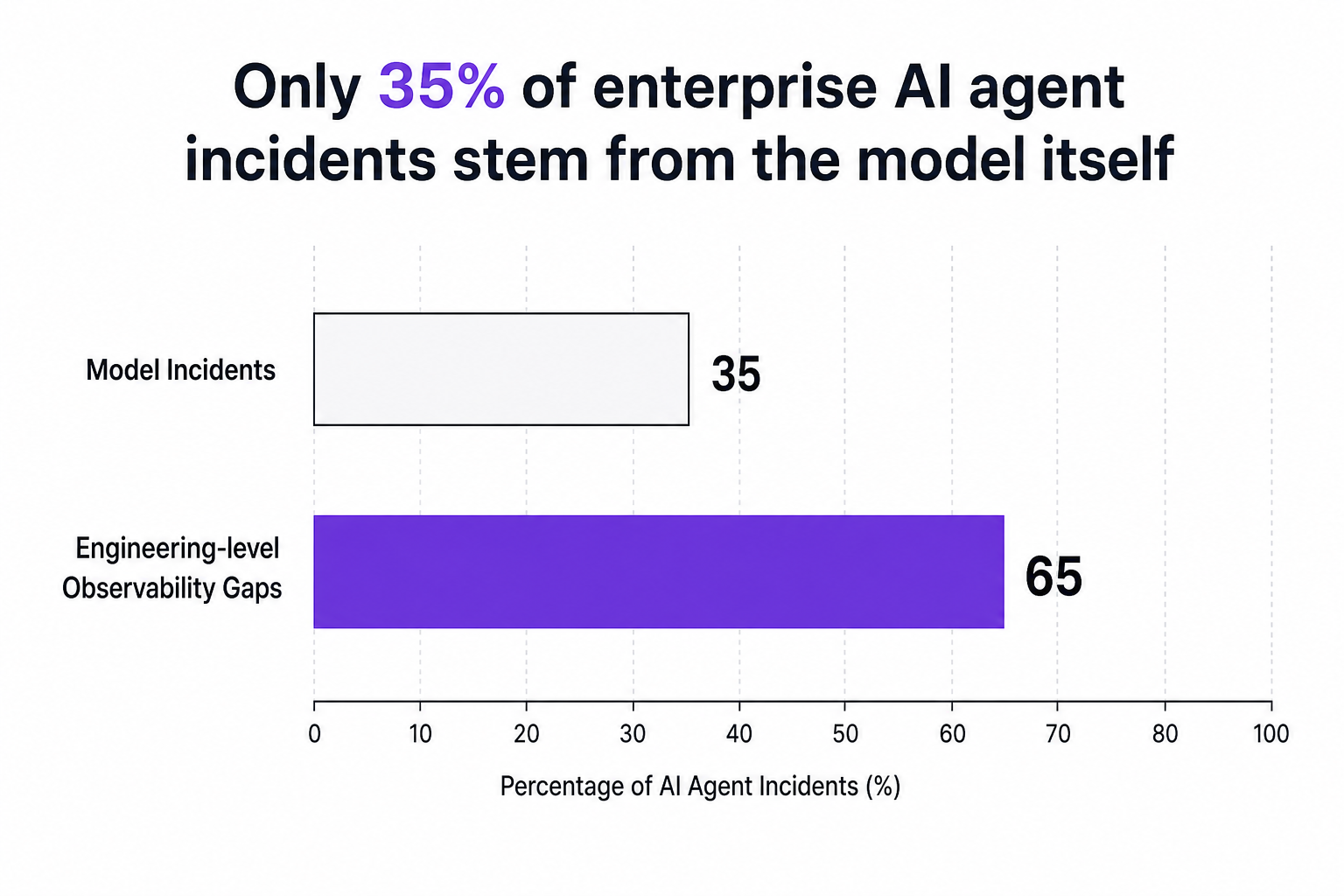
65% of enterprise AI agent incidents stem from engineering-level observability gaps, not the language model itself.
AI agent monitoring is the practice of tracking and analyzing the activity, performance, and compliance of autonomous software agents operating within enterprise infrastructure. These agents may draft contracts, manage SaaS permissions, or drive business workflows, often without human-in-the-loop checks. Monitoring serves several critical business functions:
Visibility and Accountability: Ensures every agentic action is tracked and explainable, satisfying auditing and governance needs.
Security and Compliance: Detects prompt injections, data leaks (including PII), and policy violations to meet legal and regulatory standards.
Cost Optimization: Flags inefficiencies like excessive looping or misallocated licenses, enabling proactive financial management.
Reliability: Surfaces latency and performance bottlenecks that impact user experience.
Without robust monitoring, organizations are exposed to compliance risk, operational inefficiency, and uncontrolled expenses. Only 15% of generative AI deployments currently instrument observability, but mature organizations using advanced monitoring release 60% more products or revenue streams than their peers.
To operationalize AI agent monitoring, IT teams must track a new set of indicators that reflect agentic complexity and enterprise risk:
Task Completion Rate: Ratio of successful agent tasks to attempted tasks. Crucial for measuring real business value.
Groundedness Score: Reflects how well an agent’s output aligns with trusted internal data, reducing hallucinations.
Latency (by pipeline stage): Time to first token is now a first-class user metric. Pinpointing slowdowns requires tracking prompt construction, retrieval, inference, and post-processing individually.
Token Usage and Cost per Task: Direct link between agent actions and spend; financial SLOs prevent budget overruns.
Compliance and Security Events: Frequency of detected prompt injections, sensitive data sharing, or PII exposures.
User Segmentation: Power, general, low, and dormant users segmented for proactive license allocation.
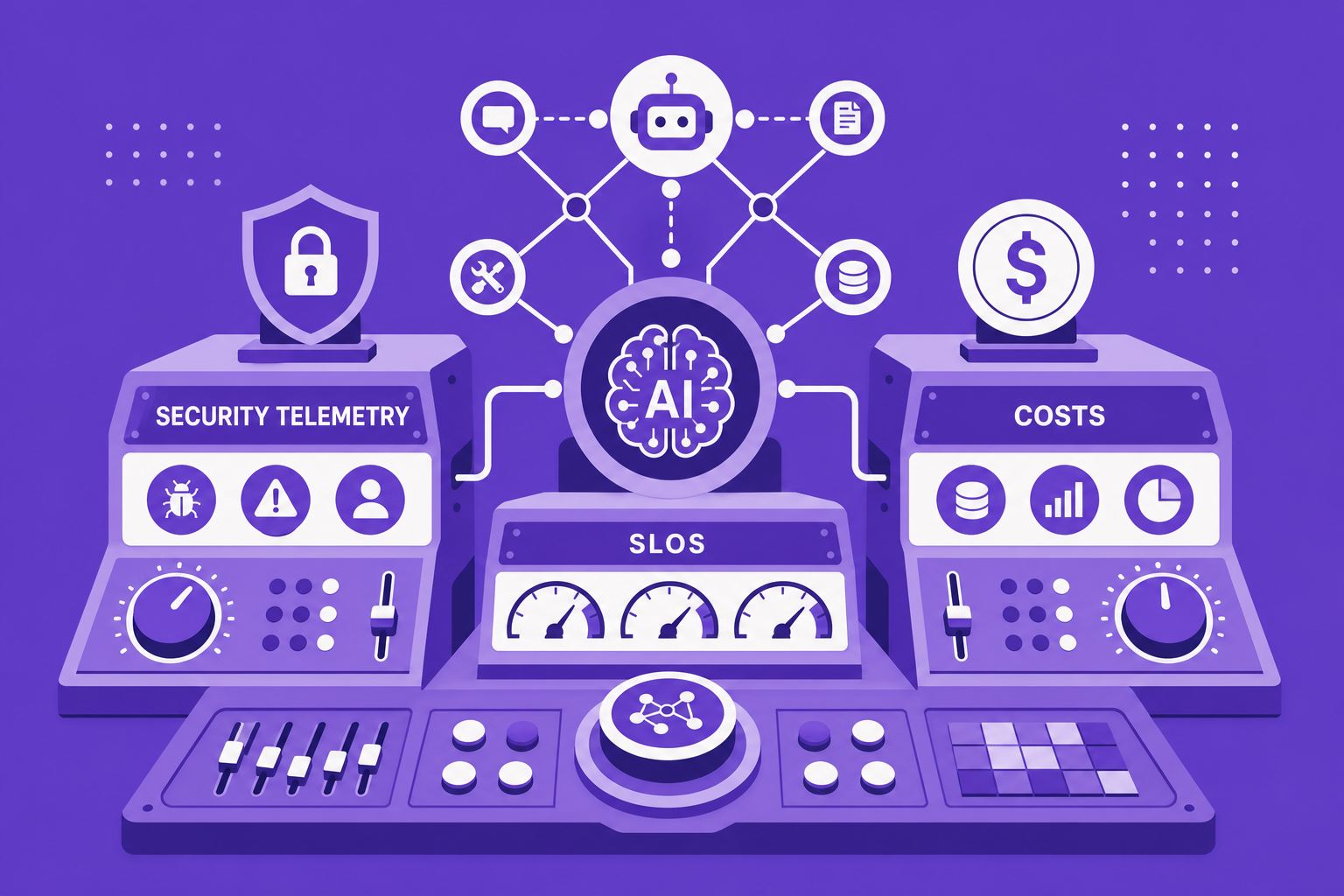
CloudNuro’s AI Custodian unifies these metrics, segmenting end users based on activity, allowing administrators to reallocate dormant licenses in real time while tracking granular agent behavior and cost.
How can operators architect a monitoring solution robust enough for dynamic, agent-driven workflows? Key building blocks include:
Modern observability platforms must integrate traditional metrics with AI-specific events:
Custom traces: Explain agent decision-making over complex, multi-step workflows
Security logs: Detect anomalies, data sharing, compliance misses
Cost data: Merge token consumption with financial rates for real-time budget tracking
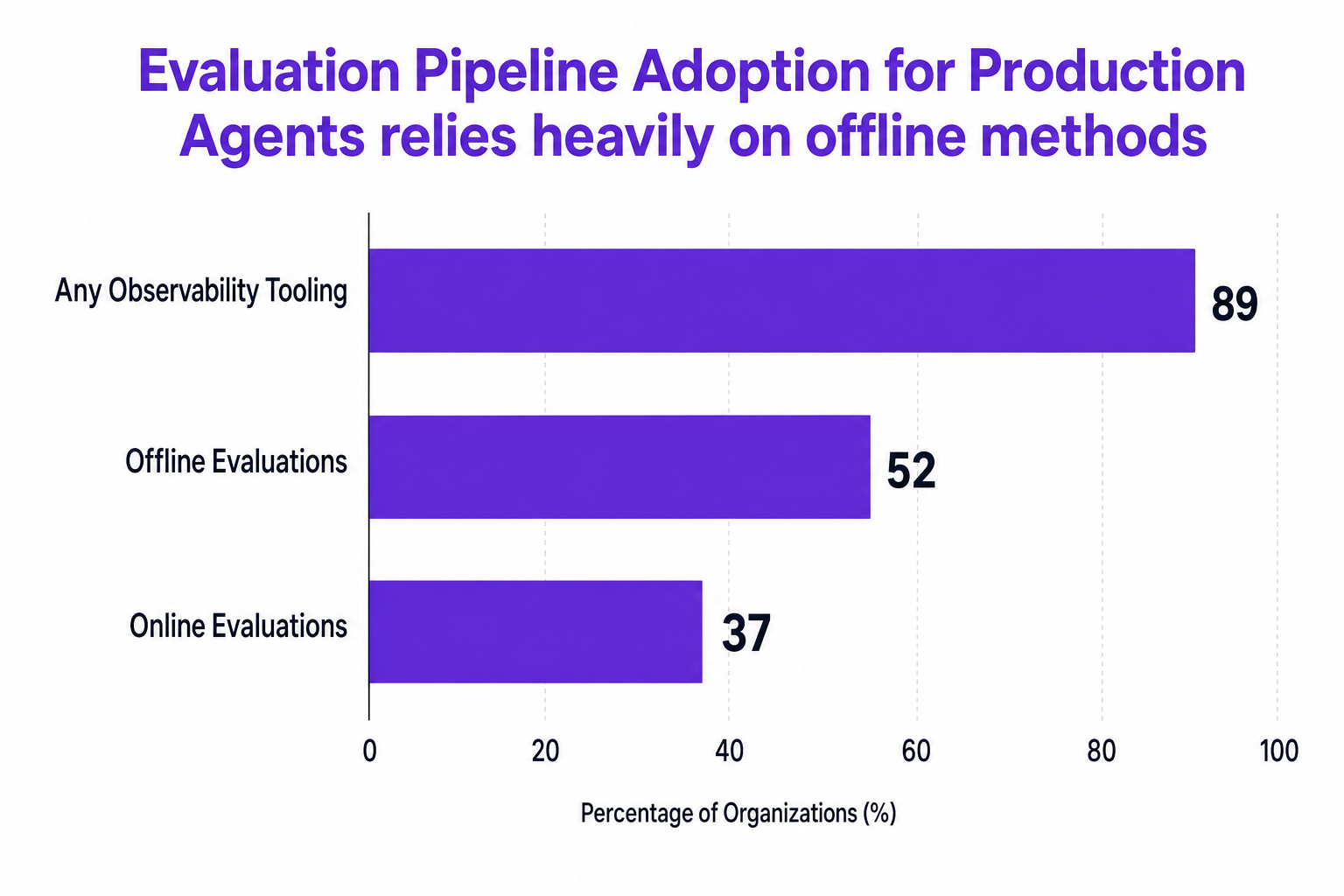
Continuous evaluation is now essential. CloudNuro’s platform supports both offline and live performance tracking for agent workflows, surfacing task success, groundedness, and accuracy at each step. Evaluation adoption is rising: 89% of organizations report using some observability tooling, but only 37% track live metrics for production agents.
Administrators can set precise budget thresholds for each agent, upload contractual cost limits, and automate license reallocation. CloudNuro’s system flags anomalies like excessive personal usage or sensitive sharing, then enforces policy automatically.
IT and Finance leaders deploy CloudNuro to shift AI monitoring from reactive troubleshooting to proactive governance and cost containment. Here’s how best-in-class organizations leverage CloudNuro’s AI Custodian:
Scenario: A public transit agency gained centralized visibility into AI agent usage, driving 64% savings on SaaS costs and validating value expansion across teams.
Sector impact: In legal, a governed FinOps approach enabled $230,000 savings in three months by segmenting users and reclaiming AI licenses.
ROI: On average, organizations deploying proactive agent monitoring achieve over 1000% ROI in one year by directly attributing AI costs and benefits at the team and project level.
CloudNuro operationalizes these results with:
Real-time dashboards for agent action, adoption, and prompt volumes
Multi-layered security and compliance checks built into agent workflows
Automated evaluation across the AI lifecycle – from development to production
Deep integration across hundreds of SaaS and cloud applications to eliminate blind spots
By 2026, successful enterprise monitoring platforms have several must-have capabilities:
Seamless integration with enterprise SaaS, cloud, and emerging agent platforms
Automated license optimization based on behavioral user segmentation
Centralized governance that embeds compliance checks and financial controls at every stage
Real-time anomaly detection to prevent excessive spend or compliance failures
CloudNuro AI Custodian delivers on these criteria, providing an agentic operations center purpose-built for the AI era.
What is AI agent monitoring and why is it important?
AI agent monitoring is the enterprise practice of tracking, analyzing, and optimizing the behavior, cost, and compliance of autonomous software agents. This is critical to ensure accountability, prevent compliance risk, and uncover cost savings in AI-driven operations.
How do you measure agentic AI observability?
Observability combines trace-based logs that explain agent reasoning, performance metrics (completion, groundedness, latency), cost analysis, and security telemetry. Unified dashboards like CloudNuro’s combine all of these for true end-to-end oversight.
What are the key AI agent metrics and SLOs?
Enterprises rely on metrics such as task completion rate, groundedness and accuracy scores, time to first token, cost per agent task, compliance events, and user segmentation for license lifecycle management. Service Level Objectives are set for business value (completion/cost) and security (compliance adherence).
How can enterprises operationalize agent monitoring for compliance?
By embedding continuous monitoring and evaluation in production, automating policy enforcement, and implementing real-time alerts to flag PII leaks, prompt injections, and contract violations, enterprises can meet stringent compliance requirements.
What tools support agentic AI monitoring in 2026?
Platforms like CloudNuro’s AI Custodian offer real-time dashboards, license optimization, integrated compliance checks, and cost governance specifically designed for agentic AI in complex enterprise environments.
As AI agents become the operational core of enterprise SaaS and cloud, the need for proactive monitoring, compliance governance, and cost optimization reaches new heights. Traditional infrastructure metrics are no longer sufficient; operators must embrace trace-based observability, dynamic budget controls, and continuous evaluation pipelines to ensure AI delivers measurable and compliant business value.
With CloudNuro, enterprise leaders gain the only monitoring solution unifying agent observability, governance, and cost optimization, purpose-built for the era of generative, agentic AI.
CloudNuro is a leader in Enterprise AI Adoption Management, providing enterprises with unmatched visibility, governance, and cost optimization. Recognized twice in a row in the SaaS Management Platforms category and named a Leader in the SoftwareReviews Data Quadrant, CloudNuro is trusted by global enterprises and government agencies to bring financial discipline to SaaS, cloud, and AI. Trusted by enterprises, CloudNuro provides centralized SaaS inventory, license optimization, and renewal management along with advanced cost allocation and chargeback, giving IT and Finance leaders the visibility, control, and cost-conscious culture needed to drive financial discipline.
Request a no cost, no obligation free assessment —just 15 minutes to savings!
Get StartedThe rise of agentic AI has fundamentally changed enterprise workflows. From automating document reviews to orchestrating dynamic SaaS permissions, autonomous AI agents now handle sensitive tasks in real time. Yet, as IT leaders and operators know, these advances also introduce new risks: without robust AI agent monitoring, enterprises face blind spots in compliance, security, and cost governance. As of 2026, 57% of organizations have AI agents in production, but observability and evaluation remain the weakest links. Organizations that lack real-time visibility into agent behavior, cost, and operational health risk runaway expenses, compliance violations, and lost business value.
This playbook tackles what it takes to operationalize AI agent monitoring at scale. CIOs, CTOs, and technology teams will learn how to implement best practices, measure key performance and compliance metrics, and leverage the observability tools that matter most. Throughout, we’ll show how CloudNuro empowers enterprise IT leaders with unmatched visibility, automated cost optimization, and real-time governance for the age of agentic AI.
AI agent monitoring extends far beyond traditional infrastructure checks. Legacy metrics like uptime, CPU, or memory usage barely scratch the surface of agentic systems, where multi-step reasoning, looping logic, and self-directed action are the norm. In 2026, best-in-class observability is:
Trace-based and continuous: Every agent action, decision, and tool call is traced end-to-end, revealing the "why" behind output, not just the "what."
Focused on business impact: Enterprises track economic signals like cost per resolved task, not just technical stats, to maximize AI return on investment.
Security-centric: Telemetry tracks prompt injections, sensitive data leaks, and compliance violations.
Market trends confirm this shift:
Security telemetry and cost visibility are now integral to AI observability.
Standardized semantics are enabling unified dashboards that show agent behavior, financial metrics, and compliance status together.
65% of enterprise AI agent incidents stem from engineering-level observability gaps, not the language model itself.
AI agent monitoring is the practice of tracking and analyzing the activity, performance, and compliance of autonomous software agents operating within enterprise infrastructure. These agents may draft contracts, manage SaaS permissions, or drive business workflows, often without human-in-the-loop checks. Monitoring serves several critical business functions:
Visibility and Accountability: Ensures every agentic action is tracked and explainable, satisfying auditing and governance needs.
Security and Compliance: Detects prompt injections, data leaks (including PII), and policy violations to meet legal and regulatory standards.
Cost Optimization: Flags inefficiencies like excessive looping or misallocated licenses, enabling proactive financial management.
Reliability: Surfaces latency and performance bottlenecks that impact user experience.
Without robust monitoring, organizations are exposed to compliance risk, operational inefficiency, and uncontrolled expenses. Only 15% of generative AI deployments currently instrument observability, but mature organizations using advanced monitoring release 60% more products or revenue streams than their peers.
To operationalize AI agent monitoring, IT teams must track a new set of indicators that reflect agentic complexity and enterprise risk:
Task Completion Rate: Ratio of successful agent tasks to attempted tasks. Crucial for measuring real business value.
Groundedness Score: Reflects how well an agent’s output aligns with trusted internal data, reducing hallucinations.
Latency (by pipeline stage): Time to first token is now a first-class user metric. Pinpointing slowdowns requires tracking prompt construction, retrieval, inference, and post-processing individually.
Token Usage and Cost per Task: Direct link between agent actions and spend; financial SLOs prevent budget overruns.
Compliance and Security Events: Frequency of detected prompt injections, sensitive data sharing, or PII exposures.
User Segmentation: Power, general, low, and dormant users segmented for proactive license allocation.
CloudNuro’s AI Custodian unifies these metrics, segmenting end users based on activity, allowing administrators to reallocate dormant licenses in real time while tracking granular agent behavior and cost.
How can operators architect a monitoring solution robust enough for dynamic, agent-driven workflows? Key building blocks include:
Modern observability platforms must integrate traditional metrics with AI-specific events:
Custom traces: Explain agent decision-making over complex, multi-step workflows
Security logs: Detect anomalies, data sharing, compliance misses
Cost data: Merge token consumption with financial rates for real-time budget tracking
Continuous evaluation is now essential. CloudNuro’s platform supports both offline and live performance tracking for agent workflows, surfacing task success, groundedness, and accuracy at each step. Evaluation adoption is rising: 89% of organizations report using some observability tooling, but only 37% track live metrics for production agents.
Administrators can set precise budget thresholds for each agent, upload contractual cost limits, and automate license reallocation. CloudNuro’s system flags anomalies like excessive personal usage or sensitive sharing, then enforces policy automatically.
IT and Finance leaders deploy CloudNuro to shift AI monitoring from reactive troubleshooting to proactive governance and cost containment. Here’s how best-in-class organizations leverage CloudNuro’s AI Custodian:
Scenario: A public transit agency gained centralized visibility into AI agent usage, driving 64% savings on SaaS costs and validating value expansion across teams.
Sector impact: In legal, a governed FinOps approach enabled $230,000 savings in three months by segmenting users and reclaiming AI licenses.
ROI: On average, organizations deploying proactive agent monitoring achieve over 1000% ROI in one year by directly attributing AI costs and benefits at the team and project level.
CloudNuro operationalizes these results with:
Real-time dashboards for agent action, adoption, and prompt volumes
Multi-layered security and compliance checks built into agent workflows
Automated evaluation across the AI lifecycle – from development to production
Deep integration across hundreds of SaaS and cloud applications to eliminate blind spots
By 2026, successful enterprise monitoring platforms have several must-have capabilities:
Seamless integration with enterprise SaaS, cloud, and emerging agent platforms
Automated license optimization based on behavioral user segmentation
Centralized governance that embeds compliance checks and financial controls at every stage
Real-time anomaly detection to prevent excessive spend or compliance failures
CloudNuro AI Custodian delivers on these criteria, providing an agentic operations center purpose-built for the AI era.
What is AI agent monitoring and why is it important?
AI agent monitoring is the enterprise practice of tracking, analyzing, and optimizing the behavior, cost, and compliance of autonomous software agents. This is critical to ensure accountability, prevent compliance risk, and uncover cost savings in AI-driven operations.
How do you measure agentic AI observability?
Observability combines trace-based logs that explain agent reasoning, performance metrics (completion, groundedness, latency), cost analysis, and security telemetry. Unified dashboards like CloudNuro’s combine all of these for true end-to-end oversight.
What are the key AI agent metrics and SLOs?
Enterprises rely on metrics such as task completion rate, groundedness and accuracy scores, time to first token, cost per agent task, compliance events, and user segmentation for license lifecycle management. Service Level Objectives are set for business value (completion/cost) and security (compliance adherence).
How can enterprises operationalize agent monitoring for compliance?
By embedding continuous monitoring and evaluation in production, automating policy enforcement, and implementing real-time alerts to flag PII leaks, prompt injections, and contract violations, enterprises can meet stringent compliance requirements.
What tools support agentic AI monitoring in 2026?
Platforms like CloudNuro’s AI Custodian offer real-time dashboards, license optimization, integrated compliance checks, and cost governance specifically designed for agentic AI in complex enterprise environments.
As AI agents become the operational core of enterprise SaaS and cloud, the need for proactive monitoring, compliance governance, and cost optimization reaches new heights. Traditional infrastructure metrics are no longer sufficient; operators must embrace trace-based observability, dynamic budget controls, and continuous evaluation pipelines to ensure AI delivers measurable and compliant business value.
With CloudNuro, enterprise leaders gain the only monitoring solution unifying agent observability, governance, and cost optimization, purpose-built for the era of generative, agentic AI.
CloudNuro is a leader in Enterprise AI Adoption Management, providing enterprises with unmatched visibility, governance, and cost optimization. Recognized twice in a row in the SaaS Management Platforms category and named a Leader in the SoftwareReviews Data Quadrant, CloudNuro is trusted by global enterprises and government agencies to bring financial discipline to SaaS, cloud, and AI. Trusted by enterprises, CloudNuro provides centralized SaaS inventory, license optimization, and renewal management along with advanced cost allocation and chargeback, giving IT and Finance leaders the visibility, control, and cost-conscious culture needed to drive financial discipline.
Request a no cost, no obligation free assessment - just 15 minutes to savings!
Get StartedWe're offering complimentary ServiceNow license assessments to only 25 enterprises this quarter who want to unlock immediate savings without disrupting operations.
Get Free AssessmentGet Started




CloudNuro Corp
1755 Park St. Suite 207
Naperville, IL 60563
Phone : +1-630-277-9470
Email: info@cloudnuro.com



.webp)

Recognized Leader in SaaS Management Platforms by Info-Tech SoftwareReviews


.png)
.svg)