At 6:40 on a Tuesday evening, a regional sales manager pastes fourteen rows of customer data into a free chatbot. The quarterly summary is due at nine, and the sanctioned tool still can't do what she needs. She isn't careless. She's efficient. And she'll never mention it. Microsoft and LinkedIn's Work Trend Index found that 52% of employees who use AI at work are reluctant to admit it.
Multiply that moment across your company, every day, and you have shadow AI.
What is shadow AI?
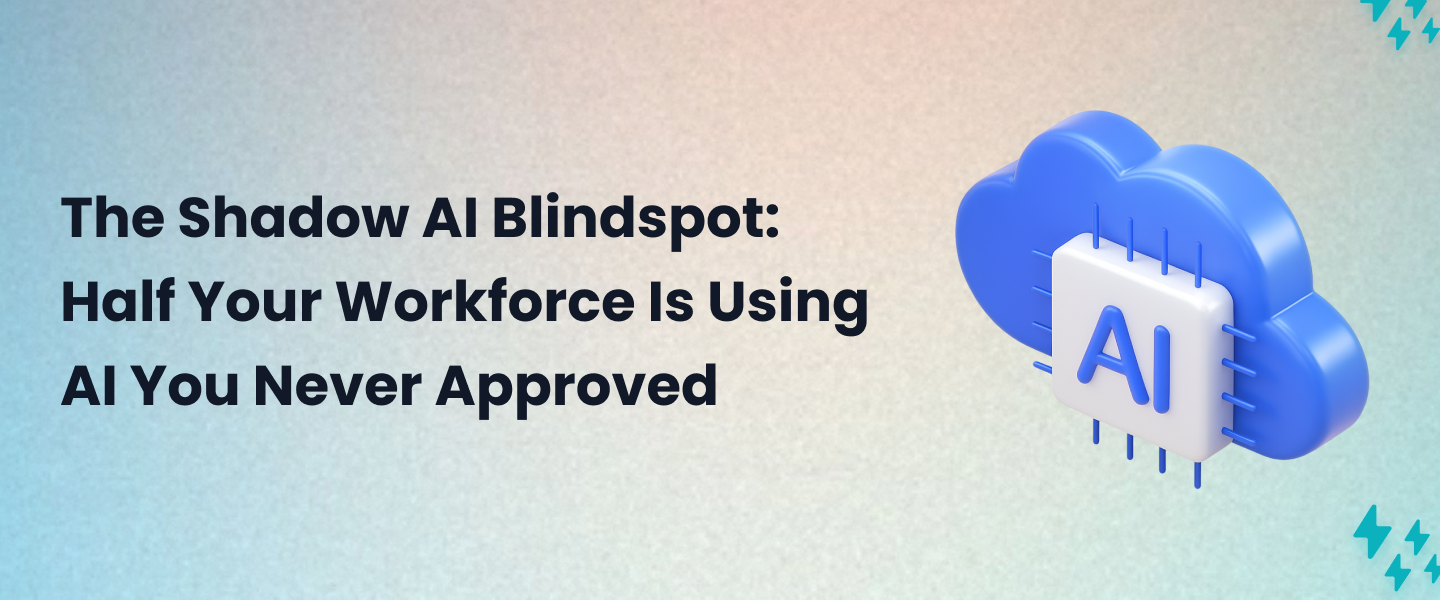
Shadow AI is any artificial intelligence used inside a business without IT approval, security review, or monitoring: chatbots, browser extensions, copilots embedded in SaaS products, personal API keys, autonomous agents, and local models. It is the successor to shadow IT, with one nasty difference. Shadow IT parked files in unapproved places. Shadow AI feeds your data into external systems that learn from it, and increasingly lets software act on your behalf without anyone watching.
How big is it, really?
Bigger than the org chart believes. MIT's GenAI Divide study (2025) found that while only about 40% of companies had bought an official LLM subscription, employees at over 90% of them were using personal AI tools for work anyway. Microsoft and LinkedIn (2024) put it at 75% of knowledge workers using generative AI on the job, with 78% bringing their own tools rather than waiting for permission.
The behavior is not slowing down as tools mature. LayerX's Enterprise AI and SaaS Data Security Report (2025) found that among employees who use AI, 77% have pasted company data into chatbots, and 82% of those pastes came from unmanaged personal accounts that corporate systems never see.
Adoption isn't the uncomfortable part, though. What happens in the dark is. IBM's 2025 Cost of a Data Breach Report found that 20% of breached organizations traced the incident to shadow AI, and those breaches cost an average of $670,000 more than others. In 65% of them, personal customer data walked out the door. Meanwhile, only 34% of companies with an AI policy actually audit for unsanctioned AI use.
Put those findings side by side and the blindspot takes shape: near-universal usage, near-zero verification. Your policy binder says one thing. Tuesday at 6:40 says another.
100+ CIOs, CTOs, CISOs, and Heads of AI are joining the CloudNuro AI Summit on August 13 to work through these questions with peers. Reserve your seat.
Where it actually hides
Most leaders picture one thing, a chatbot in a browser tab, and defend against exactly that. The real estate is messier. Shadow AI arrives through six doors: consumer AI apps on personal accounts, browser extensions with permission to read every page, AI features that vendors quietly switch on inside SaaS you already pay for, developers wiring personal API keys into scripts, autonomous agents and no-code automations running on borrowed credentials, and local models like Ollama humming away on laptops without ever touching your network.
Blocking one door and declaring victory doesn't work. Samsung found that out in 2023, when engineers pasted proprietary source code into ChatGPT and the company restricted the tool afterward. The ban didn't kill the demand, it just relocated it. And the doors keep multiplying. Gartner expects 40% of enterprise applications to ship with task-specific AI agents by the end of 2026, up from under 5%, which means some of your shadow AI will be delivered to you by your own vendors, in a routine product update, with no procurement event at all.
Why do smart executives miss this?
Three reasons come up in nearly every conversation. The dashboards lie by omission: network logs classify chatbot traffic as ordinary web browsing, so the estate looks clean. Asking employees doesn't work either, since more than half won't tell you, and 53% told Microsoft's researchers they worry that admitting AI use makes them look replaceable. And budget owners equate spend with usage: no invoice, no problem. Except the whole point of shadow AI is that it lives on personal cards, free tiers, and vendor bundles. The absence of a line item is not the absence of usage.
Shadow AI is usually your most motivated people solving real problems faster than procurement can. Treating that purely as a violation punishes initiative, which is exactly why block-only strategies always fail, and why the fix has to start somewhere else.
What works
Start with discovery, not policy. You can't write sensible rules for an estate you haven't seen.
The good news is that most of the signal is already in systems you own. Identity-provider logs show new sign-ins and OAuth grants to AI apps. Web gateway and DNS traffic, matched against a live catalog of AI domains, reveals the browser-based usage.
The rest comes from three more places. Endpoint telemetry surfaces browser extensions and local models. Code scanning finds hardcoded API keys. And expense data catches the $20 subscriptions buried in travel-and-entertainment reports. No single source sees everything. Together, they see almost everything.
Then triage what you find by data sensitivity, not by tool name. A brainstorming chatbot fed marketing slogans is a different animal from an extension reading a CRM screen, even if it's the same product underneath.
Finally, give the demand somewhere legal to go. Every shadow tool you discover is a requirement your roadmap missed. Organizations that pair discovery with a sanctioned path, an enterprise workspace, an AI gateway with approved models, and an exception process that answers in days rather than quarters, watch usage migrate voluntarily. The ones that only block watch it burrow deeper.
Think of maturity here as a ladder: blind, then sampled one-off audits, then a genuine inventory, then governed usage, then continuous accountability where discovery automatically feeds policy, budgets, and monitoring. Most enterprises sit on the first rung and sincerely believe they're on the fourth. The gap between those two beliefs is where the $670,000 premium lives.
One more thing, because boards increasingly ask: make visibility a number, not a vibe. Three figures fit on a single slide and tell the whole story: how many AI tools and agents you've discovered this quarter, what share of them touch sensitive data, and how quickly a new one shows up in your inventory after it first appears in the wild. When those numbers exist, shadow AI stops being an anecdote traded in hallways and becomes something a leadership team can actually manage.
We're spending an afternoon on this. The Shadow AI Discovery session at the CloudNuro AI Summit (August 13, virtual) covers how enterprises are building continuous discovery, governance, and sanctioned paths at scale. See the full agenda.
Shadow AI: quick answers
- Is shadow AI the same as shadow IT? Same instinct, higher stakes. Shadow IT misplaced data; shadow AI feeds it to external models and lets agents act on it.
- Should we just block AI tools? Blocking without an alternative pushes usage onto personal devices, where you have zero visibility. Broker and monitor first; block narrowly and last.
- How common are shadow-AI breaches? IBM's 2025 report tied 20% of breaches to shadow AI, at a $670,000 average cost premium.
- What's the first step? A discovery baseline. Most organizations can produce their first shadow-AI inventory within 30 days using logs they already have.
- Who should own this? The CISO and CIO jointly. One owns the risk, the other owns the sanctioned path, and discovery data should feed both.
The takeaway
Shadow AI isn't an employee-discipline story. It's an information story: the gap between what your people are doing and what your systems can see. Close that gap and everything downstream becomes possible, from governance and cost control to observability and ROI. Leave it open, and every other AI initiative in your company is built on a partial map.
Discovery is the cheapest control you will ever buy.
https://www.cloudnuro.ai/ai-summit-2026">Take a look at the agenda.
Can't make August 13? Register anyway and we'll send you the full session recordings and executive takeaways. Register for free.
Read next: The AI Governance Blindspot. You found the shadow AI. Now govern it. https://www.cloudnuro.ai/ai-summit-2026










.webp)


.svg)