

Sign Up
Thank you for Submitting!

AI agents for SaaS management are quietly becoming the new default control plane for cloud applications. They sit between your users, identity systems, and SaaS tools, continuously monitoring access, usage, and cost.
Some report in 2026 found that 78% of enterprises are deploying AI agents for SaaS access control and governance, signaling that this is no longer an experiment but a standard for secure cloud operations. For CIOs, IT leaders, and FinOps teams, the question is shifting from "what are AI agents" to "how do we use them to improve access control, audit logging, and spend governance without adding complexity or risk."
This article explains what AI agents are in a SaaS context, how they reshape access control and audit logs, and what they mean for your cost optimization strategies. It also shows how CloudNuro applies this model across SaaS, IaaS, and cloud security.
AI agents for SaaS management are autonomous or semi-autonomous software components that observe events across your SaaS and cloud stack, reason over policies and data, then take actions or recommend actions.
Think of them as policy-aware digital operators that:
In a typical enterprise, these agents are integrated with:
Instead of humans periodically running reports, AI agents run all the time, learning from patterns and triggering remediation or approvals as needed.
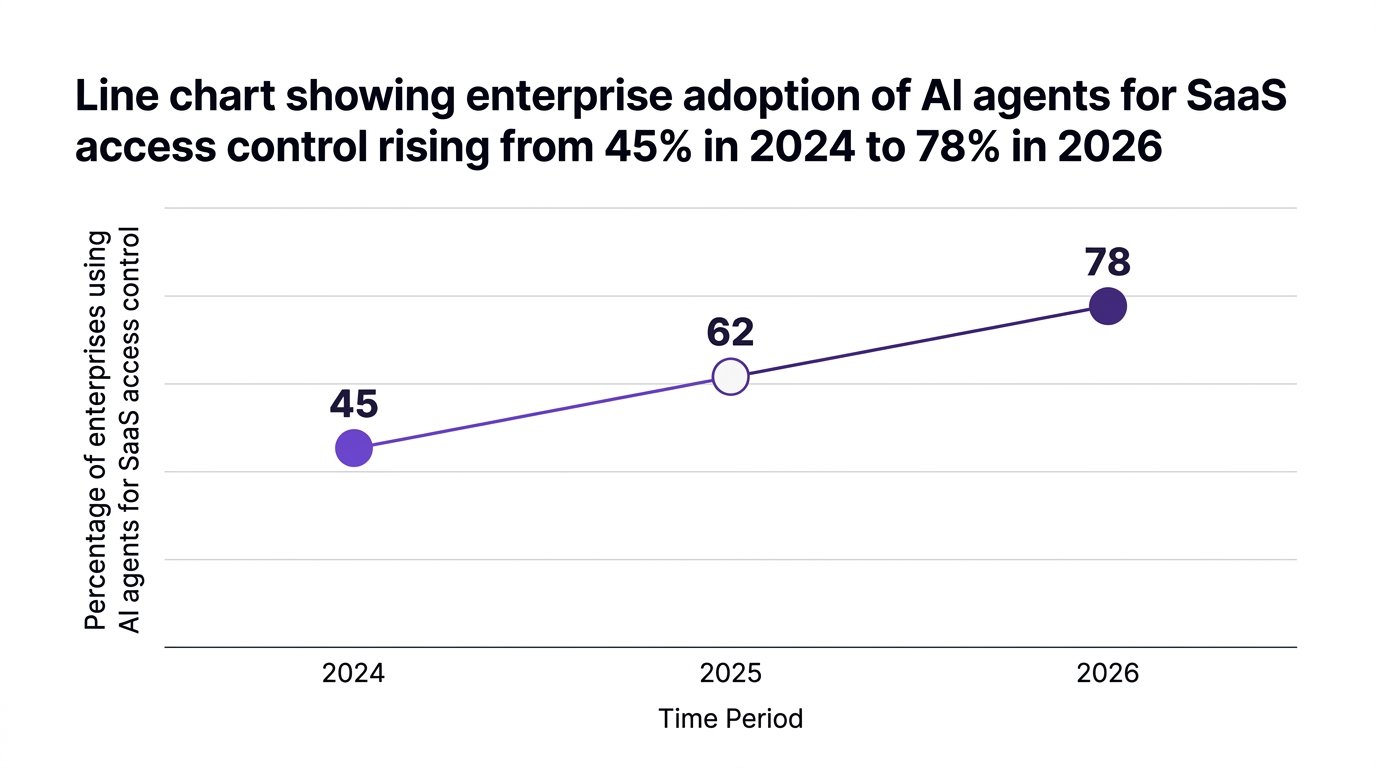
Some report data from 2024 to 2026 shows enterprise adoption of AI agents for SaaS access control rising from 45% to 78%, reflecting an aggressive shift toward AI-driven governance.
Standard scripts and scheduled jobs are brittle and static. They enforce a rule but cannot adapt when:
AI agents, by contrast, incorporate context and feedback loops. They use patterns from real-world usage, outlier behavior, and policy changes to refine which actions are safe to automate and which should route to humans.
A useful analogy: traditional automation is like a vending machine, predictable but limited. AI agents are more like a junior analyst you can train with policies, thresholds, and examples, then supervise through approvals and audit logs.
Access risk in SaaS environments is expanding. Entitlement sprawl, orphaned accounts, and inconsistent role mapping are common even in mature IT organizations.
Some report in 2026 found that 62% of organizations reported a 35% reduction in unauthorized SaaS access incidents after deploying AI agents for access control and entitlement management. That is a meaningful risk reduction for security and compliance leaders.

AI agents for SaaS management strengthen access control in several concrete ways:
According to some report in 2026, 41% of organizations using AI agents for SaaS management saw improved shadow IT detection. This matters because you cannot protect or optimize what you cannot see.
AI agents are not a silver bullet. They can create issues if:
A robust governance model defines who owns the policies, what is fully automated, and where humans remain in the loop. The most effective implementations treat the agent as part of the identity access management fabric, not an external bolt-on.
Audit logs are the backbone of SaaS audit compliance and incident response, yet many organizations still rely on fragmented exports from multiple tools.
AI agents change this by turning audit logging into a continuous, context-rich evidence stream. Some report in 2026 found that AI-powered audit logging reduced compliance reporting time by 48% for IT teams managing SaaS platforms.

Key improvements include:
Some expert commentary in 2026 described this shift clearly: automated audit trails enabled by AI provide granular visibility that manual methods cannot match. This is particularly crucial for sectors like healthcare and finance where regulators expect detailed, timely evidence.
Some report in 2026 noted that 93% of IT leaders now view AI-driven audit trails as critical to meeting evolving regulatory standards.
However, there are two key caveats:
The answer is structured transparency. IT and compliance teams should define which events must be logged, how AI decisions are documented, and how to present AI-triggered actions in a way that satisfies auditors.
AI agents for SaaS management are not only about security. They also reshape how organizations manage SaaS spend and cloud spend analytics.
Some report in 2026 found that adoption of AI for automated license reclamation and SaaS spend management delivered an average OpEx saving of $3.8 million per year for large enterprises. Another case in the same report cited a global financial services firm that used AI for entitlement reviews and license optimization, cutting SaaS overspend by $4.2 million in 12 months while reducing audit completion times by 50%.

AI agents support FinOps for SaaS and cloud in several ways:
Some expert commentary in 2026 highlighted that AI-driven spend optimization allows FinOps teams to focus on value-generating work, while agents surface inefficiencies and propose actions.
A fair critique is that many "AI" tools are little more than dashboards. The distinction with true AI agents is that they:
When evaluating solutions, IT leaders should ask: "What does the agent actually change, and how much spend have we reclaimed automatically, not just identified in reports?"
CloudNuro is built around the idea that AI agents should serve governance, not bypass it. The platform combines AI-enabled SaaS management, cost optimization, and security posture monitoring in a governance-first architecture.
Below is how CloudNuro applies AI agents for SaaS management across its core offerings.

CloudNuro AI Custodian acts as a centralized AI agent that connects to over 400 SaaS and cloud applications.
Key capabilities include:
For example, when AI Custodian detects an orphaned account with admin privileges in a collaboration tool, it can automatically:
Mission-critical platforms like Microsoft 365 and CRM suites drive a disproportionate share of SaaS spend and access risk. CloudNuro provides dedicated custodians for these ecosystems.
With Microsoft 365 Custodian and Salesforce Custodian, AI agents:
For large organizations, this often results in:
According to some report in 2026, AI-based license weatherization drove a 27% increase in successful license optimization, directly cutting SaaS waste in large enterprises.
CloudNuro's FinOps Services combine AI agents with human expertise to manage both SaaS and IaaS.
The AI components:
Human FinOps practitioners then:
The result is data-driven IT savings with clear accountability and repeatable governance.
CloudNuro integrates AI agents into compliance workflows and self-service IT governance models.
Examples include:
By combining rule-based automation with AI insights, CloudNuro gives IT, Security, and FinOps leaders a single system to manage access entitlement, audit logs automation, and SaaS spend.
For CIOs and IT leaders, the practical question is how to move from theory to measurable outcomes. A 90-day blueprint can look like this:
By the end of this cycle, organizations typically see measurable reductions in access risk in SaaS, improved SaaS audit compliance, and tangible spend savings from automated optimization.
AI agents in SaaS management are software components that continuously monitor access, usage, configuration, and cost across cloud applications, then take or recommend actions based on defined policies.
They connect to identity systems, SaaS tools, and cloud infrastructure to automate access control, entitlement management, audit logging, and spend optimization.
AI agents enhance access control by tracking entitlements in real time, detecting over-privileged or orphaned accounts, and enforcing rule-based decisions for joiners, movers, and leavers.
They can also introduce risk-aware checks, such as flagging unusual admin activity or access attempts from suspicious locations, while recording all actions in a consolidated audit trail.
AI agents automate the collection, normalization, and correlation of audit logs across multiple SaaS platforms and cloud providers.
This reduces manual effort for compliance teams, accelerates audit readiness, and provides granular event histories that support investigations and regulatory reviews.
Yes. By combining real-time usage data with entitlement records and pricing models, AI agents can automatically identify and reclaim unused licenses, rightsize plans, and recommend contract adjustments.
Some report in 2026 shows large enterprises saving an average of $3.8 million per year through AI-powered license optimization and spend management.
CloudNuro places AI agents inside a governance-first architecture, where automation is always tied to clear policies, audit evidence, and human oversight.
Its AI Custodian, Microsoft 365 Custodian, Salesforce Custodian, and FinOps Services combine to provide unified visibility, rule-based SaaS automation, and integrated cloud reporting across more than 400 apps and cloud environments.
Common pitfalls include under-specified policies, lack of stakeholder alignment, and insufficient documentation of AI actions.
Mitigation strategies include piloting in constrained domains, aligning security and FinOps teams on objectives, and ensuring that every automated action is traceable and reversible.
AI agents for SaaS management are becoming central to how enterprises manage access control, audit logs, and SaaS spend.
Research from some report in 2026 highlights broad adoption, major reductions in unauthorized access, faster compliance reporting, and multi-million-dollar savings from AI-driven cost optimization.
For CIOs, CTOs, IT Directors, and FinOps leaders, the strategic move is to treat AI agents not as a bolt-on tool but as a governance fabric that unifies security posture monitoring, entitlement management, and cloud spend analytics.
CloudNuro operationalizes this vision with AI Custodian, dedicated custodians for Microsoft 365 and CRM, and FinOps Services that combine automation with expert guidance.
Organizations that invest now in a governance-first AI agent strategy will be better positioned to manage risk, prove compliance, and drive sustainable IT cost optimization.
Ready to explore how AI agents can transform your SaaS management and cloud governance strategy? Engage with CloudNuro to align automation, security, and spend optimization under one platform.
We are proud to be recognized twice in a row by Gartner in the SaaS Management Platforms and named a Leader in the Info-Tech SoftwareReviews Data Quadrant.
Trusted by global enterprises and government agencies, CloudNuro provides centralized SaaS inventory, license optimization, and renewal management. With a 15-minute setup and measurable results in under 24 hours, CloudNuro gives IT teams a fast path to value.
Request a Demo | Get Free Savings Assessment | Explore Product
Request a no cost, no obligation free assessment —just 15 minutes to savings!
Get StartedAI agents for SaaS management are quietly becoming the new default control plane for cloud applications. They sit between your users, identity systems, and SaaS tools, continuously monitoring access, usage, and cost.
Some report in 2026 found that 78% of enterprises are deploying AI agents for SaaS access control and governance, signaling that this is no longer an experiment but a standard for secure cloud operations. For CIOs, IT leaders, and FinOps teams, the question is shifting from "what are AI agents" to "how do we use them to improve access control, audit logging, and spend governance without adding complexity or risk."
This article explains what AI agents are in a SaaS context, how they reshape access control and audit logs, and what they mean for your cost optimization strategies. It also shows how CloudNuro applies this model across SaaS, IaaS, and cloud security.
AI agents for SaaS management are autonomous or semi-autonomous software components that observe events across your SaaS and cloud stack, reason over policies and data, then take actions or recommend actions.
Think of them as policy-aware digital operators that:
In a typical enterprise, these agents are integrated with:
Instead of humans periodically running reports, AI agents run all the time, learning from patterns and triggering remediation or approvals as needed.
Some report data from 2024 to 2026 shows enterprise adoption of AI agents for SaaS access control rising from 45% to 78%, reflecting an aggressive shift toward AI-driven governance.
Standard scripts and scheduled jobs are brittle and static. They enforce a rule but cannot adapt when:
AI agents, by contrast, incorporate context and feedback loops. They use patterns from real-world usage, outlier behavior, and policy changes to refine which actions are safe to automate and which should route to humans.
A useful analogy: traditional automation is like a vending machine, predictable but limited. AI agents are more like a junior analyst you can train with policies, thresholds, and examples, then supervise through approvals and audit logs.
Access risk in SaaS environments is expanding. Entitlement sprawl, orphaned accounts, and inconsistent role mapping are common even in mature IT organizations.
Some report in 2026 found that 62% of organizations reported a 35% reduction in unauthorized SaaS access incidents after deploying AI agents for access control and entitlement management. That is a meaningful risk reduction for security and compliance leaders.
AI agents for SaaS management strengthen access control in several concrete ways:
According to some report in 2026, 41% of organizations using AI agents for SaaS management saw improved shadow IT detection. This matters because you cannot protect or optimize what you cannot see.
AI agents are not a silver bullet. They can create issues if:
A robust governance model defines who owns the policies, what is fully automated, and where humans remain in the loop. The most effective implementations treat the agent as part of the identity access management fabric, not an external bolt-on.
Audit logs are the backbone of SaaS audit compliance and incident response, yet many organizations still rely on fragmented exports from multiple tools.
AI agents change this by turning audit logging into a continuous, context-rich evidence stream. Some report in 2026 found that AI-powered audit logging reduced compliance reporting time by 48% for IT teams managing SaaS platforms.
Key improvements include:
Some expert commentary in 2026 described this shift clearly: automated audit trails enabled by AI provide granular visibility that manual methods cannot match. This is particularly crucial for sectors like healthcare and finance where regulators expect detailed, timely evidence.
Some report in 2026 noted that 93% of IT leaders now view AI-driven audit trails as critical to meeting evolving regulatory standards.
However, there are two key caveats:
The answer is structured transparency. IT and compliance teams should define which events must be logged, how AI decisions are documented, and how to present AI-triggered actions in a way that satisfies auditors.
AI agents for SaaS management are not only about security. They also reshape how organizations manage SaaS spend and cloud spend analytics.
Some report in 2026 found that adoption of AI for automated license reclamation and SaaS spend management delivered an average OpEx saving of $3.8 million per year for large enterprises. Another case in the same report cited a global financial services firm that used AI for entitlement reviews and license optimization, cutting SaaS overspend by $4.2 million in 12 months while reducing audit completion times by 50%.
AI agents support FinOps for SaaS and cloud in several ways:
Some expert commentary in 2026 highlighted that AI-driven spend optimization allows FinOps teams to focus on value-generating work, while agents surface inefficiencies and propose actions.
A fair critique is that many "AI" tools are little more than dashboards. The distinction with true AI agents is that they:
When evaluating solutions, IT leaders should ask: "What does the agent actually change, and how much spend have we reclaimed automatically, not just identified in reports?"
CloudNuro is built around the idea that AI agents should serve governance, not bypass it. The platform combines AI-enabled SaaS management, cost optimization, and security posture monitoring in a governance-first architecture.
Below is how CloudNuro applies AI agents for SaaS management across its core offerings.
CloudNuro AI Custodian acts as a centralized AI agent that connects to over 400 SaaS and cloud applications.
Key capabilities include:
For example, when AI Custodian detects an orphaned account with admin privileges in a collaboration tool, it can automatically:
Mission-critical platforms like Microsoft 365 and CRM suites drive a disproportionate share of SaaS spend and access risk. CloudNuro provides dedicated custodians for these ecosystems.
With Microsoft 365 Custodian and Salesforce Custodian, AI agents:
For large organizations, this often results in:
According to some report in 2026, AI-based license weatherization drove a 27% increase in successful license optimization, directly cutting SaaS waste in large enterprises.
CloudNuro's FinOps Services combine AI agents with human expertise to manage both SaaS and IaaS.
The AI components:
Human FinOps practitioners then:
The result is data-driven IT savings with clear accountability and repeatable governance.
CloudNuro integrates AI agents into compliance workflows and self-service IT governance models.
Examples include:
By combining rule-based automation with AI insights, CloudNuro gives IT, Security, and FinOps leaders a single system to manage access entitlement, audit logs automation, and SaaS spend.
For CIOs and IT leaders, the practical question is how to move from theory to measurable outcomes. A 90-day blueprint can look like this:
By the end of this cycle, organizations typically see measurable reductions in access risk in SaaS, improved SaaS audit compliance, and tangible spend savings from automated optimization.
AI agents in SaaS management are software components that continuously monitor access, usage, configuration, and cost across cloud applications, then take or recommend actions based on defined policies.
They connect to identity systems, SaaS tools, and cloud infrastructure to automate access control, entitlement management, audit logging, and spend optimization.
AI agents enhance access control by tracking entitlements in real time, detecting over-privileged or orphaned accounts, and enforcing rule-based decisions for joiners, movers, and leavers.
They can also introduce risk-aware checks, such as flagging unusual admin activity or access attempts from suspicious locations, while recording all actions in a consolidated audit trail.
AI agents automate the collection, normalization, and correlation of audit logs across multiple SaaS platforms and cloud providers.
This reduces manual effort for compliance teams, accelerates audit readiness, and provides granular event histories that support investigations and regulatory reviews.
Yes. By combining real-time usage data with entitlement records and pricing models, AI agents can automatically identify and reclaim unused licenses, rightsize plans, and recommend contract adjustments.
Some report in 2026 shows large enterprises saving an average of $3.8 million per year through AI-powered license optimization and spend management.
CloudNuro places AI agents inside a governance-first architecture, where automation is always tied to clear policies, audit evidence, and human oversight.
Its AI Custodian, Microsoft 365 Custodian, Salesforce Custodian, and FinOps Services combine to provide unified visibility, rule-based SaaS automation, and integrated cloud reporting across more than 400 apps and cloud environments.
Common pitfalls include under-specified policies, lack of stakeholder alignment, and insufficient documentation of AI actions.
Mitigation strategies include piloting in constrained domains, aligning security and FinOps teams on objectives, and ensuring that every automated action is traceable and reversible.
AI agents for SaaS management are becoming central to how enterprises manage access control, audit logs, and SaaS spend.
Research from some report in 2026 highlights broad adoption, major reductions in unauthorized access, faster compliance reporting, and multi-million-dollar savings from AI-driven cost optimization.
For CIOs, CTOs, IT Directors, and FinOps leaders, the strategic move is to treat AI agents not as a bolt-on tool but as a governance fabric that unifies security posture monitoring, entitlement management, and cloud spend analytics.
CloudNuro operationalizes this vision with AI Custodian, dedicated custodians for Microsoft 365 and CRM, and FinOps Services that combine automation with expert guidance.
Organizations that invest now in a governance-first AI agent strategy will be better positioned to manage risk, prove compliance, and drive sustainable IT cost optimization.
Ready to explore how AI agents can transform your SaaS management and cloud governance strategy? Engage with CloudNuro to align automation, security, and spend optimization under one platform.
We are proud to be recognized twice in a row by Gartner in the SaaS Management Platforms and named a Leader in the Info-Tech SoftwareReviews Data Quadrant.
Trusted by global enterprises and government agencies, CloudNuro provides centralized SaaS inventory, license optimization, and renewal management. With a 15-minute setup and measurable results in under 24 hours, CloudNuro gives IT teams a fast path to value.
Request a Demo | Get Free Savings Assessment | Explore Product
Request a no cost, no obligation free assessment - just 15 minutes to savings!
Get StartedWe're offering complimentary ServiceNow license assessments to only 25 enterprises this quarter who want to unlock immediate savings without disrupting operations.
Get Free AssessmentGet Started



CloudNuro Corp
1755 Park St. Suite 207
Naperville, IL 60563
Phone : +1-630-277-9470
Email: info@cloudnuro.com



.webp)

Recognized Leader in SaaS Management Platforms by Info-Tech SoftwareReviews


.svg)