

Sign Up
Thank you for Submitting!
Across industries, the optimism fueling enterprise AI adoption has collided with hard financial realities in 2026. Nearly three-quarters of companies have already run over their AI budgets, stalling initiatives and challenging executive strategy. Is ballooning spend just a growing pain of new technology, or the sign of deeper, systemic issues in managing and forecasting AI costs?

AI investments were supposed to drive efficiency, not budget shortfalls. Yet the data paints a stark picture:
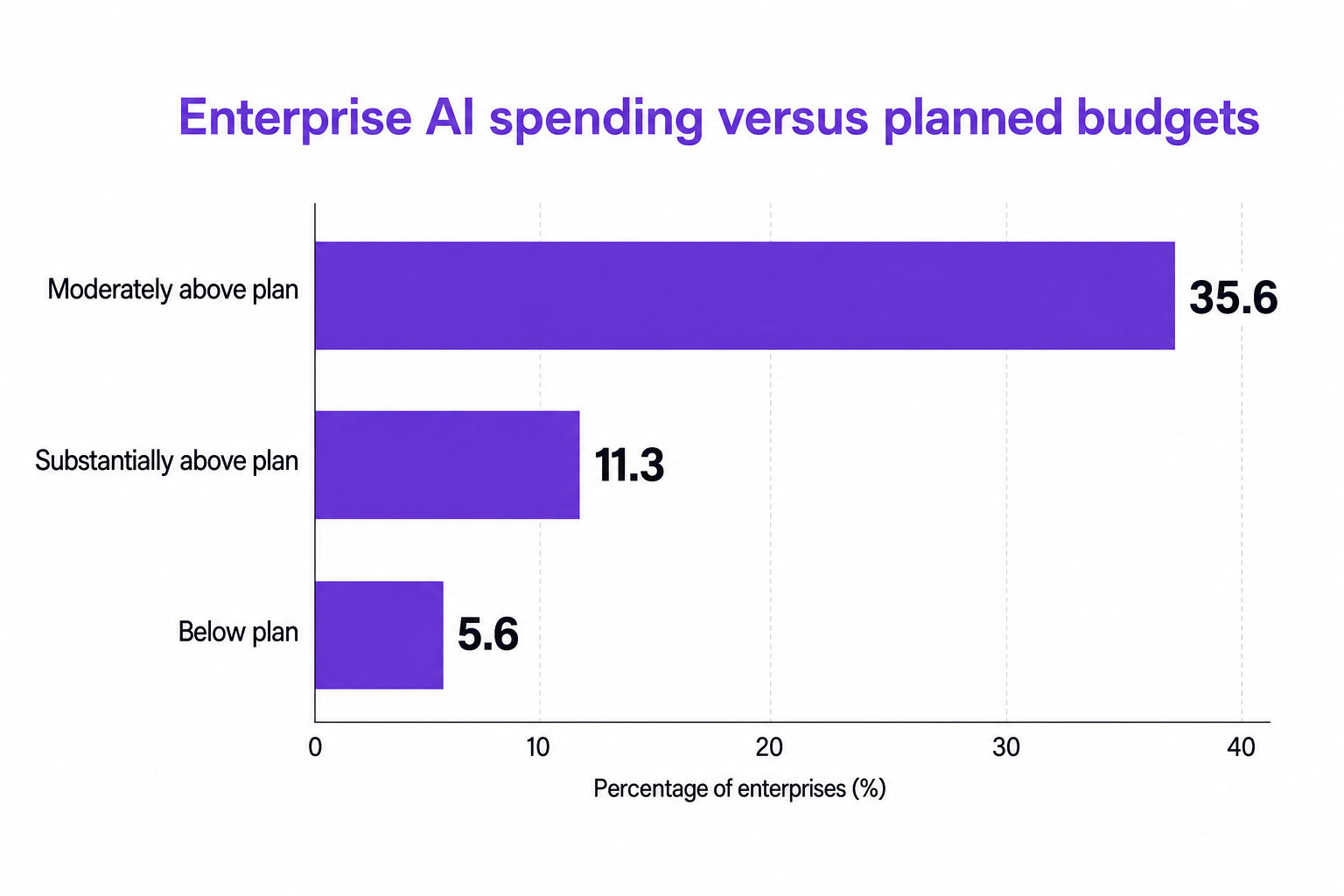
79% of enterprises experienced AI cost overruns in the past year.
46.9% of enterprises report their AI spending already runs above budget.
89% of mature FinOps organizations encounter AI-related overspend, with an average overrun of 30.9%.
59% of organizations say wasted AI spend is rising year-over-year.
These aren't isolated incidents, but a pattern. Unpredictable consumption, opaque pricing, and the rapid expansion of generative AI have left even sophisticated enterprises with gaps in visibility and control.
The cost spiral around enterprise AI is accelerating because of key market trends:
Shift from Adoption to Economics. As the focus moves beyond pilot programs to operationalized AI, enterprises are forced to reckon with ongoing compute, licensing, and integration costs, often outpacing initial projections.
Unpredictable Usage-Based Pricing. Many AI vendors moved toward consumption-driven models with complex billing. What starts as a manageable monthly fee quickly spikes with fluctuations in token usage and compute demand.
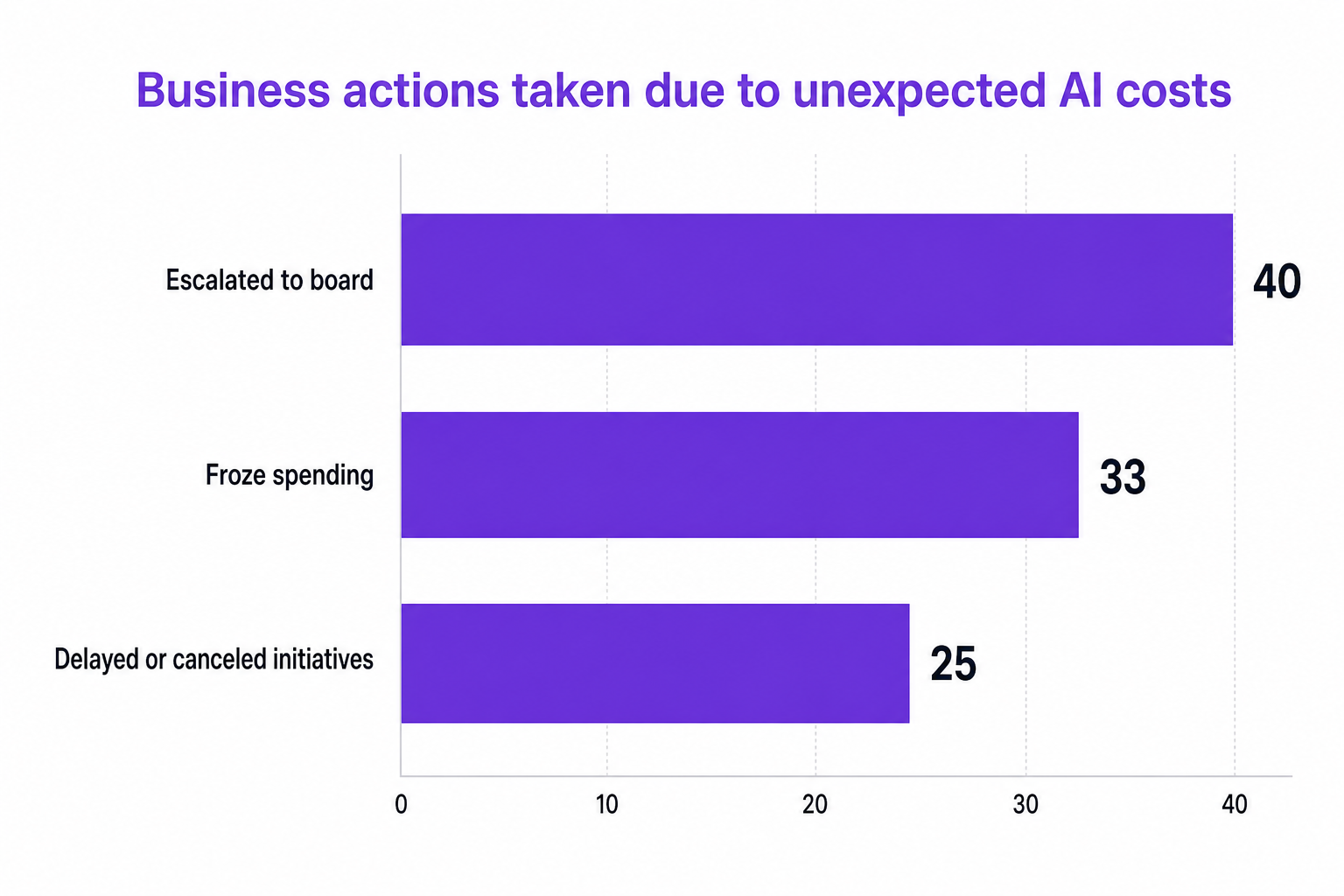
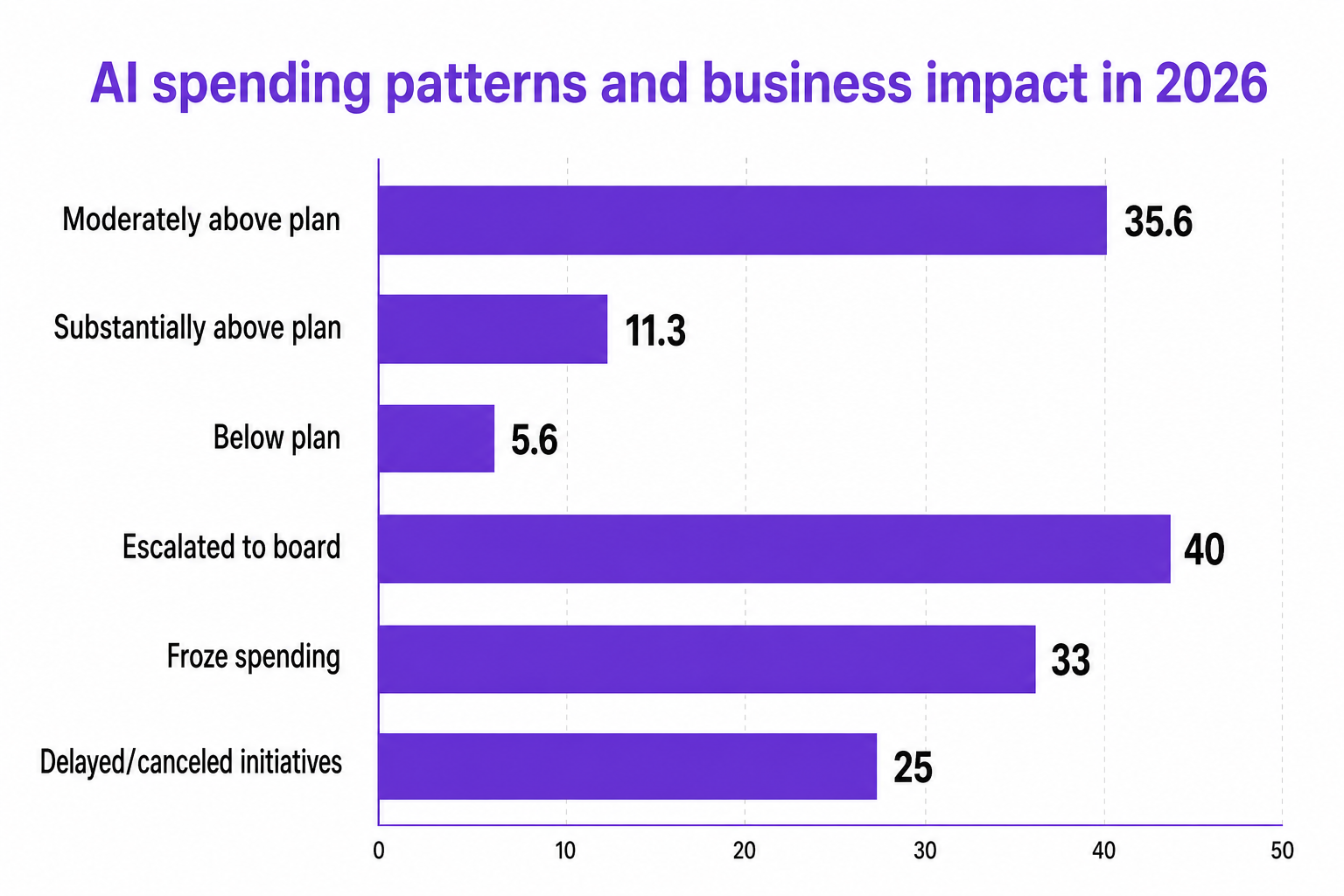
Budget Drift: Executive strategy is challenged when costs exceed forecast. 62% of organizations report that unexpected AI expenses have forced them to freeze, defer, or even cancel business initiatives.
(See 'Business actions taken due to unexpected AI costs' in the chart below.)
Too many organizations still manage AI spend as a black box. Only 31% have accurate visibility into their AI software costs. Without an agent-level breakdown of which models, projects, or users are driving spend, controlling costs becomes an uphill battle.
Case in Point: An enterprise transportation client achieved 100% AI usage visibility, validating value and curbing unwarranted expansion of AI investments.
Forecasting traditional IT or SaaS spend is hard enough. With AI, volatile and context-dependent usage means yesterday’s budget assumptions no longer hold. New projects or sudden spikes in popularity can rapidly blow up cost models.
Expert Insight: Overruns in AI spend stem from forecasting and visibility gaps, not simple budgeting errors. Even mature FinOps shops struggle to calculate true ROI for AI initiatives.
Without strong governance, AI cost overruns spread quietly. Decentralized AI adoption, shadow IT deployments, or lax policy enforcement means redundant tools and wasted spend accumulate under the radar.
Case in Point: A public sector organization implemented FinOps governance and centralized reporting, regaining control over AI assistant adoption and spend.
CloudNuro’s FinOps AI Spend Management Services were built for this moment: a robust, governance-first solution for keeping enterprise AI budgets on track.
CloudNuro’s AI Governance dashboard gives IT and finance leaders an agent-level breakdown of costs, including:
Precise token usage tracking for each AI model and user.
Project-level and agent-level budget limits that mirror internal thresholds.
Periodic consumption graphs to track burn rates and spot anomalies immediately.
With CloudNuro:
Administrators set enforceable budget limits per project and agent, not just per tool.
Advanced chargeback tools drive financial accountability across departments, with clear usage-based cost center allocation.
Continuous monitoring via the AI Custodian module ensures strict compliance with internal and regulatory policy, no more shadow IT or unmanaged spend.
Enterprises using CloudNuro gain:
Centralized reporting for all AI and SaaS spend, enabling transparent ROI analysis.
Strategic FinOps capabilities like predictive modeling and scenario-based budget forecasting.
Full visibility into adoption, utilization, and cost to drive smarter expansion, or contraction, decisions.
Case in Point: A transportation agency reclaimed 1,700 unused licenses and achieved 64% savings on core productivity suites via structured governance and usage-based insights delivered by CloudNuro.
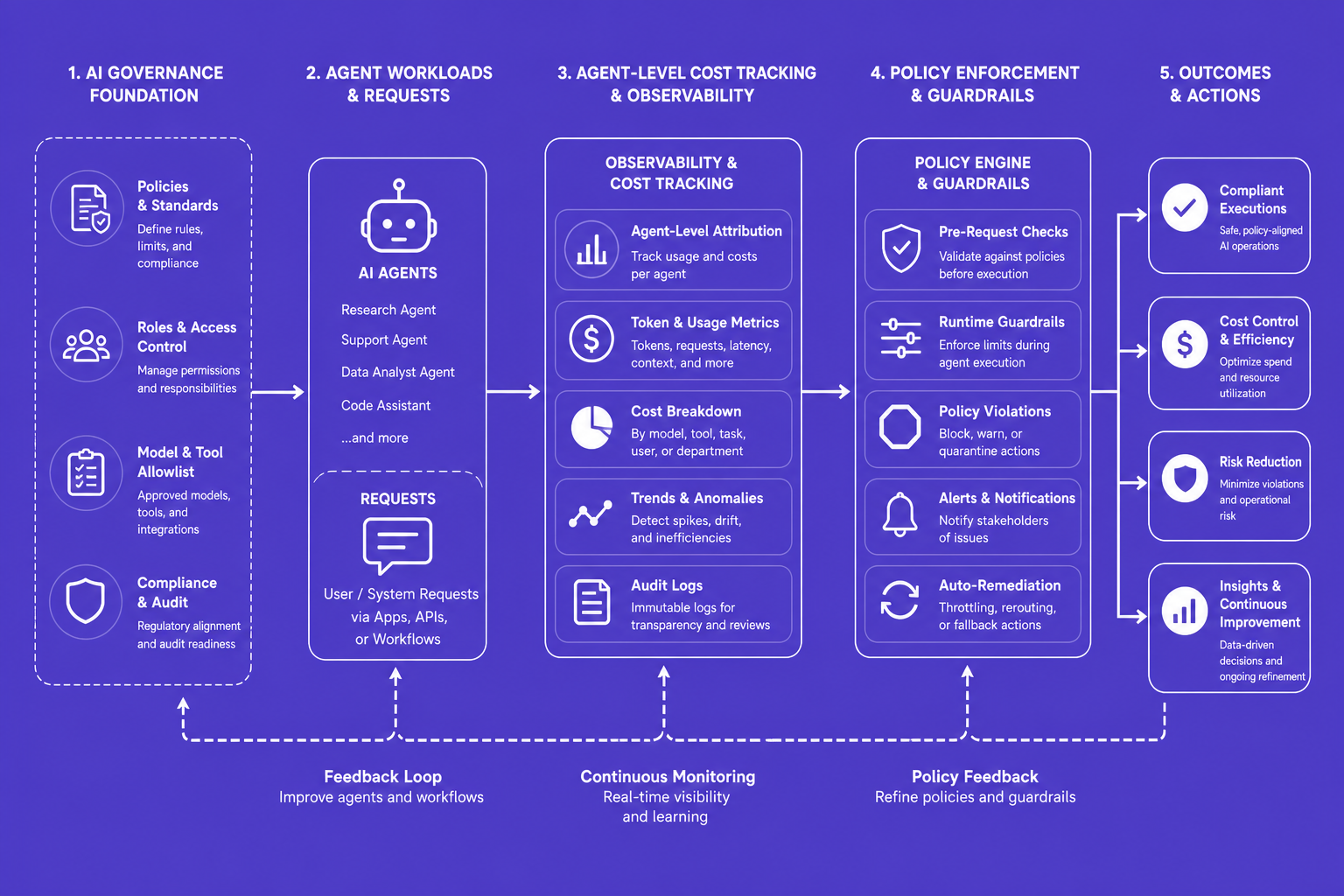
Adopt Purpose-Built AI Spend Management Tools. Choose platforms with true agent-level visibility, consumption graphs, and automated policy enforcement.
Implement Strategic FinOps Frameworks. Use advanced forecasting models, scenario analysis, and cross-departmental chargeback mechanisms.
Integrate with SaaS and Cloud Management. True cost optimization spans all digital tools, AI spend should be tracked and managed like any other enterprise software cost.
Educate Stakeholders. Regularly brief all business units on usage, spend, and budget status.
Monitor Usage in Real Time. Immediate visibility into token or compute consumption enables quick response to spikes and anomalies.
What causes AI budget overruns in enterprises?
AI budget overruns mainly result from lack of cost visibility, unpredictable usage-based pricing, and weak governance frameworks. Without agent-level tracking and policy enforcement, redundant usage and shadow IT can drive significant cost overruns.
How can companies forecast their AI budgets more accurately for 2026?
By leveraging predictive analytics, usage tracking, and scenario planning tools like CloudNuro, enterprises improve understanding of cost drivers and align budgets more closely to actual usage patterns.
What are FinOps approaches to control AI spend?
Key FinOps approaches include continuous cost monitoring, usage-based chargeback, strict budget limits at the project and agent level, centralized reporting, and automated policy enforcement.
Which tools help manage AI cost overrun in 2026?
AI cost optimization platforms with robust governance and real-time tracking, such as CloudNuro, provide the automation, analytics, and controls necessary for enterprises to manage, forecast, and justify every dollar spent on AI initiatives.
How does AI budget tracking improve enterprise governance?
Accurate budget tracking reveals spending anomalies, drives better decision-making, and enforces accountability, ensuring that expansion, renewals, and new investments are tied to business ROI, not just aspiration.
AI remains a transformative force, but only with rigorous financial discipline, coupled with real-time visibility and robust governance. As AI investments scale in 2026, enterprises that conquer the cost management challenge will maintain strategic momentum, foster innovation, and safeguard operational budgets. CloudNuro uniquely delivers this future, centralizing control, optimizing cost, and anchoring every AI dollar in business value.
About CloudNuro
CloudNuro is a leader in Enterprise AI Adoption Management, providing enterprises with unmatched visibility, governance, and cost optimization. Recognized twice in a row in the SaaS Management Platforms category and named a Leader in the SoftwareReviews Data Quadrant, CloudNuro is trusted by global enterprises and government agencies to bring financial discipline to SaaS, cloud, and AI. Trusted by enterprises, CloudNuro provides centralized SaaS inventory, license optimization, and renewal management along with advanced cost allocation and chargeback, giving IT and Finance leaders the visibility, control, and cost-conscious culture needed to drive financial discipline.
Request a no cost, no obligation free assessment —just 15 minutes to savings!
Get StartedAcross industries, the optimism fueling enterprise AI adoption has collided with hard financial realities in 2026. Nearly three-quarters of companies have already run over their AI budgets, stalling initiatives and challenging executive strategy. Is ballooning spend just a growing pain of new technology, or the sign of deeper, systemic issues in managing and forecasting AI costs?
AI investments were supposed to drive efficiency, not budget shortfalls. Yet the data paints a stark picture:
79% of enterprises experienced AI cost overruns in the past year.
46.9% of enterprises report their AI spending already runs above budget.
89% of mature FinOps organizations encounter AI-related overspend, with an average overrun of 30.9%.
59% of organizations say wasted AI spend is rising year-over-year.
These aren't isolated incidents, but a pattern. Unpredictable consumption, opaque pricing, and the rapid expansion of generative AI have left even sophisticated enterprises with gaps in visibility and control.
The cost spiral around enterprise AI is accelerating because of key market trends:
Shift from Adoption to Economics. As the focus moves beyond pilot programs to operationalized AI, enterprises are forced to reckon with ongoing compute, licensing, and integration costs, often outpacing initial projections.
Unpredictable Usage-Based Pricing. Many AI vendors moved toward consumption-driven models with complex billing. What starts as a manageable monthly fee quickly spikes with fluctuations in token usage and compute demand.
Budget Drift: Executive strategy is challenged when costs exceed forecast. 62% of organizations report that unexpected AI expenses have forced them to freeze, defer, or even cancel business initiatives.
(See 'Business actions taken due to unexpected AI costs' in the chart below.)
Too many organizations still manage AI spend as a black box. Only 31% have accurate visibility into their AI software costs. Without an agent-level breakdown of which models, projects, or users are driving spend, controlling costs becomes an uphill battle.
Case in Point: An enterprise transportation client achieved 100% AI usage visibility, validating value and curbing unwarranted expansion of AI investments.
Forecasting traditional IT or SaaS spend is hard enough. With AI, volatile and context-dependent usage means yesterday’s budget assumptions no longer hold. New projects or sudden spikes in popularity can rapidly blow up cost models.
Expert Insight: Overruns in AI spend stem from forecasting and visibility gaps, not simple budgeting errors. Even mature FinOps shops struggle to calculate true ROI for AI initiatives.
Without strong governance, AI cost overruns spread quietly. Decentralized AI adoption, shadow IT deployments, or lax policy enforcement means redundant tools and wasted spend accumulate under the radar.
Case in Point: A public sector organization implemented FinOps governance and centralized reporting, regaining control over AI assistant adoption and spend.
CloudNuro’s FinOps AI Spend Management Services were built for this moment: a robust, governance-first solution for keeping enterprise AI budgets on track.
CloudNuro’s AI Governance dashboard gives IT and finance leaders an agent-level breakdown of costs, including:
Precise token usage tracking for each AI model and user.
Project-level and agent-level budget limits that mirror internal thresholds.
Periodic consumption graphs to track burn rates and spot anomalies immediately.
With CloudNuro:
Administrators set enforceable budget limits per project and agent, not just per tool.
Advanced chargeback tools drive financial accountability across departments, with clear usage-based cost center allocation.
Continuous monitoring via the AI Custodian module ensures strict compliance with internal and regulatory policy, no more shadow IT or unmanaged spend.
Enterprises using CloudNuro gain:
Centralized reporting for all AI and SaaS spend, enabling transparent ROI analysis.
Strategic FinOps capabilities like predictive modeling and scenario-based budget forecasting.
Full visibility into adoption, utilization, and cost to drive smarter expansion, or contraction, decisions.
Case in Point: A transportation agency reclaimed 1,700 unused licenses and achieved 64% savings on core productivity suites via structured governance and usage-based insights delivered by CloudNuro.
Adopt Purpose-Built AI Spend Management Tools. Choose platforms with true agent-level visibility, consumption graphs, and automated policy enforcement.
Implement Strategic FinOps Frameworks. Use advanced forecasting models, scenario analysis, and cross-departmental chargeback mechanisms.
Integrate with SaaS and Cloud Management. True cost optimization spans all digital tools, AI spend should be tracked and managed like any other enterprise software cost.
Educate Stakeholders. Regularly brief all business units on usage, spend, and budget status.
Monitor Usage in Real Time. Immediate visibility into token or compute consumption enables quick response to spikes and anomalies.
What causes AI budget overruns in enterprises?
AI budget overruns mainly result from lack of cost visibility, unpredictable usage-based pricing, and weak governance frameworks. Without agent-level tracking and policy enforcement, redundant usage and shadow IT can drive significant cost overruns.
How can companies forecast their AI budgets more accurately for 2026?
By leveraging predictive analytics, usage tracking, and scenario planning tools like CloudNuro, enterprises improve understanding of cost drivers and align budgets more closely to actual usage patterns.
What are FinOps approaches to control AI spend?
Key FinOps approaches include continuous cost monitoring, usage-based chargeback, strict budget limits at the project and agent level, centralized reporting, and automated policy enforcement.
Which tools help manage AI cost overrun in 2026?
AI cost optimization platforms with robust governance and real-time tracking, such as CloudNuro, provide the automation, analytics, and controls necessary for enterprises to manage, forecast, and justify every dollar spent on AI initiatives.
How does AI budget tracking improve enterprise governance?
Accurate budget tracking reveals spending anomalies, drives better decision-making, and enforces accountability, ensuring that expansion, renewals, and new investments are tied to business ROI, not just aspiration.
AI remains a transformative force, but only with rigorous financial discipline, coupled with real-time visibility and robust governance. As AI investments scale in 2026, enterprises that conquer the cost management challenge will maintain strategic momentum, foster innovation, and safeguard operational budgets. CloudNuro uniquely delivers this future, centralizing control, optimizing cost, and anchoring every AI dollar in business value.
About CloudNuro
CloudNuro is a leader in Enterprise AI Adoption Management, providing enterprises with unmatched visibility, governance, and cost optimization. Recognized twice in a row in the SaaS Management Platforms category and named a Leader in the SoftwareReviews Data Quadrant, CloudNuro is trusted by global enterprises and government agencies to bring financial discipline to SaaS, cloud, and AI. Trusted by enterprises, CloudNuro provides centralized SaaS inventory, license optimization, and renewal management along with advanced cost allocation and chargeback, giving IT and Finance leaders the visibility, control, and cost-conscious culture needed to drive financial discipline.
Request a no cost, no obligation free assessment - just 15 minutes to savings!
Get StartedWe're offering complimentary ServiceNow license assessments to only 25 enterprises this quarter who want to unlock immediate savings without disrupting operations.
Get Free AssessmentGet Started




CloudNuro Corp
1755 Park St. Suite 207
Naperville, IL 60563
Phone : +1-630-277-9470
Email: info@cloudnuro.com





.webp)

Recognized Leader in SaaS Management Platforms by Info-Tech SoftwareReviews
%20Tools%20to%20Reduce%20SaaS%20Wast.png)

.png)

.svg)