

Sign Up
Thank you for Submitting!
Enterprises are accelerating their artificial intelligence (AI) investments, deploying large language models (LLMs), agent workflows, and SaaS-based AI tools across every business function. But with this innovation comes a pressing new challenge: how do you allocate every dollar of AI spend down to the right cost center, business unit, application, or even individual user?
Accurate AI tagging and granular cost attribution are now top priorities for IT leaders, FinOps teams, and enterprise CIOs tasked with controlling cloud and SaaS consumption. Unlike traditional infrastructure resources, AI workloads consume tokens, not just CPU or RAM. This token-based billing model demands new processes, automation, and end-to-end governance.
In this comprehensive guide, we’ll break down what AI cost allocation really means, why tagging every token matters, the evolving state of enterprise FinOps, and how solutions like CloudNuro AI Custodian deliver visibility and cost control, at scale.

AI’s rapid growth is challenging established cloud cost allocation methods. Previously, teams could simply tag VMs or container clusters to track spend. But now, the real cost drivers, LLMs, SaaS-based AI APIs, autonomous agents, do not map cleanly to tagged infrastructure.
Key Market Realities:
Over 53% of enterprises cannot see their total AI spend.
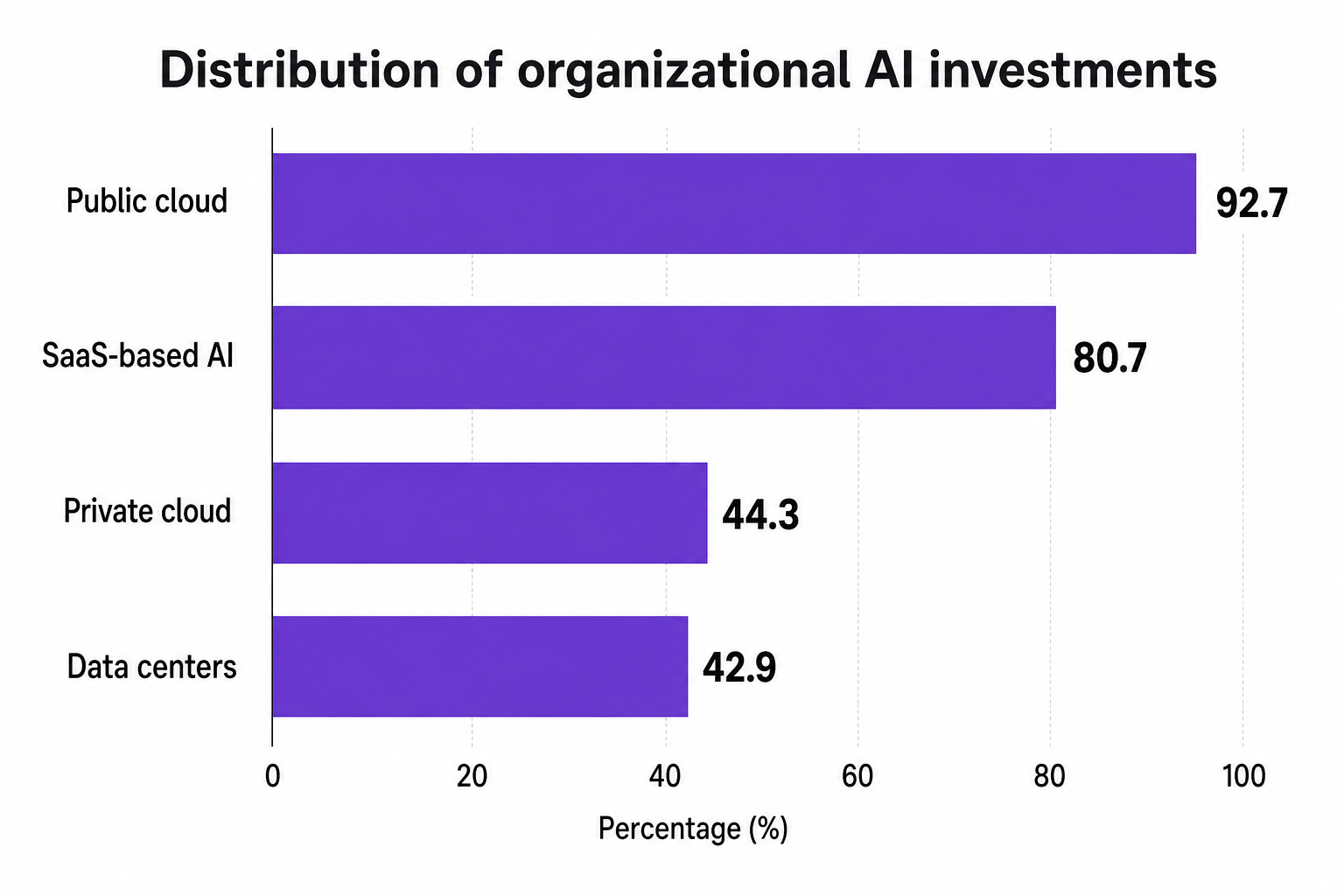
AI investments are shifting to the public cloud (92.7%) and SaaS AI platforms (80.7%).
High-cost workloads, particularly GPU-intensive jobs, now represent 18% of total cloud spend.
This demand for increased accuracy has turned AI cost allocation from an experimental exercise into an executive-level mandate for FinOps. As cost spikes from agentic AI and LLM workloads become more frequent, teams are moving away from annual budgets to dynamic consumption controls.
In token-based AI models, ‘usage’ is measured in input and output tokens. Each token translates directly to dollars spent. Tagging every API interaction, prompt, and agent action at this granular level is now essential to:
Prevent shadow AI and uncontrolled cloud consumption
Attribute costs directly to business units, projects, or individual users
Enable cost recovery, chargebacks, and financial discipline
Drive continuous license optimization and reallocation
Maintain governance, compliance, and data security
Expert Insight: Recording input and output tokens separately is vital, since AI service providers often charge different rates for each direction.
Routing all LLM/API calls through a controlled gateway enables organizations to inject mandatory metadata, monitor token volume, and enforce access control. This infrastructure pattern is foundational for robust tagging.
Manual tagging is error-prone and incompatible with the speed of AI adoption. Enterprises should automate tagging at the API or proxy layer, populating context such as:
Project, department, and business unit
Application or feature name
User or agent ID
Use case (testing, production, POC)
Solutions that enable automated tagging eliminate gaps and ensure every token is tracked and attributed.
Clear governance policies must require teams to submit complete tagging metadata on all model calls. This ensures spend is visible at every level, from team to individual function, and that budgeting data is always accurate.
Having real-time dashboards showing token consumption, cost spikes, and compliance adherence is critical for ongoing FinOps. Visualization makes outliers and unauthorized usage immediately actionable.
Traditional budget allocations fail in the face of unpredictable AI usage. Modern cost governance requires consumption-based ceilings, proactive alerts, and automated license reallocation to optimize spend.
CloudNuro AI Custodian is designed for precisely these challenges. By bringing together automated tagging, real-time dashboards, and governance-first controls, CloudNuro helps enterprise IT, security, and finance teams attribute every AI token, and optimize spend at every layer.
Automated tagging and attribution: Enforce complete tagging across all LLM, SaaS AI, and agent workloads; no manual input needed.
Granular visibility: Visualize token usage, cost, and activity by project, user, application, or department.
Full-stack governance: Track policy adherence, halt consumption before compliance violations, and detect oversharing of sensitive data.
Budget caps and spend alerts: Set strict limits by project or individual agent to prevent cost overruns.
User-based segmentation: Dynamic grouping of Power, General, Low, and Dormant users for ongoing license optimization.
Integration with Microsoft Purview and 400+ enterprise platforms: Unify chargeback, SaaS, and AI governance in a single pane of glass.
Proof in Practice:
Organizations using CloudNuro realize up to 30% SaaS spend savings.
Most see full ROI within 6 weeks, achieving over 1000% ROI in 12 months.
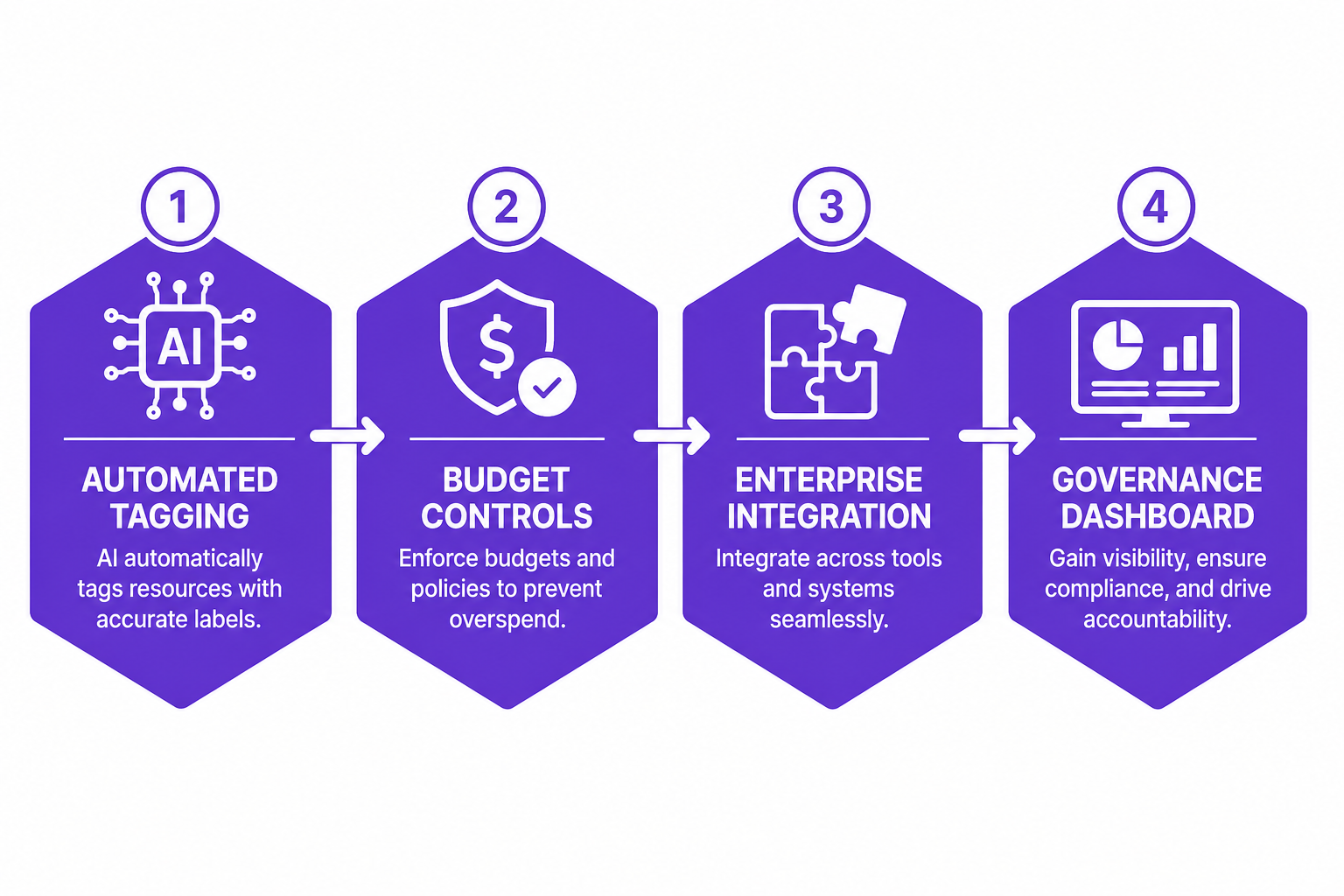
Successful AI tagging is not a one-time event but an ongoing process embedded in IT operations.
Inventory all AI and LLM endpoints: Leverage discovery tools within CloudNuro AI Custodian to map every usage point and shadow AI process.
Define and enforce tagging policies: Use CloudNuro’s governance modules to mandate and validate correct tagging and metadata.
Integrate tagging automation: Connect CloudNuro with enterprise platforms to ensure every API call or agent activity is tagged automatically.
Monitor and optimize in real-time: Review dashboards for anomalous usage, unauthorized access, and cost spikes.
Continuously refine: Use insights to reallocate licenses, adjust business unit budgets, and enforce compliance.
Enterprise teams using advanced tagging and cost attribution realize tangible value:
Elimination of budget “blind spots” for AI consumption
Chargeback accuracy for business units and project owners
Increased SaaS and LLM savings through proactive optimization
Faster response to cost spikes and compliance risks
True cost transparency to enable financial discipline

What is AI cost allocation?
AI cost allocation is the process of mapping AI and LLM usage, measured in tokens, to specific budgets, departments, features, or users, ensuring that every dollar spent is visible and accountable.
How can organizations accurately tag AI usage for cost allocation?
Achieving accurate AI tagging requires automating metadata injection at every AI endpoint, enforcing tagging policies, and unifying all data in a centralized governance platform like CloudNuro AI Custodian.
What is FinOps tagging and why is it important?
FinOps tagging is the systematic labeling of cloud and SaaS resources with context-rich metadata for cost analysis and optimization. It’s crucial for breaking down spend, supporting chargebacks, and enforcing financial accountability as AI usage proliferates.
How do you attribute LLM costs in enterprise settings?
By routing every LLM API call through a managed gateway, capturing both input/output tokens, and attaching tags that specify project, user, and business context. This ensures that LLM costs flow directly into detailed financial reports.
What are best practices for tagging every AI token?
Automate tagging, mandate attribution metadata, visualize token usage, align tagging strategy with security and compliance, and use enterprise-grade solutions like CloudNuro for unified management.
As AI investment grows, so too does the complexity of managing and allocating costs. The move from infrastructure tagging to true application-layer attribution is accelerating. Enterprises must adopt automated, policy-driven tagging and deep cost attribution to master the new world of token-based AI billing.
By enabling accurate AI tagging and end-to-end governance, CloudNuro empowers enterprises to take full control of their AI, SaaS, and LLM spend, building a foundation of financial discipline, compliance, and ongoing innovation.
About CloudNuro
CloudNuro is a leader in Enterprise AI Adoption Management, providing enterprises with unmatched visibility, governance, and cost optimization. Recognized twice in a row in the SaaS Management Platforms category and named a Leader in the SoftwareReviews Data Quadrant, CloudNuro is trusted by global enterprises and government agencies to bring financial discipline to SaaS, cloud, and AI. Trusted by enterprises, CloudNuro provides centralized SaaS inventory, license optimization, and renewal management along with advanced cost allocation and chargeback, giving IT and Finance leaders the visibility, control, and cost-conscious culture needed to drive financial discipline.
Request a no cost, no obligation free assessment —just 15 minutes to savings!
Get StartedEnterprises are accelerating their artificial intelligence (AI) investments, deploying large language models (LLMs), agent workflows, and SaaS-based AI tools across every business function. But with this innovation comes a pressing new challenge: how do you allocate every dollar of AI spend down to the right cost center, business unit, application, or even individual user?
Accurate AI tagging and granular cost attribution are now top priorities for IT leaders, FinOps teams, and enterprise CIOs tasked with controlling cloud and SaaS consumption. Unlike traditional infrastructure resources, AI workloads consume tokens, not just CPU or RAM. This token-based billing model demands new processes, automation, and end-to-end governance.
In this comprehensive guide, we’ll break down what AI cost allocation really means, why tagging every token matters, the evolving state of enterprise FinOps, and how solutions like CloudNuro AI Custodian deliver visibility and cost control, at scale.
AI’s rapid growth is challenging established cloud cost allocation methods. Previously, teams could simply tag VMs or container clusters to track spend. But now, the real cost drivers, LLMs, SaaS-based AI APIs, autonomous agents, do not map cleanly to tagged infrastructure.
Key Market Realities:
Over 53% of enterprises cannot see their total AI spend.
AI investments are shifting to the public cloud (92.7%) and SaaS AI platforms (80.7%).
High-cost workloads, particularly GPU-intensive jobs, now represent 18% of total cloud spend.
This demand for increased accuracy has turned AI cost allocation from an experimental exercise into an executive-level mandate for FinOps. As cost spikes from agentic AI and LLM workloads become more frequent, teams are moving away from annual budgets to dynamic consumption controls.
In token-based AI models, ‘usage’ is measured in input and output tokens. Each token translates directly to dollars spent. Tagging every API interaction, prompt, and agent action at this granular level is now essential to:
Prevent shadow AI and uncontrolled cloud consumption
Attribute costs directly to business units, projects, or individual users
Enable cost recovery, chargebacks, and financial discipline
Drive continuous license optimization and reallocation
Maintain governance, compliance, and data security
Expert Insight: Recording input and output tokens separately is vital, since AI service providers often charge different rates for each direction.
Routing all LLM/API calls through a controlled gateway enables organizations to inject mandatory metadata, monitor token volume, and enforce access control. This infrastructure pattern is foundational for robust tagging.
Manual tagging is error-prone and incompatible with the speed of AI adoption. Enterprises should automate tagging at the API or proxy layer, populating context such as:
Project, department, and business unit
Application or feature name
User or agent ID
Use case (testing, production, POC)
Solutions that enable automated tagging eliminate gaps and ensure every token is tracked and attributed.
Clear governance policies must require teams to submit complete tagging metadata on all model calls. This ensures spend is visible at every level, from team to individual function, and that budgeting data is always accurate.
Having real-time dashboards showing token consumption, cost spikes, and compliance adherence is critical for ongoing FinOps. Visualization makes outliers and unauthorized usage immediately actionable.
Traditional budget allocations fail in the face of unpredictable AI usage. Modern cost governance requires consumption-based ceilings, proactive alerts, and automated license reallocation to optimize spend.
CloudNuro AI Custodian is designed for precisely these challenges. By bringing together automated tagging, real-time dashboards, and governance-first controls, CloudNuro helps enterprise IT, security, and finance teams attribute every AI token, and optimize spend at every layer.
Automated tagging and attribution: Enforce complete tagging across all LLM, SaaS AI, and agent workloads; no manual input needed.
Granular visibility: Visualize token usage, cost, and activity by project, user, application, or department.
Full-stack governance: Track policy adherence, halt consumption before compliance violations, and detect oversharing of sensitive data.
Budget caps and spend alerts: Set strict limits by project or individual agent to prevent cost overruns.
User-based segmentation: Dynamic grouping of Power, General, Low, and Dormant users for ongoing license optimization.
Integration with Microsoft Purview and 400+ enterprise platforms: Unify chargeback, SaaS, and AI governance in a single pane of glass.
Proof in Practice:
Organizations using CloudNuro realize up to 30% SaaS spend savings.
Most see full ROI within 6 weeks, achieving over 1000% ROI in 12 months.
Successful AI tagging is not a one-time event but an ongoing process embedded in IT operations.
Inventory all AI and LLM endpoints: Leverage discovery tools within CloudNuro AI Custodian to map every usage point and shadow AI process.
Define and enforce tagging policies: Use CloudNuro’s governance modules to mandate and validate correct tagging and metadata.
Integrate tagging automation: Connect CloudNuro with enterprise platforms to ensure every API call or agent activity is tagged automatically.
Monitor and optimize in real-time: Review dashboards for anomalous usage, unauthorized access, and cost spikes.
Continuously refine: Use insights to reallocate licenses, adjust business unit budgets, and enforce compliance.
Enterprise teams using advanced tagging and cost attribution realize tangible value:
Elimination of budget “blind spots” for AI consumption
Chargeback accuracy for business units and project owners
Increased SaaS and LLM savings through proactive optimization
Faster response to cost spikes and compliance risks
True cost transparency to enable financial discipline
What is AI cost allocation?
AI cost allocation is the process of mapping AI and LLM usage, measured in tokens, to specific budgets, departments, features, or users, ensuring that every dollar spent is visible and accountable.
How can organizations accurately tag AI usage for cost allocation?
Achieving accurate AI tagging requires automating metadata injection at every AI endpoint, enforcing tagging policies, and unifying all data in a centralized governance platform like CloudNuro AI Custodian.
What is FinOps tagging and why is it important?
FinOps tagging is the systematic labeling of cloud and SaaS resources with context-rich metadata for cost analysis and optimization. It’s crucial for breaking down spend, supporting chargebacks, and enforcing financial accountability as AI usage proliferates.
How do you attribute LLM costs in enterprise settings?
By routing every LLM API call through a managed gateway, capturing both input/output tokens, and attaching tags that specify project, user, and business context. This ensures that LLM costs flow directly into detailed financial reports.
What are best practices for tagging every AI token?
Automate tagging, mandate attribution metadata, visualize token usage, align tagging strategy with security and compliance, and use enterprise-grade solutions like CloudNuro for unified management.
As AI investment grows, so too does the complexity of managing and allocating costs. The move from infrastructure tagging to true application-layer attribution is accelerating. Enterprises must adopt automated, policy-driven tagging and deep cost attribution to master the new world of token-based AI billing.
By enabling accurate AI tagging and end-to-end governance, CloudNuro empowers enterprises to take full control of their AI, SaaS, and LLM spend, building a foundation of financial discipline, compliance, and ongoing innovation.
About CloudNuro
CloudNuro is a leader in Enterprise AI Adoption Management, providing enterprises with unmatched visibility, governance, and cost optimization. Recognized twice in a row in the SaaS Management Platforms category and named a Leader in the SoftwareReviews Data Quadrant, CloudNuro is trusted by global enterprises and government agencies to bring financial discipline to SaaS, cloud, and AI. Trusted by enterprises, CloudNuro provides centralized SaaS inventory, license optimization, and renewal management along with advanced cost allocation and chargeback, giving IT and Finance leaders the visibility, control, and cost-conscious culture needed to drive financial discipline.
Request a no cost, no obligation free assessment - just 15 minutes to savings!
Get StartedWe're offering complimentary ServiceNow license assessments to only 25 enterprises this quarter who want to unlock immediate savings without disrupting operations.
Get Free AssessmentGet Started




CloudNuro Corp
1755 Park St. Suite 207
Naperville, IL 60563
Phone : +1-630-277-9470
Email: info@cloudnuro.com





.webp)

Recognized Leader in SaaS Management Platforms by Info-Tech SoftwareReviews


.svg)