

Sign Up
Thank you for Submitting!
In 2026, the imperative for effective AI governance frameworks has reached critical mass. As AI becomes woven into the operational fabric of every enterprise and public sector entity, the call for robust governance, risk management, and ongoing compliance is clear. AI-enabled tools promise unprecedented efficiency, but without a structured approach to policy and oversight, they also introduce new layers of risk, complexity, and regulatory scrutiny.
This practitioner's guide presents a modern framework for AI governance, with real-world insights, market data, and practical guidance. For IT and business leaders, understanding how to operationalize governance is no longer a strategic luxury, but a necessity for risk management, compliance, and cost control. Here is your roadmap to building an actionable, resilient AI governance strategy.

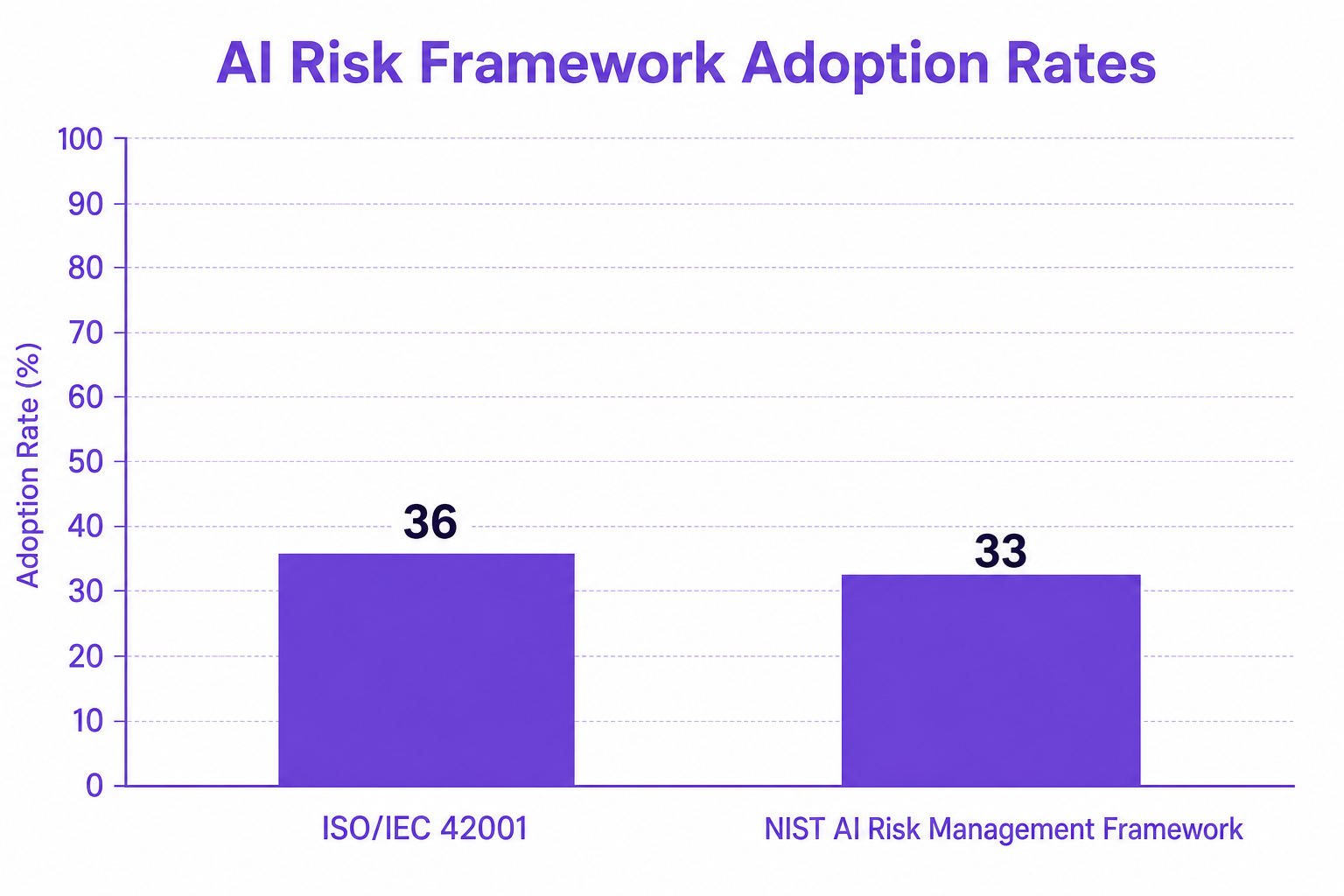
AI systems now underpin everything from healthcare records processing to financial modeling and public safety analytics. The risks are significant: algorithmic bias, shadow IT, uncontrolled cloud resource allocation, and potential data leakage. Regulatory expectations are growing rapidly, as indicated by rising adoption of formal frameworks such as ISO/IEC 42001 and the NIST AI Risk Management Framework.
Key insights show:
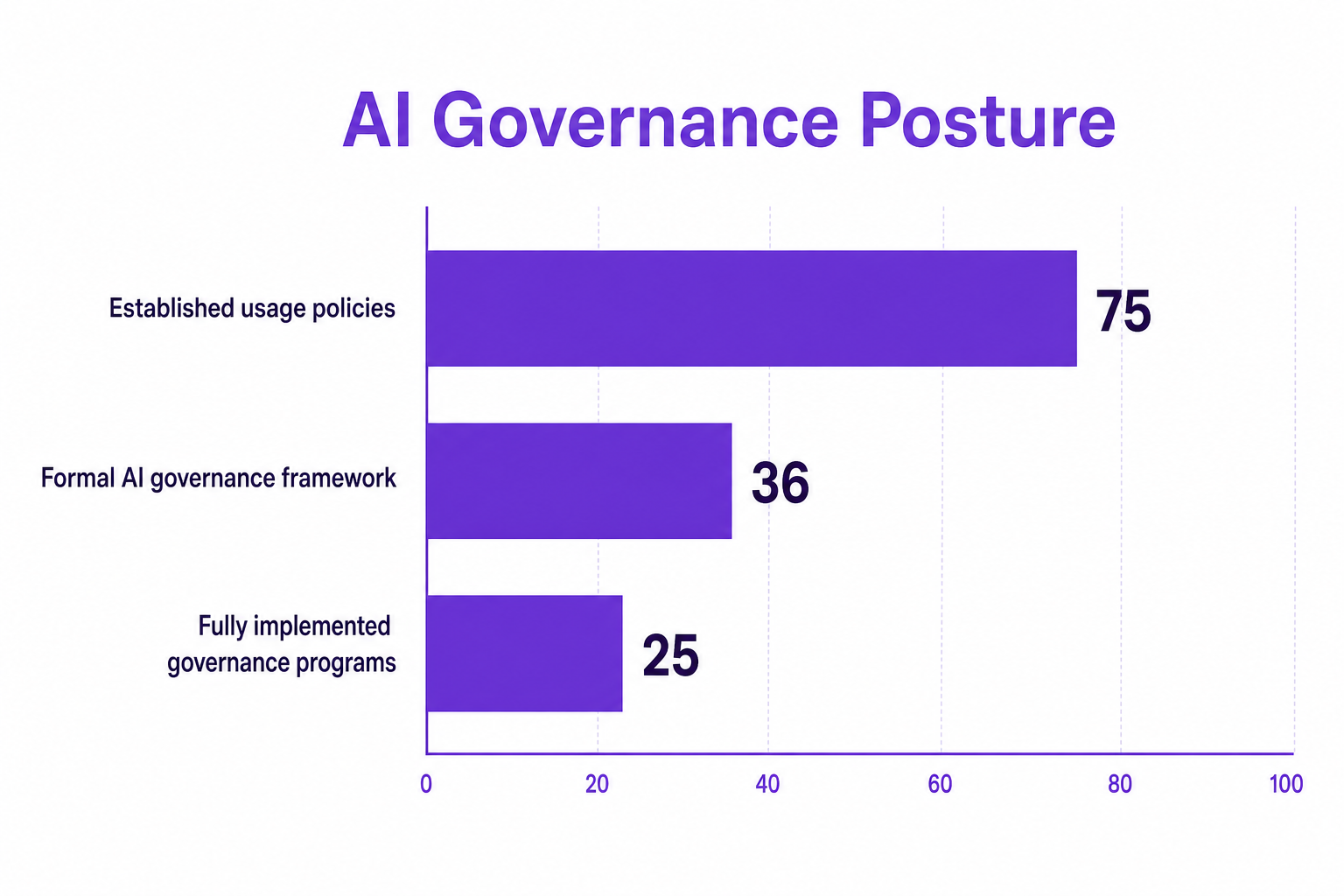
75% of organizations have established basic AI usage policies.
36% have formalized these into a comprehensive AI governance framework.
Less than 20% have advanced incident reporting or dedicated risk mitigation controls in place.
Without a purpose-built approach, organizations face fragmented control, compliance risk, and runaway costs. That is why a governance-first mindset is no longer optional.
An AI governance framework provides the structure, policies, and operational controls required to ensure that all AI systems are trustworthy, compliant, and aligned with organizational goals. As opposed to ad-hoc policies, a complete framework covers the full lifecycle:
Policy Setting & Risk Assessment: Establishing usage, ethics, and security guidelines in-line with evolving regulatory expectations.
Monitoring & Enforcement: Automated tracking of AI feature usage, model behavior, and user activity across cloud and SaaS estates.
Incident Management: Escalation mechanisms and regular audits to ensure prompt response to unanticipated AI outcomes or breaches.
Continuous Improvement: Ongoing evaluation of policies, integration of new control mechanisms, and adaptation to new legal or threat landscapes.
The backbone of successful AI governance is visibility. You can't govern what you can't see, especially as AI use sprawls across shadow IT, embedded cloud services, and SaaS platforms.
As organizations operationalize AI, they encounter not just technical, but significant cultural and regulatory challenges. The most common risks include:
Data Leakage: Employees may inadvertently expose PII or sensitive enterprise documents via AI prompts.
Shadow IT: Unsanctioned generative AI tools enter workflows, bypassing official controls.
Model Bias or Drift: AI systems generate unpredictable results or reinforce bias without proper oversight.
Cost Overruns: Uncontrolled AI resource and SaaS usage leads to unsustainable financial exposure.
Mitigating these risks requires proactive monitoring, automated cost allocation, robust policy enforcement, and centralized audit trails. Solutions like CloudNuro’s AI Custodian offer:
Continuous tracking of user activity, adoption rates, and prompt usage at the app and agent level.
Integration with Microsoft Purview to detect document overshares and with Microsoft Defender to discover and govern shadow IT.
Automated flagged alerts for risky prompt activity and oversharing.
Cost tracking and chargeback at project and user granularity.

Building a successful AI governance program goes beyond paper policies. The largest gap industry leaders identify is the operationalization of governance, turning policy into practice. CloudNuro empowers organizations to close this gap by:
Providing a single pane of glass for all AI activity across SaaS and cloud investments.
Offering agent-level cost breakdowns, ensuring teams know exactly where resources flow and how to optimize them.
Allowing administrators to segment users (Power, General, Low, Dormant) based on real usage, enabling precise license allocation and spend optimization.
Automated enforcement, incident escalation, and continuous risk posture evaluation, directly embedded into cloud/SaaS environments.
CloudNuro’s AI Custodian module has helped customers move from fragmented reports and manual review to mature, centralized, and fully auditable governance. Notably, organizations realize over 1000% ROI within the first year, with financial benefits emerging in just weeks.
Regulatory requirements in 2026 are rapidly solidifying. Authorities and standard bodies are honing AI-specific statutes for reporting, transparency, model auditability, and security. Organizations increasingly:
Adopt ISO/IEC 42001 and the NIST AI Risk Management Framework for their controls.
Move from informal AI experimentation to formal governance with embedded controls.
Operationalize policies through production monitoring, automated risk detection, and auditable logs.
With CloudNuro, enterprises achieve audit-ready compliance at scale, keeping pace with rapidly shifting law and best practices.
Inventory & Baseline: Map all SaaS and cloud-based AI usage. Shadow IT discovery is critical for holistic control.
Establish Policies: Develop practical usage, ethics, and security policies for every user cohort.
Operational Controls: Deploy automated monitoring, risk detection, and enforcement tools that minimize manual oversight.
Audit & Escalation Mechanisms: Ensure consistent incident reporting, remediation, and stakeholder sign-off processes.
Continuous Cost Optimization: Track and optimize AI licenses, prompt usage, and budget allocations using granular, agent-level data.
Engagement & Training: Build a governance-first culture through user education and transparent communication on policy and accountability.
By following and embedding these best practices, and leveraging platforms designed for governance-first cloud, SaaS, and AI oversight, organizations can meet their compliance obligations and control costs in a rapidly changing landscape.
What is an AI governance framework?
An AI governance framework is a structured system of policies, controls, and monitoring processes designed to ensure the safe, ethical, and compliant deployment of AI technologies across an organization. It provides visibility, risk mitigation, and clear operational guardrails for AI use.
Why is AI governance critical in 2026?
Proliferation of AI in business processes has vastly increased the potential risks organizations face, from regulatory fines to reputational damage. 2026 is a watershed moment for AI regulation, and robust governance frameworks are now expected by regulators, partners, and stakeholders.
How do organizations implement effective AI governance?
Implementation begins with comprehensive inventory and usage tracking, followed by clear policy setting, continuous monitoring, embedded controls, and routine audits. Automation is essential; platforms like CloudNuro operationalize governance with integrated policy enforcement and risk detection.
What are the major risks in AI adoption?
Data leakage, unauthorized tool adoption (shadow IT), model drift, bias, and spiraling costs are chief concerns. These require automated visibility, policy enforced at scale, user segmentation, and granular cost controls.
How does AI policy evolve to address compliance challenges?
Policies are shifting from generic guidelines to precise, measurable rules enforced directly in workflows. Ongoing monitoring, incident escalation, and alignment with formal risk management standards enable organizations to keep pace with new regulations and threats.
AI is a powerful catalyst for transformation, but only organizations that adopt a governance-first approach will maintain trust, compliance, and cost discipline. CloudNuro’s AI Custodian empowers IT and Finance leaders to operationalize governance, moving seamlessly from policy to enforcement, visibility, and optimization.
For those ready to institutionalize mature, resilient AI governance in 2026, the time to act is now.
About CloudNuro
CloudNuro is a leader in Enterprise AI Adoption Management, providing enterprises with unmatched visibility, governance, and cost optimization. Recognized twice in a row in the SaaS Management Platforms category and named a Leader in the SoftwareReviews Data Quadrant, CloudNuro is trusted by global enterprises and government agencies to bring financial discipline to SaaS, cloud, and AI. Trusted by enterprises, CloudNuro provides centralized SaaS inventory, license optimization, and renewal management along with advanced cost allocation and chargeback, giving IT and Finance leaders the visibility, control, and cost-conscious culture needed to drive financial discipline.
Request a no cost, no obligation free assessment —just 15 minutes to savings!
Get StartedIn 2026, the imperative for effective AI governance frameworks has reached critical mass. As AI becomes woven into the operational fabric of every enterprise and public sector entity, the call for robust governance, risk management, and ongoing compliance is clear. AI-enabled tools promise unprecedented efficiency, but without a structured approach to policy and oversight, they also introduce new layers of risk, complexity, and regulatory scrutiny.
This practitioner's guide presents a modern framework for AI governance, with real-world insights, market data, and practical guidance. For IT and business leaders, understanding how to operationalize governance is no longer a strategic luxury, but a necessity for risk management, compliance, and cost control. Here is your roadmap to building an actionable, resilient AI governance strategy.
AI systems now underpin everything from healthcare records processing to financial modeling and public safety analytics. The risks are significant: algorithmic bias, shadow IT, uncontrolled cloud resource allocation, and potential data leakage. Regulatory expectations are growing rapidly, as indicated by rising adoption of formal frameworks such as ISO/IEC 42001 and the NIST AI Risk Management Framework.
Key insights show:
75% of organizations have established basic AI usage policies.
36% have formalized these into a comprehensive AI governance framework.
Less than 20% have advanced incident reporting or dedicated risk mitigation controls in place.
Without a purpose-built approach, organizations face fragmented control, compliance risk, and runaway costs. That is why a governance-first mindset is no longer optional.
An AI governance framework provides the structure, policies, and operational controls required to ensure that all AI systems are trustworthy, compliant, and aligned with organizational goals. As opposed to ad-hoc policies, a complete framework covers the full lifecycle:
Policy Setting & Risk Assessment: Establishing usage, ethics, and security guidelines in-line with evolving regulatory expectations.
Monitoring & Enforcement: Automated tracking of AI feature usage, model behavior, and user activity across cloud and SaaS estates.
Incident Management: Escalation mechanisms and regular audits to ensure prompt response to unanticipated AI outcomes or breaches.
Continuous Improvement: Ongoing evaluation of policies, integration of new control mechanisms, and adaptation to new legal or threat landscapes.
The backbone of successful AI governance is visibility. You can't govern what you can't see, especially as AI use sprawls across shadow IT, embedded cloud services, and SaaS platforms.
As organizations operationalize AI, they encounter not just technical, but significant cultural and regulatory challenges. The most common risks include:
Data Leakage: Employees may inadvertently expose PII or sensitive enterprise documents via AI prompts.
Shadow IT: Unsanctioned generative AI tools enter workflows, bypassing official controls.
Model Bias or Drift: AI systems generate unpredictable results or reinforce bias without proper oversight.
Cost Overruns: Uncontrolled AI resource and SaaS usage leads to unsustainable financial exposure.
Mitigating these risks requires proactive monitoring, automated cost allocation, robust policy enforcement, and centralized audit trails. Solutions like CloudNuro’s AI Custodian offer:
Continuous tracking of user activity, adoption rates, and prompt usage at the app and agent level.
Integration with Microsoft Purview to detect document overshares and with Microsoft Defender to discover and govern shadow IT.
Automated flagged alerts for risky prompt activity and oversharing.
Cost tracking and chargeback at project and user granularity.
Building a successful AI governance program goes beyond paper policies. The largest gap industry leaders identify is the operationalization of governance, turning policy into practice. CloudNuro empowers organizations to close this gap by:
Providing a single pane of glass for all AI activity across SaaS and cloud investments.
Offering agent-level cost breakdowns, ensuring teams know exactly where resources flow and how to optimize them.
Allowing administrators to segment users (Power, General, Low, Dormant) based on real usage, enabling precise license allocation and spend optimization.
Automated enforcement, incident escalation, and continuous risk posture evaluation, directly embedded into cloud/SaaS environments.
CloudNuro’s AI Custodian module has helped customers move from fragmented reports and manual review to mature, centralized, and fully auditable governance. Notably, organizations realize over 1000% ROI within the first year, with financial benefits emerging in just weeks.
Regulatory requirements in 2026 are rapidly solidifying. Authorities and standard bodies are honing AI-specific statutes for reporting, transparency, model auditability, and security. Organizations increasingly:
Adopt ISO/IEC 42001 and the NIST AI Risk Management Framework for their controls.
Move from informal AI experimentation to formal governance with embedded controls.
Operationalize policies through production monitoring, automated risk detection, and auditable logs.
With CloudNuro, enterprises achieve audit-ready compliance at scale, keeping pace with rapidly shifting law and best practices.
Inventory & Baseline: Map all SaaS and cloud-based AI usage. Shadow IT discovery is critical for holistic control.
Establish Policies: Develop practical usage, ethics, and security policies for every user cohort.
Operational Controls: Deploy automated monitoring, risk detection, and enforcement tools that minimize manual oversight.
Audit & Escalation Mechanisms: Ensure consistent incident reporting, remediation, and stakeholder sign-off processes.
Continuous Cost Optimization: Track and optimize AI licenses, prompt usage, and budget allocations using granular, agent-level data.
Engagement & Training: Build a governance-first culture through user education and transparent communication on policy and accountability.
By following and embedding these best practices, and leveraging platforms designed for governance-first cloud, SaaS, and AI oversight, organizations can meet their compliance obligations and control costs in a rapidly changing landscape.
What is an AI governance framework?
An AI governance framework is a structured system of policies, controls, and monitoring processes designed to ensure the safe, ethical, and compliant deployment of AI technologies across an organization. It provides visibility, risk mitigation, and clear operational guardrails for AI use.
Why is AI governance critical in 2026?
Proliferation of AI in business processes has vastly increased the potential risks organizations face, from regulatory fines to reputational damage. 2026 is a watershed moment for AI regulation, and robust governance frameworks are now expected by regulators, partners, and stakeholders.
How do organizations implement effective AI governance?
Implementation begins with comprehensive inventory and usage tracking, followed by clear policy setting, continuous monitoring, embedded controls, and routine audits. Automation is essential; platforms like CloudNuro operationalize governance with integrated policy enforcement and risk detection.
What are the major risks in AI adoption?
Data leakage, unauthorized tool adoption (shadow IT), model drift, bias, and spiraling costs are chief concerns. These require automated visibility, policy enforced at scale, user segmentation, and granular cost controls.
How does AI policy evolve to address compliance challenges?
Policies are shifting from generic guidelines to precise, measurable rules enforced directly in workflows. Ongoing monitoring, incident escalation, and alignment with formal risk management standards enable organizations to keep pace with new regulations and threats.
AI is a powerful catalyst for transformation, but only organizations that adopt a governance-first approach will maintain trust, compliance, and cost discipline. CloudNuro’s AI Custodian empowers IT and Finance leaders to operationalize governance, moving seamlessly from policy to enforcement, visibility, and optimization.
For those ready to institutionalize mature, resilient AI governance in 2026, the time to act is now.
About CloudNuro
CloudNuro is a leader in Enterprise AI Adoption Management, providing enterprises with unmatched visibility, governance, and cost optimization. Recognized twice in a row in the SaaS Management Platforms category and named a Leader in the SoftwareReviews Data Quadrant, CloudNuro is trusted by global enterprises and government agencies to bring financial discipline to SaaS, cloud, and AI. Trusted by enterprises, CloudNuro provides centralized SaaS inventory, license optimization, and renewal management along with advanced cost allocation and chargeback, giving IT and Finance leaders the visibility, control, and cost-conscious culture needed to drive financial discipline.
Request a no cost, no obligation free assessment - just 15 minutes to savings!
Get StartedWe're offering complimentary ServiceNow license assessments to only 25 enterprises this quarter who want to unlock immediate savings without disrupting operations.
Get Free AssessmentGet Started




CloudNuro Corp
1755 Park St. Suite 207
Naperville, IL 60563
Phone : +1-630-277-9470
Email: info@cloudnuro.com


.webp)

Recognized Leader in SaaS Management Platforms by Info-Tech SoftwareReviews

%20Tools%20for%20Governance%20(2025%20Guide).png)

.png)
.svg)