

Sign Up
Thank you for Submitting!
Shadow AI Discovery is no longer a nice-to-have initiative. It is quickly becoming a regulatory expectation and a board-level priority.
A 2026 analysis from Deloitte found that 74% of enterprises saw unauthorized AI tool adoption inside departments, creating serious visibility and compliance gaps. Gartner reported that 82% of CISOs ranked shadow AI as their primary emerging risk for 2026, above cloud misconfigurations and ransomware.
If you are a security, risk, or compliance leader, you cannot wait a year for a new program. You need a practical way to stand up Shadow AI Discovery in 30 days, prove progress, and build from there.
This guide lays out a concrete 30-day plan, along with specific practices, artifacts, and controls you can implement immediately. It also shows how Venminder can support Shadow AI Discovery as an extension of your third party risk program.
Shadow AI is any use of AI-enabled SaaS or models that falls outside approved channels, controls, or vendor review. It includes:
Employees signing up for unsanctioned AI tools with corporate email
Teams feeding sensitive data into public AI assistants
Vendors quietly embedding AI capabilities into existing tools you already use
The result is a hidden layer of shadow technology risk that traditional asset inventories and CMDBs rarely capture.
Several factors make Shadow AI Discovery uniquely challenging:
Frictionless sign-up: Many AI tools offer instant trials, no procurement required.
Embedded AI: Existing software silently adds AI features, which may change risk posture overnight.
Business pressure: Lines of business are rewarded for innovation, not for risk restraint.
A 2026 study from a major HR software provider found that 68% of new AI tools entered enterprises via individual employees, not central IT. Shadow AI Discovery must assume that your current technology visibility is incomplete by design, not by accident.
Shadow AI amplifies existing risks and introduces new ones. For CISOs and compliance leaders, the most pressing are:
Data loss risk: Sensitive data copied into public AI interfaces without contractual protection or data residency assurances.
Regulatory exposure: PwC reported that 90% of early 2026 regulatory actions on AI in financial services cited poor oversight of unsanctioned AI tools.
Model integrity and bias: Unvetted AI-enabled SaaS may rely on opaque models that are impossible to validate for fairness or robustness.
Third party risk: Hidden AI features in vendor products expand your risk surface without updating contracts, controls, or audit scope.
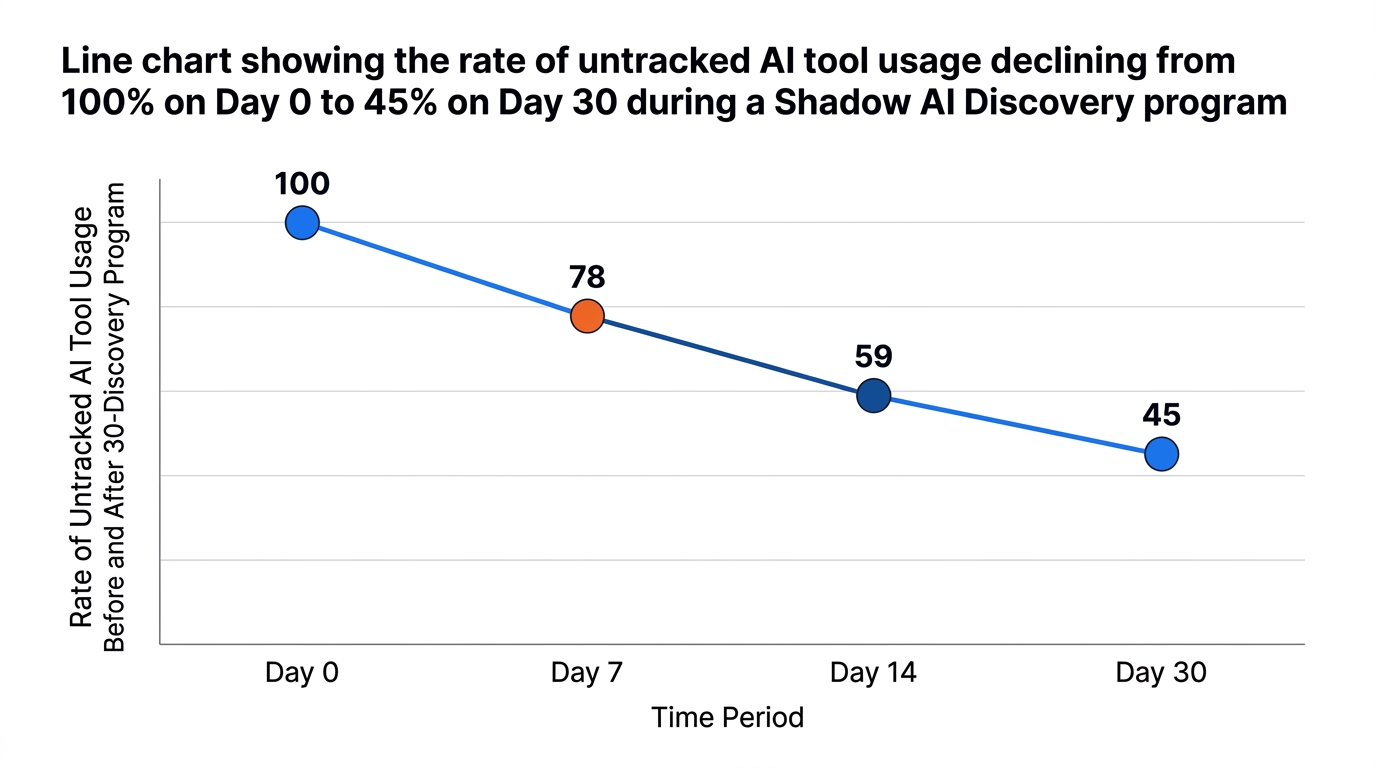
A Forrester 2026 analysis found that organizations that deployed automated Shadow AI detection and monitoring reduced untracked AI usage by 55% within 30 days. That is the same time window this guide focuses on.
At the same time, McKinsey reported that 46% of enterprises plan to audit all AI tool usage at least quarterly by the end of 2026. Shadow AI Discovery is becoming a recurring enterprise technology audit requirement, not a one-time cleanup.
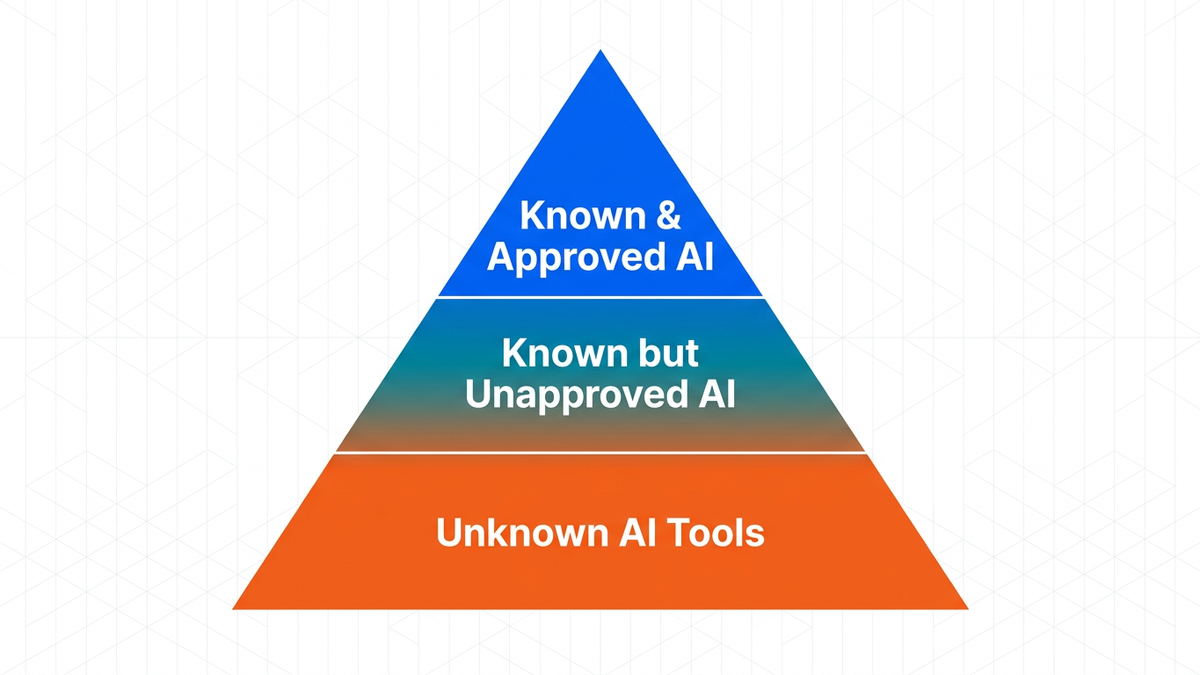
To keep the problem manageable, treat Shadow AI Discovery as a triangle of three visibility layers:
Known and approved AI tools: In asset inventory and subject to AI governance.
Known but unapproved AI tools: Identified through Shadow AI detection but not yet processed.
Unknown AI tools: Hidden uses of AI-enabled SaaS and shadow IT and AI that have never been surfaced.
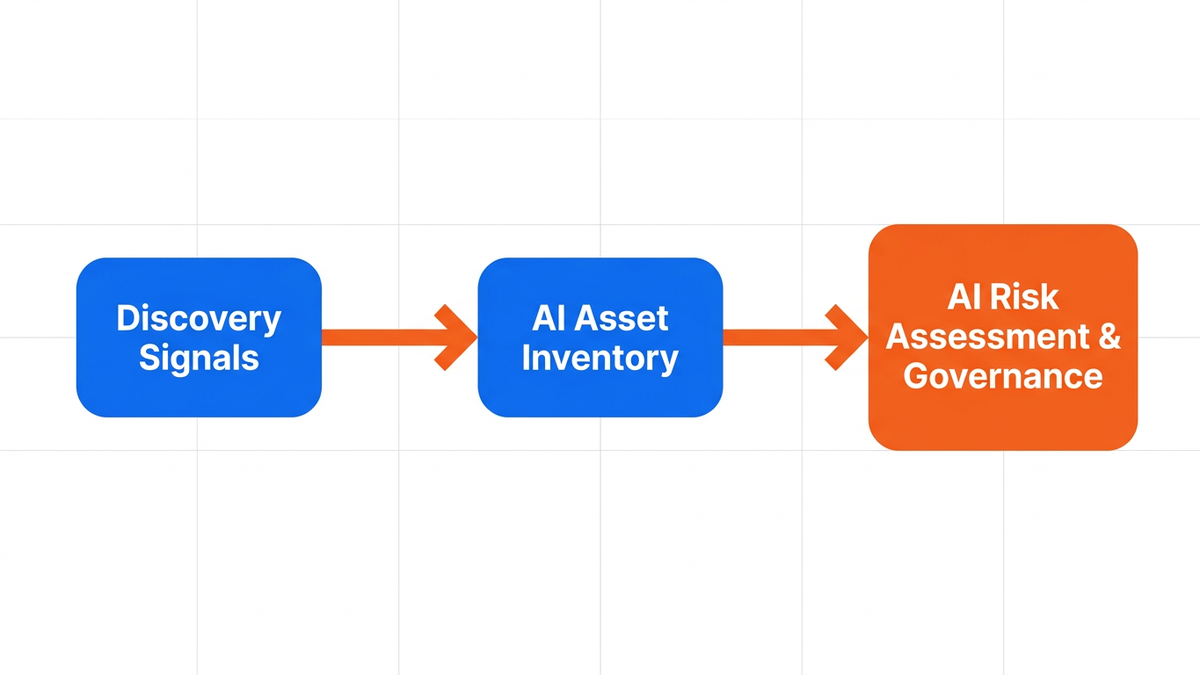
Your 30-day goal is to shrink layer 3 aggressively, organize layer 2 into an AI tool inventory, and feed layer 1 into standard AI governance and AI risk assessment processes.
This 30-day plan is structured into four weekly sprints. Each week builds assets you can reuse for ongoing automated AI monitoring.
Start with clarity, not tools. You need a definition of what “AI” means for your environment and which systems count as in-scope.
Key actions for Week 1:
Define AI usage categories
Generative text and image tools
Code assistants
AI-enabled SaaS modules inside existing platforms
Internal models and experiments
Write a short, one-page definition that can be understood by legal, compliance, and line-of-business leaders.
Align on risk tiers and data classes
Map existing information classification (public, internal, confidential, restricted) to allowed AI use.
Define what “high-risk AI usage” means in your context, for instance any exposure of regulated data to external AI providers.
Inventory your discovery signals
Cloud app and cloud app discovery logs
Identity and access logs
Proxy or secure web gateway data
Expense reports and procurement records
Existing vendor lists and contract repositories
You are not yet blocking anything. Your Week 1 outcome is a Shadow AI Discovery charter that specifies scope, data sources, and roles.

With scope defined, you can launch a first-pass AI discovery scan.
Key actions for Week 2:
Configure Shadow AI detection
Use cloud discovery and network logs to identify domains and applications tagged as AI-enabled SaaS.
Correlate accounts with corporate identity (email domains, single sign-on) to focus on enterprise exposure.
Prioritize by data risk and usage intensity
Rank tools by access level (SSO versus local account) and by frequency of use.
Flag any AI tools that are likely to process regulated or sensitive data.
Publish a quick-win summary
Share an internal report: number of unique AI tools, top 10 by usage, and departments involved.
Highlight early findings such as unapproved contract language or missing security reviews.
A Forrester 2026 case example described a financial institution that performed this scan and identified 41 previously unknown AI tools, cutting audit findings by 73% within the quarter. The pattern is repeatable: structured discovery plus prioritized remediation.
Discovery is only useful if it feeds a durable AI asset inventory and repeatable AI risk assessment process.
According to IDC 2026, 69% of IT managers expect to increase investment in AI discovery and monitoring tools, driven largely by the need for a central inventory. Another 2026 analysis from a major consulting firm found that 60% of companies with structured AI inventories improved risk mitigation response times by at least 40%.
Key actions for Week 3:
Normalize and classify AI tools
Consolidate discovered AI-enabled SaaS with existing vendor lists.
Create standard attributes such as vendor, hosting region, data types processed, and user groups.
Create AI-specific risk attributes
Model explainability, training data provenance, and model update frequency.
AI-specific controls, for example red-teaming, transparency documentation, and incident response plans.
Align with existing third party risk processes
Integrate AI tools into your third party risk taxonomy and workflows.
Extend current questionnaires to cover AI security assessment topics, such as prompt injection defenses and output validation.
This is also the week to define your AI risk policies: which data classes can be processed by which AI categories and under what conditions. That policy then becomes a simple, scorable control in your discovery and remediation program.
By Week 4 you should have:
An initial AI tools list with risk attributes
A sense of which AI uses are acceptable and which are not
Stakeholders who now see Shadow AI as concrete, not theoretical
Week 4 is about operationalizing.
Key actions for Week 4:
Stand up a minimal AI governance forum
A small working group from security, risk, compliance, and 1–2 high-usage business units.
Monthly or biweekly reviews of new AI tools and exceptions.
Move from one-time scan to continuous Shadow AI Discovery
Turn your initial AI discovery scan into a recurring job.
Integrate feeds into your shadow SaaS management or third party risk tooling.
Launch an awareness and guidance campaign
Provide a short catalog of approved AI tools and safe-use guidance.
Invite teams to nominate new tools via a streamlined intake process.
As one Gartner analyst put it in 2026, “Continuous discovery, not one-time audits, is the only sustainable approach to mitigating hidden AI threats in large enterprises.” Your 30-day effort is the starting point for that continuous state.
An effective Shadow AI Discovery program does more than find tools. It embeds AI governance and AI usage compliance into existing processes.
To avoid Shadow AI simply reappearing in new forms, you will need:
AI policy framework: Clear rules for data classes, approved use cases, and prohibited behaviors.
Intake and review process: A lightweight way for teams to propose new AI-enabled SaaS and receive a risk-based answer.
Exception handling: Documented criteria for temporary approvals with compensating controls.
These elements should reflect relevant regulatory requirements such as those from banking or privacy regulators. Boards and regulators increasingly expect explicit AI policies and documentation, not just verbal assurances.
You will encounter pushback, often in two forms:
“Shadow AI is just experimentation, not production.”
Response: Most major data breaches begin as experiments or pilots. If regulated data or customer information is involved, regulators will not care that it was “just a pilot.”
“Discovery will slow innovation.”
Response: A well-run Shadow AI Discovery program can actually accelerate adoption of safe, approved tools by providing clarity and a fast-track process. Use data from your first 30 days to show that you are removing unsafe tools while green-lighting low-risk, high-value options.
A useful analogy here is cloud adoption a decade ago. Organizations that ignored shadow IT eventually faced uncontrolled sprawl and security incidents. Those that implemented structured discovery and governance managed to enable cloud at scale with fewer surprises.
For deeper context on how AI intersects with vendor processes, see this discussion of AI risk management in vendor processes.
Shadow AI Discovery is ultimately a problem of third party AI oversight and emerging technology risk. Venminder is designed to help organizations manage exactly those categories.
Venminder’s third party risk management software provides a central system of record for your AI-enabled SaaS vendors, models, and supporting providers.
Security and risk teams can:
Import discovered AI tools into a unified AI tool inventory alongside traditional vendors.
Classify each AI-enabled SaaS product using custom fields for AI-specific risk attributes.
Attach AI-specific documentation such as model cards, transparency reports, and security whitepapers.
This turns ad hoc Shadow AI detection into a consistent, auditable AI asset inventory.
Venminder’s automated vendor risk assessments and continuous monitoring modules help you:
Trigger AI risk assessment workflows when new AI-enabled tools appear in logs or procurement feeds.
Use configurable questionnaires that cover both standard security topics and AI-specific controls.
Integrate with external data sources for ongoing automated AI monitoring of vendor posture.
Organizations that embed AI tools into this automated workflow can operationalize a 30-day Shadow AI Discovery sprint into an ongoing capability. For more insight into automation benefits, see this article on vendor risk automation.
Venminder’s document management and compliance libraries support AI compliance by:
Centralizing AI usage policies, exception approvals, and meeting minutes from AI governance forums.
Linking policy documents directly to the AI tools and vendors they govern.
Providing risk and compliance reporting tools that show AI-related controls and open issues.
When examiners ask how you handle AI-enabled SaaS and unsanctioned AI tools, you can demonstrate not only a Shadow AI Discovery process but also traceable decisions and remediation.
Shadow AI is often the first visible symptom of a broader AI threat landscape that includes:
Vendors introducing new AI features under existing contracts
Fourth parties or data sources used for model training
New categories of emerging technology risk
Venminder helps by connecting Shadow AI Discovery outcomes with your overall third party AI oversight strategy. For an in-depth look at this intersection, review the analysis on third-party AI risk and building a compliance-driven risk strategy.
The biggest risks include data loss risk, regulatory non-compliance, and expanded third party exposure.
Unsanctioned AI tools may process sensitive or regulated data without proper contracts, controls, or monitoring. This creates gaps in your AI governance and can lead to enforcement actions, especially in regulated sectors.
Most organizations start with Shadow AI detection through existing telemetry: cloud app discovery logs, identity and access data, and proxy or secure web gateway records.
They then enrich this with procurement data and vendor lists to identify AI-enabled SaaS that may not be obvious from domain names alone. Automated correlation of these sources is critical to scale discovery beyond manual spreadsheet reviews.
A basic AI discovery scan involves four steps:
Define what counts as AI in your context and which data classes are in scope.
Aggregate discovery signals from cloud, identity, and network tools.
Classify which discovered tools are AI-enabled SaaS and map them to users and departments.
Prioritize findings based on data sensitivity and usage intensity.
This can be done within the first two weeks of a 30-day program if you use existing logs and simple classification rules.
Start by turning your initial discovery results into a structured AI tool inventory that lives alongside your broader vendor list.
For each tool, record key attributes such as data types processed, AI capabilities, hosting region, and risk tier. Integrate that inventory into your risk management automation platform so new tools are automatically added when discovered.
Multiple categories of security and IT operations tools provide discovery signals, including cloud access security solutions, identity providers, and expense management systems.
The most effective programs route discovery outputs into a central risk platform that can trigger AI risk assessment workflows and continuous monitoring, instead of leaving insights trapped in point solutions.
Sustainable control comes from combining automated AI monitoring with clear governance.
You need recurring discovery jobs, a documented intake process for new tools, defined AI risk policies, and executive support. Regular reports to leadership and auditors on your Shadow AI Discovery metrics help maintain momentum and resources.
Shadow AI Discovery is fast becoming a baseline expectation for enterprise AI governance. With 74% of enterprises already experiencing unauthorized AI adoption and regulators focusing enforcement on unsanctioned AI tools, the cost of waiting is rising.
A focused 30-day sprint can give you:
A defensible Shadow AI Discovery process
A working AI asset inventory and intake workflow
Clear documentation for auditors and leadership
Venminder helps you extend this sprint into an ongoing, automated capability that aligns AI oversight with your broader third party and AI compliance strategy.
Take the next step by evaluating how your current vendor risk program can support Shadow AI Discovery, and identify where Venminder’s automation and expertise can accelerate your progress.
CloudNuro is a leader in Enterprise SaaS Management Platforms, giving enterprises unmatched visibility, governance, and cost optimization.
We are proud to be recognized twice in a row by Gartner in the SaaS Management Platforms and named a Leader in the Info-Tech SoftwareReviews Data Quadrant.
Trusted by global enterprises and government agencies, CloudNuro provides centralized SaaS inventory, license optimization, and renewal management. With a 15-minute setup and measurable results in under 24 hours, CloudNuro gives IT teams a fast path to value.
Request a Demo | Get Free Savings Assessment | Explore Product
Request a no cost, no obligation free assessment —just 15 minutes to savings!
Get StartedShadow AI Discovery is no longer a nice-to-have initiative. It is quickly becoming a regulatory expectation and a board-level priority.
A 2026 analysis from Deloitte found that 74% of enterprises saw unauthorized AI tool adoption inside departments, creating serious visibility and compliance gaps. Gartner reported that 82% of CISOs ranked shadow AI as their primary emerging risk for 2026, above cloud misconfigurations and ransomware.
If you are a security, risk, or compliance leader, you cannot wait a year for a new program. You need a practical way to stand up Shadow AI Discovery in 30 days, prove progress, and build from there.
This guide lays out a concrete 30-day plan, along with specific practices, artifacts, and controls you can implement immediately. It also shows how Venminder can support Shadow AI Discovery as an extension of your third party risk program.
Shadow AI is any use of AI-enabled SaaS or models that falls outside approved channels, controls, or vendor review. It includes:
Employees signing up for unsanctioned AI tools with corporate email
Teams feeding sensitive data into public AI assistants
Vendors quietly embedding AI capabilities into existing tools you already use
The result is a hidden layer of shadow technology risk that traditional asset inventories and CMDBs rarely capture.
Several factors make Shadow AI Discovery uniquely challenging:
Frictionless sign-up: Many AI tools offer instant trials, no procurement required.
Embedded AI: Existing software silently adds AI features, which may change risk posture overnight.
Business pressure: Lines of business are rewarded for innovation, not for risk restraint.
A 2026 study from a major HR software provider found that 68% of new AI tools entered enterprises via individual employees, not central IT. Shadow AI Discovery must assume that your current technology visibility is incomplete by design, not by accident.
Shadow AI amplifies existing risks and introduces new ones. For CISOs and compliance leaders, the most pressing are:
Data loss risk: Sensitive data copied into public AI interfaces without contractual protection or data residency assurances.
Regulatory exposure: PwC reported that 90% of early 2026 regulatory actions on AI in financial services cited poor oversight of unsanctioned AI tools.
Model integrity and bias: Unvetted AI-enabled SaaS may rely on opaque models that are impossible to validate for fairness or robustness.
Third party risk: Hidden AI features in vendor products expand your risk surface without updating contracts, controls, or audit scope.
A Forrester 2026 analysis found that organizations that deployed automated Shadow AI detection and monitoring reduced untracked AI usage by 55% within 30 days. That is the same time window this guide focuses on.
At the same time, McKinsey reported that 46% of enterprises plan to audit all AI tool usage at least quarterly by the end of 2026. Shadow AI Discovery is becoming a recurring enterprise technology audit requirement, not a one-time cleanup.
To keep the problem manageable, treat Shadow AI Discovery as a triangle of three visibility layers:
Known and approved AI tools: In asset inventory and subject to AI governance.
Known but unapproved AI tools: Identified through Shadow AI detection but not yet processed.
Unknown AI tools: Hidden uses of AI-enabled SaaS and shadow IT and AI that have never been surfaced.
Your 30-day goal is to shrink layer 3 aggressively, organize layer 2 into an AI tool inventory, and feed layer 1 into standard AI governance and AI risk assessment processes.
This 30-day plan is structured into four weekly sprints. Each week builds assets you can reuse for ongoing automated AI monitoring.
Start with clarity, not tools. You need a definition of what “AI” means for your environment and which systems count as in-scope.
Key actions for Week 1:
Define AI usage categories
Generative text and image tools
Code assistants
AI-enabled SaaS modules inside existing platforms
Internal models and experiments
Write a short, one-page definition that can be understood by legal, compliance, and line-of-business leaders.
Align on risk tiers and data classes
Map existing information classification (public, internal, confidential, restricted) to allowed AI use.
Define what “high-risk AI usage” means in your context, for instance any exposure of regulated data to external AI providers.
Inventory your discovery signals
Cloud app and cloud app discovery logs
Identity and access logs
Proxy or secure web gateway data
Expense reports and procurement records
Existing vendor lists and contract repositories
You are not yet blocking anything. Your Week 1 outcome is a Shadow AI Discovery charter that specifies scope, data sources, and roles.
With scope defined, you can launch a first-pass AI discovery scan.
Key actions for Week 2:
Configure Shadow AI detection
Use cloud discovery and network logs to identify domains and applications tagged as AI-enabled SaaS.
Correlate accounts with corporate identity (email domains, single sign-on) to focus on enterprise exposure.
Prioritize by data risk and usage intensity
Rank tools by access level (SSO versus local account) and by frequency of use.
Flag any AI tools that are likely to process regulated or sensitive data.
Publish a quick-win summary
Share an internal report: number of unique AI tools, top 10 by usage, and departments involved.
Highlight early findings such as unapproved contract language or missing security reviews.
A Forrester 2026 case example described a financial institution that performed this scan and identified 41 previously unknown AI tools, cutting audit findings by 73% within the quarter. The pattern is repeatable: structured discovery plus prioritized remediation.
Discovery is only useful if it feeds a durable AI asset inventory and repeatable AI risk assessment process.
According to IDC 2026, 69% of IT managers expect to increase investment in AI discovery and monitoring tools, driven largely by the need for a central inventory. Another 2026 analysis from a major consulting firm found that 60% of companies with structured AI inventories improved risk mitigation response times by at least 40%.
Key actions for Week 3:
Normalize and classify AI tools
Consolidate discovered AI-enabled SaaS with existing vendor lists.
Create standard attributes such as vendor, hosting region, data types processed, and user groups.
Create AI-specific risk attributes
Model explainability, training data provenance, and model update frequency.
AI-specific controls, for example red-teaming, transparency documentation, and incident response plans.
Align with existing third party risk processes
Integrate AI tools into your third party risk taxonomy and workflows.
Extend current questionnaires to cover AI security assessment topics, such as prompt injection defenses and output validation.
This is also the week to define your AI risk policies: which data classes can be processed by which AI categories and under what conditions. That policy then becomes a simple, scorable control in your discovery and remediation program.
By Week 4 you should have:
An initial AI tools list with risk attributes
A sense of which AI uses are acceptable and which are not
Stakeholders who now see Shadow AI as concrete, not theoretical
Week 4 is about operationalizing.
Key actions for Week 4:
Stand up a minimal AI governance forum
A small working group from security, risk, compliance, and 1–2 high-usage business units.
Monthly or biweekly reviews of new AI tools and exceptions.
Move from one-time scan to continuous Shadow AI Discovery
Turn your initial AI discovery scan into a recurring job.
Integrate feeds into your shadow SaaS management or third party risk tooling.
Launch an awareness and guidance campaign
Provide a short catalog of approved AI tools and safe-use guidance.
Invite teams to nominate new tools via a streamlined intake process.
As one Gartner analyst put it in 2026, “Continuous discovery, not one-time audits, is the only sustainable approach to mitigating hidden AI threats in large enterprises.” Your 30-day effort is the starting point for that continuous state.
An effective Shadow AI Discovery program does more than find tools. It embeds AI governance and AI usage compliance into existing processes.
To avoid Shadow AI simply reappearing in new forms, you will need:
AI policy framework: Clear rules for data classes, approved use cases, and prohibited behaviors.
Intake and review process: A lightweight way for teams to propose new AI-enabled SaaS and receive a risk-based answer.
Exception handling: Documented criteria for temporary approvals with compensating controls.
These elements should reflect relevant regulatory requirements such as those from banking or privacy regulators. Boards and regulators increasingly expect explicit AI policies and documentation, not just verbal assurances.
You will encounter pushback, often in two forms:
“Shadow AI is just experimentation, not production.”
Response: Most major data breaches begin as experiments or pilots. If regulated data or customer information is involved, regulators will not care that it was “just a pilot.”
“Discovery will slow innovation.”
Response: A well-run Shadow AI Discovery program can actually accelerate adoption of safe, approved tools by providing clarity and a fast-track process. Use data from your first 30 days to show that you are removing unsafe tools while green-lighting low-risk, high-value options.
A useful analogy here is cloud adoption a decade ago. Organizations that ignored shadow IT eventually faced uncontrolled sprawl and security incidents. Those that implemented structured discovery and governance managed to enable cloud at scale with fewer surprises.
For deeper context on how AI intersects with vendor processes, see this discussion of AI risk management in vendor processes.
Shadow AI Discovery is ultimately a problem of third party AI oversight and emerging technology risk. Venminder is designed to help organizations manage exactly those categories.
Venminder’s third party risk management software provides a central system of record for your AI-enabled SaaS vendors, models, and supporting providers.
Security and risk teams can:
Import discovered AI tools into a unified AI tool inventory alongside traditional vendors.
Classify each AI-enabled SaaS product using custom fields for AI-specific risk attributes.
Attach AI-specific documentation such as model cards, transparency reports, and security whitepapers.
This turns ad hoc Shadow AI detection into a consistent, auditable AI asset inventory.
Venminder’s automated vendor risk assessments and continuous monitoring modules help you:
Trigger AI risk assessment workflows when new AI-enabled tools appear in logs or procurement feeds.
Use configurable questionnaires that cover both standard security topics and AI-specific controls.
Integrate with external data sources for ongoing automated AI monitoring of vendor posture.
Organizations that embed AI tools into this automated workflow can operationalize a 30-day Shadow AI Discovery sprint into an ongoing capability. For more insight into automation benefits, see this article on vendor risk automation.
Venminder’s document management and compliance libraries support AI compliance by:
Centralizing AI usage policies, exception approvals, and meeting minutes from AI governance forums.
Linking policy documents directly to the AI tools and vendors they govern.
Providing risk and compliance reporting tools that show AI-related controls and open issues.
When examiners ask how you handle AI-enabled SaaS and unsanctioned AI tools, you can demonstrate not only a Shadow AI Discovery process but also traceable decisions and remediation.
Shadow AI is often the first visible symptom of a broader AI threat landscape that includes:
Vendors introducing new AI features under existing contracts
Fourth parties or data sources used for model training
New categories of emerging technology risk
Venminder helps by connecting Shadow AI Discovery outcomes with your overall third party AI oversight strategy. For an in-depth look at this intersection, review the analysis on third-party AI risk and building a compliance-driven risk strategy.
The biggest risks include data loss risk, regulatory non-compliance, and expanded third party exposure.
Unsanctioned AI tools may process sensitive or regulated data without proper contracts, controls, or monitoring. This creates gaps in your AI governance and can lead to enforcement actions, especially in regulated sectors.
Most organizations start with Shadow AI detection through existing telemetry: cloud app discovery logs, identity and access data, and proxy or secure web gateway records.
They then enrich this with procurement data and vendor lists to identify AI-enabled SaaS that may not be obvious from domain names alone. Automated correlation of these sources is critical to scale discovery beyond manual spreadsheet reviews.
A basic AI discovery scan involves four steps:
Define what counts as AI in your context and which data classes are in scope.
Aggregate discovery signals from cloud, identity, and network tools.
Classify which discovered tools are AI-enabled SaaS and map them to users and departments.
Prioritize findings based on data sensitivity and usage intensity.
This can be done within the first two weeks of a 30-day program if you use existing logs and simple classification rules.
Start by turning your initial discovery results into a structured AI tool inventory that lives alongside your broader vendor list.
For each tool, record key attributes such as data types processed, AI capabilities, hosting region, and risk tier. Integrate that inventory into your risk management automation platform so new tools are automatically added when discovered.
Multiple categories of security and IT operations tools provide discovery signals, including cloud access security solutions, identity providers, and expense management systems.
The most effective programs route discovery outputs into a central risk platform that can trigger AI risk assessment workflows and continuous monitoring, instead of leaving insights trapped in point solutions.
Sustainable control comes from combining automated AI monitoring with clear governance.
You need recurring discovery jobs, a documented intake process for new tools, defined AI risk policies, and executive support. Regular reports to leadership and auditors on your Shadow AI Discovery metrics help maintain momentum and resources.
Shadow AI Discovery is fast becoming a baseline expectation for enterprise AI governance. With 74% of enterprises already experiencing unauthorized AI adoption and regulators focusing enforcement on unsanctioned AI tools, the cost of waiting is rising.
A focused 30-day sprint can give you:
A defensible Shadow AI Discovery process
A working AI asset inventory and intake workflow
Clear documentation for auditors and leadership
Venminder helps you extend this sprint into an ongoing, automated capability that aligns AI oversight with your broader third party and AI compliance strategy.
Take the next step by evaluating how your current vendor risk program can support Shadow AI Discovery, and identify where Venminder’s automation and expertise can accelerate your progress.
CloudNuro is a leader in Enterprise SaaS Management Platforms, giving enterprises unmatched visibility, governance, and cost optimization.
We are proud to be recognized twice in a row by Gartner in the SaaS Management Platforms and named a Leader in the Info-Tech SoftwareReviews Data Quadrant.
Trusted by global enterprises and government agencies, CloudNuro provides centralized SaaS inventory, license optimization, and renewal management. With a 15-minute setup and measurable results in under 24 hours, CloudNuro gives IT teams a fast path to value.
Request a Demo | Get Free Savings Assessment | Explore Product
Request a no cost, no obligation free assessment - just 15 minutes to savings!
Get StartedWe're offering complimentary ServiceNow license assessments to only 25 enterprises this quarter who want to unlock immediate savings without disrupting operations.
Get Free AssessmentGet Started




CloudNuro Corp
1755 Park St. Suite 207
Naperville, IL 60563
Phone : +1-630-277-9470
Email: info@cloudnuro.com





.webp)

Recognized Leader in SaaS Management Platforms by Info-Tech SoftwareReviews

.svg)