

Sign Up
Thank you for Submitting!
AI is now embedded in almost every enterprise software category, from collaboration suites to analytics and CRM. As a result, AI data privacy vs SaaS privacy is no longer a theoretical discussion. It is a daily reality for CIOs, CISOs, and privacy leaders who must explain to auditors, regulators, and boards how AI tools are handling sensitive data.
According to a recent industry report, 61% of enterprises cite data privacy and compliance as the top challenge when adopting AI-enabled SaaS solutions in 2026. That is a clear signal that traditional SaaS privacy controls are not enough once models, training data, and continuous learning enter the picture.
This article breaks down how data privacy for AI tools differs from traditional SaaS, the emerging AI SaaS privacy requirements, and practical steps to modernize governance. It also shows how CloudNuro helps enterprises build a single, automated control plane across both AI and conventional SaaS.
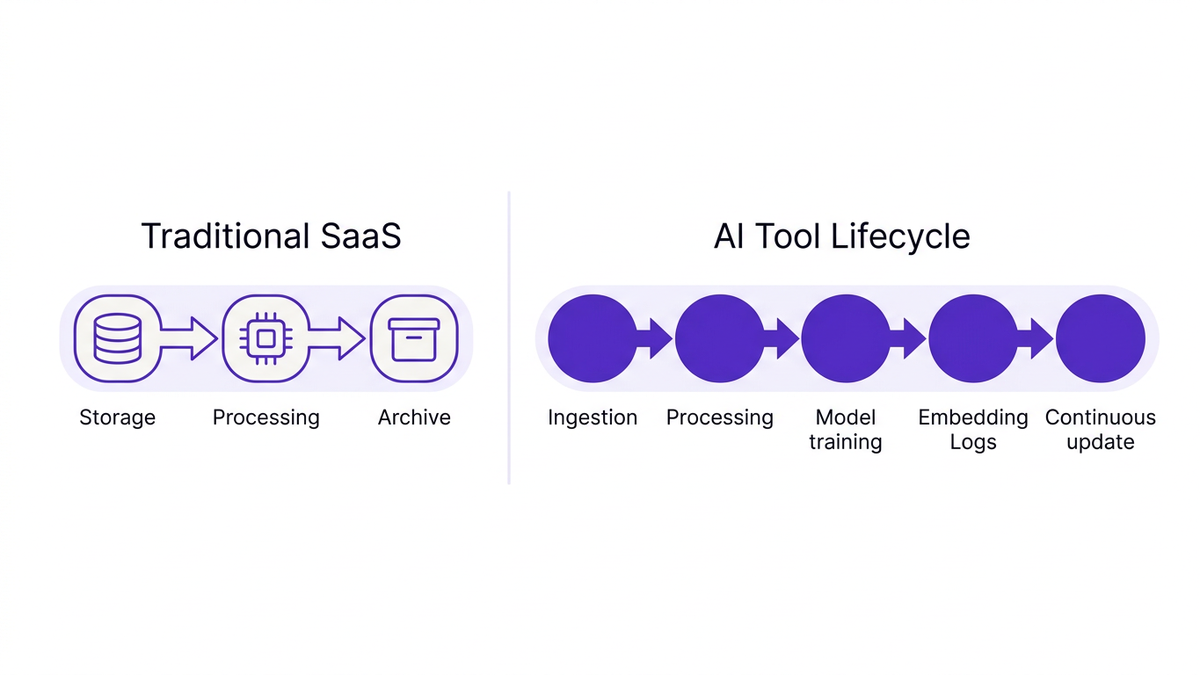
Traditional SaaS privacy has largely focused on data at rest, access rights, and vendor certifications. With AI tools, the scope expands to how data is used to train, fine-tune, and continuously update models.
A recent enterprise IT survey found that 78% of organizations implemented differentiated privacy policies for AI tools vs conventional SaaS in 2026. That shift reflects a few fundamental differences.
Key ways AI data privacy vs SaaS privacy diverge:
A leading privacy analyst summarized the shift: AI tools inherently process larger and more sensitive datasets, and enterprises must establish dedicated privacy controls beyond what is used in legacy SaaS applications.
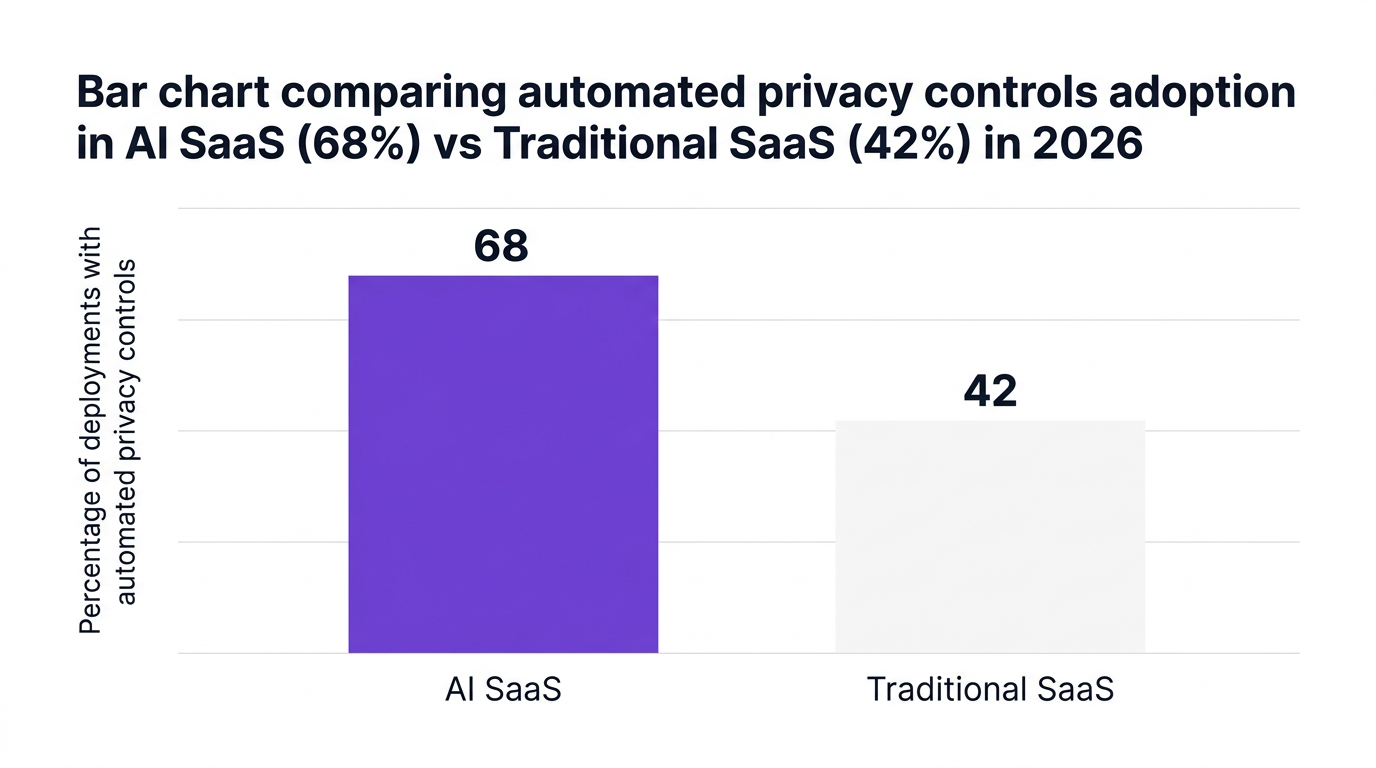
According to a 2026 privacy survey, 68% of AI SaaS deployments use automated privacy controls, compared with 42% for traditional SaaS. That gap will only widen as regulators and boards ask more pointed questions about how models treat sensitive data.
Traditional SaaS security reviews focus on data hosting, encryption, access control, and certifications. Privacy challenges in AI software add entirely new risk dimensions that standard vendor questionnaires often miss.
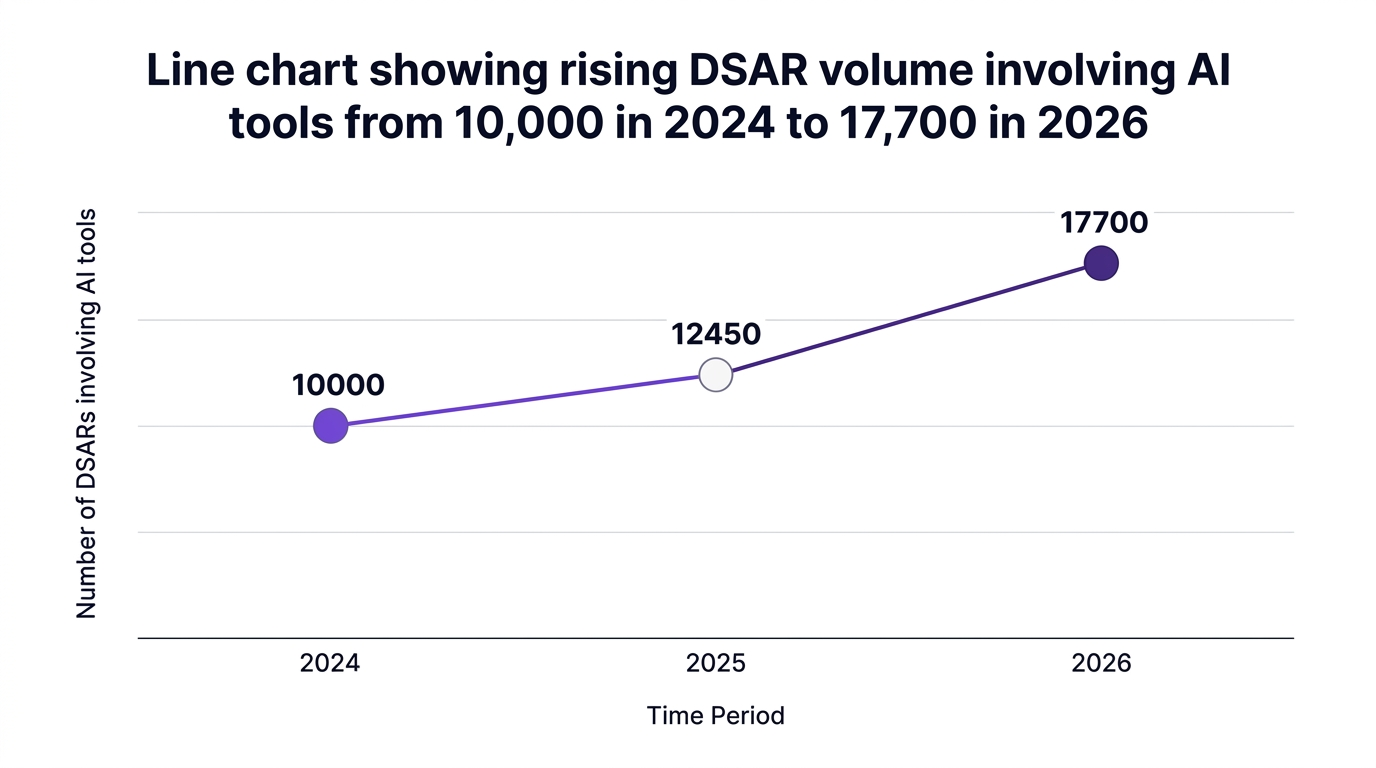
A 2026 compliance study reported a 42% year-over-year increase in DSARs involving AI tools, underscoring growing regulatory scrutiny and user expectations. Enterprises must anticipate these shifts rather than react to them after incidents.
1. Model training and data reuse risk
AI vendors may:
For privacy teams, this raises questions such as:
2. Shadow AI and uncontrolled usage
Just as shadow IT plagued early SaaS adoption, shadow AI is now a central AI risk management SaaS challenge. Business units adopt AI copilots or automation tools with minimal review, often connecting them to source-of-truth systems.
3. Inference and profiling risk
AI models can infer sensitive traits even when those attributes are not explicitly collected. This raises issues for responsible AI, fairness, and consent.
A recent RegTech commentary highlighted that data minimization and real-time access governance are now essential for AI risk management, since periodic audits miss high-velocity AI usage.
The regulatory environment for AI SaaS regulations is evolving quickly. Enterprises must understand how classic data protection rules, like GDPR for AI tools, interact with emerging AI-specific laws.
A 2026 market compliance update found a 33% rise in documented data minimization practices for AI SaaS, driven by global privacy and AI regulations. In parallel, an IT governance outlook indicates that 55% of IT leaders expect AI SaaS to require continuous, automated compliance monitoring by 2026, compared with 34% for traditional SaaS.
Key regulatory themes affecting AI-enabled SaaS compliance:
Regulators are converging on a simple expectation: if AI touches personal data, it must be discoverable, explainable, and controllable, in the same way as any other processing activity, but with higher standards of documentation and monitoring.
To address data privacy AI tools concerns, privacy and IT leaders are evolving from periodic audits to continuous compliance. This requires new controls that go beyond standard SaaS security playbooks.
A 2026 IT governance outlook indicates that nearly 55% of AI SaaS deployments require continuous, automated compliance monitoring, outpacing traditional SaaS. This shift reflects the always-on, learning nature of AI services.
A practical AI data governance blueprint:
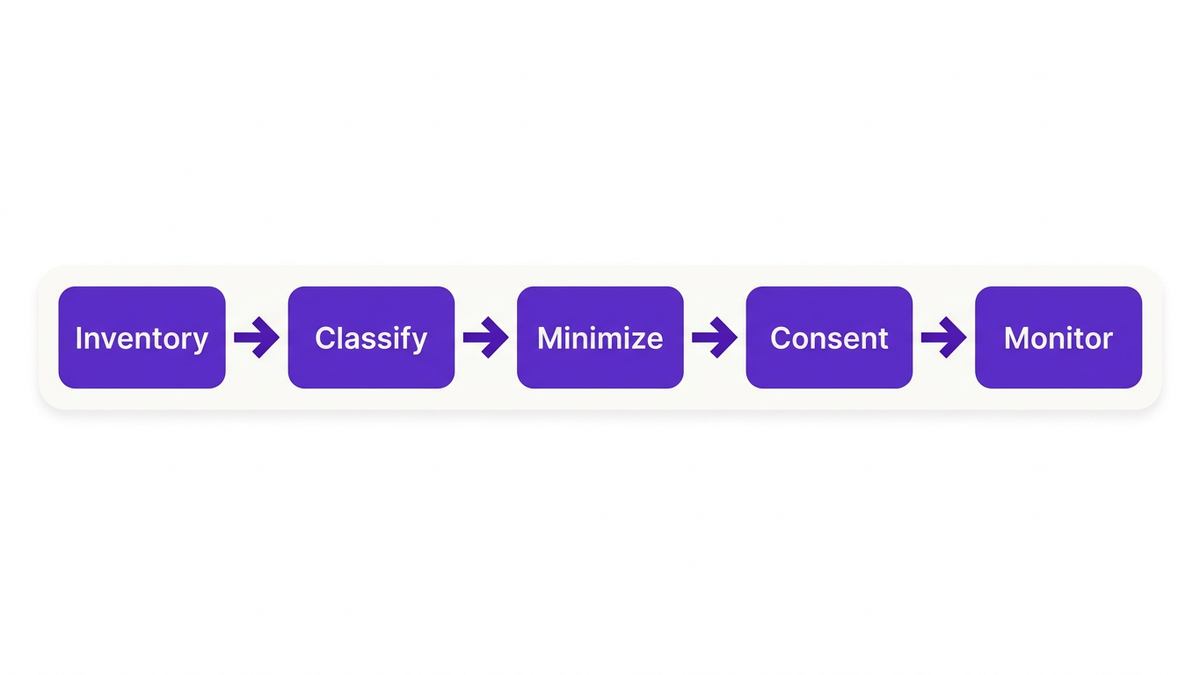
Real-world examples show how organizations are adapting AI data governance and AI SaaS security controls to reduce risk while maintaining innovation.
Case study 1: Financial services provider cuts audit findings by 25%
A global financial services provider rolled out automated SaaS governance to oversee its AI analytics suite in 2026.
Outcomes:
Case study 2: Healthcare network boosts DSAR performance by 30%
A healthcare network introduced differentiated consent and access controls for AI-backed diagnostic tools.
Results:
These case studies highlight a key pattern: organizations that treat AI data privacy vs SaaS privacy as distinct disciplines, but run them on a shared governance foundation, see better risk reduction and operational efficiency.
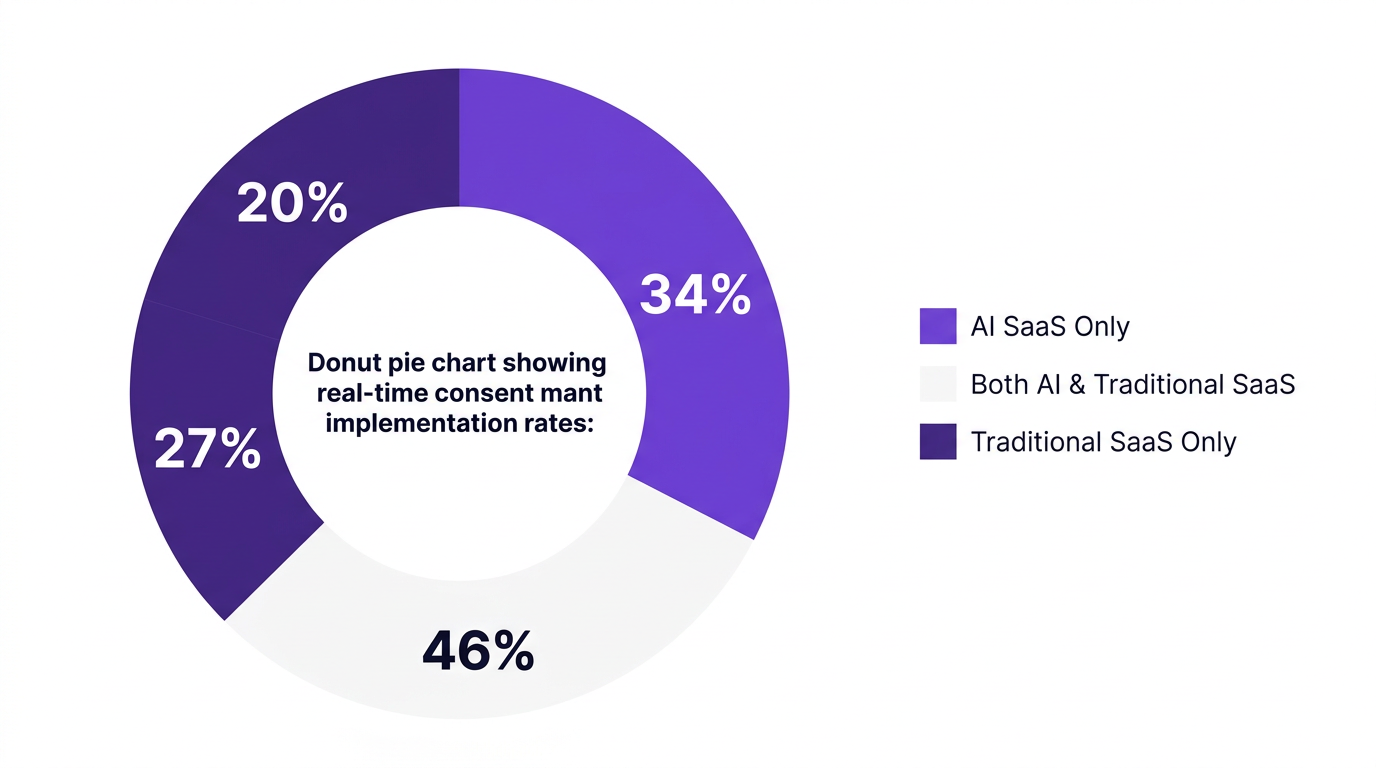
Enterprise privacy leaders increasingly recognize that they need one control plane for both AI and traditional SaaS. Managing AI-specific risks in isolation creates new silos and blind spots. CloudNuro is built to provide that unified lens.
CloudNuro’s platform is designed for enterprises that must balance AI SaaS privacy requirements, cost control, and regulatory pressure across hundreds of tools.
CloudNuro AI Custodian delivers a single pane of glass across SaaS and cloud environments, including AI-enabled tools.
Key capabilities for AI platform data security and privacy:
This gives privacy, security, and FinOps teams the ability to:
CloudNuro’s FinOps Services extend beyond cost to support enterprise AI compliance.
Capabilities include:
By connecting financial signals with privacy posture, enterprises can prioritize remediation for high-cost, high-risk AI tools and rightsize licenses with AI vendor compliance in mind.
AI is increasingly embedded in core platforms such as collaboration and CRM. CloudNuro’s Microsoft 365 Custodian and Salesforce Custodian help govern these environments where AI features and sensitive data intersect.
They provide:
This is essential for AI and PII management, because it ensures that only the right identities can invoke AI features backed by sensitive data.
CloudNuro’s platform is built around a governance-first architecture, aligned with continuous compliance expectations for AI and SaaS.
Enterprises benefit from:
For IT, Security, and Finance leaders, this provides an operational way to achieve responsible AI outcomes without slowing innovation.
With traditional SaaS, privacy programs focus on data storage, access control, and vendor certifications. For AI tools, privacy must also address how data is used to train and update models, how long it persists in prompts and logs, and how AI can infer or reconstruct sensitive attributes.
This means enterprises need additional controls around training data governance, model explainability, and consent for AI-specific processing.
AI-enabled SaaS introduces risks involving model training, secondary use of data, inference-based profiling, and shadow AI adoption across business units. Compliance obligations now include documenting AI model privacy impact, supporting DSARs that involve AI outputs, and managing AI-specific consent and opt-out mechanisms.
Regulators also expect continuous monitoring of AI systems, not just annual or ad hoc audits.
Existing privacy laws, such as GDPR-style regulations, apply fully to AI processing of personal data. These rules cover lawful basis, data minimization, purpose limitation, DSAR response, and cross-border transfers, even when AI is used.
On top of that, AI-specific regulations are emerging that impose obligations such as risk assessments, documentation, human oversight, and robust AI platform data security controls for high-risk use cases.
IT teams can promote responsible AI by building a unified inventory of AI and SaaS tools, classifying data and restricting AI access, enforcing data minimization and redaction, and implementing dynamic consent and preference controls.
They should also adopt continuous monitoring of AI data flows and access patterns, supported by platforms like CloudNuro that provide unified visibility and automated governance.
Core controls include:
These controls should integrate with broader cloud risk management and information governance programs.
Privacy policies should explicitly describe AI use cases, including whether personal data is used to train or improve models, how automated decision-making works, and what rights users have to opt out or request human review.
Internally, policies must define roles and responsibilities, approved AI tools, prohibited data types, vendor expectations for AI vendor compliance, and procedures for DSAR AI SaaS responses.
AI will continue to reshape how enterprises create value, but it also reshapes how they must think about privacy and risk. Treating AI data privacy vs SaaS as separate domains leads to overlapping tools, inconsistent policies, and audit headaches.
A better path is to adopt a unified governance framework that understands AI-specific risks yet operates across all SaaS and cloud services. With CloudNuro, enterprises gain the visibility, automation, and cost-aware controls needed to manage AI SaaS privacy requirements, respond to regulators with confidence, and keep innovation aligned with compliance.
To see how CloudNuro can help you govern AI and SaaS privacy on a single platform, request a tailored walkthrough with your IT, Security, and Finance stakeholders.
CloudNuro is a leader in Enterprise SaaS Management Platforms, providing enterprises with unmatched visibility, governance, and cost optimization. Recognized twice in a row in the SaaS Management Platforms category and named a Leader in the SoftwareReviews Data Quadrant, CloudNuro is trusted by global enterprises and government agencies to bring financial discipline to SaaS, cloud, and AI. Trusted by enterprises such as Konica Minolta and Federal Signal, CloudNuro provides centralized SaaS inventory, license optimization, and renewal management along with advanced cost allocation and chargeback, giving IT and Finance leaders the visibility, control, and cost-conscious culture needed to drive financial discipline. Request a Demo | Get Free Savings | Explore Product
Request a no cost, no obligation free assessment —just 15 minutes to savings!
Get StartedAI is now embedded in almost every enterprise software category, from collaboration suites to analytics and CRM. As a result, AI data privacy vs SaaS privacy is no longer a theoretical discussion. It is a daily reality for CIOs, CISOs, and privacy leaders who must explain to auditors, regulators, and boards how AI tools are handling sensitive data.
According to a recent industry report, 61% of enterprises cite data privacy and compliance as the top challenge when adopting AI-enabled SaaS solutions in 2026. That is a clear signal that traditional SaaS privacy controls are not enough once models, training data, and continuous learning enter the picture.
This article breaks down how data privacy for AI tools differs from traditional SaaS, the emerging AI SaaS privacy requirements, and practical steps to modernize governance. It also shows how CloudNuro helps enterprises build a single, automated control plane across both AI and conventional SaaS.
Traditional SaaS privacy has largely focused on data at rest, access rights, and vendor certifications. With AI tools, the scope expands to how data is used to train, fine-tune, and continuously update models.
A recent enterprise IT survey found that 78% of organizations implemented differentiated privacy policies for AI tools vs conventional SaaS in 2026. That shift reflects a few fundamental differences.
Key ways AI data privacy vs SaaS privacy diverge:
A leading privacy analyst summarized the shift: AI tools inherently process larger and more sensitive datasets, and enterprises must establish dedicated privacy controls beyond what is used in legacy SaaS applications.
According to a 2026 privacy survey, 68% of AI SaaS deployments use automated privacy controls, compared with 42% for traditional SaaS. That gap will only widen as regulators and boards ask more pointed questions about how models treat sensitive data.
Traditional SaaS security reviews focus on data hosting, encryption, access control, and certifications. Privacy challenges in AI software add entirely new risk dimensions that standard vendor questionnaires often miss.
A 2026 compliance study reported a 42% year-over-year increase in DSARs involving AI tools, underscoring growing regulatory scrutiny and user expectations. Enterprises must anticipate these shifts rather than react to them after incidents.
1. Model training and data reuse risk
AI vendors may:
For privacy teams, this raises questions such as:
2. Shadow AI and uncontrolled usage
Just as shadow IT plagued early SaaS adoption, shadow AI is now a central AI risk management SaaS challenge. Business units adopt AI copilots or automation tools with minimal review, often connecting them to source-of-truth systems.
3. Inference and profiling risk
AI models can infer sensitive traits even when those attributes are not explicitly collected. This raises issues for responsible AI, fairness, and consent.
A recent RegTech commentary highlighted that data minimization and real-time access governance are now essential for AI risk management, since periodic audits miss high-velocity AI usage.
The regulatory environment for AI SaaS regulations is evolving quickly. Enterprises must understand how classic data protection rules, like GDPR for AI tools, interact with emerging AI-specific laws.
A 2026 market compliance update found a 33% rise in documented data minimization practices for AI SaaS, driven by global privacy and AI regulations. In parallel, an IT governance outlook indicates that 55% of IT leaders expect AI SaaS to require continuous, automated compliance monitoring by 2026, compared with 34% for traditional SaaS.
Key regulatory themes affecting AI-enabled SaaS compliance:
Regulators are converging on a simple expectation: if AI touches personal data, it must be discoverable, explainable, and controllable, in the same way as any other processing activity, but with higher standards of documentation and monitoring.
To address data privacy AI tools concerns, privacy and IT leaders are evolving from periodic audits to continuous compliance. This requires new controls that go beyond standard SaaS security playbooks.
A 2026 IT governance outlook indicates that nearly 55% of AI SaaS deployments require continuous, automated compliance monitoring, outpacing traditional SaaS. This shift reflects the always-on, learning nature of AI services.
A practical AI data governance blueprint:
Real-world examples show how organizations are adapting AI data governance and AI SaaS security controls to reduce risk while maintaining innovation.
Case study 1: Financial services provider cuts audit findings by 25%
A global financial services provider rolled out automated SaaS governance to oversee its AI analytics suite in 2026.
Outcomes:
Case study 2: Healthcare network boosts DSAR performance by 30%
A healthcare network introduced differentiated consent and access controls for AI-backed diagnostic tools.
Results:
These case studies highlight a key pattern: organizations that treat AI data privacy vs SaaS privacy as distinct disciplines, but run them on a shared governance foundation, see better risk reduction and operational efficiency.
Enterprise privacy leaders increasingly recognize that they need one control plane for both AI and traditional SaaS. Managing AI-specific risks in isolation creates new silos and blind spots. CloudNuro is built to provide that unified lens.
CloudNuro’s platform is designed for enterprises that must balance AI SaaS privacy requirements, cost control, and regulatory pressure across hundreds of tools.
CloudNuro AI Custodian delivers a single pane of glass across SaaS and cloud environments, including AI-enabled tools.
Key capabilities for AI platform data security and privacy:
This gives privacy, security, and FinOps teams the ability to:
CloudNuro’s FinOps Services extend beyond cost to support enterprise AI compliance.
Capabilities include:
By connecting financial signals with privacy posture, enterprises can prioritize remediation for high-cost, high-risk AI tools and rightsize licenses with AI vendor compliance in mind.
AI is increasingly embedded in core platforms such as collaboration and CRM. CloudNuro’s Microsoft 365 Custodian and Salesforce Custodian help govern these environments where AI features and sensitive data intersect.
They provide:
This is essential for AI and PII management, because it ensures that only the right identities can invoke AI features backed by sensitive data.
CloudNuro’s platform is built around a governance-first architecture, aligned with continuous compliance expectations for AI and SaaS.
Enterprises benefit from:
For IT, Security, and Finance leaders, this provides an operational way to achieve responsible AI outcomes without slowing innovation.
With traditional SaaS, privacy programs focus on data storage, access control, and vendor certifications. For AI tools, privacy must also address how data is used to train and update models, how long it persists in prompts and logs, and how AI can infer or reconstruct sensitive attributes.
This means enterprises need additional controls around training data governance, model explainability, and consent for AI-specific processing.
AI-enabled SaaS introduces risks involving model training, secondary use of data, inference-based profiling, and shadow AI adoption across business units. Compliance obligations now include documenting AI model privacy impact, supporting DSARs that involve AI outputs, and managing AI-specific consent and opt-out mechanisms.
Regulators also expect continuous monitoring of AI systems, not just annual or ad hoc audits.
Existing privacy laws, such as GDPR-style regulations, apply fully to AI processing of personal data. These rules cover lawful basis, data minimization, purpose limitation, DSAR response, and cross-border transfers, even when AI is used.
On top of that, AI-specific regulations are emerging that impose obligations such as risk assessments, documentation, human oversight, and robust AI platform data security controls for high-risk use cases.
IT teams can promote responsible AI by building a unified inventory of AI and SaaS tools, classifying data and restricting AI access, enforcing data minimization and redaction, and implementing dynamic consent and preference controls.
They should also adopt continuous monitoring of AI data flows and access patterns, supported by platforms like CloudNuro that provide unified visibility and automated governance.
Core controls include:
These controls should integrate with broader cloud risk management and information governance programs.
Privacy policies should explicitly describe AI use cases, including whether personal data is used to train or improve models, how automated decision-making works, and what rights users have to opt out or request human review.
Internally, policies must define roles and responsibilities, approved AI tools, prohibited data types, vendor expectations for AI vendor compliance, and procedures for DSAR AI SaaS responses.
AI will continue to reshape how enterprises create value, but it also reshapes how they must think about privacy and risk. Treating AI data privacy vs SaaS as separate domains leads to overlapping tools, inconsistent policies, and audit headaches.
A better path is to adopt a unified governance framework that understands AI-specific risks yet operates across all SaaS and cloud services. With CloudNuro, enterprises gain the visibility, automation, and cost-aware controls needed to manage AI SaaS privacy requirements, respond to regulators with confidence, and keep innovation aligned with compliance.
To see how CloudNuro can help you govern AI and SaaS privacy on a single platform, request a tailored walkthrough with your IT, Security, and Finance stakeholders.
CloudNuro is a leader in Enterprise SaaS Management Platforms, providing enterprises with unmatched visibility, governance, and cost optimization. Recognized twice in a row in the SaaS Management Platforms category and named a Leader in the SoftwareReviews Data Quadrant, CloudNuro is trusted by global enterprises and government agencies to bring financial discipline to SaaS, cloud, and AI. Trusted by enterprises such as Konica Minolta and Federal Signal, CloudNuro provides centralized SaaS inventory, license optimization, and renewal management along with advanced cost allocation and chargeback, giving IT and Finance leaders the visibility, control, and cost-conscious culture needed to drive financial discipline. Request a Demo | Get Free Savings | Explore Product
Request a no cost, no obligation free assessment - just 15 minutes to savings!
Get StartedWe're offering complimentary ServiceNow license assessments to only 25 enterprises this quarter who want to unlock immediate savings without disrupting operations.
Get Free AssessmentGet Started




CloudNuro Corp
1755 Park St. Suite 207
Naperville, IL 60563
Phone : +1-630-277-9470
Email: info@cloudnuro.com




.webp)

Recognized Leader in SaaS Management Platforms by Info-Tech SoftwareReviews


.svg)