

Sign Up
Thank you for Submitting!
Enterprise software purchasing has fundamentally shifted away from centralized control. For years, IT departments managed every technology acquisition, ensuring each new application passed rigorous architecture and security checks before deployment. That centralized model is practically obsolete in modern business operations. Today, decentralized SaaS procurement empowers individual business units, department heads, and even individual employees to purchase their own software directly. While this autonomy accelerates departmental agility, it completely fragments overall network visibility.
When marketing teams, human resources, and sales operations buy their own tools, tracking those assets becomes extraordinarily difficult. IT and security teams are ultimately left blind to the exact software stack operating within their enterprise environment. This organizational disconnect creates a massive compliance risk, drives unchecked redundant spending, and severely impacts data security priorities. Understanding how decentralized SaaS procurement dismantled old asset management frameworks is the first step toward building a modern, automated governance strategy capable of securing the enterprise.
Business units now prioritize deployment speed over strict compliance protocols. This preference has driven widespread autonomous software adoption across nearly every major global enterprise sector. The shift from IT-controlled provisioning to department-led purchasing is substantial and firmly entrenched.
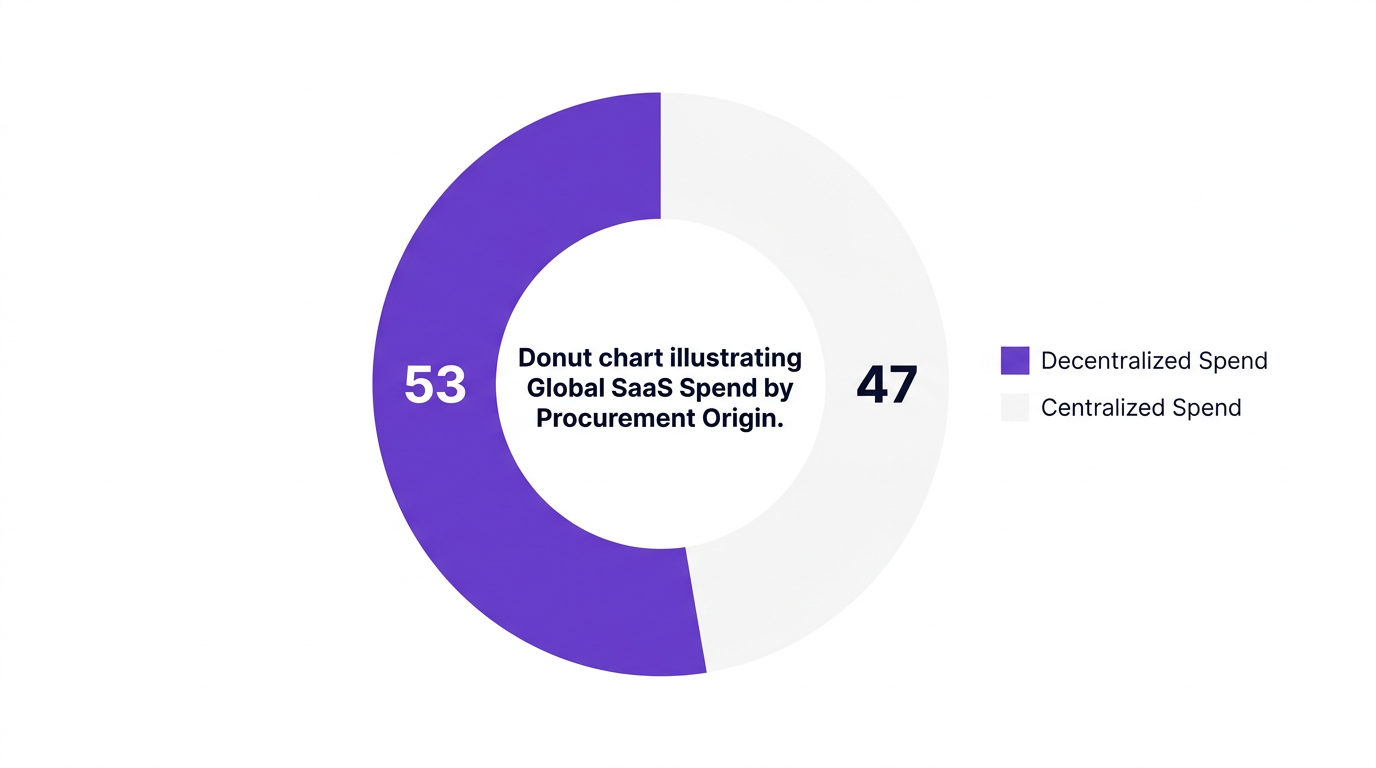
Data consistently demonstrates that department-led purchasing now frequently outpaces traditional centralized procurement channels. According to 2026 research from the Cloud Economics Council, global software adoption spending attributable strictly to department-led purchasing reached $254 billion. That massive figure represents 53 percent of all enterprise software spending under observation.
This volume of independent purchasing activity creates a sprawling ecosystem of undocumented applications. Employees frequently use corporate credit cards or departmental expense budgets to onboard productivity tools, project management platforms, and generative artificial intelligence engines. Because these tools are acquired outside the standard IT approval channels, they do not appear in conventional enterprise software catalogs. The result is a rapidly expanding shadow IT environment that operates entirely parallel to approved infrastructure.
"Decentralized SaaS procurement, while supporting agility, almost always increases unchecked SaaS sprawl, undermining compliance and driving up costs," explains Dr. Kumiko Hart, a SaaS Governance Expert at the FinOps Foundation. "Automation and unified governance are non-negotiable."
Traditional application discovery methodologies relied on centralized integration points for visibility. Network scans, manual spreadsheet surveys, and single-sign-on (SSO) gateways were considered sufficient to inventory installed software and web applications. However, these outdated methodologies fail entirely when employees expense cloud software on corporate credit cards without utilizing SSO.
When procurement workflows bypass initial IT evaluations, the applications never officially enter the corporate asset register. They exist exclusively via direct website logins or unmanaged mobile access points. According to a 2026 Gartner report, the average organization underestimates its active software portfolio by 40 percent. The finance and healthcare sectors experience the largest visibility gaps due to highly fragmented buying behaviors and remote work acceleration.
When end users entirely bypass central IT architecture, discovering those external systems requires significantly stronger tools. Identifying those shadow operations demands a combination of financial expense analysis, deep API endpoint connections, and monitored browser behavior.
Jolene Wright, a Principal Analyst at Gartner, highlights the severity of this visibility failure: "Without automated SaaS discovery, security and compliance teams operate blind. Decentralized buying fundamentally broke old asset management models; the fix lies in real-time, platform-driven visibility."
To restore structural integrity and regain visibility, enterprises must deploy robust SaaS management capable of natively connecting directly to major business systems.
The consequences of broken discovery extend far beyond untidy software inventories. When IT lacks visibility into the exact tools interacting with corporate data, the entire architectural foundation becomes vulnerable to profound security and financial risks.

The security implications are particularly concerning for regulated industries. Information technology professionals continuously struggle to enforce data protection policies on systems they do not realize exist. According to 2026 data from ISACA, 76 percent of enterprises experienced at least one security incident linked directly to an unapproved shadow application. This lack of oversight also creates severe regulatory compliance challenges. IDC 2026 research confirms that 82 percent of CIOs in regulated industries classify incomplete application discovery as their most critical operational compliance risk.
Financially, the hidden costs accumulate rapidly. Decentralized purchasing inherently creates significant operational waste through overlapping subscriptions, abandoned pilot programs, and redundant feature sets. Individual teams often purchase specialized presentation software without realizing another department already maintains an enterprise-wide license for an identical platform. A 2026 Forrester study noted that 67 percent of IT leaders cited cost overruns from untracked application subscriptions as a principal operational concern. Resolving these issues directly impacts long-term IT security postures and budget sustainability.
Reversing this trend requires a conscious shift in methodology. Organizations cannot force departments back into rigid, six-month review cycles; the demand for immediate agility is too strong. Instead, enterprises must adopt a modern governance framework that accommodates decentralized operations while enforcing centralized visibility.
A mature strategy depends on automated discovery mechanisms that continuously monitor the corporate environment for newly acquired tools. Rather than attempting to block employee acquisitions entirely, the objective is to immediately detect the purchase, assess the compliance risk, and bring the application formally under enterprise management. This continuous approach removes the burden of manual reporting from employees and heavily automates backend catalog maintenance.
[CHART_PLACEHOLDER_2]
Implementation of continuous discovery systems is accelerating rapidly as leadership recognizes the necessity of comprehensive oversight. However, adoption gaps still remain. Research from Metrigy in 2026 found that only 27 percent of organizations currently utilize fully automated discovery platforms capable of identifying new enterprise apps purchased outside standard channels. For enterprises looking to establish clear cost-allocation boundaries, investigating dedicated FinOps services offers an excellent pathway to financial alignment.
The ultimate solution to fragmented purchasing requires implementing intelligent software platforms explicitly designed to uncover and contextualize shadow systems. Enterprise software management addresses decentralized purchasing by aggregating disparate data points from across the entire corporate ecosystem.
Effective platforms scan existing enterprise systems, ingest payment processing data, and actively monitor core integrations to construct a comprehensive operational catalog. This capability requires deep architectural connections. By automatically scanning financial transaction records, the platform immediately flags unauthorized software charges, alerting IT administrators to shadow deployments before they expand across departments.
Once a shadowed purchase is discovered, the most proficient platforms automate the remediation workflows. This automation routes the newly discovered application through standard compliance review stages, integrating perfectly into approved IT procurement methodologies. This seamless pipeline transforms unverified shadow infrastructure into appropriately managed organizational assets.
CloudNuro addresses the exact challenges of decentralized purchasing by delivering real-time, automated discovery mechanisms paired with a strict governance-first architecture. Our platform eliminates the systemic blind spots created when business departments buy their own technology.
The CloudNuro Unified Cloud Custodian executes comprehensive discovery by safely integrating with more than 400 distinct cloud infrastructure systems and enterprise platforms. This extraordinary integration breadth ensures that regardless of where an employee procures software, the CloudNuro platform detects the usage, captures the spend, and aggregates the resulting shadow footprint into a single centralized console.
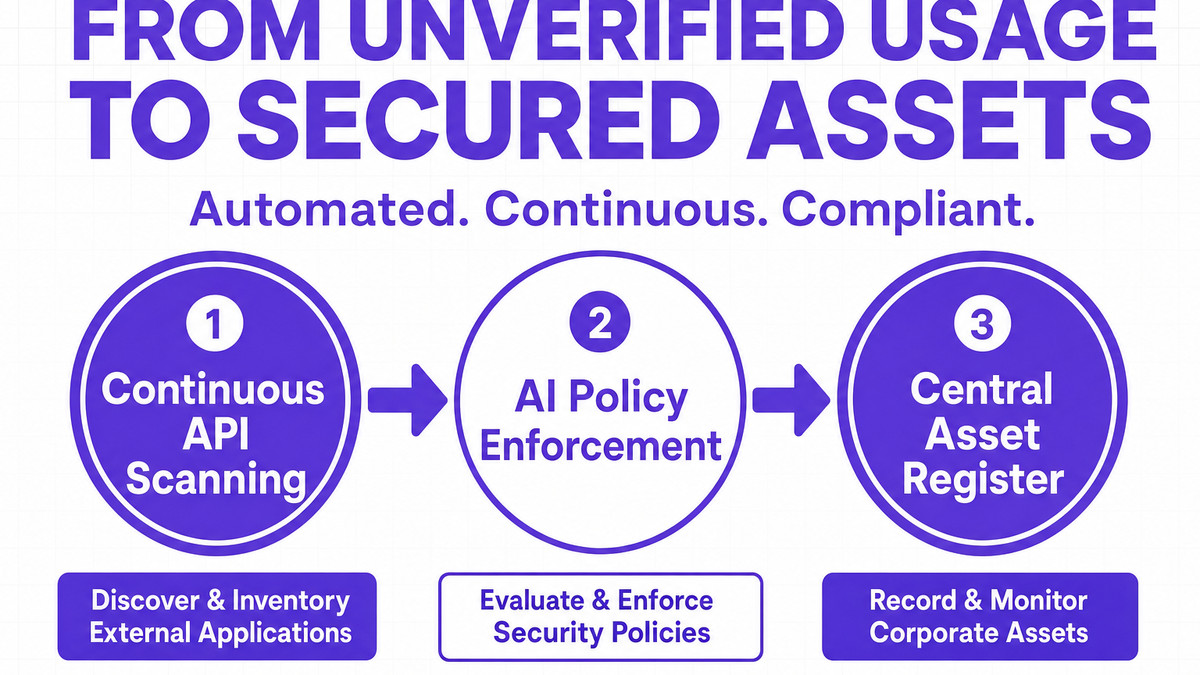
Following successful discovery audits, the AI Custodian module automatically initiates standardized access reviews and applies strict compliance policy enforcement directly against the detected applications. The system evaluates real-time risk scores and triggers targeted remediation workflows, thoroughly guaranteeing that any external departmental adoption immediately adheres to central corporate security standards.
Financially, CloudNuro Chargeback empowers technology leadership to construct precise cost accountability paradigms. By explicitly mapping specific departmental application usage directly back to designated budget owners, organizations immediately eliminate untracked expenses and strongly incentivize accurate utilization reporting.
These automated features generate exceptionally tangible corporate results. A global financial services firm utilized CloudNuro to automate their discovery pipelines, achieving a 92 percent reduction in unauthorized shadow software usage over six months while establishing perfect compliance across their total inventory. Similarly, a massive regional healthcare group employed the Unified Cloud Custodian to successfully uncover 450 undocumented applications, ultimately eliminating $2.8 million in redundant licensing fees and drastically streamlining their regulatory audits.
Decentralized SaaS procurement occurs when individual departments, teams, or employees purchase software applications directly, deliberately bypassing official, centralized technology procurement and approval pipelines.
Because isolated department teams usually acquire tools without notifying centralized administrators, these applications never enter official asset catalogs. The tools operate totally under the radar, directly creating a vast layer of untracked architecture.
Enterprises identify these hidden tools by implementing enterprise management platforms capable of natively scanning internal corporate expense reports, financial processing systems, and deep integration connections to detect unrecognized vendor billing.
The primary dangers include serious security vulnerabilities due to non-compliant data storage, extensive financial waste driven by overlapping subscription licenses, and massive regulatory penalties stemming from uncontrolled corporate data handling.
Enterprises must apply automated continuous discovery software that instantly identifies newly acquired tools. This allows employees to provision secure applications rapidly while ensuring central governance structures automatically identify and secure exactly what gets utilized.
Decentralized SaaS procurement radically transformed how organizational teams operate by offering unparalleled agility and immediate access to modern productivity platforms. However, relying on traditional evaluation methodologies to manage this modern purchasing behavior completely breaks architectural discovery processes.
Enterprises cannot afford to remain ignorant regarding exactly which systems handle their proprietary data. By implementing an automated, governance-centric software management framework, business leaders can firmly bridge the operational gap between departmental agility and absolute corporate security. Modernize your discovery strategies to securely empower teams, definitively extinguish redundant software spending, and confidently bring total clarity back to your corporate environment.
About CloudNuro
CloudNuro is a leader in Enterprise SaaS Management Platforms, providing enterprises with unmatched visibility, governance, and cost optimization. Recognized twice in a row in the SaaS Management Platforms category and named a Leader in the SoftwareReviews Data Quadrant, CloudNuro is trusted by global enterprises and government agencies to bring financial discipline to SaaS, cloud, and AI. Trusted by enterprises such as Konica Minolta and Federal Signal, CloudNuro provides centralized SaaS inventory, license optimization, and renewal management along with advanced cost allocation and chargeback, giving IT and Finance leaders the visibility, control, and cost-conscious culture needed to drive financial discipline.
Request a no cost, no obligation free assessment —just 15 minutes to savings!
Get StartedEnterprise software purchasing has fundamentally shifted away from centralized control. For years, IT departments managed every technology acquisition, ensuring each new application passed rigorous architecture and security checks before deployment. That centralized model is practically obsolete in modern business operations. Today, decentralized SaaS procurement empowers individual business units, department heads, and even individual employees to purchase their own software directly. While this autonomy accelerates departmental agility, it completely fragments overall network visibility.
When marketing teams, human resources, and sales operations buy their own tools, tracking those assets becomes extraordinarily difficult. IT and security teams are ultimately left blind to the exact software stack operating within their enterprise environment. This organizational disconnect creates a massive compliance risk, drives unchecked redundant spending, and severely impacts data security priorities. Understanding how decentralized SaaS procurement dismantled old asset management frameworks is the first step toward building a modern, automated governance strategy capable of securing the enterprise.
Business units now prioritize deployment speed over strict compliance protocols. This preference has driven widespread autonomous software adoption across nearly every major global enterprise sector. The shift from IT-controlled provisioning to department-led purchasing is substantial and firmly entrenched.
Data consistently demonstrates that department-led purchasing now frequently outpaces traditional centralized procurement channels. According to 2026 research from the Cloud Economics Council, global software adoption spending attributable strictly to department-led purchasing reached $254 billion. That massive figure represents 53 percent of all enterprise software spending under observation.
This volume of independent purchasing activity creates a sprawling ecosystem of undocumented applications. Employees frequently use corporate credit cards or departmental expense budgets to onboard productivity tools, project management platforms, and generative artificial intelligence engines. Because these tools are acquired outside the standard IT approval channels, they do not appear in conventional enterprise software catalogs. The result is a rapidly expanding shadow IT environment that operates entirely parallel to approved infrastructure.
"Decentralized SaaS procurement, while supporting agility, almost always increases unchecked SaaS sprawl, undermining compliance and driving up costs," explains Dr. Kumiko Hart, a SaaS Governance Expert at the FinOps Foundation. "Automation and unified governance are non-negotiable."
Traditional application discovery methodologies relied on centralized integration points for visibility. Network scans, manual spreadsheet surveys, and single-sign-on (SSO) gateways were considered sufficient to inventory installed software and web applications. However, these outdated methodologies fail entirely when employees expense cloud software on corporate credit cards without utilizing SSO.
When procurement workflows bypass initial IT evaluations, the applications never officially enter the corporate asset register. They exist exclusively via direct website logins or unmanaged mobile access points. According to a 2026 Gartner report, the average organization underestimates its active software portfolio by 40 percent. The finance and healthcare sectors experience the largest visibility gaps due to highly fragmented buying behaviors and remote work acceleration.
When end users entirely bypass central IT architecture, discovering those external systems requires significantly stronger tools. Identifying those shadow operations demands a combination of financial expense analysis, deep API endpoint connections, and monitored browser behavior.
Jolene Wright, a Principal Analyst at Gartner, highlights the severity of this visibility failure: "Without automated SaaS discovery, security and compliance teams operate blind. Decentralized buying fundamentally broke old asset management models; the fix lies in real-time, platform-driven visibility."
To restore structural integrity and regain visibility, enterprises must deploy robust SaaS management capable of natively connecting directly to major business systems.
The consequences of broken discovery extend far beyond untidy software inventories. When IT lacks visibility into the exact tools interacting with corporate data, the entire architectural foundation becomes vulnerable to profound security and financial risks.
The security implications are particularly concerning for regulated industries. Information technology professionals continuously struggle to enforce data protection policies on systems they do not realize exist. According to 2026 data from ISACA, 76 percent of enterprises experienced at least one security incident linked directly to an unapproved shadow application. This lack of oversight also creates severe regulatory compliance challenges. IDC 2026 research confirms that 82 percent of CIOs in regulated industries classify incomplete application discovery as their most critical operational compliance risk.
Financially, the hidden costs accumulate rapidly. Decentralized purchasing inherently creates significant operational waste through overlapping subscriptions, abandoned pilot programs, and redundant feature sets. Individual teams often purchase specialized presentation software without realizing another department already maintains an enterprise-wide license for an identical platform. A 2026 Forrester study noted that 67 percent of IT leaders cited cost overruns from untracked application subscriptions as a principal operational concern. Resolving these issues directly impacts long-term IT security postures and budget sustainability.
Reversing this trend requires a conscious shift in methodology. Organizations cannot force departments back into rigid, six-month review cycles; the demand for immediate agility is too strong. Instead, enterprises must adopt a modern governance framework that accommodates decentralized operations while enforcing centralized visibility.
A mature strategy depends on automated discovery mechanisms that continuously monitor the corporate environment for newly acquired tools. Rather than attempting to block employee acquisitions entirely, the objective is to immediately detect the purchase, assess the compliance risk, and bring the application formally under enterprise management. This continuous approach removes the burden of manual reporting from employees and heavily automates backend catalog maintenance.
[CHART_PLACEHOLDER_2]
Implementation of continuous discovery systems is accelerating rapidly as leadership recognizes the necessity of comprehensive oversight. However, adoption gaps still remain. Research from Metrigy in 2026 found that only 27 percent of organizations currently utilize fully automated discovery platforms capable of identifying new enterprise apps purchased outside standard channels. For enterprises looking to establish clear cost-allocation boundaries, investigating dedicated FinOps services offers an excellent pathway to financial alignment.
The ultimate solution to fragmented purchasing requires implementing intelligent software platforms explicitly designed to uncover and contextualize shadow systems. Enterprise software management addresses decentralized purchasing by aggregating disparate data points from across the entire corporate ecosystem.
Effective platforms scan existing enterprise systems, ingest payment processing data, and actively monitor core integrations to construct a comprehensive operational catalog. This capability requires deep architectural connections. By automatically scanning financial transaction records, the platform immediately flags unauthorized software charges, alerting IT administrators to shadow deployments before they expand across departments.
Once a shadowed purchase is discovered, the most proficient platforms automate the remediation workflows. This automation routes the newly discovered application through standard compliance review stages, integrating perfectly into approved IT procurement methodologies. This seamless pipeline transforms unverified shadow infrastructure into appropriately managed organizational assets.
CloudNuro addresses the exact challenges of decentralized purchasing by delivering real-time, automated discovery mechanisms paired with a strict governance-first architecture. Our platform eliminates the systemic blind spots created when business departments buy their own technology.
The CloudNuro Unified Cloud Custodian executes comprehensive discovery by safely integrating with more than 400 distinct cloud infrastructure systems and enterprise platforms. This extraordinary integration breadth ensures that regardless of where an employee procures software, the CloudNuro platform detects the usage, captures the spend, and aggregates the resulting shadow footprint into a single centralized console.
Following successful discovery audits, the AI Custodian module automatically initiates standardized access reviews and applies strict compliance policy enforcement directly against the detected applications. The system evaluates real-time risk scores and triggers targeted remediation workflows, thoroughly guaranteeing that any external departmental adoption immediately adheres to central corporate security standards.
Financially, CloudNuro Chargeback empowers technology leadership to construct precise cost accountability paradigms. By explicitly mapping specific departmental application usage directly back to designated budget owners, organizations immediately eliminate untracked expenses and strongly incentivize accurate utilization reporting.
These automated features generate exceptionally tangible corporate results. A global financial services firm utilized CloudNuro to automate their discovery pipelines, achieving a 92 percent reduction in unauthorized shadow software usage over six months while establishing perfect compliance across their total inventory. Similarly, a massive regional healthcare group employed the Unified Cloud Custodian to successfully uncover 450 undocumented applications, ultimately eliminating $2.8 million in redundant licensing fees and drastically streamlining their regulatory audits.
Decentralized SaaS procurement occurs when individual departments, teams, or employees purchase software applications directly, deliberately bypassing official, centralized technology procurement and approval pipelines.
Because isolated department teams usually acquire tools without notifying centralized administrators, these applications never enter official asset catalogs. The tools operate totally under the radar, directly creating a vast layer of untracked architecture.
Enterprises identify these hidden tools by implementing enterprise management platforms capable of natively scanning internal corporate expense reports, financial processing systems, and deep integration connections to detect unrecognized vendor billing.
The primary dangers include serious security vulnerabilities due to non-compliant data storage, extensive financial waste driven by overlapping subscription licenses, and massive regulatory penalties stemming from uncontrolled corporate data handling.
Enterprises must apply automated continuous discovery software that instantly identifies newly acquired tools. This allows employees to provision secure applications rapidly while ensuring central governance structures automatically identify and secure exactly what gets utilized.
Decentralized SaaS procurement radically transformed how organizational teams operate by offering unparalleled agility and immediate access to modern productivity platforms. However, relying on traditional evaluation methodologies to manage this modern purchasing behavior completely breaks architectural discovery processes.
Enterprises cannot afford to remain ignorant regarding exactly which systems handle their proprietary data. By implementing an automated, governance-centric software management framework, business leaders can firmly bridge the operational gap between departmental agility and absolute corporate security. Modernize your discovery strategies to securely empower teams, definitively extinguish redundant software spending, and confidently bring total clarity back to your corporate environment.
About CloudNuro
CloudNuro is a leader in Enterprise SaaS Management Platforms, providing enterprises with unmatched visibility, governance, and cost optimization. Recognized twice in a row in the SaaS Management Platforms category and named a Leader in the SoftwareReviews Data Quadrant, CloudNuro is trusted by global enterprises and government agencies to bring financial discipline to SaaS, cloud, and AI. Trusted by enterprises such as Konica Minolta and Federal Signal, CloudNuro provides centralized SaaS inventory, license optimization, and renewal management along with advanced cost allocation and chargeback, giving IT and Finance leaders the visibility, control, and cost-conscious culture needed to drive financial discipline.
Request a no cost, no obligation free assessment - just 15 minutes to savings!
Get StartedWe're offering complimentary ServiceNow license assessments to only 25 enterprises this quarter who want to unlock immediate savings without disrupting operations.
Get Free AssessmentGet Started




CloudNuro Corp
1755 Park St. Suite 207
Naperville, IL 60563
Phone : +1-630-277-9470
Email: info@cloudnuro.com




.webp)

Recognized Leader in SaaS Management Platforms by Info-Tech SoftwareReviews


.svg)