

Sign Up
Thank you for Submitting!
CloudNuro’s FinOps Services have redefined what’s possible when it comes to cost optimization and governance for SaaS usage at enterprise scale. As organizations expand their analytics estates in Microsoft Fabric, relentless growth in OneLake storage bills is almost inevitable, unless you arm your data platform with the two most essential maintenance commands: OPTIMIZE and VACUUM for Delta Lake.
This deep dive unpacks why these commands are critical, how they work in tandem to reduce costs and storage waste, and the best practices for automating their execution. We’ll further show how CloudNuro’s governance-first, automation-enabled solutions create measurable outcomes for CIOs, IT operation leads, and data platform managers under mounting budget pressures.
The shift to Microsoft Fabric's unified analytics platform promises limitless lakehouse scalability via OneLake. But uncontrolled table fragmentations, historical files, and legacy row versions routinely lead to ballooning storage invoices and laggy data access. In fact, large-scale analytics tables that lack disciplined file maintenance often waste 40% to 65% of their allocated storage footprint.
Delta Lake's hybrid transaction-log architecture is powerful for time travel and atomicity, but it inherently creates an accumulation of Parquet files: some tiny, some outdated, and many unreferenced. Without scheduled maintenance, your Fabric lakehouse pays for every orphaned block.
This is the dual root problem that OPTIMIZE and VACUUM solve:
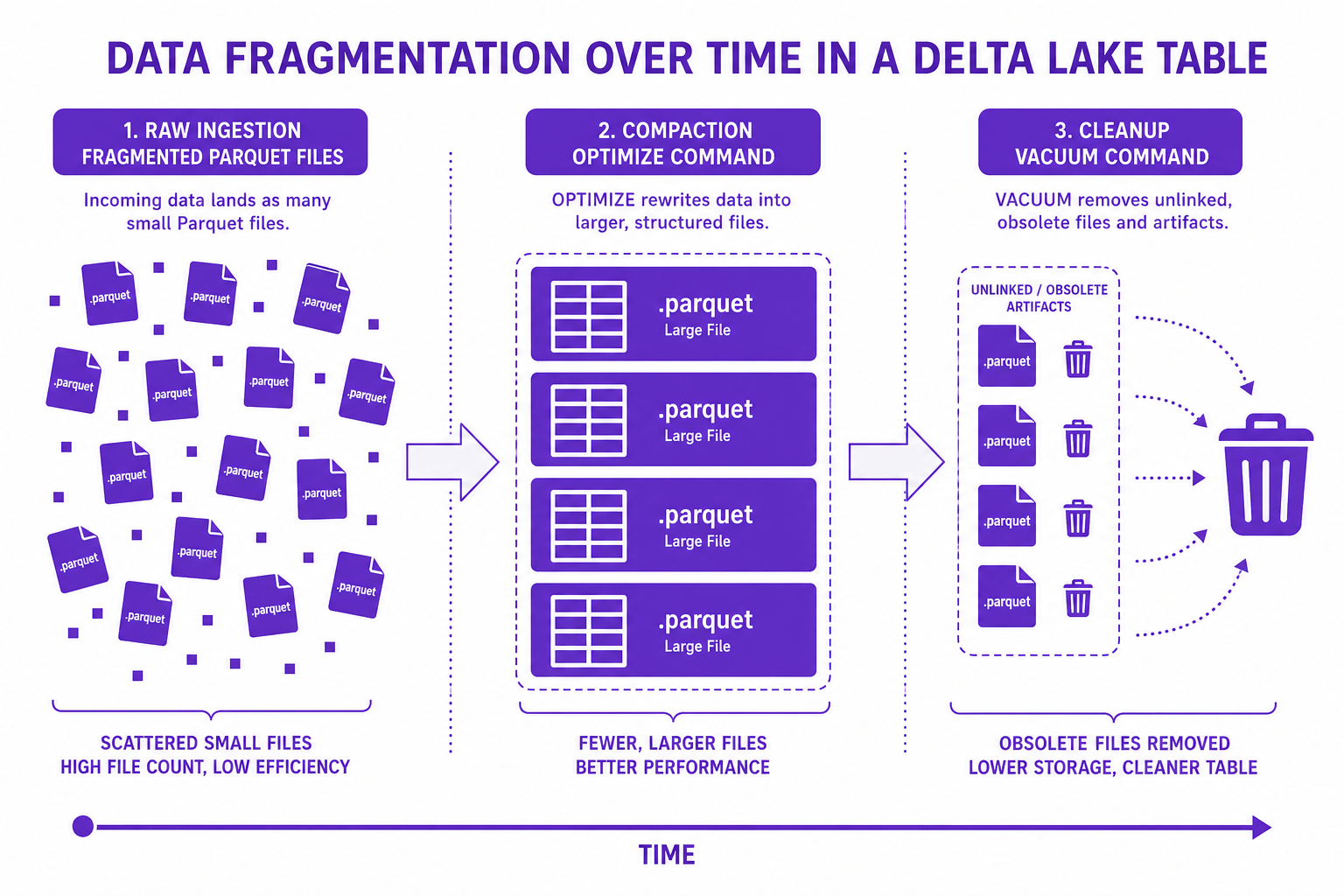
OPTIMIZE merges fragmented data and consolidates small Parquet files into large, query-efficient blocks (128 MB, 1 GB), delivering storage compactness and faster scanning.
VACUUM prunes file versions and removes older, unneeded data, reclaiming real OneLake capacity and enforcing table retention governance.
Organizations engaged with CloudNuro have seen:
Up to 65% total storage footprint reduction on their largest analytics tables
Analytics query performance boosts on 80% of workloads following disciplined OPTIMIZE routines
When paired, these commands break the cycle of infinite storage billing and legacy data sprawl
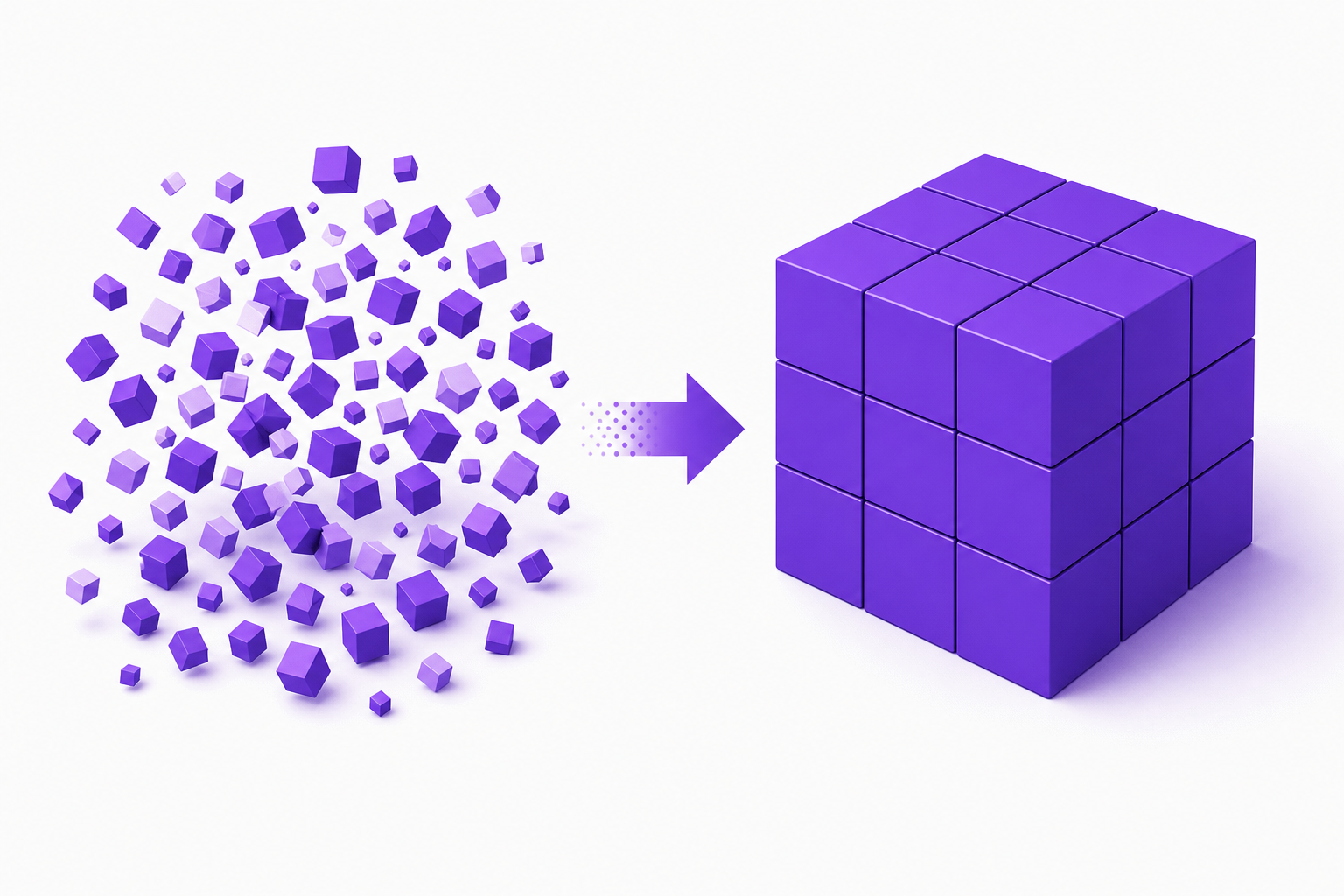
The OPTIMIZE command in Microsoft Fabric Delta Lake tackles the infamous small files problem. Routine ingestion workflows, merges, and streaming inserts scatter hundreds or thousands of small Parquet files across a lakehouse table. This fragmentation produces expensive OneLake consumption and negatively impacts scan operations.
Running OPTIMIZE performs intelligent bin compaction, combining small files into fewer, well-sized blocks. For maximum impact:
Target post-OPTIMIZE file size: 128 MB to 1 GB per Parquet file, aligned with optimal Fabric and Delta Lake query engine performance.
Use OPTIMIZE schema_name.table_name VORDER for V-Order sorting, designed for Power BI and analytics pattern acceleration.
The command rewrites and sorts data, reducing metadata overhead and enabling up to 1.6x faster analytic processing on clustered workloads.
Continuous or batch OPTIMIZE schedules are recommended, depending on workload size and business-critical SLAs.
Example command:
OPTIMIZE salesdb.transaction_history VORDER;With CloudNuro’s FinOps Services, automated job orchestrations can trigger OPTIMIZE runs on high-churn tables in accordance with usage and financial targets, cutting down both compute and storage waste proactively.

VACUUM complements OPTIMIZE by reclaiming the disk space of obsolete file versions no longer referenced by Delta Lake’s transaction log. This action is essential, as every savepoint, update or merge leaves behind old Parquet file blocks, quietly accumulating OneLake costs.
Key principles in Microsoft Fabric:
By default, VACUUM keeps files for 7 days (168 hours) to ensure rollback and data retention compliance.
Custom retention windows can be enforced based on your organization’s policies.
VACUUM permanently deletes files exceeding the retention threshold, making its operation irreversible. Automation and governance are crucial for this process.
Example command:
VACUUM salesdb.transaction_history RETAIN 168 HOURS;VACUUM is your cost-control lever for preventing infinite storage charges from historical clutter, aligned with compliance and business data retention best practices. With CloudNuro, set-and-forget scheduling with guardrails ensures 95%+ execution efficiency and auditable retention governance across regulated industries such as healthcare and finance.
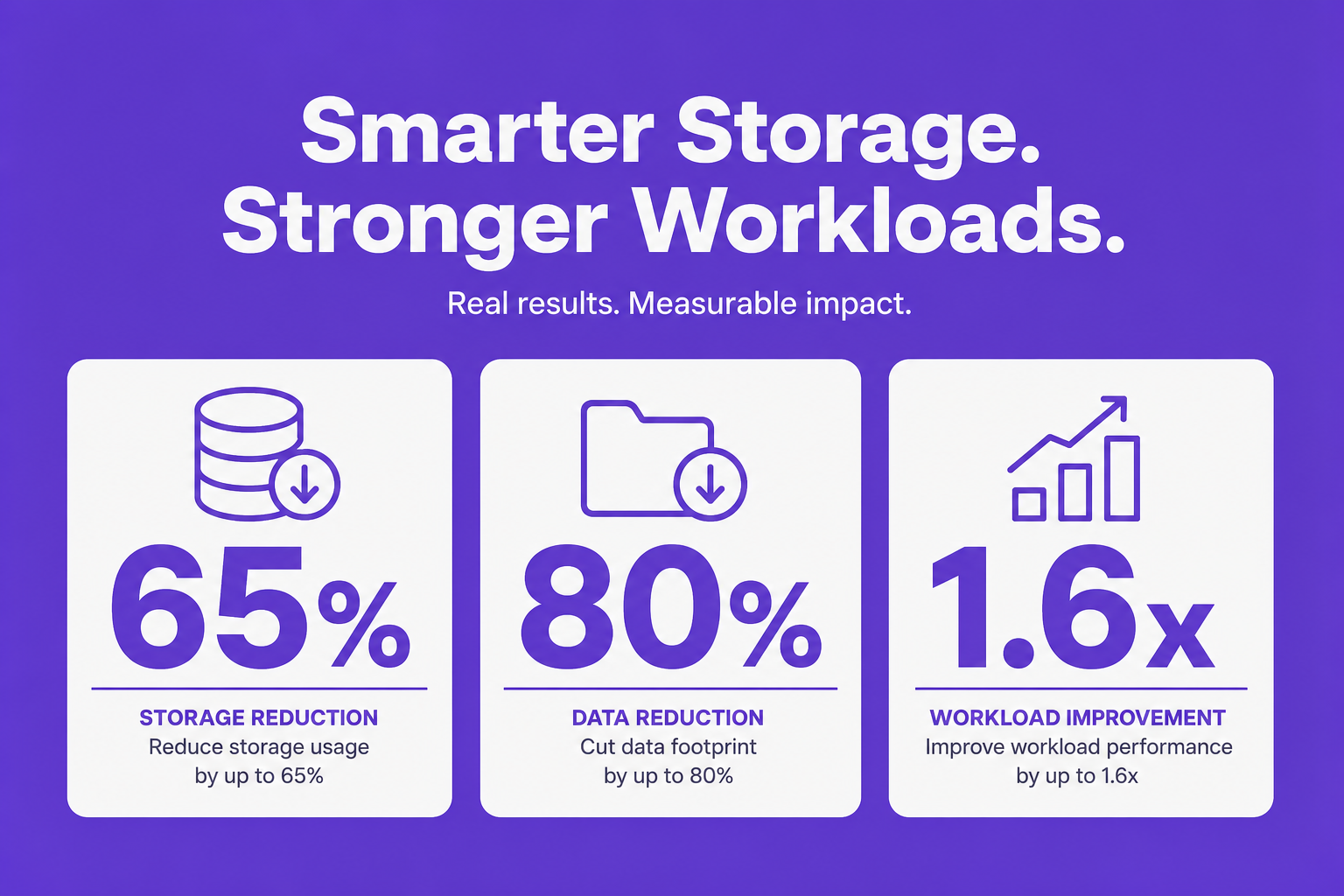
Organizations leveraging automated Delta Lake table maintenance in Microsoft Fabric, orchestrated via CloudNuro’s FinOps platform, report consistently dramatic benefits:
Storage Savings: Table optimization and routine file pruning reduce analytics storage footprint by 40%, 65%.
Performance Efficiency: File clustering and V-Order compaction factors enable 1.6x acceleration in engine-level analytic operations and scan 11% fewer files per query.
Financial Governance: Every reclaimed byte is directly tied to chargeback metrics; realized savings become part of business unit reporting, driving a cost-conscious engineering culture.
Time to Insight: Thanks to automated infrastructure discovery, new workloads can be analyzed and scheduled for maintenance in under 24 hours, eliminating idle capacity and resulting in up to 30% reduction of infrastructure spending.

While running OPTIMIZE and VACUUM manually delivers value, scaling these operations across a sprawling Fabric lakehouse estate requires managed automation, policy execution, and integrated governance:
Discovery Engine: CloudNuro identifies idle data, fragmented tables, and unused Parquet files across your entire analytics platform, triggering optimization workflows where savings are maximized.
Automation Rules: Implement policy-driven OPTIMIZE and VACUUM scheduling that perfectly aligns with your storage, compliance, and governance requirements.
Unified Visibility: Attribute all optimization savings and retention-driven reductions back to specific workloads for cross-business clarity.
Seamless Integration: With 400+ supported enterprise platforms and applications, CloudNuro manages cost optimization and governance from Microsoft Fabric to core SaaS and cloud services.
Learn more about actionable FinOps automation for Microsoft Fabric in our FinOps Services overview and explore tailored SaaS management strategies.
Schedule OPTIMIZE after heavy batch loads, merges, and ingestion spikes; choose V-Order when targeting Power BI performance scenarios.
Run VACUUM weekly, matching or exceeding organizational retention policies (default: 7 days / 168 hours).
Leverage Fabric job orchestration and third-party automation (like CloudNuro’s discovery workflows) to enforce regular maintenance for all critical Delta tables.
Review savings regularly via analytics and chargeback dashboards to demonstrate measurable business value and guide future automation improvements.
How do OPTIMIZE and VACUUM reduce OneLake storage costs in Microsoft Fabric?
OPTIMIZE consolidates many small Parquet files into large, query-efficient blocks, shrinking the overall table size; VACUUM permanently removes obsolete files, freeing space and eliminating charges for data no longer referenced by the table.
When should you run OPTIMIZE versus VACUUM on Delta tables in Fabric?
Run OPTIMIZE after significant data ingestion, merge, or update events to streamline table structure. Schedule VACUUM weekly or per your retention policy, specifically after OPTIMIZE, to safely reclaim deleted file space.
What is the recommended file size for optimized Delta tables in Fabric?
Each optimized Parquet file should be between 128 MB and 1 GB. This range maximizes scanning performance in analytics and balances file-level overhead in OneLake.
How does VACUUM affect Delta Lake time travel and retention in Microsoft Fabric?
VACUUM deletes file versions older than the retention period, thereby limiting how far back you can recover or query historical data (time travel). Always ensure the retention period aligns with your organizational or regulatory requirements.
What are the best practices for scheduling OPTIMIZE and VACUUM in a Fabric lakehouse?
Automate both commands using job scheduling and policy-driven triggers. CloudNuro enables organizations to align these workflows with usage and storage goals, avoiding manual errors and ensuring governance compliance at scale.
If you’re ready to take control of your Microsoft Fabric storage bills, boost governance, and automate savings, discover CloudNuro’s FinOps Services for actionable next steps.
CloudNuro is a leader in Enterprise AI Adoption Management, providing enterprises with unmatched visibility, governance, and cost optimization. Recognized twice in a row in the SaaS Management Platforms category and named a Leader in the SoftwareReviews Data Quadrant, CloudNuro is trusted by global enterprises and government agencies to bring financial discipline to SaaS, cloud, and AI. Trusted by enterprises, CloudNuro provides centralized SaaS inventory, license optimization, and renewal management along with advanced cost allocation and chargeback, giving IT and Finance leaders the visibility, control, and cost-conscious culture needed to drive financial discipline.
Request a no cost, no obligation free assessment —just 15 minutes to savings!
Get StartedCloudNuro’s FinOps Services have redefined what’s possible when it comes to cost optimization and governance for SaaS usage at enterprise scale. As organizations expand their analytics estates in Microsoft Fabric, relentless growth in OneLake storage bills is almost inevitable, unless you arm your data platform with the two most essential maintenance commands: OPTIMIZE and VACUUM for Delta Lake.
This deep dive unpacks why these commands are critical, how they work in tandem to reduce costs and storage waste, and the best practices for automating their execution. We’ll further show how CloudNuro’s governance-first, automation-enabled solutions create measurable outcomes for CIOs, IT operation leads, and data platform managers under mounting budget pressures.
The shift to Microsoft Fabric's unified analytics platform promises limitless lakehouse scalability via OneLake. But uncontrolled table fragmentations, historical files, and legacy row versions routinely lead to ballooning storage invoices and laggy data access. In fact, large-scale analytics tables that lack disciplined file maintenance often waste 40% to 65% of their allocated storage footprint.
Delta Lake's hybrid transaction-log architecture is powerful for time travel and atomicity, but it inherently creates an accumulation of Parquet files: some tiny, some outdated, and many unreferenced. Without scheduled maintenance, your Fabric lakehouse pays for every orphaned block.
This is the dual root problem that OPTIMIZE and VACUUM solve:
OPTIMIZE merges fragmented data and consolidates small Parquet files into large, query-efficient blocks (128 MB, 1 GB), delivering storage compactness and faster scanning.
VACUUM prunes file versions and removes older, unneeded data, reclaiming real OneLake capacity and enforcing table retention governance.
Organizations engaged with CloudNuro have seen:
Up to 65% total storage footprint reduction on their largest analytics tables
Analytics query performance boosts on 80% of workloads following disciplined OPTIMIZE routines
When paired, these commands break the cycle of infinite storage billing and legacy data sprawl
The OPTIMIZE command in Microsoft Fabric Delta Lake tackles the infamous small files problem. Routine ingestion workflows, merges, and streaming inserts scatter hundreds or thousands of small Parquet files across a lakehouse table. This fragmentation produces expensive OneLake consumption and negatively impacts scan operations.
Running OPTIMIZE performs intelligent bin compaction, combining small files into fewer, well-sized blocks. For maximum impact:
Target post-OPTIMIZE file size: 128 MB to 1 GB per Parquet file, aligned with optimal Fabric and Delta Lake query engine performance.
Use OPTIMIZE schema_name.table_name VORDER for V-Order sorting, designed for Power BI and analytics pattern acceleration.
The command rewrites and sorts data, reducing metadata overhead and enabling up to 1.6x faster analytic processing on clustered workloads.
Continuous or batch OPTIMIZE schedules are recommended, depending on workload size and business-critical SLAs.
Example command:
OPTIMIZE salesdb.transaction_history VORDER;With CloudNuro’s FinOps Services, automated job orchestrations can trigger OPTIMIZE runs on high-churn tables in accordance with usage and financial targets, cutting down both compute and storage waste proactively.
VACUUM complements OPTIMIZE by reclaiming the disk space of obsolete file versions no longer referenced by Delta Lake’s transaction log. This action is essential, as every savepoint, update or merge leaves behind old Parquet file blocks, quietly accumulating OneLake costs.
Key principles in Microsoft Fabric:
By default, VACUUM keeps files for 7 days (168 hours) to ensure rollback and data retention compliance.
Custom retention windows can be enforced based on your organization’s policies.
VACUUM permanently deletes files exceeding the retention threshold, making its operation irreversible. Automation and governance are crucial for this process.
Example command:
VACUUM salesdb.transaction_history RETAIN 168 HOURS;VACUUM is your cost-control lever for preventing infinite storage charges from historical clutter, aligned with compliance and business data retention best practices. With CloudNuro, set-and-forget scheduling with guardrails ensures 95%+ execution efficiency and auditable retention governance across regulated industries such as healthcare and finance.
Organizations leveraging automated Delta Lake table maintenance in Microsoft Fabric, orchestrated via CloudNuro’s FinOps platform, report consistently dramatic benefits:
Storage Savings: Table optimization and routine file pruning reduce analytics storage footprint by 40%, 65%.
Performance Efficiency: File clustering and V-Order compaction factors enable 1.6x acceleration in engine-level analytic operations and scan 11% fewer files per query.
Financial Governance: Every reclaimed byte is directly tied to chargeback metrics; realized savings become part of business unit reporting, driving a cost-conscious engineering culture.
Time to Insight: Thanks to automated infrastructure discovery, new workloads can be analyzed and scheduled for maintenance in under 24 hours, eliminating idle capacity and resulting in up to 30% reduction of infrastructure spending.
While running OPTIMIZE and VACUUM manually delivers value, scaling these operations across a sprawling Fabric lakehouse estate requires managed automation, policy execution, and integrated governance:
Discovery Engine: CloudNuro identifies idle data, fragmented tables, and unused Parquet files across your entire analytics platform, triggering optimization workflows where savings are maximized.
Automation Rules: Implement policy-driven OPTIMIZE and VACUUM scheduling that perfectly aligns with your storage, compliance, and governance requirements.
Unified Visibility: Attribute all optimization savings and retention-driven reductions back to specific workloads for cross-business clarity.
Seamless Integration: With 400+ supported enterprise platforms and applications, CloudNuro manages cost optimization and governance from Microsoft Fabric to core SaaS and cloud services.
Learn more about actionable FinOps automation for Microsoft Fabric in our FinOps Services overview and explore tailored SaaS management strategies.
Schedule OPTIMIZE after heavy batch loads, merges, and ingestion spikes; choose V-Order when targeting Power BI performance scenarios.
Run VACUUM weekly, matching or exceeding organizational retention policies (default: 7 days / 168 hours).
Leverage Fabric job orchestration and third-party automation (like CloudNuro’s discovery workflows) to enforce regular maintenance for all critical Delta tables.
Review savings regularly via analytics and chargeback dashboards to demonstrate measurable business value and guide future automation improvements.
How do OPTIMIZE and VACUUM reduce OneLake storage costs in Microsoft Fabric?
OPTIMIZE consolidates many small Parquet files into large, query-efficient blocks, shrinking the overall table size; VACUUM permanently removes obsolete files, freeing space and eliminating charges for data no longer referenced by the table.
When should you run OPTIMIZE versus VACUUM on Delta tables in Fabric?
Run OPTIMIZE after significant data ingestion, merge, or update events to streamline table structure. Schedule VACUUM weekly or per your retention policy, specifically after OPTIMIZE, to safely reclaim deleted file space.
What is the recommended file size for optimized Delta tables in Fabric?
Each optimized Parquet file should be between 128 MB and 1 GB. This range maximizes scanning performance in analytics and balances file-level overhead in OneLake.
How does VACUUM affect Delta Lake time travel and retention in Microsoft Fabric?
VACUUM deletes file versions older than the retention period, thereby limiting how far back you can recover or query historical data (time travel). Always ensure the retention period aligns with your organizational or regulatory requirements.
What are the best practices for scheduling OPTIMIZE and VACUUM in a Fabric lakehouse?
Automate both commands using job scheduling and policy-driven triggers. CloudNuro enables organizations to align these workflows with usage and storage goals, avoiding manual errors and ensuring governance compliance at scale.
If you’re ready to take control of your Microsoft Fabric storage bills, boost governance, and automate savings, discover CloudNuro’s FinOps Services for actionable next steps.
CloudNuro is a leader in Enterprise AI Adoption Management, providing enterprises with unmatched visibility, governance, and cost optimization. Recognized twice in a row in the SaaS Management Platforms category and named a Leader in the SoftwareReviews Data Quadrant, CloudNuro is trusted by global enterprises and government agencies to bring financial discipline to SaaS, cloud, and AI. Trusted by enterprises, CloudNuro provides centralized SaaS inventory, license optimization, and renewal management along with advanced cost allocation and chargeback, giving IT and Finance leaders the visibility, control, and cost-conscious culture needed to drive financial discipline.
Request a no cost, no obligation free assessment - just 15 minutes to savings!
Get StartedWe're offering complimentary ServiceNow license assessments to only 25 enterprises this quarter who want to unlock immediate savings without disrupting operations.
Get Free AssessmentGet Started




CloudNuro Corp
1755 Park St. Suite 207
Naperville, IL 60563
Phone : +1-630-277-9470
Email: info@cloudnuro.com





.webp)

Recognized Leader in SaaS Management Platforms by Info-Tech SoftwareReviews



.svg)