

Sign Up
Thank you for Submitting!
Generative AI has reshaped workplace productivity. Tools like ChatGPT are now default copilots for brainstorming, document summarization, and code shortcuts. But for IT leaders and security professionals, the headline story of 2026 is less about speed, and more about what sensitive data is moving, sometimes invisibly, through these ‘smart’ interfaces. As organizations accelerate adoption, the hidden risk is not theoretical: it’s real, measurable, and requiring new modes of governance and control.
It’s clear employees love AI, but the numbers behind workplace AI data leakage reveal staggering exposure:
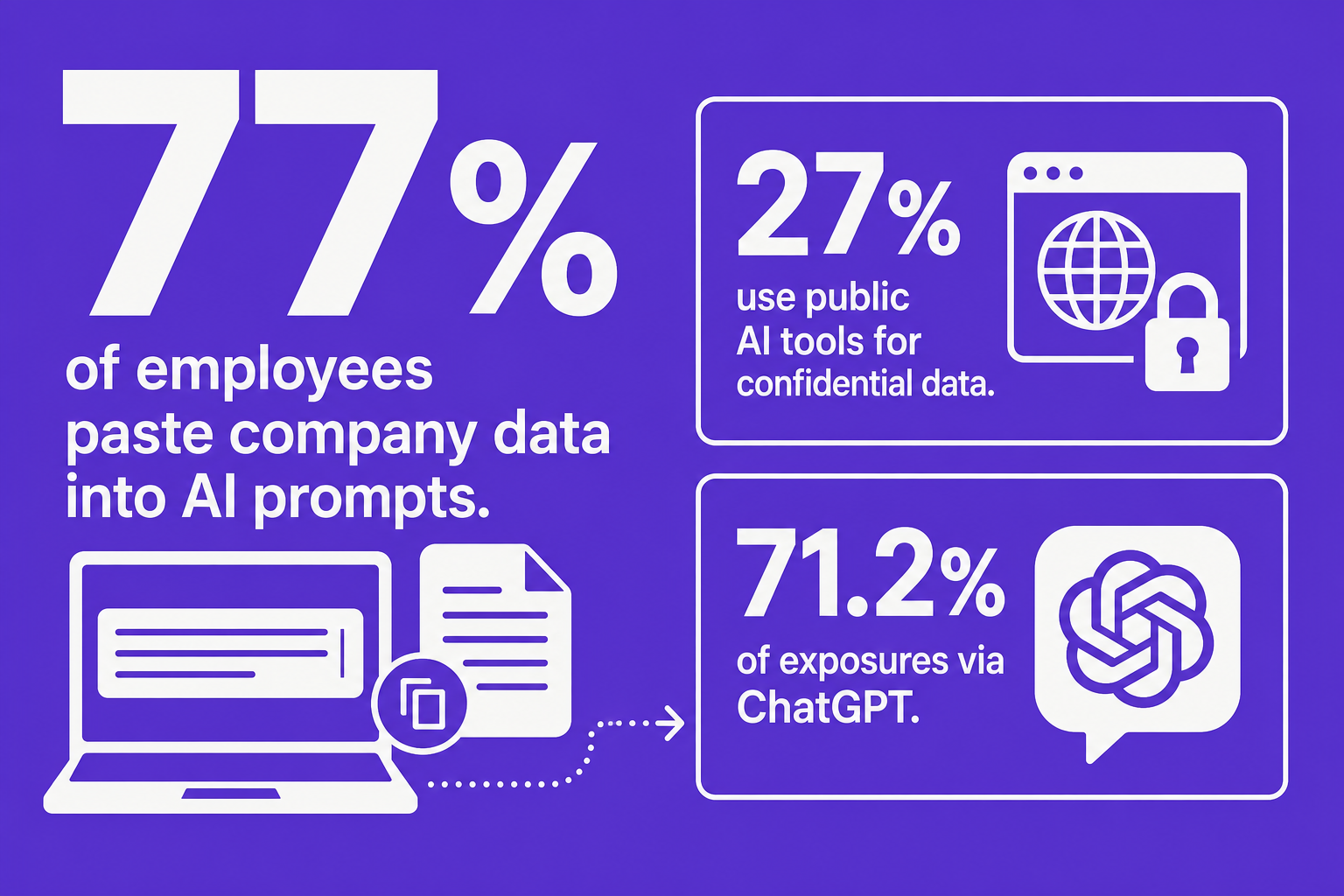
77% of employees who use generative AI at work paste company data into prompts.
34.8% of all employee inputs into ChatGPT contain sensitive data.
27% of employees admit to entering confidential company data into public AI tools.
ChatGPT, while only representing 43.9% of enterprise prompts, is responsible for 71.2% of all measured AI data exposures.
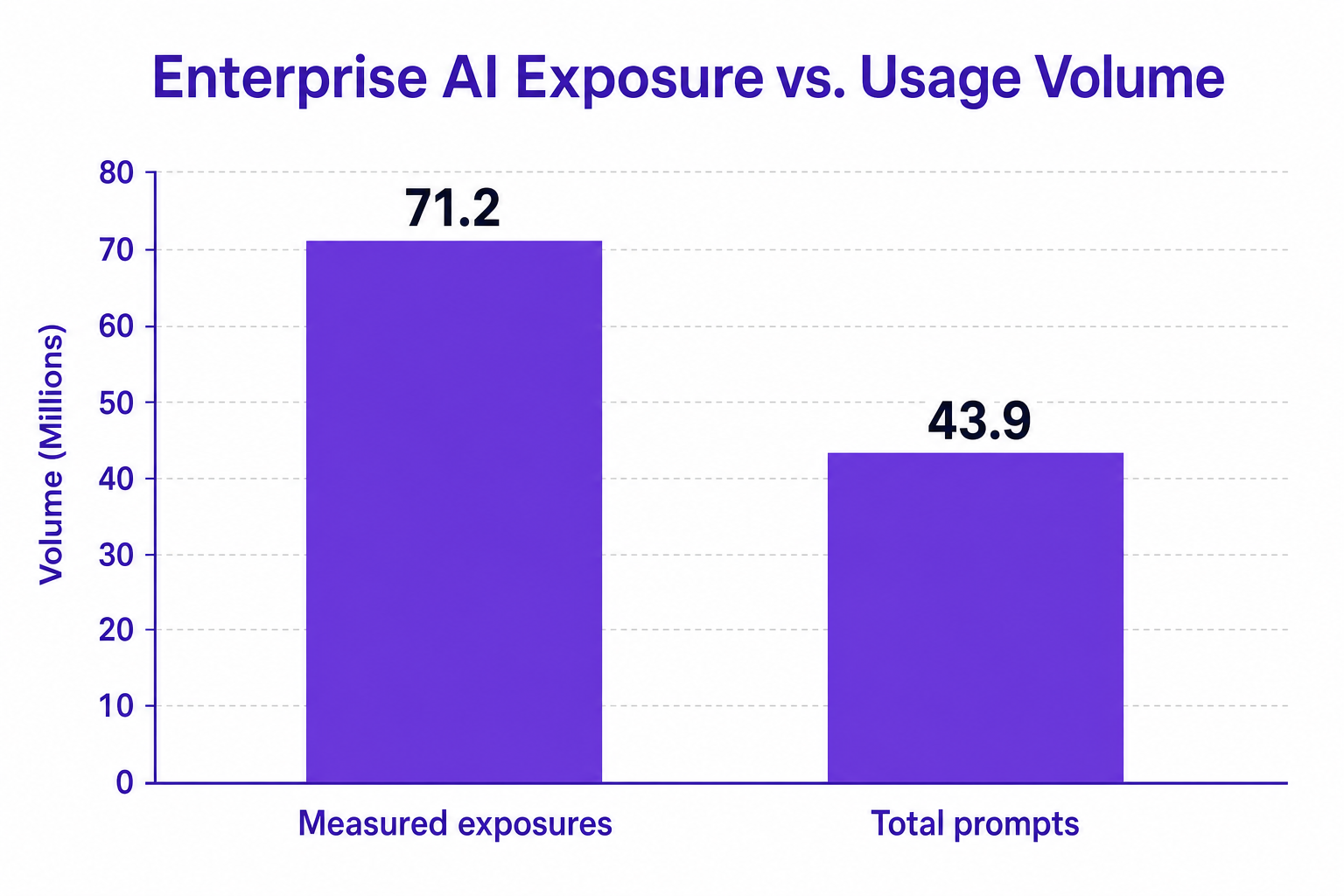
The implication is unavoidable: ChatGPT is both the most popular and riskiest vector for enterprise data leakage, followed by a long tail of AI workplace copilots and plugins embedded across SaaS applications.
Dispassionately, security teams must answer: what kinds of data are at risk? A breakdown of commonly pasted content includes:
Internal business documents (43%): Strategy decks, product plans, financial spreadsheets, vendor agreements, and roadmaps being pasted for quick analysis or content generation.
Source code (31%): Short or long code fragments for debugging, optimization, or refactoring via AI.
Meeting notes with strategic discussions (14%): Executive session summaries, decision logs, and feedback compilations.

More critically, 22% of users have pasted personally identifiable or payment card information (PII/PCI) into ChatGPT prompts, while nearly a quarter of all AI-driven leaks involve explicit corporate secrets.
Traditional IT strategies, such as blocking common AI domains or attempting to log browser history, are falling short. Key trends driving this gap:
Unmonitored accounts: 82% of pastes happen through personal or unmanaged AI accounts bypassing IT’s oversight.
‘Shadow AI’ proliferation: Employees connect unsanctioned plugins to CRMs, code tools, and file sharing apps, massively expanding the attack surface.
Clipboard-based leakage: AI prompts increasingly start as pasted snippets from source apps, not original typing, making real-time monitoring more complex.
Platform-level weaknesses compound this further, with hidden outbound data flows in code-execution runtimes, and risks from SaaS copilots pulling content directly from enterprise repositories without granular permissions.
Forward-thinking organizations are moving from blunt domain blocking to governance-driven controls. Proven tactics include:
Identity and access enforcement: Mandating single sign-on (SSO) and disabling personal AI logins so that usage is always mapped to managed accounts.
AI-activity audit trails: Automated metadata tracking, looking not at prompt contents, but at frequency, user segmentation, and app-level touchpoints for anomalies.
Continuous clipboard monitoring: Using data loss prevention tuned for genAI context, flagging high-risk paste activity in real time.
Unified policy enforcement: Centralizing rule sets so IT can see and disable unsanctioned AI plugin/OAuth connections before data escapes.
Case in point: a global financial services firm applied AI Custodian controls and saw a 92% reduction in unapproved AI logins, with zero reported shadow AI leakage incidents over six months.
CloudNuro AI Custodian was purpose-built for the demands of 2026. It identifies and controls the flow of sensitive data into AI tools, without reading the content, mapping everything back to enterprise visibility and compliance:
Comprehensive metadata tracking across Word, Teams, and embedded AI tools. No sensitive content inspected, only the ‘who, what, where, and when.’
Direct integration with Microsoft Purview to spot PII and confidential document oversharing inside AI prompts.
Automated user segmentation (Power, General, Dormant) for license allocation and usage policy correction.
Agent-level cost breakdowns that finally allow IT and Finance to allocate AI spend to real projects or teams.
Multi-signal algorithm cross-referencing SSO, DNS, and endpoint telemetry to weed out false positives, showing only actionable risk.
Unified management view to handle hundreds of SaaS and AI-enabled apps, from prompt activity to OAuth plugin lifecycle.
Rapid, automated remediation workflows to offboard AI tool accounts, clean up risky tokens, and remove unauthorized access.
For a large healthcare provider, this meant remediating 27 unsanctioned AI tool connections in a single quarter and reducing AI-driven data exposure incidents by 35% within six months.
To make AI value outweigh its risks, IT and security leaders should:
Inventory all AI tool usage company-wide, including browser-based tools and embedded copilots.
Mandate managed accounts and SSO enforcement for any AI tool handling sensitive data.
Leverage DLP and AI-specific monitoring that flags clipboard pastes, document batch uploads, and other invisible data flows into prompts.
Deploy automated onboarding/offboarding for AI entitlements and OAuth connections throughout the SaaS estate.
Train employees to treat AI prompts as a governed data-transfer channel, not a disposable scratchpad; emphasize why behavior matters, not just what not to do.
Centralize policy enforcement so finance, security, and IT are on the same page with clear ownership.
What types of data are employees pasting into ChatGPT at work?
Employees most frequently paste internal business documents, source code, and meeting notes. Alarmingly, a significant share involves PII, payment card data, and explicit trade secrets, making unauthorized AI access a substantial risk factor for enterprises.
How do companies detect and prevent ChatGPT data leakage?
Companies are moving from simple domain blocks to advanced controls: enforcing SSO sign-ins, leveraging metadata tracking, deploying continuous DLP, and integrating solutions that map AI plugin/OAuth usage across the SaaS landscape. Real-time remediation and unified policy management are essential in preventing leaks.
What are the security risks of using generative AI in the enterprise?
Risks include accidental exposure of confidential or regulated information, exposure via unmanaged accounts, hidden outbound flows in code plugins, and the amplification of data blast radius through ungoverned AI copilots.
What are the security risks of using generative AI in the enterprise?
Risks include accidental exposure of confidential or regulated information, exposure via unmanaged accounts, hidden outbound flows in code plugins, and the amplification of data blast radius through ungoverned AI copilots.
What policies should enterprises adopt for AI usage and data privacy?
Policies should mandate managed accounts for all AI access, restrict connections to approved plugins only, prohibit personal account use for work data, and require centralized auditing for prompts involving sensitive data.
How can organizations train employees to avoid AI-related data risks?
Regular mandatory training that pairs policy with real-world risk scenarios is vital. Emphasize governance over prohibition, explain the reasons for controls, and teach staff that generative AI is not a safe place to paste confidential data, even when it feels like a productivity boost.
In 2026, the technical possibilities of generative AI will keep expanding, but so will the risks, unless enterprises prioritize governance, not just productivity.
CloudNuro offers the only governance-first solution combining visibility, compliance, and cost consciousness, ensuring your data, finances, and AI use are never out of sight or out of policy.
About CloudNuro
CloudNuro is a leader in Enterprise AI Adoption Management, providing enterprises with unmatched visibility, governance, and cost optimization. Recognized twice in a row in the SaaS Management Platforms category and named a Leader in the SoftwareReviews Data Quadrant, CloudNuro is trusted by global enterprises and government agencies to bring financial discipline to SaaS, cloud, and AI. Trusted by enterprises, CloudNuro provides centralized SaaS inventory, license optimization, and renewal management along with advanced cost allocation and chargeback, giving IT and Finance leaders the visibility, control, and cost-conscious culture needed to drive financial discipline.
Request a no cost, no obligation free assessment —just 15 minutes to savings!
Get StartedGenerative AI has reshaped workplace productivity. Tools like ChatGPT are now default copilots for brainstorming, document summarization, and code shortcuts. But for IT leaders and security professionals, the headline story of 2026 is less about speed, and more about what sensitive data is moving, sometimes invisibly, through these ‘smart’ interfaces. As organizations accelerate adoption, the hidden risk is not theoretical: it’s real, measurable, and requiring new modes of governance and control.
It’s clear employees love AI, but the numbers behind workplace AI data leakage reveal staggering exposure:
77% of employees who use generative AI at work paste company data into prompts.
34.8% of all employee inputs into ChatGPT contain sensitive data.
27% of employees admit to entering confidential company data into public AI tools.
ChatGPT, while only representing 43.9% of enterprise prompts, is responsible for 71.2% of all measured AI data exposures.
The implication is unavoidable: ChatGPT is both the most popular and riskiest vector for enterprise data leakage, followed by a long tail of AI workplace copilots and plugins embedded across SaaS applications.
Dispassionately, security teams must answer: what kinds of data are at risk? A breakdown of commonly pasted content includes:
Internal business documents (43%): Strategy decks, product plans, financial spreadsheets, vendor agreements, and roadmaps being pasted for quick analysis or content generation.
Source code (31%): Short or long code fragments for debugging, optimization, or refactoring via AI.
Meeting notes with strategic discussions (14%): Executive session summaries, decision logs, and feedback compilations.
More critically, 22% of users have pasted personally identifiable or payment card information (PII/PCI) into ChatGPT prompts, while nearly a quarter of all AI-driven leaks involve explicit corporate secrets.
Traditional IT strategies, such as blocking common AI domains or attempting to log browser history, are falling short. Key trends driving this gap:
Unmonitored accounts: 82% of pastes happen through personal or unmanaged AI accounts bypassing IT’s oversight.
‘Shadow AI’ proliferation: Employees connect unsanctioned plugins to CRMs, code tools, and file sharing apps, massively expanding the attack surface.
Clipboard-based leakage: AI prompts increasingly start as pasted snippets from source apps, not original typing, making real-time monitoring more complex.
Platform-level weaknesses compound this further, with hidden outbound data flows in code-execution runtimes, and risks from SaaS copilots pulling content directly from enterprise repositories without granular permissions.
Forward-thinking organizations are moving from blunt domain blocking to governance-driven controls. Proven tactics include:
Identity and access enforcement: Mandating single sign-on (SSO) and disabling personal AI logins so that usage is always mapped to managed accounts.
AI-activity audit trails: Automated metadata tracking, looking not at prompt contents, but at frequency, user segmentation, and app-level touchpoints for anomalies.
Continuous clipboard monitoring: Using data loss prevention tuned for genAI context, flagging high-risk paste activity in real time.
Unified policy enforcement: Centralizing rule sets so IT can see and disable unsanctioned AI plugin/OAuth connections before data escapes.
Case in point: a global financial services firm applied AI Custodian controls and saw a 92% reduction in unapproved AI logins, with zero reported shadow AI leakage incidents over six months.
CloudNuro AI Custodian was purpose-built for the demands of 2026. It identifies and controls the flow of sensitive data into AI tools, without reading the content, mapping everything back to enterprise visibility and compliance:
Comprehensive metadata tracking across Word, Teams, and embedded AI tools. No sensitive content inspected, only the ‘who, what, where, and when.’
Direct integration with Microsoft Purview to spot PII and confidential document oversharing inside AI prompts.
Automated user segmentation (Power, General, Dormant) for license allocation and usage policy correction.
Agent-level cost breakdowns that finally allow IT and Finance to allocate AI spend to real projects or teams.
Multi-signal algorithm cross-referencing SSO, DNS, and endpoint telemetry to weed out false positives, showing only actionable risk.
Unified management view to handle hundreds of SaaS and AI-enabled apps, from prompt activity to OAuth plugin lifecycle.
Rapid, automated remediation workflows to offboard AI tool accounts, clean up risky tokens, and remove unauthorized access.
For a large healthcare provider, this meant remediating 27 unsanctioned AI tool connections in a single quarter and reducing AI-driven data exposure incidents by 35% within six months.
To make AI value outweigh its risks, IT and security leaders should:
Inventory all AI tool usage company-wide, including browser-based tools and embedded copilots.
Mandate managed accounts and SSO enforcement for any AI tool handling sensitive data.
Leverage DLP and AI-specific monitoring that flags clipboard pastes, document batch uploads, and other invisible data flows into prompts.
Deploy automated onboarding/offboarding for AI entitlements and OAuth connections throughout the SaaS estate.
Train employees to treat AI prompts as a governed data-transfer channel, not a disposable scratchpad; emphasize why behavior matters, not just what not to do.
Centralize policy enforcement so finance, security, and IT are on the same page with clear ownership.
What types of data are employees pasting into ChatGPT at work?
Employees most frequently paste internal business documents, source code, and meeting notes. Alarmingly, a significant share involves PII, payment card data, and explicit trade secrets, making unauthorized AI access a substantial risk factor for enterprises.
How do companies detect and prevent ChatGPT data leakage?
Companies are moving from simple domain blocks to advanced controls: enforcing SSO sign-ins, leveraging metadata tracking, deploying continuous DLP, and integrating solutions that map AI plugin/OAuth usage across the SaaS landscape. Real-time remediation and unified policy management are essential in preventing leaks.
What are the security risks of using generative AI in the enterprise?
Risks include accidental exposure of confidential or regulated information, exposure via unmanaged accounts, hidden outbound flows in code plugins, and the amplification of data blast radius through ungoverned AI copilots.
What are the security risks of using generative AI in the enterprise?
Risks include accidental exposure of confidential or regulated information, exposure via unmanaged accounts, hidden outbound flows in code plugins, and the amplification of data blast radius through ungoverned AI copilots.
What policies should enterprises adopt for AI usage and data privacy?
Policies should mandate managed accounts for all AI access, restrict connections to approved plugins only, prohibit personal account use for work data, and require centralized auditing for prompts involving sensitive data.
How can organizations train employees to avoid AI-related data risks?
Regular mandatory training that pairs policy with real-world risk scenarios is vital. Emphasize governance over prohibition, explain the reasons for controls, and teach staff that generative AI is not a safe place to paste confidential data, even when it feels like a productivity boost.
In 2026, the technical possibilities of generative AI will keep expanding, but so will the risks, unless enterprises prioritize governance, not just productivity.
CloudNuro offers the only governance-first solution combining visibility, compliance, and cost consciousness, ensuring your data, finances, and AI use are never out of sight or out of policy.
About CloudNuro
CloudNuro is a leader in Enterprise AI Adoption Management, providing enterprises with unmatched visibility, governance, and cost optimization. Recognized twice in a row in the SaaS Management Platforms category and named a Leader in the SoftwareReviews Data Quadrant, CloudNuro is trusted by global enterprises and government agencies to bring financial discipline to SaaS, cloud, and AI. Trusted by enterprises, CloudNuro provides centralized SaaS inventory, license optimization, and renewal management along with advanced cost allocation and chargeback, giving IT and Finance leaders the visibility, control, and cost-conscious culture needed to drive financial discipline.
Request a no cost, no obligation free assessment - just 15 minutes to savings!
Get StartedWe're offering complimentary ServiceNow license assessments to only 25 enterprises this quarter who want to unlock immediate savings without disrupting operations.
Get Free AssessmentGet Started




CloudNuro Corp
1755 Park St. Suite 207
Naperville, IL 60563
Phone : +1-630-277-9470
Email: info@cloudnuro.com




.webp)

Recognized Leader in SaaS Management Platforms by Info-Tech SoftwareReviews



.svg)