

Sign Up
Thank you for Submitting!
For years, engineering teams leaned on trusted, universal AI models as the backbone of intelligent applications. But with AI now driving critical workloads across enterprise SaaS, finance, healthcare, and government, the risks of relying on a single model have become starker than ever. As the landscape matures, organizations recognize that the single model default risk is a barrier to resilience, compliance, and sustainable scaling. Instead, leading teams are pivoting to multi-model engineering strategies, underpinned by rigorous governance and cost-conscious controls.

This article explores why the single-model approach no longer suffices, the operational and security risks involved, and how enterprises can engineer, and govern, robust, diversified AI environments.
Hardcoding your AI operations to a single foundational model may seem efficient, but it introduces significant liabilities:
Operational Blind Spots: If your only model fails, the entire system halts. Failure modes in AI systems become catastrophic.
Vendor Dependency: Relying on one provider creates a brittle supply chain and impedes agility when better models emerge.
Security Gaps: Vulnerabilities in a single model can expose the entire data pipeline, increasing AI governance risk.
Cost Overruns: Overpowered models may be applied to simple tasks, driving up expenses due to lack of a tailored model selection strategy.
“Engineering teams are actively moving away from single-default model architectures toward multi-model portfolios to route workloads based on latency, cost, risk, and task fit.”
Multi-model engineering approaches combat these threats by introducing diversity, redundancy, and choice into the production landscape.
Recent statistics and trends point to an undeniable shift:
More than 70% of organizations now use three or more AI models in operations.
The share of organizations deploying six or more models has nearly doubled in just one year.
Although a leading foundational model still commands a 63% market share, secondary and tertiary models have surged by 20 and 23 percentage points, respectively.
The AI Model Risk Management market stands at $6.43 billion and is set for rapid growth.
AI-related vulnerabilities spiked 34.6% in a single year, with projections that breaches will continue to escalate.
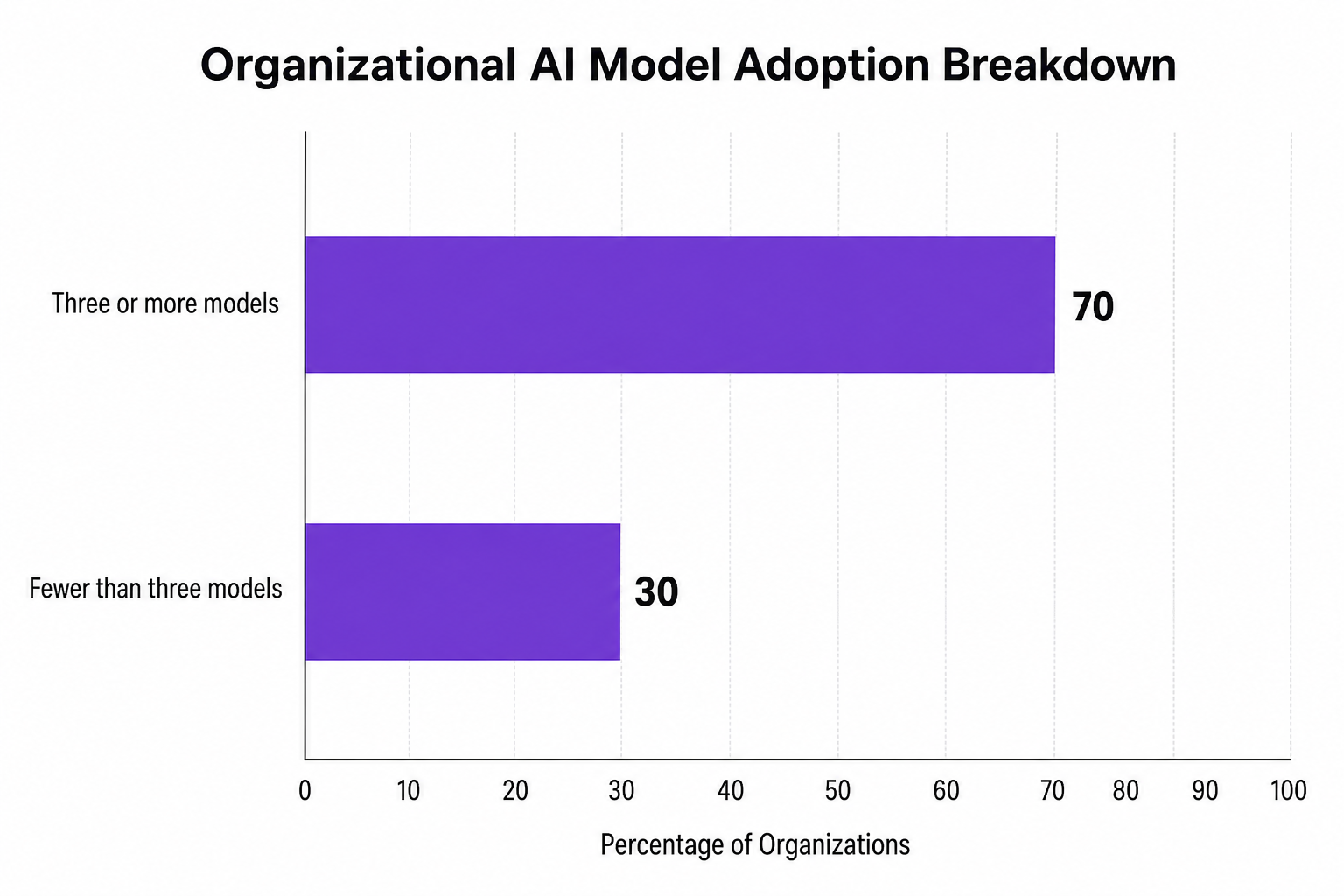
These numbers show that single model dependency risk is neither theoretical nor rare. It is the precise weakness organizations are actively remedying.
If a core model is deprecated, suffers an outage, or becomes vulnerable, all dependent applications are forced offline. Without a valid fallback model strategy or clear model rollback plan, teams scramble to patch failures in production.
As AI-related Common Vulnerabilities and Exposures (CVEs) soar (over 2,100 in just one year), organizations must monitor compliance, data leakage, and proper controls for every model in the stack, not just the dominant one.
When your engineering pipeline depends on a single provider, it is challenging to adopt newer, better, or more cost-effective models as they emerge. This slows innovation and amplifies default risk in AI systems.
Overpowered models can silently accrue excess spending, especially when used for simple jobs better suited to smaller, cheaper, or more focused models. Robust model monitoring frameworks are essential for cost optimization.
The most resilient AI organizations operate with a multi-model engineering approach, dynamically orchestrating between several models based on:
Workload fit: Latency, complexity, and required accuracy
Cost and budget thresholds
Risk posture and security considerations
Regulatory or compliance mandates
1. Centralized Visibility
Track all usage, agent activity, and costs across users, projects, and AI tools in a single dashboard for complete AI model dependency awareness.
2. AI Model Validation & Robustness Testing
Regularly audit models for accuracy, bias, and model failure modes to strengthen your model audit checklist and support model robustness.
3. Continuous Model Monitoring
Implement a model monitoring framework that includes drift detection, production model monitoring, and anomaly alerts, including regression or hallucination events.
4. Policy-Based Controls and Guardrails
Enforce strict AI safety controls, budget limits, and approval workflows to govern model use and prevent escalation of risk or spend.
5. Fallback & Rollback Capabilities
Design every production workflow with a fallback model strategy and model rollback plan, so failures do not halt business operations.
CloudNuro's AI Custodian equips engineering, IT, and security teams with the governance-first platform needed for resilient, cost-optimized, and compliant multi-model AI operations.
Key Solution Highlights:
Unified Visibility: Gain centralized, real-time insight across users, projects, tools, agents, and all active models. No hidden model dependencies; everything is traceable through a single pane of glass.
Granular Cost Attribution: Optimize AI spend by mapping costs down to project, agent, team, and model level, even identifying when overpowered models are deployed needlessly.
Guardrails and Controls: Define policy-based access, budgets, and operational guardrails to keep model use in line with company risk tolerance and compliance rules.
Anomaly and Drift Detection: Detect anomalous behaviors, runaway agents, unexpected spikes, and even prompt-based data leakage, regardless of which model is being used.
Integrated Security Monitoring: Integrate with enterprise security tools to spot PII leaks, document oversharing, and enforce compliance, even as teams adopt new models.
User Activity Segmentation: Automatically classify agent usage and categorize users into Power, General, Low, or Dormant, facilitating correct license allocation and minimization of shadow AI use.
As organizations diversify their AI portfolio, CloudNuro empowers them to maintain financial discipline, enforce security, and dramatically reduce single model default risk through complete operational control.
What is single model default risk in AI?
Single model default risk refers to the vulnerability that occurs when an organization relies entirely on one AI model, increasing exposure to failures, security liabilities, and operational bottlenecks if that model falters.
How do engineering teams manage model dependency risk?
By deploying a multi-model engineering approach, establishing centralized monitoring, and instituting policy-driven governance. Teams select and route workloads based on best fit, cost, and security profile.
What are best practices for multi-model engineering in AI?
Maintain visibility and control over every model; perform regular model robustness testing; configure fallback and rollback plans; and enforce strict access controls and usage budgets.
What strategies reduce the risk of hardcoded model defaults?
Invest in orchestration tools, adopt agentic stacks allowing flexible model selection, and integrate governance platforms that monitor, audit, and manage risk in real time for every model used.
How does model monitoring help in risk management?
Production model monitoring and drift detection enable teams to spot anomalies, unexpected outputs, or security breaches early, reducing the impact and cost of failures or vulnerabilities.
The era of the single-model default is over. Engineering organizations face a world of escalating risks, intense regulatory scrutiny, and continuous innovation. Multi-model engineering is not just best practice. It is a requirement for resilience, security, and efficient scaling.
With CloudNuro's AI Custodian, enterprises can leave single model dependency risk behind, using governance, deep visibility, and automated controls to confidently navigate the next wave of AI adoption.
CloudNuro is a leader in Enterprise AI Adoption Management, providing enterprises with unmatched visibility, governance, and cost optimization. Recognized twice in a row in the SaaS Management Platforms category and named a Leader in the SoftwareReviews Data Quadrant, CloudNuro is trusted by global enterprises and government agencies to bring financial discipline to SaaS, cloud, and AI. Trusted by enterprises, CloudNuro provides centralized SaaS inventory, license optimization, and renewal management along with advanced cost allocation and chargeback, giving IT and Finance leaders the visibility, control, and cost-conscious culture needed to drive financial discipline.
Request a no cost, no obligation free assessment —just 15 minutes to savings!
Get StartedFor years, engineering teams leaned on trusted, universal AI models as the backbone of intelligent applications. But with AI now driving critical workloads across enterprise SaaS, finance, healthcare, and government, the risks of relying on a single model have become starker than ever. As the landscape matures, organizations recognize that the single model default risk is a barrier to resilience, compliance, and sustainable scaling. Instead, leading teams are pivoting to multi-model engineering strategies, underpinned by rigorous governance and cost-conscious controls.
This article explores why the single-model approach no longer suffices, the operational and security risks involved, and how enterprises can engineer, and govern, robust, diversified AI environments.
Hardcoding your AI operations to a single foundational model may seem efficient, but it introduces significant liabilities:
Operational Blind Spots: If your only model fails, the entire system halts. Failure modes in AI systems become catastrophic.
Vendor Dependency: Relying on one provider creates a brittle supply chain and impedes agility when better models emerge.
Security Gaps: Vulnerabilities in a single model can expose the entire data pipeline, increasing AI governance risk.
Cost Overruns: Overpowered models may be applied to simple tasks, driving up expenses due to lack of a tailored model selection strategy.
“Engineering teams are actively moving away from single-default model architectures toward multi-model portfolios to route workloads based on latency, cost, risk, and task fit.”
Multi-model engineering approaches combat these threats by introducing diversity, redundancy, and choice into the production landscape.
Recent statistics and trends point to an undeniable shift:
More than 70% of organizations now use three or more AI models in operations.
The share of organizations deploying six or more models has nearly doubled in just one year.
Although a leading foundational model still commands a 63% market share, secondary and tertiary models have surged by 20 and 23 percentage points, respectively.
The AI Model Risk Management market stands at $6.43 billion and is set for rapid growth.
AI-related vulnerabilities spiked 34.6% in a single year, with projections that breaches will continue to escalate.
These numbers show that single model dependency risk is neither theoretical nor rare. It is the precise weakness organizations are actively remedying.
If a core model is deprecated, suffers an outage, or becomes vulnerable, all dependent applications are forced offline. Without a valid fallback model strategy or clear model rollback plan, teams scramble to patch failures in production.
As AI-related Common Vulnerabilities and Exposures (CVEs) soar (over 2,100 in just one year), organizations must monitor compliance, data leakage, and proper controls for every model in the stack, not just the dominant one.
When your engineering pipeline depends on a single provider, it is challenging to adopt newer, better, or more cost-effective models as they emerge. This slows innovation and amplifies default risk in AI systems.
Overpowered models can silently accrue excess spending, especially when used for simple jobs better suited to smaller, cheaper, or more focused models. Robust model monitoring frameworks are essential for cost optimization.
The most resilient AI organizations operate with a multi-model engineering approach, dynamically orchestrating between several models based on:
Workload fit: Latency, complexity, and required accuracy
Cost and budget thresholds
Risk posture and security considerations
Regulatory or compliance mandates
1. Centralized Visibility
Track all usage, agent activity, and costs across users, projects, and AI tools in a single dashboard for complete AI model dependency awareness.
2. AI Model Validation & Robustness Testing
Regularly audit models for accuracy, bias, and model failure modes to strengthen your model audit checklist and support model robustness.
3. Continuous Model Monitoring
Implement a model monitoring framework that includes drift detection, production model monitoring, and anomaly alerts, including regression or hallucination events.
4. Policy-Based Controls and Guardrails
Enforce strict AI safety controls, budget limits, and approval workflows to govern model use and prevent escalation of risk or spend.
5. Fallback & Rollback Capabilities
Design every production workflow with a fallback model strategy and model rollback plan, so failures do not halt business operations.
CloudNuro's AI Custodian equips engineering, IT, and security teams with the governance-first platform needed for resilient, cost-optimized, and compliant multi-model AI operations.
Key Solution Highlights:
Unified Visibility: Gain centralized, real-time insight across users, projects, tools, agents, and all active models. No hidden model dependencies; everything is traceable through a single pane of glass.
Granular Cost Attribution: Optimize AI spend by mapping costs down to project, agent, team, and model level, even identifying when overpowered models are deployed needlessly.
Guardrails and Controls: Define policy-based access, budgets, and operational guardrails to keep model use in line with company risk tolerance and compliance rules.
Anomaly and Drift Detection: Detect anomalous behaviors, runaway agents, unexpected spikes, and even prompt-based data leakage, regardless of which model is being used.
Integrated Security Monitoring: Integrate with enterprise security tools to spot PII leaks, document oversharing, and enforce compliance, even as teams adopt new models.
User Activity Segmentation: Automatically classify agent usage and categorize users into Power, General, Low, or Dormant, facilitating correct license allocation and minimization of shadow AI use.
As organizations diversify their AI portfolio, CloudNuro empowers them to maintain financial discipline, enforce security, and dramatically reduce single model default risk through complete operational control.
What is single model default risk in AI?
Single model default risk refers to the vulnerability that occurs when an organization relies entirely on one AI model, increasing exposure to failures, security liabilities, and operational bottlenecks if that model falters.
How do engineering teams manage model dependency risk?
By deploying a multi-model engineering approach, establishing centralized monitoring, and instituting policy-driven governance. Teams select and route workloads based on best fit, cost, and security profile.
What are best practices for multi-model engineering in AI?
Maintain visibility and control over every model; perform regular model robustness testing; configure fallback and rollback plans; and enforce strict access controls and usage budgets.
What strategies reduce the risk of hardcoded model defaults?
Invest in orchestration tools, adopt agentic stacks allowing flexible model selection, and integrate governance platforms that monitor, audit, and manage risk in real time for every model used.
How does model monitoring help in risk management?
Production model monitoring and drift detection enable teams to spot anomalies, unexpected outputs, or security breaches early, reducing the impact and cost of failures or vulnerabilities.
The era of the single-model default is over. Engineering organizations face a world of escalating risks, intense regulatory scrutiny, and continuous innovation. Multi-model engineering is not just best practice. It is a requirement for resilience, security, and efficient scaling.
With CloudNuro's AI Custodian, enterprises can leave single model dependency risk behind, using governance, deep visibility, and automated controls to confidently navigate the next wave of AI adoption.
CloudNuro is a leader in Enterprise AI Adoption Management, providing enterprises with unmatched visibility, governance, and cost optimization. Recognized twice in a row in the SaaS Management Platforms category and named a Leader in the SoftwareReviews Data Quadrant, CloudNuro is trusted by global enterprises and government agencies to bring financial discipline to SaaS, cloud, and AI. Trusted by enterprises, CloudNuro provides centralized SaaS inventory, license optimization, and renewal management along with advanced cost allocation and chargeback, giving IT and Finance leaders the visibility, control, and cost-conscious culture needed to drive financial discipline.
Request a no cost, no obligation free assessment - just 15 minutes to savings!
Get StartedWe're offering complimentary ServiceNow license assessments to only 25 enterprises this quarter who want to unlock immediate savings without disrupting operations.
Get Free AssessmentGet Started




CloudNuro Corp
1755 Park St. Suite 207
Naperville, IL 60563
Phone : +1-630-277-9470
Email: info@cloudnuro.com





.webp)

Recognized Leader in SaaS Management Platforms by Info-Tech SoftwareReviews


.svg)