

Sign Up
Thank you for Submitting!

Managing cloud expense requires deep visibility into operational workloads at every layer of the architecture. For enterprise technology leaders managing extensive enterprise data platforms, understanding consumption metrics is critical. Organizations deploy vast analytics and data management capabilities to drive decision-making but often encounter unpredictable billing linked directly to fabric capacity units. These units measure the computational power required to execute tasks across the platform. While centralized data management accelerates business intelligence, unchecked queries and automated operations quickly escalate monthly invoices.
Deploying proactive governance frameworks ensures operational efficiency across every digital department. Without a strategy to monitor and rein in runaway workloads, budgets face constant pressure from invisible background tasks. This is where CloudNuro steps in. By leveraging FinOps Services, organizations gain complete visibility into capacity unit consumption. Automated cost optimization protocols safely expose the true cost of runaway data operations, allowing teams to align expenses precisely with actual business applications. A highly optimized infrastructure guarantees that modern analytics provide maximum value without draining critical financial resources.
Capacity units represent the lifeblood of modern enterprise analytics workloads. Every pipeline, notebook, and report viewer draws from this central computational pool. To optimize costs effectively, administrators must first decode how these metrics accumulate. Pay-as-you-go capacity units cost approximately $0.18 per hour in typical operating regions. While this hourly rate appears minimal, continuous utilization across hundreds of automated jobs scales rapidly into substantial expenditures. A thorough CU consumption breakdown is necessary to establish operational baselines.
Evaluating baseline limits reveals foundational infrastructure requirements. Running a heavy-duty 64-capacity-unit environment continuously costs roughly $8,410 per month without optimization. Reaching the 64-unit threshold represents a critical strategic inflection point. The significantly higher computational costs can be dramatically offset by unlocking free viewing capabilities for all downstream users. However, if inefficient processes drain the pool, performance degrades dramatically, administrators must then trigger premium autoscale capabilities just to maintain baseline functionality.
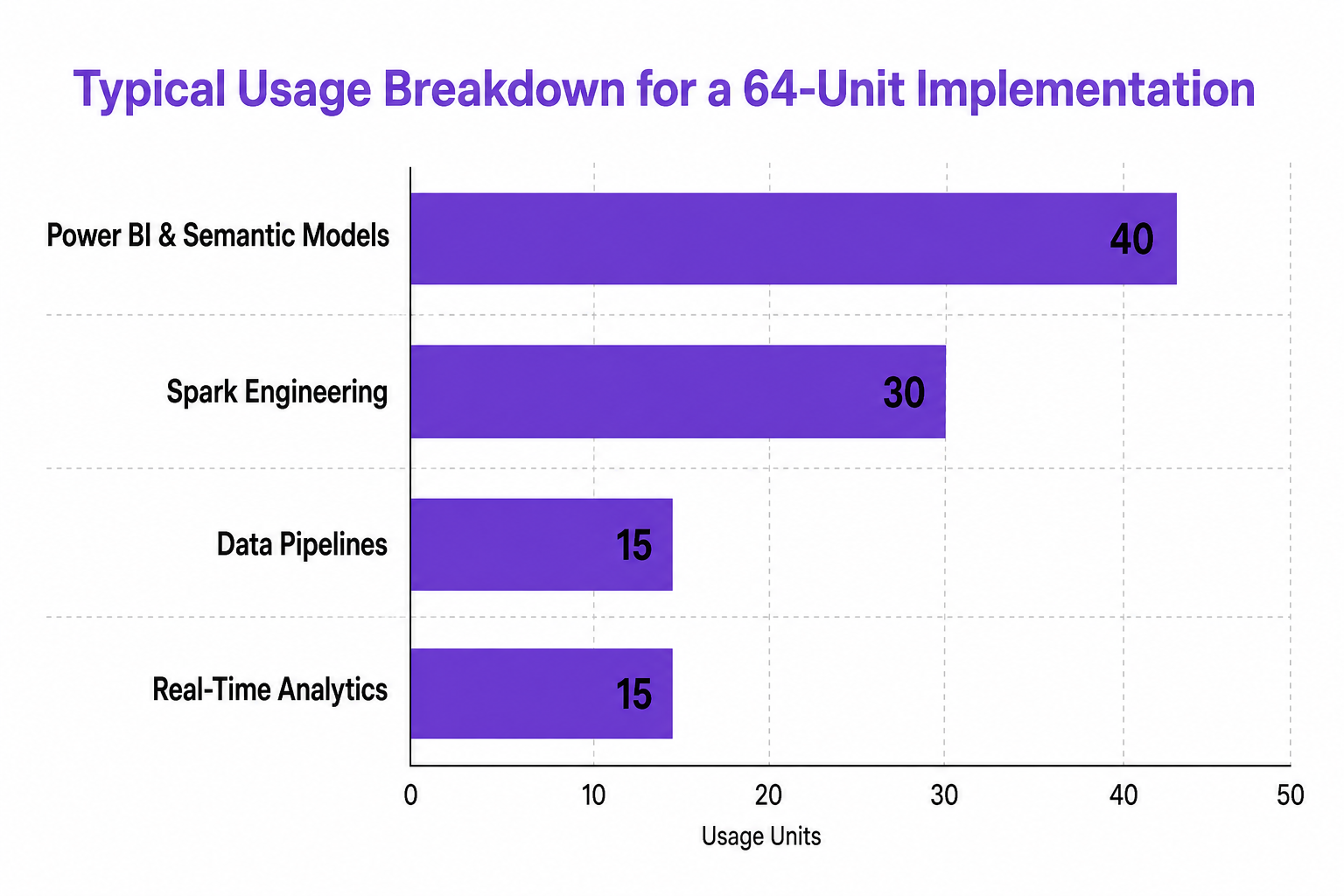
Before diving into individual tasks, it helps to view the ecosystem at a macro level. Standard large-scale implementations dedicate distinct portions of compute to different architectural pillars. Recognizing where the baseline limits lie helps infrastructure teams identify overlapping workflows that drive unnecessary burst utilization. Understanding these core allocations prevents departments from unintentionally monopolizing resources at the expense of automated reporting.
Understanding which tasks monopolize compute resources enables precise tuning and superior cost management. The hierarchy of expense reveals that background operations and poorly optimized code often outweigh standard report viewing. Identifying these costly fabric operations allows teams to redesign execution schedules safely and efficiently.
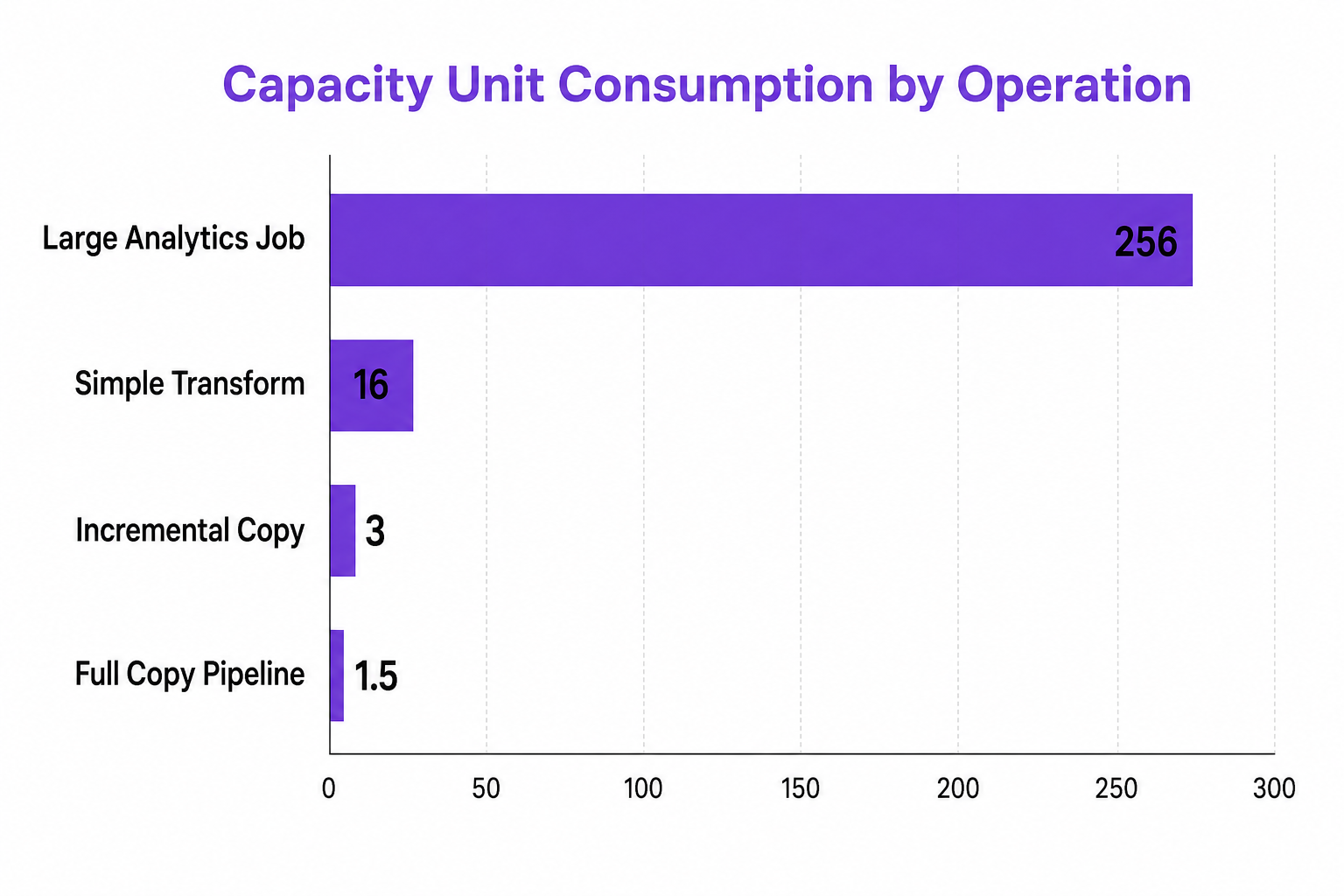
At the summit of capacity unit consumption sits the interactive analytical notebook. Large-scale interactive notebooks running complex data transformations can consume between 32 and 256 capacity units per active session. Advanced dataflow compute operates on a fully distinct consumption meter, meaning organizations often experience unexpected billing surges outside of their reserved capacity constraints. When data engineers leave high-cluster compute running idle or deploy inefficient algorithms over large datasets, the cost accumulates fiercely. Routine code optimization combined with strict session timeouts represents a mandatory safeguard for enterprise fabric operations.
Poorly structured analytical queries represent a massive hidden expense. Complex sequential queries can scale up to utilize 70 percent to 80 percent of total deployed capacity units in high-concurrency environments. Strict concurrency limits are forcing cloud operations teams to scrutinize and tune large analytical queries to prevent persistent consumption drains during core business hours. Rather than parallelizing the workload to execute efficiently, sequential operations force the engine to hold active memory state, starving other critical dependencies. When dozens of users submit sequential logic simultaneously, the impact multiplies exponentially.
Business intelligence relies heavily on semantic models to serve accurate data to end users. However, semantic model refreshes typically account for 75 percent of capacity unit consumption in business intelligence workloads, leaving only 25 percent for actual report viewing. FinOps units are increasingly enforcing strict isolation for semantic model refreshes, classifying these recurrent background updates as the primary invisible factor driving operational cost. Staggering these refreshes prevents system bottlenecks and avoids pushing the server into costly burst states.
To prevent systemic failure during peak demand, platforms automatically allocate extra compute resources temporarily. Autoscale and bursting operations are billed strictly at pay-as-you-go rates, representing a 23 percent to 37 percent premium over reserved capacity costs. Organizations are rapidly shifting heavily scheduled data pipelines out of peak operational windows to avoid triggering costly autoscale ceilings and premium capacity bursts. Reserving compute provides stability, but elastic scaling demands rigorous policy guardrails.
Moving data continuously sounds ideal for real-time analytics but introduces exceptional fixed costs. Data pipeline copy operations run on a fixed-cost-per-execution basis rather than scaling proportionally to data volume, meaning high-frequency incremental jobs drive capacity consumption exponentially. Heavy incremental copy data pipelines consume up to 3.0 hours of capacity units per individual execution. Consolidating these executions into larger, less frequent batches preserves significant compute allocation. Utilizing delta architectures rather than brute-force copying fundamentally protects capacity unit allocations.
Transforming these costly operations into highly tuned workflows mandates immediate intervention and continuous technical monitoring. Intelligent workload placement is the first line of defense against infrastructure waste. Moving heavy data ingestion away from high-traffic user hours ensures interactive reports remain responsive without triggering autoscale penalties. Power BI capacity management depends entirely on keeping the foundational compute layer unburdened during peak reporting times.
Proper architectural planning also involves optimizing the operational code itself. Converting sequential processes into parallel execution models frees up compute cycles to handle a higher volume of standard tasks. For semantic models, implementing incremental refresh logic rather than full historical reloads drastically minimizes the system footprint.
CloudNuro empowers IT and finance leaders to automate these precise optimization workflows comprehensively. The platform delivers operational analytics for major cloud environments, providing actionable recommendations for resource commitments alongside proactive FinOps for Microsoft Fabric. With continuous policy enforcement workflows, CloudNuro ensures that organizations scale instances only when actual, productive human usage necessitates the upgrade. Seamless integration empowers operational teams to identify optimization candidates long before those inefficiencies materialize on the monthly billing cycle.
A robust governance framework transforms unmanaged capacity spikes into predictable, allocated line items. Enterprise SaaS expense management requires more than a standard software dashboard; it requires a deep integration between financial accountability and technical execution. Complete visibility into capacity operations allows leadership to enforce budgets dynamically and securely.
CloudNuro integrates an automated policy engine with continuous enforcement capabilities alongside single sign-on and multi-factor authentication integrations for continuous compliance workflows. This governance-first architecture ensures compliance and transparency consistently. By leveraging intelligent usage analytics and heatmaps, CloudNuro improves forecast and renewal accuracy based on actual consumption data.
These methodologies deliver substantial results natively in the field. Leveraging advanced cost strategy, a transportation enterprise reclaimed massive user license volumes, uncovered over 35 virtual machine rightsizing opportunities, and achieved a 55 percent savings on collaboration platforms. Similarly, a healthcare organization realized 27 percent infrastructure commitment savings and achieved 30 percent savings through database rightsizing of unutilized resources. Demonstrating similar efficacy, a treatment company identified 26 percent overall operational savings, recovered hundreds of inactive communication licenses, and secured 41 percent renewal savings through proactive contract optimization.
Effective enterprise FinOps ties directly back to granular operational accountability. Every digital asset must be tracked, measured, and assigned to a responsible business unit. CloudNuro supports automated, rule-based chargeback with direct ledger mapping for precise cost allocation across departments. This seamless system ensures that departments consuming massive analytics compute absorb the respective operational cost, inherently promoting efficient coding practices.
Further establishing enterprise security, CloudNuro enables identity-based discovery protocols to establish a complete enterprise application inventory and prevent shadow infrastructure exposure. Security remains at the core of all operations, ensuring that compliance dictates every cost management decision. Combining rigorous technical analytics with deep SaaS governance positions organizations to maximize their infrastructure effectively.
What are fabric capacity units and how are they calculated?
Fabric capacity units are dedicated metrics used to quantify the compute and memory dynamically allocated to process enterprise cloud workloads. They are calculated based on continuous usage per hour, mapping the intensity of computational requests such as complex analytics or pipeline transformations to an equivalent billing rate.
Which operations consume the most CUs in Microsoft Fabric?
Large-scale interactive notebooks utilizing massive algorithmic clusters generally consume the absolute highest units per session. They are followed closely by complex sequential queries, semantic model refreshes, autoscale utilization, and high-frequency data copying pipelines.
How can I optimize fabric CU consumption in Power BI?
Optimizing these units entails isolating and staggering semantic model refreshes outside of standard business hours. Limiting the execution frequency of background jobs reduces the sustained baseline, ensuring that valuable dedicated computes remain available for active daily dashboard consumption.
What factors affect CU costs in Microsoft Fabric?
Key factors include concurrency density, query complexity, data pipeline frequencies, and the utilization of interactive notebooks. The choice between reserved scaling limits and elastic bursting also plays a fundamental role in defining ultimate cost multipliers.
How do expensive operations impact overall SaaS governance?
Runaway costs fracture budget allocations and obscure true departmental chargebacks. Excessive consumption undermines technical governance by necessitating emergency compute provisions, masking workflow inefficiencies, and compromising strict corporate cloud cost parameters.
Managing advanced data environments does not have to result in unmanageable monthly expenses. Uncovering the highest-draining operations delivers immediate opportunities for refinement. By restructuring notebook usage, tuning automated queries, and isolating refreshes, technology teams eliminate waste while maintaining pristine Power BI performance.
CloudNuro provides the definitive blueprint for intelligent capacity stewardship. The powerful suite of FinOps Services correlates consumption directly to business outcomes, establishing unshakeable SaaS cost control strategies. With an architecture designed to champion compliance, security, and visibility, CloudNuro equips modern enterprises with the tools necessary to make cloud operations scalable, transparent, and decisively cost-effective.
CloudNuro is a leader in Enterprise AI Adoption Management, providing enterprises with unmatched visibility, governance, and cost optimization. Recognized twice in a row in the SaaS Management Platforms category and named a Leader in the SoftwareReviews Data Quadrant, CloudNuro is trusted by global enterprises and government agencies to bring financial discipline to SaaS, cloud, and AI. Trusted by enterprises such as Konica Minolta and Federal Signal, CloudNuro provides centralized SaaS inventory, license optimization, and renewal management along with advanced cost allocation and chargeback, giving IT and Finance leaders the visibility, control, and cost-conscious culture needed to drive financial discipline.
Request a no cost, no obligation free assessment —just 15 minutes to savings!
Get StartedManaging cloud expense requires deep visibility into operational workloads at every layer of the architecture. For enterprise technology leaders managing extensive enterprise data platforms, understanding consumption metrics is critical. Organizations deploy vast analytics and data management capabilities to drive decision-making but often encounter unpredictable billing linked directly to fabric capacity units. These units measure the computational power required to execute tasks across the platform. While centralized data management accelerates business intelligence, unchecked queries and automated operations quickly escalate monthly invoices.
Deploying proactive governance frameworks ensures operational efficiency across every digital department. Without a strategy to monitor and rein in runaway workloads, budgets face constant pressure from invisible background tasks. This is where CloudNuro steps in. By leveraging FinOps Services, organizations gain complete visibility into capacity unit consumption. Automated cost optimization protocols safely expose the true cost of runaway data operations, allowing teams to align expenses precisely with actual business applications. A highly optimized infrastructure guarantees that modern analytics provide maximum value without draining critical financial resources.
Capacity units represent the lifeblood of modern enterprise analytics workloads. Every pipeline, notebook, and report viewer draws from this central computational pool. To optimize costs effectively, administrators must first decode how these metrics accumulate. Pay-as-you-go capacity units cost approximately $0.18 per hour in typical operating regions. While this hourly rate appears minimal, continuous utilization across hundreds of automated jobs scales rapidly into substantial expenditures. A thorough CU consumption breakdown is necessary to establish operational baselines.
Evaluating baseline limits reveals foundational infrastructure requirements. Running a heavy-duty 64-capacity-unit environment continuously costs roughly $8,410 per month without optimization. Reaching the 64-unit threshold represents a critical strategic inflection point. The significantly higher computational costs can be dramatically offset by unlocking free viewing capabilities for all downstream users. However, if inefficient processes drain the pool, performance degrades dramatically, administrators must then trigger premium autoscale capabilities just to maintain baseline functionality.
Before diving into individual tasks, it helps to view the ecosystem at a macro level. Standard large-scale implementations dedicate distinct portions of compute to different architectural pillars. Recognizing where the baseline limits lie helps infrastructure teams identify overlapping workflows that drive unnecessary burst utilization. Understanding these core allocations prevents departments from unintentionally monopolizing resources at the expense of automated reporting.
Understanding which tasks monopolize compute resources enables precise tuning and superior cost management. The hierarchy of expense reveals that background operations and poorly optimized code often outweigh standard report viewing. Identifying these costly fabric operations allows teams to redesign execution schedules safely and efficiently.
At the summit of capacity unit consumption sits the interactive analytical notebook. Large-scale interactive notebooks running complex data transformations can consume between 32 and 256 capacity units per active session. Advanced dataflow compute operates on a fully distinct consumption meter, meaning organizations often experience unexpected billing surges outside of their reserved capacity constraints. When data engineers leave high-cluster compute running idle or deploy inefficient algorithms over large datasets, the cost accumulates fiercely. Routine code optimization combined with strict session timeouts represents a mandatory safeguard for enterprise fabric operations.
Poorly structured analytical queries represent a massive hidden expense. Complex sequential queries can scale up to utilize 70 percent to 80 percent of total deployed capacity units in high-concurrency environments. Strict concurrency limits are forcing cloud operations teams to scrutinize and tune large analytical queries to prevent persistent consumption drains during core business hours. Rather than parallelizing the workload to execute efficiently, sequential operations force the engine to hold active memory state, starving other critical dependencies. When dozens of users submit sequential logic simultaneously, the impact multiplies exponentially.
Business intelligence relies heavily on semantic models to serve accurate data to end users. However, semantic model refreshes typically account for 75 percent of capacity unit consumption in business intelligence workloads, leaving only 25 percent for actual report viewing. FinOps units are increasingly enforcing strict isolation for semantic model refreshes, classifying these recurrent background updates as the primary invisible factor driving operational cost. Staggering these refreshes prevents system bottlenecks and avoids pushing the server into costly burst states.
To prevent systemic failure during peak demand, platforms automatically allocate extra compute resources temporarily. Autoscale and bursting operations are billed strictly at pay-as-you-go rates, representing a 23 percent to 37 percent premium over reserved capacity costs. Organizations are rapidly shifting heavily scheduled data pipelines out of peak operational windows to avoid triggering costly autoscale ceilings and premium capacity bursts. Reserving compute provides stability, but elastic scaling demands rigorous policy guardrails.
Moving data continuously sounds ideal for real-time analytics but introduces exceptional fixed costs. Data pipeline copy operations run on a fixed-cost-per-execution basis rather than scaling proportionally to data volume, meaning high-frequency incremental jobs drive capacity consumption exponentially. Heavy incremental copy data pipelines consume up to 3.0 hours of capacity units per individual execution. Consolidating these executions into larger, less frequent batches preserves significant compute allocation. Utilizing delta architectures rather than brute-force copying fundamentally protects capacity unit allocations.
Transforming these costly operations into highly tuned workflows mandates immediate intervention and continuous technical monitoring. Intelligent workload placement is the first line of defense against infrastructure waste. Moving heavy data ingestion away from high-traffic user hours ensures interactive reports remain responsive without triggering autoscale penalties. Power BI capacity management depends entirely on keeping the foundational compute layer unburdened during peak reporting times.
Proper architectural planning also involves optimizing the operational code itself. Converting sequential processes into parallel execution models frees up compute cycles to handle a higher volume of standard tasks. For semantic models, implementing incremental refresh logic rather than full historical reloads drastically minimizes the system footprint.
CloudNuro empowers IT and finance leaders to automate these precise optimization workflows comprehensively. The platform delivers operational analytics for major cloud environments, providing actionable recommendations for resource commitments alongside proactive FinOps for Microsoft Fabric. With continuous policy enforcement workflows, CloudNuro ensures that organizations scale instances only when actual, productive human usage necessitates the upgrade. Seamless integration empowers operational teams to identify optimization candidates long before those inefficiencies materialize on the monthly billing cycle.
A robust governance framework transforms unmanaged capacity spikes into predictable, allocated line items. Enterprise SaaS expense management requires more than a standard software dashboard; it requires a deep integration between financial accountability and technical execution. Complete visibility into capacity operations allows leadership to enforce budgets dynamically and securely.
CloudNuro integrates an automated policy engine with continuous enforcement capabilities alongside single sign-on and multi-factor authentication integrations for continuous compliance workflows. This governance-first architecture ensures compliance and transparency consistently. By leveraging intelligent usage analytics and heatmaps, CloudNuro improves forecast and renewal accuracy based on actual consumption data.
These methodologies deliver substantial results natively in the field. Leveraging advanced cost strategy, a transportation enterprise reclaimed massive user license volumes, uncovered over 35 virtual machine rightsizing opportunities, and achieved a 55 percent savings on collaboration platforms. Similarly, a healthcare organization realized 27 percent infrastructure commitment savings and achieved 30 percent savings through database rightsizing of unutilized resources. Demonstrating similar efficacy, a treatment company identified 26 percent overall operational savings, recovered hundreds of inactive communication licenses, and secured 41 percent renewal savings through proactive contract optimization.
Effective enterprise FinOps ties directly back to granular operational accountability. Every digital asset must be tracked, measured, and assigned to a responsible business unit. CloudNuro supports automated, rule-based chargeback with direct ledger mapping for precise cost allocation across departments. This seamless system ensures that departments consuming massive analytics compute absorb the respective operational cost, inherently promoting efficient coding practices.
Further establishing enterprise security, CloudNuro enables identity-based discovery protocols to establish a complete enterprise application inventory and prevent shadow infrastructure exposure. Security remains at the core of all operations, ensuring that compliance dictates every cost management decision. Combining rigorous technical analytics with deep SaaS governance positions organizations to maximize their infrastructure effectively.
What are fabric capacity units and how are they calculated?
Fabric capacity units are dedicated metrics used to quantify the compute and memory dynamically allocated to process enterprise cloud workloads. They are calculated based on continuous usage per hour, mapping the intensity of computational requests such as complex analytics or pipeline transformations to an equivalent billing rate.
Which operations consume the most CUs in Microsoft Fabric?
Large-scale interactive notebooks utilizing massive algorithmic clusters generally consume the absolute highest units per session. They are followed closely by complex sequential queries, semantic model refreshes, autoscale utilization, and high-frequency data copying pipelines.
How can I optimize fabric CU consumption in Power BI?
Optimizing these units entails isolating and staggering semantic model refreshes outside of standard business hours. Limiting the execution frequency of background jobs reduces the sustained baseline, ensuring that valuable dedicated computes remain available for active daily dashboard consumption.
What factors affect CU costs in Microsoft Fabric?
Key factors include concurrency density, query complexity, data pipeline frequencies, and the utilization of interactive notebooks. The choice between reserved scaling limits and elastic bursting also plays a fundamental role in defining ultimate cost multipliers.
How do expensive operations impact overall SaaS governance?
Runaway costs fracture budget allocations and obscure true departmental chargebacks. Excessive consumption undermines technical governance by necessitating emergency compute provisions, masking workflow inefficiencies, and compromising strict corporate cloud cost parameters.
Managing advanced data environments does not have to result in unmanageable monthly expenses. Uncovering the highest-draining operations delivers immediate opportunities for refinement. By restructuring notebook usage, tuning automated queries, and isolating refreshes, technology teams eliminate waste while maintaining pristine Power BI performance.
CloudNuro provides the definitive blueprint for intelligent capacity stewardship. The powerful suite of FinOps Services correlates consumption directly to business outcomes, establishing unshakeable SaaS cost control strategies. With an architecture designed to champion compliance, security, and visibility, CloudNuro equips modern enterprises with the tools necessary to make cloud operations scalable, transparent, and decisively cost-effective.
CloudNuro is a leader in Enterprise AI Adoption Management, providing enterprises with unmatched visibility, governance, and cost optimization. Recognized twice in a row in the SaaS Management Platforms category and named a Leader in the SoftwareReviews Data Quadrant, CloudNuro is trusted by global enterprises and government agencies to bring financial discipline to SaaS, cloud, and AI. Trusted by enterprises such as Konica Minolta and Federal Signal, CloudNuro provides centralized SaaS inventory, license optimization, and renewal management along with advanced cost allocation and chargeback, giving IT and Finance leaders the visibility, control, and cost-conscious culture needed to drive financial discipline.
Request a no cost, no obligation free assessment - just 15 minutes to savings!
Get StartedWe're offering complimentary ServiceNow license assessments to only 25 enterprises this quarter who want to unlock immediate savings without disrupting operations.
Get Free AssessmentGet Started




CloudNuro Corp
1755 Park St. Suite 207
Naperville, IL 60563
Phone : +1-630-277-9470
Email: info@cloudnuro.com





.webp)

Recognized Leader in SaaS Management Platforms by Info-Tech SoftwareReviews




.svg)