

Sign Up
Thank you for Submitting!
Microsoft Fabric capacity governance is becoming a make or break discipline for data and analytics leaders. As more workloads move into Fabric and Power BI, capacity consumption can spike quietly, budgets are strained, and accountability becomes blurred across teams.
Research from a major analyst firm shows that 82% of enterprises implementing chargeback models for Microsoft Fabric saw at least a 15% improvement in cost accountability by 2026 (Gartner 2026). At the same time, 85% of enterprises cite lack of unified workspace metadata governance as a primary barrier to scaling Fabric and Power BI (InfoTech 2026). The message is clear: capacity governance is no longer optional.
This article lays out a practical, enterprise-ready approach to Fabric capacity governance, with a specific focus on fabric chargeback, workspace tagging, and fabric budget alerts. You will see how to design models that stick, how automation can reduce friction, and how CloudNuro helps organizations turn Fabric capacity governance into a sustained operational discipline.
Most organizations did not start with Microsoft Fabric capacity governance in mind. They adopted Power BI, then Fabric, then layered in more workloads, and only later tried to retrofit policies. The result is often a patchwork of manual spreadsheets, ad hoc policies, and inconsistent enforcement.
According to a cloud economics study, 69% of organizations using automated tagging for workspace governance in cloud platforms reported a 20% reduction in orphaned or underutilized resources (Forrester 2026). Yet many Fabric deployments still rely on manual tagging, local conventions, or unstructured descriptions that never feed into cost governance.
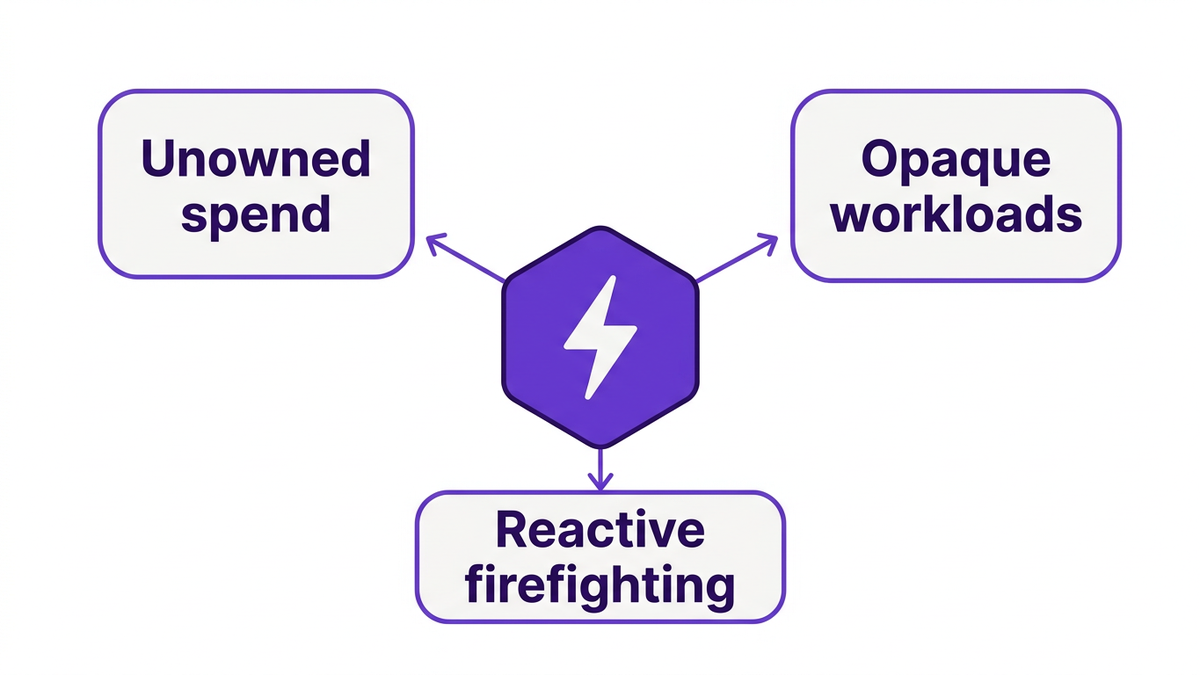
The consequences usually show up in three patterns:
Unowned spend: No clear owner for a capacity, workspace, or project, so nobody feels accountable for overruns.
Opaque workloads: Multiple teams share capacities with no consistent workspace cost allocation tags, so cost conversations devolve into guesswork.
Reactive firefighting: Capacity overages, throttling, or runaway workloads are discovered only when performance or bills spike.
A leading research body highlights that 76% of IT teams that set up real-time budget and capacity alerts kept spend within 5% of plan (IDC 2026). Yet, in many enterprises, fabric budget alerts are either absent, misconfigured, or too noisy to be trusted.
The big lesson: governance that lives only in policy documents, with no automation, quickly erodes. To make Microsoft Fabric capacity governance stick, you need a repeatable framework, clear metadata, and integrated automation across fabric capacity management, tagging, and alerts.
Think of Fabric capacity governance like airport traffic control. Without a tower, planes can technically fly, but the risk of collisions, delays, and wasted fuel is enormous. Similarly, without a governance tower, Fabric workloads will run, but cost and risk increase exponentially.
A practical Microsoft Fabric capacity governance framework usually includes five building blocks:
Capacity hierarchy and ownership
Workspace classification and tagging
Capacity-based chargeback and showback
Budget alerts and predictive utilization alerts
Continuous policy enforcement and automation
Each block reinforces the others. Without workspace classification, chargeback is brittle. Without predictive capacity utilization alerts, governance is always catching up.
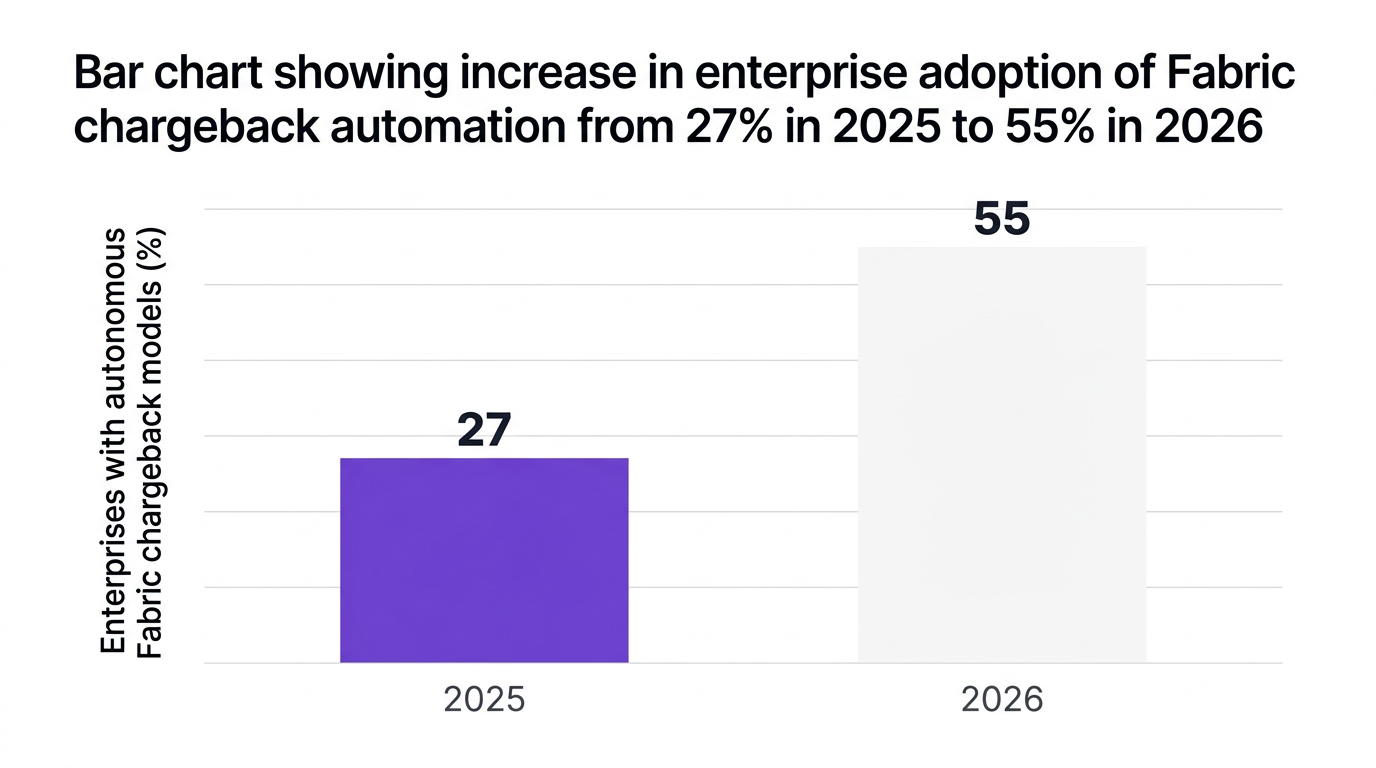
Analyst research shows a strong trend toward automation. By 2026, 55% of global enterprises with Fabric and Power BI rely on autonomous chargeback models, up from 27% in 2025 (Forrester 2026). Another study notes that over 60% of enterprise Fabric deployments now include predictive utilization and budget anomaly alerting (Everest Group 2026).
The takeaway: governance that sticks is automated, enforced at the workspace level, and aligned with cloud chargeback governance and saas chargeback programs already in place.
Effective capacity-based chargeback for Fabric is about more than passing bills to business units. It is about workload cost attribution that teams trust, understand, and can act on.
A research study on cloud economics found that enterprises using automated SaaS chargeback report 34% greater accuracy in workload cost attribution compared with manual methods (Ventana Research 2026). Another analyst report notes that 82% of enterprises implementing Fabric chargeback realized at least 15% improvement in cost accountability (Gartner 2026). These numbers highlight the payoff when organizations treat finops for fabric as a first-class discipline.
To build a chargeback and fabric showback model that sticks, apply these principles:
Tie capacities to clear owners: Every capacity must have a named owner, cost center, and budget threshold.
Use workspace-level metering: Attribute costs based on fabric capacity utilization by workspace, not only capacity-level consumption.
Align with cloud cost governance: Use the same cost centers and hierarchy as your broader cloud cost governance and cloud chargeback governance models.
Start with showback, progress to chargeback: Begin with showback reports, then move to explicit saas chargeback when teams have adjusted.
An effective fabric cost allocation formula can be kept simple at the outset:
Allocate capacity costs by total consumption per workspace.
Apply a standard rate per capacity unit.
Add a small overhead factor for shared services and governance.
For example:
Workspace cost = (workspace consumption ÷ total capacity consumption) × capacity cost × overhead factor
The simplicity keeps conversations focused on fabric capacity optimization, not on debating formulas. Once trust is established, you can add refinements such as peak time weightings or differentiated rates for premium capacities.
Not every capacity-based chargeback model works. Common failure modes include:
Overly complex allocation rules that finance loves but engineers ignore.
No alignment with budgets, so teams get surprise invoices.
Lack of transparency, so teams cannot reconcile their Fabric usage with chargeback statements.
A balanced approach requires not only data but also strong communication. Capacity governance should be framed as an enabler for data teams, not a policing function.
If chargeback is the fuel meter, power bi workspace tagging and classification are the dashboard. Without consistent workspace cost allocation tags, you cannot see which business units, projects, or environments are consuming capacity.
A landmark report notes that over 85% of enterprises cite lack of unified workspace metadata governance as a primary barrier to scaling Fabric and Power BI deployments (InfoTech 2026). Another study reports that 69% of organizations using automated tagging for workspace governance achieved a 20% reduction in orphaned resources (Forrester 2026).
At minimum, every workspace should have governance tags for workspaces that cover:
Business unit or department
Cost center or P&L owner
Environment (production, staging, development, sandbox)
Data sensitivity classification
Owner or steward
Project or initiative code
This workspace classification scheme should be centrally defined and versioned. Treat it like a data model, not a static policy document.
Manual tagging eventually fails. People forget, standards drift, and new teams appear faster than governance can keep up. That is why 77% of organizations deploying Fabric in 2026 have automated policy enforcement for workspace tags and cost attribution (Gartner 2026).
You can enforce workspace metadata governance with automation such as:
Preventing workspace creation without required tags.
Auto-assigning tags based on directory group or project template.
Regularly scanning for missing tags and notifying owners.
Blocking capacity assignment to workspaces that lack mandatory metadata.
Done well, this becomes the backbone for workload governance, tenant governance, and access control governance in Microsoft Fabric.
Even with chargeback and tagging, capacity risk persists if you cannot detect trends early. Fabric budget alerts, cloud budget alerts, and saas budget notifications form the early warning system.
A leading research body reports that 76% of IT teams with real-time budget and capacity alerts avoided unexpected Fabric overages and kept spend within 5% of plan (IDC 2026). Another study found that Fabric environments with predictive utilization alerts saw 28% fewer capacity breaches than those without (Everest Group 2026).
The goal is not to drown teams in alerts, but to create predictive utilization alerts that are meaningful. Practical patterns include:
Spend thresholds: 50%, 75%, 90%, and 100% of monthly or quarterly budget.
Capacity utilization alerts: warnings when sustained utilization exceeds a set percentage over a rolling window.
Budget anomaly alerts: detection of unusual spikes compared with typical patterns.
These alerts can route to specific channels: data platform teams, FinOps, or business unit owners. They should also be logged centrally to feed policy enforcement discussions.
Predictive alerts work like an early weather forecast. They will not stop storms, but they give you time to decide whether to cancel flights, redirect traffic, or adjust runway schedules.
In Fabric, predictive alerts analyze trends in fabric capacity utilization and forecast potential fabric capacity overage. This allows teams to:
Pause or reschedule heavy workloads.
Move noncritical workloads to other capacities.
Increase capacity deliberately rather than reactively.
A market study notes that over 60% of enterprise-scale Fabric deployments now feature integrated predictive utilization and budget anomaly alerting (Everest Group 2026). This is increasingly seen as a best practice for fabric capacity planning and fabric workload governance.
Some organizations argue that basic cloud budget alerts are sufficient. They configure email notifications at 80% and 100% of budget and call it a day.
In smaller or less dynamic environments, this may work for a while. However, as workloads scale and AI-driven jobs increase, budget anomaly alerts and predictive models often become necessary to avoid surprises. Simple threshold alerts are a start, but they rarely satisfy mature cloud cost governance requirements in the long term.
The thread connecting chargeback, tagging, and alerts is governance automation. Without automation, Microsoft Fabric capacity governance lives only in slide decks.
According to market research, the global market for SaaS and cloud chargeback solutions is projected to reach 4.2 billion dollars by 2026, with a CAGR of 19.3% (MarketsandMarkets 2026). In parallel, 77% of enterprises deploying Fabric now automate policy enforcement for workspace tags and cost attribution (Gartner 2026).

Automation should cover the full lifecycle:
Workspace creation: enforce required workspace cost allocation tags and governance tags for workspaces.
Capacity assignment: ensure only compliant workspaces can join production capacities.
Policy enforcement: implement continuous policy enforcement across tenant governance, access policies, and workload governance rules.
Alert routing: connect saas budget notifications, cloud budget alerts, and capacity utilization alerts into incident channels.
Showback and chargeback: feed cloud chargeback governance and saas chargeback engines with clean data.
An analogy here is quality gates in a CI/CD pipeline. Just as you would not deploy code without passing tests and checks, you should not allow Fabric workspaces or capacities to operate without passing governance gates.
CloudNuro was designed to bring financial discipline to SaaS, cloud, and AI environments. For Microsoft Fabric capacity governance, the platform provides a set of integrated capabilities that help enterprises implement fabric capacity controls, workload cost attribution, and capacity-based chargeback without adding friction for data teams.
CloudNuro combines SaaS Discovery, User Access Review, Workflow Automation, and Cloud Commitment Optimization into a single Enterprise SaaS Management Platform. It integrates directly with Microsoft Fabric and Power BI, enabling unified governance across SaaS, PaaS, and IaaS.
You can explore these capabilities in more depth in the CloudNuro product overview and the dedicated SaaS management solution. For FinOps leaders, CloudNuro also provides specialized FinOps services and a FinOps maturity assessment to benchmark and improve practices.
With CloudNuro Chargeback, enterprises can implement fabric chargeback and fabric showback models grounded in actual fabric capacity utilization. The platform collects usage data from Microsoft Fabric, aligns it with workspace classification, and performs fabric cost allocation down to business units, projects, and teams.
Key capabilities include:
Automated capacity-based chargeback across Fabric and other cloud platforms.
Unified cloud chargeback governance and saas chargeback across SaaS, PaaS, and IaaS.
Granular workload cost attribution with support for multiple hierarchies and chargeback rules.
One financial institution used CloudNuro Chargeback and FinOps Services to streamline Fabric capacity management. They achieved 30% faster onboarding for new teams and 18% improved accountability via automated chargeback, while maintaining zero budget overruns over 12 months (CloudNuro Case Repository 2026).
CloudNuro's Unified Cloud Custodian and AI Custodian automate workspace metadata governance for Fabric and Power BI. They enforce consistent governance tags for workspaces and workspace cost allocation tags.
Highlights include:
Auto-tagging based on directory groups, business unit mappings, and templates.
Continuous scans to detect missing or inconsistent tags.
Integration with User Access Review and Workflow Automation to ensure access control governance.
A healthcare organization implemented CloudNuro Unified Cloud Custodian for Microsoft Fabric, automating workspace tagging and chargeback. They saw a 22% reduction in overall Fabric spend and eliminated capacity overages for six consecutive quarters (CloudNuro Customer Success 2026).
CloudNuro's Predictive Budget Alerting and Capacity Governance modules provide real-time insight into fabric capacity management and fabric capacity planning. These capabilities help organizations move from reactive to proactive governance.
Core features include:
Configurable fabric budget alerts tied to capacities, workspaces, and business units.
Capacity utilization alerts powered by predictive models to prevent fabric capacity overage.
Budget anomaly alerts across SaaS, cloud, and AI workloads.
These capabilities align with CloudNuro's FinOps Services, helping organizations embed finops for fabric into broader cloud cost governance. IT and finance teams gain dashboards and reports that support fabric capacity optimization discussions, while operational teams receive targeted saas budget notifications.
For IT operations leaders, CloudNuro also provides targeted solutions for IT operations and IT asset management, ensuring that Fabric governance is part of a wider operational strategy.
Start by defining a clear capacity-based chargeback model that attributes costs by fabric capacity utilization per workspace. Use a simple formula based on consumption share, capacity cost, and a modest overhead factor. Begin with fabric showback reports for several months, then move to full chargeback once teams trust the data and understand the impact.
CloudNuro helps by automating fabric chargeback, aligning consumption with workspace classification, and feeding results into cloud chargeback governance dashboards. This creates consistent workload cost attribution across Fabric and other cloud platforms.
Consistent power bi workspace tagging and governance tags for workspaces provide the metadata needed for fabric cost allocation, reporting, and compliance. Tags such as business unit, cost center, environment, and owner ensure that every capacity and workspace has a clear accountable party.
Automated workspace metadata governance reduces orphaned workspaces and underutilized capacities. According to one study, automated tagging reduced orphaned or underutilized resources by 20% (Forrester 2026). CloudNuro automates tagging, validates workspace cost allocation tags, and enforces policies so that governance data remains reliable.
Best practices for fabric budget alerts include:
Setting spend thresholds at 50%, 75%, 90%, and 100% of the budget.
Configuring capacity utilization alerts when usage exceeds a sustained threshold.
Enabling budget anomaly alerts to catch unusual spikes.
Alerts should route to both operational teams and FinOps stakeholders. CloudNuro's predictive alerting modules centralize cloud budget alerts and saas budget notifications, and provide dashboards for monitoring and drill-down across Microsoft Fabric and other platforms.
Predictive utilization alerts analyze trends in fabric capacity utilization and forecast when utilization may exceed a safe threshold. This enables teams to adjust workloads, revise schedules, or increase capacity in a planned fashion.
Research indicates that environments with embedded predictive alerts experience 28% fewer capacity breaches than those without (Everest Group 2026). CloudNuro uses AI-driven models to provide predictive utilization alerts, helping organizations avoid fabric capacity overage and maintain service quality.
Automation can enforce tags and alerts at multiple stages:
Blocking workspace creation without required governance tags for workspaces.
Auto-assigning tags based on directory group or template.
Generating saas budget notifications and routing them to owners.
Integrating alerts with incident management workflows.
CloudNuro's Unified Cloud Custodian, AI Custodian, and Workflow Automation modules support governance automation across Microsoft Fabric. They ensure that workspace tags, cloud budget alerts, and policy enforcement rules remain synchronized, even as new teams and workloads are onboarded.
Effective Microsoft Fabric capacity governance aligns technical usage with financial accountability. By combining fabric chargeback, workspace classification, and fabric capacity controls, organizations make costs visible and actionable at the team level.
CloudNuro supports this shift by providing transparent dashboards, fabric showback, and chargeback reports that are tailored to business units. This creates a culture where teams own their Fabric budgets, and governance is seen as a shared responsibility rather than a centralized constraint.
Microsoft Fabric capacity governance is no longer optional. Forward-looking organizations are pairing capacity-based chargeback, automation of workspace metadata governance, and fabric budget alerts to create a sustainable framework for cost accountability.
Analyst data shows that enterprises implementing Fabric chargeback, predictive alerts, and automated tagging see improved cost accuracy, fewer capacity breaches, and stronger financial discipline. With a unified approach, you can move from reactive firefighting to proactive fabric capacity planning, fabric capacity optimization, and strategic fabric workload governance.
CloudNuro helps enterprises turn Microsoft Fabric capacity governance into an operational habit. By unifying cloud cost governance, tagging automation, and predictive alerting, CloudNuro enables IT, data, and finance leaders to align Fabric usage with organizational goals.
If you are ready to strengthen your Microsoft Fabric capacity governance, explore how CloudNuro can support your strategy.
CloudNuro is a leader in Enterprise SaaS Management Platforms, providing enterprises with unmatched visibility, governance, and cost optimization. Recognized twice in a row in the SaaS Management Platforms category and named a Leader in the SoftwareReviews Data Quadrant, CloudNuro is trusted by global enterprises and government agencies to bring financial discipline to SaaS, cloud, and AI. Trusted by enterprises such as Konica Minolta and Federal Signal, CloudNuro provides centralized SaaS inventory, license optimization, and renewal management along with advanced cost allocation and chargeback, giving IT and Finance leaders the visibility, control, and cost-conscious culture needed to drive financial discipline.
Request a no cost, no obligation free assessment —just 15 minutes to savings!
Get StartedMicrosoft Fabric capacity governance is becoming a make or break discipline for data and analytics leaders. As more workloads move into Fabric and Power BI, capacity consumption can spike quietly, budgets are strained, and accountability becomes blurred across teams.
Research from a major analyst firm shows that 82% of enterprises implementing chargeback models for Microsoft Fabric saw at least a 15% improvement in cost accountability by 2026 (Gartner 2026). At the same time, 85% of enterprises cite lack of unified workspace metadata governance as a primary barrier to scaling Fabric and Power BI (InfoTech 2026). The message is clear: capacity governance is no longer optional.
This article lays out a practical, enterprise-ready approach to Fabric capacity governance, with a specific focus on fabric chargeback, workspace tagging, and fabric budget alerts. You will see how to design models that stick, how automation can reduce friction, and how CloudNuro helps organizations turn Fabric capacity governance into a sustained operational discipline.
Most organizations did not start with Microsoft Fabric capacity governance in mind. They adopted Power BI, then Fabric, then layered in more workloads, and only later tried to retrofit policies. The result is often a patchwork of manual spreadsheets, ad hoc policies, and inconsistent enforcement.
According to a cloud economics study, 69% of organizations using automated tagging for workspace governance in cloud platforms reported a 20% reduction in orphaned or underutilized resources (Forrester 2026). Yet many Fabric deployments still rely on manual tagging, local conventions, or unstructured descriptions that never feed into cost governance.
The consequences usually show up in three patterns:
Unowned spend: No clear owner for a capacity, workspace, or project, so nobody feels accountable for overruns.
Opaque workloads: Multiple teams share capacities with no consistent workspace cost allocation tags, so cost conversations devolve into guesswork.
Reactive firefighting: Capacity overages, throttling, or runaway workloads are discovered only when performance or bills spike.
A leading research body highlights that 76% of IT teams that set up real-time budget and capacity alerts kept spend within 5% of plan (IDC 2026). Yet, in many enterprises, fabric budget alerts are either absent, misconfigured, or too noisy to be trusted.
The big lesson: governance that lives only in policy documents, with no automation, quickly erodes. To make Microsoft Fabric capacity governance stick, you need a repeatable framework, clear metadata, and integrated automation across fabric capacity management, tagging, and alerts.
Think of Fabric capacity governance like airport traffic control. Without a tower, planes can technically fly, but the risk of collisions, delays, and wasted fuel is enormous. Similarly, without a governance tower, Fabric workloads will run, but cost and risk increase exponentially.
A practical Microsoft Fabric capacity governance framework usually includes five building blocks:
Capacity hierarchy and ownership
Workspace classification and tagging
Capacity-based chargeback and showback
Budget alerts and predictive utilization alerts
Continuous policy enforcement and automation
Each block reinforces the others. Without workspace classification, chargeback is brittle. Without predictive capacity utilization alerts, governance is always catching up.
Analyst research shows a strong trend toward automation. By 2026, 55% of global enterprises with Fabric and Power BI rely on autonomous chargeback models, up from 27% in 2025 (Forrester 2026). Another study notes that over 60% of enterprise Fabric deployments now include predictive utilization and budget anomaly alerting (Everest Group 2026).
The takeaway: governance that sticks is automated, enforced at the workspace level, and aligned with cloud chargeback governance and saas chargeback programs already in place.
Effective capacity-based chargeback for Fabric is about more than passing bills to business units. It is about workload cost attribution that teams trust, understand, and can act on.
A research study on cloud economics found that enterprises using automated SaaS chargeback report 34% greater accuracy in workload cost attribution compared with manual methods (Ventana Research 2026). Another analyst report notes that 82% of enterprises implementing Fabric chargeback realized at least 15% improvement in cost accountability (Gartner 2026). These numbers highlight the payoff when organizations treat finops for fabric as a first-class discipline.
To build a chargeback and fabric showback model that sticks, apply these principles:
Tie capacities to clear owners: Every capacity must have a named owner, cost center, and budget threshold.
Use workspace-level metering: Attribute costs based on fabric capacity utilization by workspace, not only capacity-level consumption.
Align with cloud cost governance: Use the same cost centers and hierarchy as your broader cloud cost governance and cloud chargeback governance models.
Start with showback, progress to chargeback: Begin with showback reports, then move to explicit saas chargeback when teams have adjusted.
An effective fabric cost allocation formula can be kept simple at the outset:
Allocate capacity costs by total consumption per workspace.
Apply a standard rate per capacity unit.
Add a small overhead factor for shared services and governance.
For example:
Workspace cost = (workspace consumption ÷ total capacity consumption) × capacity cost × overhead factor
The simplicity keeps conversations focused on fabric capacity optimization, not on debating formulas. Once trust is established, you can add refinements such as peak time weightings or differentiated rates for premium capacities.
Not every capacity-based chargeback model works. Common failure modes include:
Overly complex allocation rules that finance loves but engineers ignore.
No alignment with budgets, so teams get surprise invoices.
Lack of transparency, so teams cannot reconcile their Fabric usage with chargeback statements.
A balanced approach requires not only data but also strong communication. Capacity governance should be framed as an enabler for data teams, not a policing function.
If chargeback is the fuel meter, power bi workspace tagging and classification are the dashboard. Without consistent workspace cost allocation tags, you cannot see which business units, projects, or environments are consuming capacity.
A landmark report notes that over 85% of enterprises cite lack of unified workspace metadata governance as a primary barrier to scaling Fabric and Power BI deployments (InfoTech 2026). Another study reports that 69% of organizations using automated tagging for workspace governance achieved a 20% reduction in orphaned resources (Forrester 2026).
At minimum, every workspace should have governance tags for workspaces that cover:
Business unit or department
Cost center or P&L owner
Environment (production, staging, development, sandbox)
Data sensitivity classification
Owner or steward
Project or initiative code
This workspace classification scheme should be centrally defined and versioned. Treat it like a data model, not a static policy document.
Manual tagging eventually fails. People forget, standards drift, and new teams appear faster than governance can keep up. That is why 77% of organizations deploying Fabric in 2026 have automated policy enforcement for workspace tags and cost attribution (Gartner 2026).
You can enforce workspace metadata governance with automation such as:
Preventing workspace creation without required tags.
Auto-assigning tags based on directory group or project template.
Regularly scanning for missing tags and notifying owners.
Blocking capacity assignment to workspaces that lack mandatory metadata.
Done well, this becomes the backbone for workload governance, tenant governance, and access control governance in Microsoft Fabric.
Even with chargeback and tagging, capacity risk persists if you cannot detect trends early. Fabric budget alerts, cloud budget alerts, and saas budget notifications form the early warning system.
A leading research body reports that 76% of IT teams with real-time budget and capacity alerts avoided unexpected Fabric overages and kept spend within 5% of plan (IDC 2026). Another study found that Fabric environments with predictive utilization alerts saw 28% fewer capacity breaches than those without (Everest Group 2026).
The goal is not to drown teams in alerts, but to create predictive utilization alerts that are meaningful. Practical patterns include:
Spend thresholds: 50%, 75%, 90%, and 100% of monthly or quarterly budget.
Capacity utilization alerts: warnings when sustained utilization exceeds a set percentage over a rolling window.
Budget anomaly alerts: detection of unusual spikes compared with typical patterns.
These alerts can route to specific channels: data platform teams, FinOps, or business unit owners. They should also be logged centrally to feed policy enforcement discussions.
Predictive alerts work like an early weather forecast. They will not stop storms, but they give you time to decide whether to cancel flights, redirect traffic, or adjust runway schedules.
In Fabric, predictive alerts analyze trends in fabric capacity utilization and forecast potential fabric capacity overage. This allows teams to:
Pause or reschedule heavy workloads.
Move noncritical workloads to other capacities.
Increase capacity deliberately rather than reactively.
A market study notes that over 60% of enterprise-scale Fabric deployments now feature integrated predictive utilization and budget anomaly alerting (Everest Group 2026). This is increasingly seen as a best practice for fabric capacity planning and fabric workload governance.
Some organizations argue that basic cloud budget alerts are sufficient. They configure email notifications at 80% and 100% of budget and call it a day.
In smaller or less dynamic environments, this may work for a while. However, as workloads scale and AI-driven jobs increase, budget anomaly alerts and predictive models often become necessary to avoid surprises. Simple threshold alerts are a start, but they rarely satisfy mature cloud cost governance requirements in the long term.
The thread connecting chargeback, tagging, and alerts is governance automation. Without automation, Microsoft Fabric capacity governance lives only in slide decks.
According to market research, the global market for SaaS and cloud chargeback solutions is projected to reach 4.2 billion dollars by 2026, with a CAGR of 19.3% (MarketsandMarkets 2026). In parallel, 77% of enterprises deploying Fabric now automate policy enforcement for workspace tags and cost attribution (Gartner 2026).
Automation should cover the full lifecycle:
Workspace creation: enforce required workspace cost allocation tags and governance tags for workspaces.
Capacity assignment: ensure only compliant workspaces can join production capacities.
Policy enforcement: implement continuous policy enforcement across tenant governance, access policies, and workload governance rules.
Alert routing: connect saas budget notifications, cloud budget alerts, and capacity utilization alerts into incident channels.
Showback and chargeback: feed cloud chargeback governance and saas chargeback engines with clean data.
An analogy here is quality gates in a CI/CD pipeline. Just as you would not deploy code without passing tests and checks, you should not allow Fabric workspaces or capacities to operate without passing governance gates.
CloudNuro was designed to bring financial discipline to SaaS, cloud, and AI environments. For Microsoft Fabric capacity governance, the platform provides a set of integrated capabilities that help enterprises implement fabric capacity controls, workload cost attribution, and capacity-based chargeback without adding friction for data teams.
CloudNuro combines SaaS Discovery, User Access Review, Workflow Automation, and Cloud Commitment Optimization into a single Enterprise SaaS Management Platform. It integrates directly with Microsoft Fabric and Power BI, enabling unified governance across SaaS, PaaS, and IaaS.
You can explore these capabilities in more depth in the CloudNuro product overview and the dedicated SaaS management solution. For FinOps leaders, CloudNuro also provides specialized FinOps services and a FinOps maturity assessment to benchmark and improve practices.
With CloudNuro Chargeback, enterprises can implement fabric chargeback and fabric showback models grounded in actual fabric capacity utilization. The platform collects usage data from Microsoft Fabric, aligns it with workspace classification, and performs fabric cost allocation down to business units, projects, and teams.
Key capabilities include:
Automated capacity-based chargeback across Fabric and other cloud platforms.
Unified cloud chargeback governance and saas chargeback across SaaS, PaaS, and IaaS.
Granular workload cost attribution with support for multiple hierarchies and chargeback rules.
One financial institution used CloudNuro Chargeback and FinOps Services to streamline Fabric capacity management. They achieved 30% faster onboarding for new teams and 18% improved accountability via automated chargeback, while maintaining zero budget overruns over 12 months (CloudNuro Case Repository 2026).
CloudNuro's Unified Cloud Custodian and AI Custodian automate workspace metadata governance for Fabric and Power BI. They enforce consistent governance tags for workspaces and workspace cost allocation tags.
Highlights include:
Auto-tagging based on directory groups, business unit mappings, and templates.
Continuous scans to detect missing or inconsistent tags.
Integration with User Access Review and Workflow Automation to ensure access control governance.
A healthcare organization implemented CloudNuro Unified Cloud Custodian for Microsoft Fabric, automating workspace tagging and chargeback. They saw a 22% reduction in overall Fabric spend and eliminated capacity overages for six consecutive quarters (CloudNuro Customer Success 2026).
CloudNuro's Predictive Budget Alerting and Capacity Governance modules provide real-time insight into fabric capacity management and fabric capacity planning. These capabilities help organizations move from reactive to proactive governance.
Core features include:
Configurable fabric budget alerts tied to capacities, workspaces, and business units.
Capacity utilization alerts powered by predictive models to prevent fabric capacity overage.
Budget anomaly alerts across SaaS, cloud, and AI workloads.
These capabilities align with CloudNuro's FinOps Services, helping organizations embed finops for fabric into broader cloud cost governance. IT and finance teams gain dashboards and reports that support fabric capacity optimization discussions, while operational teams receive targeted saas budget notifications.
For IT operations leaders, CloudNuro also provides targeted solutions for IT operations and IT asset management, ensuring that Fabric governance is part of a wider operational strategy.
Start by defining a clear capacity-based chargeback model that attributes costs by fabric capacity utilization per workspace. Use a simple formula based on consumption share, capacity cost, and a modest overhead factor. Begin with fabric showback reports for several months, then move to full chargeback once teams trust the data and understand the impact.
CloudNuro helps by automating fabric chargeback, aligning consumption with workspace classification, and feeding results into cloud chargeback governance dashboards. This creates consistent workload cost attribution across Fabric and other cloud platforms.
Consistent power bi workspace tagging and governance tags for workspaces provide the metadata needed for fabric cost allocation, reporting, and compliance. Tags such as business unit, cost center, environment, and owner ensure that every capacity and workspace has a clear accountable party.
Automated workspace metadata governance reduces orphaned workspaces and underutilized capacities. According to one study, automated tagging reduced orphaned or underutilized resources by 20% (Forrester 2026). CloudNuro automates tagging, validates workspace cost allocation tags, and enforces policies so that governance data remains reliable.
Best practices for fabric budget alerts include:
Setting spend thresholds at 50%, 75%, 90%, and 100% of the budget.
Configuring capacity utilization alerts when usage exceeds a sustained threshold.
Enabling budget anomaly alerts to catch unusual spikes.
Alerts should route to both operational teams and FinOps stakeholders. CloudNuro's predictive alerting modules centralize cloud budget alerts and saas budget notifications, and provide dashboards for monitoring and drill-down across Microsoft Fabric and other platforms.
Predictive utilization alerts analyze trends in fabric capacity utilization and forecast when utilization may exceed a safe threshold. This enables teams to adjust workloads, revise schedules, or increase capacity in a planned fashion.
Research indicates that environments with embedded predictive alerts experience 28% fewer capacity breaches than those without (Everest Group 2026). CloudNuro uses AI-driven models to provide predictive utilization alerts, helping organizations avoid fabric capacity overage and maintain service quality.
Automation can enforce tags and alerts at multiple stages:
Blocking workspace creation without required governance tags for workspaces.
Auto-assigning tags based on directory group or template.
Generating saas budget notifications and routing them to owners.
Integrating alerts with incident management workflows.
CloudNuro's Unified Cloud Custodian, AI Custodian, and Workflow Automation modules support governance automation across Microsoft Fabric. They ensure that workspace tags, cloud budget alerts, and policy enforcement rules remain synchronized, even as new teams and workloads are onboarded.
Effective Microsoft Fabric capacity governance aligns technical usage with financial accountability. By combining fabric chargeback, workspace classification, and fabric capacity controls, organizations make costs visible and actionable at the team level.
CloudNuro supports this shift by providing transparent dashboards, fabric showback, and chargeback reports that are tailored to business units. This creates a culture where teams own their Fabric budgets, and governance is seen as a shared responsibility rather than a centralized constraint.
Microsoft Fabric capacity governance is no longer optional. Forward-looking organizations are pairing capacity-based chargeback, automation of workspace metadata governance, and fabric budget alerts to create a sustainable framework for cost accountability.
Analyst data shows that enterprises implementing Fabric chargeback, predictive alerts, and automated tagging see improved cost accuracy, fewer capacity breaches, and stronger financial discipline. With a unified approach, you can move from reactive firefighting to proactive fabric capacity planning, fabric capacity optimization, and strategic fabric workload governance.
CloudNuro helps enterprises turn Microsoft Fabric capacity governance into an operational habit. By unifying cloud cost governance, tagging automation, and predictive alerting, CloudNuro enables IT, data, and finance leaders to align Fabric usage with organizational goals.
If you are ready to strengthen your Microsoft Fabric capacity governance, explore how CloudNuro can support your strategy.
CloudNuro is a leader in Enterprise SaaS Management Platforms, providing enterprises with unmatched visibility, governance, and cost optimization. Recognized twice in a row in the SaaS Management Platforms category and named a Leader in the SoftwareReviews Data Quadrant, CloudNuro is trusted by global enterprises and government agencies to bring financial discipline to SaaS, cloud, and AI. Trusted by enterprises such as Konica Minolta and Federal Signal, CloudNuro provides centralized SaaS inventory, license optimization, and renewal management along with advanced cost allocation and chargeback, giving IT and Finance leaders the visibility, control, and cost-conscious culture needed to drive financial discipline.
Request a no cost, no obligation free assessment - just 15 minutes to savings!
Get StartedWe're offering complimentary ServiceNow license assessments to only 25 enterprises this quarter who want to unlock immediate savings without disrupting operations.
Get Free AssessmentGet Started




CloudNuro Corp
1755 Park St. Suite 207
Naperville, IL 60563
Phone : +1-630-277-9470
Email: info@cloudnuro.com





.webp)

Recognized Leader in SaaS Management Platforms by Info-Tech SoftwareReviews



.svg)