

Sign Up
Thank you for Submitting!
Managing permissions across a sprawling infrastructure demands absolute precision. An AWS access review is no longer a periodic check box for compliance teams. It is a fundamental operational necessity to prevent data breaches and control cloud computing costs. As enterprises expand their digital footprints, tracking exactly who has access to which resource becomes incredibly complex. Manual audits relying on static spreadsheets consistently fail to capture the reality of dynamic cloud permissions.
This comprehensive guide explores the exact phases required to build a highly secure, automated authorization framework. IT security and operations leaders will learn how to shift from reactive audits to proactive, continuous governance. By enforcing strict access controls, your engineering teams can maintain agility without sacrificing corporate security or failing critical compliance audits.
The scale of modern cloud platforms makes manual oversight impossible. According to current platform documentation, AWS had 188 services in scope for its Spring 2026 SOC reporting period (AWS SOC Report 2026). This immense compliance surface means that unused roles, abandoned user accounts, and over-provisioned permissions present significant risks to enterprise data.
Quarterly reviews of IAM group memberships and the continuous automated monitoring of unused permissions are now standardized best practices for compliance. Without formalized oversight, the consequences of identity sprawl compound quickly. Gartner projects that 70 percent of identity-first security strategies will fail by 2026 unless organizations adopt continuous, context-based access controls (Gartner 2026).
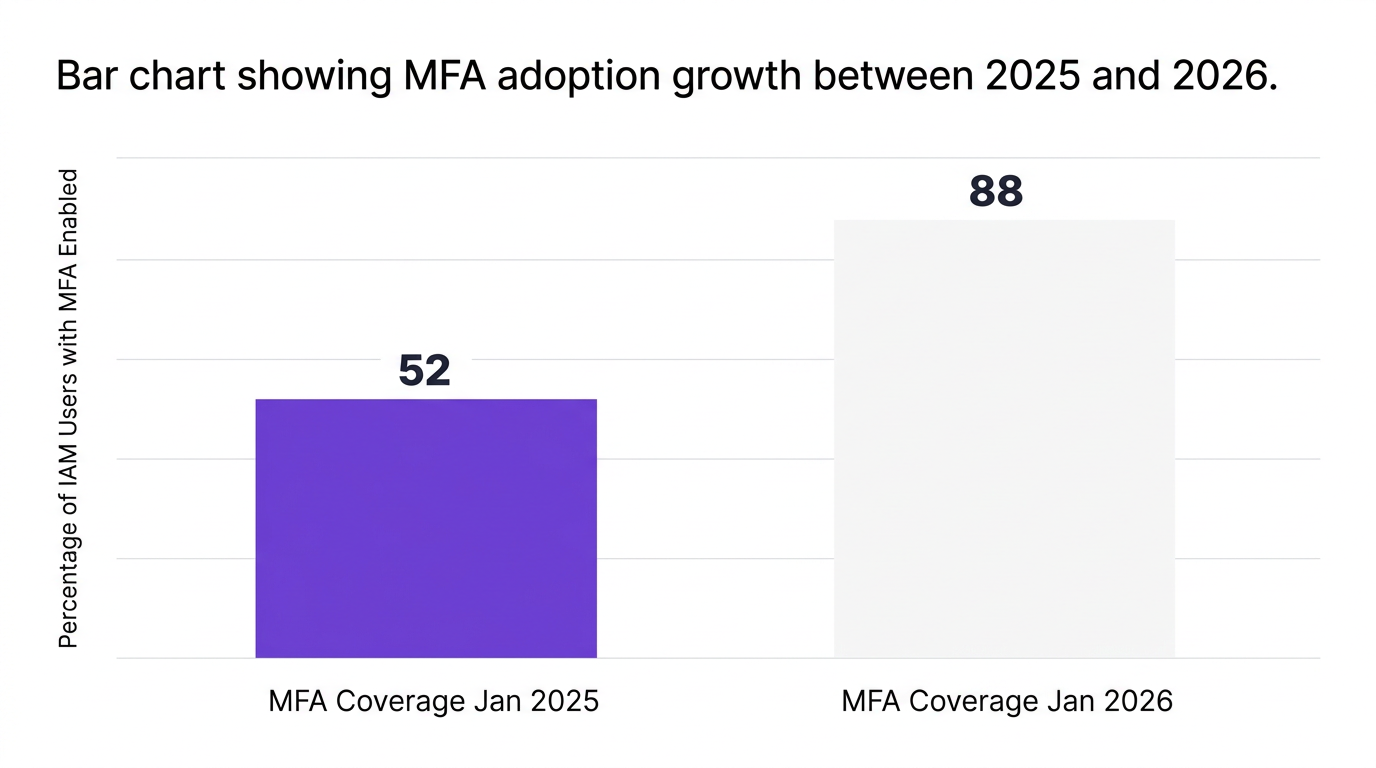
Enforcing an automated framework dramatically improves basic security hygiene. Internal benchmarking shows that implementing continuous reviews drives MFA device coverage from 52 percent up to 88 percent over a 12-month period. Maintaining this level of operational discipline ensures that cloud investments remain secure while meeting the rigorous demands of external auditors.
An effective AWS identity and access management audit evaluates who holds access, how those privileges are provisioned, and what activities those users perform. The primary goal is achieving the principle of least privilege. Unfortunately, current benchmarking data reveals that more than 70 percent of companies maintain overly permissive administrative roles (2026 Industry Security Benchmark).
To combat this, teams must focus on three primary data sources during their audit cycles:
IAM Access Analyzer: This utility offers organization-wide policy analysis to automatically identify unused permissions based on historical activity.
AWS CloudTrail: The definitive log of API calls. CloudTrail provides the empirical proof of what permissions a user or service actually executes.
Service Control Policies (SCPs): These provide organizational guardrails. Reviewing SCPs ensures that even if an individual account administrator grants excessive permissions locally, the organization-wide boundary prevents high-risk actions.
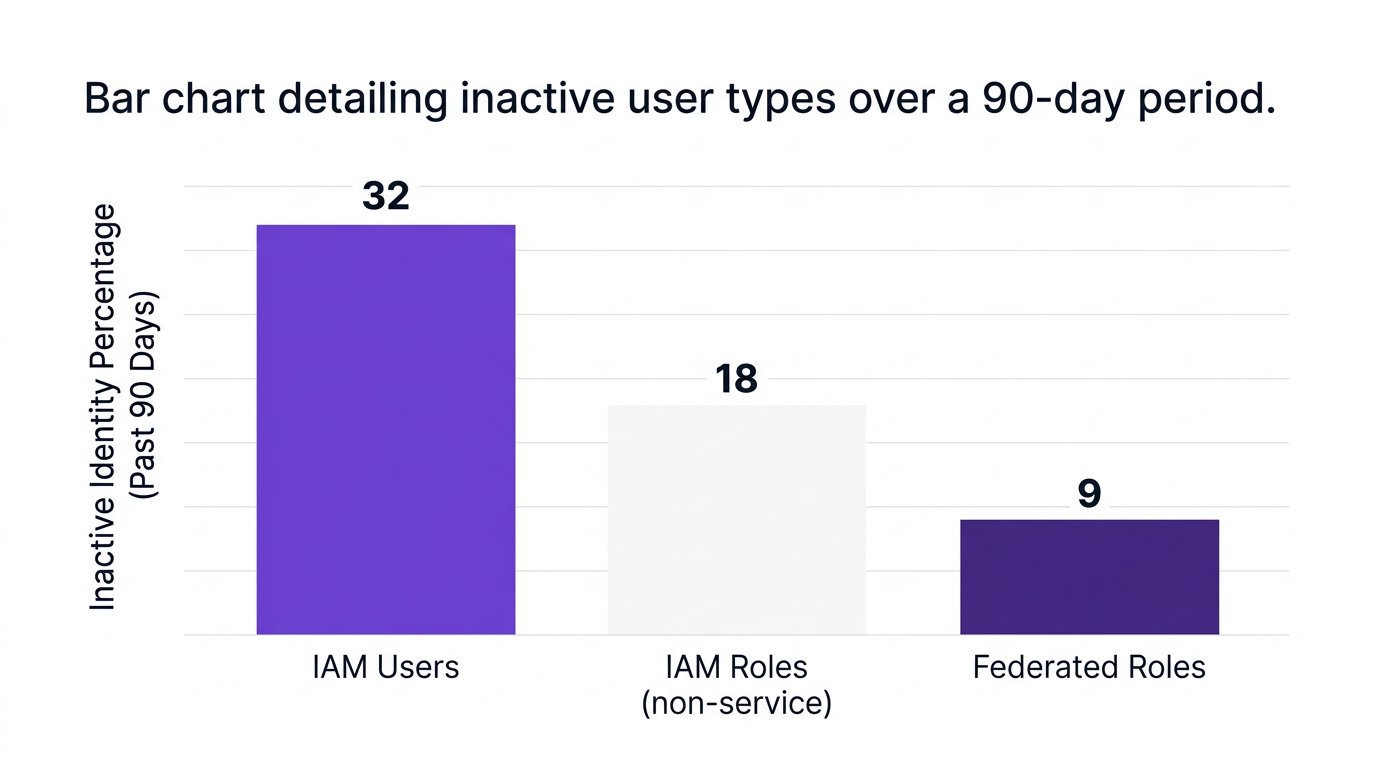
When administrators dive deep into credential usage, they often discover glaring inefficiencies. Standard audits frequently reveal that 32 percent of IAM users, 18 percent of non-service roles, and 9 percent of federated roles remain inactive over a 90-day period. Cleaning up these orphaned identities is the first stage of a successful certification campaign.
Transitioning from messy, manual checks to a streamlined AWS user access review process requires coordination. Follow this exact workflow to conduct an audit that stands up to regulatory scrutiny while minimizing friction for internal development teams.
Before launching a review, you must define the boundaries. Will you audit all accounts globally, or focus solely on the production environments governed by strict compliance standards like PCI-DSS or SOX? Establish clear success metrics. Document the exact organizational units involved and identify the business owners responsible for validating permissions within their respective departments.
Do not rely entirely on human memory or outdated documentation. Use IAM Access Analyzer alongside intelligent posture management tools to compare requested permissions against actual usage. This gap analysis highlights every user holding excess privileges. Compile this data centrally so reviewers see exactly which rights remain dormant and therefore pose a security risk.
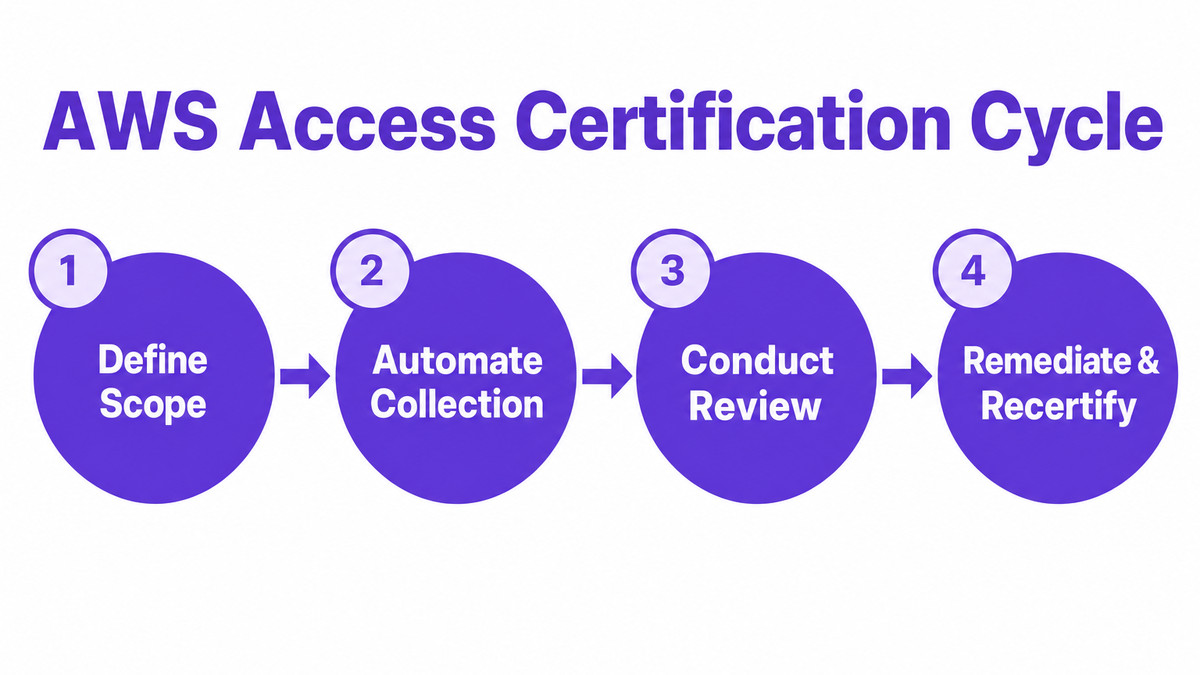
Route the refined data to the appropriate resource owners. Managers must explicitly approve or revoke access for their direct reports. Because you have enriched the review data with actual usage statistics, managers can make informed decisions rather than simply rubber-stamping requests. They will immediately see if a developer has not touched a specific database in six months.
Once the reviewers submit their decisions, execute the changes programmatically. Remove unused roles, tighten overly broad policies, and deactivate inactive user credentials immediately. Establish a scheduled AWS user recertification interval to guarantee your environment remains compliant over time.
Modern cloud security requires moving beyond post-deployment monitoring. The most mature organizations are shifting their identity validation left. By embedding IAM policy analysis directly into DevOps pipelines, security teams can evaluate permissions before the infrastructure is ever provisioned.
Implementing policy-as-code checks within continuous integration workflows prevents risky permissions from reaching the production environment. Instead of waiting for a quarterly AWS compliance checklist audit to catch errors, automated guardrails reject unsafe configurations during the code commit phase. This proactive strategy dramatically reduces the workload during formal review periods and ensures that IT security remains constantly vigilant.
Securing sprawling IT environments requires centralized visibility. CloudNuro delivers an award-winning UI and orchestration layer designed to streamline standard governance activities. The Unified Cloud Custodian functions as a central dashboard that aggregates findings from your cloud logs, explicitly targeting unused permissions to simplify review cycles.
Tracking identities is only half the battle. Our AI Custodian uses deep intelligence to detect policy drift, visualizing privilege risks and automatically compiling the evidence required by external auditors. By moving away from slow, manual tracking methods, compliance frameworks become fundamentally resilient.
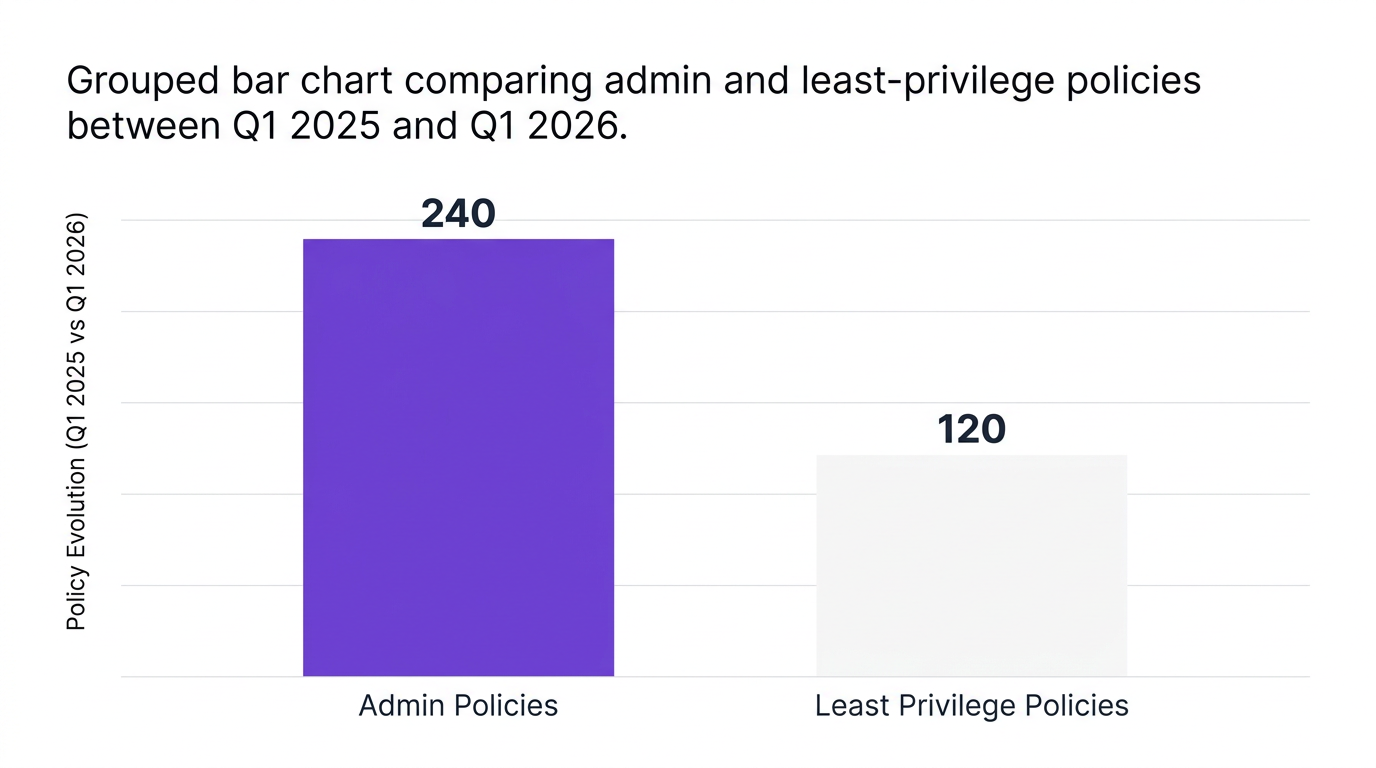
The results of automation speak clearly. Applying intelligent workflows reduces administrative overhead dramatically. Standard implementation metrics show a 50 percent reduction in admin-like policies and an 80 percent reduction in over-privileged users within the first year.
Furthermore, the CloudNuro Chargeback and FinOps Services modules enrich this data. By mapping validated roles and identities directly to departmental cost centers, finance teams can enforce accurate IT operations chargebacks. This joint visibility ensures your organization exercises strict financial discipline alongside its security mandates.
Running an audit involves gathering credential reports, analyzing active versus dormant permissions using access analyzers, and distributing this data to managers. The managers then verify if their team members still require these privileges. Once decided, IT operations immediately revoca any unneeded access.
The primary purpose is mitigating risk by enforcing the principle of least privilege. Regular audits ensure that employees hold only the bare minimum permissions necessary to execute their daily tasks, ultimately fulfilling SaaS management and compliance obligations.
Enterprises should perform complete organizational reviews at least quarterly. However, high-risk administrative roles and permissions mapping to sensitive production data warrant continuous, automated monitoring to prevent unauthorized access.
The essential steps include defining the audit scope, discovering existing permissions, analyzing historical usage to identify necessary versus excessive access, distributing findings for managerial approval, and implementing the required remediations to update user profiles.
Automation replaces error-prone spreadsheets with intelligent routing. It instantly correlates identity data with real-world usage logs, routes approval requests directly to the correct business owner, and automatically executes policy remediations the moment an audit concludes.
Executing a meticulous and automated AWS access review process shields your business from internal vulnerabilities and external threats. When you replace manual guesses with data-driven access certifications, you protect critical infrastructure. Centralizing visibility across all platforms allows your IT operations to operate efficiently, securely, and within strictly defined budgets.
About CloudNuro
CloudNuro is a leader in Enterprise SaaS Management Platforms, providing enterprises with unmatched visibility, governance, and cost optimization. Recognized twice in a row in the SaaS Management Platforms category and named a Leader in the SoftwareReviews Data Quadrant, CloudNuro is trusted by global enterprises and government agencies to bring financial discipline to SaaS, cloud, and AI. Trusted by enterprises such as Konica Minolta and Federal Signal, CloudNuro provides centralized SaaS inventory, license optimization, and renewal management along with advanced cost allocation and chargeback, giving IT and Finance leaders the visibility, control, and cost-conscious culture needed to drive financial discipline.
Request a no cost, no obligation free assessment —just 15 minutes to savings!
Get StartedManaging permissions across a sprawling infrastructure demands absolute precision. An AWS access review is no longer a periodic check box for compliance teams. It is a fundamental operational necessity to prevent data breaches and control cloud computing costs. As enterprises expand their digital footprints, tracking exactly who has access to which resource becomes incredibly complex. Manual audits relying on static spreadsheets consistently fail to capture the reality of dynamic cloud permissions.
This comprehensive guide explores the exact phases required to build a highly secure, automated authorization framework. IT security and operations leaders will learn how to shift from reactive audits to proactive, continuous governance. By enforcing strict access controls, your engineering teams can maintain agility without sacrificing corporate security or failing critical compliance audits.
The scale of modern cloud platforms makes manual oversight impossible. According to current platform documentation, AWS had 188 services in scope for its Spring 2026 SOC reporting period (AWS SOC Report 2026). This immense compliance surface means that unused roles, abandoned user accounts, and over-provisioned permissions present significant risks to enterprise data.
Quarterly reviews of IAM group memberships and the continuous automated monitoring of unused permissions are now standardized best practices for compliance. Without formalized oversight, the consequences of identity sprawl compound quickly. Gartner projects that 70 percent of identity-first security strategies will fail by 2026 unless organizations adopt continuous, context-based access controls (Gartner 2026).
Enforcing an automated framework dramatically improves basic security hygiene. Internal benchmarking shows that implementing continuous reviews drives MFA device coverage from 52 percent up to 88 percent over a 12-month period. Maintaining this level of operational discipline ensures that cloud investments remain secure while meeting the rigorous demands of external auditors.
An effective AWS identity and access management audit evaluates who holds access, how those privileges are provisioned, and what activities those users perform. The primary goal is achieving the principle of least privilege. Unfortunately, current benchmarking data reveals that more than 70 percent of companies maintain overly permissive administrative roles (2026 Industry Security Benchmark).
To combat this, teams must focus on three primary data sources during their audit cycles:
IAM Access Analyzer: This utility offers organization-wide policy analysis to automatically identify unused permissions based on historical activity.
AWS CloudTrail: The definitive log of API calls. CloudTrail provides the empirical proof of what permissions a user or service actually executes.
Service Control Policies (SCPs): These provide organizational guardrails. Reviewing SCPs ensures that even if an individual account administrator grants excessive permissions locally, the organization-wide boundary prevents high-risk actions.
When administrators dive deep into credential usage, they often discover glaring inefficiencies. Standard audits frequently reveal that 32 percent of IAM users, 18 percent of non-service roles, and 9 percent of federated roles remain inactive over a 90-day period. Cleaning up these orphaned identities is the first stage of a successful certification campaign.
Transitioning from messy, manual checks to a streamlined AWS user access review process requires coordination. Follow this exact workflow to conduct an audit that stands up to regulatory scrutiny while minimizing friction for internal development teams.
Before launching a review, you must define the boundaries. Will you audit all accounts globally, or focus solely on the production environments governed by strict compliance standards like PCI-DSS or SOX? Establish clear success metrics. Document the exact organizational units involved and identify the business owners responsible for validating permissions within their respective departments.
Do not rely entirely on human memory or outdated documentation. Use IAM Access Analyzer alongside intelligent posture management tools to compare requested permissions against actual usage. This gap analysis highlights every user holding excess privileges. Compile this data centrally so reviewers see exactly which rights remain dormant and therefore pose a security risk.
Route the refined data to the appropriate resource owners. Managers must explicitly approve or revoke access for their direct reports. Because you have enriched the review data with actual usage statistics, managers can make informed decisions rather than simply rubber-stamping requests. They will immediately see if a developer has not touched a specific database in six months.
Once the reviewers submit their decisions, execute the changes programmatically. Remove unused roles, tighten overly broad policies, and deactivate inactive user credentials immediately. Establish a scheduled AWS user recertification interval to guarantee your environment remains compliant over time.
Modern cloud security requires moving beyond post-deployment monitoring. The most mature organizations are shifting their identity validation left. By embedding IAM policy analysis directly into DevOps pipelines, security teams can evaluate permissions before the infrastructure is ever provisioned.
Implementing policy-as-code checks within continuous integration workflows prevents risky permissions from reaching the production environment. Instead of waiting for a quarterly AWS compliance checklist audit to catch errors, automated guardrails reject unsafe configurations during the code commit phase. This proactive strategy dramatically reduces the workload during formal review periods and ensures that IT security remains constantly vigilant.
Securing sprawling IT environments requires centralized visibility. CloudNuro delivers an award-winning UI and orchestration layer designed to streamline standard governance activities. The Unified Cloud Custodian functions as a central dashboard that aggregates findings from your cloud logs, explicitly targeting unused permissions to simplify review cycles.
Tracking identities is only half the battle. Our AI Custodian uses deep intelligence to detect policy drift, visualizing privilege risks and automatically compiling the evidence required by external auditors. By moving away from slow, manual tracking methods, compliance frameworks become fundamentally resilient.
The results of automation speak clearly. Applying intelligent workflows reduces administrative overhead dramatically. Standard implementation metrics show a 50 percent reduction in admin-like policies and an 80 percent reduction in over-privileged users within the first year.
Furthermore, the CloudNuro Chargeback and FinOps Services modules enrich this data. By mapping validated roles and identities directly to departmental cost centers, finance teams can enforce accurate IT operations chargebacks. This joint visibility ensures your organization exercises strict financial discipline alongside its security mandates.
Running an audit involves gathering credential reports, analyzing active versus dormant permissions using access analyzers, and distributing this data to managers. The managers then verify if their team members still require these privileges. Once decided, IT operations immediately revoca any unneeded access.
The primary purpose is mitigating risk by enforcing the principle of least privilege. Regular audits ensure that employees hold only the bare minimum permissions necessary to execute their daily tasks, ultimately fulfilling SaaS management and compliance obligations.
Enterprises should perform complete organizational reviews at least quarterly. However, high-risk administrative roles and permissions mapping to sensitive production data warrant continuous, automated monitoring to prevent unauthorized access.
The essential steps include defining the audit scope, discovering existing permissions, analyzing historical usage to identify necessary versus excessive access, distributing findings for managerial approval, and implementing the required remediations to update user profiles.
Automation replaces error-prone spreadsheets with intelligent routing. It instantly correlates identity data with real-world usage logs, routes approval requests directly to the correct business owner, and automatically executes policy remediations the moment an audit concludes.
Executing a meticulous and automated AWS access review process shields your business from internal vulnerabilities and external threats. When you replace manual guesses with data-driven access certifications, you protect critical infrastructure. Centralizing visibility across all platforms allows your IT operations to operate efficiently, securely, and within strictly defined budgets.
About CloudNuro
CloudNuro is a leader in Enterprise SaaS Management Platforms, providing enterprises with unmatched visibility, governance, and cost optimization. Recognized twice in a row in the SaaS Management Platforms category and named a Leader in the SoftwareReviews Data Quadrant, CloudNuro is trusted by global enterprises and government agencies to bring financial discipline to SaaS, cloud, and AI. Trusted by enterprises such as Konica Minolta and Federal Signal, CloudNuro provides centralized SaaS inventory, license optimization, and renewal management along with advanced cost allocation and chargeback, giving IT and Finance leaders the visibility, control, and cost-conscious culture needed to drive financial discipline.
Request a no cost, no obligation free assessment - just 15 minutes to savings!
Get StartedWe're offering complimentary ServiceNow license assessments to only 25 enterprises this quarter who want to unlock immediate savings without disrupting operations.
Get Free AssessmentGet Started




CloudNuro Corp
1755 Park St. Suite 207
Naperville, IL 60563
Phone : +1-630-277-9470
Email: info@cloudnuro.com




.webp)

Recognized Leader in SaaS Management Platforms by Info-Tech SoftwareReviews


.svg)