

Sign Up
Thank you for Submitting!

Optimizing the cost, performance, and governance of Power BI deployments involves critical decisions about data storage and query modes. Technology leaders evaluating Microsoft Fabric Semantic Models must weigh Import, DirectQuery, and Direct Lake options, each with unique impact on scale, data freshness, and finance. For organizations in highly regulated sectors, striking the right balance ensures robust business insights without spiraling platform spend. This guide delivers a practical framework for choosing the mode that fits your needs and highlights how CloudNuro’s FinOps Services and governance-first architecture turn mode selection into a strategic advantage.
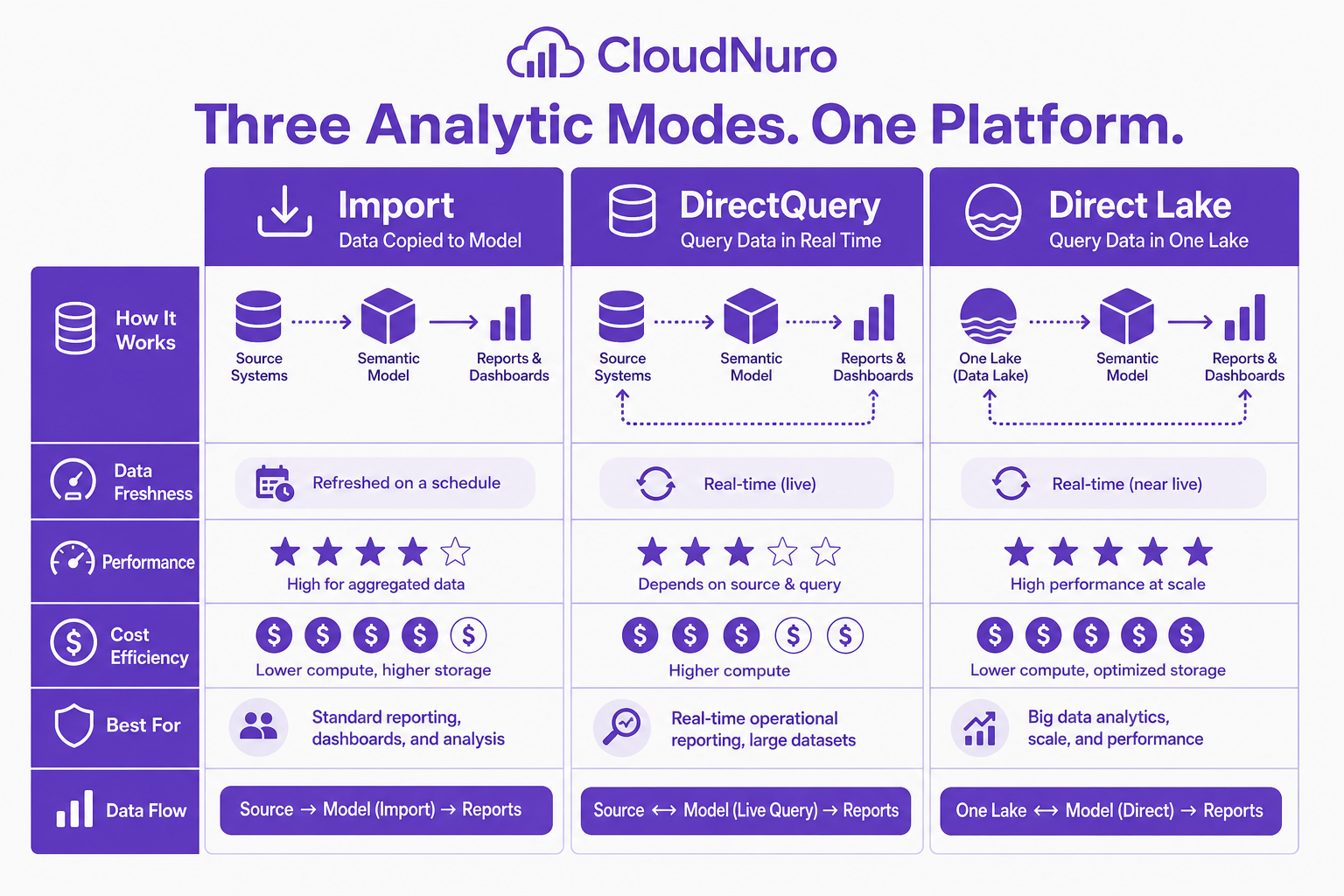
When building or modernizing semantic models in Microsoft Fabric, most leaders face a choice among Import, DirectQuery, and Direct Lake modes. Each mode represents a different approach to data access, latency, and resource utilization.
Import Mode: Imports data directly into a Power BI or Fabric model. Data is refreshed on a scheduled basis. Delivers the highest query performance but demands storage and increased refresh-driven compute activity, especially with gigabyte, or terabyte-scale models.
DirectQuery Mode: Leaves data in the source system, sending queries live whenever a report runs. Useful for real-time insights and up-to-second information, but can strain back-end sources and introduce variable performance subject to network and infrastructure bottlenecks.
Direct Lake Mode: A Fabric-native innovation, Direct Lake streams data from OneLake storage directly into the semantic model without staging or full refreshes. Prominent for large datasets, it supports near real-time freshness while minimizing compute and storage costs by avoiding unnecessary data movement.
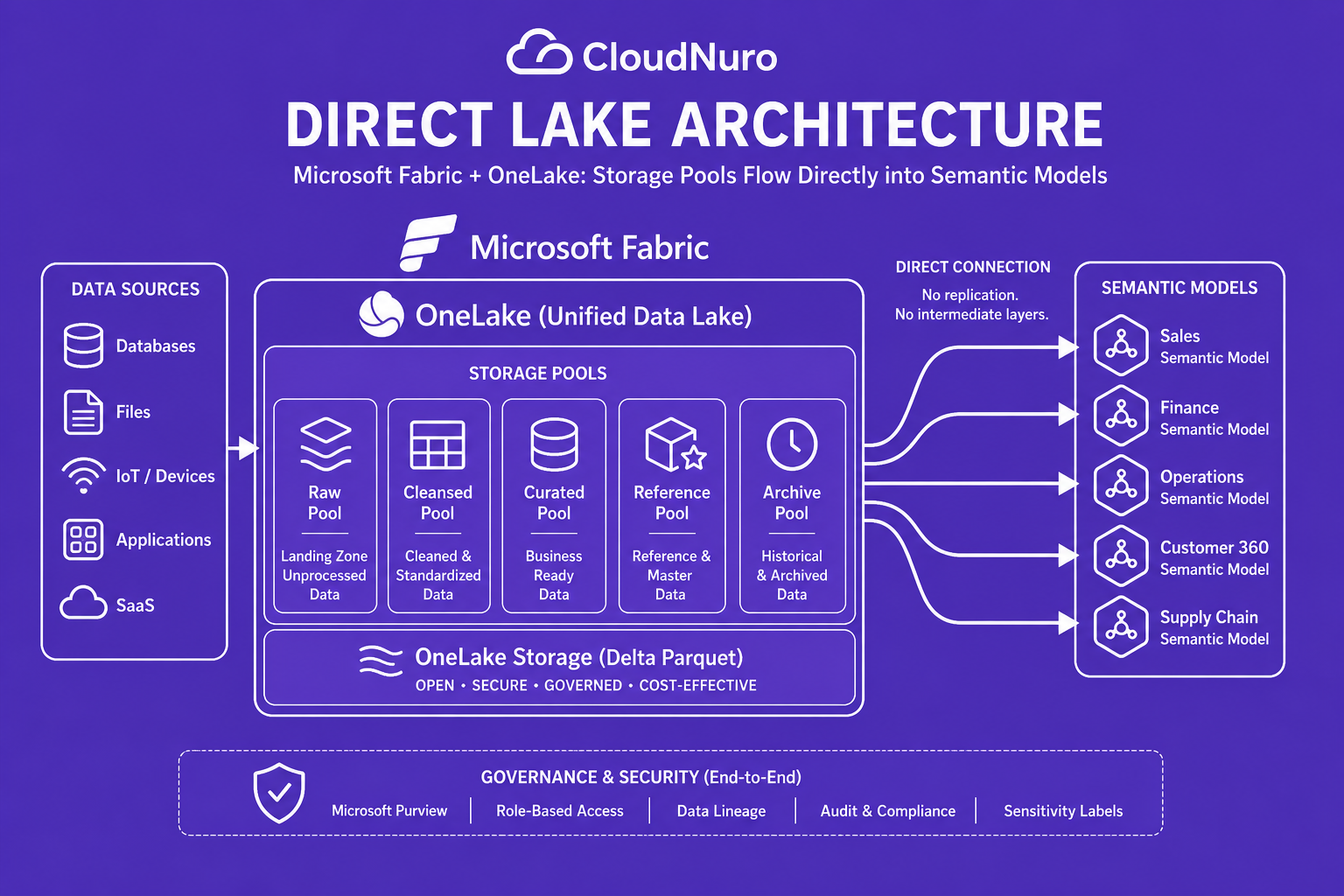
Import Mode: Offers predictable performance, but data duplication inflates storage costs and ongoing capacity consumption. Full-copy refreshes can generate surprising compute expenses with larger models, particularly for compliance workloads.
DirectQuery Mode: Reduces storage costs and offers on-demand usage, but exposes organizations to unpredictable query loads and possible back-end overages, especially during concurrent reporting peaks.
Direct Lake Mode: Reduces both storage and compute costs by sourcing data directly from OneLake tiers. Optimized models leverage cost efficiencies, especially when combined with intelligent data tiering across hot, cool, and cold storage.

Migrating 10 terabytes of compliance data from hot to cold storage cuts five-year storage costs from $13,800 to just $2,400.
Performance requirements often shape storage mode decisions. Import mode typically gives the fastest report interactions due to in-memory analytics, but refresh time can become a problem for very large datasets. DirectQuery depends on source performance and networking, potentially leading to slow dashboards. Direct Lake, on the other hand, offers near real-time responsiveness by streaming data from OneLake, supporting modern analytics requirements with minimal refresh overhead.
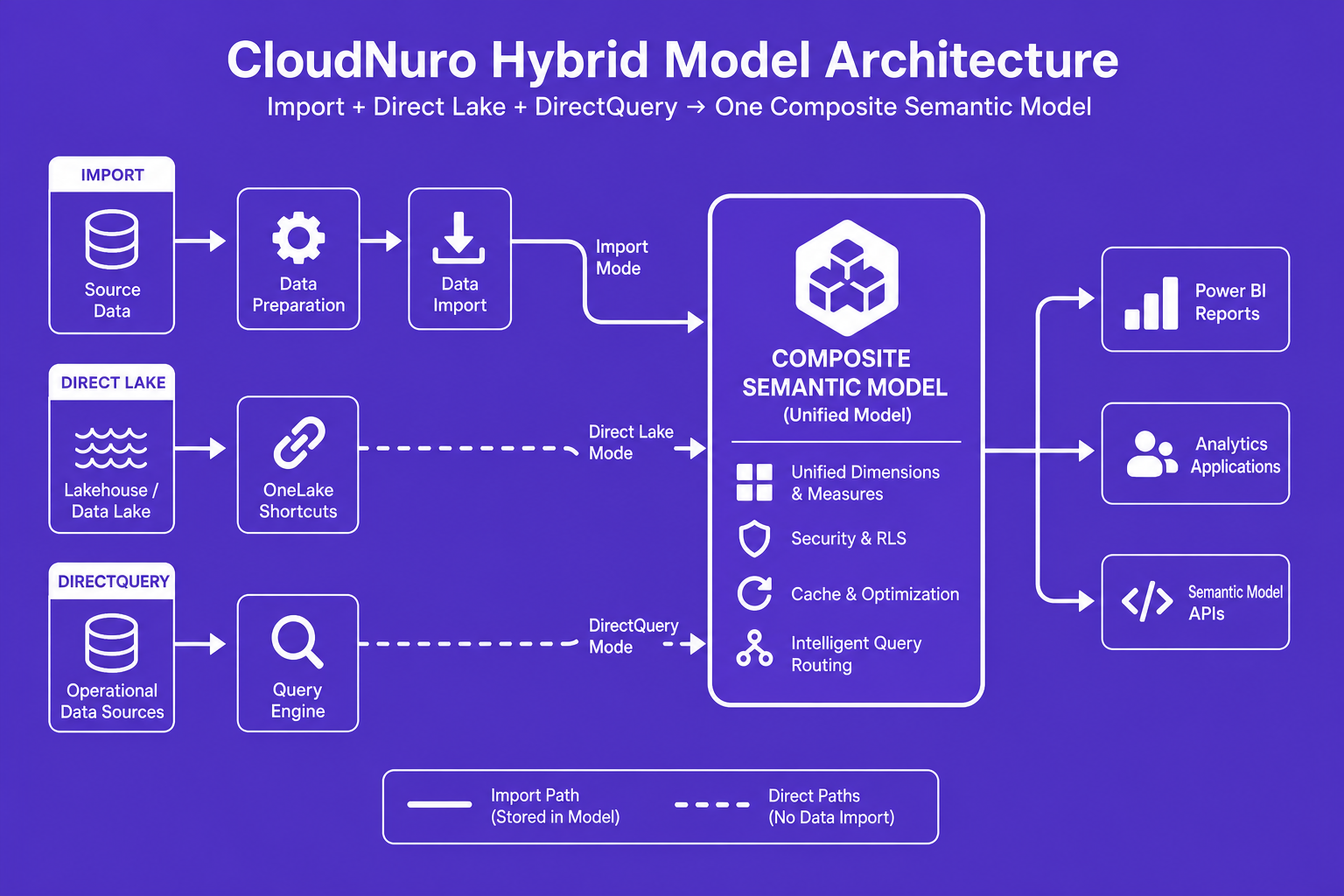
Optimal Case: Many enterprises maximize value by blending Import mode for small, frequently used dimensions or calculated tables with Direct Lake for large fact tables, a hybrid composite model that optimizes speed and cost.
In regulated industries like healthcare and finance, governance, role-based controls, and compliance auditing cannot be afterthoughts. CloudNuro’s platform supports secure semantic models by mapping analytic capacity use, tracking license allocation, and providing granular chargeback to business units for stronger budget discipline. This ensures that as data moves between modes or storage tiers, governance stays intact, critical in a shared enterprise analytics ecosystem.
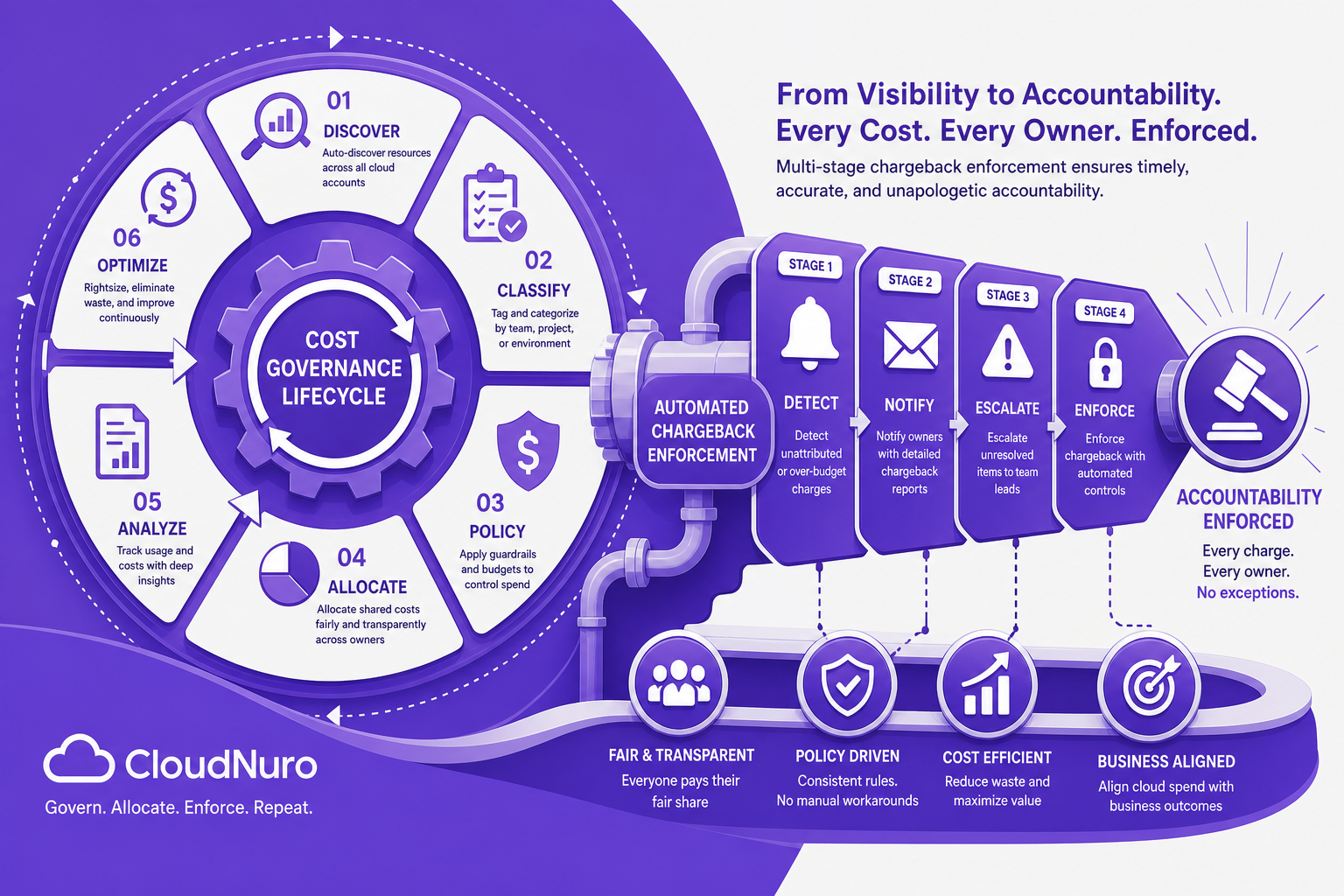
Semantic model optimization does not end with mode selection. Efficient capacity allocation, lifecycle management, and policy enforcement are all essential for cost optimization, security, and compliance.
CloudNuro’s Unified Cloud Custodian consolidates all Power BI and Fabric licenses, capacity units, and analytic workspaces into a unified console. AI-powered policy engines identify inflated models and suggest or automate compression actions. Administrators can:
Discover and migrate heavy-use workspaces from PPU to Fabric Capacity for lower bulk rates
Track analytic consumption and enforce chargeback to specific departments or business units
Automate lifecycle rules to move rarely-accessed data to lower-cost storage

Enterprise teams using CloudNuro's FinOps Services realized a 36% drop in analytics platform spend and a 45% cut in unused capacity hours after rightsizing.
Market adoption patterns show that leading enterprises are shifting toward composite architectures, mixing Direct Lake, Import, and DirectQuery modes as workload needs dictate:
Hybrid Use: Direct Lake for scalable fact tables, Import for fast access to dimension and calculation tables, and DirectQuery for connections to highly dynamic or transactional sources.
Continuous Optimization: Reserved capacity, automated lifecycle management, and intelligent data tiering drive down ongoing costs without sacrificing analytic power or freshness.
CloudNuro’s governance-first controls and automated cost optimization empower IT leaders to balance innovation and accountability, enabling the flexible use of all mode types, without the risk of unmanaged sprawl or compliance gaps.
Start with Direct Lake for new Fabric models leveraging large or semi-structured datasets in OneLake.
Apply Import Mode strategically for small, high-refresh tables and business-critical calculations.
Reserve DirectQuery for datasets needing real-time feeds where latency is critical and data is constantly changing.
Integrate cost control and lifecycle policies using automated platforms like CloudNuro to prevent cost overruns and support security requirements.
Iterate and Monitor: Regularly review consumption, model sizes, and data freshness as part of a governance cycle.
Import replicates the data into Power BI’s in-memory engine for high performance, refreshed on schedule. DirectQuery leaves data at source, querying on-the-fly for each interaction. Direct Lake streams data directly from OneLake, blending performance and freshness without bulk refreshes or full data copies.
Start by assessing your data size, update frequency, and cost tolerance. Direct Lake fits large or fast-changing datasets needing freshness and efficiency. Import is best for static, small, or mission-critical tables. DirectQuery is a fit for niche real-time requirements but can strain source systems.
Direct Lake mode avoids costly data movement and supports efficient tiered storage (hot/cool/cold). This reduces both storage and compute costs, especially when governed by chargeback and use detection policies.
Direct Lake generally provides the ideal balance for large datasets, combining high responsiveness with minimal overhead. For lighter or business-critical tables, Import mode may outperform in specific scenarios; hybrid models can maximize both speed and efficiency.
Direct Lake excels in organizations using OneLake, where real-time reporting from large, rapidly updated datasets is required without sacrificing cost control or governance.
CloudNuro stands apart by fusing automated cost optimization, granular chargeback, and unified governance into every BI architecture decision. Organizations embracing Direct Lake or hybrid semantic model modes receive real-time capacity mapping, AI-enforced policy controls, and automated lifecycle management. The result: streamlined analytics, robust compliance, and maximized value from every capacity dollar spent.
Learn more about CloudNuro’s FinOps Services, or explore our IT Operations and IT Asset Management solutions for deeper visibility and governance across your Power BI estate.
CloudNuro is a leader in Enterprise AI Adoption Management, providing enterprises with unmatched visibility, governance, and cost optimization. Recognized twice in a row in the SaaS Management Platforms category and named a Leader in the SoftwareReviews Data Quadrant, CloudNuro is trusted by global enterprises and government agencies to bring financial discipline to SaaS, cloud, and AI. Trusted by enterprises, CloudNuro provides centralized SaaS inventory, license optimization, and renewal management along with advanced cost allocation and chargeback, giving IT and Finance leaders the visibility, control, and cost-conscious culture needed to drive financial discipline.
Request a no cost, no obligation free assessment —just 15 minutes to savings!
Get StartedOptimizing the cost, performance, and governance of Power BI deployments involves critical decisions about data storage and query modes. Technology leaders evaluating Microsoft Fabric Semantic Models must weigh Import, DirectQuery, and Direct Lake options, each with unique impact on scale, data freshness, and finance. For organizations in highly regulated sectors, striking the right balance ensures robust business insights without spiraling platform spend. This guide delivers a practical framework for choosing the mode that fits your needs and highlights how CloudNuro’s FinOps Services and governance-first architecture turn mode selection into a strategic advantage.
When building or modernizing semantic models in Microsoft Fabric, most leaders face a choice among Import, DirectQuery, and Direct Lake modes. Each mode represents a different approach to data access, latency, and resource utilization.
Import Mode: Imports data directly into a Power BI or Fabric model. Data is refreshed on a scheduled basis. Delivers the highest query performance but demands storage and increased refresh-driven compute activity, especially with gigabyte, or terabyte-scale models.
DirectQuery Mode: Leaves data in the source system, sending queries live whenever a report runs. Useful for real-time insights and up-to-second information, but can strain back-end sources and introduce variable performance subject to network and infrastructure bottlenecks.
Direct Lake Mode: A Fabric-native innovation, Direct Lake streams data from OneLake storage directly into the semantic model without staging or full refreshes. Prominent for large datasets, it supports near real-time freshness while minimizing compute and storage costs by avoiding unnecessary data movement.
Import Mode: Offers predictable performance, but data duplication inflates storage costs and ongoing capacity consumption. Full-copy refreshes can generate surprising compute expenses with larger models, particularly for compliance workloads.
DirectQuery Mode: Reduces storage costs and offers on-demand usage, but exposes organizations to unpredictable query loads and possible back-end overages, especially during concurrent reporting peaks.
Direct Lake Mode: Reduces both storage and compute costs by sourcing data directly from OneLake tiers. Optimized models leverage cost efficiencies, especially when combined with intelligent data tiering across hot, cool, and cold storage.
Migrating 10 terabytes of compliance data from hot to cold storage cuts five-year storage costs from $13,800 to just $2,400.
Performance requirements often shape storage mode decisions. Import mode typically gives the fastest report interactions due to in-memory analytics, but refresh time can become a problem for very large datasets. DirectQuery depends on source performance and networking, potentially leading to slow dashboards. Direct Lake, on the other hand, offers near real-time responsiveness by streaming data from OneLake, supporting modern analytics requirements with minimal refresh overhead.
Optimal Case: Many enterprises maximize value by blending Import mode for small, frequently used dimensions or calculated tables with Direct Lake for large fact tables, a hybrid composite model that optimizes speed and cost.
In regulated industries like healthcare and finance, governance, role-based controls, and compliance auditing cannot be afterthoughts. CloudNuro’s platform supports secure semantic models by mapping analytic capacity use, tracking license allocation, and providing granular chargeback to business units for stronger budget discipline. This ensures that as data moves between modes or storage tiers, governance stays intact, critical in a shared enterprise analytics ecosystem.
Semantic model optimization does not end with mode selection. Efficient capacity allocation, lifecycle management, and policy enforcement are all essential for cost optimization, security, and compliance.
CloudNuro’s Unified Cloud Custodian consolidates all Power BI and Fabric licenses, capacity units, and analytic workspaces into a unified console. AI-powered policy engines identify inflated models and suggest or automate compression actions. Administrators can:
Discover and migrate heavy-use workspaces from PPU to Fabric Capacity for lower bulk rates
Track analytic consumption and enforce chargeback to specific departments or business units
Automate lifecycle rules to move rarely-accessed data to lower-cost storage
Enterprise teams using CloudNuro's FinOps Services realized a 36% drop in analytics platform spend and a 45% cut in unused capacity hours after rightsizing.
Market adoption patterns show that leading enterprises are shifting toward composite architectures, mixing Direct Lake, Import, and DirectQuery modes as workload needs dictate:
Hybrid Use: Direct Lake for scalable fact tables, Import for fast access to dimension and calculation tables, and DirectQuery for connections to highly dynamic or transactional sources.
Continuous Optimization: Reserved capacity, automated lifecycle management, and intelligent data tiering drive down ongoing costs without sacrificing analytic power or freshness.
CloudNuro’s governance-first controls and automated cost optimization empower IT leaders to balance innovation and accountability, enabling the flexible use of all mode types, without the risk of unmanaged sprawl or compliance gaps.
Start with Direct Lake for new Fabric models leveraging large or semi-structured datasets in OneLake.
Apply Import Mode strategically for small, high-refresh tables and business-critical calculations.
Reserve DirectQuery for datasets needing real-time feeds where latency is critical and data is constantly changing.
Integrate cost control and lifecycle policies using automated platforms like CloudNuro to prevent cost overruns and support security requirements.
Iterate and Monitor: Regularly review consumption, model sizes, and data freshness as part of a governance cycle.
Import replicates the data into Power BI’s in-memory engine for high performance, refreshed on schedule. DirectQuery leaves data at source, querying on-the-fly for each interaction. Direct Lake streams data directly from OneLake, blending performance and freshness without bulk refreshes or full data copies.
Start by assessing your data size, update frequency, and cost tolerance. Direct Lake fits large or fast-changing datasets needing freshness and efficiency. Import is best for static, small, or mission-critical tables. DirectQuery is a fit for niche real-time requirements but can strain source systems.
Direct Lake mode avoids costly data movement and supports efficient tiered storage (hot/cool/cold). This reduces both storage and compute costs, especially when governed by chargeback and use detection policies.
Direct Lake generally provides the ideal balance for large datasets, combining high responsiveness with minimal overhead. For lighter or business-critical tables, Import mode may outperform in specific scenarios; hybrid models can maximize both speed and efficiency.
Direct Lake excels in organizations using OneLake, where real-time reporting from large, rapidly updated datasets is required without sacrificing cost control or governance.
CloudNuro stands apart by fusing automated cost optimization, granular chargeback, and unified governance into every BI architecture decision. Organizations embracing Direct Lake or hybrid semantic model modes receive real-time capacity mapping, AI-enforced policy controls, and automated lifecycle management. The result: streamlined analytics, robust compliance, and maximized value from every capacity dollar spent.
Learn more about CloudNuro’s FinOps Services, or explore our IT Operations and IT Asset Management solutions for deeper visibility and governance across your Power BI estate.
CloudNuro is a leader in Enterprise AI Adoption Management, providing enterprises with unmatched visibility, governance, and cost optimization. Recognized twice in a row in the SaaS Management Platforms category and named a Leader in the SoftwareReviews Data Quadrant, CloudNuro is trusted by global enterprises and government agencies to bring financial discipline to SaaS, cloud, and AI. Trusted by enterprises, CloudNuro provides centralized SaaS inventory, license optimization, and renewal management along with advanced cost allocation and chargeback, giving IT and Finance leaders the visibility, control, and cost-conscious culture needed to drive financial discipline.
Request a no cost, no obligation free assessment - just 15 minutes to savings!
Get StartedWe're offering complimentary ServiceNow license assessments to only 25 enterprises this quarter who want to unlock immediate savings without disrupting operations.
Get Free AssessmentGet Started




CloudNuro Corp
1755 Park St. Suite 207
Naperville, IL 60563
Phone : +1-630-277-9470
Email: info@cloudnuro.com





.webp)

Recognized Leader in SaaS Management Platforms by Info-Tech SoftwareReviews



.svg)