

Sign Up
Thank you for Submitting!
In the age of generative AI, enterprises are accelerating large language model (LLM) deployments across industries such as healthcare, finance, government, and beyond. As LLMs move from pilot projects to production workflows, one requirement has emerged as non-negotiable: LLM observability.
For CIOs, CTOs, and IT leaders, observability means more than just system uptime. It is now foundational for tracking performance, ensuring robust compliance, and, critically, driving financial discipline around AI. This comprehensive guide breaks down why LLM observability matters, the unique challenges it solves, and how innovators like CloudNuro deliver the visibility, governance, and cost optimization that modern enterprises demand.
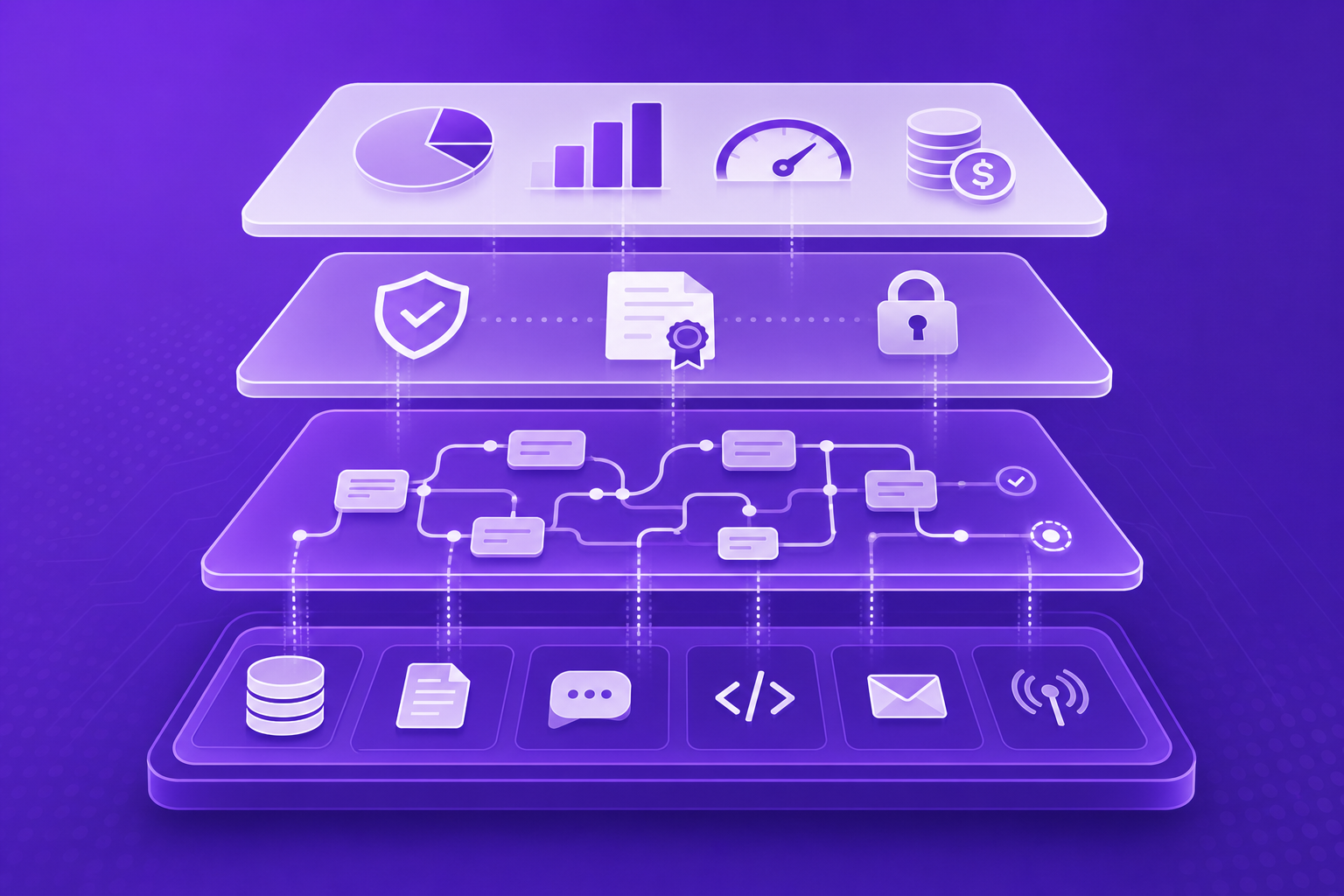
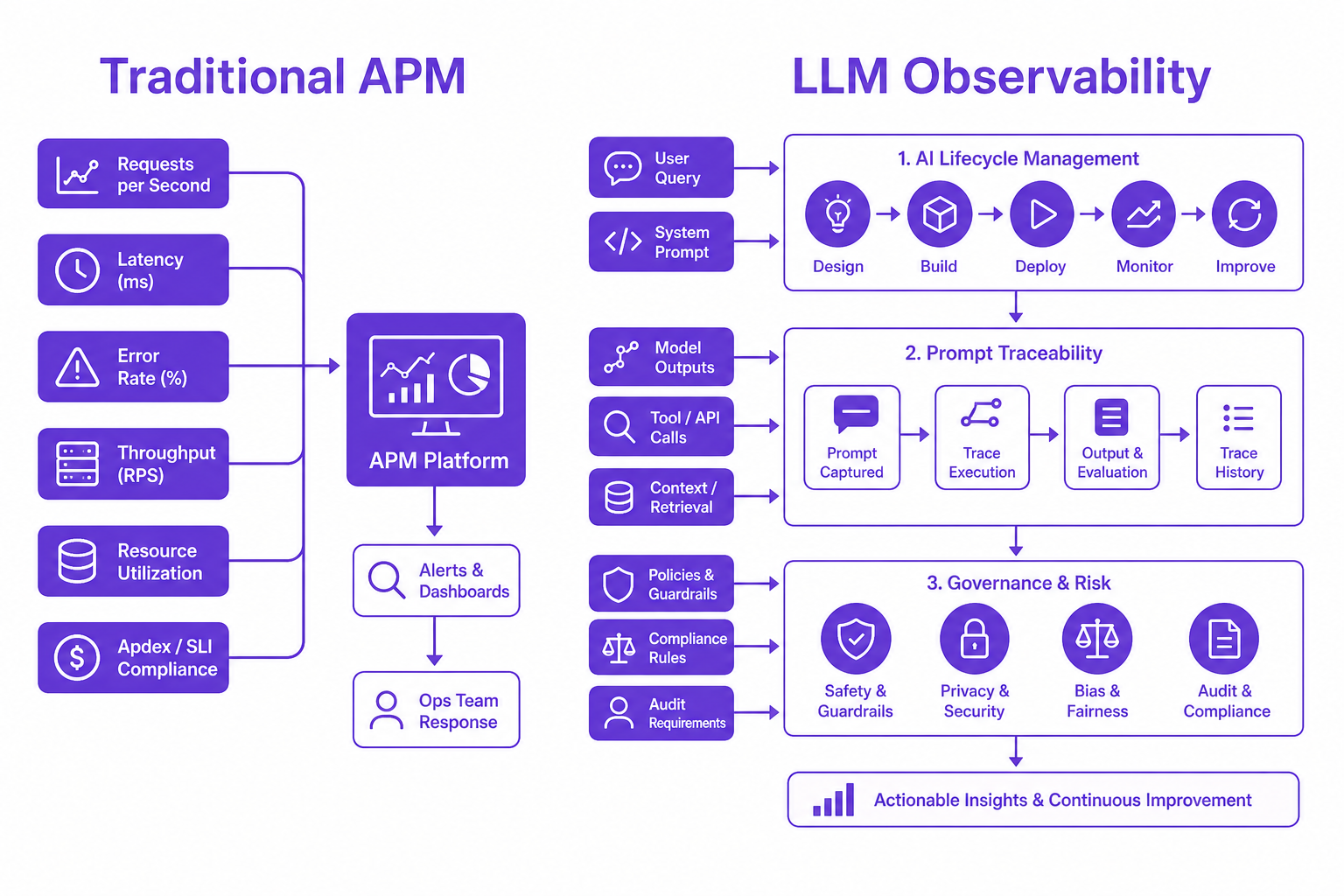
LLM observability refers to the end-to-end monitoring, analysis, and governance of large language model behavior across the full AI lifecycle. Unlike traditional application monitoring, LLM observability encompasses:
Prompt and response traceability for analyzing every AI interaction;
Token and latency monitoring to optimize speed and cost;
Drift and hallucination detection for consistent model quality;
Compliance and safety guardrails for sensitive data handling.
This approach gives IT and operations leaders the power to:
See precisely how and where LLMs are used across cloud and SaaS environments;
Detect risk factors like data drift, prompt abuse, and potential policy violations in real time;
Attribute AI activity and costs down to individual projects or users, supporting effective FinOps for AI.
Enterprises need more than simple uptime stats, they need actionable intelligence across every dimension of model operations.
LLM workloads introduce monitoring challenges that far surpass those of legacy software and infrastructure. Static dashboards of logs and metrics are insufficient. With LLMs, enterprises need:
Granular usage tracking that includes prompt volumes, agent-level activity, and detailed adoption rates in common enterprise applications (Word, Excel, Teams, and more).
Automated user segmentation (power, general, low, dormant) to support license reallocation and cut SaaS costs by up to 30% in just 90 days.
Policy-driven governance that enforces security, detects oversharing of sensitive or PII data, and flags non-compliant prompts in real time.
Financial controls that enable administrators to set project- and agent-level budget thresholds, tightly mirroring internal allocations and preventing uncontrolled AI spend.
This depth of observability can rapidly pay for itself. In fact, deployments see over 1000% ROI within a year, with some realizing payback in as little as six weeks.
The rapid shift towards AI-driven operations is driving seismic changes in enterprise observability:
The LLM observability platform market is projected to grow from $510.5 million to $8.08 billion at a 31.8% CAGR.
Cloud-based deployments account for 76.3% of the segment, outpacing on-premises approaches.
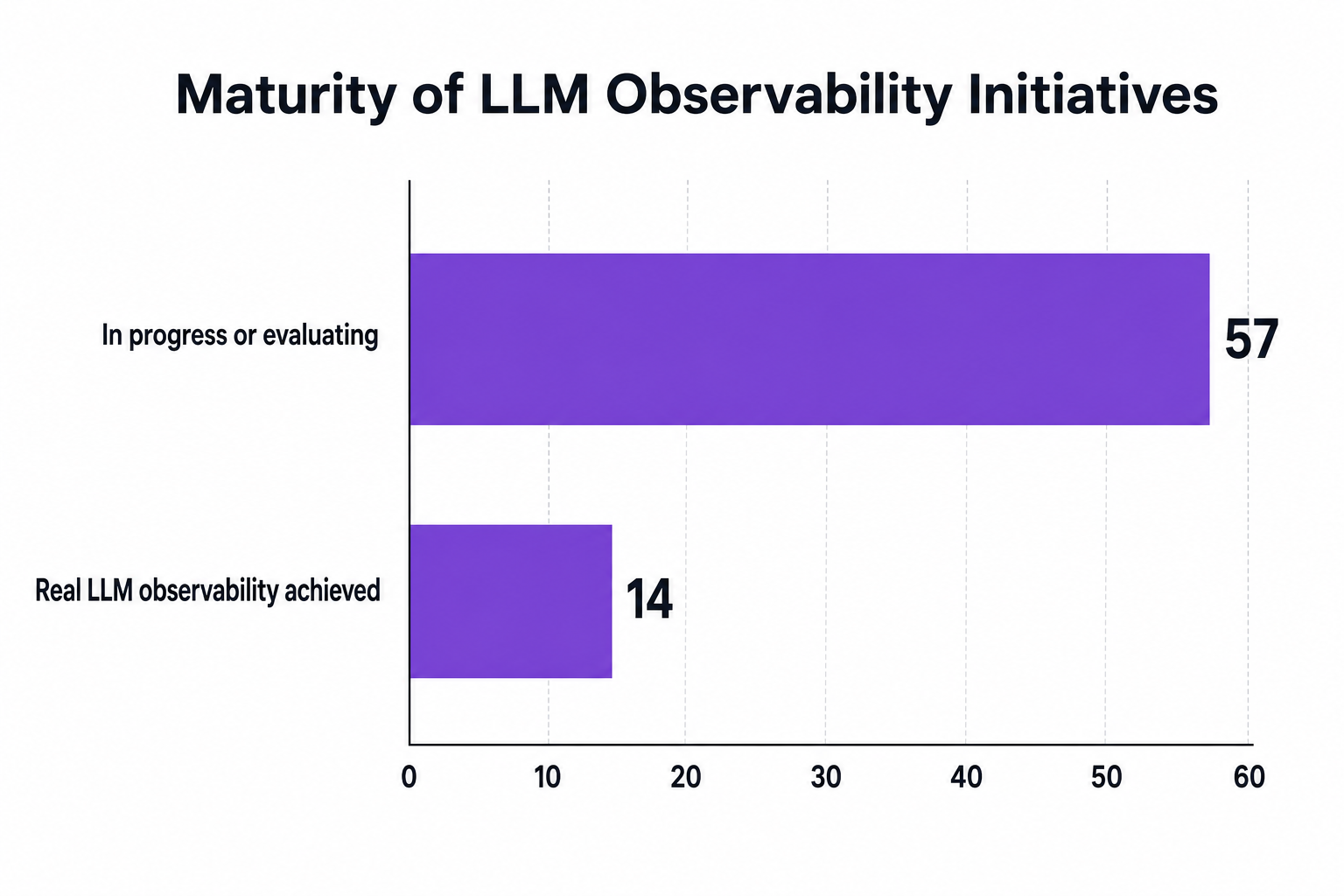
Only 14% of organizations actually claim to have true LLM observability today, even as nearly half state that 26% to 50% of observability spend now underpins AI workloads.
Key product needs have shifted to include prompt-level traceability, hallucination scoring, and robust cost/safety guardrails, not simply traditional infrastructure stats. OpenTelemetry and cross-observability integrations are rising rapidly to meet diverse enterprise needs.
Enterprises, especially those in regulated sectors, cannot afford to let AI models become black boxes. Complete, governance-first observability empowers organizations to:
Ensure ongoing compliance by detecting and stopping the flow of sensitive information (PII, legal content, regulated data) into LLM prompts;
Continuously validate model outputs and user interactions for consistency and bias, reducing operational risk;
Establish clear audit trails for every AI transaction, essential for both external compliance and internal accountability.
With job functions and departments increasingly empowered to embed LLMs into their workflows, centralized oversight is critical. No single point of view can suffice, organizations must be able to aggregate, correlate, and act on a unified governance platform.
Unmonitored LLM usage can drive spiraling SaaS and infrastructure costs, particularly with premium AI agents and variable token pricing.
CloudNuro’s AI Custodian addresses this challenge head-on by:
Tracking active users, adoption rates, and prompt volumes across all supported tools and apps;
Segregating users based on behavioral data to reclaim unused licenses and drive immediate cost reductions (customers report savings exceeding $120,000 in the first quarter alone);
Enabling project-based budgeting, token expense allocation, and granular cost controls down to individual AI agents.
One international legal firm, for example, was able to move from highly manual tracking to full visibility and FinOps model oversight, achieving over $230,000 in savings within three months.
The combination of financial transparency and automated license optimization builds an enduring cost-conscious culture across both IT and line-of-business departments.
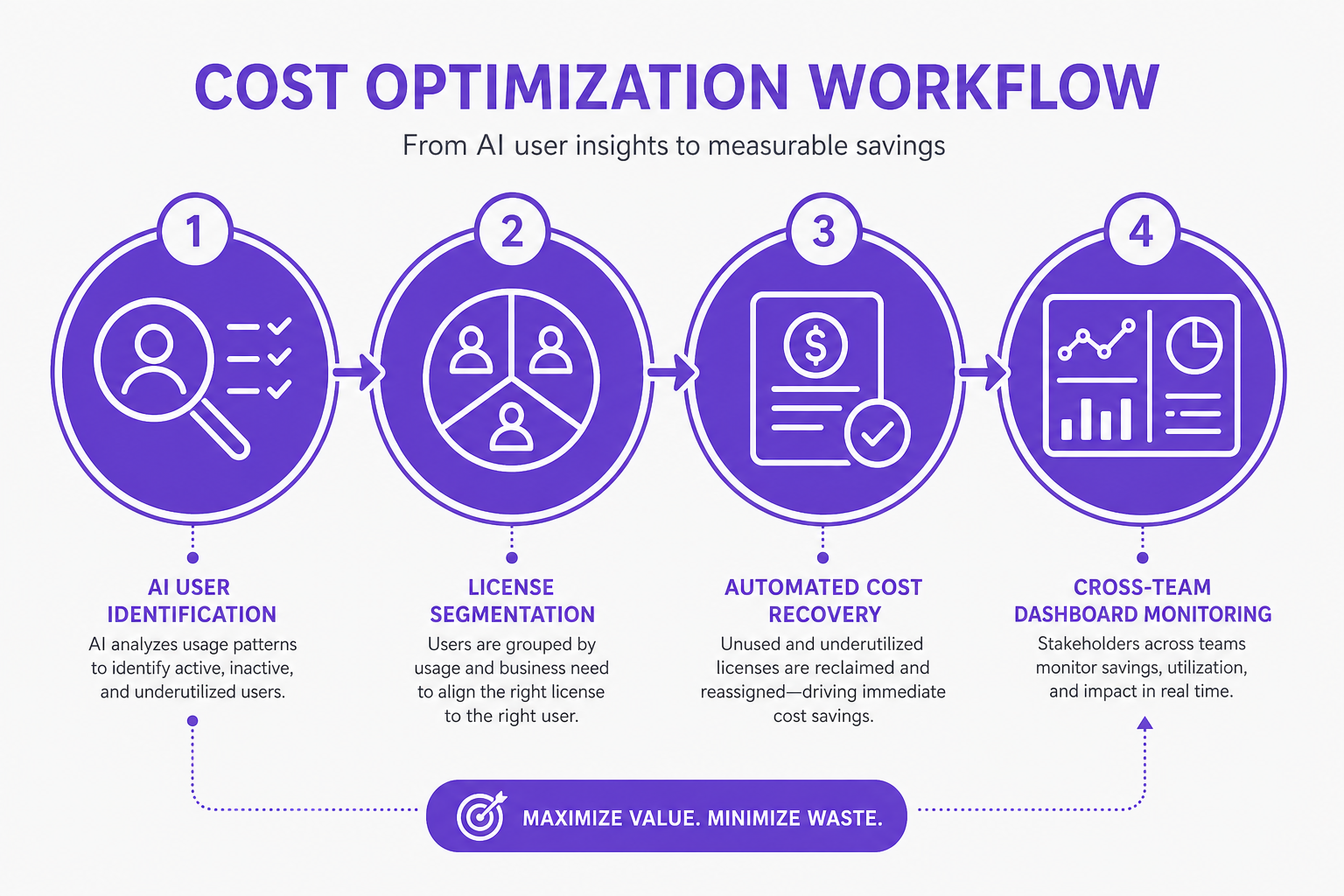
For organizations struggling with fragmented monitoring tools and opaque AI workflows, CloudNuro delivers:
Unified SaaS, Cloud, and AI visibility, bringing all usage and performance data into a single, actionable dashboard;
Governance-first design, ensuring every LLM deployment meets compliance and security standards, with automated detection for PII exposure and policy drift;
Automated cost optimization, harvesting granular entitlements and supporting continuous cost reductions through segmentation and budget controls;
Seamless integration with over 400 enterprise apps, supporting rapid deployment and organization-wide adoption.
With the AI Custodian module, enterprises finally gain the tools to:
Correlate financial impact and performance data for all AI initiatives;
Implement real-time controls that prevent overspend and data leakage;
Foster collaboration across IT, security, finance, and business stakeholders.
Organizations with superior observability are able to release 60% more products and revenue streams than their peers, a capability CloudNuro is purpose-built to deliver.
As LLMs become foundational for enterprise transformation, here’s how to launch your observability journey effectively:
Centralize data collection through an open, interoperable platform that aggregates usage, performance, and compliance signals from every AI and SaaS system.
Automate segmentation to identify high-impact users and reclaim underutilized licenses rapidly.
Set budget thresholds for all projects and AI agents to control costs proactively, without constraining innovation.
Establish policy-driven governance to detect data leaks and prompt abuse in real time.
Drive cross-functional collaboration using dashboards and alerts tailored for IT, security, and finance audiences alike.
Leaders should look for a solution that is ready to scale as AI adoption increases, with the flexibility to adapt to evolving compliance landscapes, while consistently optimizing spend.
What is LLM observability?
LLM observability is the enterprise practice of end-to-end monitoring and governance of large language models, encompassing traceability, drift detection, cost attribution, and compliance enforcement for all AI operations.
How does LLM monitoring differ from traditional monitoring?
LLM monitoring requires deeper granularity: prompt-level tracking, user segmentation, hallucination and drift scoring, and policy compliance, far beyond the metrics and logs of traditional application performance monitoring (APM).
Why is observability important for AI models?
Observability ensures model quality, operational safety, policy compliance, and financial management in complex, fast-evolving AI workflows. It’s foundational for responsible, cost-effective AI adoption at scale.
What tools exist for AI observability?
Unified platforms like CloudNuro AI Custodian provide governance-first observability, combining SaaS, cloud, and AI data to deliver actionable insights, compliance enforcement, and cost optimization.
How can organizations implement LLM observability best practices?
They should centralize collection, automate user segmentation and cost controls, set enforceable policies, and facilitate collaboration across IT, security, and finance teams.
LLM observability is no longer optional for any enterprise that expects to maximize the opportunities of generative AI while keeping risk, compliance, and spend fully controlled. For IT, security, and finance leaders alike, CloudNuro’s governance-first platform unlocks the visibility, accountability, and ongoing cost optimization needed to scale AI safely and confidently.
Explore how CloudNuro can help your organization achieve true LLM observability, bringing financial discipline, compliance, and innovation together in one powerful solution.
About CloudNuro
CloudNuro is a leader in Enterprise AI Adoption Management, providing enterprises with unmatched visibility, governance, and cost optimization. Recognized twice in a row in the SaaS Management Platforms category and named a Leader in the SoftwareReviews Data Quadrant, CloudNuro is trusted by global enterprises and government agencies to bring financial discipline to SaaS, cloud, and AI. Trusted by enterprises, CloudNuro provides centralized SaaS inventory, license optimization, and renewal management along with advanced cost allocation and chargeback, giving IT and Finance leaders the visibility, control, and cost-conscious culture needed to drive financial discipline.
Request a no cost, no obligation free assessment —just 15 minutes to savings!
Get StartedIn the age of generative AI, enterprises are accelerating large language model (LLM) deployments across industries such as healthcare, finance, government, and beyond. As LLMs move from pilot projects to production workflows, one requirement has emerged as non-negotiable: LLM observability.
For CIOs, CTOs, and IT leaders, observability means more than just system uptime. It is now foundational for tracking performance, ensuring robust compliance, and, critically, driving financial discipline around AI. This comprehensive guide breaks down why LLM observability matters, the unique challenges it solves, and how innovators like CloudNuro deliver the visibility, governance, and cost optimization that modern enterprises demand.
LLM observability refers to the end-to-end monitoring, analysis, and governance of large language model behavior across the full AI lifecycle. Unlike traditional application monitoring, LLM observability encompasses:
Prompt and response traceability for analyzing every AI interaction;
Token and latency monitoring to optimize speed and cost;
Drift and hallucination detection for consistent model quality;
Compliance and safety guardrails for sensitive data handling.
This approach gives IT and operations leaders the power to:
See precisely how and where LLMs are used across cloud and SaaS environments;
Detect risk factors like data drift, prompt abuse, and potential policy violations in real time;
Attribute AI activity and costs down to individual projects or users, supporting effective FinOps for AI.
Enterprises need more than simple uptime stats, they need actionable intelligence across every dimension of model operations.
LLM workloads introduce monitoring challenges that far surpass those of legacy software and infrastructure. Static dashboards of logs and metrics are insufficient. With LLMs, enterprises need:
Granular usage tracking that includes prompt volumes, agent-level activity, and detailed adoption rates in common enterprise applications (Word, Excel, Teams, and more).
Automated user segmentation (power, general, low, dormant) to support license reallocation and cut SaaS costs by up to 30% in just 90 days.
Policy-driven governance that enforces security, detects oversharing of sensitive or PII data, and flags non-compliant prompts in real time.
Financial controls that enable administrators to set project- and agent-level budget thresholds, tightly mirroring internal allocations and preventing uncontrolled AI spend.
This depth of observability can rapidly pay for itself. In fact, deployments see over 1000% ROI within a year, with some realizing payback in as little as six weeks.
The rapid shift towards AI-driven operations is driving seismic changes in enterprise observability:
The LLM observability platform market is projected to grow from $510.5 million to $8.08 billion at a 31.8% CAGR.
Cloud-based deployments account for 76.3% of the segment, outpacing on-premises approaches.
Only 14% of organizations actually claim to have true LLM observability today, even as nearly half state that 26% to 50% of observability spend now underpins AI workloads.
Key product needs have shifted to include prompt-level traceability, hallucination scoring, and robust cost/safety guardrails, not simply traditional infrastructure stats. OpenTelemetry and cross-observability integrations are rising rapidly to meet diverse enterprise needs.
Enterprises, especially those in regulated sectors, cannot afford to let AI models become black boxes. Complete, governance-first observability empowers organizations to:
Ensure ongoing compliance by detecting and stopping the flow of sensitive information (PII, legal content, regulated data) into LLM prompts;
Continuously validate model outputs and user interactions for consistency and bias, reducing operational risk;
Establish clear audit trails for every AI transaction, essential for both external compliance and internal accountability.
With job functions and departments increasingly empowered to embed LLMs into their workflows, centralized oversight is critical. No single point of view can suffice, organizations must be able to aggregate, correlate, and act on a unified governance platform.
Unmonitored LLM usage can drive spiraling SaaS and infrastructure costs, particularly with premium AI agents and variable token pricing.
CloudNuro’s AI Custodian addresses this challenge head-on by:
Tracking active users, adoption rates, and prompt volumes across all supported tools and apps;
Segregating users based on behavioral data to reclaim unused licenses and drive immediate cost reductions (customers report savings exceeding $120,000 in the first quarter alone);
Enabling project-based budgeting, token expense allocation, and granular cost controls down to individual AI agents.
One international legal firm, for example, was able to move from highly manual tracking to full visibility and FinOps model oversight, achieving over $230,000 in savings within three months.
The combination of financial transparency and automated license optimization builds an enduring cost-conscious culture across both IT and line-of-business departments.
For organizations struggling with fragmented monitoring tools and opaque AI workflows, CloudNuro delivers:
Unified SaaS, Cloud, and AI visibility, bringing all usage and performance data into a single, actionable dashboard;
Governance-first design, ensuring every LLM deployment meets compliance and security standards, with automated detection for PII exposure and policy drift;
Automated cost optimization, harvesting granular entitlements and supporting continuous cost reductions through segmentation and budget controls;
Seamless integration with over 400 enterprise apps, supporting rapid deployment and organization-wide adoption.
With the AI Custodian module, enterprises finally gain the tools to:
Correlate financial impact and performance data for all AI initiatives;
Implement real-time controls that prevent overspend and data leakage;
Foster collaboration across IT, security, finance, and business stakeholders.
Organizations with superior observability are able to release 60% more products and revenue streams than their peers, a capability CloudNuro is purpose-built to deliver.
As LLMs become foundational for enterprise transformation, here’s how to launch your observability journey effectively:
Centralize data collection through an open, interoperable platform that aggregates usage, performance, and compliance signals from every AI and SaaS system.
Automate segmentation to identify high-impact users and reclaim underutilized licenses rapidly.
Set budget thresholds for all projects and AI agents to control costs proactively, without constraining innovation.
Establish policy-driven governance to detect data leaks and prompt abuse in real time.
Drive cross-functional collaboration using dashboards and alerts tailored for IT, security, and finance audiences alike.
Leaders should look for a solution that is ready to scale as AI adoption increases, with the flexibility to adapt to evolving compliance landscapes, while consistently optimizing spend.
What is LLM observability?
LLM observability is the enterprise practice of end-to-end monitoring and governance of large language models, encompassing traceability, drift detection, cost attribution, and compliance enforcement for all AI operations.
How does LLM monitoring differ from traditional monitoring?
LLM monitoring requires deeper granularity: prompt-level tracking, user segmentation, hallucination and drift scoring, and policy compliance, far beyond the metrics and logs of traditional application performance monitoring (APM).
Why is observability important for AI models?
Observability ensures model quality, operational safety, policy compliance, and financial management in complex, fast-evolving AI workflows. It’s foundational for responsible, cost-effective AI adoption at scale.
What tools exist for AI observability?
Unified platforms like CloudNuro AI Custodian provide governance-first observability, combining SaaS, cloud, and AI data to deliver actionable insights, compliance enforcement, and cost optimization.
How can organizations implement LLM observability best practices?
They should centralize collection, automate user segmentation and cost controls, set enforceable policies, and facilitate collaboration across IT, security, and finance teams.
LLM observability is no longer optional for any enterprise that expects to maximize the opportunities of generative AI while keeping risk, compliance, and spend fully controlled. For IT, security, and finance leaders alike, CloudNuro’s governance-first platform unlocks the visibility, accountability, and ongoing cost optimization needed to scale AI safely and confidently.
Explore how CloudNuro can help your organization achieve true LLM observability, bringing financial discipline, compliance, and innovation together in one powerful solution.
About CloudNuro
CloudNuro is a leader in Enterprise AI Adoption Management, providing enterprises with unmatched visibility, governance, and cost optimization. Recognized twice in a row in the SaaS Management Platforms category and named a Leader in the SoftwareReviews Data Quadrant, CloudNuro is trusted by global enterprises and government agencies to bring financial discipline to SaaS, cloud, and AI. Trusted by enterprises, CloudNuro provides centralized SaaS inventory, license optimization, and renewal management along with advanced cost allocation and chargeback, giving IT and Finance leaders the visibility, control, and cost-conscious culture needed to drive financial discipline.
Request a no cost, no obligation free assessment - just 15 minutes to savings!
Get StartedWe're offering complimentary ServiceNow license assessments to only 25 enterprises this quarter who want to unlock immediate savings without disrupting operations.
Get Free AssessmentGet Started




CloudNuro Corp
1755 Park St. Suite 207
Naperville, IL 60563
Phone : +1-630-277-9470
Email: info@cloudnuro.com




.webp)

Recognized Leader in SaaS Management Platforms by Info-Tech SoftwareReviews


%20Tools%20for%20Data%20Security%20in%202025.png)
.svg)