

Sign Up
Thank you for Submitting!

Generative AI initiatives require substantial computational resources to operate efficiently in enterprise environments. As these capabilities scale across multiple departments, 83% of enterprise IT leaders state that AI and large language model cost unpredictability is a top concern (Gartner 2026). Establishing a strict LLM token budget is critical for bringing financial predictability to these strategic investments. By moving away from reactive billing practices and adopting proactive usage caps, leaders can ensure that compute consumption directly aligns with business value. This guide outlines how IT and finance stakeholders can set, monitor, and enforce team-based artificial intelligence spending limits.
Early deployments of generative tools often bypass standard procurement workflows. This decentralized adoption leads to unoptimized resource consumption across isolated business units. When individual departments consume computing resources without centralized oversight, overall cloud expenditures spike unpredictably. Technology analysts note that 72% of organizations identify a lack of granular cost allocation for AI spend as their primary barrier to governance (IDC 2026).
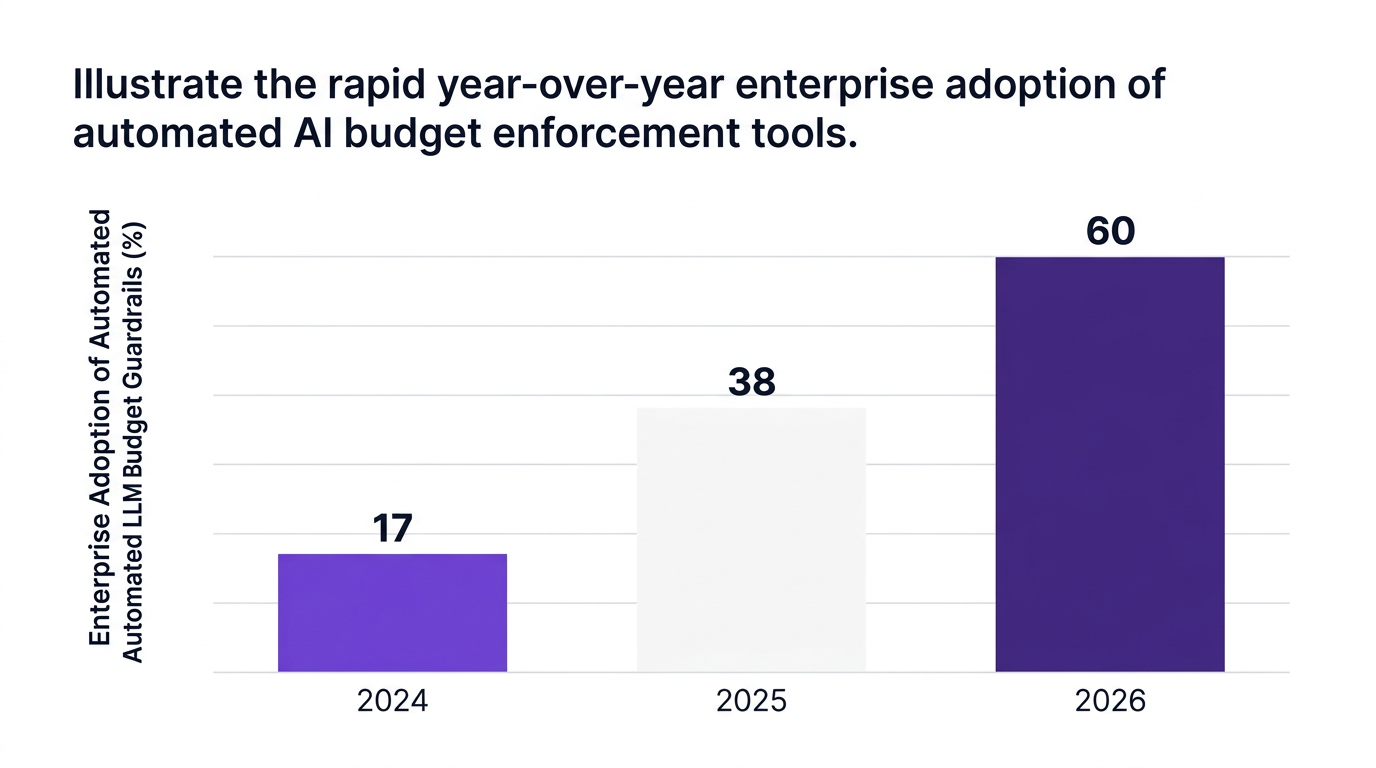
Without automated caps or monitoring tools, an engineering team testing unstructured dataset extraction or a marketing team running high-volume text generation can exhaust the quarterly AI budget in days. Recognizing this operational risk, the market is moving quickly toward advanced enforcement mechanisms. By 2026, industry data projects that 60% of enterprises will adopt automated policies capable of restricting generative budgets per specific team or department (Forrester 2026).
A successful AI budget requires baseline visibility and disciplined LLM resource allocation. Finance leaders must evaluate historical software consumption data and cloud infrastructure metrics to establish realistic usage baselines. Once historical usage is clear, administrators can divide the total anticipated expense pool into dedicated operational quotas, distributing them based on distinct departmental needs.
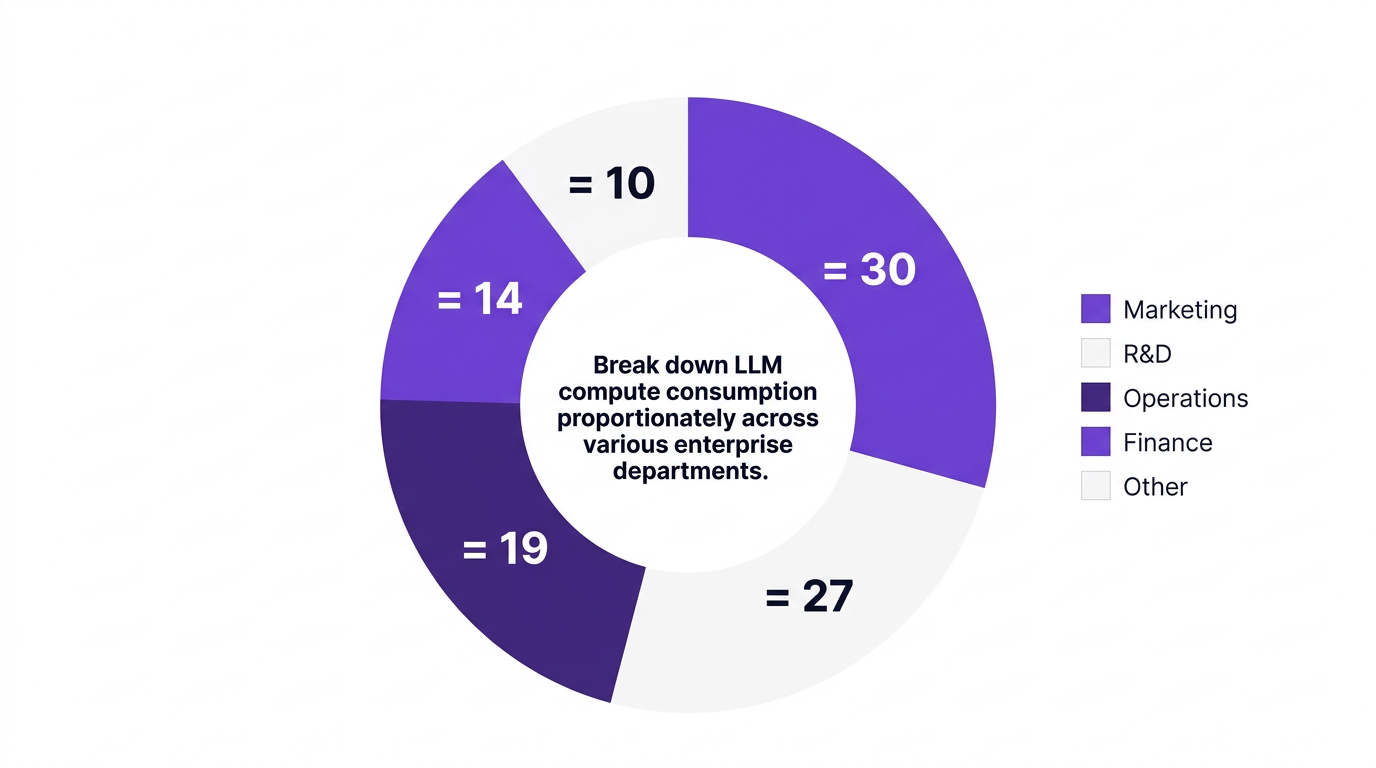
For example, research and development units running heavy automated code queries require significantly higher limits than human resources departments generating weekly training summaries. Distributing tokens effectively depends on categorizing departments by their intended workload intensity. According to enterprise usage samples, marketing and engineering routinely capture the highest volume of token share during early enterprise rollouts (TechRepublic 2026).
Holding individual teams accountable for their consumption is the most reliable method for curbing waste. Implementing an effective IT chargeback process means routing AI expense data directly to the specific department ledger. This visibility transforms artificial intelligence from an ambiguous IT overhead cost into a measurable departmental operating expense.
Organizations applying these financial frameworks achieve tangible operational results. A recent analysis of a global pharmaceutical research firm demonstrated the impact of enforcing departmental LLM token quotas. By linking an advanced cost governance tool directly to their internal accounting systems, the firm achieved a 22% year-over-year reduction in their AI cloud infrastructure costs (Everest Group 2026). Teams become highly selective about prompt design and payload sizes when their own departmental budgets are immediately impacted by the computation footprint. Creating a clear chargeback requirement alters resource behavior immediately.
Creating the financial structure is only the first phase. Ongoing token cost optimization requires constant technical adjustments and active user coaching. Organizations must establish alert thresholds that warn users well before they hit their hard limits. Notifications at 50%, 75%, and 90% utilization allow teams to throttle their activity naturally rather than experiencing sudden service cutoffs during critical business hours.
Technical administrators should also centralize model routing protocols. Not every task requires the most sophisticated, expensive reasoning engine available. Routing simpler data extraction tasks to smaller, highly efficient models preserves expensive premium tokens for complex logic workloads. Research indicates that global enterprises enforcing strict departmental usage quotas achieved an average 19% reduction in unnecessary infrastructure waste compared to those operating without quotas (Everest Group 2026).
Setting allocation targets has no impact if internal systems allow continuous overruns. Implementing automated enforcement tools ensures that any session attempting to exceed the set LLM token budget is immediately paused or heavily throttled until an administrator approves a quota increase. This policy enforcement mechanism guarantees absolute compliance with overarching financial guardrails.
"Effective LLM budget enforcement requires both technical integration and ongoing cultural alignment between IT, finance, and business teams" (Sarah Kramer, AI FinOps Lead, Deloitte 2026). Achieving this operational alignment relies heavily on a written, standardized AI usage policy. A strong policy dictates exactly which internal channels are approved for generating text or code, how expenses will be tracked, and the business consequences of exceeding assigned allowances.
Implementing governance across varied enterprise systems requires a centralized command structure. CloudNuro acts as the intelligence layer for your entire software ecosystem, delivering the architecture required to set, enforce, and optimize an AI budget dynamically. Organizations turn to CloudNuro to achieve total visibility and apply robust governance configurations directly to their active platforms.
Through advanced FinOps services, enterprises gain automated spend analysis and recommendations, enabling administrators to track AI budgets over every internal capability. CloudNuro AI Custodian delivers granular usage monitoring and rigid enforcement for text generation quotas. Furthermore, the Microsoft 365 Custodian and Salesforce Custodian enable IT leadership to place strict LLM cost controls natively within fundamental enterprise systems, guaranteeing that every external computation aligns exactly with compliance mandates.
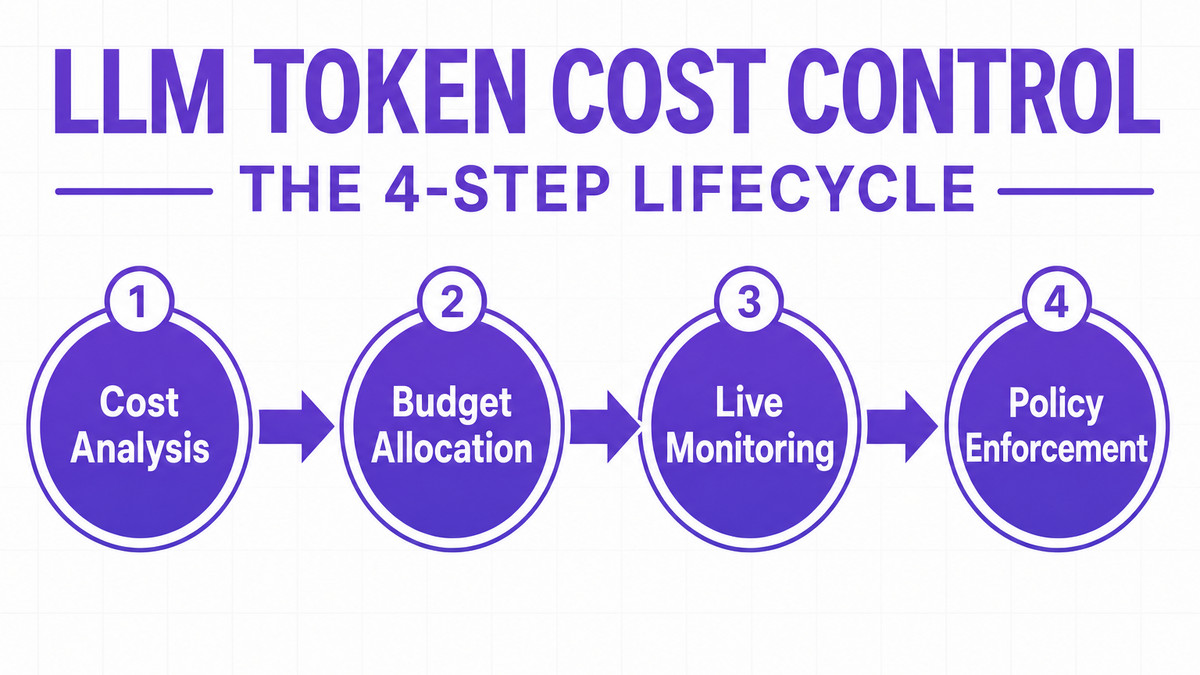
Setting budgets begins by analyzing historical baseline usage and classifying departments by their operational requirement for generative capabilities. Administrators assign a precise volume of consumption credits to each team based on their projected business outcome, selectively restricting access to high-tier models for teams that only execute basic administrative tasks.
The most effective practice is employing automated gateway tools that monitor consumption in real time. These configurations must support hard limits that actively pause queries when a team exhausts its funding, alongside soft alerts that notify department managers when their group hits predetermined utilization thresholds.
Tracking requires piping resource telemetry logs directly into an enterprise financial management tool. By attaching specific user identification tags to every API request, finance leaders can aggregate usage data monthly and accurately debit the calculated operational expense from the corresponding departmental ledger.
Dedicated FinOps management platforms and centralized SaaS governance solutions orchestrate this complex process. Platforms like CloudNuro intercept utilization data across the enterprise environment, convert raw operational metrics into distinct financial reports, and facilitate direct departmental invoicing.
A strict LLM token budget replaces ambiguous monthly cloud bills with precise, predictable resource consumption statements. When teams are held accountable for their specific usage volumes, organizations organically eliminate redundant queries, optimize prompt efficiency, and ensure that infrastructure investments directly fund productive business outcomes.
Managing the rapid expansion of generative capabilities requires robust internal frameworks and modern financial controls. Establishing a firm LLM token budget equips organizations to deploy advanced computation securely without risking sudden quarterly cost overruns. By implementing intelligent governance platforms, enterprises can monitor live usage, enforce strict departmental quotas, and automate IT chargeback procedures with absolute precision. Bringing financial discipline to this space ensures that organizations scale their technological ambitions sustainably and optimize every dollar spent on intelligence.
About CloudNuro
CloudNuro is a leader in Enterprise SaaS Management Platforms, providing enterprises with unmatched visibility, governance, and cost optimization. Recognized twice in a row in the SaaS Management Platforms category and named a Leader in the SoftwareReviews Data Quadrant, CloudNuro is trusted by global enterprises and government agencies to bring financial discipline to SaaS, cloud, and AI. Trusted by enterprises such as Konica Minolta and Federal Signal, CloudNuro provides centralized SaaS inventory, license optimization, and renewal management along with advanced cost allocation and chargeback, giving IT and Finance leaders the visibility, control, and cost-conscious culture needed to drive financial discipline.
Request a no cost, no obligation free assessment —just 15 minutes to savings!
Get StartedGenerative AI initiatives require substantial computational resources to operate efficiently in enterprise environments. As these capabilities scale across multiple departments, 83% of enterprise IT leaders state that AI and large language model cost unpredictability is a top concern (Gartner 2026). Establishing a strict LLM token budget is critical for bringing financial predictability to these strategic investments. By moving away from reactive billing practices and adopting proactive usage caps, leaders can ensure that compute consumption directly aligns with business value. This guide outlines how IT and finance stakeholders can set, monitor, and enforce team-based artificial intelligence spending limits.
Early deployments of generative tools often bypass standard procurement workflows. This decentralized adoption leads to unoptimized resource consumption across isolated business units. When individual departments consume computing resources without centralized oversight, overall cloud expenditures spike unpredictably. Technology analysts note that 72% of organizations identify a lack of granular cost allocation for AI spend as their primary barrier to governance (IDC 2026).
Without automated caps or monitoring tools, an engineering team testing unstructured dataset extraction or a marketing team running high-volume text generation can exhaust the quarterly AI budget in days. Recognizing this operational risk, the market is moving quickly toward advanced enforcement mechanisms. By 2026, industry data projects that 60% of enterprises will adopt automated policies capable of restricting generative budgets per specific team or department (Forrester 2026).
A successful AI budget requires baseline visibility and disciplined LLM resource allocation. Finance leaders must evaluate historical software consumption data and cloud infrastructure metrics to establish realistic usage baselines. Once historical usage is clear, administrators can divide the total anticipated expense pool into dedicated operational quotas, distributing them based on distinct departmental needs.
For example, research and development units running heavy automated code queries require significantly higher limits than human resources departments generating weekly training summaries. Distributing tokens effectively depends on categorizing departments by their intended workload intensity. According to enterprise usage samples, marketing and engineering routinely capture the highest volume of token share during early enterprise rollouts (TechRepublic 2026).
Holding individual teams accountable for their consumption is the most reliable method for curbing waste. Implementing an effective IT chargeback process means routing AI expense data directly to the specific department ledger. This visibility transforms artificial intelligence from an ambiguous IT overhead cost into a measurable departmental operating expense.
Organizations applying these financial frameworks achieve tangible operational results. A recent analysis of a global pharmaceutical research firm demonstrated the impact of enforcing departmental LLM token quotas. By linking an advanced cost governance tool directly to their internal accounting systems, the firm achieved a 22% year-over-year reduction in their AI cloud infrastructure costs (Everest Group 2026). Teams become highly selective about prompt design and payload sizes when their own departmental budgets are immediately impacted by the computation footprint. Creating a clear chargeback requirement alters resource behavior immediately.
Creating the financial structure is only the first phase. Ongoing token cost optimization requires constant technical adjustments and active user coaching. Organizations must establish alert thresholds that warn users well before they hit their hard limits. Notifications at 50%, 75%, and 90% utilization allow teams to throttle their activity naturally rather than experiencing sudden service cutoffs during critical business hours.
Technical administrators should also centralize model routing protocols. Not every task requires the most sophisticated, expensive reasoning engine available. Routing simpler data extraction tasks to smaller, highly efficient models preserves expensive premium tokens for complex logic workloads. Research indicates that global enterprises enforcing strict departmental usage quotas achieved an average 19% reduction in unnecessary infrastructure waste compared to those operating without quotas (Everest Group 2026).
Setting allocation targets has no impact if internal systems allow continuous overruns. Implementing automated enforcement tools ensures that any session attempting to exceed the set LLM token budget is immediately paused or heavily throttled until an administrator approves a quota increase. This policy enforcement mechanism guarantees absolute compliance with overarching financial guardrails.
"Effective LLM budget enforcement requires both technical integration and ongoing cultural alignment between IT, finance, and business teams" (Sarah Kramer, AI FinOps Lead, Deloitte 2026). Achieving this operational alignment relies heavily on a written, standardized AI usage policy. A strong policy dictates exactly which internal channels are approved for generating text or code, how expenses will be tracked, and the business consequences of exceeding assigned allowances.
Implementing governance across varied enterprise systems requires a centralized command structure. CloudNuro acts as the intelligence layer for your entire software ecosystem, delivering the architecture required to set, enforce, and optimize an AI budget dynamically. Organizations turn to CloudNuro to achieve total visibility and apply robust governance configurations directly to their active platforms.
Through advanced FinOps services, enterprises gain automated spend analysis and recommendations, enabling administrators to track AI budgets over every internal capability. CloudNuro AI Custodian delivers granular usage monitoring and rigid enforcement for text generation quotas. Furthermore, the Microsoft 365 Custodian and Salesforce Custodian enable IT leadership to place strict LLM cost controls natively within fundamental enterprise systems, guaranteeing that every external computation aligns exactly with compliance mandates.
Setting budgets begins by analyzing historical baseline usage and classifying departments by their operational requirement for generative capabilities. Administrators assign a precise volume of consumption credits to each team based on their projected business outcome, selectively restricting access to high-tier models for teams that only execute basic administrative tasks.
The most effective practice is employing automated gateway tools that monitor consumption in real time. These configurations must support hard limits that actively pause queries when a team exhausts its funding, alongside soft alerts that notify department managers when their group hits predetermined utilization thresholds.
Tracking requires piping resource telemetry logs directly into an enterprise financial management tool. By attaching specific user identification tags to every API request, finance leaders can aggregate usage data monthly and accurately debit the calculated operational expense from the corresponding departmental ledger.
Dedicated FinOps management platforms and centralized SaaS governance solutions orchestrate this complex process. Platforms like CloudNuro intercept utilization data across the enterprise environment, convert raw operational metrics into distinct financial reports, and facilitate direct departmental invoicing.
A strict LLM token budget replaces ambiguous monthly cloud bills with precise, predictable resource consumption statements. When teams are held accountable for their specific usage volumes, organizations organically eliminate redundant queries, optimize prompt efficiency, and ensure that infrastructure investments directly fund productive business outcomes.
Managing the rapid expansion of generative capabilities requires robust internal frameworks and modern financial controls. Establishing a firm LLM token budget equips organizations to deploy advanced computation securely without risking sudden quarterly cost overruns. By implementing intelligent governance platforms, enterprises can monitor live usage, enforce strict departmental quotas, and automate IT chargeback procedures with absolute precision. Bringing financial discipline to this space ensures that organizations scale their technological ambitions sustainably and optimize every dollar spent on intelligence.
About CloudNuro
CloudNuro is a leader in Enterprise SaaS Management Platforms, providing enterprises with unmatched visibility, governance, and cost optimization. Recognized twice in a row in the SaaS Management Platforms category and named a Leader in the SoftwareReviews Data Quadrant, CloudNuro is trusted by global enterprises and government agencies to bring financial discipline to SaaS, cloud, and AI. Trusted by enterprises such as Konica Minolta and Federal Signal, CloudNuro provides centralized SaaS inventory, license optimization, and renewal management along with advanced cost allocation and chargeback, giving IT and Finance leaders the visibility, control, and cost-conscious culture needed to drive financial discipline.
Request a no cost, no obligation free assessment - just 15 minutes to savings!
Get StartedWe're offering complimentary ServiceNow license assessments to only 25 enterprises this quarter who want to unlock immediate savings without disrupting operations.
Get Free AssessmentGet Started




CloudNuro Corp
1755 Park St. Suite 207
Naperville, IL 60563
Phone : +1-630-277-9470
Email: info@cloudnuro.com





.webp)

Recognized Leader in SaaS Management Platforms by Info-Tech SoftwareReviews


.png)
.svg)