

Sign Up
Thank you for Submitting!
Transitioning artificial intelligence workloads from experimental sandboxes to production environments creates a profound shift in financial accountability. For technology leaders operating in 2026, managing an LLM token budget is no longer an optional financial exercise; it is a critical mandate. As enterprise-wide adoption scales, generative AI features are consuming computational resources at unprecedented rates. Traditional cloud budgeting models, which focus on fixed server capacities, fail to capture the variable, usage-driven reality of prompt and completion token costs. Establishing precise controls per team, per developer, and per product feature marks the evolution into Token Budgeting 2.0.

Generative AI operational scale is reaching extraordinary heights across the enterprise sector. Technology budgets have fundamentally restructured to accommodate these new demands. According to Deloitte (Jan 2026), AI represents the fastest-growing expense category in modern technology budgets. For certain organizations, AI-related costs now consume up to 50 percent of total IT spending. Furthermore, AI workloads directly drove a 19 percent increase in baseline cloud infrastructure spending among enterprises studied in 2025.
The volume of prompts processed continues outstripping previous projections. A review of industry benchmark data from early 2026 shows weekly token usage on leading routing platforms surged from 0.4 trillion in December 2024 to a staggering 27.0 trillion by March 2026. This 68-fold increase stems largely from the deployment of agentic workflows, where autonomous systems trigger multiple sequential language model calls without direct human intervention. As token consumption scales geometrically, unit cost control becomes the primary driver of SaaS financial health.
Understanding the unit economics for AI features requires a clear view of current vendor pricing structures. Significant price competition among cloud LLM providers caused major input token price drops over the past year. However, overall spending continues to rise because applications demand far more capability and context per interaction.
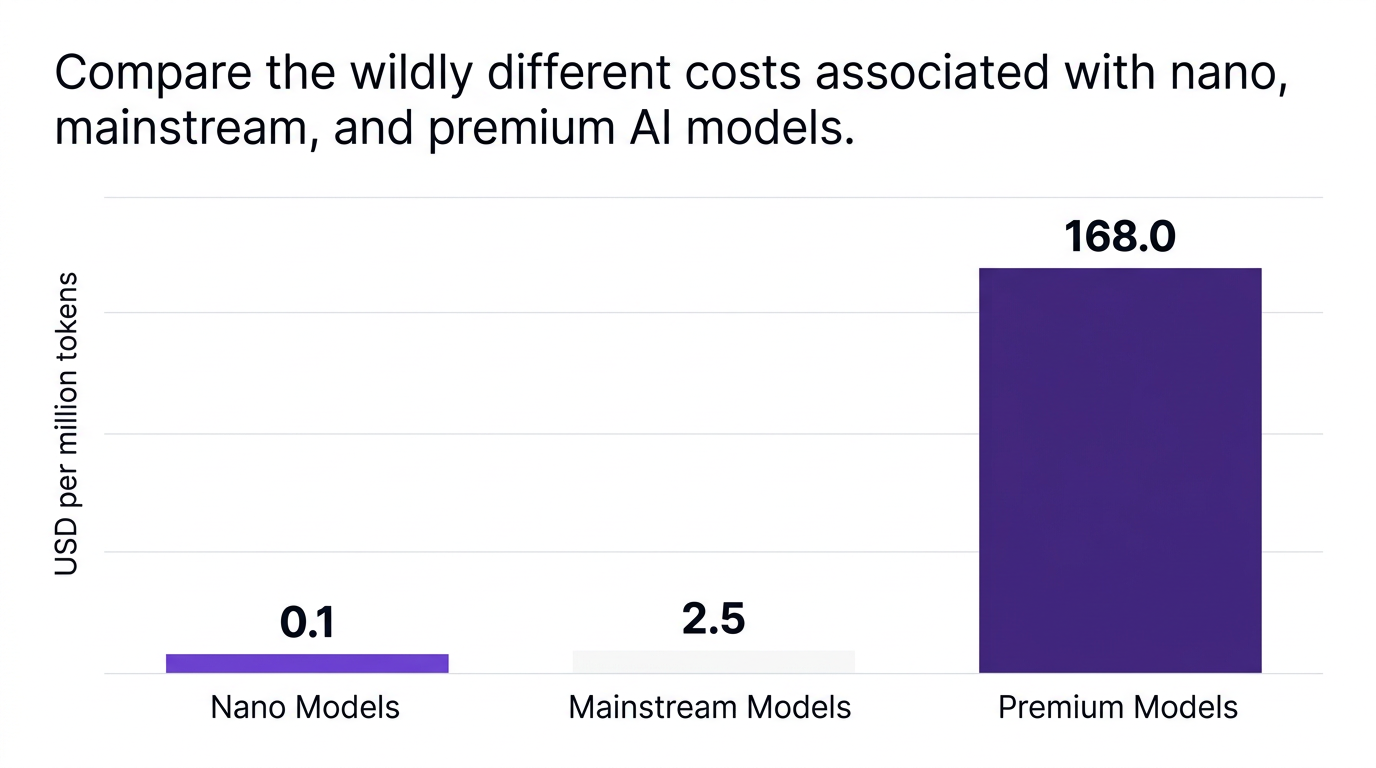
Prices per million tokens in 2026 vary dramatically based on model capability. Nano and edge-focused models cost roughly $0.10 per million tokens. Mainstream conversational models stabilized around $2.50 per million input tokens, representing a steep decline from the $5.00 benchmark seen in early 2025. Conversely, premium reasoning and complex analytic models can command up to $168 per million tokens (Industry Synthesis, 2026).
A persistent challenge in LLM cost allocation is the structural disparity between input and output costs. Output tokens are consistently priced three to eight times higher than input tokens, carrying a median ratio of four times the input cost (Enterprise AI Budgeting Benchmarks, 2026). Complex agentic systems generate extensive text or code outputs, rapidly multiplying expenses if left uncapped by formal AI spend governance.
Implementing structured automated chargeback workflows fundamentally changes how organizations consume AI resources. Without granular visibility, finance teams cannot determine if a specific product feature remains profitable. The modern approach to token cost optimization relies heavily on segmenting usage data.
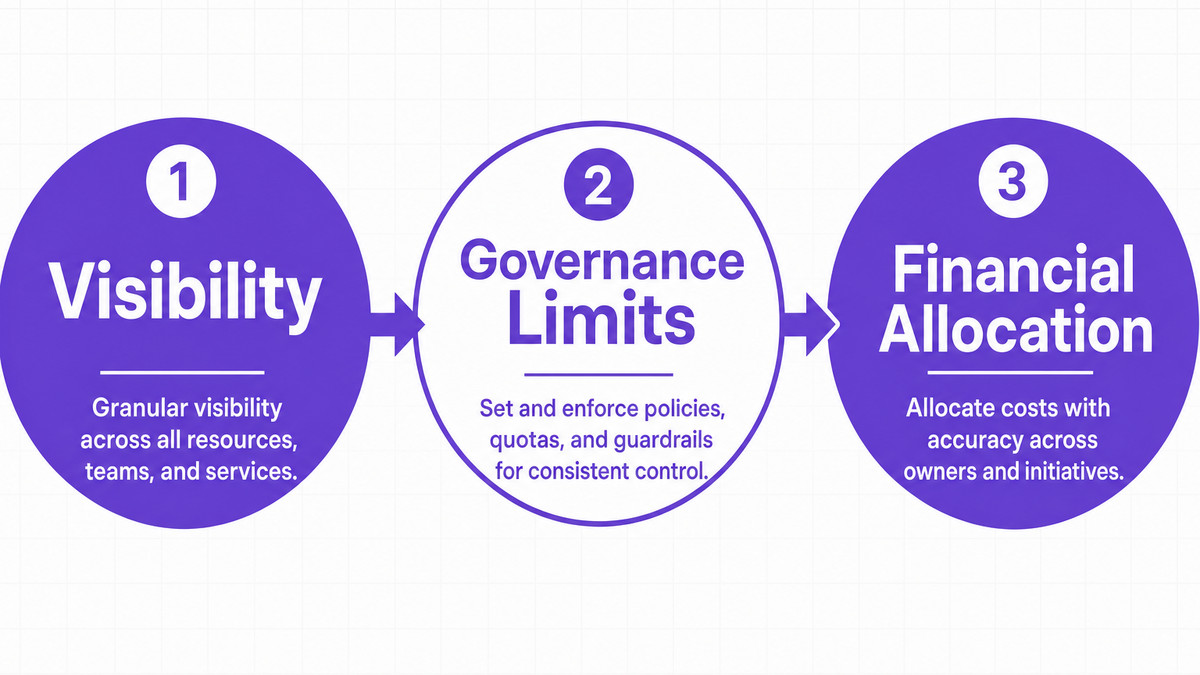
Enterprise FinOps advisory leaders note that modern token budgeting requires tracking per-feature, per-team, and per-tenant spending rather than relying on aggregate organizational budgets. Effective management dashboards must isolate prompt tokens from completion tokens, highlight excessive context window usage, and break down multi-step agent workflows. Implementing this depth of governance requires three primary operational pillars:
Granular Visibility: Financial controllers need immediate, tagged usage data. Every API call must carry metadata indicating the originating developer, the product feature, and the ultimate business unit.
Dynamic Governance Limits: Static token allocations quickly become outdated. Modern operations deploy policy-driven token allocation that shifts budgets dynamically based on task priority or revenue potential.
Financial Alignment: Token expenditures must tie directly to product margins. If an AI summarization feature costs more in compute resources than the client pays in licensing, the company experiences inverted unit economics.
Teams that actively govern their consumption avoid runaway bills. Systematic token management allows organizations to achieve a 60 to 80 percent cost reduction over unoptimized baselines (Practitioner Benchmarking, 2026). Applying specific engineering constraints ensures product capabilities expand without breaking the LLM token budget.
Strict context window management serves as the most immediate optimization lever. Limiting the amount of historical text fed into the language model often yields 20 to 40 percent fewer tokens consumed per request. Furthermore, exploiting new technological capabilities such as prompt caching provides massive savings. Cached prompt tokens can be up to 90 percent cheaper than standard rates for models supporting the technology (Enterprise Data, 2026).
Model routing provides another critical layer of control. Development teams often default to using the most expensive premium reasoning models for basic categorization tasks. By dynamically routing simpler requests to nano models and reserving premium models strictly for complex reasoning, companies preserve their budget. For example, a mainstream SaaS company implemented per-feature LLM budgeting combined with strict model routing policies. This approach reduced their total monthly AI spend by 63 percent while enabling them to triple the number of shipped AI features, driven entirely by clear threshold alerts and effective LLM chargeback policies.
Financial accountability disintegrates when engineers can infinitely scale API requests without guardrails. Establishing formal AI budget enforcement mechanisms protects the enterprise from anomalous spikes, such as infinite loops in agent architectures or sudden bursts of user activity.
Teams must differentiate between soft and hard limits. Soft limits act as early warning systems, triggering notifications to product managers and FinOps teams when a specific feature consumes 75 percent of its allocated weekly budget. These notifications allow teams to investigate whether an efficiency bug exists before real financial damage occurs.
Hard limits prevent further expenditure entirely. When a test environment or non-critical application hits a hard ceiling, the system automatically rejects further generation requests until the business formally approves an expansion. Integrating these controls into daily operations requires sophisticated advanced SaaS management tools that bridge the gap between engineering execution and financial oversight.
Navigating usage-based cloud models requires specialized, governance-first architecture. This is precisely where CloudNuro provides unmatched value to modern technology teams. The AI Custodian platform delivers real-time token tracking, policy-driven usage limits, and dynamic budgeting dashboards. This empowers organizations to enforce per-team, per-feature, and per-developer token caps across multiple providers intelligently.
CloudNuro Chargeback fundamentally enables precise AI spend allocation and absolute financial accountability. By utilizing this framework, IT and FinOps teams allocate exact consumption costs per business unit or user cohort. This supports truly automated workflows for budget enforcement. Through the Unified Cloud Custodian, teams aggregate SaaS infrastructure, standard cloud resources, and complex generative AI workloads into a single operational interface.
The real-world impact of these tools is substantial. A large financial platform recently deployed CloudNuro Chargeback and AI Custodian to enforce token spending limits at both the feature and team levels. This implementation generated a 78 percent reduction in budget overruns. The reclaimed capital enabled the business to expand from two to 18 distinct AI-powered features, supported by continuous financial transparency. Supplemented by CloudNuro's FinOps Services, companies receive actionable cost optimization strategies and reliable governance operations built for 2026 priorities.
Allocation requires strict API key tagging or header metadata for every request sent to the language model. By tagging requests with distinct identifiers for "Feature A" versus "Feature B," FinOps teams can monitor usage dashboards and assign specific monthly token limits based on the revenue generated by that exact feature.
Continuous real-time monitoring coupled with automated policy gates constitutes the most effective approach. Platforms must monitor usage against predefined daily or weekly quotas, triggering soft alert notifications at 80 percent utilization and instituting automated API cutoffs (hard limits) when usage reaches 100 percent of the team's allocation.
Implementing chargeback requires calculating the exact unit economics of token consumption and mapping those costs accurately to internal departments. IT and finance teams utilize cost allocation software to translate raw token counts into financial metrics, billing each department or product team for their specific portion of overall model usage.
Key performance indicators should track the ratio of input to output tokens, the overall cost per 1,000 application user interactions, and the percentage of tokens successfully routed to less expensive models. Furthermore, tracking cache hit rates provides deep insight into whether development teams are actively optimizing their prompt structures.
Purpose-built governance platforms are crucial for usage scaling. Tools like CloudNuro's AI Custodian provide continuous discovery, rate-limit enforcement, and precise visual dashboards that allow organizations to track both token volume and dollar consumption natively.
Escalating enterprise adoption of autonomous generative models has permanently altered cloud expenditure paradigms. Organizations can no longer rely on unconstrained experimentation budgets. Scaling successfully requires treating the LLM token budget with the exact same rigor previously applied to massive database migrations or hardware procurement. By deploying structured token cost optimization frameworks, engineering controls, and dynamic model routing, teams protect their margins while accelerating product development.
FinOps and IT leaders must bridge the gap between financial oversight and engineering agility. Applying formal accountability through precise allocation ensures that every generation delivers more value to the business than it consumes in computational expense.
About CloudNuro
CloudNuro is a leader in Enterprise SaaS Management Platforms, providing enterprises with unmatched visibility, governance, and cost optimization. Recognized twice in a row in the SaaS Management Platforms category and named a Leader in the SoftwareReviews Data Quadrant, CloudNuro is trusted by global enterprises and government agencies to bring financial discipline to SaaS, cloud, and AI. Trusted by enterprises such as Konica Minolta and Federal Signal, CloudNuro provides centralized SaaS inventory, license optimization, and renewal management along with advanced cost allocation and chargeback, giving IT and Finance leaders the visibility, control, and cost-conscious culture needed to drive financial discipline.
Request a no cost, no obligation free assessment —just 15 minutes to savings!
Get StartedTransitioning artificial intelligence workloads from experimental sandboxes to production environments creates a profound shift in financial accountability. For technology leaders operating in 2026, managing an LLM token budget is no longer an optional financial exercise; it is a critical mandate. As enterprise-wide adoption scales, generative AI features are consuming computational resources at unprecedented rates. Traditional cloud budgeting models, which focus on fixed server capacities, fail to capture the variable, usage-driven reality of prompt and completion token costs. Establishing precise controls per team, per developer, and per product feature marks the evolution into Token Budgeting 2.0.
Generative AI operational scale is reaching extraordinary heights across the enterprise sector. Technology budgets have fundamentally restructured to accommodate these new demands. According to Deloitte (Jan 2026), AI represents the fastest-growing expense category in modern technology budgets. For certain organizations, AI-related costs now consume up to 50 percent of total IT spending. Furthermore, AI workloads directly drove a 19 percent increase in baseline cloud infrastructure spending among enterprises studied in 2025.
The volume of prompts processed continues outstripping previous projections. A review of industry benchmark data from early 2026 shows weekly token usage on leading routing platforms surged from 0.4 trillion in December 2024 to a staggering 27.0 trillion by March 2026. This 68-fold increase stems largely from the deployment of agentic workflows, where autonomous systems trigger multiple sequential language model calls without direct human intervention. As token consumption scales geometrically, unit cost control becomes the primary driver of SaaS financial health.
Understanding the unit economics for AI features requires a clear view of current vendor pricing structures. Significant price competition among cloud LLM providers caused major input token price drops over the past year. However, overall spending continues to rise because applications demand far more capability and context per interaction.
Prices per million tokens in 2026 vary dramatically based on model capability. Nano and edge-focused models cost roughly $0.10 per million tokens. Mainstream conversational models stabilized around $2.50 per million input tokens, representing a steep decline from the $5.00 benchmark seen in early 2025. Conversely, premium reasoning and complex analytic models can command up to $168 per million tokens (Industry Synthesis, 2026).
A persistent challenge in LLM cost allocation is the structural disparity between input and output costs. Output tokens are consistently priced three to eight times higher than input tokens, carrying a median ratio of four times the input cost (Enterprise AI Budgeting Benchmarks, 2026). Complex agentic systems generate extensive text or code outputs, rapidly multiplying expenses if left uncapped by formal AI spend governance.
Implementing structured automated chargeback workflows fundamentally changes how organizations consume AI resources. Without granular visibility, finance teams cannot determine if a specific product feature remains profitable. The modern approach to token cost optimization relies heavily on segmenting usage data.
Enterprise FinOps advisory leaders note that modern token budgeting requires tracking per-feature, per-team, and per-tenant spending rather than relying on aggregate organizational budgets. Effective management dashboards must isolate prompt tokens from completion tokens, highlight excessive context window usage, and break down multi-step agent workflows. Implementing this depth of governance requires three primary operational pillars:
Granular Visibility: Financial controllers need immediate, tagged usage data. Every API call must carry metadata indicating the originating developer, the product feature, and the ultimate business unit.
Dynamic Governance Limits: Static token allocations quickly become outdated. Modern operations deploy policy-driven token allocation that shifts budgets dynamically based on task priority or revenue potential.
Financial Alignment: Token expenditures must tie directly to product margins. If an AI summarization feature costs more in compute resources than the client pays in licensing, the company experiences inverted unit economics.
Teams that actively govern their consumption avoid runaway bills. Systematic token management allows organizations to achieve a 60 to 80 percent cost reduction over unoptimized baselines (Practitioner Benchmarking, 2026). Applying specific engineering constraints ensures product capabilities expand without breaking the LLM token budget.
Strict context window management serves as the most immediate optimization lever. Limiting the amount of historical text fed into the language model often yields 20 to 40 percent fewer tokens consumed per request. Furthermore, exploiting new technological capabilities such as prompt caching provides massive savings. Cached prompt tokens can be up to 90 percent cheaper than standard rates for models supporting the technology (Enterprise Data, 2026).
Model routing provides another critical layer of control. Development teams often default to using the most expensive premium reasoning models for basic categorization tasks. By dynamically routing simpler requests to nano models and reserving premium models strictly for complex reasoning, companies preserve their budget. For example, a mainstream SaaS company implemented per-feature LLM budgeting combined with strict model routing policies. This approach reduced their total monthly AI spend by 63 percent while enabling them to triple the number of shipped AI features, driven entirely by clear threshold alerts and effective LLM chargeback policies.
Financial accountability disintegrates when engineers can infinitely scale API requests without guardrails. Establishing formal AI budget enforcement mechanisms protects the enterprise from anomalous spikes, such as infinite loops in agent architectures or sudden bursts of user activity.
Teams must differentiate between soft and hard limits. Soft limits act as early warning systems, triggering notifications to product managers and FinOps teams when a specific feature consumes 75 percent of its allocated weekly budget. These notifications allow teams to investigate whether an efficiency bug exists before real financial damage occurs.
Hard limits prevent further expenditure entirely. When a test environment or non-critical application hits a hard ceiling, the system automatically rejects further generation requests until the business formally approves an expansion. Integrating these controls into daily operations requires sophisticated advanced SaaS management tools that bridge the gap between engineering execution and financial oversight.
Navigating usage-based cloud models requires specialized, governance-first architecture. This is precisely where CloudNuro provides unmatched value to modern technology teams. The AI Custodian platform delivers real-time token tracking, policy-driven usage limits, and dynamic budgeting dashboards. This empowers organizations to enforce per-team, per-feature, and per-developer token caps across multiple providers intelligently.
CloudNuro Chargeback fundamentally enables precise AI spend allocation and absolute financial accountability. By utilizing this framework, IT and FinOps teams allocate exact consumption costs per business unit or user cohort. This supports truly automated workflows for budget enforcement. Through the Unified Cloud Custodian, teams aggregate SaaS infrastructure, standard cloud resources, and complex generative AI workloads into a single operational interface.
The real-world impact of these tools is substantial. A large financial platform recently deployed CloudNuro Chargeback and AI Custodian to enforce token spending limits at both the feature and team levels. This implementation generated a 78 percent reduction in budget overruns. The reclaimed capital enabled the business to expand from two to 18 distinct AI-powered features, supported by continuous financial transparency. Supplemented by CloudNuro's FinOps Services, companies receive actionable cost optimization strategies and reliable governance operations built for 2026 priorities.
Allocation requires strict API key tagging or header metadata for every request sent to the language model. By tagging requests with distinct identifiers for "Feature A" versus "Feature B," FinOps teams can monitor usage dashboards and assign specific monthly token limits based on the revenue generated by that exact feature.
Continuous real-time monitoring coupled with automated policy gates constitutes the most effective approach. Platforms must monitor usage against predefined daily or weekly quotas, triggering soft alert notifications at 80 percent utilization and instituting automated API cutoffs (hard limits) when usage reaches 100 percent of the team's allocation.
Implementing chargeback requires calculating the exact unit economics of token consumption and mapping those costs accurately to internal departments. IT and finance teams utilize cost allocation software to translate raw token counts into financial metrics, billing each department or product team for their specific portion of overall model usage.
Key performance indicators should track the ratio of input to output tokens, the overall cost per 1,000 application user interactions, and the percentage of tokens successfully routed to less expensive models. Furthermore, tracking cache hit rates provides deep insight into whether development teams are actively optimizing their prompt structures.
Purpose-built governance platforms are crucial for usage scaling. Tools like CloudNuro's AI Custodian provide continuous discovery, rate-limit enforcement, and precise visual dashboards that allow organizations to track both token volume and dollar consumption natively.
Escalating enterprise adoption of autonomous generative models has permanently altered cloud expenditure paradigms. Organizations can no longer rely on unconstrained experimentation budgets. Scaling successfully requires treating the LLM token budget with the exact same rigor previously applied to massive database migrations or hardware procurement. By deploying structured token cost optimization frameworks, engineering controls, and dynamic model routing, teams protect their margins while accelerating product development.
FinOps and IT leaders must bridge the gap between financial oversight and engineering agility. Applying formal accountability through precise allocation ensures that every generation delivers more value to the business than it consumes in computational expense.
About CloudNuro
CloudNuro is a leader in Enterprise SaaS Management Platforms, providing enterprises with unmatched visibility, governance, and cost optimization. Recognized twice in a row in the SaaS Management Platforms category and named a Leader in the SoftwareReviews Data Quadrant, CloudNuro is trusted by global enterprises and government agencies to bring financial discipline to SaaS, cloud, and AI. Trusted by enterprises such as Konica Minolta and Federal Signal, CloudNuro provides centralized SaaS inventory, license optimization, and renewal management along with advanced cost allocation and chargeback, giving IT and Finance leaders the visibility, control, and cost-conscious culture needed to drive financial discipline.
Request a no cost, no obligation free assessment - just 15 minutes to savings!
Get StartedWe're offering complimentary ServiceNow license assessments to only 25 enterprises this quarter who want to unlock immediate savings without disrupting operations.
Get Free AssessmentGet Started




CloudNuro Corp
1755 Park St. Suite 207
Naperville, IL 60563
Phone : +1-630-277-9470
Email: info@cloudnuro.com





.webp)

Recognized Leader in SaaS Management Platforms by Info-Tech SoftwareReviews



.svg)