

Sign Up
Thank you for Submitting!
Navigating enterprise AI budgets in 2026 requires clarity on the cost structures, usage patterns, and financial pitfalls unique to today’s language model ecosystem. With OpenAI, Anthropic, Bedrock, and Vertex leading the landscape, procurement and IT finance leaders increasingly seek ways to benchmark and optimize LLM provider costs. In this deep-dive, we unpack the biggest pricing levers, hidden charges, and financial management strategies, giving you the knowledge to make confident, cost-effective choices for your GenAI initiatives.

The generative AI market has matured rapidly. Prices for commodity language models are collapsing, but premium models for advanced reasoning remain expensive due to proprietary features. For CIOs and IT finance leaders, understanding where spend is consolidated, what drives unpredictability, and how to govern consumption is now part of the strategic AI budgeting playbook.
Recent trends include:
Fierce downward pressure on basic generation costs, while premium reasoning APIs command a persistent price gap.
AI spending is no longer just about infrastructure; multi-model features, vector search, and orchestration impact true cost per outcome.
Usage patterns have grown bursty and experimental, making budgeting far more complex than static annual plans.
Token-based billing, model refresh fees, and hidden contract uplifts often create a hazy view of Total Cost of Ownership (TCO).
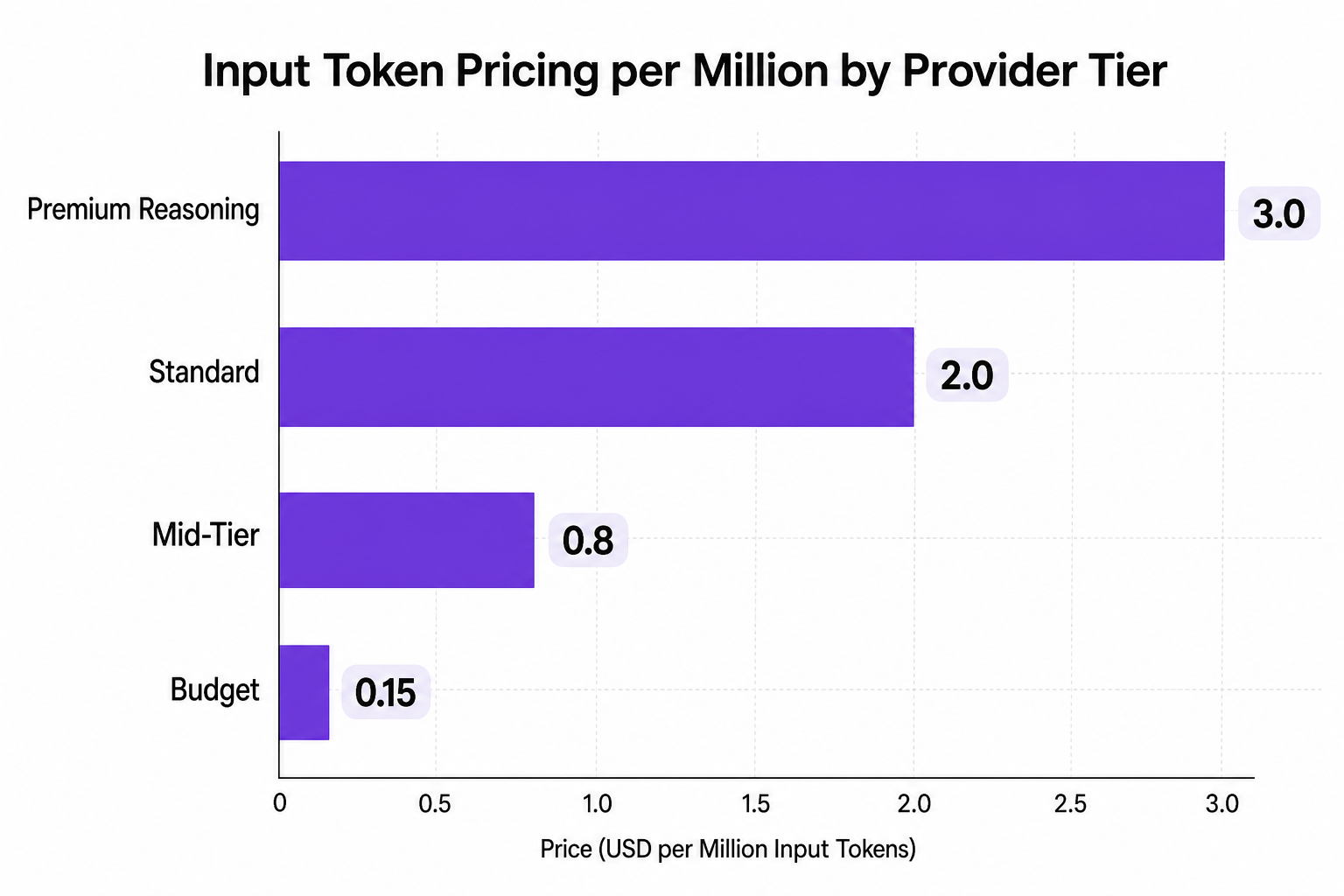
Budget LLMs now command prices as low as $0.10, $0.80 per million input tokens, a price level nearly unimaginable just three years prior. However, premium innovative models still see sticker prices between $3 and $15 for input and up to $75 per million output tokens, with output often billed at a higher rate.
Key statistics for 2026:
The spread between the cheapest and most expensive major APIs is over 600x.
The overall token price index has dropped 88% since 2023.
Generative AI-driven cloud expenses are now 30% higher, on average, versus 2025.
72% of IT and finance leaders cite GenAI-related cloud spend as unmanageable.
98% of organizations have moved to active AI spend management within FinOps.
Data prep can quietly consume 15, 20% of the initial-year budget.
While unit token pricing grabs attention, the reality is that LLM provider contracts host numerous ancillary charges and operational levers:
Model refresh clauses ramp up costs as providers accelerate capability upgrades
Data egress fees and obscure per-call surcharges
Opaque reasoning-cycle pricing and API minimums
Security and compliance premiums tucked into advanced SLAs
Year-two and contract renewal escalators hidden from initial order forms
These add up. TCO often ends up 30, 60% higher in year two compared to the initial budget. A single feature might ping multiple models, resulting in complex orchestration and shadow spend that’s hard to track.
The main cost driver in LLM deployments is often workload shape rather than just sticker rates:
Output tokens are far pricier than input tokens; use-case architecture matters.
Caching structures and prompt re-use can yield 90%+ reduction in API calls (with 94% cache hit rate typical in optimized environments).
Prompt engineering lowers total token load by an additional 15, 20%.
Behavior-based consumption means a single business feature may span several models and orchestration layers; spend centralizes around usage not infrastructure.
Real-world impact:
One financial platform cut spend from $36,000 to $3,200/month in one quarter by optimizing API calls.
A healthcare diagnostics leader reduced GenAI serving costs by 89% and doubled platform speed.
When organizations deploy deliberate prompt and cache architectures, returns move positive within three months.
|
Provider |
Budget Input Tokens (per million) |
Premium Input Tokens (per million) |
Premium Output Tokens (per million) |
Notable Billing Model Features |
|---|---|---|---|---|
|
OpenAI |
$0.10, $0.80 |
$3, $15 |
$15, $75 |
Heavy on usage-based, output premium |
|
Anthropic |
$0.12, $0.75 |
$2.5, $12 |
$12, $70 |
Volume discounts, contract escalators |
|
Bedrock |
$0.15, $0.75 |
$2, $14 |
$15, $65 |
Batch/feature pricing, add-on fees |
|
Vertex |
$0.15, $0.80 |
$3, $13 |
$14, $60 |
Focus on orchestration, API minimums |
Billing models use a mix of token, usage, feature, and orchestration charges. True cost often emerges only after detailed contract and usage review.
With the market compressing sticker prices and hidden expenses increasing, enterprise teams are shifting focus to:
Cost per message or outcome, not just compute spend
Automated prompt engineering for token minimization
Proactive caching and batch processing
Rigorous contract review and benchmarking
Internal unit economics dashboards, by team/outcome/model
Active chargeback and cost allocation to business units
CloudNuro’s AI Custodian platform empowers IT and finance teams to:
Measure and visualize cache savings and prompt reuse impacts
Track AI model spend at the level of feature, provider, and outcome
Normalize GenAI usage into business unit terms
Run governance and license optimization campaigns for AI/SaaS
Implement policy guardrails that cap cost for experimental workloads
Surface shadow AI usage and map it back to spend and business value
CloudNuro customers leverage AI-aware FinOps tools to confidently:
Benchmark top provider pricing, adjusting for usage mix
Allocate AI spend by model, feature, and business unit with precision
Uncover and mitigate hidden surge and shadow usage across SaaS and cloud
Build a culture of cost discipline, supporting rapid GenAI innovation without budgetary chaos
For organizations managing multiple LLM and AI data services, CloudNuro is uniquely positioned to turn chaotic, unpredictable spend into a visible, predictable, and optimized financial operation. Enabling both control and cost-driven innovation at scale.
How do OpenAI, Anthropic, Bedrock, and Vertex LLM pricing models compare in 2026?
All major providers charge lower rates for basic input tokens and premium rates for advanced model outputs, with significant price floors on output. True costs emerge based on usage shape, contract minimums, and feature-level orchestration.
What factors influence LLM provider costs for enterprises?
Key factors include usage patterns (input vs. output tokens), caching effectiveness, orchestration layers, contract terms (minimums, refreshes), and compliance/security add-ons.
Which LLM provider offers the most cost-effective solution in 2026?
No universal winner. Enterprises achieve best value by matching provider and model to specific outcome and engineering robust prompt/caching structures. Benchmarking by feature/unit is essential.
How can businesses predict and optimize their generative AI spend?
Adopt FinOps best practices with detailed benchmarking, spend tracking, prompt/token optimization, and active chargeback. Governance controls and spend-capping policies are critical.
Are there hidden fees in LLM and AI provider contracts?
Yes; expect data egress charges, model refresh escalators, per-call surcharges, and compliance premiums not visible in headline rates. Detailed contract review is mandatory.
The LLM landscape in 2026 is both opportunity-rich and cost-complex. As spending shifts from infra to feature-driven GenAI, procurement, IT, and finance leaders need robust tools to normalize, forecast, and optimize across OpenAI, Anthropic, Bedrock, and Vertex deployments. CloudNuro provides the AI-powered visibility, active governance, and precise cost optimization required to confidently manage enterprise AI initiatives. Driving innovation and budget alignment.
About CloudNuro
CloudNuro is a leader in Enterprise AI Adoption Management, providing enterprises with unmatched visibility, governance, and cost optimization. Recognized twice in a row in the SaaS Management Platforms category and named a Leader in the SoftwareReviews Data Quadrant, CloudNuro is trusted by global enterprises and government agencies to bring financial discipline to SaaS, cloud, and AI. Trusted by enterprises, CloudNuro provides centralized SaaS inventory, license optimization, and renewal management along with advanced cost allocation and chargeback, giving IT and Finance leaders the visibility, control, and cost-conscious culture needed to drive financial discipline.
Request a no cost, no obligation free assessment —just 15 minutes to savings!
Get StartedNavigating enterprise AI budgets in 2026 requires clarity on the cost structures, usage patterns, and financial pitfalls unique to today’s language model ecosystem. With OpenAI, Anthropic, Bedrock, and Vertex leading the landscape, procurement and IT finance leaders increasingly seek ways to benchmark and optimize LLM provider costs. In this deep-dive, we unpack the biggest pricing levers, hidden charges, and financial management strategies, giving you the knowledge to make confident, cost-effective choices for your GenAI initiatives.
The generative AI market has matured rapidly. Prices for commodity language models are collapsing, but premium models for advanced reasoning remain expensive due to proprietary features. For CIOs and IT finance leaders, understanding where spend is consolidated, what drives unpredictability, and how to govern consumption is now part of the strategic AI budgeting playbook.
Recent trends include:
Fierce downward pressure on basic generation costs, while premium reasoning APIs command a persistent price gap.
AI spending is no longer just about infrastructure; multi-model features, vector search, and orchestration impact true cost per outcome.
Usage patterns have grown bursty and experimental, making budgeting far more complex than static annual plans.
Token-based billing, model refresh fees, and hidden contract uplifts often create a hazy view of Total Cost of Ownership (TCO).
Budget LLMs now command prices as low as $0.10, $0.80 per million input tokens, a price level nearly unimaginable just three years prior. However, premium innovative models still see sticker prices between $3 and $15 for input and up to $75 per million output tokens, with output often billed at a higher rate.
Key statistics for 2026:
The spread between the cheapest and most expensive major APIs is over 600x.
The overall token price index has dropped 88% since 2023.
Generative AI-driven cloud expenses are now 30% higher, on average, versus 2025.
72% of IT and finance leaders cite GenAI-related cloud spend as unmanageable.
98% of organizations have moved to active AI spend management within FinOps.
Data prep can quietly consume 15, 20% of the initial-year budget.
While unit token pricing grabs attention, the reality is that LLM provider contracts host numerous ancillary charges and operational levers:
Model refresh clauses ramp up costs as providers accelerate capability upgrades
Data egress fees and obscure per-call surcharges
Opaque reasoning-cycle pricing and API minimums
Security and compliance premiums tucked into advanced SLAs
Year-two and contract renewal escalators hidden from initial order forms
These add up. TCO often ends up 30, 60% higher in year two compared to the initial budget. A single feature might ping multiple models, resulting in complex orchestration and shadow spend that’s hard to track.
The main cost driver in LLM deployments is often workload shape rather than just sticker rates:
Output tokens are far pricier than input tokens; use-case architecture matters.
Caching structures and prompt re-use can yield 90%+ reduction in API calls (with 94% cache hit rate typical in optimized environments).
Prompt engineering lowers total token load by an additional 15, 20%.
Behavior-based consumption means a single business feature may span several models and orchestration layers; spend centralizes around usage not infrastructure.
Real-world impact:
One financial platform cut spend from $36,000 to $3,200/month in one quarter by optimizing API calls.
A healthcare diagnostics leader reduced GenAI serving costs by 89% and doubled platform speed.
When organizations deploy deliberate prompt and cache architectures, returns move positive within three months.
|
Provider |
Budget Input Tokens (per million) |
Premium Input Tokens (per million) |
Premium Output Tokens (per million) |
Notable Billing Model Features |
|---|---|---|---|---|
|
OpenAI |
$0.10, $0.80 |
$3, $15 |
$15, $75 |
Heavy on usage-based, output premium |
|
Anthropic |
$0.12, $0.75 |
$2.5, $12 |
$12, $70 |
Volume discounts, contract escalators |
|
Bedrock |
$0.15, $0.75 |
$2, $14 |
$15, $65 |
Batch/feature pricing, add-on fees |
|
Vertex |
$0.15, $0.80 |
$3, $13 |
$14, $60 |
Focus on orchestration, API minimums |
Billing models use a mix of token, usage, feature, and orchestration charges. True cost often emerges only after detailed contract and usage review.
With the market compressing sticker prices and hidden expenses increasing, enterprise teams are shifting focus to:
Cost per message or outcome, not just compute spend
Automated prompt engineering for token minimization
Proactive caching and batch processing
Rigorous contract review and benchmarking
Internal unit economics dashboards, by team/outcome/model
Active chargeback and cost allocation to business units
CloudNuro’s AI Custodian platform empowers IT and finance teams to:
Measure and visualize cache savings and prompt reuse impacts
Track AI model spend at the level of feature, provider, and outcome
Normalize GenAI usage into business unit terms
Run governance and license optimization campaigns for AI/SaaS
Implement policy guardrails that cap cost for experimental workloads
Surface shadow AI usage and map it back to spend and business value
CloudNuro customers leverage AI-aware FinOps tools to confidently:
Benchmark top provider pricing, adjusting for usage mix
Allocate AI spend by model, feature, and business unit with precision
Uncover and mitigate hidden surge and shadow usage across SaaS and cloud
Build a culture of cost discipline, supporting rapid GenAI innovation without budgetary chaos
For organizations managing multiple LLM and AI data services, CloudNuro is uniquely positioned to turn chaotic, unpredictable spend into a visible, predictable, and optimized financial operation. Enabling both control and cost-driven innovation at scale.
How do OpenAI, Anthropic, Bedrock, and Vertex LLM pricing models compare in 2026?
All major providers charge lower rates for basic input tokens and premium rates for advanced model outputs, with significant price floors on output. True costs emerge based on usage shape, contract minimums, and feature-level orchestration.
What factors influence LLM provider costs for enterprises?
Key factors include usage patterns (input vs. output tokens), caching effectiveness, orchestration layers, contract terms (minimums, refreshes), and compliance/security add-ons.
Which LLM provider offers the most cost-effective solution in 2026?
No universal winner. Enterprises achieve best value by matching provider and model to specific outcome and engineering robust prompt/caching structures. Benchmarking by feature/unit is essential.
How can businesses predict and optimize their generative AI spend?
Adopt FinOps best practices with detailed benchmarking, spend tracking, prompt/token optimization, and active chargeback. Governance controls and spend-capping policies are critical.
Are there hidden fees in LLM and AI provider contracts?
Yes; expect data egress charges, model refresh escalators, per-call surcharges, and compliance premiums not visible in headline rates. Detailed contract review is mandatory.
The LLM landscape in 2026 is both opportunity-rich and cost-complex. As spending shifts from infra to feature-driven GenAI, procurement, IT, and finance leaders need robust tools to normalize, forecast, and optimize across OpenAI, Anthropic, Bedrock, and Vertex deployments. CloudNuro provides the AI-powered visibility, active governance, and precise cost optimization required to confidently manage enterprise AI initiatives. Driving innovation and budget alignment.
About CloudNuro
CloudNuro is a leader in Enterprise AI Adoption Management, providing enterprises with unmatched visibility, governance, and cost optimization. Recognized twice in a row in the SaaS Management Platforms category and named a Leader in the SoftwareReviews Data Quadrant, CloudNuro is trusted by global enterprises and government agencies to bring financial discipline to SaaS, cloud, and AI. Trusted by enterprises, CloudNuro provides centralized SaaS inventory, license optimization, and renewal management along with advanced cost allocation and chargeback, giving IT and Finance leaders the visibility, control, and cost-conscious culture needed to drive financial discipline.
Request a no cost, no obligation free assessment - just 15 minutes to savings!
Get StartedWe're offering complimentary ServiceNow license assessments to only 25 enterprises this quarter who want to unlock immediate savings without disrupting operations.
Get Free AssessmentGet Started




CloudNuro Corp
1755 Park St. Suite 207
Naperville, IL 60563
Phone : +1-630-277-9470
Email: info@cloudnuro.com





.webp)

Recognized Leader in SaaS Management Platforms by Info-Tech SoftwareReviews
%20and%20CMDB%20Integrati.png)


.png)
.svg)