

Sign Up
Thank you for Submitting!
Shadow AI has emerged as one of the most urgent risk vectors for enterprises in 2026. Integrating artificial intelligence into daily operations once promised efficiency and innovation, but unsanctioned AI adoption, or 'shadow AI', now stands as a leading cause of major data breaches, compliance failures, and spiraling costs. CIOs, CTOs, and IT leaders face a fast-evolving landscape where the true shadow AI breach cost is rising at an alarming rate, fueled by unchecked tool proliferation and gaps in governance.
In this report, we break down what’s behind the surge in shadow AI breach costs, unveil current statistics and stakes, and chart a technology-backed path to visibility and control.
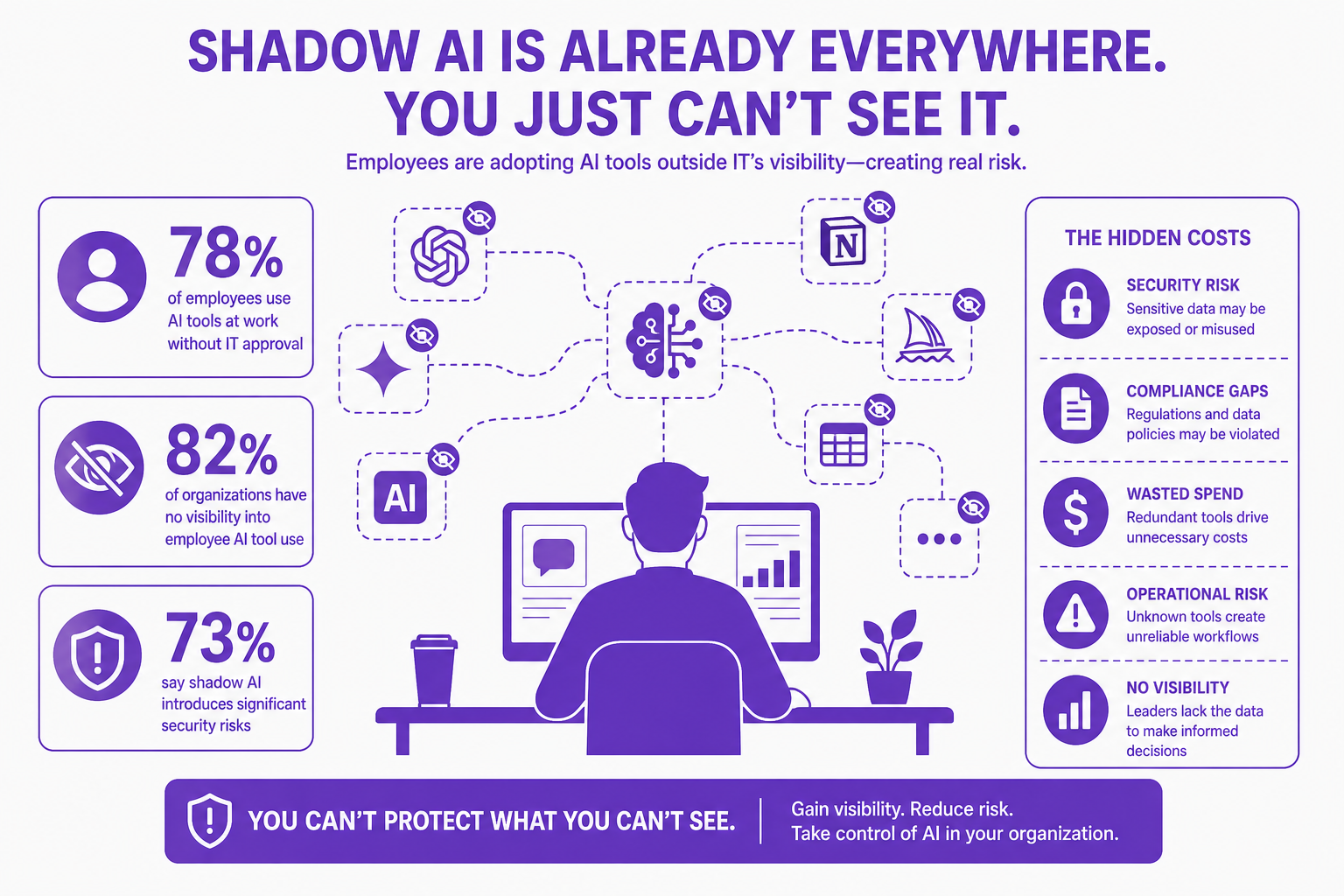
Shadow AI encapsulates the unsanctioned use of AI-powered applications, APIs, and services that are adopted without oversight from IT or security teams. Employees bring AI tools into workflows to solve real business problems, but these shortcuts circumvent existing security, compliance, and financial controls. A staggering 98% of organizations now observe employees regularly using unapproved AI and SaaS applications within their daily tasks.
This exposure is not trivial. Shadow AI multiplies access points for sensitive data, leaves security and audit trails fractured, and accelerates the risk of compliance missteps as new autonomous AI agents proliferate in the enterprise ecosystem.
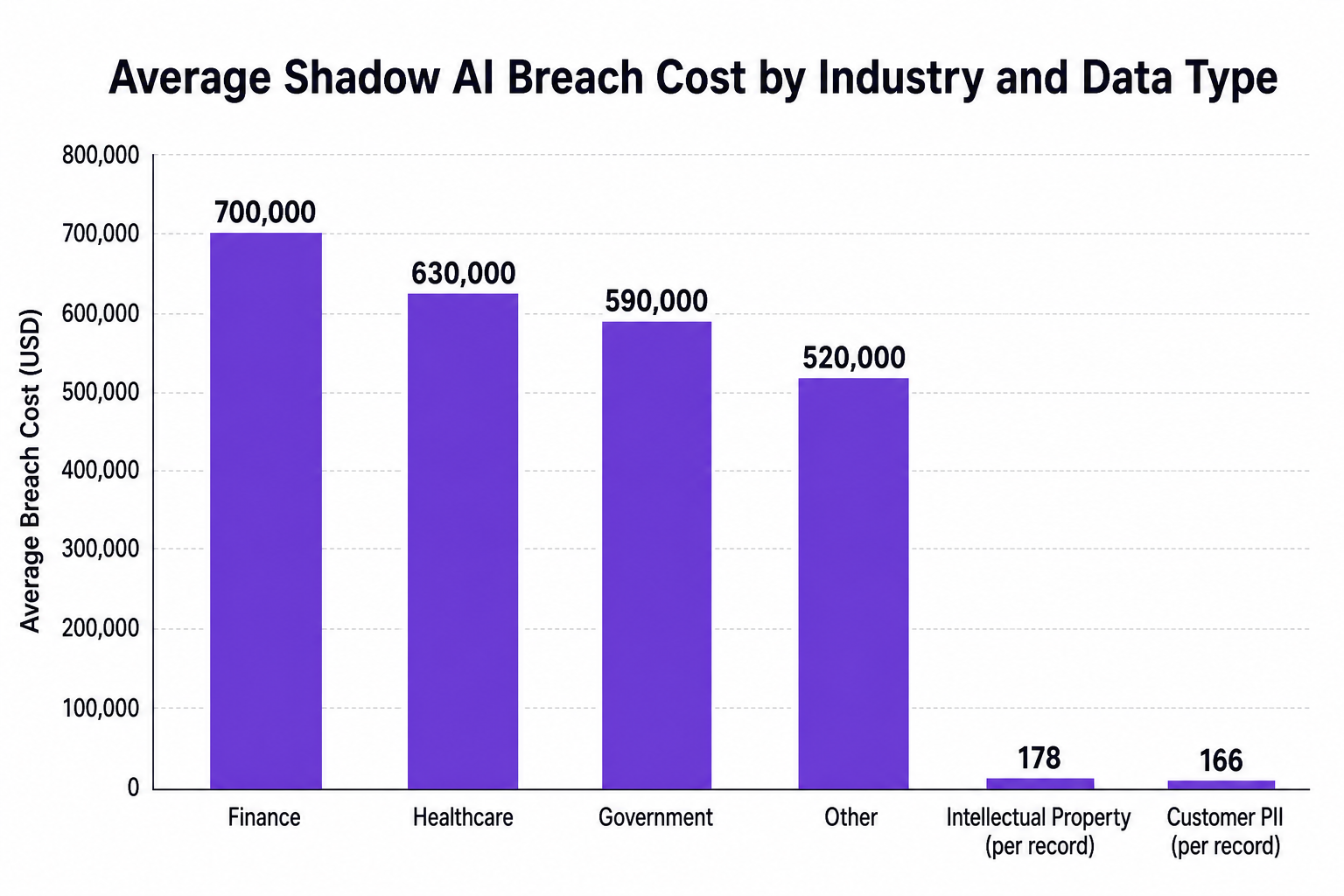
The dollar risk is now substantial. On average, shadow AI adds $670,000 to every data breach, pushing the total cost of these incidents to $4.63 million. Per record, breaches involving intellectual property command premiums up to $178, while customer PII exposures hover at $166 per record. Finance leads with an average shadow AI breach cost of $700,000, followed by healthcare ($630,000) and government ($590,000).
But the financial toll extends beyond direct response and recovery. Shadow AI breaches take an average of 247 days to even detect, often meaning compliance investigations, legal reviews, and customer notification processes are triggered months after the fact. Each day of exposure compounds regulatory, reputational, and opportunity costs, making reactive approaches increasingly unviable for large organizations.
Governance Fragmentation: Only 34% of organizations have a formal program for shadow AI detection. Disconnected governance platforms and manual inventory leave a compliance blind spot that grows with every new shadow app adoption.
Speed-to-Market Pressure: Employees bypass slow approval processes, bringing personal and open-source AI into production environments to keep up with aggressive innovation timelines.
Hidden Complexity: Autonomous AI agents and embedded AI features in SaaS apps increase traceability and policy enforcement challenges for IT teams.
Expansive Scope: The average enterprise now faces 269 distinct shadow AI applications per 1,000 employees, each representing a potential vulnerability.
Expert insights confirm: Shadow AI tools, left unguided, bypass core identity management and data retention controls, undermining even the most robust enterprise security frameworks.
The compliance landscape has grown more onerous. Regulatory bodies increasingly require that organizations not only account for publicly visible AI systems but also demonstrate complete auditability of every AI-enabled workload, feature, and integration.
Disconnected monitoring means most enterprises cannot trace AI data flows, nor can they reliably map SaaS or cloud expenditures to sanctioned or unsanctioned AI usage. This lack of transparency transforms compliance reviews into high-stress, high-cost exercises. Indeed, 22% of compliance incidents are directly linked to a lack of AI visibility, and organizations lacking unified governance face a 25% increase in cost containment challenges for their AI-enabled SaaS stack.
A global financial services provider using unified governance flagged 187 shadow AI workloads, reducing compliance investigation costs by 38% and avoiding over $1.4 million in projected penalties.
A healthcare enterprise uncovered unauthorized LLM (large language model) usage involving sensitive patient-adjacent data. By centralizing policy management, they saw a 26% reduction in operational AI risk exposure within six months.
Across all industries, integrated governance platforms deliver a 22% reduction in compliance incidents and a 25% improvement in cost containment for both AI and SaaS.
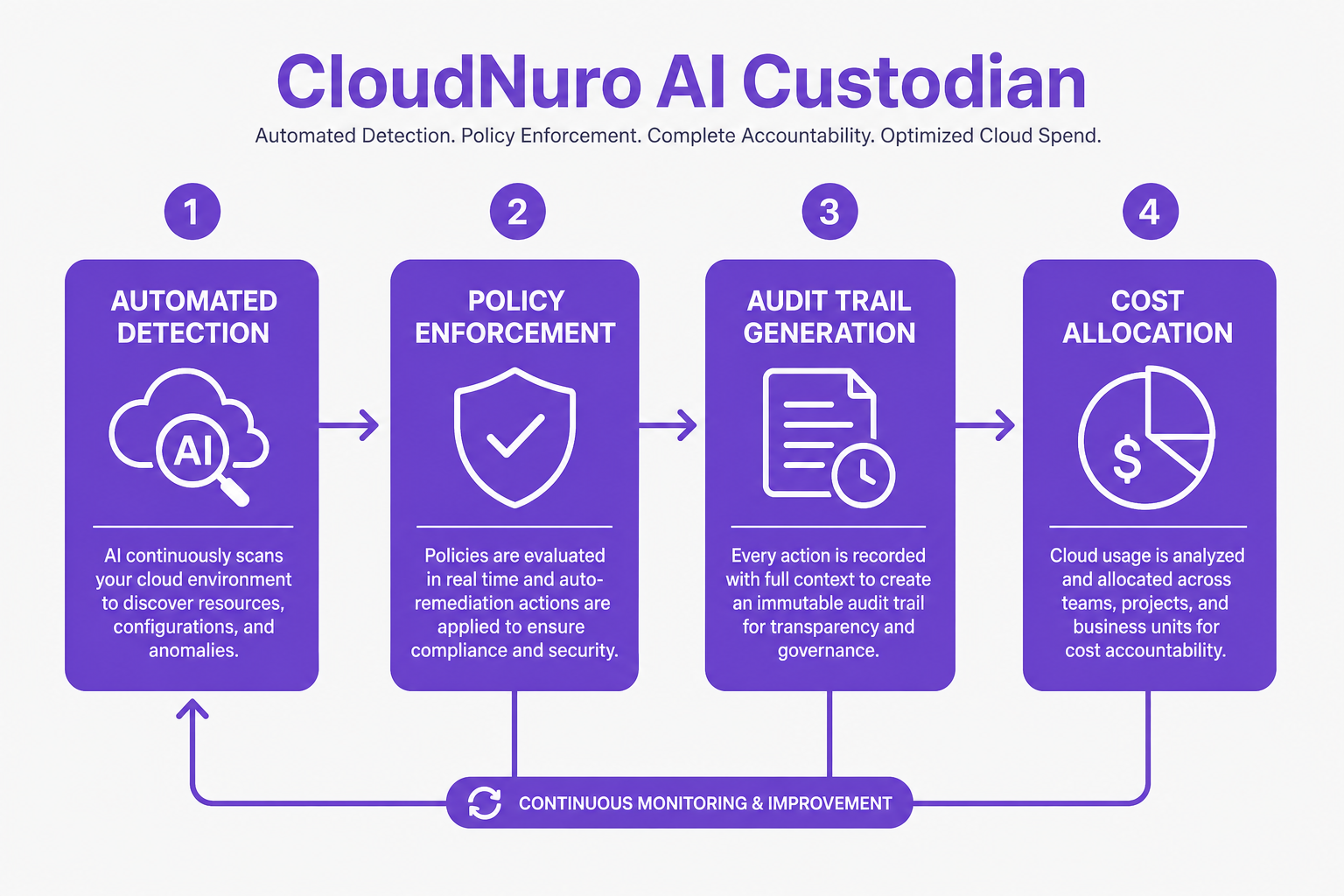
Automated, real-time monitoring discovers unsanctioned workloads, APIs, and AI-driven tools across SaaS and cloud environments. CloudNuro’s platform maps all assets to users and cost centers, exposing invisible risk and financial leakage.
Unified Cloud Custodian applies automated guardrails that detect and block risky AI usage. including MFA-disabled accounts or public storage linked to AI workflows. Policy-based controls keep compliance steps active at all times.
Centralized dashboards generate exportable audit trails, mapping AI and SaaS usage to regulatory requirements and supporting external reviews.
FinOps services tag AI and SaaS costs to specific business units, ensuring unbudgeted services and redundant tools become immediately visible and actionable.
With over 400 ready-to-integrate SaaS and cloud connectors, CloudNuro streamlines governance, eliminating the security and compliance gaps driven by tool fragmentation.
How much does a shadow AI breach cost in 2026?
The average cost of a shadow AI data breach is $4.63 million, with shadow AI usage adding $670,000 to each breach on average. Industries like finance can see breach costs rise to $700,000 per incident.
What makes shadow AI such a high-impact risk in enterprise SaaS?
Shadow AI introduces unmanaged access points, bypassing formal review and compliance controls. This multiplies vulnerability and complicates both detection and remediation.
How can organizations detect and prevent shadow AI threats?
Centralized AI governance platforms like CloudNuro AI Custodian provide real-time discovery and monitoring, mapping AI activities to users, costs, and policy breaches for immediate risk mitigation.
What are best practices for shadow AI governance in 2026?
Establish unified visibility across all SaaS and cloud environments, automate policy enforcement, audit every AI-enabled feature, and employ cost allocation to expose and remediate shadow AI risk.
How does compliance factor into shadow AI risk management?
Modern regulations demand auditability for all AI workloads, whether sanctioned or not. Centralized compliance dashboards and exportable audit trails are critical for reducing incidents and containing costs.
Shadow AI cost and exposure are rising fast as enterprises battle to maintain control and compliance in a rapidly evolving AI and SaaS landscape. Inaction is now prohibitively expensive. CloudNuro equips IT, compliance, and security leaders with the real-time intelligence, automation, and integration needed to contain shadow AI risk, optimize costs, and ensure regulatory confidence.
About CloudNuro
CloudNuro is a leader in Enterprise AI Adoption Management, providing enterprises with unmatched visibility, governance, and cost optimization. Recognized twice in a row in the SaaS Management Platforms category and named a Leader in the SoftwareReviews Data Quadrant, CloudNuro is trusted by global enterprises and government agencies to bring financial discipline to SaaS, cloud, and AI. Trusted by enterprises, CloudNuro provides centralized SaaS inventory, license optimization, and renewal management along with advanced cost allocation and chargeback, giving IT and Finance leaders the visibility, control, and cost-conscious culture needed to drive financial discipline.
Request a no cost, no obligation free assessment —just 15 minutes to savings!
Get StartedShadow AI has emerged as one of the most urgent risk vectors for enterprises in 2026. Integrating artificial intelligence into daily operations once promised efficiency and innovation, but unsanctioned AI adoption, or 'shadow AI', now stands as a leading cause of major data breaches, compliance failures, and spiraling costs. CIOs, CTOs, and IT leaders face a fast-evolving landscape where the true shadow AI breach cost is rising at an alarming rate, fueled by unchecked tool proliferation and gaps in governance.
In this report, we break down what’s behind the surge in shadow AI breach costs, unveil current statistics and stakes, and chart a technology-backed path to visibility and control.
Shadow AI encapsulates the unsanctioned use of AI-powered applications, APIs, and services that are adopted without oversight from IT or security teams. Employees bring AI tools into workflows to solve real business problems, but these shortcuts circumvent existing security, compliance, and financial controls. A staggering 98% of organizations now observe employees regularly using unapproved AI and SaaS applications within their daily tasks.
This exposure is not trivial. Shadow AI multiplies access points for sensitive data, leaves security and audit trails fractured, and accelerates the risk of compliance missteps as new autonomous AI agents proliferate in the enterprise ecosystem.
The dollar risk is now substantial. On average, shadow AI adds $670,000 to every data breach, pushing the total cost of these incidents to $4.63 million. Per record, breaches involving intellectual property command premiums up to $178, while customer PII exposures hover at $166 per record. Finance leads with an average shadow AI breach cost of $700,000, followed by healthcare ($630,000) and government ($590,000).
But the financial toll extends beyond direct response and recovery. Shadow AI breaches take an average of 247 days to even detect, often meaning compliance investigations, legal reviews, and customer notification processes are triggered months after the fact. Each day of exposure compounds regulatory, reputational, and opportunity costs, making reactive approaches increasingly unviable for large organizations.
Governance Fragmentation: Only 34% of organizations have a formal program for shadow AI detection. Disconnected governance platforms and manual inventory leave a compliance blind spot that grows with every new shadow app adoption.
Speed-to-Market Pressure: Employees bypass slow approval processes, bringing personal and open-source AI into production environments to keep up with aggressive innovation timelines.
Hidden Complexity: Autonomous AI agents and embedded AI features in SaaS apps increase traceability and policy enforcement challenges for IT teams.
Expansive Scope: The average enterprise now faces 269 distinct shadow AI applications per 1,000 employees, each representing a potential vulnerability.
Expert insights confirm: Shadow AI tools, left unguided, bypass core identity management and data retention controls, undermining even the most robust enterprise security frameworks.
The compliance landscape has grown more onerous. Regulatory bodies increasingly require that organizations not only account for publicly visible AI systems but also demonstrate complete auditability of every AI-enabled workload, feature, and integration.
Disconnected monitoring means most enterprises cannot trace AI data flows, nor can they reliably map SaaS or cloud expenditures to sanctioned or unsanctioned AI usage. This lack of transparency transforms compliance reviews into high-stress, high-cost exercises. Indeed, 22% of compliance incidents are directly linked to a lack of AI visibility, and organizations lacking unified governance face a 25% increase in cost containment challenges for their AI-enabled SaaS stack.
A global financial services provider using unified governance flagged 187 shadow AI workloads, reducing compliance investigation costs by 38% and avoiding over $1.4 million in projected penalties.
A healthcare enterprise uncovered unauthorized LLM (large language model) usage involving sensitive patient-adjacent data. By centralizing policy management, they saw a 26% reduction in operational AI risk exposure within six months.
Across all industries, integrated governance platforms deliver a 22% reduction in compliance incidents and a 25% improvement in cost containment for both AI and SaaS.
Automated, real-time monitoring discovers unsanctioned workloads, APIs, and AI-driven tools across SaaS and cloud environments. CloudNuro’s platform maps all assets to users and cost centers, exposing invisible risk and financial leakage.
Unified Cloud Custodian applies automated guardrails that detect and block risky AI usage. including MFA-disabled accounts or public storage linked to AI workflows. Policy-based controls keep compliance steps active at all times.
Centralized dashboards generate exportable audit trails, mapping AI and SaaS usage to regulatory requirements and supporting external reviews.
FinOps services tag AI and SaaS costs to specific business units, ensuring unbudgeted services and redundant tools become immediately visible and actionable.
With over 400 ready-to-integrate SaaS and cloud connectors, CloudNuro streamlines governance, eliminating the security and compliance gaps driven by tool fragmentation.
How much does a shadow AI breach cost in 2026?
The average cost of a shadow AI data breach is $4.63 million, with shadow AI usage adding $670,000 to each breach on average. Industries like finance can see breach costs rise to $700,000 per incident.
What makes shadow AI such a high-impact risk in enterprise SaaS?
Shadow AI introduces unmanaged access points, bypassing formal review and compliance controls. This multiplies vulnerability and complicates both detection and remediation.
How can organizations detect and prevent shadow AI threats?
Centralized AI governance platforms like CloudNuro AI Custodian provide real-time discovery and monitoring, mapping AI activities to users, costs, and policy breaches for immediate risk mitigation.
What are best practices for shadow AI governance in 2026?
Establish unified visibility across all SaaS and cloud environments, automate policy enforcement, audit every AI-enabled feature, and employ cost allocation to expose and remediate shadow AI risk.
How does compliance factor into shadow AI risk management?
Modern regulations demand auditability for all AI workloads, whether sanctioned or not. Centralized compliance dashboards and exportable audit trails are critical for reducing incidents and containing costs.
Shadow AI cost and exposure are rising fast as enterprises battle to maintain control and compliance in a rapidly evolving AI and SaaS landscape. Inaction is now prohibitively expensive. CloudNuro equips IT, compliance, and security leaders with the real-time intelligence, automation, and integration needed to contain shadow AI risk, optimize costs, and ensure regulatory confidence.
About CloudNuro
CloudNuro is a leader in Enterprise AI Adoption Management, providing enterprises with unmatched visibility, governance, and cost optimization. Recognized twice in a row in the SaaS Management Platforms category and named a Leader in the SoftwareReviews Data Quadrant, CloudNuro is trusted by global enterprises and government agencies to bring financial discipline to SaaS, cloud, and AI. Trusted by enterprises, CloudNuro provides centralized SaaS inventory, license optimization, and renewal management along with advanced cost allocation and chargeback, giving IT and Finance leaders the visibility, control, and cost-conscious culture needed to drive financial discipline.
Request a no cost, no obligation free assessment - just 15 minutes to savings!
Get StartedWe're offering complimentary ServiceNow license assessments to only 25 enterprises this quarter who want to unlock immediate savings without disrupting operations.
Get Free AssessmentGet Started




CloudNuro Corp
1755 Park St. Suite 207
Naperville, IL 60563
Phone : +1-630-277-9470
Email: info@cloudnuro.com




.webp)

Recognized Leader in SaaS Management Platforms by Info-Tech SoftwareReviews

.svg)