

Sign Up
Thank you for Submitting!
Today, the nature of software procurement is radically different from a decade ago. Fast-paced digital transformation, cloud-native strategies, and the growing autonomy of individual business units have created a new dynamic: software-as-a-service (SaaS) is easier to buy than ever, but vastly harder to govern and control. This decentralization has upended traditional discovery, making it nearly impossible for technology leaders to answer the simple question, "What SaaS tools do we actually have?" This article unpacks why SaaS discovery is broken, what that means for your organization, and, most importantly, how a SaaS governance framework can restore compliance, cost control, and security.

For years, IT departments managed software centralization, hand-picking solutions to serve every business need. In the modern cloud economy, however, spend ownership is shifting rapidly away from internal IT approvals and toward distributed business units and even individual employees. In fact, business units now own 81% of software spend, while central technology departments manage only 15% of the total spend. The push for agility, productivity, and specialized tools means that SaaS adoption is happening everywhere, often with little oversight or alignment to company policy.
What is decentralized SaaS procurement? It is the process where the ability to discover, evaluate, and purchase cloud-based applications shifts away from a single gatekeeping authority and into the hands of multiple business groups. This shift is simultaneously fueling innovation and creating new challenges in software visibility.
With so many teams and individuals able to buy software, the discovery process, once as simple as auditing a central asset register, has become fragmented across different data sources. Applications are acquired through credit cards, invoiced directly to departments, or even trialed on free plans, all without passing through official procurement. The result? Security and compliance teams are left blind to what is running in their environment, and financial leaders are forced to make decisions based on an incomplete picture.
Shadow IT now accounts for 45% of applications in the average corporate stack, and the average organization underestimates its active SaaS portfolio by 40%. As a result, millions of dollars flow every year into software that is redundant, underutilized, or even unauthorized. Companies waste an average of $18 million annually on unused or underutilized software licenses. Worse, unchecked SaaS purchases open backdoors for compliance lapses, data loss, and spiraling expenses.
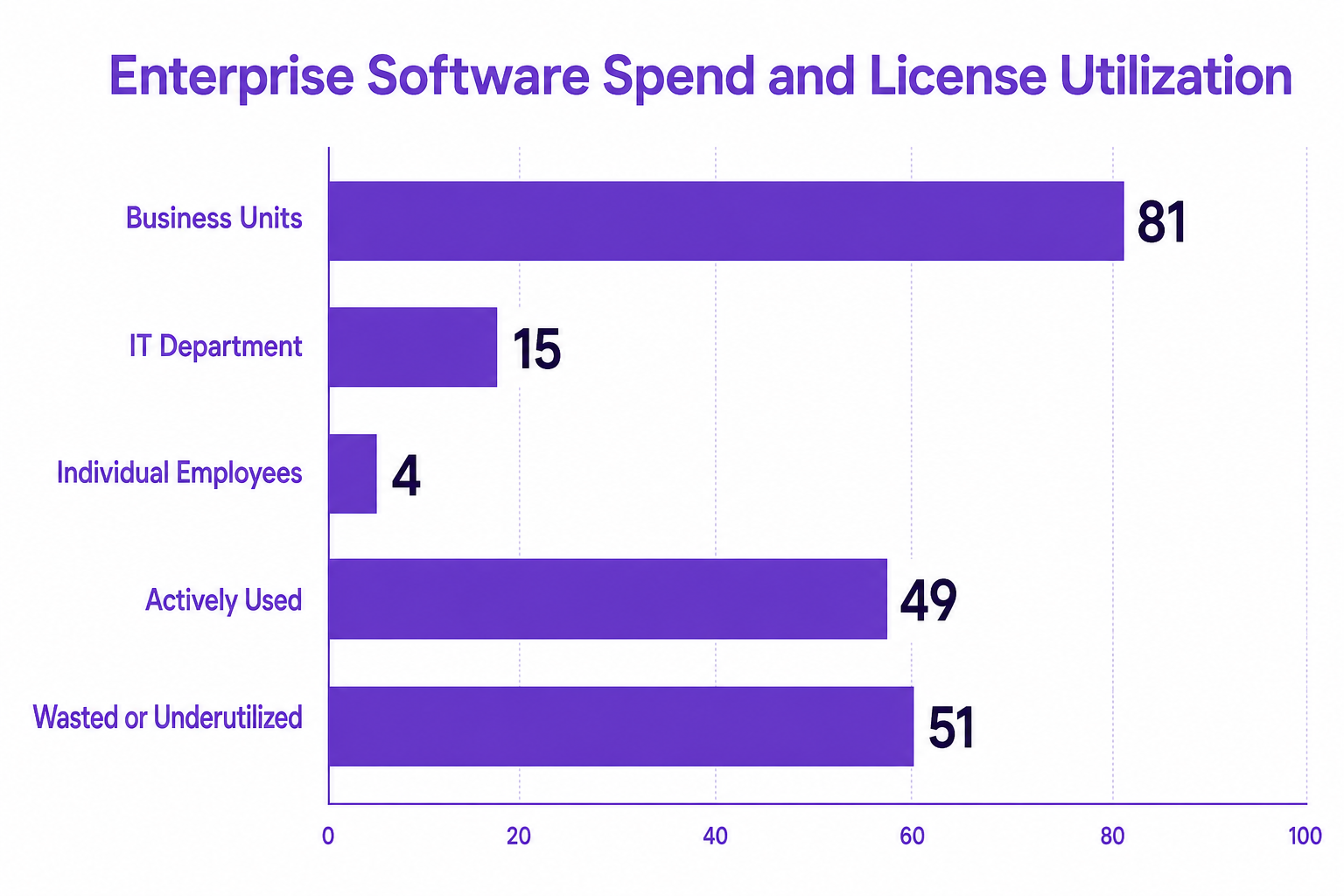
The visibility gap created by decentralized buying has direct, measurable impacts. Without structured spend management, organizations overspend by up to 25% annually due to unused entitlements and overlapping tools. Only 49% of purchased software licenses are actively used, and pricing for cloud software contracts has risen 11.4% year-over-year. The stakes are not just financial, regulatory audits become harder, compliance incidents escalate, and security postures weaken.
Let’s consider the people behind these numbers:
Procurement leaders struggle to reconcile invoices across multiple departments and vendors.
IT security must chase down unauthorized apps during every audit cycle.
CIOs and CFOs lose faith in budgeting forecasts as hidden spend grows.
An expert from CloudNuro summarizes the challenge: "Decentralized software procurement inevitably increases unchecked application sprawl and undermines compliance, making automated and unified governance an absolute requirement rather than an option."
The challenges snowball as shadow IT grows in scale:
Fragmented application inventory: No one has a unified view of what SaaS apps are active across departments.
Untracked spend: Expenses for SaaS fly under the radar, buried in credit card statements and departmental invoices.
Compliance risk: Sensitive data may reside in unapproved, non-compliant tools.
Audit headaches: Gathering evidence for audits requires manual outreach and data triangulation, increasing the risk of failure.
License waste: Overlapping tools and unused licenses drive duplicative costs and waste.
A regional healthcare group using CloudNuro, for example, uncovered 450 undocumented applications. That insight not only eliminated $2.8 million in redundant licensing fees but also streamlined the organization’s regulatory audits, highlighting the operational and financial benefits of robust SaaS discovery.
The broken discovery problem is not simply about lost dollars; it is an existential issue for compliance, risk management, and business agility. A modern SaaS governance framework aims to:
Deliver complete visibility across every SaaS application, approved or not
Automate discovery by ingesting data from financial, identity, and network systems
Standardize access reviews and trigger compliance workflows automatically
Drive remediation actions (license reclamation, access restrictions, or contract renegotiation) without manual intervention
Surface actionable insights for IT and procurement leaders to optimize spend and rationalize application portfolios
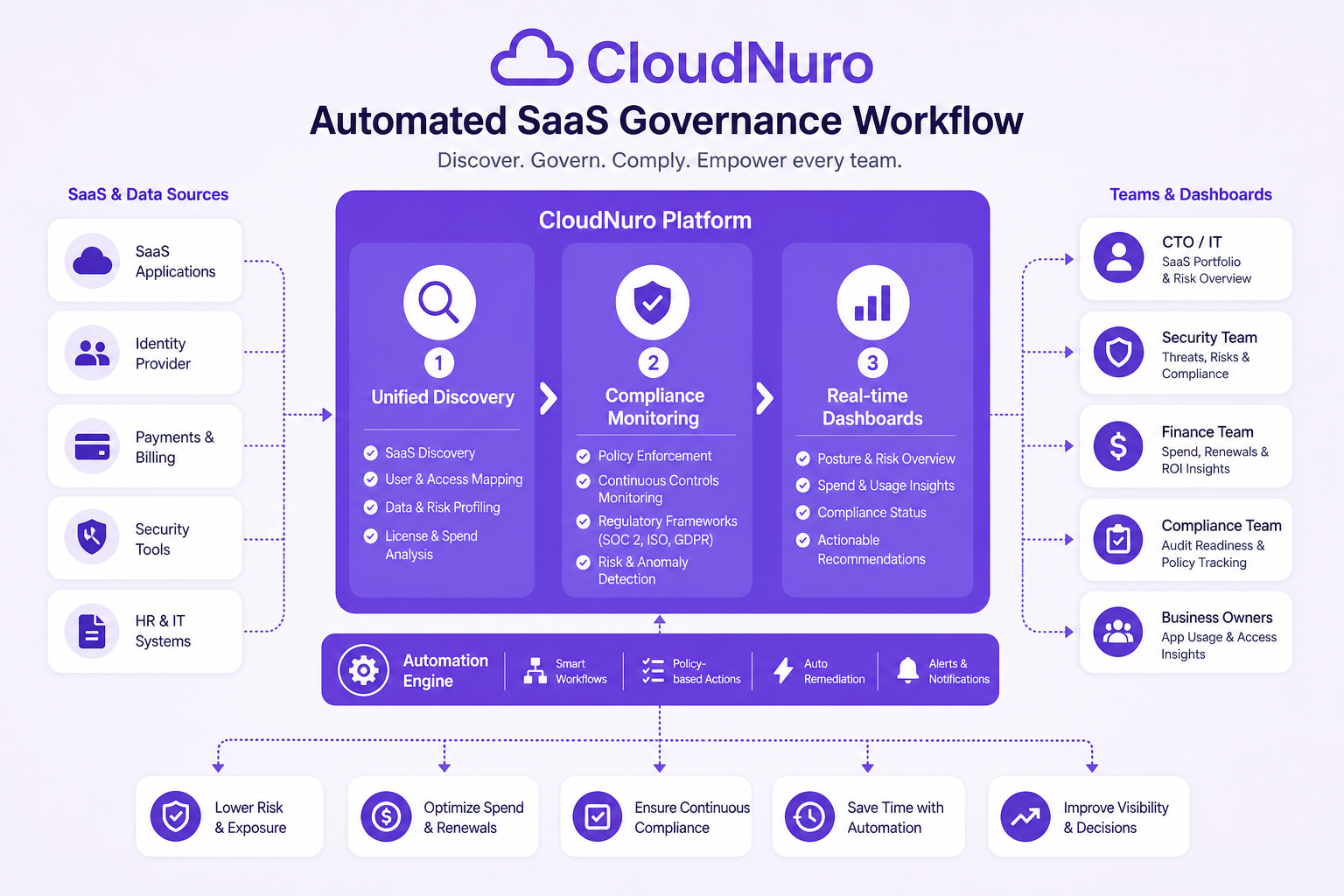
CloudNuro’s AI-powered Unified Cloud Custodian is purpose-built for organizations grappling with the risks of decentralized SaaS buying. The platform:
Executes comprehensive discovery by safely integrating with more than 400 distinct cloud infrastructure systems and enterprise platforms
Automatically scans financial records to flag unauthorized charges and alert administrators to shadow deployments before they grow
Initiates standardized access reviews and applies compliance policy enforcement at application level
Aggregates identity, expense, and native API data into a single authoritative software inventory
Evaluates risk scores in real time and triggers remediation workflows to ensure departmental adoption adheres to security standards
Maps application usage back to designated budget owners, eliminating untracked expenses with chargeback
Continuously reclaims unused licenses, downgrades plans, and terminates redundant apps
Take the case of a global financial services firm: After automating their discovery pipelines using CloudNuro, they saw a 92% reduction in unauthorized shadow software and achieved perfect compliance across their portfolio in just six months. Likewise, a healthcare provider rationalized over 200 unapproved applications and saved $1.2 million annually, all while reducing compliance incidents by 47%.
Restoring order to SaaS discovery and spend starts with a governance-first approach:
Unify discovery: Aggregate all discovery touchpoints (cloud spend, expense feeds, identity logs, application APIs) for a single source of truth.
Automate compliance: Deploy automated policy enforcement on app onboarding, access management, and usage monitoring.
Establish chargeback: Map SaaS usage and costs directly to budget owners to incentivize accountability.
Optimize license management: Use automated workflows to reclaim, downgrade, or terminate unused licenses.
Enable real-time risk response: Trigger targeted remediation when risky SaaS activities or noncompliant apps are detected.
CloudNuro’s comprehensive SaaS governance framework helps IT and procurement leaders transition from chasing the next shadow app to proactively managing their entire cloud estate, for cost, compliance, and security.
What is decentralized SaaS procurement?
Decentralized SaaS procurement is when software purchasing control shifts from centralized IT or procurement teams to individual business units or employees. This enables faster tool adoption but increases risks around visibility, compliance, and cost control.
How does decentralized SaaS buying impact visibility?
It fragments vital spend and usage information, often hiding applications from IT’s view. Applications may be purchased via department credit cards or directly by employees, escaping traditional procurement processes and creating blind spots.
Why is SaaS governance important for procurement?
Effective governance ensures a full view of all SaaS assets, standardizes security and compliance measures, and prevents the waste associated with shadow IT and redundant licenses. It is crucial for fiscal responsibility and regulatory compliance.
What are common issues with shadow IT in SaaS?
Shadow IT leads to fragmented inventories, untracked spend, regulatory non-compliance, overlapping applications, and license waste. Audit cycles become more complicated and security risks increase.
How can organizations regain SaaS purchasing control?
Adopting a SaaS management platform like CloudNuro that delivers automated discovery, policy-driven governance, continuous compliance monitoring, and holistic cost optimization is key. By centralizing visibility and creating clear chargeback and remediation workflows, organizations can bring decentralized procurement back under control.
SaaS is enabling business innovation on an unprecedented scale, but only organizations with a governance-first mindset can convert shadow IT chaos into secure, efficient, and compliant operations. Decentralized buying is a fact of the modern workplace, but visibility, control, and cost optimization do not have to be sacrificed. CloudNuro empowers leaders to put SaaS discovery, compliance, and spend management back at the heart of enterprise IT. The future of SaaS is decentralized, but with the right SaaS governance framework, your control does not have to be.
For a deeper dive on how CloudNuro helps organizations master SaaS management, learn more here, or explore related topics:
CloudNuro is a leader in Enterprise AI Adoption Management, providing enterprises with unmatched visibility, governance, and cost optimization. Recognized twice in a row in the SaaS Management Platforms category and named a Leader in the SoftwareReviews Data Quadrant, CloudNuro is trusted by global enterprises and government agencies to bring financial discipline to SaaS, cloud, and AI. Trusted by enterprises, CloudNuro provides centralized SaaS inventory, license optimization, and renewal management along with advanced cost allocation and chargeback, giving IT and Finance leaders the visibility, control, and cost-conscious culture needed to drive financial discipline.
Request a no cost, no obligation free assessment —just 15 minutes to savings!
Get StartedToday, the nature of software procurement is radically different from a decade ago. Fast-paced digital transformation, cloud-native strategies, and the growing autonomy of individual business units have created a new dynamic: software-as-a-service (SaaS) is easier to buy than ever, but vastly harder to govern and control. This decentralization has upended traditional discovery, making it nearly impossible for technology leaders to answer the simple question, "What SaaS tools do we actually have?" This article unpacks why SaaS discovery is broken, what that means for your organization, and, most importantly, how a SaaS governance framework can restore compliance, cost control, and security.
For years, IT departments managed software centralization, hand-picking solutions to serve every business need. In the modern cloud economy, however, spend ownership is shifting rapidly away from internal IT approvals and toward distributed business units and even individual employees. In fact, business units now own 81% of software spend, while central technology departments manage only 15% of the total spend. The push for agility, productivity, and specialized tools means that SaaS adoption is happening everywhere, often with little oversight or alignment to company policy.
What is decentralized SaaS procurement? It is the process where the ability to discover, evaluate, and purchase cloud-based applications shifts away from a single gatekeeping authority and into the hands of multiple business groups. This shift is simultaneously fueling innovation and creating new challenges in software visibility.
With so many teams and individuals able to buy software, the discovery process, once as simple as auditing a central asset register, has become fragmented across different data sources. Applications are acquired through credit cards, invoiced directly to departments, or even trialed on free plans, all without passing through official procurement. The result? Security and compliance teams are left blind to what is running in their environment, and financial leaders are forced to make decisions based on an incomplete picture.
Shadow IT now accounts for 45% of applications in the average corporate stack, and the average organization underestimates its active SaaS portfolio by 40%. As a result, millions of dollars flow every year into software that is redundant, underutilized, or even unauthorized. Companies waste an average of $18 million annually on unused or underutilized software licenses. Worse, unchecked SaaS purchases open backdoors for compliance lapses, data loss, and spiraling expenses.
The visibility gap created by decentralized buying has direct, measurable impacts. Without structured spend management, organizations overspend by up to 25% annually due to unused entitlements and overlapping tools. Only 49% of purchased software licenses are actively used, and pricing for cloud software contracts has risen 11.4% year-over-year. The stakes are not just financial, regulatory audits become harder, compliance incidents escalate, and security postures weaken.
Let’s consider the people behind these numbers:
Procurement leaders struggle to reconcile invoices across multiple departments and vendors.
IT security must chase down unauthorized apps during every audit cycle.
CIOs and CFOs lose faith in budgeting forecasts as hidden spend grows.
An expert from CloudNuro summarizes the challenge: "Decentralized software procurement inevitably increases unchecked application sprawl and undermines compliance, making automated and unified governance an absolute requirement rather than an option."
The challenges snowball as shadow IT grows in scale:
Fragmented application inventory: No one has a unified view of what SaaS apps are active across departments.
Untracked spend: Expenses for SaaS fly under the radar, buried in credit card statements and departmental invoices.
Compliance risk: Sensitive data may reside in unapproved, non-compliant tools.
Audit headaches: Gathering evidence for audits requires manual outreach and data triangulation, increasing the risk of failure.
License waste: Overlapping tools and unused licenses drive duplicative costs and waste.
A regional healthcare group using CloudNuro, for example, uncovered 450 undocumented applications. That insight not only eliminated $2.8 million in redundant licensing fees but also streamlined the organization’s regulatory audits, highlighting the operational and financial benefits of robust SaaS discovery.
The broken discovery problem is not simply about lost dollars; it is an existential issue for compliance, risk management, and business agility. A modern SaaS governance framework aims to:
Deliver complete visibility across every SaaS application, approved or not
Automate discovery by ingesting data from financial, identity, and network systems
Standardize access reviews and trigger compliance workflows automatically
Drive remediation actions (license reclamation, access restrictions, or contract renegotiation) without manual intervention
Surface actionable insights for IT and procurement leaders to optimize spend and rationalize application portfolios
CloudNuro’s AI-powered Unified Cloud Custodian is purpose-built for organizations grappling with the risks of decentralized SaaS buying. The platform:
Executes comprehensive discovery by safely integrating with more than 400 distinct cloud infrastructure systems and enterprise platforms
Automatically scans financial records to flag unauthorized charges and alert administrators to shadow deployments before they grow
Initiates standardized access reviews and applies compliance policy enforcement at application level
Aggregates identity, expense, and native API data into a single authoritative software inventory
Evaluates risk scores in real time and triggers remediation workflows to ensure departmental adoption adheres to security standards
Maps application usage back to designated budget owners, eliminating untracked expenses with chargeback
Continuously reclaims unused licenses, downgrades plans, and terminates redundant apps
Take the case of a global financial services firm: After automating their discovery pipelines using CloudNuro, they saw a 92% reduction in unauthorized shadow software and achieved perfect compliance across their portfolio in just six months. Likewise, a healthcare provider rationalized over 200 unapproved applications and saved $1.2 million annually, all while reducing compliance incidents by 47%.
Restoring order to SaaS discovery and spend starts with a governance-first approach:
Unify discovery: Aggregate all discovery touchpoints (cloud spend, expense feeds, identity logs, application APIs) for a single source of truth.
Automate compliance: Deploy automated policy enforcement on app onboarding, access management, and usage monitoring.
Establish chargeback: Map SaaS usage and costs directly to budget owners to incentivize accountability.
Optimize license management: Use automated workflows to reclaim, downgrade, or terminate unused licenses.
Enable real-time risk response: Trigger targeted remediation when risky SaaS activities or noncompliant apps are detected.
CloudNuro’s comprehensive SaaS governance framework helps IT and procurement leaders transition from chasing the next shadow app to proactively managing their entire cloud estate, for cost, compliance, and security.
What is decentralized SaaS procurement?
Decentralized SaaS procurement is when software purchasing control shifts from centralized IT or procurement teams to individual business units or employees. This enables faster tool adoption but increases risks around visibility, compliance, and cost control.
How does decentralized SaaS buying impact visibility?
It fragments vital spend and usage information, often hiding applications from IT’s view. Applications may be purchased via department credit cards or directly by employees, escaping traditional procurement processes and creating blind spots.
Why is SaaS governance important for procurement?
Effective governance ensures a full view of all SaaS assets, standardizes security and compliance measures, and prevents the waste associated with shadow IT and redundant licenses. It is crucial for fiscal responsibility and regulatory compliance.
What are common issues with shadow IT in SaaS?
Shadow IT leads to fragmented inventories, untracked spend, regulatory non-compliance, overlapping applications, and license waste. Audit cycles become more complicated and security risks increase.
How can organizations regain SaaS purchasing control?
Adopting a SaaS management platform like CloudNuro that delivers automated discovery, policy-driven governance, continuous compliance monitoring, and holistic cost optimization is key. By centralizing visibility and creating clear chargeback and remediation workflows, organizations can bring decentralized procurement back under control.
SaaS is enabling business innovation on an unprecedented scale, but only organizations with a governance-first mindset can convert shadow IT chaos into secure, efficient, and compliant operations. Decentralized buying is a fact of the modern workplace, but visibility, control, and cost optimization do not have to be sacrificed. CloudNuro empowers leaders to put SaaS discovery, compliance, and spend management back at the heart of enterprise IT. The future of SaaS is decentralized, but with the right SaaS governance framework, your control does not have to be.
For a deeper dive on how CloudNuro helps organizations master SaaS management, learn more here, or explore related topics:
CloudNuro is a leader in Enterprise AI Adoption Management, providing enterprises with unmatched visibility, governance, and cost optimization. Recognized twice in a row in the SaaS Management Platforms category and named a Leader in the SoftwareReviews Data Quadrant, CloudNuro is trusted by global enterprises and government agencies to bring financial discipline to SaaS, cloud, and AI. Trusted by enterprises, CloudNuro provides centralized SaaS inventory, license optimization, and renewal management along with advanced cost allocation and chargeback, giving IT and Finance leaders the visibility, control, and cost-conscious culture needed to drive financial discipline.
Request a no cost, no obligation free assessment - just 15 minutes to savings!
Get StartedWe're offering complimentary ServiceNow license assessments to only 25 enterprises this quarter who want to unlock immediate savings without disrupting operations.
Get Free AssessmentGet Started




CloudNuro Corp
1755 Park St. Suite 207
Naperville, IL 60563
Phone : +1-630-277-9470
Email: info@cloudnuro.com



.webp)

Recognized Leader in SaaS Management Platforms by Info-Tech SoftwareReviews


.svg)