

Sign Up
Thank you for Submitting!
Smart cloud cost management is now more than a boardroom mantra, it is an operational survival skill for any data-driven enterprise. Fabric capacity pricing models, especially reserved versus pay-as-you-go (PAYG), present one of the biggest opportunities for IT, finance, and procurement leaders to drastically cut annual spend while safeguarding performance. Yet, the true math and break-even points often remain buried under high-level summaries in vendor sales decks or muddled by generic advice.
This deep-dive unpacks when reserved fabric capacity actually outperforms PAYG in the real world, the mathematical framework to justify each route, and how CloudNuro’s governance-driven FinOps tooling is empowering CIOs and CTOs to optimize every cloud dollar on their terms.
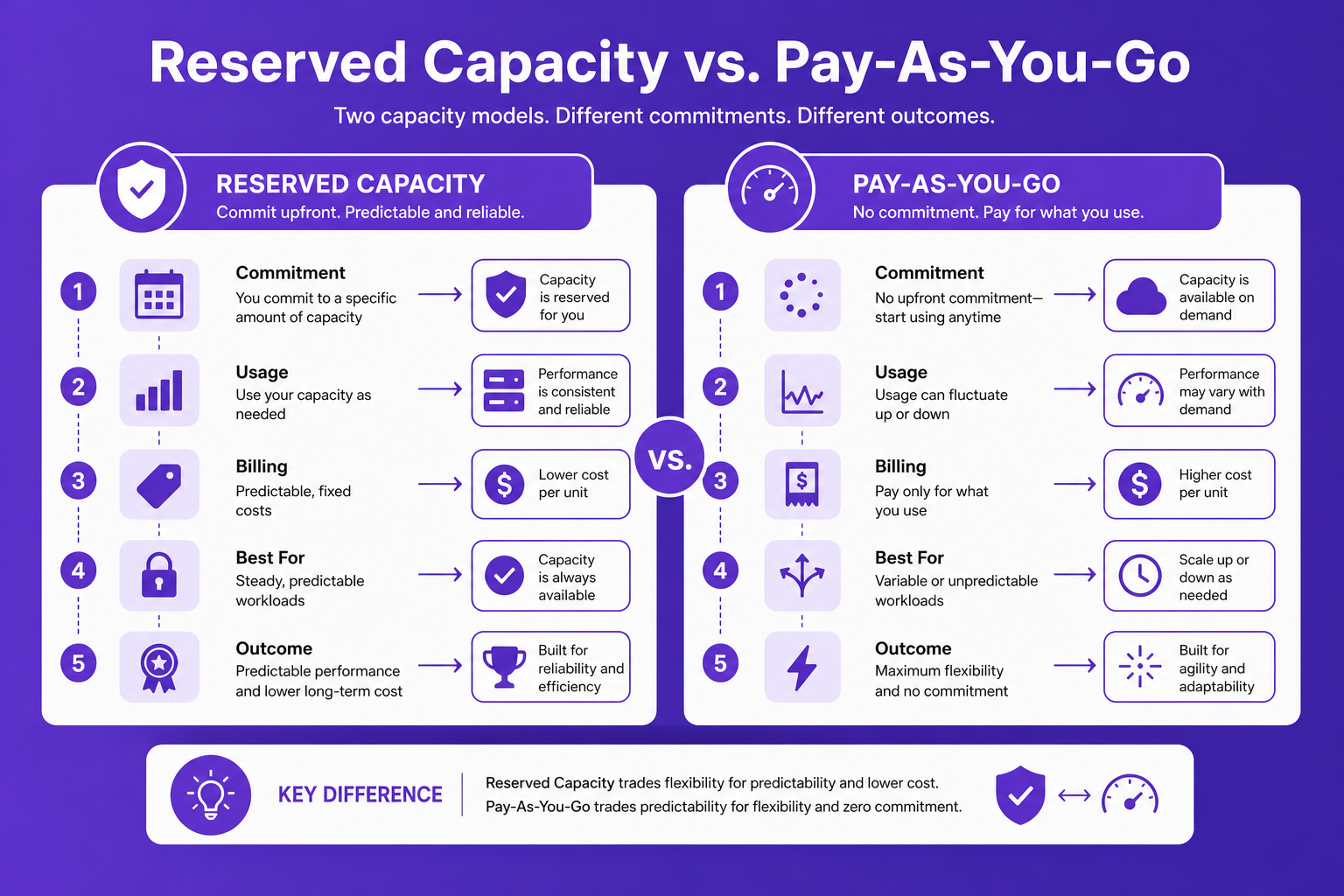
At its core, fabric capacity pricing revolves around two models: reserved capacity (commitment-based, typically in monthly or annual blocks) and pay-as-you-go (metered, on-demand consumption). A typical baseline example:
A 64-capacity unit environment is priced at about $8,395/month reserved; larger 2048-unit tiers can approach $268,000/month.
PAYG, including autoscaling and burst scenarios, introduces a 23% to 37% cost premium over the reserved unit rate.
Reserved capacity provides budget predictability and steep discounts, but requires upfront forecasting and commitment. Whereas PAYG rewards flexibility, especially for highly variable or experiment-driven workloads. The optimal path depends on usage patterns, resource governance, and the ability to model the true utilization curve.
Key enterprise incentive: Reserving capacity for a one-year term can yield a 40% to 41% discount compared to PAYG list prices. This headline figure is supported both by platform invoice audits and CloudNuro’s cost modeling telemetry. But pulling that lever without understanding the breakpoint can backfire.
The math hinges on the percentage of time capacity is actually used:
The break-even point generally sits at just 60% uptime; below this, PAYG can win out, while beyond it, reserved is virtually always cheaper.
Autoscale/burst can make sense for less than 50% utilization, or short-lived, unpredictable workloads.
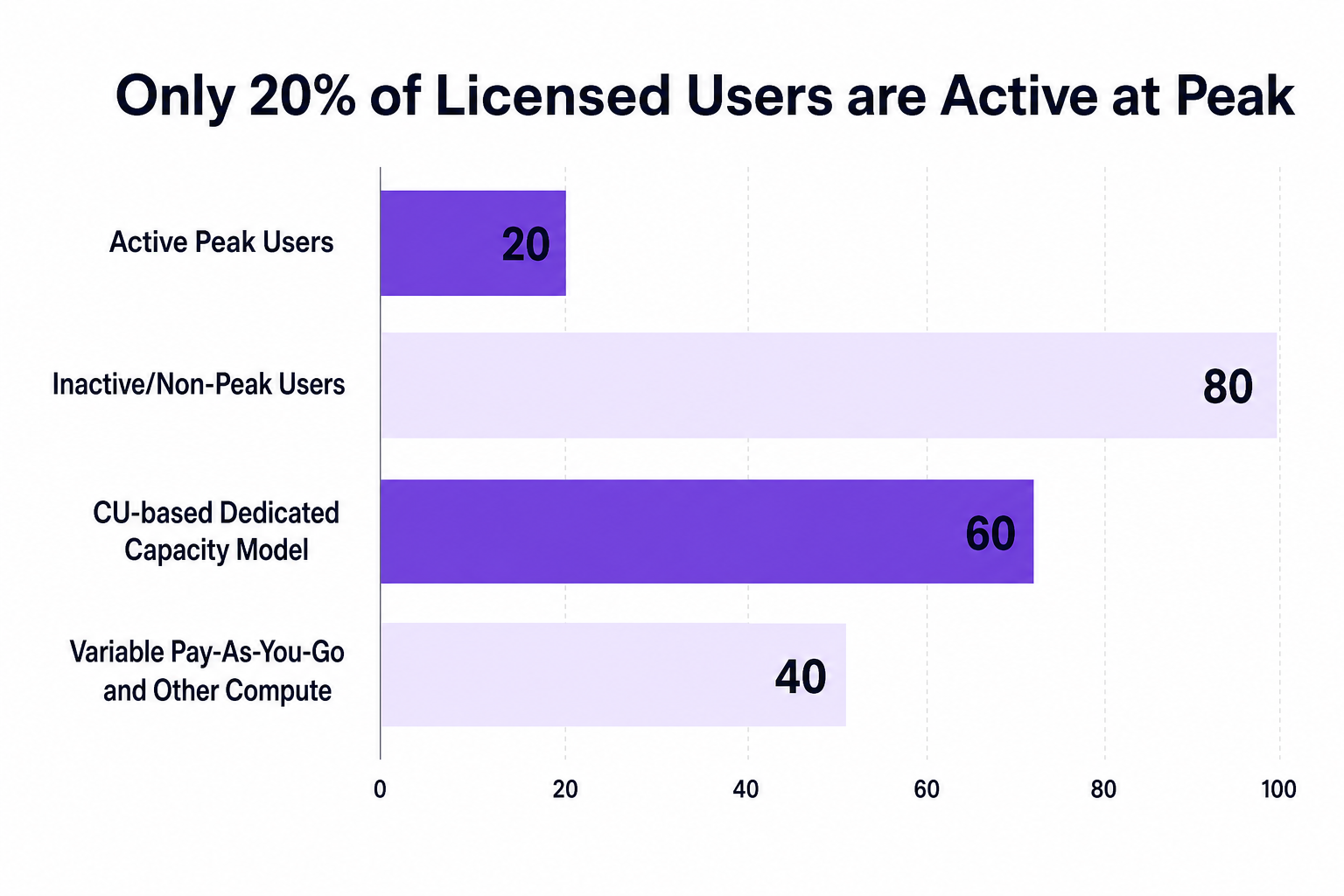
A typical consumption curve: enterprise data shows only 15% to 25% of licensed users are concurrently active at peak. Large organizations often overprovision by 20% to 30% up front, but end up with 80% of capacity idle outside core work hours. This makes precise monitoring and intelligent right-sizing essential.
Let’s run a hypothetical scenario for a 128-capacity unit norm:
Monthly reserved cost: $16,790 ($8,395 x 2)
PAYG equivalent at the higher burst rate: $23,049 (assuming 37% premium; $16,790 x 1.37)
For a one-year reserved term with 100% utilization, the math is simple: save $6,259/mo or $75,108/yr versus PAYG. But real enterprise workloads dip and surge so:
At 60% utilization, reserved still wins (your effective cost per actual used hour drops fast as uptime rises).
If you routinely pause infrastructure for nights/weekends and use fewer than 50% of possible hours, PAYG can prove cheaper, especially when paired with automated resume schedules.
Hybrid Model Tip: Many organizations reserve just enough to cover the operational baseline and flex up with PAYG for peaks. This is where CloudNuro’s telemetry and governance shines, actively surfacing where under- or over-commits hit the budget.
One of the main perceived drawbacks of reserved capacity is flexibility. However, modern fabric platforms offer swap functionality on reserved units:
Vertical swaps: Downgrade tiers (e.g., F128 to F64) when demand dips, avoiding overpaying for idle headroom.
Horizontal swaps: Shift reserved capacity across business units or functional workloads, maximizing utility.
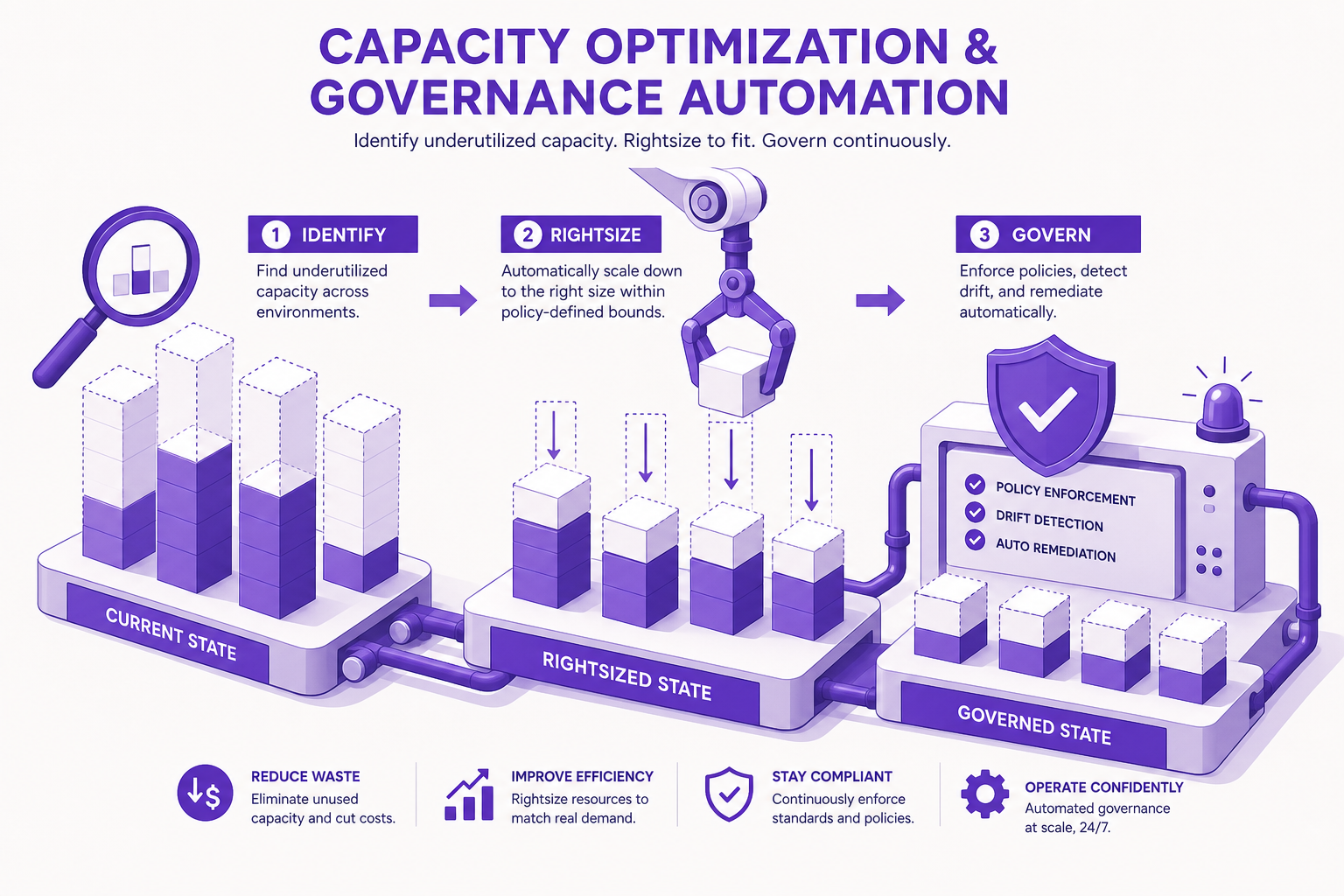
CloudNuro’s Commitments Optimization engine identifies underutilized resources. Automatically flagging environments (like an F128 running at 20% utilization), then executing intelligent downshifts without manual engineering intervention. It also supports chargeback models, mapping consumption directly to departmental budgets and making the case for swaps in both technical and financial language.
The gold standard is quantitative, data-driven cost modeling:
Track Actual Utilization: Monitor peak concurrent usage, after-hours idleness, and environmental drift vs. user count.
Apply True Pricing Curves: Simulate monthly/quarterly fabric needs against both PAYG (with premium) and reserved rates.
Calculate the Break-Even: Identify the uptime percentage at which reserved flips to ‘always-save’ over PAYG. For most, this is at 60% uptime with 41% realized savings.
Leverage Automated Rightsizing: Deploy tools to dynamically pause, downgrade, or shift capacity so you never pay for slack infrastructure.
CloudNuro builds this rigorously into its FinOps platform:
Unified Cloud Custodian enforces off-hours suspensions, cutting idle compute.
Automated Chargeback directly maps costs and consumption to business owners, ending overprovisioning.
Commitment Optimization engine reviews real utilization, surfaces swap opportunities, and executes shift-down automations.
CloudNuro clients’ results illustrate the scalability and impact of quantitative capacity governance:
A global pharma enterprise cut penalty overage costs by 36% and automated chargebacks across 27 departments within a year.
A multinational bank slashed unused compute hours by 45% and reduced analytics platform costs by 36%.
A healthcare provider eliminated 19% of annual SaaS spend and reduced orphaned admin licenses by 32% through automated optimization.
These are not theoretical gains, but reflect institutional change at scale thanks to real-time telemetry, automated rightsizing, and transparent financial governance.
Market trends are accelerating the need for better fabric pricing strategies:
Dedication to capacity pools now accounts for 60% of ongoing data compute spending; enterprise adoption of dedicated data units has surpassed 45% among large data-driven organizations.
Burgeoning machine learning and generative AI use cases are drastically lifting baseline capacity consumption, making one-size-fits-all PAYG even riskier.
Embedded analytics and operational AI forecasts 10% to 20% sustained utilization growth across key workloads.
CloudNuro uniquely blends automated optimization with governance-first controls, giving IT and financial leaders:
Automated cost optimization for SaaS and cloud resources
Complete visibility and break-even frameworks for reserved versus PAYG
Governance controls to stop idle and orphaned spend
Quantitative insights for every cloud capacity commitment
Whether you are recalibrating existing architectures or scaling into new data territories, CloudNuro’s FinOps services deliver measurable savings with operational flexibility at the core.
What is the break-even point for reserved vs pay-as-you-go fabric capacity?
The break-even point is typically 60% utilization: if your capacity is in use at or above this threshold, reserved capacity provides the maximum cost benefit. Below 50% utilization, aggressively managed PAYG can be more cost-effective.
How do you calculate 41% savings with reserved fabric capacity?
The 41% savings figure is based on direct list price comparisons between reserved and PAYG rates for one-year terms. If reserved capacity costs $8,395 per month, PAYG for the same resources would be about $13,881 (assuming a 65% premium). The gap between the two is your monthly and annual savings, typically after 60%+ utilization.
When does pay-as-you-go fabric win over reserved?
PAYG is ideal when usage is highly variable or below 50% of the time, such as intermittent machine learning projects or non-continuous workloads, especially when coupled with automated start/stop schedules to avoid idle costs.
How flexible are reserved instance swaps for fabric capacity?
Modern fabric platforms offer both vertical and horizontal swap flexibility. CloudNuro’s platform automates identification and execution of swaps across environments, letting you downshift, reallocate, or repurpose reserved units without manual intervention or waste.
What quantitative framework supports fabric capacity pricing decisions?
CloudNuro enables organizations to model real utilization against both pricing models, dynamically track headroom, and recommend the optimal split of reserved and PAYG units, all governed by automated policy enforcement and rigorous cost reporting.
The future of cloud value is clear: hard math outpaces guesswork. Reserved versus pay-as-you-go fabric decisions, when grounded in rigorous telemetry, real utilization modeling, and governance automation, can routinely yield 41% or more in savings. CloudNuro empowers IT, finance, and procurement leaders with the data-driven frameworks, automation, and transparency needed to extract every dollar of value from both SaaS and AI-powered cloud resources.
Ready to optimize your capacity strategy with confidence? Learn more about CloudNuro FinOps Services.
CloudNuro is a leader in Enterprise AI Adoption Management, providing enterprises with unmatched visibility, governance, and cost optimization. Recognized twice in a row in the SaaS Management Platforms category and named a Leader in the SoftwareReviews Data Quadrant, CloudNuro is trusted by global enterprises and government agencies to bring financial discipline to SaaS, cloud, and AI. Trusted by enterprises, CloudNuro provides centralized SaaS inventory, license optimization, and renewal management along with advanced cost allocation and chargeback, giving IT and Finance leaders the visibility, control, and cost-conscious culture needed to drive financial discipline.
Request a no cost, no obligation free assessment —just 15 minutes to savings!
Get StartedSmart cloud cost management is now more than a boardroom mantra, it is an operational survival skill for any data-driven enterprise. Fabric capacity pricing models, especially reserved versus pay-as-you-go (PAYG), present one of the biggest opportunities for IT, finance, and procurement leaders to drastically cut annual spend while safeguarding performance. Yet, the true math and break-even points often remain buried under high-level summaries in vendor sales decks or muddled by generic advice.
This deep-dive unpacks when reserved fabric capacity actually outperforms PAYG in the real world, the mathematical framework to justify each route, and how CloudNuro’s governance-driven FinOps tooling is empowering CIOs and CTOs to optimize every cloud dollar on their terms.
At its core, fabric capacity pricing revolves around two models: reserved capacity (commitment-based, typically in monthly or annual blocks) and pay-as-you-go (metered, on-demand consumption). A typical baseline example:
A 64-capacity unit environment is priced at about $8,395/month reserved; larger 2048-unit tiers can approach $268,000/month.
PAYG, including autoscaling and burst scenarios, introduces a 23% to 37% cost premium over the reserved unit rate.
Reserved capacity provides budget predictability and steep discounts, but requires upfront forecasting and commitment. Whereas PAYG rewards flexibility, especially for highly variable or experiment-driven workloads. The optimal path depends on usage patterns, resource governance, and the ability to model the true utilization curve.
Key enterprise incentive: Reserving capacity for a one-year term can yield a 40% to 41% discount compared to PAYG list prices. This headline figure is supported both by platform invoice audits and CloudNuro’s cost modeling telemetry. But pulling that lever without understanding the breakpoint can backfire.
The math hinges on the percentage of time capacity is actually used:
The break-even point generally sits at just 60% uptime; below this, PAYG can win out, while beyond it, reserved is virtually always cheaper.
Autoscale/burst can make sense for less than 50% utilization, or short-lived, unpredictable workloads.
A typical consumption curve: enterprise data shows only 15% to 25% of licensed users are concurrently active at peak. Large organizations often overprovision by 20% to 30% up front, but end up with 80% of capacity idle outside core work hours. This makes precise monitoring and intelligent right-sizing essential.
Let’s run a hypothetical scenario for a 128-capacity unit norm:
Monthly reserved cost: $16,790 ($8,395 x 2)
PAYG equivalent at the higher burst rate: $23,049 (assuming 37% premium; $16,790 x 1.37)
For a one-year reserved term with 100% utilization, the math is simple: save $6,259/mo or $75,108/yr versus PAYG. But real enterprise workloads dip and surge so:
At 60% utilization, reserved still wins (your effective cost per actual used hour drops fast as uptime rises).
If you routinely pause infrastructure for nights/weekends and use fewer than 50% of possible hours, PAYG can prove cheaper, especially when paired with automated resume schedules.
Hybrid Model Tip: Many organizations reserve just enough to cover the operational baseline and flex up with PAYG for peaks. This is where CloudNuro’s telemetry and governance shines, actively surfacing where under- or over-commits hit the budget.
One of the main perceived drawbacks of reserved capacity is flexibility. However, modern fabric platforms offer swap functionality on reserved units:
Vertical swaps: Downgrade tiers (e.g., F128 to F64) when demand dips, avoiding overpaying for idle headroom.
Horizontal swaps: Shift reserved capacity across business units or functional workloads, maximizing utility.
CloudNuro’s Commitments Optimization engine identifies underutilized resources. Automatically flagging environments (like an F128 running at 20% utilization), then executing intelligent downshifts without manual engineering intervention. It also supports chargeback models, mapping consumption directly to departmental budgets and making the case for swaps in both technical and financial language.
The gold standard is quantitative, data-driven cost modeling:
Track Actual Utilization: Monitor peak concurrent usage, after-hours idleness, and environmental drift vs. user count.
Apply True Pricing Curves: Simulate monthly/quarterly fabric needs against both PAYG (with premium) and reserved rates.
Calculate the Break-Even: Identify the uptime percentage at which reserved flips to ‘always-save’ over PAYG. For most, this is at 60% uptime with 41% realized savings.
Leverage Automated Rightsizing: Deploy tools to dynamically pause, downgrade, or shift capacity so you never pay for slack infrastructure.
CloudNuro builds this rigorously into its FinOps platform:
Unified Cloud Custodian enforces off-hours suspensions, cutting idle compute.
Automated Chargeback directly maps costs and consumption to business owners, ending overprovisioning.
Commitment Optimization engine reviews real utilization, surfaces swap opportunities, and executes shift-down automations.
CloudNuro clients’ results illustrate the scalability and impact of quantitative capacity governance:
A global pharma enterprise cut penalty overage costs by 36% and automated chargebacks across 27 departments within a year.
A multinational bank slashed unused compute hours by 45% and reduced analytics platform costs by 36%.
A healthcare provider eliminated 19% of annual SaaS spend and reduced orphaned admin licenses by 32% through automated optimization.
These are not theoretical gains, but reflect institutional change at scale thanks to real-time telemetry, automated rightsizing, and transparent financial governance.
Market trends are accelerating the need for better fabric pricing strategies:
Dedication to capacity pools now accounts for 60% of ongoing data compute spending; enterprise adoption of dedicated data units has surpassed 45% among large data-driven organizations.
Burgeoning machine learning and generative AI use cases are drastically lifting baseline capacity consumption, making one-size-fits-all PAYG even riskier.
Embedded analytics and operational AI forecasts 10% to 20% sustained utilization growth across key workloads.
CloudNuro uniquely blends automated optimization with governance-first controls, giving IT and financial leaders:
Automated cost optimization for SaaS and cloud resources
Complete visibility and break-even frameworks for reserved versus PAYG
Governance controls to stop idle and orphaned spend
Quantitative insights for every cloud capacity commitment
Whether you are recalibrating existing architectures or scaling into new data territories, CloudNuro’s FinOps services deliver measurable savings with operational flexibility at the core.
What is the break-even point for reserved vs pay-as-you-go fabric capacity?
The break-even point is typically 60% utilization: if your capacity is in use at or above this threshold, reserved capacity provides the maximum cost benefit. Below 50% utilization, aggressively managed PAYG can be more cost-effective.
How do you calculate 41% savings with reserved fabric capacity?
The 41% savings figure is based on direct list price comparisons between reserved and PAYG rates for one-year terms. If reserved capacity costs $8,395 per month, PAYG for the same resources would be about $13,881 (assuming a 65% premium). The gap between the two is your monthly and annual savings, typically after 60%+ utilization.
When does pay-as-you-go fabric win over reserved?
PAYG is ideal when usage is highly variable or below 50% of the time, such as intermittent machine learning projects or non-continuous workloads, especially when coupled with automated start/stop schedules to avoid idle costs.
How flexible are reserved instance swaps for fabric capacity?
Modern fabric platforms offer both vertical and horizontal swap flexibility. CloudNuro’s platform automates identification and execution of swaps across environments, letting you downshift, reallocate, or repurpose reserved units without manual intervention or waste.
What quantitative framework supports fabric capacity pricing decisions?
CloudNuro enables organizations to model real utilization against both pricing models, dynamically track headroom, and recommend the optimal split of reserved and PAYG units, all governed by automated policy enforcement and rigorous cost reporting.
The future of cloud value is clear: hard math outpaces guesswork. Reserved versus pay-as-you-go fabric decisions, when grounded in rigorous telemetry, real utilization modeling, and governance automation, can routinely yield 41% or more in savings. CloudNuro empowers IT, finance, and procurement leaders with the data-driven frameworks, automation, and transparency needed to extract every dollar of value from both SaaS and AI-powered cloud resources.
Ready to optimize your capacity strategy with confidence? Learn more about CloudNuro FinOps Services.
CloudNuro is a leader in Enterprise AI Adoption Management, providing enterprises with unmatched visibility, governance, and cost optimization. Recognized twice in a row in the SaaS Management Platforms category and named a Leader in the SoftwareReviews Data Quadrant, CloudNuro is trusted by global enterprises and government agencies to bring financial discipline to SaaS, cloud, and AI. Trusted by enterprises, CloudNuro provides centralized SaaS inventory, license optimization, and renewal management along with advanced cost allocation and chargeback, giving IT and Finance leaders the visibility, control, and cost-conscious culture needed to drive financial discipline.
Request a no cost, no obligation free assessment - just 15 minutes to savings!
Get StartedWe're offering complimentary ServiceNow license assessments to only 25 enterprises this quarter who want to unlock immediate savings without disrupting operations.
Get Free AssessmentGet Started




CloudNuro Corp
1755 Park St. Suite 207
Naperville, IL 60563
Phone : +1-630-277-9470
Email: info@cloudnuro.com





.webp)

Recognized Leader in SaaS Management Platforms by Info-Tech SoftwareReviews
.png)

.png)
.svg)