

Sign Up
Thank you for Submitting!
SaaS portfolios are entering a new phase of consolidation as enterprises seek SaaS cost optimization, stronger governance, and faster delivery of digital services. What used to be a sprawling ecosystem of point tools is shifting toward suites, platforms, and curated marketplaces that promise control as well as convenience.
A recent market projection for 2026 notes that 76% of enterprises plan to consolidate their SaaS portfolios by prioritizing suites and platforms over standalone apps. At the same time, SaaS cost optimization initiatives are expected to reduce overall SaaS spend by up to 28% by 2026 through tighter governance and automation. The decisions you make about suites, platforms, and marketplace strategy over the next 12 to 18 months will determine whether you realize those savings or simply shift spend around.
This article breaks down how SaaS consolidation is evolving in 2026, how suites and platforms differ, the rise of marketplaces, and what a governance-first architecture looks like when your north star is sustainable cloud SaaS cost optimization.
SaaS consolidation is the process of rationalizing and simplifying your application stack by converging on fewer, more capable suites and platforms combined with a disciplined SaaS marketplace strategy. The goal is not only lower cost, but also better control over risk, data, and operations.
According to recent industry forecasts, several forces are driving this consolidation wave:
In short, consolidation is about more than trimming a few licenses. SaaS consolidation is becoming a core pillar of enterprise SaaS management, bringing security, finance, and IT together around a common operating model.
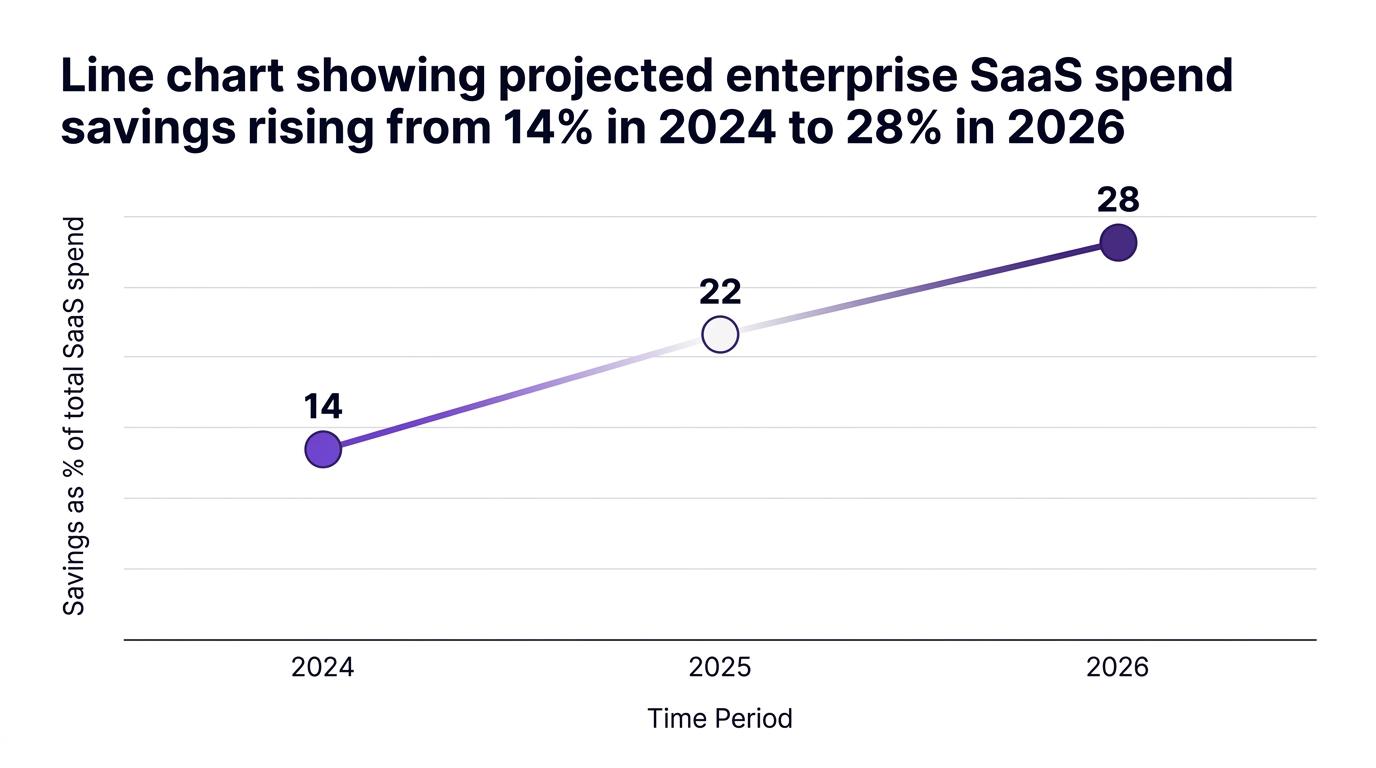
According to a 2026 forecast, SaaS cost optimization programs are on track to drive savings from 14% of spend in 2024 to 28% by 2026. The organizations that reach the higher end of that range are the ones treating consolidation as a structured FinOps and governance initiative, not just a one-time cleanup.
To build a rational consolidation strategy, you need a clear view of the three dominant models: suites, platforms, and marketplaces. Each plays a different role in your multi-SaaS management strategy and has unique cost and governance implications.
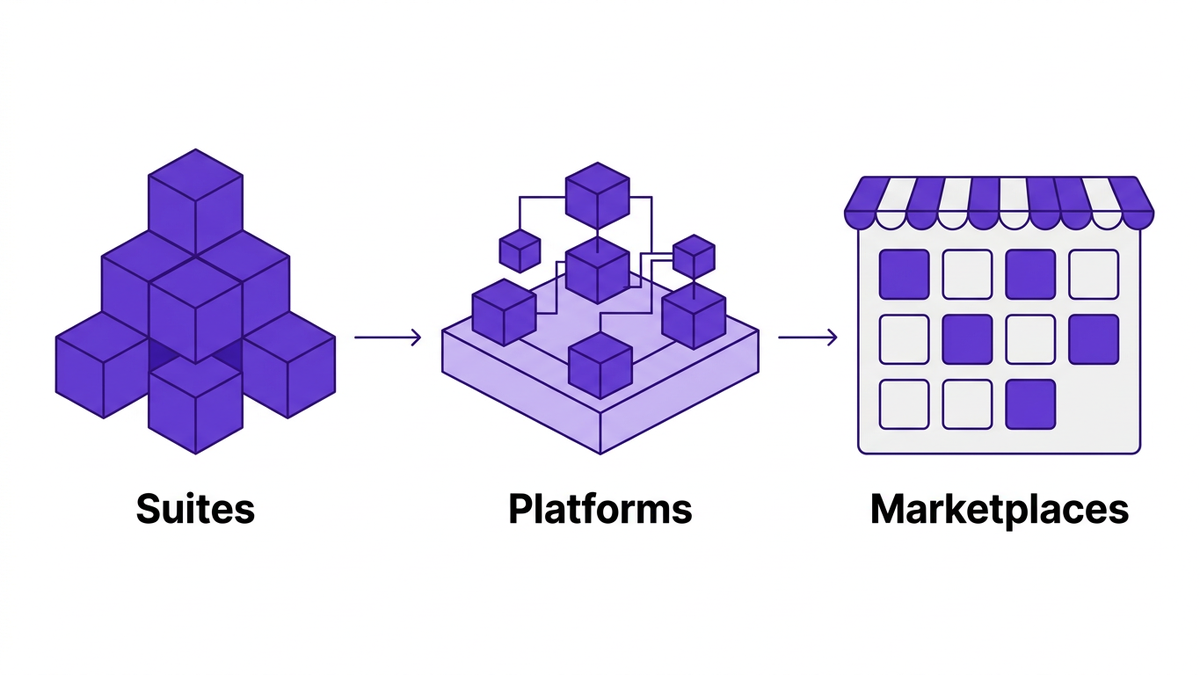
SaaS suites bundle multiple capabilities in a specific domain such as productivity, CRM, or IT service management. They offer breadth within that domain, shared administration, and one primary vendor relationship.
Advantages of suites for SaaS cost optimization:
Risks and tradeoffs:
For 2026 planning, suites remain powerful anchors, but they must be evaluated with a SaaS suites vs platforms lens, especially around license optimization and vendor risk.
SaaS platforms provide a foundation for multiple applications and workflows, often with a strong integration, workflow, or data layer. In the context of consolidation, platforms are where governance-first architecture lives.
Why platforms matter for enterprise SaaS management:
An insight from a 2026 SaaS research leader summarizes this shift: SaaS consolidation is not just a cost play in 2026, it is about reducing risk and unlocking agility through unified management environments.
The best consolidation programs treat platforms as the control plane for SaaS governance, with suites and specialized tools connected into that plane rather than operating in isolation.
Enterprise SaaS marketplace strategy is evolving rapidly. A 2026 forecast estimates that 84% of IT leaders expect to use SaaS marketplaces to streamline procurement, compliance checks, and contract negotiations, reducing administrative time by up to 32%.
Modern marketplaces offer:
When aligned with cloud FinOps and SaaS governance policies, marketplaces can become the front door for SaaS, not a backdoor for more sprawl.
A useful way to think about 2026 strategy is what we can call the Consolidation Triangle:
The goal is not to pick one corner, but to define clear roles and guardrails:
When these three are aligned, SaaS spend reduction becomes a continuous outcome, not a once-a-year project.
The case for consolidation starts with a realistic assessment of SaaS sprawl. Many enterprises still cannot answer basic questions like how many apps they have in use, who owns them, and where sensitive data flows.
Common impacts of unmanaged sprawl include:
A 2026 study projects that AI-driven SaaS license management will reclaim or rightsize up to 23% of underutilized licenses in large organizations. That number reflects how much waste is still hiding in plain sight.
A multinational healthcare provider in 2026 consolidated more than 110 SaaS applications into a unified governance platform. By eliminating redundant tools and rightsizing access, the organization reduced redundant licenses by 26%.
With centralized policy enforcement and evidence collection, compliance audits accelerated by 40%. This illustrates how it asset management SaaS capabilities, when applied across suites and platforms, can simultaneously impact cloud optimization, security, and audit outcomes.
A credible SaaS cost optimization program in 2026 rests on five pillars: discovery, rationalization, usage analytics, financial accountability, and renewal discipline. Together, they form a practical playbook that IT, procurement, and finance teams can execute.
Start by building a single pane of glass for all SaaS, PaaS, and IaaS services. This requires automated app discovery across SSO, financial systems, expense data, and network logs.
Key practices:
With a clean inventory, group apps by business capability and assess where suites or platforms can replace fragmented point tools.
Questions to ask:
This is where SaaS platform comparison work pays off. The aim is to move from accidental overlap to intentional architecture decisions.
Next, connect usage data for every major application. This is the engine of license optimization and SaaS spend reduction.
Focus on:
Recent forecasts suggest that SaaS cost optimization initiatives can save up to 28% of spend by 2026 when combined with usage-based actions and policy-driven rightsizing.
To make savings stick, integrate FinOps for SaaS into your financial operations. That means:
By 2026, financial accountability practices such as chargebacks and usage-based allocation are expected to be the norm in most mature SaaS programs, reinforcing cloud FinOps as a core capability.
Finally, put SaaS renewal optimization on a proactive footing. Instead of reacting to auto-renewal notices, use a data-backed playbook.
Best practices:
A global financial services firm that adopted these practices in 2026, along with a marketplace-centric procurement model, reported 4.8 million dollars in annualized SaaS spend reduction through rationalized contracts and better usage alignment.
Manual SaaS management does not scale. As the number of apps grows and the pace of change accelerates, AI in SaaS management and automation become essential.
An industry analyst in 2026 observes that AI and automation will be fundamental in unifying disparate SaaS stacks, enabling real-time cost control and compliance scoring at scale.
Concrete AI-driven scenarios include:
These are not abstract futures. Many enterprises already apply machine learning within their enterprise SaaS management platforms to prioritize actions and suggest optimization opportunities.
Automation complements AI insights with repeatable execution. Core SaaS workflow automation patterns include:
The combination of AI-driven insights with automated workflows turns consolidation into an ongoing process that quietly improves cloud optimization and risk posture every week.
CloudNuro is designed for organizations that want consolidation to produce sustained SaaS cost optimization, not just a one-time cleanup. The platform combines multi-SaaS management, cost analytics, and governance automation into a unified control plane.
Here is how CloudNuro supports suites, platforms, and marketplace strategies in 2026.
CloudNuro integrates with more than 400 SaaS and cloud applications to deliver single pane of glass visibility. IT and finance teams gain correlated views of usage, spend, and risk across:
This unified cloud SaaS cost optimization view is the foundation for credible rationalization and license rightsizing.
CloudNuro’s AI Custodian and Unified Cloud Custodian apply AI in SaaS management to continuously scan for underused or misaligned licenses. The platform:
Given that AI-driven license management is projected to reclaim up to 23% of underutilized licenses by 2026, these capabilities translate directly into measurable SaaS spend reduction.
CloudNuro is built on a governance-first architecture that addresses shadow IT control, compliance, and security alongside cost.
Key capabilities include:
This ensures that as you expand your use of SaaS marketplaces, apps pass through the same compliance management lens as traditional procurements.
CloudNuro provides a configurable self-service store that acts as a curated front end for employees. It connects to your suites, core platforms, and approved marketplace SKUs.
Users can request apps from a standardized catalog, while automated workflows handle:
This model aligns SaaS marketplace strategy with centralized governance, transforming marketplaces from a sprawl risk into a controlled channel.
CloudNuro’s FinOps capabilities support financial accountability through chargeback, cost allocation, and showback reports.
Teams can:
Combined with the platform’s SaaS Spend Analysis and IT Asset Management for SaaS, organizations gain a durable discipline that keeps savings in place even as new apps and AI services are introduced.
Not every consolidation story is positive. There are valid concerns and potential missteps.
Counterargument 1: Suites reduce choice and innovation
Some leaders worry that standardizing on large suites will stifle team-level innovation. This risk is real if governance is too rigid.
A better model is to standardize core workflows in suites while allowing controlled exceptions, routed through your marketplace and platform governance. App integration capabilities are crucial to connect those specialized tools back into your control plane.
Counterargument 2: Consolidation projects are too disruptive
Large migrations and contract shifts can be disruptive if tackled as big-bang projects. Successful organizations treat consolidation as a rolling program, sequenced by risk and value.
Using a platform like CloudNuro to prioritize high-value targets and automate deprovisioning reduces disruption and preserves business continuity.
SaaS consolidation is the practice of simplifying and rationalizing your SaaS portfolio by converging on fewer suites, platforms, and governed marketplace channels. It is trending in 2026 because organizations need to control spend, reduce risk, and improve operational agility in multi-SaaS environments.
Industry projections show that 76% of enterprises plan to prioritize suites and platforms in their portfolios by 2026 to address these challenges.
Suites bundle capabilities within a business domain and simplify contracts. Platforms provide a shared foundation for workflows, integrations, and governance across many apps. Marketplaces, by contrast, are procurement and discovery channels that can embed approvals, security checks, and billing.
An effective SaaS integration strategy connects these three so that suites and specialized tools are governed and automated through platforms, while marketplaces serve as a controlled entry point.
Best practices include continuous discovery, rationalization based on business capabilities, usage-driven license optimization, and proactive SaaS renewal optimization. Embedding cloud FinOps concepts such as cost allocation and chargeback creates accountability.
Many organizations use AI-driven usage analytics and automated workflows to make these practices repeatable rather than manual projects.
SaaS sprawl increases the number of systems that handle sensitive data and widens the attack surface. Unapproved or poorly controlled apps can bypass security reviews, generate data residency issues, and complicate audits.
Forecasts for 2026 show that shadow IT may account for 35% of SaaS-related security incidents in regulated industries if not governed through unified platforms. Addressing sprawl is therefore a security and compliance imperative, not just a cost project.
AI and automation will underpin multi-SaaS management by analyzing usage patterns, identifying optimization opportunities, and triggering workflows. Examples include predictive license reclamation, anomaly detection in app spending, and automated enforcement of access policies.
According to 2026 studies, AI-based license management can reclaim or rightsize up to 23% of underutilized licenses, which directly supports SaaS cost optimization and improved governance.
CloudNuro combines deep integrations, AI-driven optimization, and governance workflows tailored to complex, regulated environments such as healthcare, finance, and government. The platform centralizes cost visibility, risk scoring, and lifecycle automation across SaaS, PaaS, and IaaS.
By supporting discovery, rationalization, license optimization, and financial accountability from a single place, CloudNuro enables organizations to pursue ambitious consolidation goals while strengthening compliance and security.
SaaS consolidation in 2026 will favor enterprises that move beyond one-off cleanup efforts toward continuous SaaS cost optimization anchored in governance-first platforms. Suites, platforms, and marketplaces all have a role to play, but only if they are connected through a unified operating model for visibility, automation, and financial accountability.
By combining AI-driven insights, automated workflows, and a clear SaaS integration strategy, organizations can transform multi-SaaS complexity into a controlled, efficient, and secure environment.
CloudNuro is built to support that journey, giving CIOs, CTOs, and IT finance leaders the clarity and control needed to turn consolidation into lasting value. To see how this model can work in your environment, request a CloudNuro demo and explore what a governance-first SaaS future can look like.
CloudNuro is a leader in Enterprise SaaS Management Platforms, providing enterprises with unmatched visibility, governance, and cost optimization. Recognized twice in a row in the SaaS Management Platforms category and named a Leader in the SoftwareReviews Data Quadrant, CloudNuro is trusted by global enterprises and government agencies to bring financial discipline to SaaS, cloud, and AI. Trusted by enterprises such as Konica Minolta and Federal Signal, CloudNuro provides centralized SaaS inventory, license optimization, and renewal management along with advanced cost allocation and chargeback, giving IT and Finance leaders the visibility, control, and cost-conscious culture needed to drive financial discipline. Request a Demo | Get Free Savings | Explore Product
Request a no cost, no obligation free assessment —just 15 minutes to savings!
Get StartedSaaS portfolios are entering a new phase of consolidation as enterprises seek SaaS cost optimization, stronger governance, and faster delivery of digital services. What used to be a sprawling ecosystem of point tools is shifting toward suites, platforms, and curated marketplaces that promise control as well as convenience.
A recent market projection for 2026 notes that 76% of enterprises plan to consolidate their SaaS portfolios by prioritizing suites and platforms over standalone apps. At the same time, SaaS cost optimization initiatives are expected to reduce overall SaaS spend by up to 28% by 2026 through tighter governance and automation. The decisions you make about suites, platforms, and marketplace strategy over the next 12 to 18 months will determine whether you realize those savings or simply shift spend around.
This article breaks down how SaaS consolidation is evolving in 2026, how suites and platforms differ, the rise of marketplaces, and what a governance-first architecture looks like when your north star is sustainable cloud SaaS cost optimization.
SaaS consolidation is the process of rationalizing and simplifying your application stack by converging on fewer, more capable suites and platforms combined with a disciplined SaaS marketplace strategy. The goal is not only lower cost, but also better control over risk, data, and operations.
According to recent industry forecasts, several forces are driving this consolidation wave:
In short, consolidation is about more than trimming a few licenses. SaaS consolidation is becoming a core pillar of enterprise SaaS management, bringing security, finance, and IT together around a common operating model.
According to a 2026 forecast, SaaS cost optimization programs are on track to drive savings from 14% of spend in 2024 to 28% by 2026. The organizations that reach the higher end of that range are the ones treating consolidation as a structured FinOps and governance initiative, not just a one-time cleanup.
To build a rational consolidation strategy, you need a clear view of the three dominant models: suites, platforms, and marketplaces. Each plays a different role in your multi-SaaS management strategy and has unique cost and governance implications.
SaaS suites bundle multiple capabilities in a specific domain such as productivity, CRM, or IT service management. They offer breadth within that domain, shared administration, and one primary vendor relationship.
Advantages of suites for SaaS cost optimization:
Risks and tradeoffs:
For 2026 planning, suites remain powerful anchors, but they must be evaluated with a SaaS suites vs platforms lens, especially around license optimization and vendor risk.
SaaS platforms provide a foundation for multiple applications and workflows, often with a strong integration, workflow, or data layer. In the context of consolidation, platforms are where governance-first architecture lives.
Why platforms matter for enterprise SaaS management:
An insight from a 2026 SaaS research leader summarizes this shift: SaaS consolidation is not just a cost play in 2026, it is about reducing risk and unlocking agility through unified management environments.
The best consolidation programs treat platforms as the control plane for SaaS governance, with suites and specialized tools connected into that plane rather than operating in isolation.
Enterprise SaaS marketplace strategy is evolving rapidly. A 2026 forecast estimates that 84% of IT leaders expect to use SaaS marketplaces to streamline procurement, compliance checks, and contract negotiations, reducing administrative time by up to 32%.
Modern marketplaces offer:
When aligned with cloud FinOps and SaaS governance policies, marketplaces can become the front door for SaaS, not a backdoor for more sprawl.
A useful way to think about 2026 strategy is what we can call the Consolidation Triangle:
The goal is not to pick one corner, but to define clear roles and guardrails:
When these three are aligned, SaaS spend reduction becomes a continuous outcome, not a once-a-year project.
The case for consolidation starts with a realistic assessment of SaaS sprawl. Many enterprises still cannot answer basic questions like how many apps they have in use, who owns them, and where sensitive data flows.
Common impacts of unmanaged sprawl include:
A 2026 study projects that AI-driven SaaS license management will reclaim or rightsize up to 23% of underutilized licenses in large organizations. That number reflects how much waste is still hiding in plain sight.
A multinational healthcare provider in 2026 consolidated more than 110 SaaS applications into a unified governance platform. By eliminating redundant tools and rightsizing access, the organization reduced redundant licenses by 26%.
With centralized policy enforcement and evidence collection, compliance audits accelerated by 40%. This illustrates how it asset management SaaS capabilities, when applied across suites and platforms, can simultaneously impact cloud optimization, security, and audit outcomes.
A credible SaaS cost optimization program in 2026 rests on five pillars: discovery, rationalization, usage analytics, financial accountability, and renewal discipline. Together, they form a practical playbook that IT, procurement, and finance teams can execute.
Start by building a single pane of glass for all SaaS, PaaS, and IaaS services. This requires automated app discovery across SSO, financial systems, expense data, and network logs.
Key practices:
With a clean inventory, group apps by business capability and assess where suites or platforms can replace fragmented point tools.
Questions to ask:
This is where SaaS platform comparison work pays off. The aim is to move from accidental overlap to intentional architecture decisions.
Next, connect usage data for every major application. This is the engine of license optimization and SaaS spend reduction.
Focus on:
Recent forecasts suggest that SaaS cost optimization initiatives can save up to 28% of spend by 2026 when combined with usage-based actions and policy-driven rightsizing.
To make savings stick, integrate FinOps for SaaS into your financial operations. That means:
By 2026, financial accountability practices such as chargebacks and usage-based allocation are expected to be the norm in most mature SaaS programs, reinforcing cloud FinOps as a core capability.
Finally, put SaaS renewal optimization on a proactive footing. Instead of reacting to auto-renewal notices, use a data-backed playbook.
Best practices:
A global financial services firm that adopted these practices in 2026, along with a marketplace-centric procurement model, reported 4.8 million dollars in annualized SaaS spend reduction through rationalized contracts and better usage alignment.
Manual SaaS management does not scale. As the number of apps grows and the pace of change accelerates, AI in SaaS management and automation become essential.
An industry analyst in 2026 observes that AI and automation will be fundamental in unifying disparate SaaS stacks, enabling real-time cost control and compliance scoring at scale.
Concrete AI-driven scenarios include:
These are not abstract futures. Many enterprises already apply machine learning within their enterprise SaaS management platforms to prioritize actions and suggest optimization opportunities.
Automation complements AI insights with repeatable execution. Core SaaS workflow automation patterns include:
The combination of AI-driven insights with automated workflows turns consolidation into an ongoing process that quietly improves cloud optimization and risk posture every week.
CloudNuro is designed for organizations that want consolidation to produce sustained SaaS cost optimization, not just a one-time cleanup. The platform combines multi-SaaS management, cost analytics, and governance automation into a unified control plane.
Here is how CloudNuro supports suites, platforms, and marketplace strategies in 2026.
CloudNuro integrates with more than 400 SaaS and cloud applications to deliver single pane of glass visibility. IT and finance teams gain correlated views of usage, spend, and risk across:
This unified cloud SaaS cost optimization view is the foundation for credible rationalization and license rightsizing.
CloudNuro’s AI Custodian and Unified Cloud Custodian apply AI in SaaS management to continuously scan for underused or misaligned licenses. The platform:
Given that AI-driven license management is projected to reclaim up to 23% of underutilized licenses by 2026, these capabilities translate directly into measurable SaaS spend reduction.
CloudNuro is built on a governance-first architecture that addresses shadow IT control, compliance, and security alongside cost.
Key capabilities include:
This ensures that as you expand your use of SaaS marketplaces, apps pass through the same compliance management lens as traditional procurements.
CloudNuro provides a configurable self-service store that acts as a curated front end for employees. It connects to your suites, core platforms, and approved marketplace SKUs.
Users can request apps from a standardized catalog, while automated workflows handle:
This model aligns SaaS marketplace strategy with centralized governance, transforming marketplaces from a sprawl risk into a controlled channel.
CloudNuro’s FinOps capabilities support financial accountability through chargeback, cost allocation, and showback reports.
Teams can:
Combined with the platform’s SaaS Spend Analysis and IT Asset Management for SaaS, organizations gain a durable discipline that keeps savings in place even as new apps and AI services are introduced.
Not every consolidation story is positive. There are valid concerns and potential missteps.
Counterargument 1: Suites reduce choice and innovation
Some leaders worry that standardizing on large suites will stifle team-level innovation. This risk is real if governance is too rigid.
A better model is to standardize core workflows in suites while allowing controlled exceptions, routed through your marketplace and platform governance. App integration capabilities are crucial to connect those specialized tools back into your control plane.
Counterargument 2: Consolidation projects are too disruptive
Large migrations and contract shifts can be disruptive if tackled as big-bang projects. Successful organizations treat consolidation as a rolling program, sequenced by risk and value.
Using a platform like CloudNuro to prioritize high-value targets and automate deprovisioning reduces disruption and preserves business continuity.
SaaS consolidation is the practice of simplifying and rationalizing your SaaS portfolio by converging on fewer suites, platforms, and governed marketplace channels. It is trending in 2026 because organizations need to control spend, reduce risk, and improve operational agility in multi-SaaS environments.
Industry projections show that 76% of enterprises plan to prioritize suites and platforms in their portfolios by 2026 to address these challenges.
Suites bundle capabilities within a business domain and simplify contracts. Platforms provide a shared foundation for workflows, integrations, and governance across many apps. Marketplaces, by contrast, are procurement and discovery channels that can embed approvals, security checks, and billing.
An effective SaaS integration strategy connects these three so that suites and specialized tools are governed and automated through platforms, while marketplaces serve as a controlled entry point.
Best practices include continuous discovery, rationalization based on business capabilities, usage-driven license optimization, and proactive SaaS renewal optimization. Embedding cloud FinOps concepts such as cost allocation and chargeback creates accountability.
Many organizations use AI-driven usage analytics and automated workflows to make these practices repeatable rather than manual projects.
SaaS sprawl increases the number of systems that handle sensitive data and widens the attack surface. Unapproved or poorly controlled apps can bypass security reviews, generate data residency issues, and complicate audits.
Forecasts for 2026 show that shadow IT may account for 35% of SaaS-related security incidents in regulated industries if not governed through unified platforms. Addressing sprawl is therefore a security and compliance imperative, not just a cost project.
AI and automation will underpin multi-SaaS management by analyzing usage patterns, identifying optimization opportunities, and triggering workflows. Examples include predictive license reclamation, anomaly detection in app spending, and automated enforcement of access policies.
According to 2026 studies, AI-based license management can reclaim or rightsize up to 23% of underutilized licenses, which directly supports SaaS cost optimization and improved governance.
CloudNuro combines deep integrations, AI-driven optimization, and governance workflows tailored to complex, regulated environments such as healthcare, finance, and government. The platform centralizes cost visibility, risk scoring, and lifecycle automation across SaaS, PaaS, and IaaS.
By supporting discovery, rationalization, license optimization, and financial accountability from a single place, CloudNuro enables organizations to pursue ambitious consolidation goals while strengthening compliance and security.
SaaS consolidation in 2026 will favor enterprises that move beyond one-off cleanup efforts toward continuous SaaS cost optimization anchored in governance-first platforms. Suites, platforms, and marketplaces all have a role to play, but only if they are connected through a unified operating model for visibility, automation, and financial accountability.
By combining AI-driven insights, automated workflows, and a clear SaaS integration strategy, organizations can transform multi-SaaS complexity into a controlled, efficient, and secure environment.
CloudNuro is built to support that journey, giving CIOs, CTOs, and IT finance leaders the clarity and control needed to turn consolidation into lasting value. To see how this model can work in your environment, request a CloudNuro demo and explore what a governance-first SaaS future can look like.
CloudNuro is a leader in Enterprise SaaS Management Platforms, providing enterprises with unmatched visibility, governance, and cost optimization. Recognized twice in a row in the SaaS Management Platforms category and named a Leader in the SoftwareReviews Data Quadrant, CloudNuro is trusted by global enterprises and government agencies to bring financial discipline to SaaS, cloud, and AI. Trusted by enterprises such as Konica Minolta and Federal Signal, CloudNuro provides centralized SaaS inventory, license optimization, and renewal management along with advanced cost allocation and chargeback, giving IT and Finance leaders the visibility, control, and cost-conscious culture needed to drive financial discipline. Request a Demo | Get Free Savings | Explore Product
Request a no cost, no obligation free assessment - just 15 minutes to savings!
Get StartedWe're offering complimentary ServiceNow license assessments to only 25 enterprises this quarter who want to unlock immediate savings without disrupting operations.
Get Free AssessmentGet Started




CloudNuro Corp
1755 Park St. Suite 207
Naperville, IL 60563
Phone : +1-630-277-9470
Email: info@cloudnuro.com




.webp)

Recognized Leader in SaaS Management Platforms by Info-Tech SoftwareReviews


%20(1).png)
.svg)