

Sign Up
Thank you for Submitting!
Corporate IT infrastructures no longer operate behind a single, well-defined firewall. The widespread adoption of decentralized cloud tools dictates that modern attack surface management must prioritize continuous monitoring above physical network controls. Cybersecurity Ventures reports from 2026 show that 82% of enterprises name shadow IT and unsanctioned applications as their largest cybersecurity blind spots. Unsanctioned sign-ups create fragmented perimeters, leaving IT departments blind to the full scope of their vulnerabilities. Security professionals are realizing that identifying hidden assets is the only reliable way to measure true enterprise risk.
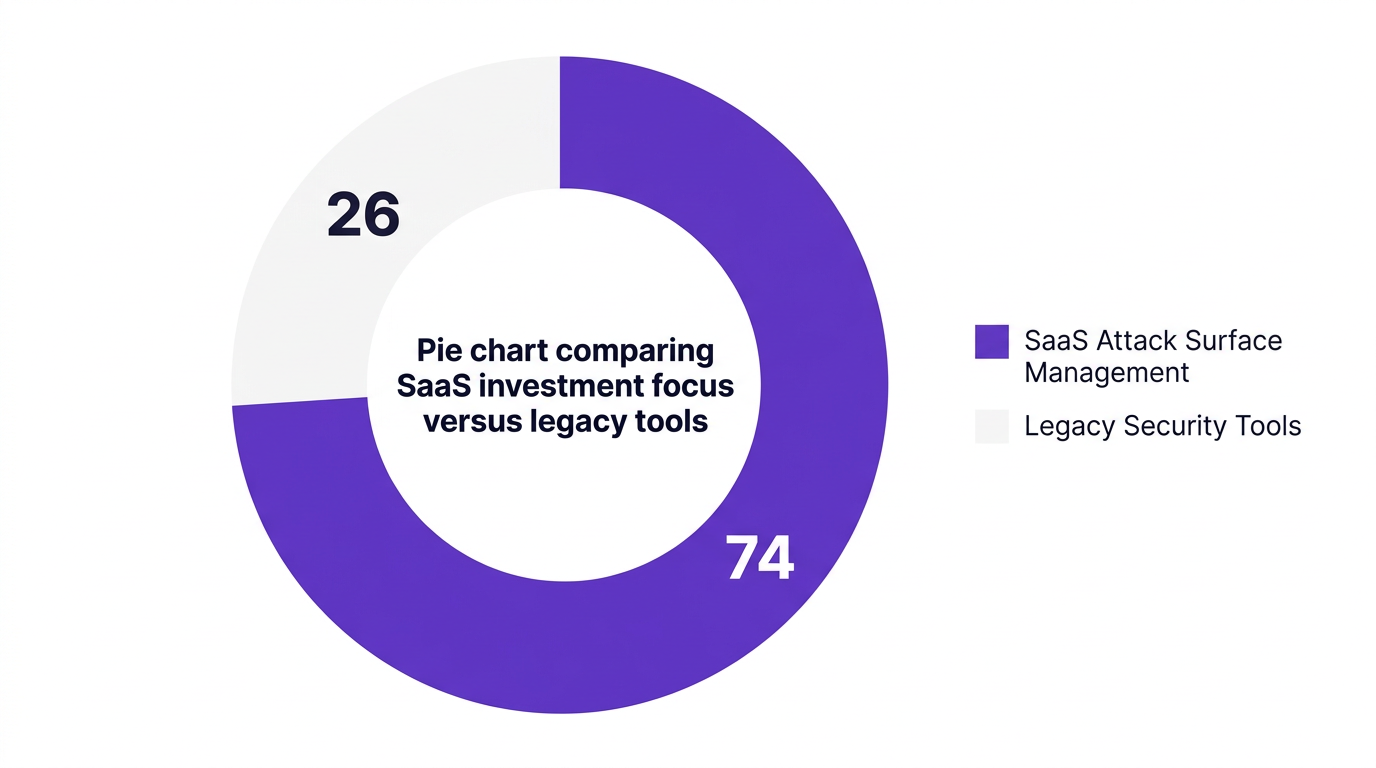
Security teams cannot defend applications they do not know exist. A comprehensive attack surface management strategy requires systematic discovery methodologies to maintain a stable security posture. This necessity is entirely reshaping how enterprise compliance budgets are allocated, forcing leaders to prioritize targeted SaaS visibility tools to map the expanding boundaries of daily operational workflows.
The most persistent vulnerability in modern IT environments originates from everyday employee actions. When team members adopt collaborative tools, file-sharing utilities, or specialized AI aids without IT approval, they bypass foundational security reviews. This unchecked momentum creates deep SaaS sprawl.
SANS Institute research from 2026 reveals that more than 50% of security leaders cite the inability to inventory SaaS assets as their single largest risk in external attack surface management. Conventional attack surface monitoring tools often fail in this context. Legacy tools heavily prioritize IP addresses and domain registrations, while modern shadow IT risk relies on compromised OAuth tokens and persistent API keys connecting unsanctioned platforms to secured corporate data.
The resulting fallout is measurable. According to Gartner reports from 2026, 61% of SaaS security incidents involved unauthorized application access due directly to a lack of real-time visibility. When an employee departs the organization, their credentials might be deactivated in the central directory, but their active sessions in rogue, unmanaged platforms remain alive. Each unmonitored integration acts as a silent expansion of the attack surface, presenting a clear path for malicious actors to infiltrate core environments.
Annual or quarterly capability audits are obsolete in an environment where applications are adopted by the hour. Resolving persistent vulnerabilities requires a shift toward real-time attack surface management solutions. Organizations that rely exclusively on manual spreadsheet tracking remain consistently behind the actual curve of cloud utilization.
Dr. Maya Patel, Chief Security Analyst at Gartner, highlights this reality in 2026: "Continuous SaaS discovery is now essential for shrinking the attack surface; without it, organizations are essentially blind to new threats."
Prolific application usage underscores Dr. Patel's insight. The Ponemon Institute in 2026 observed that organizations discover an average of 39 previously unknown SaaS applications per quarter after deploying formal SaaS discovery capabilities. These applications frequently include unsanctioned cloud storage nodes, unofficial communication platforms, and unvetted productivity boosters.
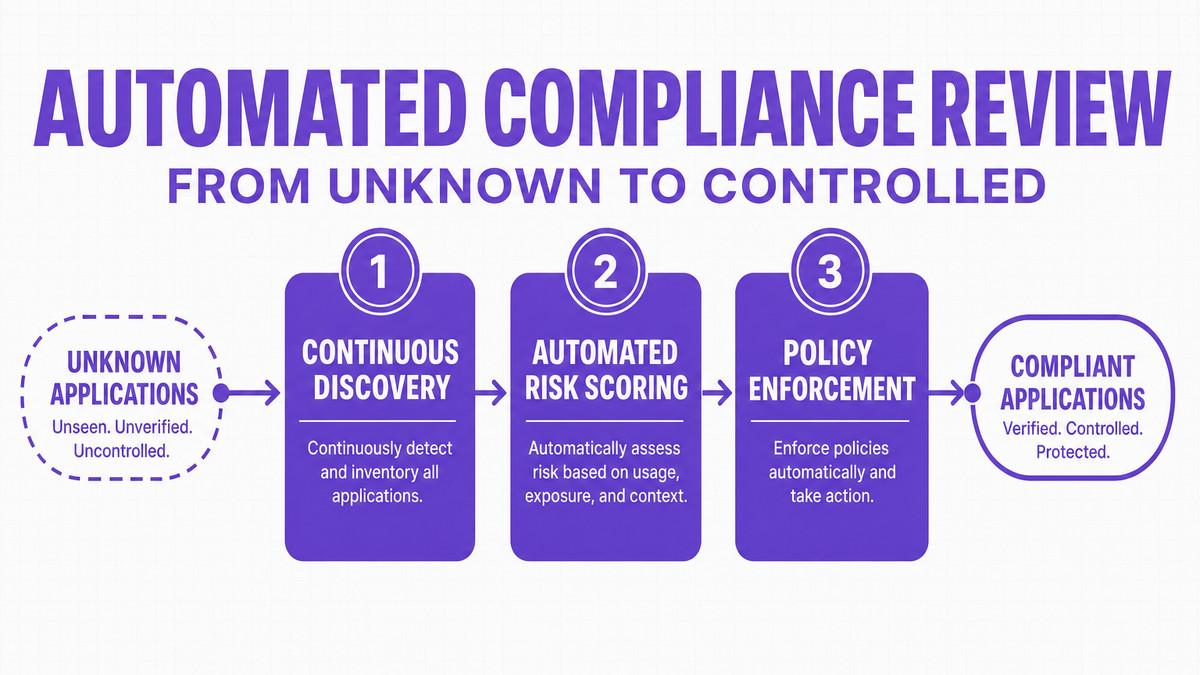
Achieving true SaaS visibility means scanning identity providers, analyzing web gateways, and tracking financial expense reports to map all cloud asset connections. Implementing continuous attack surface management tools transforms previously hidden anomalies into categorized, governable entities.
Security teams historically struggled with manual reconciliation when resolving shadow IT incidents. Translating raw application metrics into enforceable policies requires dedicated workflow automation. Without automated controls, uncovering an unsanctioned application only solves half the problem.
Rajiv Menon, VP of Security Solutions at Forrester in 2026, notes that the convergence of shadow IT risk and SaaS sprawl makes attack surface management the most strategic control for modern enterprises. Using automated workflows for onboarding and offboarding ensures that access profiles match corporate policies at all times. When continuous discovery detects an unfamiliar external application accessing a trusted corporate environment, automated incident response protocols can immediately revoke broad OAuth authorizations and trigger a detailed user access review.
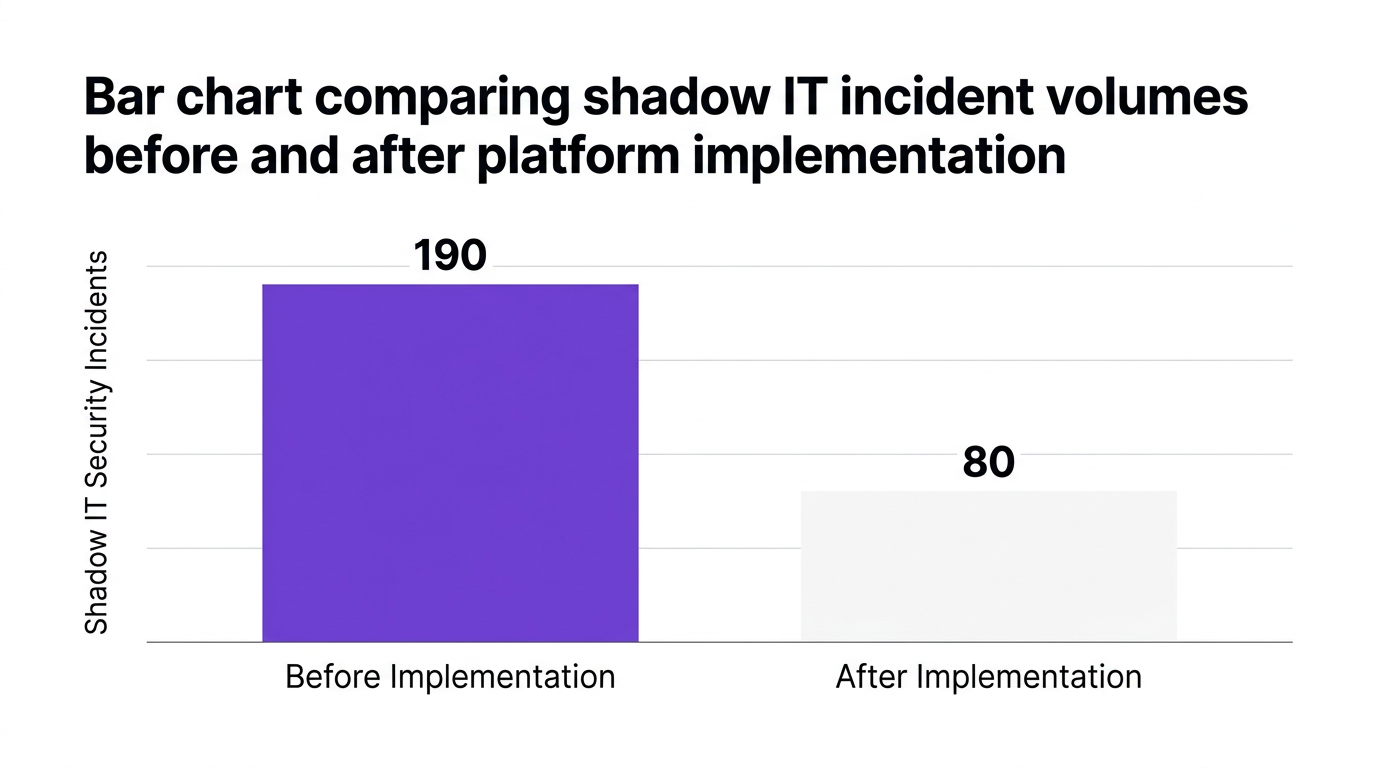
The security benefits of this automated approach are mathematically clear. Forrester documented in 2026 that enterprises using continuous SaaS discovery tools reduced shadow IT-related security incidents by 58%. The drastic volume reduction directly correlates with automated offboarding systems immediately terminating lingering application entitlements. Using enterprise attack surface management capabilities to automate these manual revocation tasks drastically accelerates incident response timelines.
Beyond external threat reduction, stringent regulatory environments now directly obligate security teams to maintain comprehensive application registries. Auditors are increasingly expanding their purview to include unauthorized applications containing sensitive operational or customer data.
Ellen Torres, Senior Fellow at ESG Global in 2026, observed that automated visibility and governance of SaaS assets shifted from an optional organizational goal into a fundamental compliance requirement. Regulators expect organizations to catalog and control their third-party connections. An IDC 2026 study confirms this shift, proving that 67% of organizations require real-time SaaS application monitoring to comply with rigorous new regulations, including DORA and strict SEC mandates.

Internal attack surface management must align natively with SOC 2 Type II strictures. Achieving compliant security architectures means ensuring your controls address policy automation, transparent risk scoring, and continuous access reviews. Maintaining a complete IT cost transparency framework that tracks individual software licenses allows security teams to prove total control over their connected operational environments, satisfying regulatory audit requirements with minimal friction.
CloudNuro provides a governance-first architecture designed to aggressively shrink persistent vulnerabilities. By focusing natively on SaaS discovery and active compliance mapping, CloudNuro enables IT and security teams to gain authoritative command over their complete cloud landscape.
The intelligence core of this capability relies on the proprietary SaaS Discovery module, which detects applications in real time and enforces continuous monitoring across SaaS, PaaS, and IaaS environments. CloudNuro deeply connects with over 400 software ecosystems to ensure highly accurate data ingestion. These immediate integrations foster total SaaS visibility, driving automated user access reviews that locate, isolate, and remove unauthorized internal and external interconnections.
Practical implementation validates the CloudNuro methodology. A leading global banking institution recently adopted real-time SaaS discovery utilizing CloudNuro to uncover 125 completely unknown decentralized applications. By automating their offboarding processes, the banking leader achieved a 70% decrease in shadow IT security incidents and drastically strengthened their governance audit scores. Similarly, a major global healthcare provider applied the Unified Cloud Custodian to achieve absolute application transparency. This implementation cut regulatory compliance risks by 65% and optimized sprawling software licenses by 40% through continuous application inventory controls.
Through an intentionally designed employee self-service portal, CloudNuro ensures that application adoption takes place entirely within an authenticated catalog. This eliminates the ad-hoc usage behaviors that originally spawn shadow IT networks. As a member of the Cloud Security Alliance operating on a strict SOC 2 Type II-certified architecture, CloudNuro operates exactly aligned with modern security regulations, ensuring enterprise IT security solutions smoothly adapt to complex organizational demands.
What is attack surface management in SaaS security?
Attack surface management in SaaS security involves tracking, evaluating, and securing every external and internal cloud application connected to an enterprise network. Instead of merely tracking physical IP addresses, this process focuses heavily on user access roles, active API connections, and lingering OAuth tokens that could be exploited by threat actors.
How can SaaS visibility reduce security risks?
Visibility acts as the baseline for all subsequent security controls. Establishing deep visibility allows organizations to measure application usage trends, enforce automated application onboarding, and identify unexpected configuration gaps. It is impossible to govern or secure assets you cannot see, making baseline visibility critical to threat prevention.
What tools help eliminate shadow IT in enterprises?
A dedicated SaaS management platform provides the deepest level of defense against unmonitored technology. By scanning financial ledgers, web activity, and identity access providers, these tools centralize application discovery. CloudNuro specifically provides analytics and deep integrations that immediately map the complete digital footprint of all organizational users.
Why is continuous SaaS discovery important?
Enterprise software adoption happens constantly. Quarterly manual audits become wildly inaccurate within days. Continuous discovery immediately spots unusual software adoption, highlights unvetted file-sharing utilities, and ensures security policies are maintained during periods of rapid corporate growth or large-scale remote operations.
How do security teams use SaaS management platforms?
Modern security teams apply these platforms to enact continuous governance. They use continuous discovery features to track asset risk scoring, implement immediate user offboarding across hundreds of external applications, and guarantee that compliance measures like SOC 2 are definitively met through verified access audits.
Enterprises cannot rely on localized controls to secure interconnected global workflows. Attack surface monitoring must reflect the speed at which business units adopt new collaborative solutions. Relying on legacy identification methods ensures continuous exposure to data leaks and regulatory failures.
The time to formalize your asset controls is right now. Security leaders must equip their teams with dedicated discovery mechanisms that translate hidden risks into measurable operational controls. Take complete control over your cloud applications and explore highly rated SaaS management operations using CloudNuro to secure your digital future.
CloudNuro is a leader in Enterprise SaaS Management Platforms, providing enterprises with unmatched visibility, governance, and cost optimization. Recognized twice in a row in the SaaS Management Platforms category and named a Leader in the SoftwareReviews Data Quadrant, CloudNuro is trusted by global enterprises and government agencies to bring financial discipline to SaaS, cloud, and AI. Trusted by enterprises such as Konica Minolta and Federal Signal, CloudNuro provides centralized SaaS inventory, license optimization, and renewal management along with advanced cost allocation and chargeback, giving IT and Finance leaders the visibility, control, and cost-conscious culture needed to drive financial discipline.
Request a no cost, no obligation free assessment —just 15 minutes to savings!
Get StartedCorporate IT infrastructures no longer operate behind a single, well-defined firewall. The widespread adoption of decentralized cloud tools dictates that modern attack surface management must prioritize continuous monitoring above physical network controls. Cybersecurity Ventures reports from 2026 show that 82% of enterprises name shadow IT and unsanctioned applications as their largest cybersecurity blind spots. Unsanctioned sign-ups create fragmented perimeters, leaving IT departments blind to the full scope of their vulnerabilities. Security professionals are realizing that identifying hidden assets is the only reliable way to measure true enterprise risk.
Security teams cannot defend applications they do not know exist. A comprehensive attack surface management strategy requires systematic discovery methodologies to maintain a stable security posture. This necessity is entirely reshaping how enterprise compliance budgets are allocated, forcing leaders to prioritize targeted SaaS visibility tools to map the expanding boundaries of daily operational workflows.
The most persistent vulnerability in modern IT environments originates from everyday employee actions. When team members adopt collaborative tools, file-sharing utilities, or specialized AI aids without IT approval, they bypass foundational security reviews. This unchecked momentum creates deep SaaS sprawl.
SANS Institute research from 2026 reveals that more than 50% of security leaders cite the inability to inventory SaaS assets as their single largest risk in external attack surface management. Conventional attack surface monitoring tools often fail in this context. Legacy tools heavily prioritize IP addresses and domain registrations, while modern shadow IT risk relies on compromised OAuth tokens and persistent API keys connecting unsanctioned platforms to secured corporate data.
The resulting fallout is measurable. According to Gartner reports from 2026, 61% of SaaS security incidents involved unauthorized application access due directly to a lack of real-time visibility. When an employee departs the organization, their credentials might be deactivated in the central directory, but their active sessions in rogue, unmanaged platforms remain alive. Each unmonitored integration acts as a silent expansion of the attack surface, presenting a clear path for malicious actors to infiltrate core environments.
Annual or quarterly capability audits are obsolete in an environment where applications are adopted by the hour. Resolving persistent vulnerabilities requires a shift toward real-time attack surface management solutions. Organizations that rely exclusively on manual spreadsheet tracking remain consistently behind the actual curve of cloud utilization.
Dr. Maya Patel, Chief Security Analyst at Gartner, highlights this reality in 2026: "Continuous SaaS discovery is now essential for shrinking the attack surface; without it, organizations are essentially blind to new threats."
Prolific application usage underscores Dr. Patel's insight. The Ponemon Institute in 2026 observed that organizations discover an average of 39 previously unknown SaaS applications per quarter after deploying formal SaaS discovery capabilities. These applications frequently include unsanctioned cloud storage nodes, unofficial communication platforms, and unvetted productivity boosters.
Achieving true SaaS visibility means scanning identity providers, analyzing web gateways, and tracking financial expense reports to map all cloud asset connections. Implementing continuous attack surface management tools transforms previously hidden anomalies into categorized, governable entities.
Security teams historically struggled with manual reconciliation when resolving shadow IT incidents. Translating raw application metrics into enforceable policies requires dedicated workflow automation. Without automated controls, uncovering an unsanctioned application only solves half the problem.
Rajiv Menon, VP of Security Solutions at Forrester in 2026, notes that the convergence of shadow IT risk and SaaS sprawl makes attack surface management the most strategic control for modern enterprises. Using automated workflows for onboarding and offboarding ensures that access profiles match corporate policies at all times. When continuous discovery detects an unfamiliar external application accessing a trusted corporate environment, automated incident response protocols can immediately revoke broad OAuth authorizations and trigger a detailed user access review.
The security benefits of this automated approach are mathematically clear. Forrester documented in 2026 that enterprises using continuous SaaS discovery tools reduced shadow IT-related security incidents by 58%. The drastic volume reduction directly correlates with automated offboarding systems immediately terminating lingering application entitlements. Using enterprise attack surface management capabilities to automate these manual revocation tasks drastically accelerates incident response timelines.
Beyond external threat reduction, stringent regulatory environments now directly obligate security teams to maintain comprehensive application registries. Auditors are increasingly expanding their purview to include unauthorized applications containing sensitive operational or customer data.
Ellen Torres, Senior Fellow at ESG Global in 2026, observed that automated visibility and governance of SaaS assets shifted from an optional organizational goal into a fundamental compliance requirement. Regulators expect organizations to catalog and control their third-party connections. An IDC 2026 study confirms this shift, proving that 67% of organizations require real-time SaaS application monitoring to comply with rigorous new regulations, including DORA and strict SEC mandates.
Internal attack surface management must align natively with SOC 2 Type II strictures. Achieving compliant security architectures means ensuring your controls address policy automation, transparent risk scoring, and continuous access reviews. Maintaining a complete IT cost transparency framework that tracks individual software licenses allows security teams to prove total control over their connected operational environments, satisfying regulatory audit requirements with minimal friction.
CloudNuro provides a governance-first architecture designed to aggressively shrink persistent vulnerabilities. By focusing natively on SaaS discovery and active compliance mapping, CloudNuro enables IT and security teams to gain authoritative command over their complete cloud landscape.
The intelligence core of this capability relies on the proprietary SaaS Discovery module, which detects applications in real time and enforces continuous monitoring across SaaS, PaaS, and IaaS environments. CloudNuro deeply connects with over 400 software ecosystems to ensure highly accurate data ingestion. These immediate integrations foster total SaaS visibility, driving automated user access reviews that locate, isolate, and remove unauthorized internal and external interconnections.
Practical implementation validates the CloudNuro methodology. A leading global banking institution recently adopted real-time SaaS discovery utilizing CloudNuro to uncover 125 completely unknown decentralized applications. By automating their offboarding processes, the banking leader achieved a 70% decrease in shadow IT security incidents and drastically strengthened their governance audit scores. Similarly, a major global healthcare provider applied the Unified Cloud Custodian to achieve absolute application transparency. This implementation cut regulatory compliance risks by 65% and optimized sprawling software licenses by 40% through continuous application inventory controls.
Through an intentionally designed employee self-service portal, CloudNuro ensures that application adoption takes place entirely within an authenticated catalog. This eliminates the ad-hoc usage behaviors that originally spawn shadow IT networks. As a member of the Cloud Security Alliance operating on a strict SOC 2 Type II-certified architecture, CloudNuro operates exactly aligned with modern security regulations, ensuring enterprise IT security solutions smoothly adapt to complex organizational demands.
What is attack surface management in SaaS security?
Attack surface management in SaaS security involves tracking, evaluating, and securing every external and internal cloud application connected to an enterprise network. Instead of merely tracking physical IP addresses, this process focuses heavily on user access roles, active API connections, and lingering OAuth tokens that could be exploited by threat actors.
How can SaaS visibility reduce security risks?
Visibility acts as the baseline for all subsequent security controls. Establishing deep visibility allows organizations to measure application usage trends, enforce automated application onboarding, and identify unexpected configuration gaps. It is impossible to govern or secure assets you cannot see, making baseline visibility critical to threat prevention.
What tools help eliminate shadow IT in enterprises?
A dedicated SaaS management platform provides the deepest level of defense against unmonitored technology. By scanning financial ledgers, web activity, and identity access providers, these tools centralize application discovery. CloudNuro specifically provides analytics and deep integrations that immediately map the complete digital footprint of all organizational users.
Why is continuous SaaS discovery important?
Enterprise software adoption happens constantly. Quarterly manual audits become wildly inaccurate within days. Continuous discovery immediately spots unusual software adoption, highlights unvetted file-sharing utilities, and ensures security policies are maintained during periods of rapid corporate growth or large-scale remote operations.
How do security teams use SaaS management platforms?
Modern security teams apply these platforms to enact continuous governance. They use continuous discovery features to track asset risk scoring, implement immediate user offboarding across hundreds of external applications, and guarantee that compliance measures like SOC 2 are definitively met through verified access audits.
Enterprises cannot rely on localized controls to secure interconnected global workflows. Attack surface monitoring must reflect the speed at which business units adopt new collaborative solutions. Relying on legacy identification methods ensures continuous exposure to data leaks and regulatory failures.
The time to formalize your asset controls is right now. Security leaders must equip their teams with dedicated discovery mechanisms that translate hidden risks into measurable operational controls. Take complete control over your cloud applications and explore highly rated SaaS management operations using CloudNuro to secure your digital future.
CloudNuro is a leader in Enterprise SaaS Management Platforms, providing enterprises with unmatched visibility, governance, and cost optimization. Recognized twice in a row in the SaaS Management Platforms category and named a Leader in the SoftwareReviews Data Quadrant, CloudNuro is trusted by global enterprises and government agencies to bring financial discipline to SaaS, cloud, and AI. Trusted by enterprises such as Konica Minolta and Federal Signal, CloudNuro provides centralized SaaS inventory, license optimization, and renewal management along with advanced cost allocation and chargeback, giving IT and Finance leaders the visibility, control, and cost-conscious culture needed to drive financial discipline.
Request a no cost, no obligation free assessment - just 15 minutes to savings!
Get StartedWe're offering complimentary ServiceNow license assessments to only 25 enterprises this quarter who want to unlock immediate savings without disrupting operations.
Get Free AssessmentGet Started




CloudNuro Corp
1755 Park St. Suite 207
Naperville, IL 60563
Phone : +1-630-277-9470
Email: info@cloudnuro.com





.webp)

Recognized Leader in SaaS Management Platforms by Info-Tech SoftwareReviews


.png)

.svg)