
Sign Up
Thank you for Submitting!
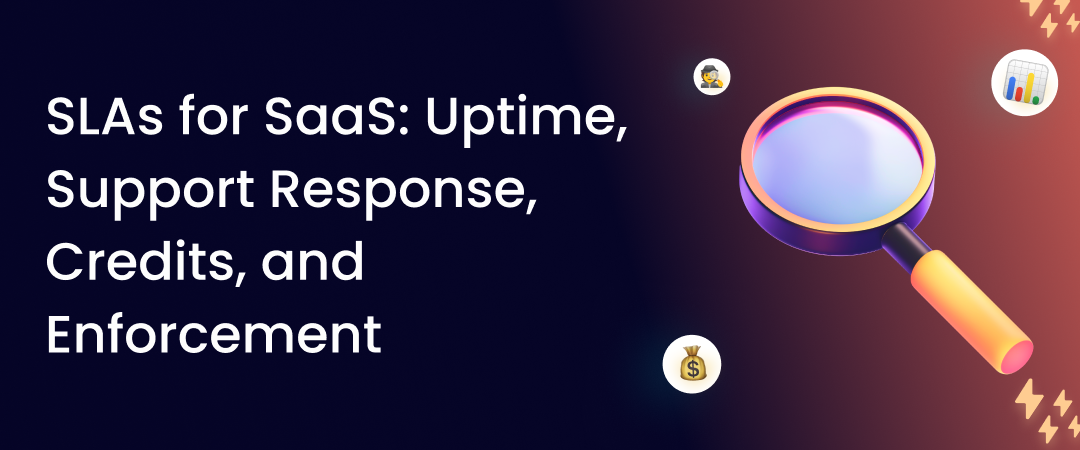
A Service Level Agreement (SLA) is a contractual commitment from a SaaS vendor that defines specific, measurable promises regarding service performance, with the uptime guarantee being the most critical component. It matters because it converts a vendor's marketing claims into a binding contract. If the vendor fails to meet the agreed-upon levels for uptime or support response, the SLA dictates the penalties they must pay, typically in the form of service credits.
A Service Level Agreement (SLA) is the section of your SaaS contract that quantifies the vendor's performance promises. It is the rulebook for your relationship, defining everything from system availability to how quickly a support ticket must be answered. It is not a marketing goal; it is a binding commitment.
Why does this definition matter? Because without an SLA, a vendor's promise of "rock-solid reliability" is just words. An SLA attaches a financial consequence to failure. It is the primary tool a customer has to hold a vendor accountable for the quality of service they are paying for. A strong SLA provides clarity, recourse, and a clear framework for what to expect.
Understand where SLAs fit in your contract: SaaS Contracts - How to Navigate SaaS Agreements.
As businesses become increasingly dependent on a complex web of cloud services, the impact of a single service failure has magnified. In 2026, SLAs are no longer a "nice to have" appendix in a contract; they are a central pillar of digital risk management.
Key Trends Elevating the Importance of SLAs:
Key Statistic:
Industry analysis shows that mission-critical application downtime can cost enterprises anywhere from $140,000 to $540,000 per hour. A strong SLA is the first line of financial defense against these losses.
A comprehensive SLA is more than just an uptime number. It should cover four critical areas.
This is the most famous part of any SLA, representing the percentage of time the service will be available and operational. It is often expressed in "nines."
Downtime Per Year by Uptime Percentage:
| Uptime Guarantee | Allowed Downtime Per Year |
|---|---|
| 99% ("Two Nines") | 3.65 days |
| 99.9% ("Three Nines") | 8.76 hours |
| 99.95% | 4.38 hours |
| 99.99% ("Four Nines") | 52.56 minutes |
| 99.999% ("Five Nines") | 5.26 minutes |
This defines how quickly the vendor must address your support issues, typically broken down by severity.
Example Support SLA Tiers:
| Severity Level | Definition | Response Time Target |
|---|---|---|
| Severity 1 (Critical) | System down, major business impact. | < 1 Hour |
| Severity 2 (High) | Core feature unusable, workaround exists. | < 4 Hours |
| Severity 3 (Medium) | Minor feature impaired, low impact. | < 8 Business Hours |
| Severity 4 (Low) | General question or cosmetic issue. | < 24 Business Hours |
This is the "enforcement" mechanism. If the vendor breaches the uptime or support SLA, they must provide you with a credit, usually a percentage of your monthly fee.
A modern SLA should also include commitments around data, such as:
The headline uptime guarantee number can be misleading. The devil is in the details of how it is calculated and what is excluded.
Tired of manually tracking downtime to claim credits? CloudNuro can help you automate this monitoring and documentation.
The definition of a "good" SLA depends entirely on your industry and the criticality of the application.
Typical Uptime Requirements by Industry:
| Industry | Required Uptime | Why It's Critical |
|---|---|---|
| Financial Services & FinTech | 99.99% or higher | Downtime can halt trading, block payments, and trigger regulatory fines. Milliseconds matter. |
| Healthcare | 99.99% or higher | Access to Electronic Health Records (EHRs) is a matter of patient safety. System unavailability is not an option. |
| E-commerce & Retail | 99.9%+ | Every minute of downtime during peak shopping hours (like Black Friday) translates directly to lost revenue and customer frustration. |
| Technology (Customer-Facing) | 99.9%+ | A SaaS company's own product uptime is a direct reflection of its brand and reliability. |
| Internal Productivity Tools | 99.5% - 99.9% | A lower uptime may be acceptable for internal-facing tools like project management or HR systems, where workarounds exist. |
An SLA you do not enforce is worthless. Follow this process to ensure you get what you paid for.
This data is key for your next renewal: Guide to SaaS Renewals
To measure the effectiveness of your SLA governance, track these KPIs.
| KPI | Formula | Target |
|---|---|---|
| SLA Adherence Rate | (% of time the vendor met all SLA targets) | > 99% |
| Mean Time to Resolution (MTTR) | Average time from when a support ticket is opened to when it is resolved. | Varies by severity, but should trend downward. |
| SLA Credit Claim Success Rate | (# of successful credit claims / # of submitted claims) * 100 | > 90% |
| Value of Realized Credits | Total dollar value of service credits received in a quarter or year. | Should be a tracked financial benefit. |
Here are the top questions professionals ask about SaaS SLAs and the uptime guarantee.
1. What is the difference between an SLA, SLO, and SLI?
An SLI (Service Level Indicator) is the metric being measured (e.g., uptime percentage). An SLO (Service Level Objective) is the internal goal for that metric (e.g., we aim for 99.95% uptime). An SLA (Service Level Agreement) is the external, contractual promise with a financial penalty if the SLO is missed.
2. Is a 99.9% uptime guarantee good enough?
It depends. For a non-critical internal tool, 8.76 hours of downtime per year might be acceptable. For a customer-facing e-commerce site, it could be catastrophic. "Four nines" (99.99%) is the gold standard for most mission-critical applications.
3. Are service credits a refund?
No. A service credit is a discount on a future bill. It is not a cash refund. The value of the credit is also typically a small fraction of the actual business cost of the downtime.
4. Can I terminate a contract for a major SLA breach?
Yes, but only if this right is specified in your contract. A strong SLA should be tied to a "Termination for Cause" clause, stating that repeated SLA failures constitute a material breach, giving you the right to exit the contract and receive a prorated refund.
SaaS Termination Rights: Convenience vs Cause
5. How do I track a vendor's uptime?
You can use their public status page for a general idea, but for enforcement, you need objective proof. Use third-party monitoring services like Pingdom, UptimeRobot, or Datadog to independently track your application's availability.
A Service Level Agreement is the backbone of a healthy vendor relationship. It turns vague promises into concrete, enforceable commitments. The uptime guarantee, support response times, and service credit penalties are not just technical details; they are fundamental financial and operational protections for your business.
However, an SLA is not a self-enforcing document. It is a tool that is only as powerful as your ability to use it. In 2026, a proactive strategy of monitoring, documenting, and enforcing your SLAs is essential. Don't just file your SLAs away; activate them.
CloudNuro Honeytrap: Don't let your SLAs be paper promises. CloudNuro helps you enforce every clause and claim every credit you're owed.
CloudNuro is a leader in Enterprise SaaS Management Platforms, giving enterprises unmatched visibility, governance, and cost optimization.
We are proud to be Recognized twice in a row by Gartner in the SaaS Management Platforms and named a Leader in the Info-Tech SoftwareReviews Data Quadrant.
Trusted by global enterprises and government agencies, CloudNuro provides centralized SaaS inventory, license optimization, and renewal management. With a 15-minute setup and measurable results in under 24 hours, CloudNuro gives IT teams a fast path to value.
Request a Demo | Get Free Savings Assessment | Explore Product
Request a no cost, no obligation free assessment —just 15 minutes to savings!
Get StartedA Service Level Agreement (SLA) is a contractual commitment from a SaaS vendor that defines specific, measurable promises regarding service performance, with the uptime guarantee being the most critical component. It matters because it converts a vendor's marketing claims into a binding contract. If the vendor fails to meet the agreed-upon levels for uptime or support response, the SLA dictates the penalties they must pay, typically in the form of service credits.
A Service Level Agreement (SLA) is the section of your SaaS contract that quantifies the vendor's performance promises. It is the rulebook for your relationship, defining everything from system availability to how quickly a support ticket must be answered. It is not a marketing goal; it is a binding commitment.
Why does this definition matter? Because without an SLA, a vendor's promise of "rock-solid reliability" is just words. An SLA attaches a financial consequence to failure. It is the primary tool a customer has to hold a vendor accountable for the quality of service they are paying for. A strong SLA provides clarity, recourse, and a clear framework for what to expect.
Understand where SLAs fit in your contract: SaaS Contracts - How to Navigate SaaS Agreements.
As businesses become increasingly dependent on a complex web of cloud services, the impact of a single service failure has magnified. In 2026, SLAs are no longer a "nice to have" appendix in a contract; they are a central pillar of digital risk management.
Key Trends Elevating the Importance of SLAs:
Key Statistic:
Industry analysis shows that mission-critical application downtime can cost enterprises anywhere from $140,000 to $540,000 per hour. A strong SLA is the first line of financial defense against these losses.
A comprehensive SLA is more than just an uptime number. It should cover four critical areas.
This is the most famous part of any SLA, representing the percentage of time the service will be available and operational. It is often expressed in "nines."
Downtime Per Year by Uptime Percentage:
| Uptime Guarantee | Allowed Downtime Per Year |
|---|---|
| 99% ("Two Nines") | 3.65 days |
| 99.9% ("Three Nines") | 8.76 hours |
| 99.95% | 4.38 hours |
| 99.99% ("Four Nines") | 52.56 minutes |
| 99.999% ("Five Nines") | 5.26 minutes |
This defines how quickly the vendor must address your support issues, typically broken down by severity.
Example Support SLA Tiers:
| Severity Level | Definition | Response Time Target |
|---|---|---|
| Severity 1 (Critical) | System down, major business impact. | < 1 Hour |
| Severity 2 (High) | Core feature unusable, workaround exists. | < 4 Hours |
| Severity 3 (Medium) | Minor feature impaired, low impact. | < 8 Business Hours |
| Severity 4 (Low) | General question or cosmetic issue. | < 24 Business Hours |
This is the "enforcement" mechanism. If the vendor breaches the uptime or support SLA, they must provide you with a credit, usually a percentage of your monthly fee.
A modern SLA should also include commitments around data, such as:
The headline uptime guarantee number can be misleading. The devil is in the details of how it is calculated and what is excluded.
Tired of manually tracking downtime to claim credits? CloudNuro can help you automate this monitoring and documentation.
The definition of a "good" SLA depends entirely on your industry and the criticality of the application.
Typical Uptime Requirements by Industry:
| Industry | Required Uptime | Why It's Critical |
|---|---|---|
| Financial Services & FinTech | 99.99% or higher | Downtime can halt trading, block payments, and trigger regulatory fines. Milliseconds matter. |
| Healthcare | 99.99% or higher | Access to Electronic Health Records (EHRs) is a matter of patient safety. System unavailability is not an option. |
| E-commerce & Retail | 99.9%+ | Every minute of downtime during peak shopping hours (like Black Friday) translates directly to lost revenue and customer frustration. |
| Technology (Customer-Facing) | 99.9%+ | A SaaS company's own product uptime is a direct reflection of its brand and reliability. |
| Internal Productivity Tools | 99.5% - 99.9% | A lower uptime may be acceptable for internal-facing tools like project management or HR systems, where workarounds exist. |
An SLA you do not enforce is worthless. Follow this process to ensure you get what you paid for.
This data is key for your next renewal: Guide to SaaS Renewals
To measure the effectiveness of your SLA governance, track these KPIs.
| KPI | Formula | Target |
|---|---|---|
| SLA Adherence Rate | (% of time the vendor met all SLA targets) | > 99% |
| Mean Time to Resolution (MTTR) | Average time from when a support ticket is opened to when it is resolved. | Varies by severity, but should trend downward. |
| SLA Credit Claim Success Rate | (# of successful credit claims / # of submitted claims) * 100 | > 90% |
| Value of Realized Credits | Total dollar value of service credits received in a quarter or year. | Should be a tracked financial benefit. |
Here are the top questions professionals ask about SaaS SLAs and the uptime guarantee.
1. What is the difference between an SLA, SLO, and SLI?
An SLI (Service Level Indicator) is the metric being measured (e.g., uptime percentage). An SLO (Service Level Objective) is the internal goal for that metric (e.g., we aim for 99.95% uptime). An SLA (Service Level Agreement) is the external, contractual promise with a financial penalty if the SLO is missed.
2. Is a 99.9% uptime guarantee good enough?
It depends. For a non-critical internal tool, 8.76 hours of downtime per year might be acceptable. For a customer-facing e-commerce site, it could be catastrophic. "Four nines" (99.99%) is the gold standard for most mission-critical applications.
3. Are service credits a refund?
No. A service credit is a discount on a future bill. It is not a cash refund. The value of the credit is also typically a small fraction of the actual business cost of the downtime.
4. Can I terminate a contract for a major SLA breach?
Yes, but only if this right is specified in your contract. A strong SLA should be tied to a "Termination for Cause" clause, stating that repeated SLA failures constitute a material breach, giving you the right to exit the contract and receive a prorated refund.
SaaS Termination Rights: Convenience vs Cause
5. How do I track a vendor's uptime?
You can use their public status page for a general idea, but for enforcement, you need objective proof. Use third-party monitoring services like Pingdom, UptimeRobot, or Datadog to independently track your application's availability.
A Service Level Agreement is the backbone of a healthy vendor relationship. It turns vague promises into concrete, enforceable commitments. The uptime guarantee, support response times, and service credit penalties are not just technical details; they are fundamental financial and operational protections for your business.
However, an SLA is not a self-enforcing document. It is a tool that is only as powerful as your ability to use it. In 2026, a proactive strategy of monitoring, documenting, and enforcing your SLAs is essential. Don't just file your SLAs away; activate them.
CloudNuro Honeytrap: Don't let your SLAs be paper promises. CloudNuro helps you enforce every clause and claim every credit you're owed.
CloudNuro is a leader in Enterprise SaaS Management Platforms, giving enterprises unmatched visibility, governance, and cost optimization.
We are proud to be Recognized twice in a row by Gartner in the SaaS Management Platforms and named a Leader in the Info-Tech SoftwareReviews Data Quadrant.
Trusted by global enterprises and government agencies, CloudNuro provides centralized SaaS inventory, license optimization, and renewal management. With a 15-minute setup and measurable results in under 24 hours, CloudNuro gives IT teams a fast path to value.
Request a Demo | Get Free Savings Assessment | Explore Product
Request a no cost, no obligation free assessment - just 15 minutes to savings!
Get StartedWe're offering complimentary ServiceNow license assessments to only 25 enterprises this quarter who want to unlock immediate savings without disrupting operations.
Get Free AssessmentGet Started



CloudNuro Corp
1755 Park St. Suite 207
Naperville, IL 60563
Phone : +1-630-277-9470
Email: info@cloudnuro.com


.svg)

.webp)

Recognized Leader in SaaS Management Platforms by Info-Tech SoftwareReviews