

Sign Up
Thank you for Submitting!
With the August 2, 2026, deadline for EU AI Act compliance looming, enterprises face their most significant regulatory test in AI to date. Designed to protect citizens while fostering innovation, the EU Artificial Intelligence Act introduces sweeping rules for transparency, risk management, and accountability. But the heart of the challenge is practical: How can CIOs and CTOs rapidly identify high-risk AI systems, implement compliant governance, and guarantee a transparent audit trail across vast SaaS and cloud landscapes? This guide presents an actionable checklist for enterprise readiness, unpacks current market realities, and shows how CloudNuro’s governance-driven automation empowers organizations to meet their obligations with confidence.

The EU AI Act applies to a wide range of organizations providing, operating, or using AI systems in the European Union. Enterprises in finance, healthcare, government, and corporate sectors must map their AI landscape, classify systems by risk, and implement control measures that withstand regulatory scrutiny.
Key statistics:
67% of large enterprises in the EU are expected to fall under high-risk AI requirements
82% of enterprises lack end-to-end AI inventory and usage tracking
Only 18% of organizations report full visibility into AI tools used across their SaaS landscape
Traditional, manual approaches to compliance are no longer viable. Enterprises are shifting to real-time governance platforms that inventory, monitor, and control AI use, internally and with third parties. Efforts are moving from policy documents to evidence-based control systems, complete with audit trails, automated documentation, and continuous oversight.
The foundation of compliance: The most cited gap by compliance executives is not knowing which AI tools are in use, a problem compounded by Shadow AI and SaaS proliferation. AI inventories must capture sanctioned and unsanctioned tools, who uses them, and in what context.
Why this matters:
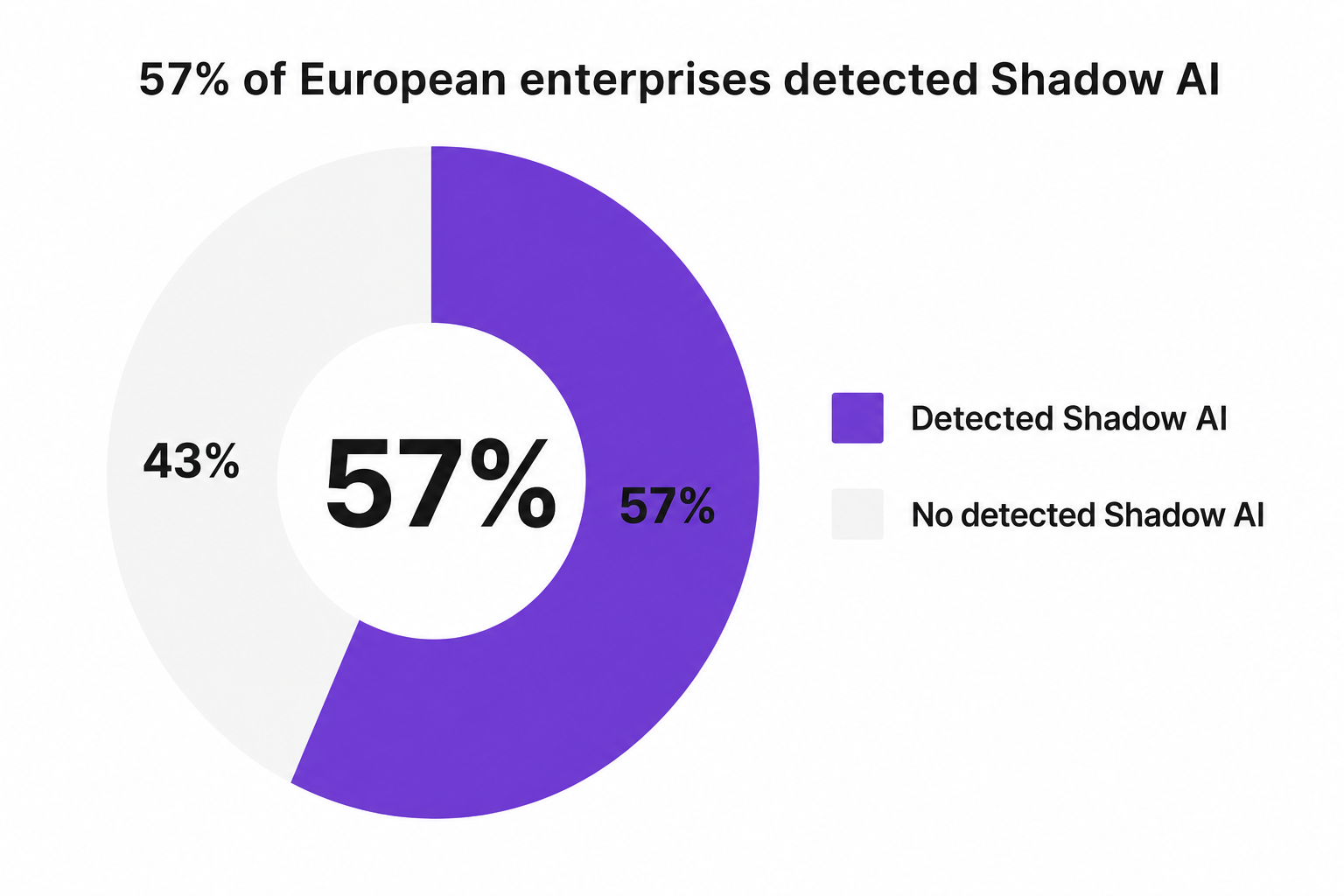
57% of European enterprises found at least one instance of Shadow AI in the past year
65% of compliance executives see Shadow AI as the top AI governance risk
How CloudNuro helps:
Automated 360-degree discovery across 400+ integrations, including SaaS and cloud-native AI features
Proprietary multi-signal scoring to filter out noise and build confidence in your system register
Segmentation of users (Power, General, Low, Dormant) based on AI prompt activity, supporting risk-based controls
The EU AI Act identifies ‘high-risk’ AI systems that impact fundamental rights, safety, or critical infrastructure. Enterprises must:
Apply structured risk assessments
Use a common classification matrix
Maintain a dynamic ‘evidence register’ to track model and system status
Market trend: Enterprises are consolidating assessments, documentation, and controls into unified registers to break the silos between IT, security, legal, and compliance.
CloudNuro in action:
Automated mapping of AI tools to risk categories
Consolidation of rogue or orphaned accounts into governed platforms
One-click evidence registers for regulatory disclosures
Continuous compliance, not point-in-time audits, is emerging as the new norm. Controls must cover:
Continuous monitoring of AI system usage and model changes
Granular user access reviews and least privilege enforcement
Documentation of policies, usage, and changes as auditable artifacts
Sensitive data tracking and prevention of unauthorized PII handling
Key proof points:
Automated documentation reduced a leading bank’s annual compliance workload by 33%, clearing a regulatory review in 90 days
Automatic user access reviews enabled a pharma company to achieve zero non-conformities
CloudNuro delivers:
Real-time monitoring of user adoption, prompt volumes, and suspicious activity
Integration with data protection tools to detect oversharing and PII leakage
Policy-driven workflows that automate onboarding, license allocation, and compliance tasks, no-code/low-code simplicity
EU AI Act compliance relies on the ability to produce timely, complete, and accurate evidence on demand:
Keep detailed histories of tool usage and configuration changes
Generate unified audit trails that map users to systems and activities
Retain evidence in centralized, regulator-ready formats
Expert insight: The “single AI inventory and evidence register” is now the practical priority, regulatory success hinges on integration, not more reviews.
CloudNuro’s differentiators:
Unified audit trails spanning SaaS, cloud-native, and hybrid AI environments
Structured, regulator-ready evidence exports
Automated reminders for periodic reviews, model updates, and compliance deadlines
With 56% of organizations in regulated sectors projecting over 20% increases in compliance budgets, the ability to control SaaS and AI spend, while sustaining governance, becomes critical. Overlapping and redundant AI tools waste money and expose organizations to unnecessary risk.
How CloudNuro brings financial discipline:
Automated cost optimization linked to governance: identify and rationalize redundant tools
License optimization through continuous discovery and entitlement tracking
Centralized dashboard to allocate compliance costs across business units
Map your AI landscape: Run a full inventory across SaaS and cloud to discover all AI-enabled tools
Classify and document high-risk systems: Use structured workflows and evidence registers to link controls and classification
Automate monitoring and access controls: Implement real-time user activity tracking and policy-driven enforcement
Centralize evidence and audit logs: Ensure every change, access, and control is tied to a user and system
Rationalize costs and entitlements: Continuously optimize licenses and spend, funding compliance investments
The August 2026 deadline demands urgent, sustained action. CloudNuro’s AI Custodian is architected for this new governance era, enabling security, cost optimization, and regulatory compliance as a single motion, so enterprises gain not just compliance but true control.
What are the key requirements of the EU AI Act for enterprises?
Enterprises must maintain an up-to-date AI inventory, classify high-risk systems, implement controls for transparency and fairness, log model updates and user actions, and be able to generate audit-ready compliance evidence on demand.
How can companies identify high-risk AI systems under the EU AI Act?
Use structured risk assessment tools and classification frameworks. High-risk AI includes systems affecting human safety, legal rights, or operating in regulated sectors, typically more than two-thirds of large enterprises’ AI workloads.
What steps must be taken for EU AI Act compliance by August 2026?
Begin with discovery and inventory, automate governance workflows, centralize evidence, and rationalize costs. Deploy AI governance platforms for continuous compliance monitoring and real-time reporting.
Which sectors are most impacted by the EU AI Act compliance deadline?
Finance, healthcare, government/public sector, and large corporate enterprises, all due to the nature of their data, customer touchpoints, and regulatory oversight.
What tools help automate EU AI Act compliance in large organizations?
AI governance platforms like CloudNuro integrate inventory discovery, classification, monitoring, access control, documentation, and evidence production with cost and license optimization.
For CIOs and CTOs, EU AI Act compliance is not a project, it is an operational capability. Success depends on a unified approach that automates discovery, control, evidence, and cost management. Enterprises that build their house on an integrated platform gain security, cost savings, and continuous audit readiness.
Take the proactive path. With CloudNuro’s Unified Cloud Custodian, your organization is EU AI Act-ready, today and tomorrow.
About CloudNuro
CloudNuro is a leader in Enterprise AI Adoption Management, providing enterprises with unmatched visibility, governance, and cost optimization. Recognized twice in a row in the SaaS Management Platforms category and named a Leader in the SoftwareReviews Data Quadrant, CloudNuro is trusted by global enterprises and government agencies to bring financial discipline to SaaS, cloud, and AI. Trusted by enterprises, CloudNuro provides centralized SaaS inventory, license optimization, and renewal management along with advanced cost allocation and chargeback, giving IT and Finance leaders the visibility, control, and cost-conscious culture needed to drive financial discipline.
Request a no cost, no obligation free assessment —just 15 minutes to savings!
Get StartedWith the August 2, 2026, deadline for EU AI Act compliance looming, enterprises face their most significant regulatory test in AI to date. Designed to protect citizens while fostering innovation, the EU Artificial Intelligence Act introduces sweeping rules for transparency, risk management, and accountability. But the heart of the challenge is practical: How can CIOs and CTOs rapidly identify high-risk AI systems, implement compliant governance, and guarantee a transparent audit trail across vast SaaS and cloud landscapes? This guide presents an actionable checklist for enterprise readiness, unpacks current market realities, and shows how CloudNuro’s governance-driven automation empowers organizations to meet their obligations with confidence.
The EU AI Act applies to a wide range of organizations providing, operating, or using AI systems in the European Union. Enterprises in finance, healthcare, government, and corporate sectors must map their AI landscape, classify systems by risk, and implement control measures that withstand regulatory scrutiny.
Key statistics:
67% of large enterprises in the EU are expected to fall under high-risk AI requirements
82% of enterprises lack end-to-end AI inventory and usage tracking
Only 18% of organizations report full visibility into AI tools used across their SaaS landscape
Traditional, manual approaches to compliance are no longer viable. Enterprises are shifting to real-time governance platforms that inventory, monitor, and control AI use, internally and with third parties. Efforts are moving from policy documents to evidence-based control systems, complete with audit trails, automated documentation, and continuous oversight.
The foundation of compliance: The most cited gap by compliance executives is not knowing which AI tools are in use, a problem compounded by Shadow AI and SaaS proliferation. AI inventories must capture sanctioned and unsanctioned tools, who uses them, and in what context.
Why this matters:
57% of European enterprises found at least one instance of Shadow AI in the past year
65% of compliance executives see Shadow AI as the top AI governance risk
How CloudNuro helps:
Automated 360-degree discovery across 400+ integrations, including SaaS and cloud-native AI features
Proprietary multi-signal scoring to filter out noise and build confidence in your system register
Segmentation of users (Power, General, Low, Dormant) based on AI prompt activity, supporting risk-based controls
The EU AI Act identifies ‘high-risk’ AI systems that impact fundamental rights, safety, or critical infrastructure. Enterprises must:
Apply structured risk assessments
Use a common classification matrix
Maintain a dynamic ‘evidence register’ to track model and system status
Market trend: Enterprises are consolidating assessments, documentation, and controls into unified registers to break the silos between IT, security, legal, and compliance.
CloudNuro in action:
Automated mapping of AI tools to risk categories
Consolidation of rogue or orphaned accounts into governed platforms
One-click evidence registers for regulatory disclosures
Continuous compliance, not point-in-time audits, is emerging as the new norm. Controls must cover:
Continuous monitoring of AI system usage and model changes
Granular user access reviews and least privilege enforcement
Documentation of policies, usage, and changes as auditable artifacts
Sensitive data tracking and prevention of unauthorized PII handling
Key proof points:
Automated documentation reduced a leading bank’s annual compliance workload by 33%, clearing a regulatory review in 90 days
Automatic user access reviews enabled a pharma company to achieve zero non-conformities
CloudNuro delivers:
Real-time monitoring of user adoption, prompt volumes, and suspicious activity
Integration with data protection tools to detect oversharing and PII leakage
Policy-driven workflows that automate onboarding, license allocation, and compliance tasks, no-code/low-code simplicity
EU AI Act compliance relies on the ability to produce timely, complete, and accurate evidence on demand:
Keep detailed histories of tool usage and configuration changes
Generate unified audit trails that map users to systems and activities
Retain evidence in centralized, regulator-ready formats
Expert insight: The “single AI inventory and evidence register” is now the practical priority, regulatory success hinges on integration, not more reviews.
CloudNuro’s differentiators:
Unified audit trails spanning SaaS, cloud-native, and hybrid AI environments
Structured, regulator-ready evidence exports
Automated reminders for periodic reviews, model updates, and compliance deadlines
With 56% of organizations in regulated sectors projecting over 20% increases in compliance budgets, the ability to control SaaS and AI spend, while sustaining governance, becomes critical. Overlapping and redundant AI tools waste money and expose organizations to unnecessary risk.
How CloudNuro brings financial discipline:
Automated cost optimization linked to governance: identify and rationalize redundant tools
License optimization through continuous discovery and entitlement tracking
Centralized dashboard to allocate compliance costs across business units
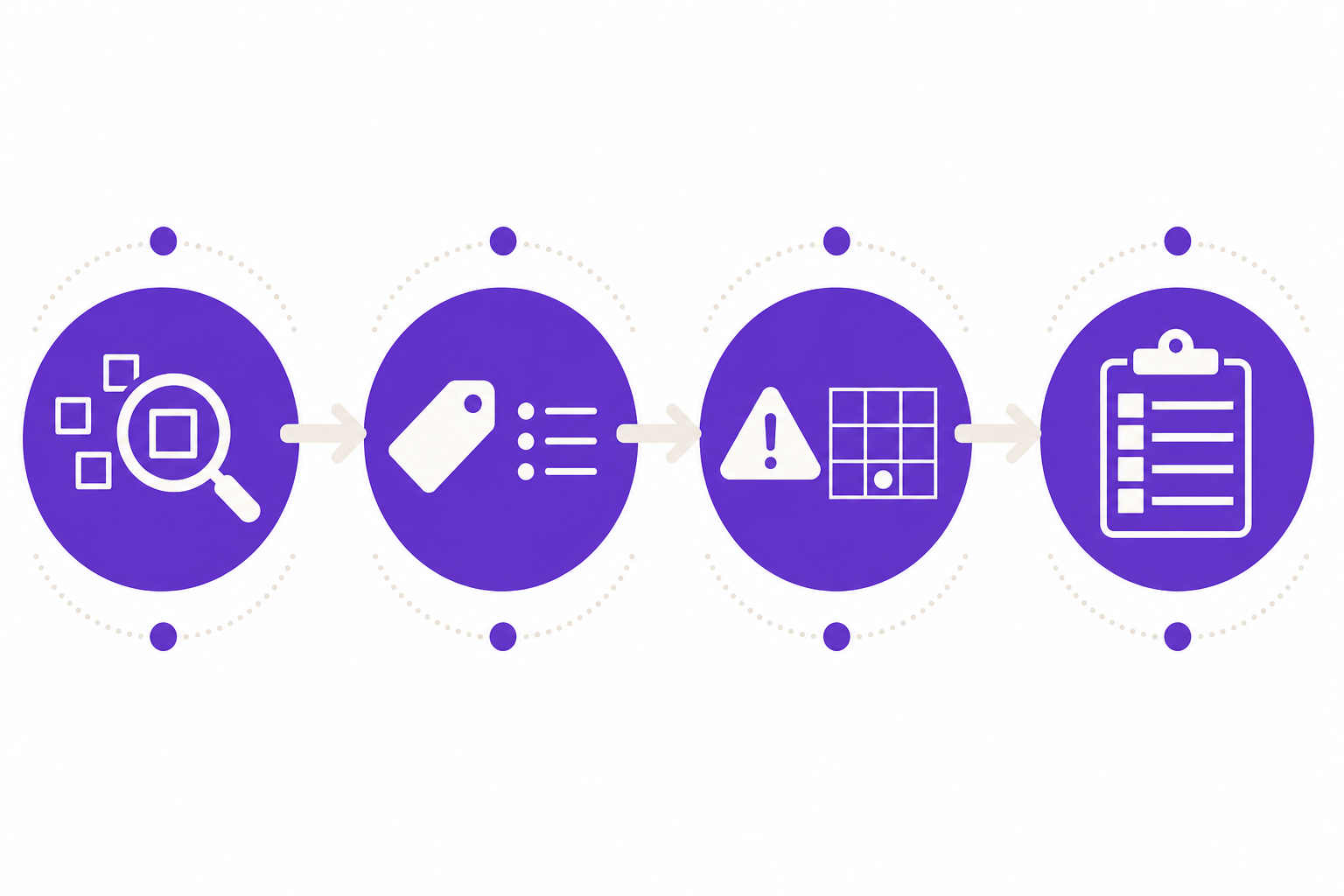
Map your AI landscape: Run a full inventory across SaaS and cloud to discover all AI-enabled tools
Classify and document high-risk systems: Use structured workflows and evidence registers to link controls and classification
Automate monitoring and access controls: Implement real-time user activity tracking and policy-driven enforcement
Centralize evidence and audit logs: Ensure every change, access, and control is tied to a user and system
Rationalize costs and entitlements: Continuously optimize licenses and spend, funding compliance investments
The August 2026 deadline demands urgent, sustained action. CloudNuro’s AI Custodian is architected for this new governance era, enabling security, cost optimization, and regulatory compliance as a single motion, so enterprises gain not just compliance but true control.
What are the key requirements of the EU AI Act for enterprises?
Enterprises must maintain an up-to-date AI inventory, classify high-risk systems, implement controls for transparency and fairness, log model updates and user actions, and be able to generate audit-ready compliance evidence on demand.
How can companies identify high-risk AI systems under the EU AI Act?
Use structured risk assessment tools and classification frameworks. High-risk AI includes systems affecting human safety, legal rights, or operating in regulated sectors, typically more than two-thirds of large enterprises’ AI workloads.
What steps must be taken for EU AI Act compliance by August 2026?
Begin with discovery and inventory, automate governance workflows, centralize evidence, and rationalize costs. Deploy AI governance platforms for continuous compliance monitoring and real-time reporting.
Which sectors are most impacted by the EU AI Act compliance deadline?
Finance, healthcare, government/public sector, and large corporate enterprises, all due to the nature of their data, customer touchpoints, and regulatory oversight.
What tools help automate EU AI Act compliance in large organizations?
AI governance platforms like CloudNuro integrate inventory discovery, classification, monitoring, access control, documentation, and evidence production with cost and license optimization.
For CIOs and CTOs, EU AI Act compliance is not a project, it is an operational capability. Success depends on a unified approach that automates discovery, control, evidence, and cost management. Enterprises that build their house on an integrated platform gain security, cost savings, and continuous audit readiness.
Take the proactive path. With CloudNuro’s Unified Cloud Custodian, your organization is EU AI Act-ready, today and tomorrow.
About CloudNuro
CloudNuro is a leader in Enterprise AI Adoption Management, providing enterprises with unmatched visibility, governance, and cost optimization. Recognized twice in a row in the SaaS Management Platforms category and named a Leader in the SoftwareReviews Data Quadrant, CloudNuro is trusted by global enterprises and government agencies to bring financial discipline to SaaS, cloud, and AI. Trusted by enterprises, CloudNuro provides centralized SaaS inventory, license optimization, and renewal management along with advanced cost allocation and chargeback, giving IT and Finance leaders the visibility, control, and cost-conscious culture needed to drive financial discipline.
Request a no cost, no obligation free assessment - just 15 minutes to savings!
Get StartedWe're offering complimentary ServiceNow license assessments to only 25 enterprises this quarter who want to unlock immediate savings without disrupting operations.
Get Free AssessmentGet Started




CloudNuro Corp
1755 Park St. Suite 207
Naperville, IL 60563
Phone : +1-630-277-9470
Email: info@cloudnuro.com



.webp)

Recognized Leader in SaaS Management Platforms by Info-Tech SoftwareReviews


.svg)